University Discrete Mathematics — Graphs and Trees Worksheet
The last set of the course, and the one where every earlier habit is used on a new kind of object. Vertices, degrees, complements and the named families K, C and P; the handshake theorem and what it decides about a list of degrees; the adjacency matrix and what a power of it counts; components, distance, bridges and cut vertices; Euler circuits, which a degree count settles, and Hamilton circuits, which nothing settles for you; Dijkstra's algorithm on two weighted networks; trees; and Euler's formula for a drawing with no crossings. Have a look on this page, then print the free PDF when you want to write on it.
Practice worksheet — free PDF
No email, no account, no watermark. Teachers: photocopy it for your classes freely. Worked solutions and 9 harder problems come with the University Discrete Math bundle.
12 of the 14 questions
Each question targets one named concept from the sheet. Read them here, or print the PDF — it has working space under each one. 12 of the 14 questions are printed below. The other 2 are built on a diagram or a table of values that does not translate to the page, so they are in the free PDF — marked below where they would have come.
-
Q1Graph Terminology and Special Graphs
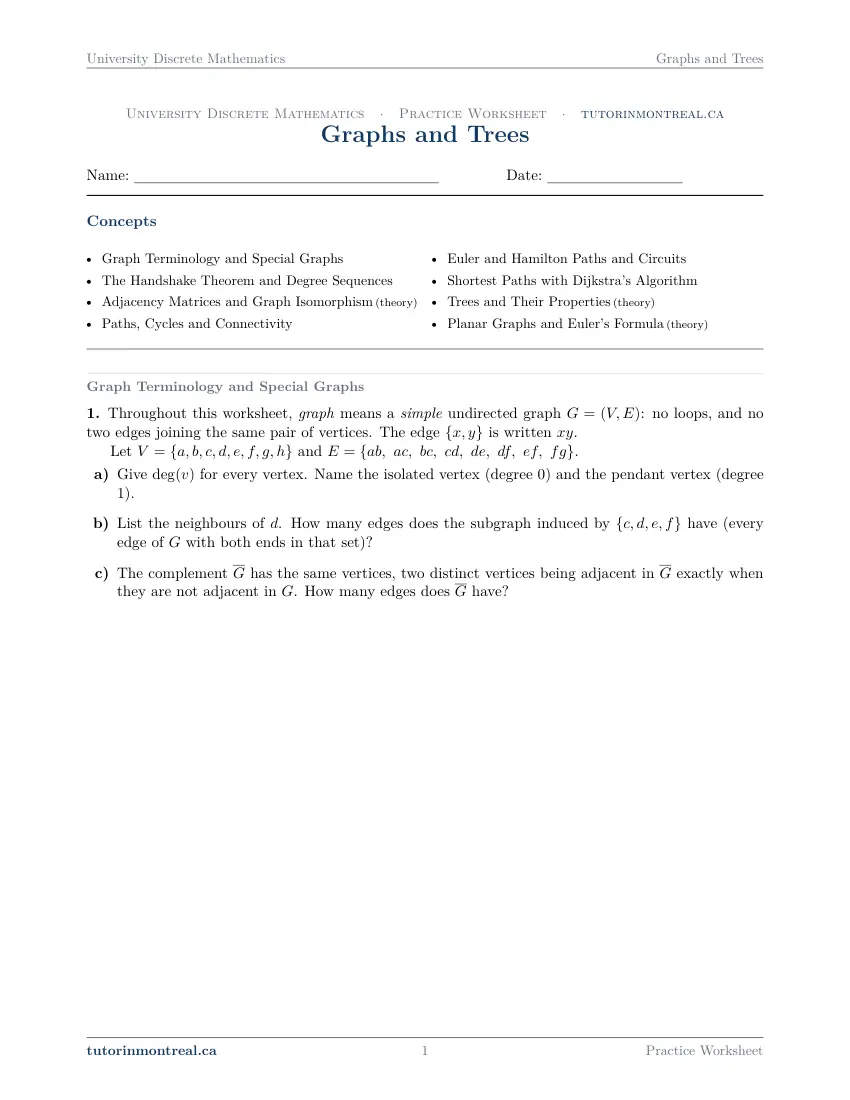
Throughout this worksheet, graph means a simple undirected graph : no loops, and no two edges joining the same pair of vertices. The edge is written .
Let and .
- Give for every vertex. Name the isolated vertex (degree ) and the pendant vertex (degree ).
- List the neighbours of . How many edges does the subgraph induced by have (every edge of with both ends in that set)?
- The complement has the same vertices, two distinct vertices being adjacent in exactly when they are not adjacent in . How many edges does have?
-
Q2Graph Terminology and Special Graphs
A graph is bipartite when its vertices can be split into two sets so that every edge joins a vertex of one set to a vertex of the other. For each graph below, give the number of vertices, the number of edges, and say whether it is bipartite, with a reason (a valid split, or why none exists).
- , the complete graph on vertices.
- , the cycle on vertices.
- , the complete bipartite graph with parts of sizes and .
- , the path on vertices.
-
Q3The Handshake Theorem and Degree Sequences
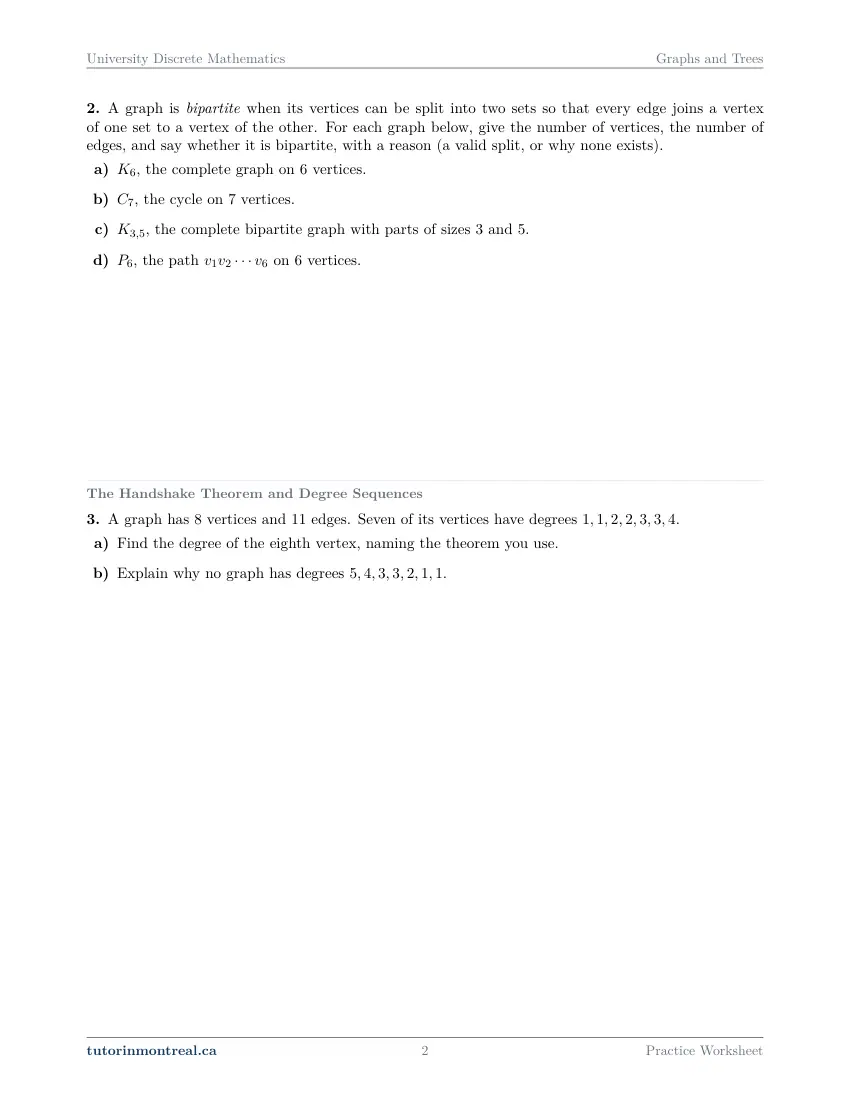
A graph has vertices and edges. Seven of its vertices have degrees .
- Find the degree of the eighth vertex, naming the theorem you use.
- Explain why no graph has degrees .
-
Q4The Handshake Theorem and Degree Sequences
Decide whether each list is the degree sequence of a graph. If it is, give such a graph by listing its edges; if it is not, explain why.
-
Q5Adjacency Matrices and Graph Isomorphism
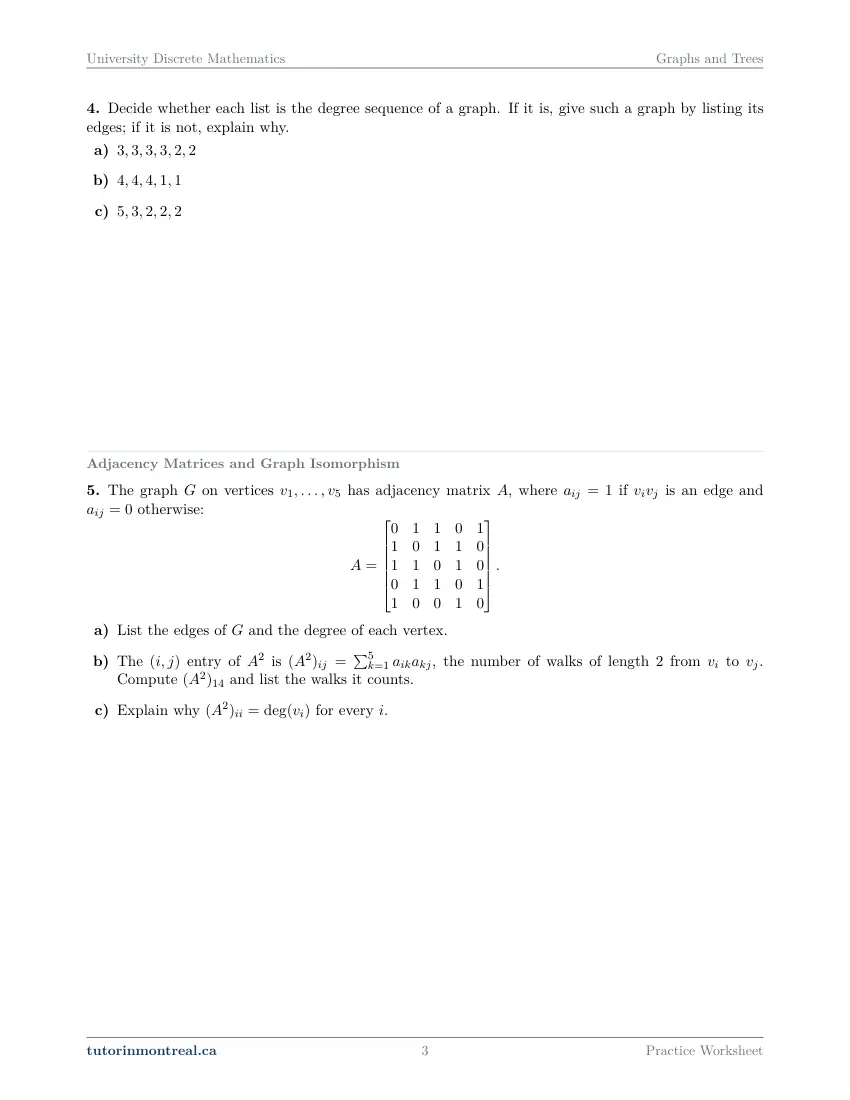
The graph on vertices has adjacency matrix , where if is an edge and otherwise:
- List the edges of and the degree of each vertex.
- The entry of is , the number of walks of length from to . Compute and list the walks it counts.
- Explain why for every .
-
Q6Paths, Cycles and Connectivity
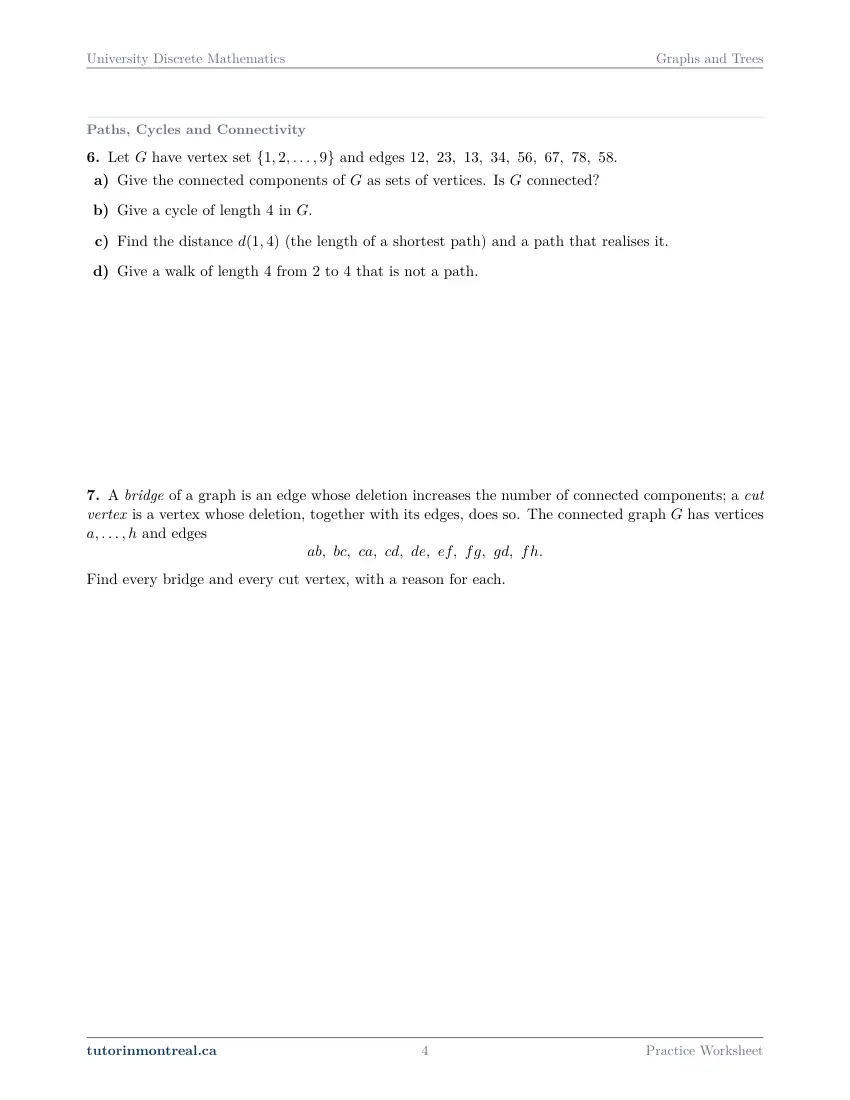
Let have vertex set and edges .
- Give the connected components of as sets of vertices. Is connected?
- Give a cycle of length in .
- Find the distance (the length of a shortest path) and a path that realises it.
- Give a walk of length from to that is not a path.
-
Q7Paths, Cycles and Connectivity
A bridge of a graph is an edge whose deletion increases the number of connected components; a cut vertex is a vertex whose deletion, together with its edges, does so. The connected graph has vertices and edges Find every bridge and every cut vertex, with a reason for each.
-
Q8Euler and Hamilton Paths and Circuits
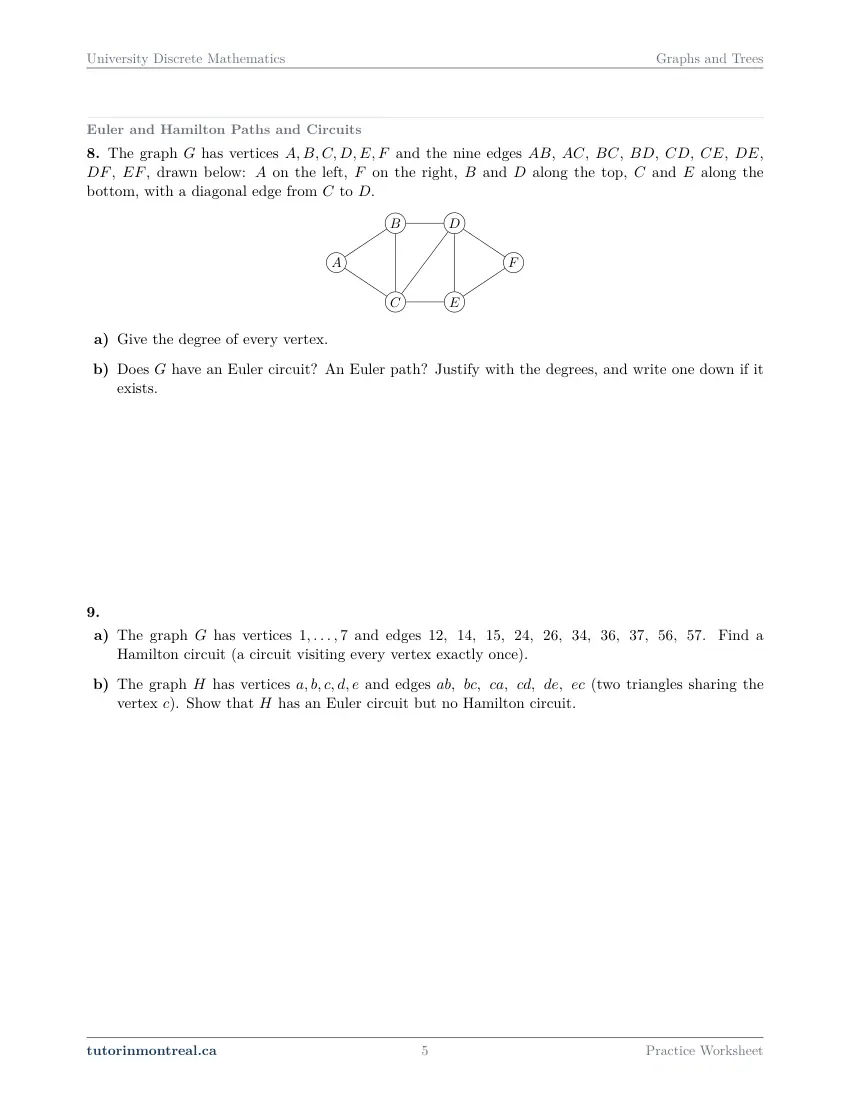
This question is built around a diagram or a table of values. Open it in the PDF.
-
Q9Euler and Hamilton Paths and Circuits
- The graph has vertices and edges . Find a Hamilton circuit (a circuit visiting every vertex exactly once).
- The graph has vertices and edges (two triangles sharing the vertex ). Show that has an Euler circuit but no Hamilton circuit.
-
Q10Shortest Paths with Dijkstra's Algorithm
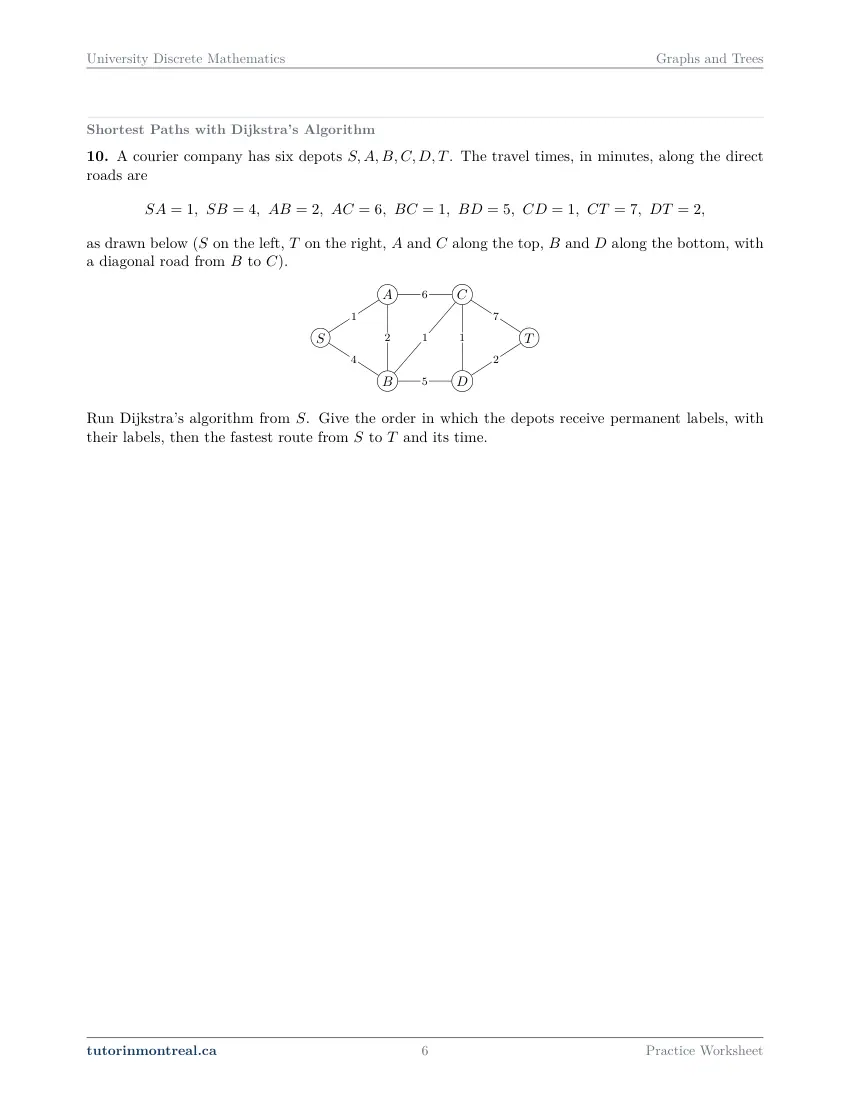
This question is built around a diagram or a table of values. Open it in the PDF.
-
Q11Shortest Paths with Dijkstra's Algorithm
A cycling network joins six stations by trails with these lengths, in kilometres: Use Dijkstra's algorithm from to find the shortest distance from to every other station and the station just before it on a shortest route. Then give the shortest route from to .
-
Q12Trees and Their Properties
A tree is a connected graph with no cycle, and a leaf is a vertex of degree . A tree has exactly two vertices of degree , three of degree , one of degree , and every other vertex is a leaf. How many leaves does it have, and how many vertices?
-
Q13Planar Graphs and Euler's Formula
Euler's formula: a connected graph drawn in the plane without crossings, with vertices, edges and faces (the unbounded outer face included), satisfies .
- A connected planar graph has vertices, each of degree . How many faces does any crossing-free drawing of it have?
- A connected graph drawn without crossings has edges and faces. How many vertices does it have?
-
Q14Synthesis — drawing on several topics in this unit
The graph has vertices , grouped into the pairs , , . Two distinct vertices are adjacent exactly when they are not in the same pair.
- Give the degree of every vertex and use the handshake theorem to find the number of edges.
- Does have an Euler circuit? If so, give one.
- Give a Hamilton circuit of .
- can be drawn without crossings. How many faces does such a drawing have?
The 9 challenge problems for this topic are a separate, paid sheet and are not reproduced here.
What does this set assume? This set assumes Secondary 5 mathematics only — no calculus and no linear algebra, whatever a calendar lists as a prerequisite — and it is the last set of the course, so it draws on more of what came before than any other. From Counting Techniques it uses the sum and product rules and the counting of pairs, which is what a question about the number of edges of a complete or a complete bipartite graph really is. From Induction and Recursion it borrows the habit of proving a statement about every size at once, since a graph on n vertices is the first setting where that argument is made about a picture rather than a formula. From Methods of Proof it wants the familiar forms: a direct argument from a definition, a counterexample, and an impossibility argument. A matrix appears here only as the adjacency matrix of a graph, and any question that needs a product of matrices defines the entry it needs inside the question, so no linear algebra is assumed anywhere. Deliberately out of this set and this course: graph colouring; spanning trees and tree traversals, so no question asks for a minimum spanning tree or for a preorder or postorder listing; and the running-time analysis of the algorithms, which belongs to a later course — Dijkstra's algorithm is run here by hand and judged on the table, not on its complexity.
Which course is this for? In the public course calendars of Montreal universities, this material is part of the courses numbered MATH 240, MAT1500, INF1132 and MAT210. Each course orders and weights the topics its own way, so check your own outline for what your exam covers. Which sets match your course.
How to do every concept on this sheet
This is the part worksheet sites usually leave out. Below is the actual reasoning behind each group of questions — not a full solution set, the decisions that get you to one. Read it before you start, or after you get stuck.
The vocabulary, and the fact that it is all definitions
Q1 fixes the convention for the whole set: graph means a simple undirected graph G = (V, E), with no loops and no repeated edge, and the edge {x, y} is written xy. Everything the question asks — deg(v) for each vertex, the isolated vertex, the pendant vertex, the neighbours of one vertex, the edges of an induced subgraph, the edges of the complement — is a definition applied once. There is no technique here to learn and no shortcut to take; the work is being systematic enough that nothing is missed.
Reading a graph given as a list of edges
Three habits that make the rest of the set quicker.
- 1Draw it once, carefully
Place the vertices with space between them and add the edges one at a time, ticking each off the list. A vertex named in V but in no edge is exactly the isolated one the question asks for, and it is the one a hurried drawing omits.
- 2Tabulate the degrees, do not eyeball them
Write the vertices in a row and put a stroke under both ends of every edge as you read the list. Two strokes per edge, always — which is also the check that you copied the list correctly.
- 3For an induced subgraph, filter the edge list
Keep the edges with both ends in the chosen set. Both — an edge with one end outside is not in the induced subgraph, and that is the only way Q1(b) goes wrong.
The complement is counted, not drawn. Q1(c) asks how many edges the complement has, and drawing it is the slow route. In a simple graph on n vertices every pair of distinct vertices is either an edge of G or an edge of the complement and never both, so the two counts add to the number of pairs, C(n, 2). Count the edges of G from the list, count the pairs, and subtract. That is a counting argument of exactly the kind Counting Techniques drills, reused on a graph.
Special graphs, and deciding bipartiteness
Q2 names four families — Kₙ, Cₙ, Kₘ,ₙ and Pₙ — and asks for the number of vertices, the number of edges, and a decision about bipartiteness with a reason. Learn each family as a sentence, and the vertex and edge counts follow from the sentence rather than from a drawing you have to make every time.
Kₙ: every pair joined · Cₙ: one closed ring · Kₘ,ₙ: every cross pair joined, none inside a part · Pₙ: an open chainSo the edge count of a complete graph is the number of pairs, the edge count of a complete bipartite graph is a product by the product rule, and a cycle and a path on the same number of vertices differ by exactly one edge. Write the general formula and then substitute; a formula written once is worth more on an exam than four separate counts.
A reason for bipartiteness is one of two things, and only one of them is a picture. To show a graph is bipartite, exhibit the split: name the two sets and say that every edge of the graph runs between them, checking the edges rather than asserting it. To show a graph is not, an exhibited split proves nothing, because there are many splits — you need an argument that rules them all out. The usable one is a cycle of odd length: walking round it, the two parts have to take turns, so a walk of odd length returns to its starting vertex on the wrong side of the split. Both directions are asked for in Q2.
Bipartite does not mean two pieces. The word describes a split of the vertices, not a disconnection: a bipartite graph can be perfectly connected, and a graph in two pieces need not be bipartite. Q6 is where connectivity is actually the subject.
The handshake theorem, and what it can rule out
Every edge contributes 1 to the degree of each of its two ends, so summing deg(v) over all vertices counts every edge exactly twice. That one sentence is the whole theorem, and it is the only tool Q3 needs.
Σ over v in V of deg(v) = 2 · (number of edges)Q3(a) gives the number of vertices, the number of edges, and all but one degree, and asks for the missing one — name the theorem as the question requires, write the equation with the unknown degree in it, and solve. Q3(b) turns the same equation into an impossibility argument: a list of degrees can only belong to a graph if its total is twice a whole number of edges, so look at the parity of the sum before anything else. Phrase the answer as an argument, not as a verdict: the sum would have to equal twice an integer, and the marks are for saying why it cannot.
The corollary worth remembering. Because the total is even, the vertices of odd degree cannot be odd in number — they pair off. Counting odd entries is usually faster than adding the whole list, and it is the form of the theorem that reappears in Q8.
Degree sequences: building one or ruling it out
Q4 gives three lists and asks, for each, whether some graph has exactly those degrees. The two answers are completely different kinds of work, and the question is really asking you to decide which kind each list needs.
Which way to go on a degree list
Run the cheap tests first; construct only when they all pass.
- 1Parity
Add the entries. An odd total is impossible by the handshake theorem, and that is a complete answer.
- 2The ceiling on a single degree
In a simple graph on n vertices no vertex can be adjacent to itself or twice to the same vertex, so no degree can exceed n − 1. An entry at or above the number of entries kills the list at once.
- 3A local count
If a few vertices have very high degree, ask where their edges must land: their neighbours all need degrees large enough to receive them. A list can fail for this reason with an even sum and no entry too large.
- 4Construct
If nothing rules it out, the answer must be an actual graph, given as a list of edges. Then recount the degrees from your own list — that recount is the proof, and it is the step people skip.
"I could not draw one" is not a reason. Failing to find a graph is evidence about you, not about the list. An impossibility answer has to point at a fixed obstruction — the parity, the ceiling, or a counting argument about where the edges of the high-degree vertices can go. Start each part of Q4 with the tests above, and write down which one decided it.
Adjacency matrices, and what a power of one counts
Q5 gives a graph as a 5 by 5 matrix A, with a 1 wherever two vertices are joined and a 0 otherwise. Part (a) is translation in the easy direction: the edges are the positions of the 1s above the diagonal, and the degree of a vertex is the number of 1s in its row. Since the graph is undirected the matrix is symmetric, so reading only the upper half lists each edge once rather than twice.
Part (b) is the one idea in this sheet. The question supplies the entry of A² as a sum over k of a term in row i and a term in column j, so no linear algebra is needed and nothing has to be recalled: each term of that sum is 1 exactly when both vᵢvₖ and vₖvⱼ are edges, which is exactly one two-step walk from vᵢ to vⱼ through vₖ. Compute the sum term by term, and then list the walks as the question asks — the count and the list must agree, and that agreement is the check.
Part (c) is a proof, and the proof is one sentence long. A walk of length two from a vertex back to itself has to step out along an edge and back along the same edge, so the walks counted by a diagonal entry correspond to the edges at that vertex, one each. Write that correspondence out — the marks here are for the reason, and a table of computed values is not a reason. This is the whole of the linear-algebra content of the course, stated in the question and proved from the definition.
Same graph, different matrix. Relabelling the vertices permutes the rows and columns, so one graph has many adjacency matrices and two different-looking matrices can describe the same graph — the question this sheet's title puts beside them. Deciding it is never done by staring at two drawings: compare the counts that cannot change under relabelling — the number of vertices, the number of edges, the degree sequence, the lengths of the cycles present — and a disagreement in any one of them settles it. If they all agree, nothing has been settled yet, and the work becomes matching the vertices up one by one so that every edge maps to an edge.
Walks, paths, components and distance
Q6 is a vocabulary question with four parts, and the vocabulary is the part that is marked. A walk may repeat vertices and edges; a path may not; a cycle is a closed path; the distance d(x, y) is the length of a shortest path, counted in edges and not in vertices; and a component is a maximal set of vertices reachable from one another.
Find the components first and the rest falls out. Start at the lowest-numbered vertex, list everything reachable from it by following the edge list, and close the set off; then start again at the smallest vertex not yet used. A graph is connected exactly when that procedure produces one set, which is how Q6(a) is answered. Q6(b), (c) and (d) then live inside one component each, so the components tell you where to look.
For the distance in Q6(c), a claimed shortest path needs two things: the path itself, and the reason nothing shorter exists. On a graph this size the reason is a short check — every walk of one or two edges from the starting vertex is easy to list, so say that none of them reaches the target. Q6(d) asks for a walk that is not a path, which is the definition tested from the other side: repeat a vertex or an edge on purpose, and count the edges rather than the vertices so the required length comes out right.
Bridges and cut vertices
Q7 defines both terms inside the question — a bridge is an edge whose removal increases the number of components, a cut vertex is a vertex whose removal, with its edges, does the same — and asks for every one of each, with a reason for each. The word every is what makes the question hard: a correct list is only half of it, because the other half is knowing that nothing was missed.
A method that finishes
Test candidates systematically; justify both the yes and the no.
- 1Find the cycles
An edge on a cycle is never a bridge: delete it and the rest of the cycle is a detour. So mark the cycles first and only the remaining edges are candidates.
- 2Delete each candidate edge and re-check connectivity
Run the component procedure from Q6 on what is left. One component means the edge was not a bridge.
- 3Delete each vertex, with all its edges
Do this for every vertex of degree 2 or more — a leaf can never be a cut vertex, since removing it leaves everything else joined as it was.
- 4Write the reason both ways
For each one you keep, name the two pieces the deletion creates. For the ones you reject, name the detour that survives.
The two notions are related but not the same. An endpoint of a bridge is a cut vertex unless it is a leaf, and a graph can have cut vertices and no bridge at all. Do not derive one list from the other — build both, then look at how they line up, which is a good sanity check on the drawing of Q7.
Euler and Hamilton: a test that exists, and one that does not
Q8 works on a drawn graph with six vertices and asks first for every degree and then whether an Euler circuit or an Euler path exists, justified by those degrees, with one written out if it does. An Euler circuit or path uses every edge exactly once, and the criterion is a parity count, a direct descendant of the handshake theorem: each visit to a vertex consumes two edges at it, one in and one out, except at the two ends of an open walk.
Euler circuit ⇔ connected and no vertex of odd degree · Euler path ⇔ connected and exactly two vertices of odd degreeSo the order of work in Q8 is fixed: degrees first, then count the odd ones, then decide, then construct if the count allows it. When you construct, start at an odd-degree vertex if there are two — an Euler path has to — and cross each edge off the list as you use it, so that the finished walk can be checked against the edge count in one line.
Hamilton has no such test, and that is the lesson. Q9(a) asks for a Hamilton circuit — a circuit visiting every vertex exactly once — and no degree count decides whether one exists. Finding one is a search: begin at a low-degree vertex, because it constrains the route most, use both of its edges since a circuit through it must, and back up when a partial route strands a vertex. Then verify by listing the vertices in order and checking that each consecutive pair is an edge and that every vertex appeared once.
Q9(b) puts the two ideas on one small graph, made of two triangles sharing a vertex, and asks you to show the Euler side by the degree criterion and the Hamilton side by an argument. The second half is the interesting one: an impossibility claim about Hamilton circuits cannot be made by failing to find one, so it has to rest on a structural feature — a cut vertex has to be passed through more than once to get from one side of the graph to the other, and a Hamilton circuit is allowed to visit it only once. Write that as a proof, naming the vertex and the two sides.
Dijkstra's algorithm, run as a table
Q10 and Q11 are the same algorithm on two weighted networks — a courier's depots with travel times in minutes, and a cycling network with trail lengths in kilometres. Both give every edge weight in the question, both ask you to run the algorithm from a named starting vertex, and both want the working, not just the route. Q10 asks for the order in which vertices become permanent together with their labels; Q11 asks for a distance to every vertex and the vertex just before it on a shortest route.
One row per iteration
The same four moves until every vertex is permanent.
- 1Start the labels
The starting vertex gets 0; every other vertex gets a label meaning "no route found yet". Nothing is permanent.
- 2Make the smallest temporary label permanent
Among the vertices not yet fixed, the smallest label cannot be improved later, because every weight is positive and any other route would already be longer. Circle it and record the order — that order is what Q10 asks for.
- 3Relax its edges
For each neighbour still temporary, compare its current label with the new permanent label plus the weight of the joining edge. Keep the smaller, and when it changes, note which vertex it came from.
- 4Repeat, then walk the predecessors back
Stop when every vertex is permanent. The route is read by starting at the destination and following the recorded predecessor back to the start, then reversing the list.
Record the predecessor while you relax, not afterwards. A label alone gives a distance and no route, and reconstructing the route at the end from the numbers is where this method is usually lost. One extra column costs nothing: Q11 asks for that column outright, and Q10 needs it to produce the fastest route it asks for.
A short first edge is not a short route. The whole point of the algorithm is that the cheapest edge out of the start need not lie on the best route to the far end, and both networks here are built so that a greedy guess along the obvious road can be beaten by a detour. Never fix a vertex because it looks close on the drawing; fix it because its label is the smallest temporary one on the table.
Trees
A tree is a connected graph with no cycle, and a leaf is a vertex of degree 1. Q12 lists how many vertices a tree has of degree 4, of degree 3 and of degree 2, says every other vertex is a leaf, and asks for the number of leaves and the number of vertices.
Two facts, and they meet in one equation. The first is the handshake theorem again: the degrees sum to twice the number of edges. The second is the property that separates a tree from any other connected graph — its number of edges is determined by its number of vertices, one fewer. Call the number of leaves L, write the total number of vertices in terms of L, write the degree sum in terms of L, and set the two expressions for the edge count equal. The unknown appears on both sides, which is exactly why one equation is enough.
It is worth knowing why a tree has one edge fewer than it has vertices, because the reason is the argument the course has been building towards all term: it is proved by induction on the number of vertices, with a leaf removed at the inductive step to reach a smaller tree. Q12 does not ask for that proof, but treating the fact as a formula to memorise rather than a theorem you could restate is what makes the next such question unapproachable.
Planar graphs and Euler's formula
Q13 quotes the formula it needs: a connected graph drawn in the plane with no crossings, with v vertices, e edges and f faces, satisfies v − e + f = 2. Both parts are the formula plus one other relation, and the skill is noticing which relation the part supplies.
v − e + f = 2 · the outer unbounded region is a face tooPart (a) gives the number of vertices and the degree of each of them, and no edge count — so the handshake theorem supplies e before the formula can be used, which is the link the question is testing. Part (b) gives e and f directly, so the formula is rearranged for v in one line. In both, write the formula, list the quantities you know beside it, and only then substitute.
Forgetting the outer face is the classic error. The region outside the whole drawing counts, and a face count that is one too small propagates straight into the answer. Note also what the formula does and does not claim: it holds for a connected graph drawn without crossings, and every such drawing of the same graph gives the same number of faces — which is why Q13(a) can ask for the face count without showing you a drawing.
The synthesis question
Q14 defines a graph on six vertices by a rule rather than an edge list — the vertices come in three pairs, and two distinct vertices are joined exactly when they are not in the same pair — and then walks through four of this set's topics on that one graph. Translate the rule into a drawing or an edge list first; every part afterwards is easier on a picture than on the sentence.
Part (a) is Q3: read off the degree of a vertex from the rule, note that the rule treats all six alike, and use the handshake theorem to get the edge count rather than counting edges one at a time. Part (b) is Q8: the parity of those degrees decides the Euler question before any route is attempted, and only then is a circuit written out. Part (c) is Q9: search for a Hamilton circuit, and verify it by listing consecutive pairs against the rule. Part (d) is Q13: with v from the definition and e from part (a), Euler's formula gives the face count of any crossing-free drawing — and if your own drawing has crossings, that does not contradict the answer, since the question grants that a drawing without them exists.
Four answers about one object should agree with each other. The degrees in part (a) are what part (b) is decided on, and the edge count from part (a) is what part (d) substitutes. If part (d) gives an implausible face count, suspect the edge count rather than the formula. That cross-checking between parts is the habit the synthesis question is built to reward.
Preview all 8 pages
Click any page to open the full PDF.
Getting the most out of it
Draw it, then never trust the drawing
A drawing is how you find a route, a cycle or a split; it is not why the answer is right. Every claim on this sheet is settled against the edge list or the definition — a degree recounted from the list, a Hamilton circuit checked pair by pair, a bridge justified by the components that remain. Two vertices that look close on a page are the commonest source of a wrong answer.
Count with the handshake theorem before you count edges
It appears in four different disguises on this sheet — a missing degree, an impossible list, an edge count from a regular graph, and the parity test for an Euler circuit. Whenever a question mentions degrees and edges in the same breath, write the sum equation down first.
Know which questions have a test and which need a search
Euler, bipartiteness and planarity all come with a criterion you can apply. Hamilton circuits do not. Recognising which kind of question you are in decides whether you should be computing or searching, and stops you hunting for a criterion that does not exist.
For an impossibility, name the obstruction
"I could not find one" is never an answer. A negative claim on this sheet rests on a parity, a ceiling, an odd cycle or a cut vertex — a fixed feature that rules out every attempt at once. Write the feature down first and the argument follows from it.
Keep the algorithm's table
Dijkstra's algorithm produces an order, a set of labels and a predecessor for each vertex, and different questions ask for different pieces of it. Keeping all three columns as you go means one run answers whatever is asked, instead of a second run done under exam pressure.
Want the solutions, or something more challenging?
The worksheet, the questions above and every explanation on this page stay free permanently. Three more PDFs exist for this topic — the worked answer key, a harder problem set, and the answer key to that. They come with the University Discrete Math Solutions Bundle, beside the unit notes and the unit test, which is what keeps the rest of the series free.
What else exists for Graphs and Trees
Three PDFs · 13 pages · all three are in the bundle below.
- Answer key — 3 pages. All 14 questions worked step by step, including the restrictions and the justifications. Not a list of final answers.
- Challenge problems — 7 pages, 9 problems. A separate sheet at exam-plus difficulty covering the same 8 concepts. Harder than anything on the free sheet.
- Challenge answer key — 3 pages. Every challenge problem worked to the same standard, with the checks shown.
- PDF, letter size, print-ready.
The one thing that's for sale
Every University Discrete Math topic — the complete Solutions Bundle
One download, one payment, the whole program. For all 9 University Discrete Math units: the worksheet, the reference notes, the challenge set, the unit test and every answer key — including this one.
- Worked solutions, not answer lists — every step written out
- Covers the whole year's program at this level
- Less than the price of one hour of tutoring — for the entire year's solutions
Taking Secondary 1 Math as well? The Secondary 1 Math bundle covers all 15 of its units — 106 PDFs, 474 pages — on the same terms.
Taking Secondary 2 Math as well? The Secondary 2 Math bundle covers all 14 of its units — 98 PDFs, 449 pages — on the same terms.
Taking Secondary 3 Math as well? The Secondary 3 Math bundle covers all 11 of its units — 77 PDFs, 367 pages — on the same terms.
Taking Secondary 4 Math as well? The Secondary 4 Math bundle covers all 17 of its units — 122 PDFs, 466 pages — on the same terms.
Taking Secondary 5 Math as well? The Secondary 5 Math bundle covers all 21 of its units — 147 PDFs, 589 pages — on the same terms.
Taking CEGEP Calculus I as well? The CEGEP Calculus I bundle covers all 9 of its units — 72 PDFs, 371 pages — on the same terms.
Taking CEGEP Calculus II as well? The CEGEP Calculus II bundle covers all 8 of its units — 64 PDFs, 335 pages — on the same terms.
Taking CEGEP Linear Algebra as well? The CEGEP Linear Algebra bundle covers all 7 of its units — 56 PDFs, 298 pages — on the same terms.
Taking University Calculus III as well? The University Calculus III bundle covers all 9 of its units — 72 PDFs, 516 pages — on the same terms.
Taking University Linear Algebra as well? The University Linear Algebra bundle covers all 9 of its units — 72 PDFs, 496 pages — on the same terms.
Taking University Differential Equations as well? The University Differential Equations bundle covers all 9 of its units — 36 PDFs, 182 pages — on the same terms.
Taking University Business Math as well? The University Business Math bundle covers all 9 of its units — 36 PDFs, 190 pages — on the same terms.
Taking University Introductory Statistics as well? The University Introductory Statistics bundle covers all 9 of its units — 36 PDFs, 186 pages — on the same terms.
Taking AP Calculus AB as well? The AP Calculus AB bundle covers all 8 of its units — 64 PDFs, 527 pages — on the same terms.
Common questions
Is this worksheet really free?
Yes — the questions are on this page to read, and the PDF downloads directly, no email and no account. The one paid item is optional: the complete University Discrete Mathematics Solutions Bundle, which covers every set at this level.
Which university courses is this for?
The course codes listed on this page are taken from the public course calendars of universities that teach discrete mathematics to mathematics, computer science and engineering students. Each course orders and weights the chapters its own way, and some reach a chapter late in the term or not at all — so check the outline for your own section to see where this set falls in your term.
What do I need to know before starting this set?
Secondary 5 algebra, the counting rules from the earlier set Counting Techniques, and the proof habits from Methods of Proof. No calculus and no linear algebra are used anywhere in this set: the one matrix that appears is an adjacency matrix, and every entry it needs is defined in the question.
What is the difference between a walk, a path and a circuit?
A walk is any sequence of vertices with consecutive ones joined by an edge, and it may repeat vertices and edges. A path is a walk that repeats nothing. A circuit is a closed walk that returns to its starting vertex. Lengths are counted in edges, not in vertices, which is where an off-by-one usually comes from.
What is the difference between an Euler circuit and a Hamilton circuit?
An Euler circuit uses each edge once; a Hamilton circuit calls at each vertex once. The two are unrelated — a graph can have one without the other — and only the Euler question is settled by a degree count.
Why is there no simple test for a Hamilton circuit?
There are conditions that guarantee one when the degrees are large enough, and structural features such as a cut vertex that rule one out, but no criterion covers every graph the way the parity of the degrees covers Euler circuits. For the graphs on this sheet the honest methods are a systematic search for existence and a structural argument for impossibility.
Does Dijkstra's algorithm always give the shortest route?
Yes, as long as every weight is positive, which is the case in both questions here. That assumption is exactly what justifies making the smallest temporary label permanent: no route discovered later can come back and improve it.
How do I show two graphs are not the same graph?
Find a count that relabelling cannot change and that the two disagree on — the number of vertices, the number of edges, the degree sequence, or the lengths of the cycles present. One disagreement is a complete answer. Agreement on all of them proves nothing on its own, so the other direction has to be shown by matching the vertices up explicitly.
Can teachers use this in class?
Yes. Print and photocopy it for your own classes freely — I just ask that the tutorinmontreal.ca footer stays on the page.
I'm stuck on one question. Can you help?
Yes — through one-on-one tutoring, in Montreal or online. Get in touch to arrange a session, or see the current rates.
← All 9 University Discrete Math worksheets · Secondary 1 Math series (15 sheets) → · Secondary 2 Math series (14 sheets) → · Secondary 3 Math series (11 sheets) → · Secondary 4 Math series (17 sheets) → · Secondary 5 Math series (21 sheets) → · CEGEP Calculus I series (9 sheets) → · CEGEP Calculus II series (8 sheets) → · CEGEP Linear Algebra series (7 sheets) → · University Calculus III series (9 sheets) → · University Linear Algebra series (9 sheets) → · University Differential Equations series (9 sheets) → · University Business Math series (9 sheets) → · University Introductory Statistics series (9 sheets) → · AP Calculus AB series (8 sheets) →