University Discrete Mathematics — Methods of Proof Worksheet
The five ways a mathematical statement gets proved, and the judgement about which one to reach for. Direct proof from the definitions of even, odd and divides; contraposition, and the care that negating a statement takes; contradiction, where the whole work is choosing the right assumption to start from; proof by cases, where the cases have to cover everything; the two separate directions of an if and only if; and existence proofs and counterexamples, where one well-chosen object settles the question. Have a look on this page, then print the free PDF when you want to write on it.
Practice worksheet — free PDF
No email, no account, no watermark. Teachers: photocopy it for your classes freely. Worked solutions and 7 harder problems come with the University Discrete Math bundle.
All 10 questions
Each question targets one named concept from the sheet. Read them here, or print the PDF — it has working space under each one.
-
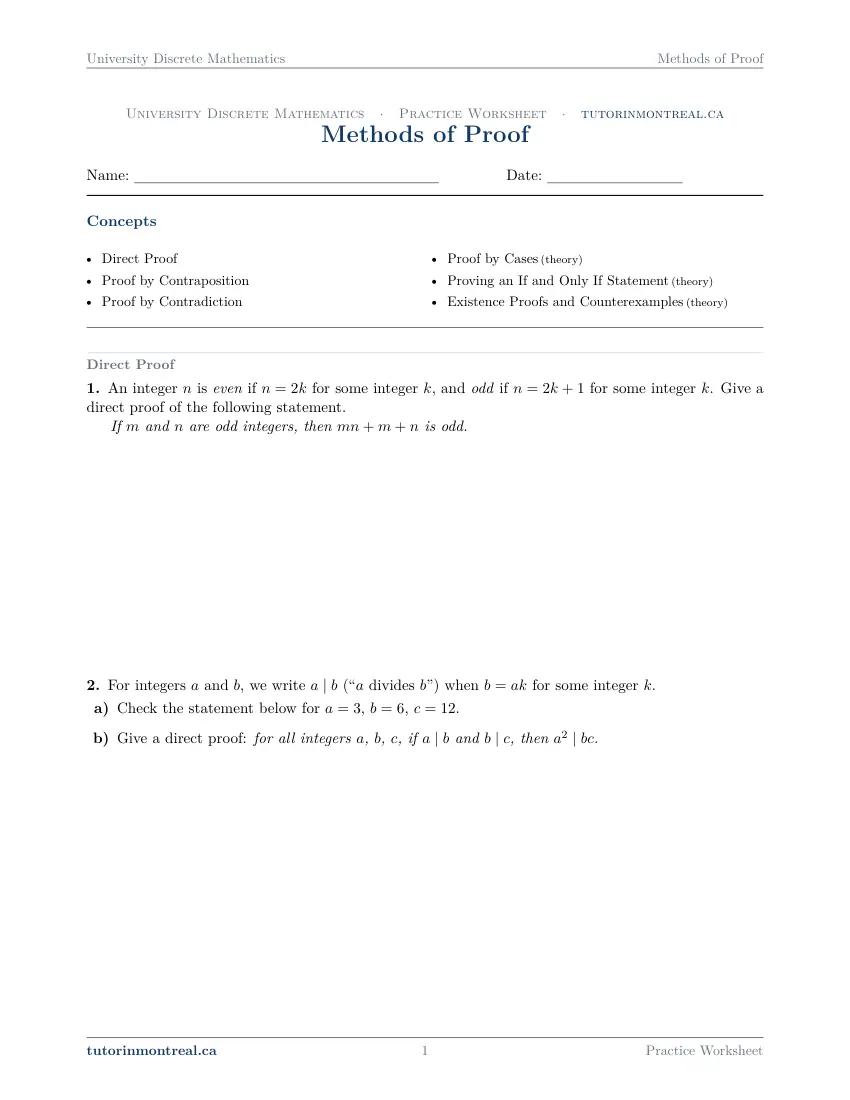
Q1Direct Proof
An integer is even if for some integer , and odd if for some integer . Give a direct proof of the following statement.
If and are odd integers, then is odd.
-
Q2Direct Proof
For integers and , we write (“ divides ”) when for some integer .
- Check the statement below for , , .
- Give a direct proof: for all integers , , , if and , then .
-
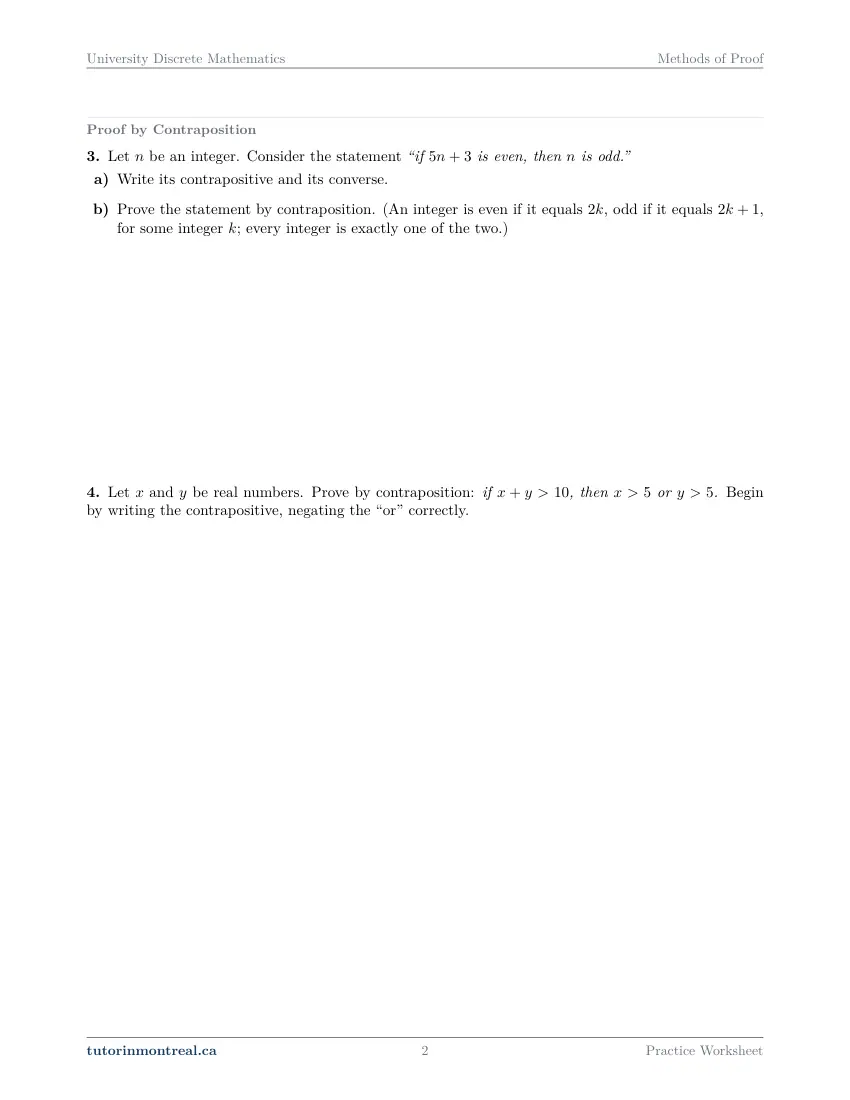
Q3Proof by Contraposition
Let be an integer. Consider the statement “if is even, then is odd.”
- Write its contrapositive and its converse.
- Prove the statement by contraposition. (An integer is even if it equals , odd if it equals , for some integer ; every integer is exactly one of the two.)
-
Q4Proof by Contraposition
Let and be real numbers. Prove by contraposition: if , then or . Begin by writing the contrapositive, negating the “or” correctly.
-
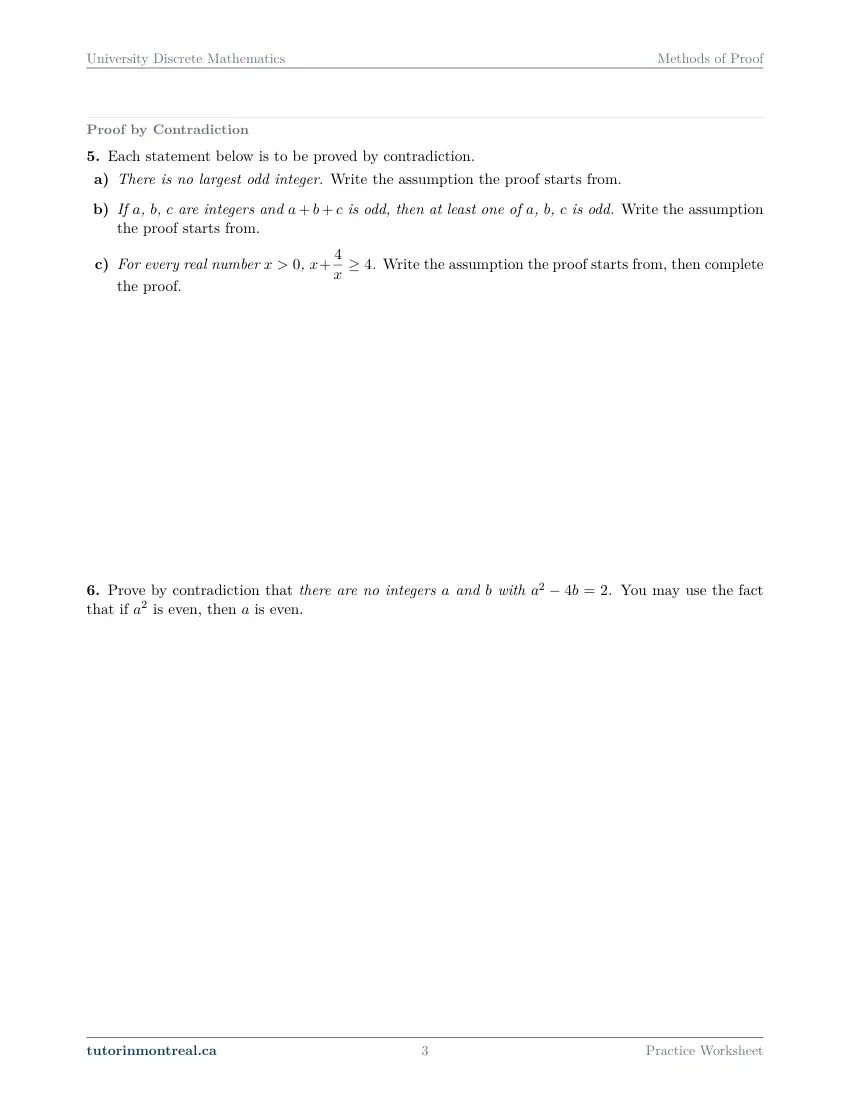
Q5Proof by Contradiction
Each statement below is to be proved by contradiction.
- There is no largest odd integer. Write the assumption the proof starts from.
- If , , are integers and is odd, then at least one of , , is odd. Write the assumption the proof starts from.
- For every real number , . Write the assumption the proof starts from, then complete the proof.
-
Q6Proof by Contradiction
Prove by contradiction that there are no integers and with . You may use the fact that if is even, then is even.
-
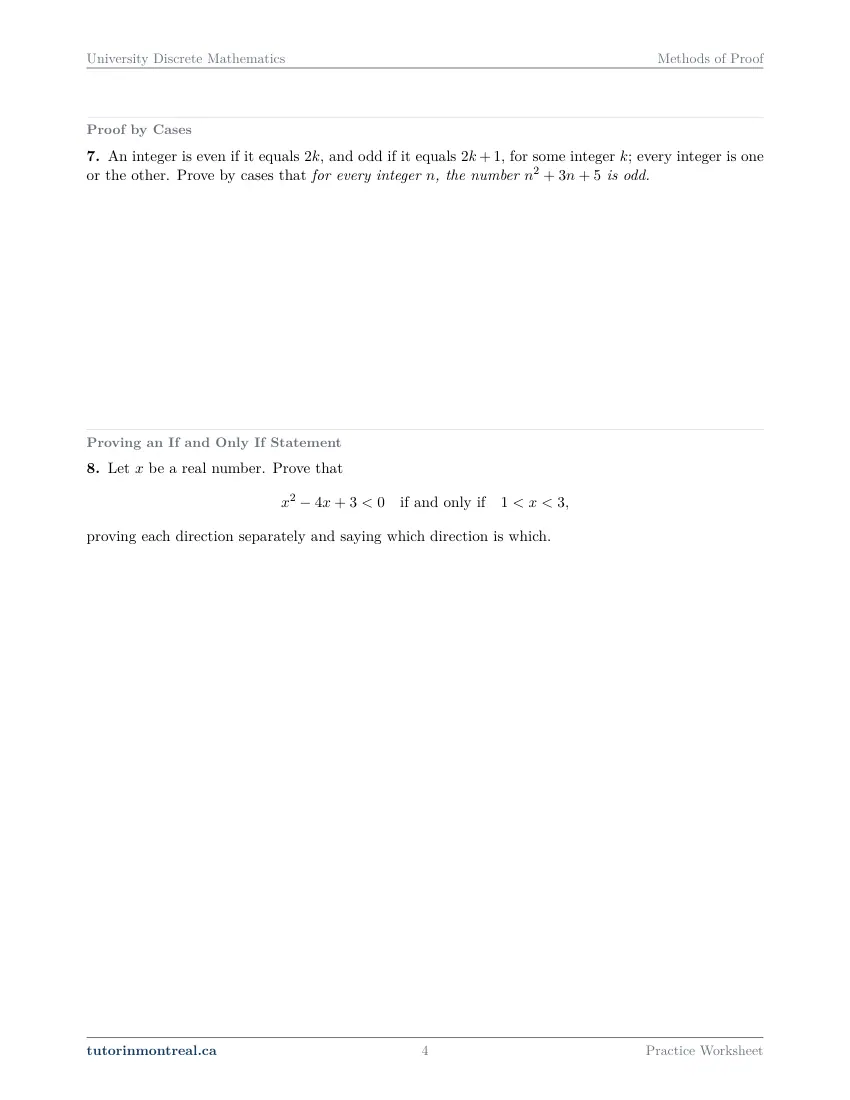
Q7Proof by Cases
An integer is even if it equals , and odd if it equals , for some integer ; every integer is one or the other. Prove by cases that for every integer , the number is odd.
-
Q8Proving an If and Only If Statement
Let be a real number. Prove that proving each direction separately and saying which direction is which.
-
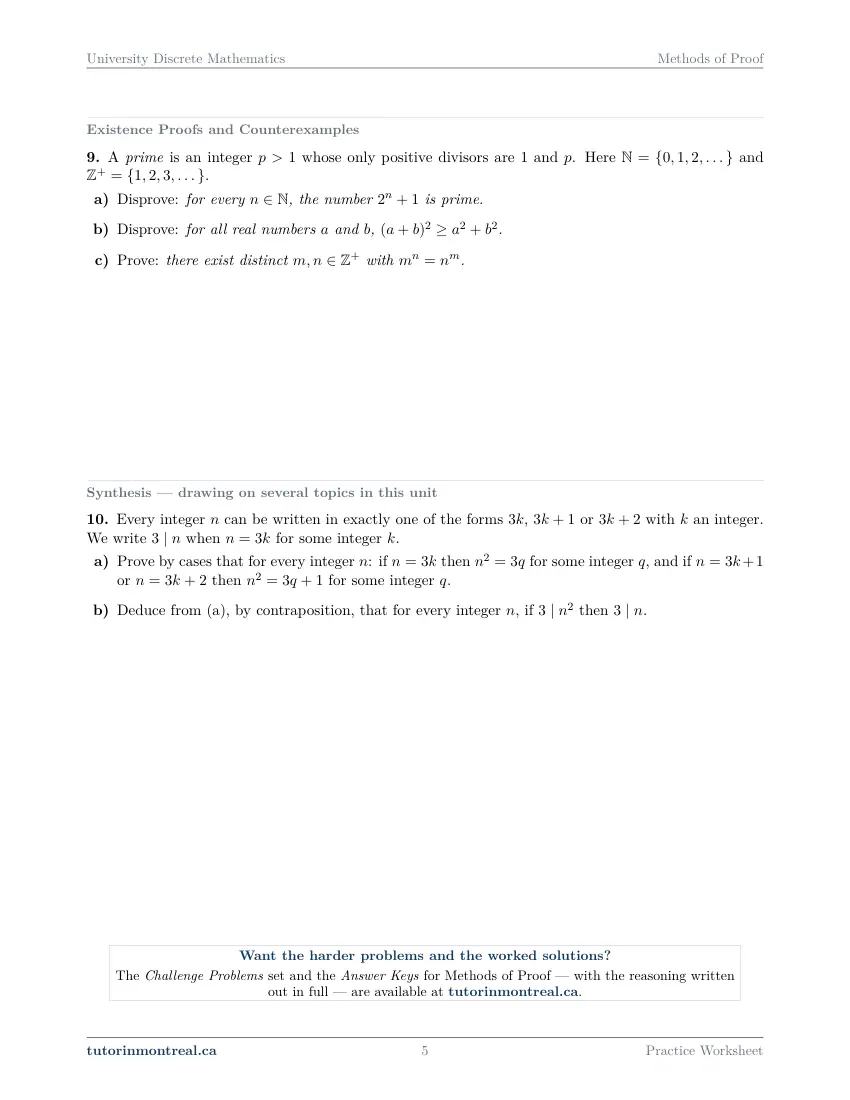
Q9Existence Proofs and Counterexamples
A prime is an integer whose only positive divisors are and . Here and .
- Disprove: for every , the number is prime.
- Disprove: for all real numbers and , .
- Prove: there exist distinct with .
-
Q10Synthesis — drawing on several topics in this unit
Every integer can be written in exactly one of the forms , or with an integer. We write when for some integer .
- Prove by cases that for every integer : if then for some integer , and if or then for some integer .
- Deduce from (a), by contraposition, that for every integer , if then .
The 7 challenge problems for this topic are a separate, paid sheet and are not reproduced here.
What does this set assume? This set assumes Secondary 5 mathematics only — expanding and factoring, working with inequalities, and comfort with a quadratic — plus the previous set, Propositional and Predicate Logic. That is where the conditional, its contrapositive and its converse, De Morgan's laws and the negation of a quantified statement are established, and every method here is one of those ideas turned into a way of writing. No calculus and no linear algebra is used anywhere, whatever a calendar lists as a prerequisite. The arithmetic stays with the definitions the questions state: even, odd, divides, prime. Proof by mathematical induction is deliberately not here — it gets its own set, Induction and Recursion, later in the course, after Sets, Functions and Relations, Divisibility and Primes and Modular Arithmetic and Cryptography have supplied the statements worth proving that way. Proving set identities belongs to Sets, Functions and Relations, and the deeper divisibility results to Divisibility and Primes. Probability is not in this course at all, and neither are big-O notation and algorithm complexity.
Which course is this for? In the public course calendars of Montreal universities, this material is part of the courses numbered MATH 240, COMP 232, MAT1500, INF1132 and MAT210. Each course orders and weights the topics its own way, so check your own outline for what your exam covers. Which sets match your course.
How to do every concept on this sheet
This is the part worksheet sites usually leave out. Below is the actual reasoning behind each group of questions — not a full solution set, the decisions that get you to one. Read it before you start, or after you get stuck.
Direct proof, and the definitions that make it possible
A direct proof assumes the hypothesis and argues forward to the conclusion. Nothing about it is clever; what makes it work is refusing to use any word whose definition you have not written down. Q1 and Q2 both hand you the definitions in the question itself — even, odd, and a divides b — which is a signal that the definitions are meant to be the first line of your work.
The shape of a direct proof
Four moves, in this order, every time.
- 1Name the objects the hypothesis gives you
"m is odd" means m = 2j + 1 for some integer j. Use a fresh letter for each object — two odd numbers do not share the same j.
- 2Write the goal in the same language
What would the conclusion look like if it were true? Write that target down before working towards it.
- 3Do the algebra towards the target form
Expand, collect, and group the expression so that the shape you wrote in step 2 is visible.
- 4Name the integer and say it is one
The definition asks for an integer, so point at yours and say why it is an integer: sums and products of integers are integers.
Q1 is that skeleton with nothing in the way. Two odd integers come in, an expression built from them goes out, and the whole proof is substitution followed by grouping. The step people skip is the last one: the algebra is finished, the required form is on the page, and the sentence naming the integer is missing.
Two objects, two letters. Writing m = 2k + 1 and n = 2k + 1 does not say "both are odd" — it says they are the same number. It is the single most common way a direct proof about two integers goes wrong, and it usually still reaches a true-looking conclusion, which is why it survives unnoticed.
Q2 adds the divides relation and splits into two parts that do different jobs. Part (a) asks you to check the statement on particular numbers: substitute them into each hypothesis, name the integer multiplier each one needs, and then do the same for the conclusion. Part (b) is the proof itself, for all integers. Translate each hypothesis into an equation with its own named multiplier, substitute one into the other to get an expression for the quantity you care about, and then group it so the required divisibility is visible.
A check is not a proof, and it is not wasted either. Q2(a) does not prove Q2(b) — three numbers cannot establish a statement about all integers. What it does is show you the mechanism on numbers you can see, and confirm you have read the statement the way it was meant. Do it first, then prove.
Proof by contraposition
A conditional and its contrapositive are logically equivalent, so proving one proves the other. That is the entire justification for the method, and it is worth writing out once: you are allowed to prove a different statement because the previous set established that it is the same statement.
p → q is equivalent to ¬q → ¬p, but NOT to the converse q → pQ3 makes the distinction explicit before anything is proved. Part (a) asks for the contrapositive and the converse of a statement about 5n + 3. Build each mechanically: identify the hypothesis p and the conclusion q first, then swap them for the converse, and swap and negate both for the contrapositive. Negating "n is odd" uses a fact the question supplies: an integer that fails to be odd has to be even, the two possibilities being exclusive and leaving nothing out. That is what makes the negation a usable sentence rather than a phrase with "not" in front of it.
Part (b) is then a direct proof of the contrapositive: start from the negated conclusion, write that integer in the form its definition gives, substitute into the expression, and reach the negated hypothesis. Say at the top which statement you are proving and why that settles the original. A proof of the contrapositive that never announces itself reads like a proof of the converse.
The converse is a different statement. It can be true, false or unrelated while the original is true. Q3(a) asks for both precisely so that the two stop being interchangeable in your head — one of them you are entitled to prove instead, and the other you are not.
Q4 moves to real numbers and turns on the negation rather than on the algebra. The conclusion is an "or", and the negation of an "or" is an "and" — De Morgan, from the previous set — so the contrapositive assumes two things at once rather than one. Negate each strict inequality carefully: the opposite of x > 5 is x ≤ 5, not x < 5. Once both bounds are assumed, the proof needs one move only, and it is the move that two inequalities pointing the same way allow.
Why contraposition suits this one. Directly, the hypothesis is one inequality and the conclusion is a choice between two things, which gives you nothing to work with. Contraposed, the hypothesis becomes two concrete bounds and the conclusion becomes a single inequality. When the conclusion of a statement is an "or" and its hypothesis is thin, look at the contrapositive first.
Proof by contradiction: choosing the assumption
A proof by contradiction assumes the statement is false, derives something impossible, and concludes that the assumption was. Almost all of the difficulty is in the first line, which is why Q5 asks for that line three times and only completes one of the proofs.
Writing the opening assumption
Negate the whole statement, not a piece of it.
- 1Read the statement's logical form
Is it a plain assertion, a conditional, or a quantified statement? The form fixes how it negates.
- 2Negate it with the rules, not by feel
A conditional negates to its hypothesis together with the negated conclusion. "For every" negates to "there exists"; "there exists" negates to "for every". "At least one" is an existential in disguise.
- 3Turn the negation into an object you can hold
An existential assumption gives you a specific thing — name it with a letter, and everything after that is ordinary algebra about it.
- 4Say what would count as the contradiction
Usually a quantity that must be an integer and is not, a number both smaller and larger than another, or a sign that cannot be what it is.
Q5(a) negates a statement that denies an object exists, so the assumption hands you one to work with. Q5(b) negates a conditional: the hypothesis stays, and it is the conclusion that flips — and since that conclusion says "at least one", the negation is a statement about all three numbers. Q5(c) negates a "for every" over the positive reals, which yields one particular number with a reversed inequality, and then asks you to finish. Clear the fraction by multiplying through by that number, which is legitimate and leaves the inequality pointing the same way because it is positive; bring everything to one side; factor the quadratic that appears; and compare the sign you have assumed with the sign that expression is capable of having.
Negating only the conclusion of a statement that is not a conditional. Q5(a) is not an "if … then", so there is no conclusion to flip on its own — the negation is of the whole sentence. Getting this wrong produces a first line that looks like a proof by contradiction and proves nothing at all.
Q6 is a full contradiction proof about an equation in two integers, and it comes with a fact you are allowed to use: if a square is even then the number itself is even. That fact is a bridge. Assume integers satisfying the equation exist, rearrange so that the square stands alone and its parity can be read off the other side, apply the supplied fact to learn the parity of the number itself, write it in the form that parity gives, and substitute it back into the original equation. Then divide through by the common factor and read the parity of each side. The contradiction is a statement about parity, not about the size of anything.
Contradiction or contraposition? If the statement is a conditional and the negated conclusion is easy to work from, contraposition gives a shorter and cleaner write-up. Use contradiction when the statement is not a conditional at all (Q5(a)), or when the assumption that something exists is what gives you an object to compute with (Q6).
Proof by cases
Splitting into cases is allowed as long as the cases are exhaustive: every object the statement is about must fall into at least one of them. Q7 is about every integer, and the question states the split it wants — every integer is even or odd — so the exhaustiveness is handed to you and the work is doing the same algebra twice.
A proof by cases, written properly
The structure is worth marks by itself.
- 1State the split and why it is complete
One sentence: every integer is of one form or the other, and no third possibility exists.
- 2Case 1, in full
Substitute that form into the expression, expand, and group it into the shape the conclusion needs.
- 3Case 2, in full — not "similarly"
The algebra differs, so write it. "The other case is similar" is where the marks are lost, and occasionally where the mathematics is.
- 4Close
The conclusion held in every case, so it holds always.
In Q7 the expression is a quadratic in n, so each case is an expansion followed by a grouping. Keep the target form in front of you — an integer is odd when it can be written as twice an integer, plus one — and stop when the expression is in it, naming the integer as in Q1.
Proving an if and only if statement
An if and only if is two conditionals, and the standard way to prove one is to prove each direction separately and label it. Q8 says so explicitly: prove both directions and say which is which.
p ↔ q means (p → q) and (q → p)The statement in Q8 relates a quadratic inequality to a pair of bounds on x. Factor the quadratic first; after that both directions are arguments about the signs of two factors, since a product of two real numbers is negative exactly when the two have opposite signs. Going one way, you know the product's sign and must locate x; coming back, you know where x sits and must determine each factor's sign and then their product's. Each direction is a few lines, and each needs its own opening sentence naming what is assumed and what is to be shown.
A chain of equivalences is not two directions unless every step is reversible. It is tempting to write one column of inequalities joined by arrows and call it done. That works only if each step really does go both ways — squaring, multiplying by an expression whose sign is unknown, and dropping a factor all break it. Q8 asks for the two directions separately precisely so the question of reversibility is faced rather than assumed.
Existence proofs and counterexamples
A statement about all objects is destroyed by one object that fails it. A statement that some object exists is established by one object that works. Q9 has both kinds, three times over, and the asymmetry is the lesson: to disprove a "for all" you exhibit, and to prove a "there exists" you also exhibit.
¬(∀x, P(x)) is ∃x, ¬P(x) ¬(∃x, P(x)) is ∀x, ¬P(x)Q9(a) asks you to disprove a claim that a certain family of numbers is always prime. Read the definition of prime the question gives, note which values the question's own definition of the number set allows — it says where the index starts — and test them in order. A counterexample is not complete until you have shown the number fails the definition, which for a primality claim means writing the number as a product of two smaller positive integers, or pointing to a divisor other than 1 and itself.
Q9(b) disproves an inequality claimed for all real a and b. Expand the left side and set it beside the right: the two differ by a single term, so the entire question is whether that term can have the wrong sign, and the counterexample is any pair of numbers that makes it do so. Having chosen the pair, compute both sides and write them next to each other — the reader has to see the inequality fail, not be told it does.
Q9(c) is a genuine existence proof: distinct positive integers with a certain relation between them. The honest method is a constructive one — search small values systematically, and when a pair works, present it and verify the relation by computing both sides. An existence proof does not have to explain how the object was found, but it does have to check that it qualifies, including any side condition such as the two being distinct.
One example proves nothing about a "for all". The reverse of Q9's lesson is the error Q2(a) is designed to expose. Exhibiting works for disproving a universal and for proving an existential; for proving a universal you need an argument about an arbitrary object.
The synthesis question
Q10 uses two of the methods on one problem, and the second part depends on the first. It works with the three forms an integer can take relative to 3 — the question states them and states that every integer takes exactly one — which is a proof by cases with three cases instead of two.
Part (a) is that proof by cases: square each of the three forms, expand, and group the result into the form the statement asks for, naming the integer each time exactly as in Q1 and Q7. Three cases means three complete arguments, and two of them will land on the same form, which is worth remarking rather than hiding.
Part (b) asks you to deduce a divisibility statement by contraposition. Write the contrapositive of the statement first, as in Q3(a); it is a claim about the integers that are not multiples of 3, and those are exactly the two forms part (a) already handled. So the work is not new algebra but an argument about coverage: name the cases of (a) you are invoking, say why together they account for every integer of that kind, and say why what (a) establishes about them gives what the contrapositive claims. Then close by stating that the contrapositive is equivalent to the original.
Preview all 5 pages
Click any page to open the full PDF.
Getting the most out of it
Write the definition before you write the proof
Even, odd, divides, prime: each of these is an equation or a condition, and a proof that uses one without writing it down has nothing to manipulate. Put the definitions of every term in the statement at the top of the page, then start. This alone fixes most stalled proofs.
Say what you are assuming and what you are showing
Every proof here opens with one sentence — "assume m and n are odd", "suppose for contradiction that such integers exist", "we prove the contrapositive" — and closes with one. Written work in this course is marked on the quality of the expression as well as the mathematics, and those two sentences are where a correct calculation turns into a proof.
Practise negating before you practise proving
Take any statement on the sheet and write its negation, its converse and its contrapositive, without proving anything. Contradiction and contraposition are only as good as that step, and it is the step that carries the "or", "at least one" and "for every" traps from the previous set into this one.
Choose the method deliberately, and say why
Before writing, ask three questions. Is the conclusion an "or", or a negation? Try contraposition. Is the statement a denial that something exists? Try contradiction. Does the object have finitely many forms? Try cases. A line naming the method and the reason costs nothing and organises everything after it.
Reread your proof as someone who does not believe it
Check for the specific failures: two objects given the same letter, an "or" negated as an "or", a case left out, a step that reverses only in one direction, a counterexample asserted but not verified. Each of them leaves a proof that reads convincingly and is wrong.
Want the solutions, or something more challenging?
The worksheet, the questions above and every explanation on this page stay free permanently. Three more PDFs exist for this topic — the worked answer key, a harder problem set, and the answer key to that. They come with the University Discrete Math Solutions Bundle, beside the unit notes and the unit test, which is what keeps the rest of the series free.
What else exists for Methods of Proof
Three PDFs · 10 pages · all three are in the bundle below.
- Answer key — 2 pages. All 10 questions worked step by step, including the restrictions and the justifications. Not a list of final answers.
- Challenge problems — 6 pages, 7 problems. A separate sheet at exam-plus difficulty covering the same 6 concepts. Harder than anything on the free sheet.
- Challenge answer key — 2 pages. Every challenge problem worked to the same standard, with the checks shown.
- PDF, letter size, print-ready.
The one thing that's for sale
Every University Discrete Math topic — the complete Solutions Bundle
One download, one payment, the whole program. For all 9 University Discrete Math units: the worksheet, the reference notes, the challenge set, the unit test and every answer key — including this one.
- Worked solutions, not answer lists — every step written out
- Covers the whole year's program at this level
- Less than the price of one hour of tutoring — for the entire year's solutions
Taking Secondary 1 Math as well? The Secondary 1 Math bundle covers all 15 of its units — 106 PDFs, 474 pages — on the same terms.
Taking Secondary 2 Math as well? The Secondary 2 Math bundle covers all 14 of its units — 98 PDFs, 449 pages — on the same terms.
Taking Secondary 3 Math as well? The Secondary 3 Math bundle covers all 11 of its units — 77 PDFs, 367 pages — on the same terms.
Taking Secondary 4 Math as well? The Secondary 4 Math bundle covers all 17 of its units — 122 PDFs, 466 pages — on the same terms.
Taking Secondary 5 Math as well? The Secondary 5 Math bundle covers all 21 of its units — 147 PDFs, 589 pages — on the same terms.
Taking CEGEP Calculus I as well? The CEGEP Calculus I bundle covers all 9 of its units — 72 PDFs, 371 pages — on the same terms.
Taking CEGEP Calculus II as well? The CEGEP Calculus II bundle covers all 8 of its units — 64 PDFs, 335 pages — on the same terms.
Taking CEGEP Linear Algebra as well? The CEGEP Linear Algebra bundle covers all 7 of its units — 56 PDFs, 298 pages — on the same terms.
Taking University Calculus III as well? The University Calculus III bundle covers all 9 of its units — 72 PDFs, 516 pages — on the same terms.
Taking University Linear Algebra as well? The University Linear Algebra bundle covers all 9 of its units — 72 PDFs, 496 pages — on the same terms.
Taking University Differential Equations as well? The University Differential Equations bundle covers all 9 of its units — 36 PDFs, 182 pages — on the same terms.
Taking University Business Math as well? The University Business Math bundle covers all 9 of its units — 36 PDFs, 190 pages — on the same terms.
Taking University Introductory Statistics as well? The University Introductory Statistics bundle covers all 9 of its units — 36 PDFs, 186 pages — on the same terms.
Taking AP Calculus AB as well? The AP Calculus AB bundle covers all 8 of its units — 64 PDFs, 527 pages — on the same terms.
Common questions
Is this worksheet really free?
Yes — the questions are on this page to read, and the PDF downloads directly, no email and no account. The one paid item is optional: the complete University Discrete Mathematics Solutions Bundle, which covers every set at this level.
Which university courses is this for?
The course codes listed on this page are taken from the public course calendars of universities that teach discrete mathematics to mathematics, computer science and engineering students. Each course orders and weights the chapters its own way, and some reach a chapter late in the term or not at all — so check the outline for your own section to see where this set falls in your term.
What do I need to know before starting this set?
Secondary 5 algebra — expanding, factoring and handling inequalities — and the previous set, Propositional and Predicate Logic, for the conditional, the contrapositive, De Morgan's laws and negating a quantified statement. No calculus and no linear algebra is used.
What is the difference between the contrapositive and the converse?
The contrapositive of p → q is ¬q → ¬p: swap the two and negate both. The converse is q → p: swap only. The contrapositive is equivalent to the original, so proving it proves the original; the converse is a different statement, which may be true or false independently.
When should I use contradiction rather than contraposition?
Contraposition needs a conditional to work on, and gives a shorter write-up when the negated conclusion is something you can compute with. Contradiction handles statements that are not conditionals at all, and is the natural choice when assuming an object exists is what gives you something to manipulate.
Is one counterexample really enough to disprove a statement?
Yes, when the statement claims something holds for every object: a single object that fails it makes the claim false. What the counterexample must include is the verification — show that the object fails the condition, do not just name it.
Do proofs have to be written in sentences?
Yes. A column of algebra is the content of a proof, not the proof: the reader needs to know what is assumed, what each line follows from, and what has been established. The written expression is explicitly part of what is marked in this course.
Where is proof by induction?
Later in the course, in its own set — Induction and Recursion. It needs statements indexed by the positive integers to be worth using, which is why it comes after sets and functions, divisibility and modular arithmetic have supplied them.
Can teachers use this in class?
Yes. Print and photocopy it for your own classes freely — I just ask that the tutorinmontreal.ca footer stays on the page.
I'm stuck on one question. Can you help?
Yes — through one-on-one tutoring, in Montreal or online. Get in touch to arrange a session, or see the current rates.
← All 9 University Discrete Math worksheets · Secondary 1 Math series (15 sheets) → · Secondary 2 Math series (14 sheets) → · Secondary 3 Math series (11 sheets) → · Secondary 4 Math series (17 sheets) → · Secondary 5 Math series (21 sheets) → · CEGEP Calculus I series (9 sheets) → · CEGEP Calculus II series (8 sheets) → · CEGEP Linear Algebra series (7 sheets) → · University Calculus III series (9 sheets) → · University Linear Algebra series (9 sheets) → · University Differential Equations series (9 sheets) → · University Business Math series (9 sheets) → · University Introductory Statistics series (9 sheets) → · AP Calculus AB series (8 sheets) →