University Discrete Mathematics — Induction and Recursion Worksheet
The proof technique that handles an infinite list of statements one rung at a time, and the sequences and procedures that are built the same way. Sigma notation and a summation formula proved from the ground up; induction used on a divisibility statement and on an inequality; strong induction, where the step reaches back further than one and the base cases multiply; sequences given by an initial term and a rule, read forwards and written down from a pattern; and a recursive procedure traced, shown to terminate, and proved to return what it claims. Have a look on this page, then print the free PDF when you want to write on it.
Practice worksheet — free PDF
No email, no account, no watermark. Teachers: photocopy it for your classes freely. Worked solutions and 7 harder problems come with the University Discrete Math bundle.
All 10 questions
Each question targets one named concept from the sheet. Read them here, or print the PDF — it has working space under each one.
-
Q1Mathematical Induction for Summation Formulas
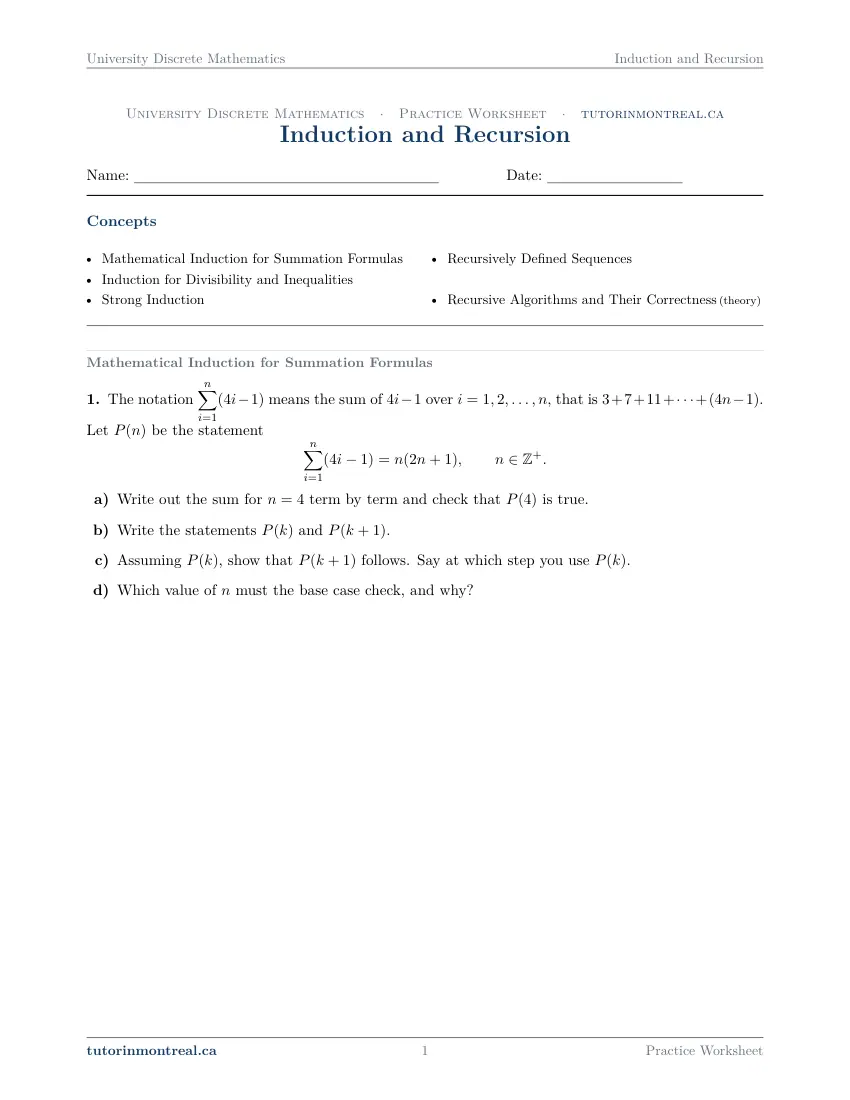
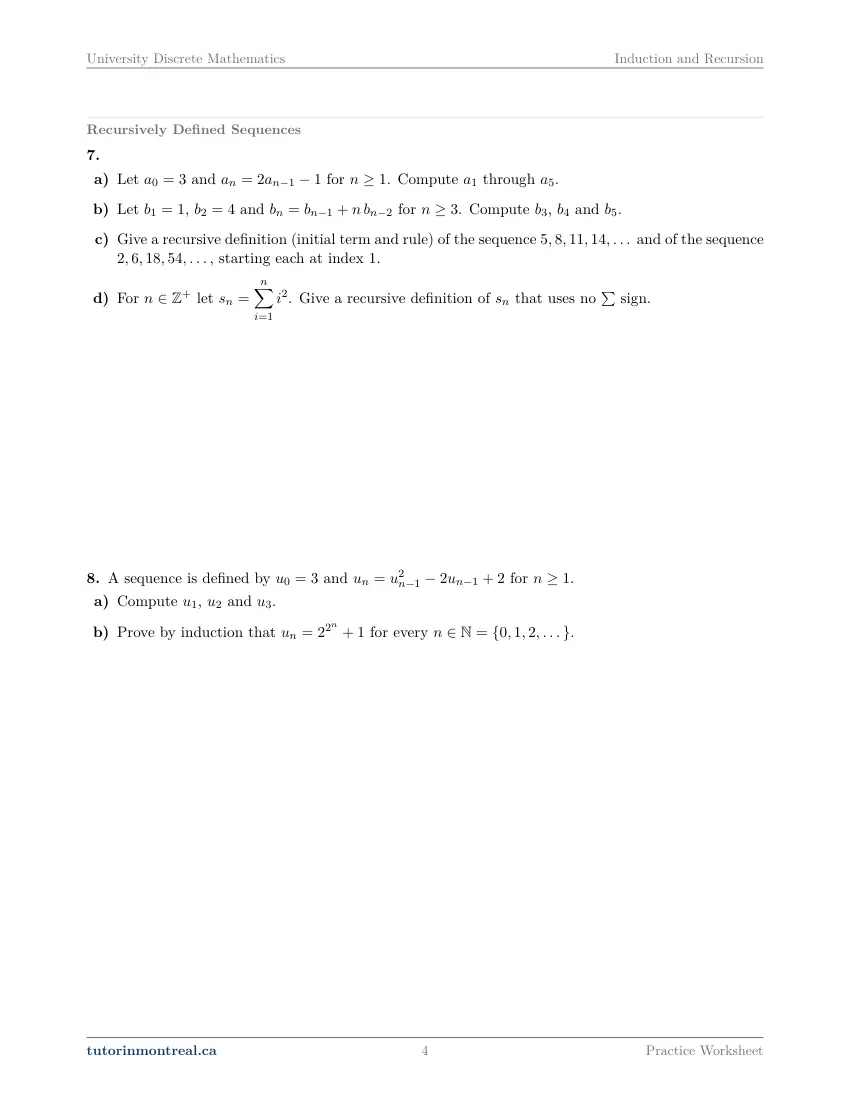
The notation means the sum of over , that is . Let be the statement
- Write out the sum for term by term and check that is true.
- Write the statements and .
- Assuming , show that follows. Say at which step you use .
- Which value of must the base case check, and why?
-
Q2Mathematical Induction for Summation Formulas
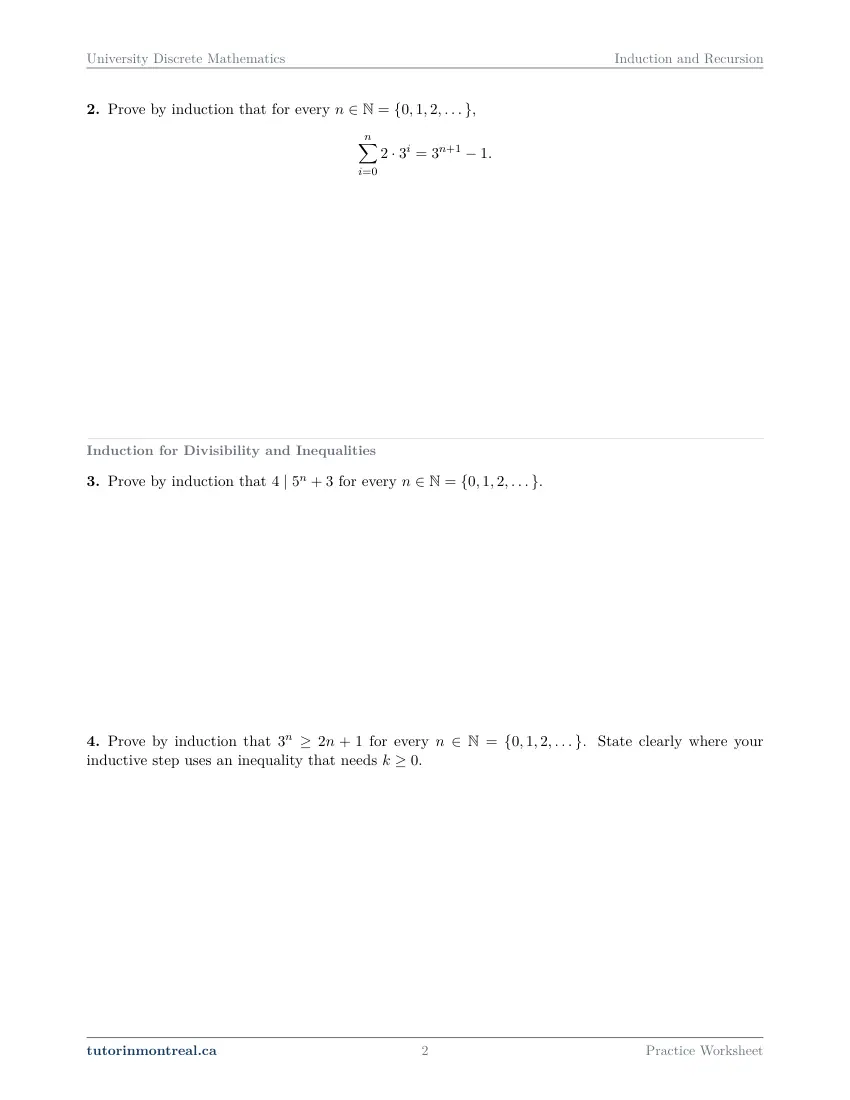
Prove by induction that for every ,
-
Q3Induction for Divisibility and Inequalities
Prove by induction that for every .
-
Q4Induction for Divisibility and Inequalities
Prove by induction that for every . State clearly where your inductive step uses an inequality that needs .
-
Q5Strong Induction
A café sells muffins only in boxes of and boxes of . An order of muffins can be filled exactly when for some .
- Show that orders of , and muffins can be filled, and that an order of cannot.
- Use strong induction to prove that every order of muffins can be filled.
- Why does your proof need three base cases rather than one?
-
Q6Strong Induction
A sequence is defined by , , and for .
- Compute through .
- Use strong induction to prove that for every .
-
Q7Recursively Defined Sequences
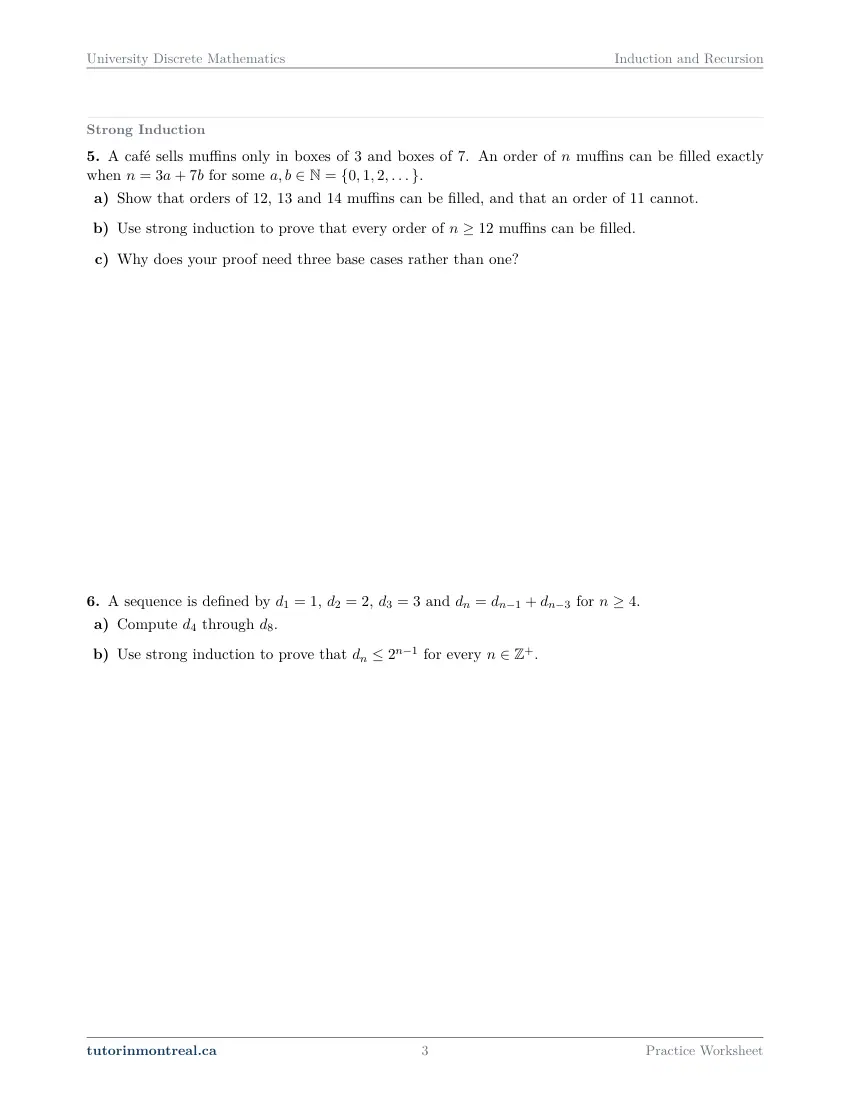
- Let and for . Compute through .
- Let , and for . Compute , and .
- Give a recursive definition (initial term and rule) of the sequence and of the sequence , starting each at index .
- For let . Give a recursive definition of that uses no sign.
-
Q8Recursively Defined Sequences
A sequence is defined by and for .
- Compute , and .
- Prove by induction that for every .
-
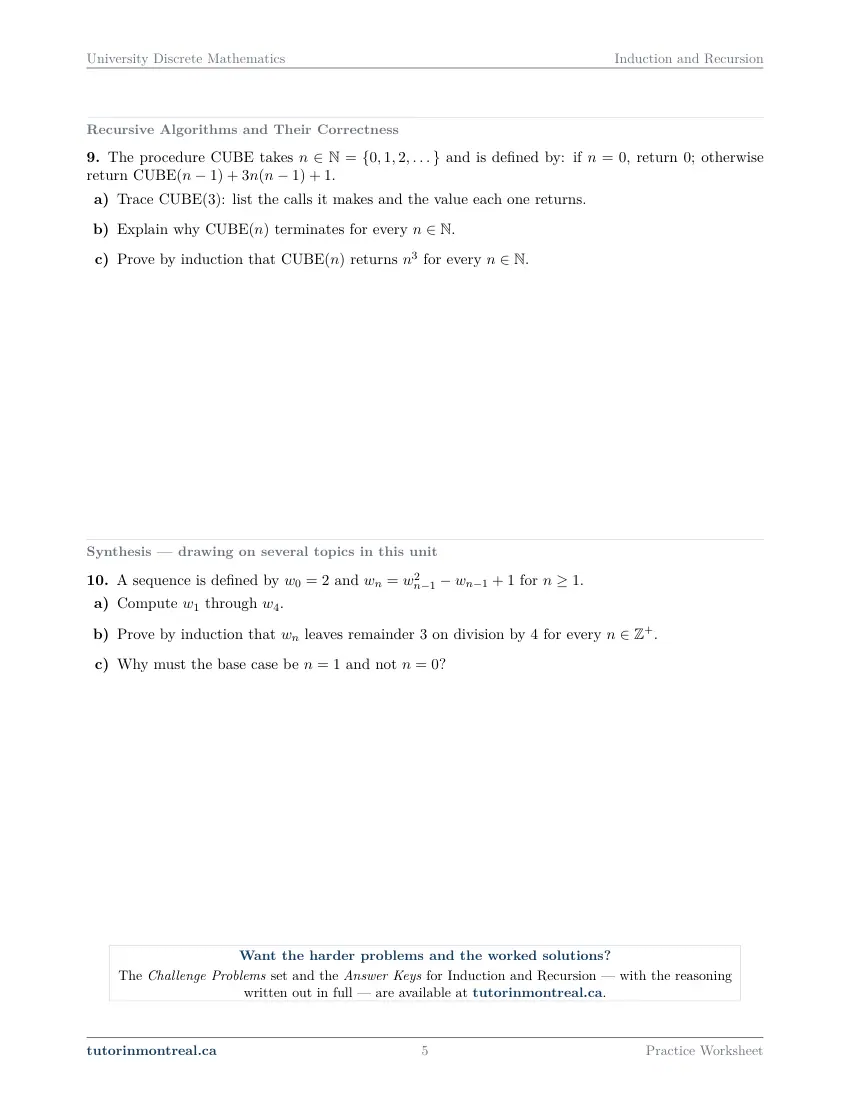
Q9Recursive Algorithms and Their Correctness
The procedure takes and is defined by: if , return ; otherwise return .
- Trace : list the calls it makes and the value each one returns.
- Explain why terminates for every .
- Prove by induction that returns for every .
-
Q10Synthesis — drawing on several topics in this unit
A sequence is defined by and for .
- Compute through .
- Prove by induction that leaves remainder on division by for every .
- Why must the base case be and not ?
The 7 challenge problems for this topic are a separate, paid sheet and are not reproduced here.
What does this set assume? This set assumes Secondary 5 mathematics and nothing past it — no calculus and no linear algebra, whatever a calendar lists as a prerequisite. What it does lean on is ordinary algebraic manipulation, the laws of exponents, and two earlier sets: Methods of Proof, for what a proof is and how one is written out, and Divisibility and Primes, for the divisibility statements the second sheet proves. Sigma notation is explained where these sheets first use it, so it needs no earlier course. This course owns sequences defined by recursion, and it never asks whether one converges — convergence belongs to a calculus course. Out of scope here and in the course: big-O notation and algorithm complexity, divide-and-conquer recurrences, and generating functions.
Which course is this for? In the public course calendars of Montreal universities, this material is part of the courses numbered COMP 232, INF1132 and MAT210. Each course orders and weights the topics its own way, so check your own outline for what your exam covers. Which sets match your course.
How to do every concept on this sheet
This is the part worksheet sites usually leave out. Below is the actual reasoning behind each group of questions — not a full solution set, the decisions that get you to one. Read it before you start, or after you get stuck.
Sigma notation, and what a summation formula claims
Σ is an instruction to add. The letter under it is the index, the numbers below and above are where the index starts and stops, and the expression after it is the term. Q1 spells the notation out and then asks you to use it: write the sum for one small value of n term by term, add the terms, and compare with what the formula predicts for that n. That comparison is exactly what "check the statement" means, and it is also the base case of the proof.
P(n) is a statement, not a number. P(4) is the claim that one particular sum equals one particular value — something that is true or false, not something you evaluate. Writing P(k) and P(k + 1) in Q1(b) is a substitution exercise: replace every n in the statement by k, then by k + 1, and leave both sides unsimplified so you can see what you are given and what you are aiming at.
The template every induction proof follows
The principle is the same in all ten questions on this set. If the statement holds at the starting value, and if its holding at one stage forces it to hold at the next, then it holds at every stage from the start onwards.
Writing the proof
Four moves, in this order, every time.
- 1Name the statement
Say what P(n) is, in full, and say which integers n it is claimed for. Q1(d) asks you to read the base case off that range, and Q10(c) asks the same about a different range.
- 2Base case
Verify P at the first value in the range by direct computation. Show the arithmetic; a claim that it is obvious is not a base case.
- 3Inductive hypothesis
Assume P(k) for an arbitrary k in the range. Write it out as an equation or inequality you can use as a line of algebra later.
- 4Inductive step
Start from one side of P(k + 1), reach a point where the hypothesis applies, use it, and finish at the other side. Q1(c) asks you to say at which step you used it.
Point at the hypothesis. A proof that never says "by the inductive hypothesis" has either not used it or has hidden the one line that matters. The habit Q1(c) builds — a marginal note at the substitution — is what a marker looks for in every later question.
Q2 runs the same template with no scaffolding and with a different starting value: the range is stated with the statement, and the first value in that range is the one the base case has to check. The terms are powers, so the laws of exponents do the work of the step; factor rather than expand, and keep the target for k + 1 written at the bottom of the page so you can see when you have arrived at it.
Induction for divisibility
Q3 proves a divisibility statement, so the first job is to say what divisibility means in a form algebra can use. a | b says that b is a times an integer — so the hypothesis gives you an integer, and the step must end by exhibiting another one.
4 | m means m = 4t for some integer tThe step in a divisibility proof
Three moves that replace guesswork.
- 1Turn the hypothesis into an equation
Name the integer the hypothesis promises. That letter is what you will build the next one from.
- 2Rewrite the n + 1 expression in terms of the n one
A power at stage n + 1 is the power at stage n times the base. Split it so that one piece is the expression you already know about.
- 3Factor the divisor out
Both pieces must carry it. End by naming the new integer explicitly — "which is 4 times an integer" is the sentence that closes the proof.
Integers, not fractions. Dividing through and saying the result "looks whole" proves nothing. Every divisibility proof in this set ends with a product, and the factor beside the divisor has to be visibly an integer — a sum and product of integers.
Induction for an inequality
Q4 replaces the equals sign with ≥, and that changes the shape of the step. An equality proof is a chain of equalities; an inequality proof is a chain in which each link may weaken the statement, provided it weakens it in the right direction.
Every inequality you use needs a reason valid for your k. Q4 asks you to state where your step uses one that needs k ≥ 0. Write the range beside the line where you use it, and check the claim at the smallest k in range before you rely on it — that is the difference between a proof and a plausible-looking chain.
Work from the left side of P(k + 1) towards the right, applying the hypothesis to replace a piece by something you know is no larger, and keeping the direction of every sign the same. If you need to run the chain the other way, say so in words rather than reversing signs silently.
Strong induction, and how many base cases to check
Ordinary induction assumes the statement at k and proves it at k + 1. Strong induction assumes it at every value from the start up to k, and that is what a question needs when the step reaches back further than one stage — or back by an amount you cannot pin down in advance.
assume P(m) for every m with start ≤ m ≤ k, then prove P(k + 1)Q5 is the standard setting: quantities built from two fixed sizes, where filling an order of n is reduced to filling a smaller order and adding one more box. Part (a) is a hands-on check of a few small orders, including one that cannot be filled — a counterexample is exhibited, not argued. Part (b) turns the reduction into a proof, and part (c) asks why more than one base case is needed.
Count how far back your step reaches. If the step proves the case at n from the case at n − 3, then n − 3 must already be known for every n the step is applied to. Line up the smallest n your step handles, subtract the reach, and every value below that has to be checked by hand. That count is the number of base cases, and it is a decision you make from your own step, not a number to memorise.
Q6 makes the same point with a sequence whose rule looks back three terms. Part (a) is arithmetic: run the rule forwards and tabulate. Part (b) proves a bound on every term, and the step needs the bound at more than one earlier index, so ordinary induction has nothing to offer. Write which earlier cases the step uses before you write the step itself.
A missing base case is the classic invalid proof. The step can be perfect and the conclusion still false if the chain never starts, or starts too late to feed the first application of the step. Check the base cases last, against the step you actually wrote.
Sequences defined by recursion
A recursive definition has two halves: one or more initial terms, and a rule that gives aₙ in terms of earlier terms, valid from a stated index onwards. Neither half is optional — without the initial terms the rule computes nothing.
a₀ given, aₙ = (a rule in aₙ₋₁, aₙ₋₂, …) for n ≥ 1Q7 works in both directions. Parts (a) and (b) read a definition forwards: substitute, compute, and keep a column of values — in (b) the rule uses the two previous terms and the index n itself, so the multiplier changes at every stage, which is the whole reason to write the substitution out rather than doing it in your head. Part (c) runs backwards, from a listed pattern to a definition: decide first whether consecutive terms differ by a fixed amount or by a fixed factor, then write the initial term and the rule, with the index the question asks you to start at. Part (d) is the same move applied to a sum: a partial sum of n terms is the partial sum of n − 1 terms plus the nth term, and that one sentence is the whole recursion.
State the range with the rule. "For n ≥ 1" and "for n ≥ 3" are part of the definition, and which one is right depends on how many initial terms you gave. A rule that refers to a term before the first one you defined is not a definition.
Q8 joins the two ideas of the set: a sequence given recursively, and a closed formula for its nth term to be proved by induction. Part (a) is computation. In part (b) the hypothesis is the formula at k, the recursion is what lets you write the term at k + 1 in terms of it, and the exponent laws — a power of a power, an exponent that is itself a power of two — are what turn the result into the formula at k + 1. Write the target for k + 1 down first; the algebra is then aimed at something instead of wandering.
Recursive algorithms and their correctness
A recursive procedure is a recursive definition written as instructions: a base case that returns a value outright, and a case that calls the procedure on a smaller input and combines the result. Q9 asks the three questions every recursive procedure has to answer.
The three questions
Trace, terminate, then prove.
- 1Trace it
List the calls going down until the base case, then the value each one returns coming back up. The values are produced in the reverse of the order the calls are made, and writing them in two columns keeps that straight.
- 2Termination
Point at a quantity that strictly decreases at every call and cannot skip past the base case. Here that quantity is the input itself, and the argument is one sentence — but it is a sentence, not a shrug.
- 3Correctness
Induction on the input. The base case of the proof is the base case of the procedure; the step assumes the call on the smaller input returns what it should, and computes what the combining step then returns.
Correctness is induction with the hypothesis renamed. "Assume the recursive call is correct" is the inductive hypothesis, word for word. Naming it that way in your write-up is what makes the proof a proof rather than a description of the code.
Nothing in this set asks how long a procedure takes — counting operations and comparing growth rates belong to a later course. What is asked is that it stops, and that what it returns is what was claimed.
The synthesis question
Q10 puts the whole set into one chain. Part (a) is Q7's forward computation on a new rule. Part (b) proves a statement about every term — but the statement is about a remainder on division, so the hypothesis has to be turned into an equation the way Q3 turned divisibility into one, and then substituted into the recursion. Part (c) returns to the first decision of all: which value the base case must check, and why the range the claim is made for settles it.
Read the range before you prove anything. Two of the questions on this set turn on the difference between a claim made for every integer from zero upwards and one made for the positive integers only. The range is written into the statement; it is not a detail to be filled in once the algebra works.
Preview all 5 pages
Click any page to open the full PDF.
Getting the most out of it
Write P(k) and P(k + 1) before you start
Both, in full, at the top of the page: one is everything you are allowed to assume, the other is exactly what you have to reach. Most failed inductive steps are algebra aimed at nothing in particular, and this one habit fixes them.
Label the line where the hypothesis is used
Every proof on this set has one line that is the whole argument. Mark it. If you cannot find it, you have either written a direct proof by accident or left a gap where the hypothesis should have been.
Compute the first few terms, always
Before proving anything about a recursively defined sequence, run the rule forwards for four or five stages. It confirms you have read the rule correctly, it shows how far back the rule reaches, and it tells you how many base cases your proof is going to need.
Finish with a sentence, not an expression
"This is 4 times an integer, so the statement holds at k + 1." "Hence by induction the statement holds for every n in the stated range." Written work in this course is marked on the quality of the writing as well as the algebra, and the closing sentence is where a correct calculation turns into a proof.
Want the solutions, or something more challenging?
The worksheet, the questions above and every explanation on this page stay free permanently. Three more PDFs exist for this topic — the worked answer key, a harder problem set, and the answer key to that. They come with the University Discrete Math Solutions Bundle, beside the unit notes and the unit test, which is what keeps the rest of the series free.
What else exists for Induction and Recursion
Three PDFs · 11 pages · all three are in the bundle below.
- Answer key — 3 pages. All 10 questions worked step by step, including the restrictions and the justifications. Not a list of final answers.
- Challenge problems — 5 pages, 7 problems. A separate sheet at exam-plus difficulty covering the same 5 concepts. Harder than anything on the free sheet.
- Challenge answer key — 3 pages. Every challenge problem worked to the same standard, with the checks shown.
- PDF, letter size, print-ready.
The one thing that's for sale
Every University Discrete Math topic — the complete Solutions Bundle
One download, one payment, the whole program. For all 9 University Discrete Math units: the worksheet, the reference notes, the challenge set, the unit test and every answer key — including this one.
- Worked solutions, not answer lists — every step written out
- Covers the whole year's program at this level
- Less than the price of one hour of tutoring — for the entire year's solutions
Taking Secondary 1 Math as well? The Secondary 1 Math bundle covers all 15 of its units — 106 PDFs, 474 pages — on the same terms.
Taking Secondary 2 Math as well? The Secondary 2 Math bundle covers all 14 of its units — 98 PDFs, 449 pages — on the same terms.
Taking Secondary 3 Math as well? The Secondary 3 Math bundle covers all 11 of its units — 77 PDFs, 367 pages — on the same terms.
Taking Secondary 4 Math as well? The Secondary 4 Math bundle covers all 17 of its units — 122 PDFs, 466 pages — on the same terms.
Taking Secondary 5 Math as well? The Secondary 5 Math bundle covers all 21 of its units — 147 PDFs, 589 pages — on the same terms.
Taking CEGEP Calculus I as well? The CEGEP Calculus I bundle covers all 9 of its units — 72 PDFs, 371 pages — on the same terms.
Taking CEGEP Calculus II as well? The CEGEP Calculus II bundle covers all 8 of its units — 64 PDFs, 335 pages — on the same terms.
Taking CEGEP Linear Algebra as well? The CEGEP Linear Algebra bundle covers all 7 of its units — 56 PDFs, 298 pages — on the same terms.
Taking University Calculus III as well? The University Calculus III bundle covers all 9 of its units — 72 PDFs, 516 pages — on the same terms.
Taking University Linear Algebra as well? The University Linear Algebra bundle covers all 9 of its units — 72 PDFs, 496 pages — on the same terms.
Taking University Differential Equations as well? The University Differential Equations bundle covers all 9 of its units — 36 PDFs, 182 pages — on the same terms.
Taking University Business Math as well? The University Business Math bundle covers all 9 of its units — 36 PDFs, 190 pages — on the same terms.
Taking University Introductory Statistics as well? The University Introductory Statistics bundle covers all 9 of its units — 36 PDFs, 186 pages — on the same terms.
Taking AP Calculus AB as well? The AP Calculus AB bundle covers all 8 of its units — 64 PDFs, 527 pages — on the same terms.
Common questions
Is this worksheet really free?
Yes — the questions are on this page to read, and the PDF downloads directly, no email and no account. The one paid item is optional: the complete University Discrete Mathematics Solutions Bundle, which covers every set at this level.
Which university courses is this for?
The course codes listed on this page are taken from the public course calendars of universities that teach discrete mathematics to mathematics, computer science and engineering students. Each course orders and weights the chapters its own way, and some reach a chapter late in the term or not at all — so check the outline for your own section to see where this set falls in your term.
What do I need to know before starting this set?
Secondary 5 algebra and the laws of exponents, what a proof is and how one is written out from the Methods of Proof set, and the meaning of a | b from Divisibility and Primes. No calculus is used anywhere in this set, and sigma notation is explained where it is first needed.
When do I need strong induction instead of ordinary induction?
When the step that proves the case at n uses more than the single case at n − 1 — because the rule reaches back several terms, or because the reduction produces a smaller case you cannot name in advance. Strong induction assumes every case from the start up to k, and it needs as many base cases as the reach of your step demands.
How many base cases does a proof need?
As many as the inductive step leaves unproved. Work out the smallest value your step can be applied to and how far back it reaches; every value below that has to be checked directly. It is read off your own step, not off a rule of thumb.
Does induction prove a formula, or only check it?
It proves it, for every value in the stated range — but only the formula you were given. Induction is a verification technique, not a way of discovering a closed form; finding one is a separate job, and solving a recurrence for one comes in a later set.
Do I have to prove that a recursive sequence converges?
No. This course treats a sequence as something defined by an initial term and a rule, and asks what its terms are and what can be proved about them. Limits and convergence belong to a calculus course and are never asked for here.
Is algorithm complexity part of this set?
No. Big-O notation and counting the work an algorithm does are outside this course. What is here is the argument that a recursive procedure stops, and the induction proof that it returns the value it claims.
Can teachers use this in class?
Yes. Print and photocopy it for your own classes freely — I just ask that the tutorinmontreal.ca footer stays on the page.
I'm stuck on one question. Can you help?
Yes — through one-on-one tutoring, in Montreal or online. Get in touch to arrange a session, or see the current rates.
← All 9 University Discrete Math worksheets · Secondary 1 Math series (15 sheets) → · Secondary 2 Math series (14 sheets) → · Secondary 3 Math series (11 sheets) → · Secondary 4 Math series (17 sheets) → · Secondary 5 Math series (21 sheets) → · CEGEP Calculus I series (9 sheets) → · CEGEP Calculus II series (8 sheets) → · CEGEP Linear Algebra series (7 sheets) → · University Calculus III series (9 sheets) → · University Linear Algebra series (9 sheets) → · University Differential Equations series (9 sheets) → · University Business Math series (9 sheets) → · University Introductory Statistics series (9 sheets) → · AP Calculus AB series (8 sheets) →