University Discrete Mathematics — Propositional and Predicate Logic Worksheet
The language the whole course is written in, drilled before anything is proved with it. What counts as a proposition and what does not; the connectives, and the English phrases that hide them — "only if", "unless", "either … or … but not both"; truth tables built row by row and read as a verdict; converse, inverse and contrapositive, and which of them travels with the original; De Morgan's laws used to push a negation inwards; predicates, domains and the two quantifiers; the negation of a quantified sentence, in symbols and in natural English; nested quantifiers, where the order of ∀ and ∃ changes the claim; and arguments tested against the named rules of inference. Have a look on this page, then print the free PDF when you want to write on it.
Practice worksheet — free PDF
No email, no account, no watermark. Teachers: photocopy it for your classes freely. Worked solutions and 11 harder problems come with the University Discrete Math bundle.
All 15 questions
Each question targets one named concept from the sheet. Read them here, or print the PDF — it has working space under each one.
-
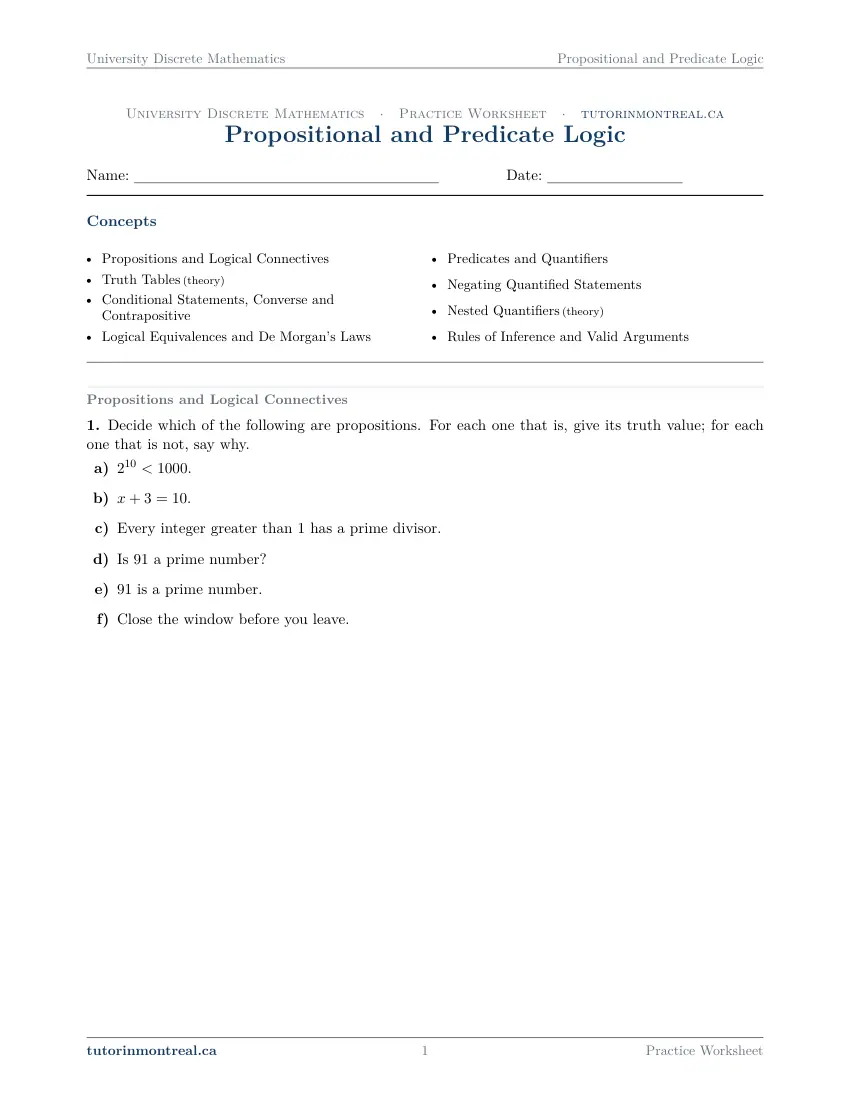
Q1Propositions and Logical Connectives
Decide which of the following are propositions. For each one that is, give its truth value; for each one that is not, say why.
- .
- .
- Every integer greater than has a prime divisor.
- Is a prime number?
- is a prime number.
- Close the window before you leave.
-
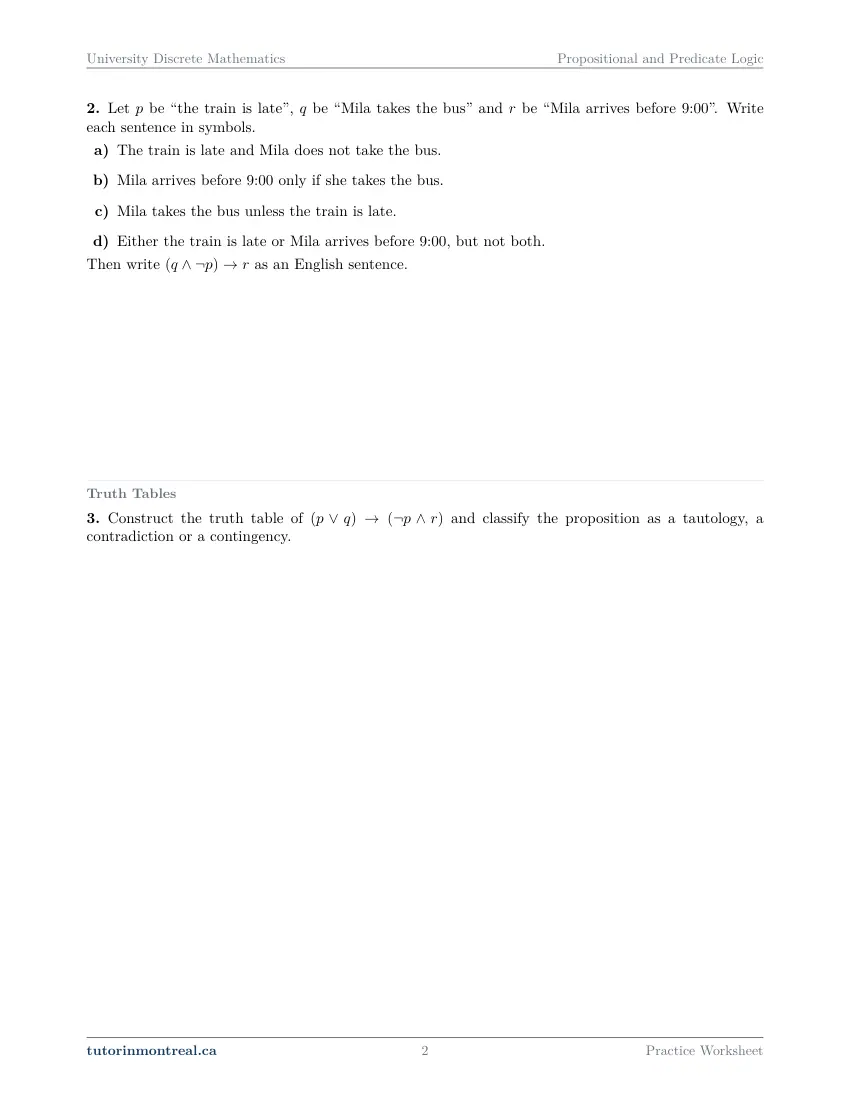
Q2Propositions and Logical Connectives
Let be “the train is late”, be “Mila takes the bus” and be “Mila arrives before 9:00”. Write each sentence in symbols.
- The train is late and Mila does not take the bus.
- Mila arrives before 9:00 only if she takes the bus.
- Mila takes the bus unless the train is late.
- Either the train is late or Mila arrives before 9:00, but not both.
Then write as an English sentence.
-
Q3Truth Tables
Construct the truth table of and classify the proposition as a tautology, a contradiction or a contingency.
-
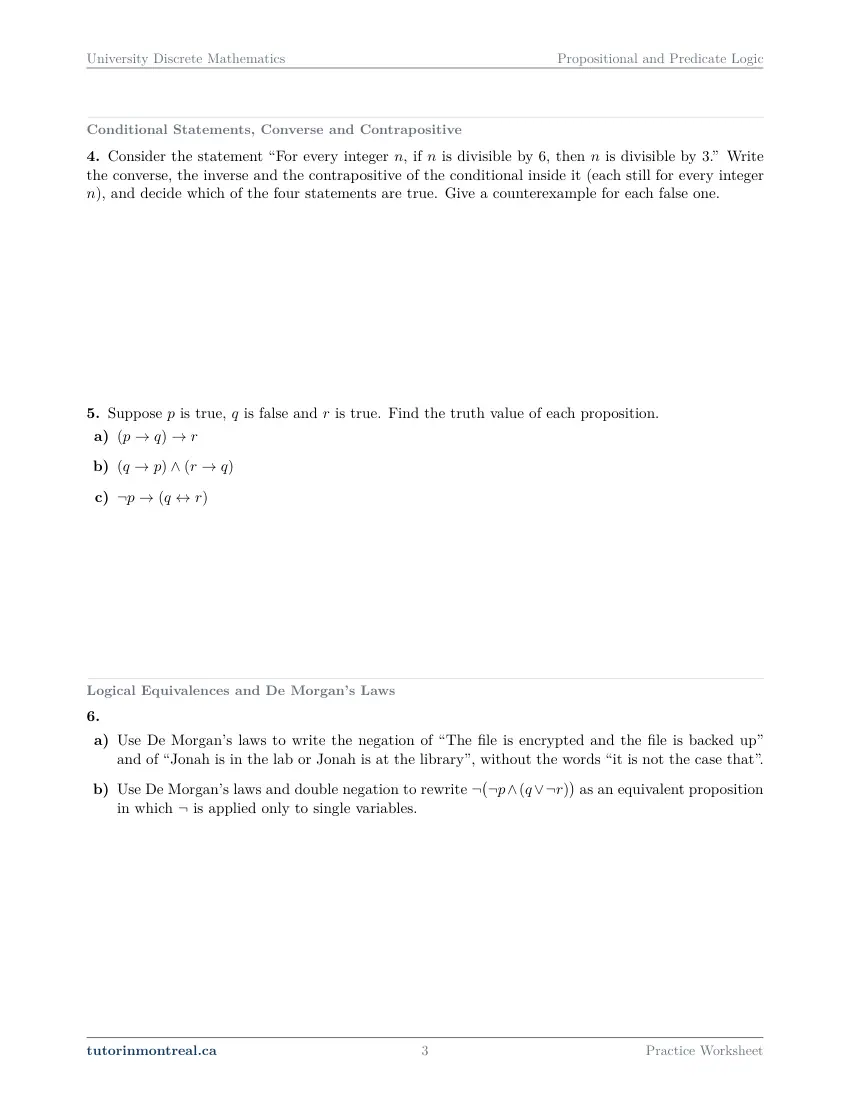
Q4Conditional Statements, Converse and Contrapositive
Consider the statement “For every integer , if is divisible by , then is divisible by .” Write the converse, the inverse and the contrapositive of the conditional inside it (each still for every integer ), and decide which of the four statements are true. Give a counterexample for each false one.
-
Q5Conditional Statements, Converse and Contrapositive
Suppose is true, is false and is true. Find the truth value of each proposition.
-
Q6Logical Equivalences and De Morgan's Laws
- Use De Morgan's laws to write the negation of “The file is encrypted and the file is backed up” and of “Jonah is in the lab or Jonah is at the library”, without the words “it is not the case that”.
- Use De Morgan's laws and double negation to rewrite as an equivalent proposition in which is applied only to single variables.
-
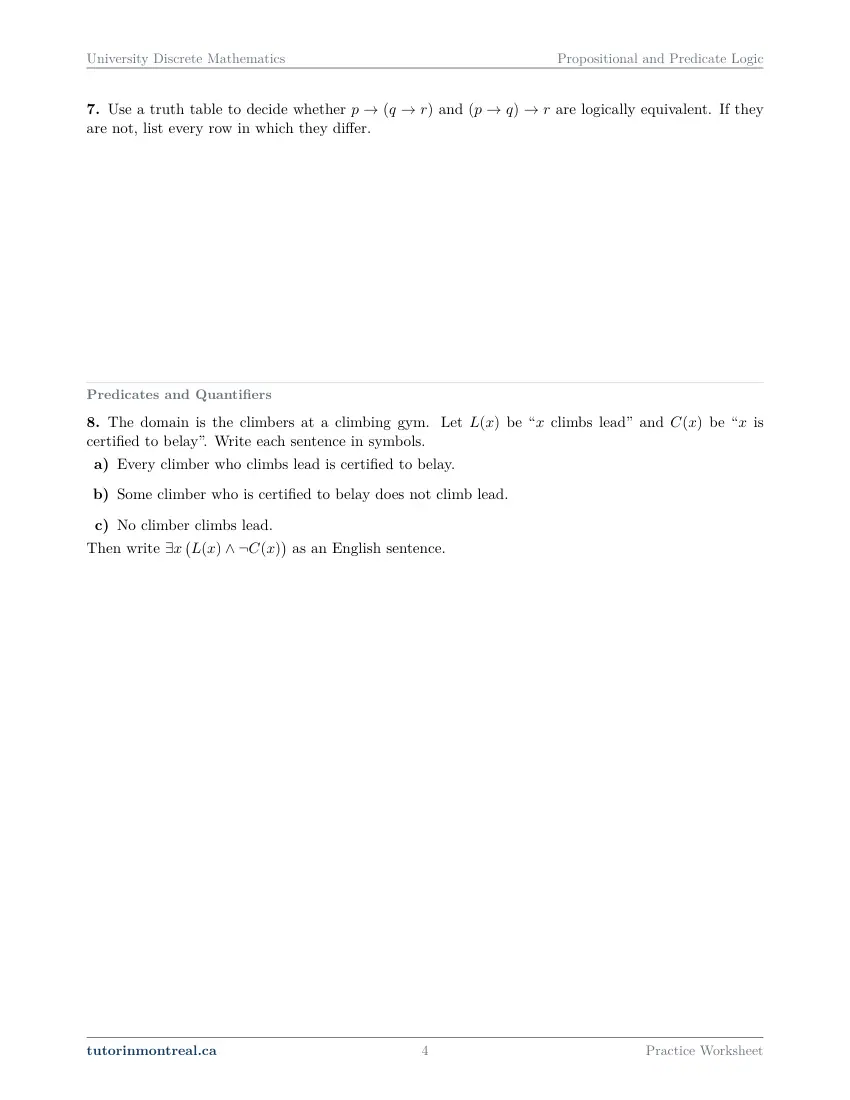
Q7Logical Equivalences and De Morgan's Laws
Use a truth table to decide whether and are logically equivalent. If they are not, list every row in which they differ.
-
Q8Predicates and Quantifiers
The domain is the climbers at a climbing gym. Let be “ climbs lead” and be “ is certified to belay”. Write each sentence in symbols.
- Every climber who climbs lead is certified to belay.
- Some climber who is certified to belay does not climb lead.
- No climber climbs lead.
Then write as an English sentence.
-
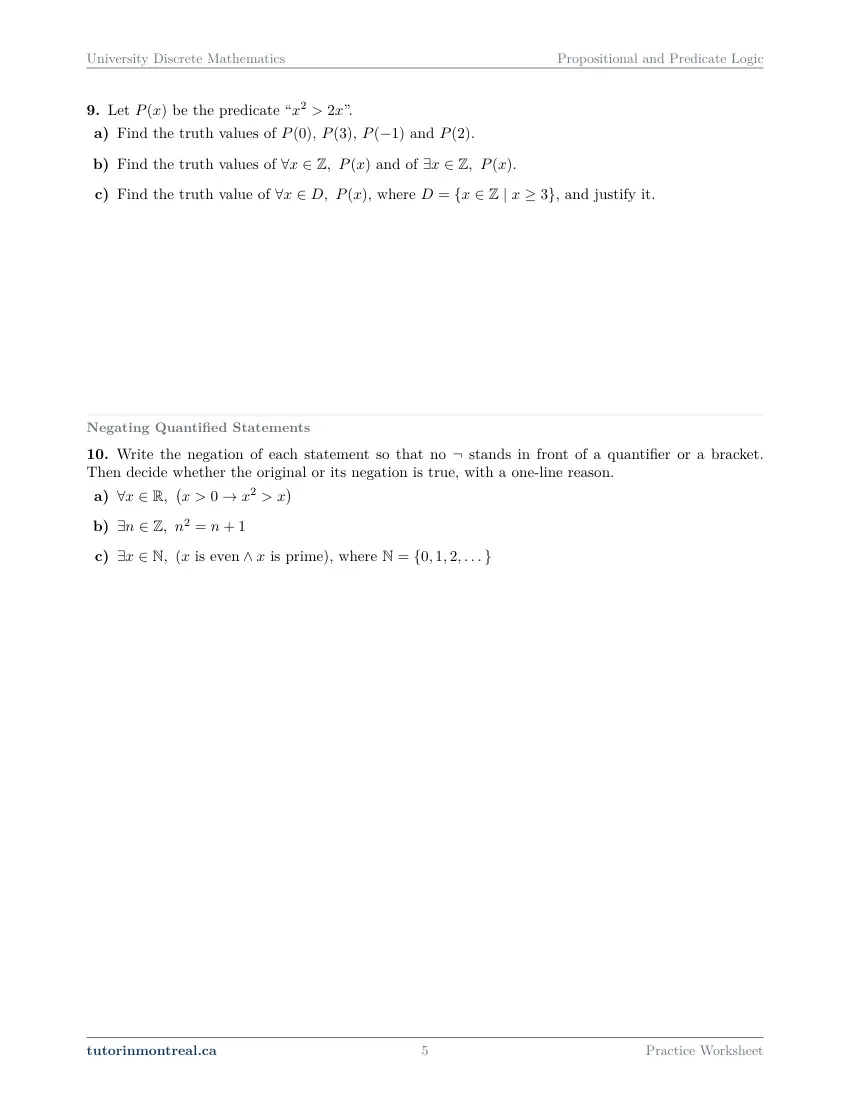
Q9Predicates and Quantifiers
Let be the predicate “”.
- Find the truth values of , , and .
- Find the truth values of and of .
- Find the truth value of , where , and justify it.
-
Q10Negating Quantified Statements
Write the negation of each statement so that no stands in front of a quantifier or a bracket. Then decide whether the original or its negation is true, with a one-line reason.
- , where
-
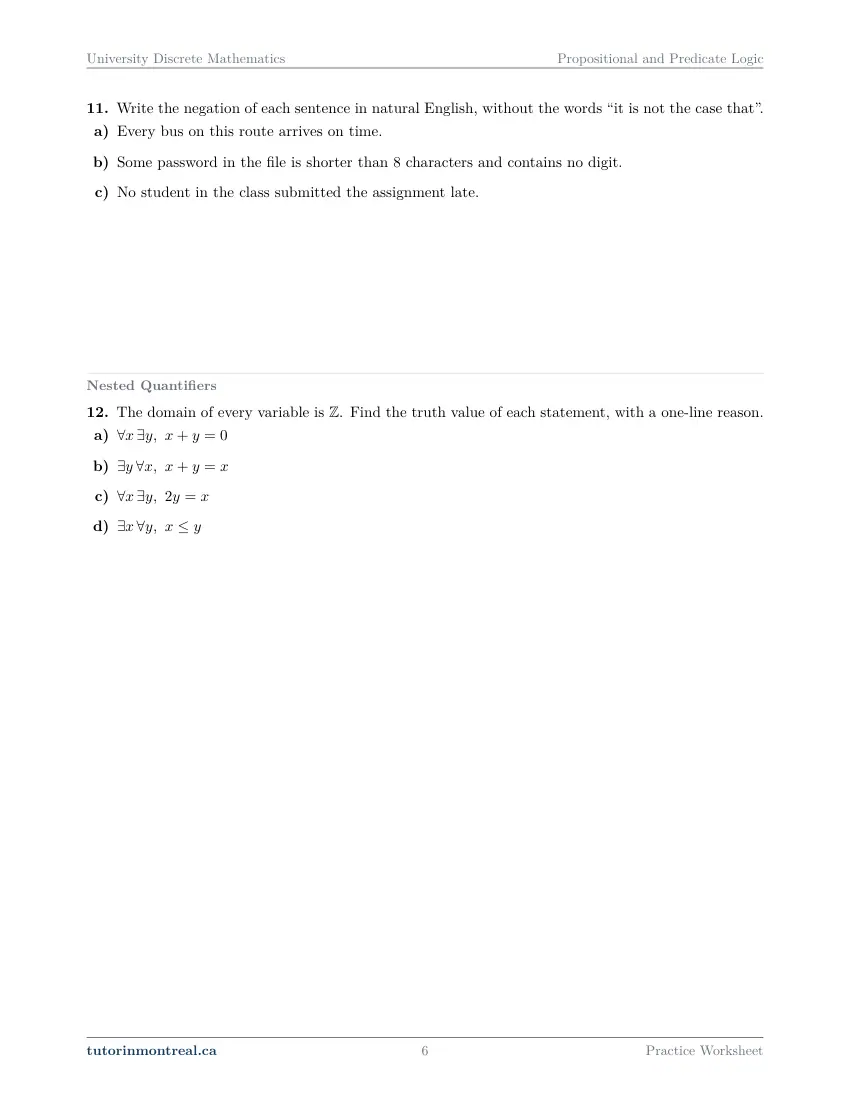
Q11Negating Quantified Statements
Write the negation of each sentence in natural English, without the words “it is not the case that”.
- Every bus on this route arrives on time.
- Some password in the file is shorter than 8 characters and contains no digit.
- No student in the class submitted the assignment late.
-
Q12Nested Quantifiers
The domain of every variable is . Find the truth value of each statement, with a one-line reason.
-
Q13Rules of Inference and Valid Arguments
For each argument, write its form in symbols and name the rule of inference it uses, or say that it is not valid.
- If the reactor temperature exceeds 300 degrees, the alarm sounds. The alarm did not sound. Therefore the temperature did not exceed 300 degrees.
- Kofi is in Toronto or Kofi is in Ottawa. Kofi is not in Toronto. Therefore Kofi is in Ottawa.
- If an integer is divisible by 9, it is divisible by 3. The integer 51 is divisible by 3. Therefore 51 is divisible by 9.
- If the meeting runs late, Inès misses the ferry. If Inès misses the ferry, she takes a taxi. Therefore, if the meeting runs late, Inès takes a taxi.
-
Q14Rules of Inference and Valid Arguments
Decide whether the argument with premises , , and conclusion is valid. If it is not, give an assignment of truth values that shows it.
-
Q15Synthesis — drawing on several topics in this unit
The domain is , the positive integers. Let be “ is prime” and let be the statement
- Write the negation of with no in front of a quantifier or a bracket.
- Decide which of and its negation is true, and give a witness or a counterexample.
- Write the contrapositive of the conditional inside as an English sentence.
The 11 challenge problems for this topic are a separate, paid sheet and are not reproduced here.
What does this set assume? This is the first set of the course and it leans on nothing earlier in it. It assumes Secondary 5 mathematics only — no calculus and no linear algebra, whatever a calendar lists as a prerequisite — and in practice it needs very little of that: ordinary algebraic manipulation, the meaning of an inequality, and the vocabulary of integers, even and odd, prime and divisible, all of which the questions use as raw material for logic rather than as the subject. Everything logical is built here from nothing. What this set does not do is prove anything: writing a direct proof, a proof by contraposition and a proof by contradiction is the next set, Methods of Proof, and this one only supplies the forms those proofs are built out of, so an argument here is tested for validity rather than developed into an argument of your own. Set notation is used only in the loose sense of a domain a variable ranges over; Sets, Functions and Relations comes later, and induction later still. Deliberately not in this set or anywhere in this course: Boolean algebra, logic circuits, and normal forms such as conjunctive and disjunctive normal form, together with automata and formal languages. Truth tables here are a tool for deciding equivalence and validity, never a step towards simplifying a circuit.
Which course is this for? In the public course calendars of Montreal universities, this material is part of the courses numbered COMP 232, MAT1500, INF1132 and MAT210. Each course orders and weights the topics its own way, so check your own outline for what your exam covers. Which sets match your course.
How to do every concept on this sheet
This is the part worksheet sites usually leave out. Below is the actual reasoning behind each group of questions — not a full solution set, the decisions that get you to one. Read it before you start, or after you get stuck.
What is a proposition, and what the connectives mean
A proposition asserts something, and it carries exactly one truth value, true or false, even if nobody present knows which. Q1 asks you to sort six sentences by that test and, for the ones that pass, to give the truth value; for the ones that fail, a reason is part of the answer, not an afterthought.
Three ways a sentence fails the test. It is not declarative — a question asks rather than asserts, and a command instructs rather than asserts. Or it is declarative but contains a free variable, so its truth depends on a value nobody has supplied; such a sentence is a predicate, and it becomes a proposition only once the variable is given a value or bound by a quantifier. Q1 has instances of more than one of these, and Q9 picks the free-variable case up again in earnest.
"Nobody knows the answer" is never a reason for failing the test, and "I would have to compute it" is not either. A statement about a specific number is a proposition whether or not the arithmetic has been done; the work of settling it is the answer, not the classification.
Translating English into symbols
Q2 fixes three simple propositions p, q and r and asks for four English sentences in symbols, then for one symbolic formula back in English. Translation is the skill this whole chapter is graded on, and it turns on a handful of phrases that do not mean what their word order suggests.
The phrases that hide a connective
Decide the connective before writing anything down.
- 1"A only if B" is A → B
Not B → A. "Only if" names a necessary condition for A, and a necessary condition is the consequent. The common error is to hear "only" as emphasis and write the arrow backwards.
- 2"A unless B" is ¬B → A
Unless introduces the exception: with B absent, A holds. It is equivalent to A ∨ B, and either form is a correct answer as long as you can say why.
- 3"Either A or B, but not both" is exclusive
Plain "or" in logic is inclusive. The exclusive sense has to be written out — as (A ∨ B) ∧ ¬(A ∧ B), or with the ⊕ symbol if your course has introduced it.
- 4A negation inside a clause stays inside
"A and not B" is A ∧ ¬B, not ¬(A ∧ B). Where the ¬ sits is the difference between two different claims.
The last part of Q2 runs the translation the other way, turning (q ∧ ¬p) → r into a sentence. Going back to English means writing something a person would say, so replace the letters by their sentences, render ∧ with "and", ¬ by negating the clause naturally, and make the arrow an "if … then" — then read it aloud and check that it still says what the formula says.
Truth tables, built and then read
Q3 asks for the full truth table of (p ∨ q) → (¬p ∧ r) and for a classification of the result as a tautology, a contradiction or a contingency. Three variables mean 2³ = 8 rows, and the table is only as reliable as its bookkeeping.
Building a table you can trust
Columns in order of construction, never in one leap.
- 1List the rows systematically
Eight rows for three letters. Use the standard pattern — p alternating in blocks of four, q in blocks of two, r every other row — so that no combination goes missing.
- 2One column per subformula
Columns for ¬p, then p ∨ q, then ¬p ∧ r, and only then the whole implication. A single column for the whole formula is where errors hide.
- 3Apply one connective per column
Conjunction is true only when both sides are; disjunction is false only when both are false; the implication is false only in the row where its antecedent is true and its consequent is false.
- 4Read the last column, then name it
All true is a tautology, all false is a contradiction, a mixture is a contingency. The classification is a sentence about that column, so say which it is and why.
Only one row makes an implication false. A → B is true whenever A is false, however unrelated the two sides are. That is a definition, not an accident, and most surprises in a truth table trace back to forgetting it.
Converse, inverse and contrapositive
Q4 takes one conditional about integers — if n is divisible by 6, then n is divisible by 3 — and asks for its converse, its inverse and its contrapositive, each still quantified over every integer n, and then for a decision about all four statements with a counterexample for each false one.
original p → q converse q → p inverse ¬p → ¬q contrapositive ¬q → ¬pTwo pairs, not four separate statements. A conditional and its contrapositive are logically equivalent, so they stand or fall together; and the inverse is itself the contrapositive of the converse, so that second pair matches too. That is a check on your answer: if your four verdicts do not fall into those two matching pairs, one of the four is wrong.
A counterexample to a statement of the form "for every integer n, if … then …" is a single specific integer that makes the hypothesis true and the conclusion false. An integer that fails the hypothesis proves nothing, because the conditional is automatically true there. Produce the number and show both halves — that it satisfies the "if" and fails the "then".
Q5 is the same connectives under a fixed assignment: p true, q false, r true, and three compound propositions to evaluate. Work strictly from the inside out, writing the value of each bracket above it before combining. A biconditional A ↔ B is true exactly when the two sides have the same truth value, which is quicker to check than to build a table for.
Logical equivalences and De Morgan's laws
De Morgan's laws say how a negation moves across a conjunction or a disjunction, and moving a negation inwards is what turns an unreadable negative sentence into a usable one.
¬(p ∧ q) ≡ ¬p ∨ ¬q and ¬(p ∨ q) ≡ ¬p ∧ ¬q with ¬(¬p) ≡ pThe connective flips. The negation of an "and" is an "or", and the negation of an "or" is an "and". Negating both halves and leaving the connective alone is the single most common error in this section, and it produces a statement that is not equivalent to the original.
Q6(a) does this in English on two sentences, and the instruction is strict: the phrase "it is not the case that" is banned, so the negation has to be a sentence someone would actually say. Negate each clause in plain words first — an encrypted file becomes a file that is not encrypted — then join the two with whichever of "and" or "or" the law hands you. Q6(b) does it in symbols on ¬(¬p ∧ (q ∨ ¬r)), where the requirement is that ¬ ends up in front of single variables only. Apply the law to the outer bracket first, then to whatever bracket the result exposes, and clear every double negation as it appears.
Q7 compares p → (q → r) with (p → q) → r by truth table and, if they are not equivalent, asks for every row in which they differ. Two formulas are logically equivalent exactly when their final columns agree in every row, so the comparison is a row-by-row reading and nothing else. The differing rows are the answer, so record the values of p, q and r for each one rather than just counting them.
The arrow does not associate. Unlike ∧ and ∨, nesting an implication one way rather than the other genuinely changes the claim, which is why p → q → r is never written without brackets. Q7 is the demonstration of that.
Predicates, domains and the two quantifiers
A predicate becomes a proposition when its variable is bound. ∀x P(x) claims P holds for every member of the domain; ∃x P(x) claims at least one member satisfies it. The domain belongs to the statement itself rather than to the scenery: one and the same predicate can be universally true over one domain and false over another.
Q8 sets the domain to the climbers at a gym with two predicates, L(x) and C(x), and asks for three sentences in symbols and one formula back in English. The three sentences are the three standard shapes, and each has a pairing that has to be respected.
Which connective goes with which quantifier
∀ takes an arrow; ∃ takes an "and".
- 1"Every A is B" is ∀x (A(x) → B(x))
The arrow restricts the claim to the A's. Writing ∀x (A(x) ∧ B(x)) says instead that everything in the domain is both, which is a far stronger and usually false claim.
- 2"Some A is B" is ∃x (A(x) ∧ B(x))
Here the conjunction is right. ∃x (A(x) → B(x)) is satisfied by any object that simply is not an A, so it says almost nothing.
- 3"No A is B" is ∀x (A(x) → ¬B(x))
Equivalently ¬∃x (A(x) ∧ B(x)). A sentence beginning "no" is a universal in disguise; both forms are correct and one line of De Morgan converts between them.
The last part of Q8 turns ∃x (L(x) ∧ ¬C(x)) into English. Say "there is a climber who …", and keep the domain implicit in the noun rather than adding a clause for it.
Q9 works with the predicate x² > 2x. Part (a) substitutes four specific values, so each one becomes an arithmetic comparison to be checked and reported as true or false. Part (b) quantifies over the integers, and here the two quantifiers need two different kinds of evidence. Part (c) restricts the domain to the integers that are at least 3 and demands a justification, which means an argument covering every such integer at once — rearrange the inequality into a form where the hypothesis x ≥ 3 visibly forces it, rather than testing a few values and stopping.
What settles a quantified claim. To establish ∃x P(x), exhibit one witness and check it. To refute ∀x P(x), exhibit one counterexample and check it. To establish ∀x P(x) you need a general argument, and to refute ∃x P(x) you need a general argument too — one example never does either of those two jobs.
Negating a quantified statement
Negation is mechanical once you know the two rules, and Q10 asks for negations in which no ¬ is left standing in front of a quantifier or a bracket — so the negation has to be pushed all the way in.
¬∀x P(x) ≡ ∃x ¬P(x) ¬∃x P(x) ≡ ∀x ¬P(x) ¬(p → q) ≡ p ∧ ¬qPush from the outside in, one step at a time: swap each quantifier as the negation passes it, then use De Morgan on any ∧ or ∨ and the implication rule on any arrow, then simplify negated comparisons — the negation of > is ≤, and the negation of = is ≠. Note that the negation of an implication is a conjunction with no arrow left in it at all, which is what makes negated conditionals feel so different from their originals.
Q10 then asks you to decide whether the original or the negation is true, with a one-line reason. Exactly one of the two is true, so the decision is really the choice of which one you can support: a witness for whichever of the pair is existential, or a short general argument for whichever is universal. The domain differs from part to part — the reals, the integers, the natural numbers starting at 0 — and the answer can turn on it, so read it each time.
Q11 is the same operation in natural English, again without "it is not the case that". Identify the quantifier hiding in the sentence — "every", "some", "no" — swap it, and negate the property. "Every bus arrives on time" becomes a claim about at least one bus; "no student did X" becomes a claim about at least one student; and where the property itself is a conjunction, De Morgan turns it into an "or" inside the new sentence.
The negation of "all are" is not "none is". It is "at least one is not". Claiming the opposite extreme is a much stronger statement than the negation, and it is a mistake that survives into proofs by contradiction if it is not fixed here.
Nested quantifiers, where order is the whole question
Q12 works over the integers and asks for the truth value of four statements, each with a one-line reason. Two of them are ∀ followed by ∃ and two are ∃ followed by ∀, and the difference between those two patterns is the point of the sheet.
∀x ∃y lets y depend on x; ∃y ∀x does not. To support ∀x ∃y P(x, y), give a recipe that produces a suitable y from any given x, and check that it works. To support ∃y ∀x P(x, y), you must name one fixed y in advance that works for every x at once. To refute the first, give an x for which no y can exist; to refute the second, show that any candidate y is defeated by some x — and that x is usually built out of y.
A one-line reason should be the recipe or the counterexample, not a verdict. "For any x, take y equal to …" is a reason; so is "take x equal to …, which defeats it". Where the statement involves a divisibility or a solvability condition, check that the y your recipe produces is actually in the domain — an integer domain will not accept a y that comes out as a fraction, and that is often exactly where one of these four turns.
Rules of inference and valid arguments
An argument is valid when the conclusion is true in every situation that makes all the premises true. Validity is about form alone: whether the sentences are about reactors, cities or integers makes no difference.
The forms worth recognising on sight
Four that are valid, and two that look valid and are not.
- 1Modus ponens
From p → q and p, conclude q.
- 2Modus tollens
From p → q and ¬q, conclude ¬p.
- 3Disjunctive syllogism
From p ∨ q and ¬p, conclude q.
- 4Hypothetical syllogism
From p → q and q → r, conclude p → r.
- 5Affirming the consequent — invalid
From p → q and q, nothing about p follows.
- 6Denying the antecedent — invalid
From p → q and ¬p, nothing about q follows.
Q13 gives four arguments in words and asks for the form in symbols and the name of the rule, or a statement that the argument is not valid. Do the symbols first: assign a letter to each simple proposition, write the premises and conclusion one per line, and only then compare the shape with the list. A conclusion that happens to be true does not make an argument valid — one of these parts is built to make exactly that point, and the honest answer there is about the form, not about the arithmetic in it.
Q14 is the same decision without the English, for the premises p → q, q ∨ r and ¬r with conclusion p. A short truth table over p, q and r settles it: look only at the rows where all three premises are true, and check whether the conclusion is true in every one of them. If some row has true premises and a false conclusion, that row is the assignment the question asks for, so write out the values of p, q and r rather than describing the row.
An invalid argument needs an exhibit, not an opinion. Saying "the conclusion does not follow" is not an answer. The answer is one assignment of truth values that makes every premise true and the conclusion false, written down and checked premise by premise.
The synthesis question
Q15 puts three of these sheets into one statement: over the positive integers, with P(n) meaning that n is prime, the statement S says that for every n, if n is prime then n + 2 is prime. Part (a) is the negation with no ¬ in front of a quantifier or a bracket, which needs the quantifier rule and the rule for negating an implication in sequence, so the result is an existential with a conjunction inside it.
Part (b) asks which of S and its negation is true, with a witness or a counterexample. The shape of the negation tells you what kind of object to hunt for — read your own answer to part (a) and it names the two conditions the object has to satisfy at once. Whichever you produce, check both conditions explicitly, since a single number that meets only one of them proves nothing.
Part (c) is Q4's operation applied inside a quantified statement: the contrapositive of the inner conditional, written as an English sentence. Negate both halves and swap them, then say it the way a person would — a statement about an integer that fails to be prime, and what that forces about another integer.
Preview all 8 pages
Click any page to open the full PDF.
Getting the most out of it
Symbolise first, decide second
Almost every question here rewards writing the letters down before thinking about truth. Q13 and Q15 are explicitly two-stage, and Q2, Q8 and Q10 become mechanical once the symbols are on the page. A decision made from the English sentence and then dressed in symbols afterwards is where the mistakes come from.
Give the evidence the quantifier asks for
An existential claim is settled by one worked witness; a universal claim is settled by a general argument, and refuted by one worked counterexample. Before writing a reason, ask which of those four jobs you are doing. Q9, Q10, Q12 and Q15 all mark that choice.
Keep a column per subformula
In Q3, Q7 and Q14, build the table one connective at a time and label each column with the subformula it holds. It costs a little width and it makes an error findable — a wrong column is visible, a wrong final answer is not.
Say it in English at the end
Q2, Q6, Q8, Q11 and Q15 all ask for a sentence, and the written work in this course is marked on expression. Read your sentence aloud: if it needs "it is not the case that" or a bracket to be understood, push the negation further in and try again.
Use the equivalences as a check, not just a tool
A conditional and its contrapositive must agree; a negation and its original must disagree in every row; the two forms of "no A is B" must match. Whenever a question produces several related answers, those relations are a free check on all of them at once.
Want the solutions, or something more challenging?
The worksheet, the questions above and every explanation on this page stay free permanently. Three more PDFs exist for this topic — the worked answer key, a harder problem set, and the answer key to that. They come with the University Discrete Math Solutions Bundle, beside the unit notes and the unit test, which is what keeps the rest of the series free.
What else exists for Propositional and Predicate Logic
Three PDFs · 14 pages · all three are in the bundle below.
- Answer key — 4 pages. All 15 questions worked step by step, including the restrictions and the justifications. Not a list of final answers.
- Challenge problems — 7 pages, 11 problems. A separate sheet at exam-plus difficulty covering the same 8 concepts. Harder than anything on the free sheet.
- Challenge answer key — 3 pages. Every challenge problem worked to the same standard, with the checks shown.
- PDF, letter size, print-ready.
The one thing that's for sale
Every University Discrete Math topic — the complete Solutions Bundle
One download, one payment, the whole program. For all 9 University Discrete Math units: the worksheet, the reference notes, the challenge set, the unit test and every answer key — including this one.
- Worked solutions, not answer lists — every step written out
- Covers the whole year's program at this level
- Less than the price of one hour of tutoring — for the entire year's solutions
Taking Secondary 1 Math as well? The Secondary 1 Math bundle covers all 15 of its units — 106 PDFs, 474 pages — on the same terms.
Taking Secondary 2 Math as well? The Secondary 2 Math bundle covers all 14 of its units — 98 PDFs, 449 pages — on the same terms.
Taking Secondary 3 Math as well? The Secondary 3 Math bundle covers all 11 of its units — 77 PDFs, 367 pages — on the same terms.
Taking Secondary 4 Math as well? The Secondary 4 Math bundle covers all 17 of its units — 122 PDFs, 466 pages — on the same terms.
Taking Secondary 5 Math as well? The Secondary 5 Math bundle covers all 21 of its units — 147 PDFs, 589 pages — on the same terms.
Taking CEGEP Calculus I as well? The CEGEP Calculus I bundle covers all 9 of its units — 72 PDFs, 371 pages — on the same terms.
Taking CEGEP Calculus II as well? The CEGEP Calculus II bundle covers all 8 of its units — 64 PDFs, 335 pages — on the same terms.
Taking CEGEP Linear Algebra as well? The CEGEP Linear Algebra bundle covers all 7 of its units — 56 PDFs, 298 pages — on the same terms.
Taking University Calculus III as well? The University Calculus III bundle covers all 9 of its units — 72 PDFs, 516 pages — on the same terms.
Taking University Linear Algebra as well? The University Linear Algebra bundle covers all 9 of its units — 72 PDFs, 496 pages — on the same terms.
Taking University Differential Equations as well? The University Differential Equations bundle covers all 9 of its units — 36 PDFs, 182 pages — on the same terms.
Taking University Business Math as well? The University Business Math bundle covers all 9 of its units — 36 PDFs, 190 pages — on the same terms.
Taking University Introductory Statistics as well? The University Introductory Statistics bundle covers all 9 of its units — 36 PDFs, 186 pages — on the same terms.
Taking AP Calculus AB as well? The AP Calculus AB bundle covers all 8 of its units — 64 PDFs, 527 pages — on the same terms.
Common questions
Is this worksheet really free?
Yes — the questions are on this page to read, and the PDF downloads directly, no email and no account. The one paid item is optional: the complete University Discrete Mathematics Solutions Bundle, which covers every set at this level.
Which university courses is this for?
The course codes listed on this page are taken from the public course calendars of universities that teach discrete mathematics to mathematics, computer science and engineering students. Each course orders and weights the chapters its own way, and some reach a chapter late in the term or not at all — so check the outline for your own section to see where this set falls in your term.
What do I need to know before starting this set?
Secondary 5 mathematics, and very little of it: algebraic manipulation, inequalities, and the words even, odd, prime and divisible. No calculus and no linear algebra. This is the first set of the course, so nothing later in it is assumed either.
Why is p → q true when p is false?
Because a conditional only promises something about the situations where its hypothesis holds. With the hypothesis false, the promise has not been broken, so the statement counts as true. That convention is what makes "every integer with property A has property B" true when nothing has property A, and it is the reason a counterexample must satisfy the hypothesis.
What is the difference between the converse and the contrapositive?
The converse swaps the two halves; the contrapositive swaps them and negates both. Only the contrapositive is logically equivalent to the original, which is why proving the contrapositive proves the statement and proving the converse does not.
How do I know whether to use ∀ with → or with ∧?
A universal statement about a restricted group takes an arrow: ∀x (A(x) → B(x)). The conjunction belongs with the existential: ∃x (A(x) ∧ B(x)). Swapping them gives statements that are far too strong and far too weak respectively, and it is the most heavily penalised translation error in this chapter.
Does the order of two quantifiers really matter?
Yes, whenever they are different. ∀x ∃y allows the y to be chosen after seeing x, while ∃y ∀x demands a single y that works for every x at once. Two quantifiers of the same kind can be swapped freely; two different ones cannot.
Do I always have to build the whole truth table?
For a full classification or a full comparison, yes — every row is part of the answer. For a validity question you can often argue directly: assume the premises true and the conclusion false, and see whether that is possible. The table is the safe method and the direct argument is the fast one, and it is worth being able to do both.
Can teachers use this in class?
Yes. Print and photocopy it for your own classes freely — I just ask that the tutorinmontreal.ca footer stays on the page.
I'm stuck on one question. Can you help?
Yes — through one-on-one tutoring, in Montreal or online. Get in touch to arrange a session, or see the current rates.
← All 9 University Discrete Math worksheets · Secondary 1 Math series (15 sheets) → · Secondary 2 Math series (14 sheets) → · Secondary 3 Math series (11 sheets) → · Secondary 4 Math series (17 sheets) → · Secondary 5 Math series (21 sheets) → · CEGEP Calculus I series (9 sheets) → · CEGEP Calculus II series (8 sheets) → · CEGEP Linear Algebra series (7 sheets) → · University Calculus III series (9 sheets) → · University Linear Algebra series (9 sheets) → · University Differential Equations series (9 sheets) → · University Business Math series (9 sheets) → · University Introductory Statistics series (9 sheets) → · AP Calculus AB series (8 sheets) →