University Discrete Mathematics — Sets, Functions and Relations Worksheet
The language the rest of the course is written in. Describing a set by a rule and reading one back as a list; subsets, membership and power sets; unions, intersections, differences, complements and Cartesian products; two ways of proving a set identity, one mechanical and one by named laws; injective, surjective and bijective functions; composition and inverses; the four properties a relation may have; equivalence relations and the partitions they are the same thing as; and partial orders drawn as Hasse diagrams. Have a look on this page, then print the free PDF when you want to write on it.
Practice worksheet — free PDF
No email, no account, no watermark. Teachers: photocopy it for your classes freely. Worked solutions and 10 harder problems come with the University Discrete Math bundle.
13 of the 14 questions
Each question targets one named concept from the sheet. Read them here, or print the PDF — it has working space under each one. 13 of the 14 questions are printed below. The other 1 is built on a diagram or a table of values that does not translate to the page, so it is in the free PDF — marked below where it would have come.
-
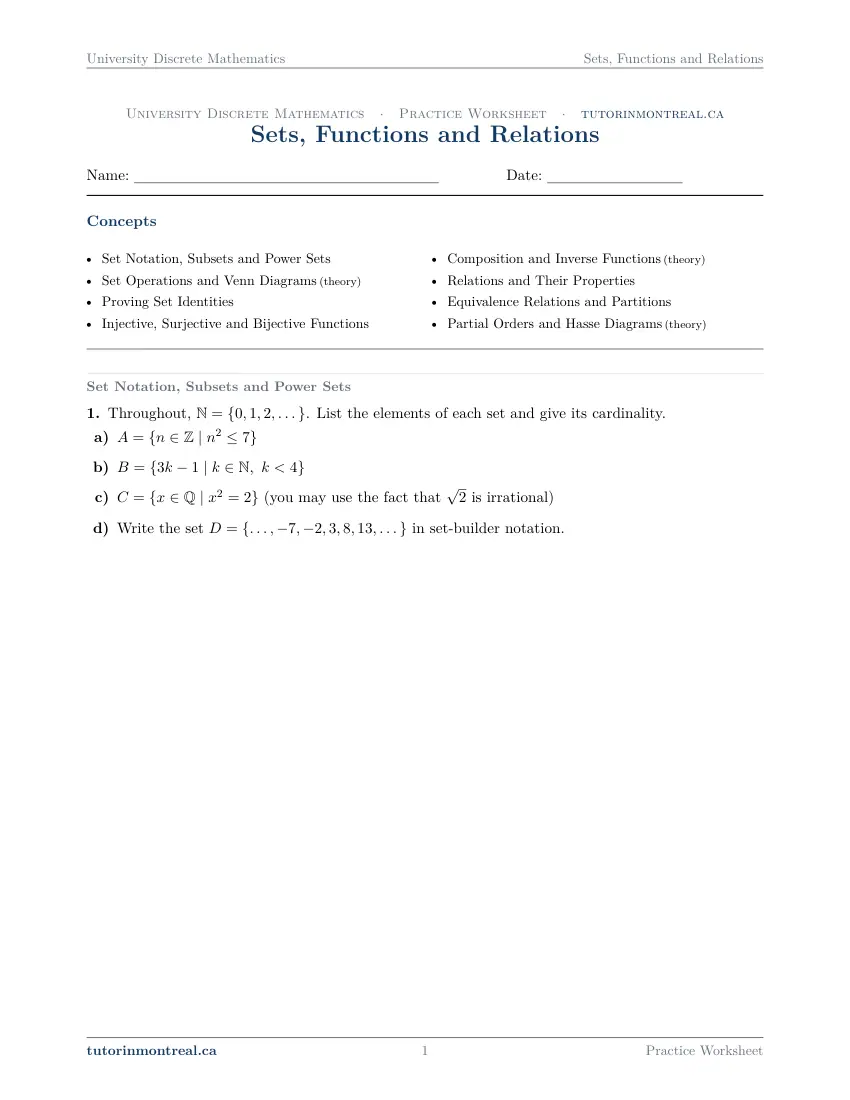
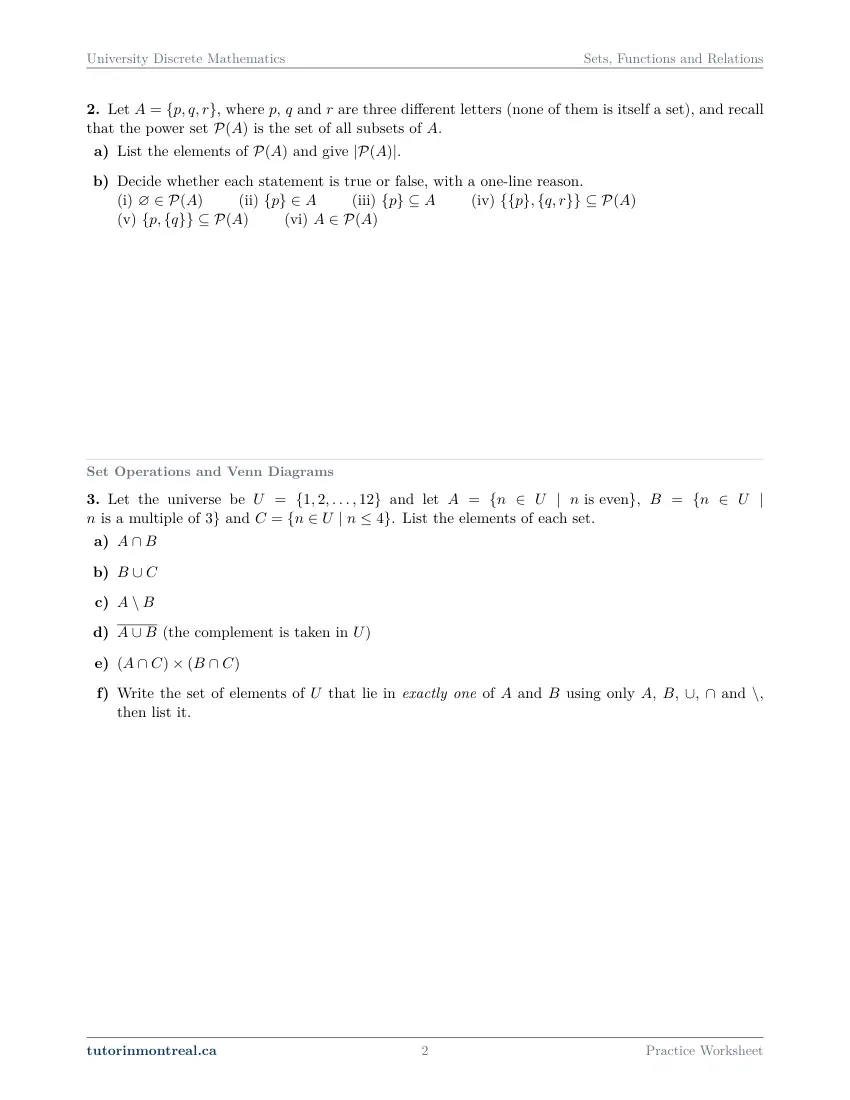
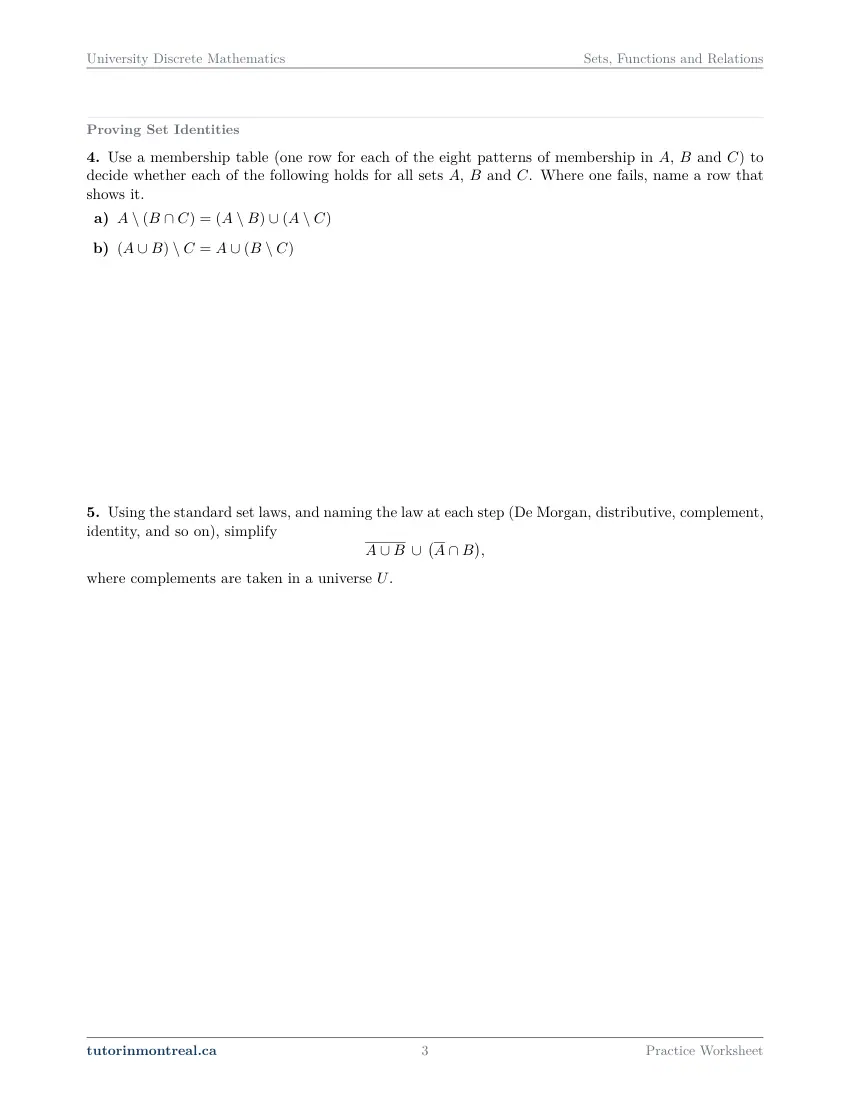
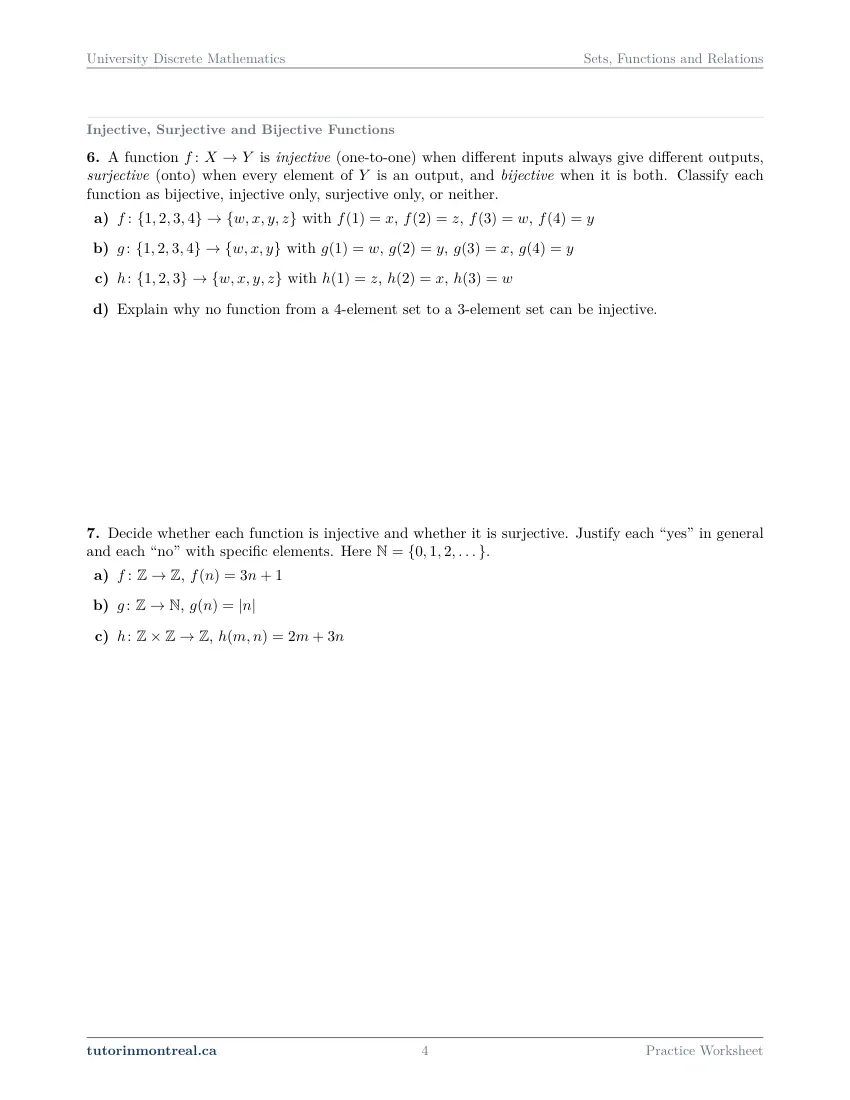
Q1Set Notation, Subsets and Power Sets
Throughout, . List the elements of each set and give its cardinality.
- (you may use the fact that is irrational)
- Write the set in set-builder notation.
-
Q2Set Notation, Subsets and Power Sets
Let , where , and are three different letters (none of them is itself a set), and recall that the power set is the set of all subsets of .
- List the elements of and give .
- Decide whether each statement is true or false, with a one-line reason.\\ (i)~ (ii)~ (iii)~ (iv)~\\ (v)~ (vi)~
-
Q3Set Operations and Venn Diagrams
Let the universe be and let , and . List the elements of each set.
- (the complement is taken in )
- Write the set of elements of that lie in exactly one of and using only , , , and , then list it.
-
Q4Proving Set Identities
Use a membership table (one row for each of the eight patterns of membership in , and ) to decide whether each of the following holds for all sets , and . Where one fails, name a row that shows it.
-
Q5Proving Set Identities
Using the standard set laws, and naming the law at each step (De Morgan, distributive, complement, identity, and so on), simplify where complements are taken in a universe .
-
Q6Injective, Surjective and Bijective Functions
A function is injective (one-to-one) when different inputs always give different outputs, surjective (onto) when every element of is an output, and bijective when it is both. Classify each function as bijective, injective only, surjective only, or neither.
- with , , ,
- with , , ,
- with , ,
- Explain why no function from a -element set to a -element set can be injective.
-
Q7Injective, Surjective and Bijective Functions
Decide whether each function is injective and whether it is surjective. Justify each “yes” in general and each “no” with specific elements. Here .
- ,
- ,
- ,
-
Q8Composition and Inverse Functions
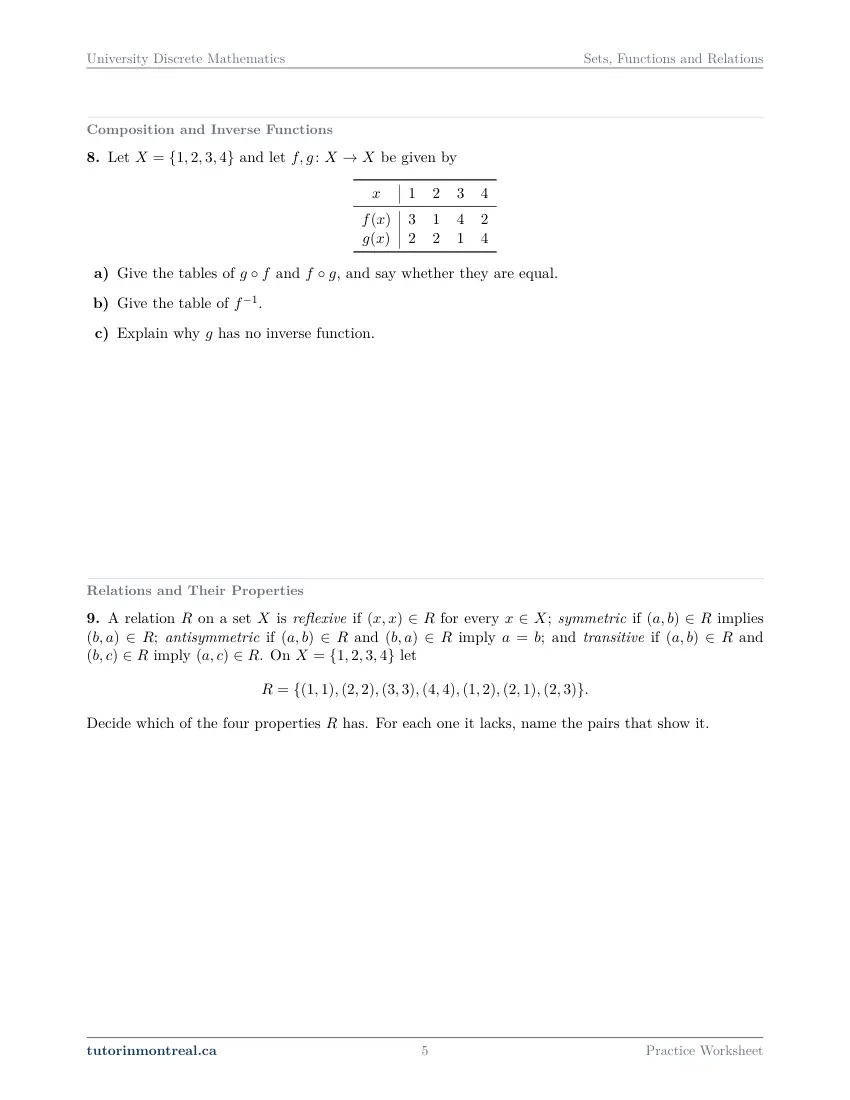
This question is built around a diagram or a table of values. Open it in the PDF.
-
Q9Relations and Their Properties
A relation on a set is reflexive if for every ; symmetric if implies ; antisymmetric if and imply ; and transitive if and imply . On let Decide which of the four properties has. For each one it lacks, name the pairs that show it.
-
Q10Relations and Their Properties
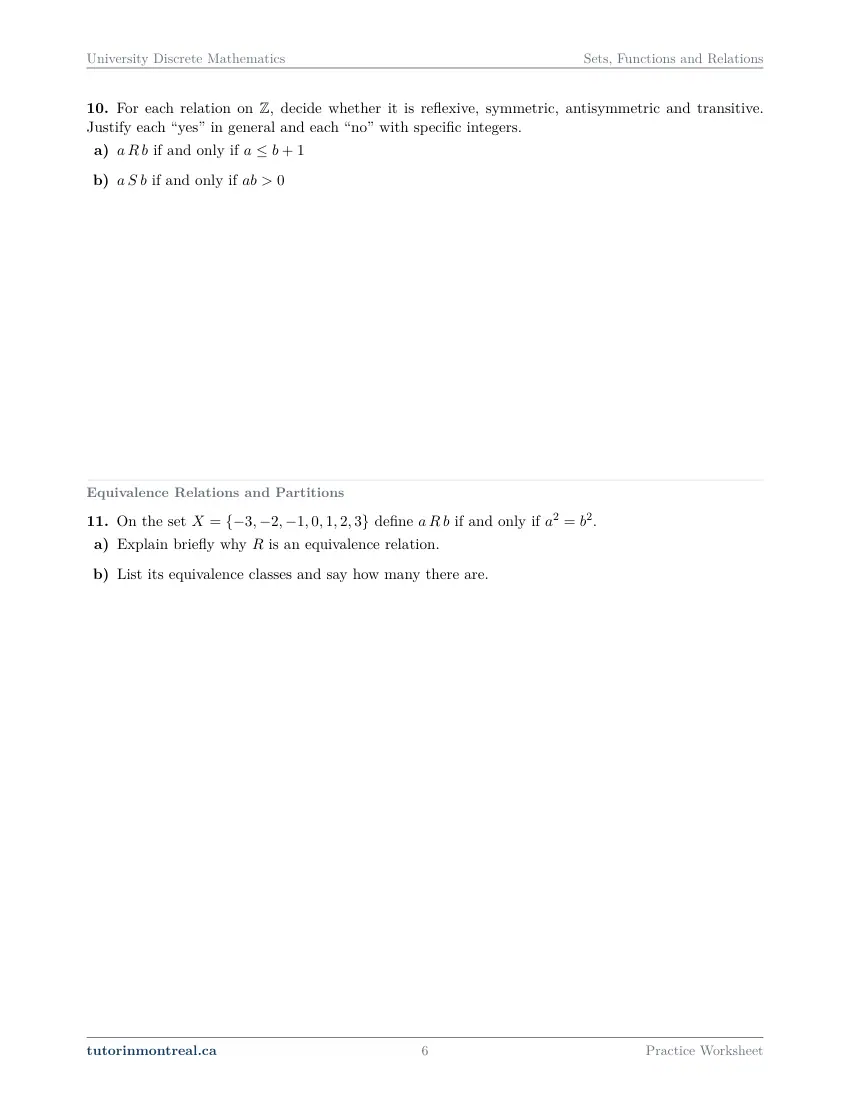
For each relation on , decide whether it is reflexive, symmetric, antisymmetric and transitive. Justify each “yes” in general and each “no” with specific integers.
- if and only if
- if and only if
-
Q11Equivalence Relations and Partitions
On the set define if and only if .
- Explain briefly why is an equivalence relation.
- List its equivalence classes and say how many there are.
-
Q12Equivalence Relations and Partitions
- The collection is a partition of . List the ordered pairs of the equivalence relation whose classes are these blocks, and give the number of pairs.
- Explain why neither nor is a partition of .
-
Q13Partial Orders and Hasse Diagrams
On write when is an integer multiple of . The relation is a partial order on .
- List the pairs with for which no other than and satisfies and , and draw the Hasse diagram.
- Give the minimal and the maximal elements, and say whether has a least or a greatest element.
- Give two elements that are incomparable.
-
Q14Synthesis — drawing on several topics in this unit
Let and define by , the greatest integer less than or equal to . Define a relation on by if and only if .
- Is injective? Is it surjective?
- List the equivalence classes of .
- How many ordered pairs does contain?
- List the set .
The 10 challenge problems for this topic are a separate, paid sheet and are not reproduced here.
What does this set assume? This set assumes Secondary 5 mathematics only — no calculus and no linear algebra, whatever a calendar lists as a prerequisite. What it does use is ordinary algebraic manipulation, comfort with the number systems ℤ, ℚ and ℕ, and two earlier University Discrete Mathematics sets: Propositional and Predicate Logic, because an identity between sets is a logical equivalence between membership conditions and every definition here is a quantified statement; and Methods of Proof, because the identities and the general claims about functions and relations are proved with direct proof, contraposition and counterexamples rather than checked on examples. Nothing from the later sets is needed, and this set is written so that Equivalence Relations and Partitions can be leaned on when congruence modulo n arrives in Modular Arithmetic and Cryptography. Three things are deliberately out: closures of relations, representing a relation by a matrix or a digraph as a topic of its own, and the cardinality of infinite sets — every cardinality here is a count of a finite set. Counting techniques of their own come later, in Counting Techniques.
Which course is this for? In the public course calendars of Montreal universities, this material is part of the courses numbered COMP 232, MAT1500, INF1132 and MAT210. Each course orders and weights the topics its own way, so check your own outline for what your exam covers. Which sets match your course.
How to do every concept on this sheet
This is the part worksheet sites usually leave out. Below is the actual reasoning behind each group of questions — not a full solution set, the decisions that get you to one. Read it before you start, or after you get stuck.
Describing a set, and reading the description back
A set is determined by its elements and by nothing else: no order, no repetition. Half the work in Q1 is translating between the two ways of writing one down — a list inside braces, and a rule of the form {x ∈ (some known set) | (a condition on x)}. Translating a rule into a list means testing candidates one at a time; translating a list into a rule means finding the pattern and naming the set the elements are drawn from.
Turning a rule into a list
Three questions, in this order.
- 1Which universe?
ℤ, ℕ or ℚ in front of the bar decides what is even allowed to be tested. Q1(a) draws from ℤ, so negative candidates must be tested too.
- 2Which candidates can satisfy the condition?
Bound the search before you start. A condition like n² ≤ 7 fails for every integer past a certain size, so only a handful of candidates need testing at all.
- 3Test each one and count
Write the survivors in braces, each once, and read |the set| off the list. Cardinality here is just the length of that list.
Q1(b) is the other shape of rule: the element is given as an expression in a parameter, and the condition constrains the parameter rather than the element. Run k through every value the condition allows — with ℕ starting at 0, as the question states — and evaluate. Q1(c) is a rule that may be satisfied by nothing at all; the question hands you the fact about √2 that settles it, and your job is to say in a line why that fact decides membership. A set with no elements is a legitimate answer, written ∅, and its cardinality is a number like any other.
Going the other way. Q1(d) gives a two-way infinite list and asks for set-builder notation. Find the constant gap between consecutive entries, find one entry to anchor on, and write the elements as that gap times an integer parameter, shifted. The parameter must run over ℤ, not ℕ, or the description stops one end of the list short — check your rule by feeding it a negative parameter and seeing a listed element come out.
Membership, subsets and power sets
∈ and ⊆ are different relations between different kinds of object, and Q2 is built to catch the confusion between them. x ∈ A says x is one of the things A contains. B ⊆ A says every element of B is also an element of A — a statement about two sets. The power set 𝒫(A) is the set whose elements are the subsets of A, so its elements are themselves sets, and that is where the two symbols start trading places.
B ⊆ A ⇔ B ∈ 𝒫(A)For Q2(a), build 𝒫(A) systematically rather than by inspiration: the empty set, then every one-element subset, then every two-element subset, then A itself. Listing by size is what stops a subset going missing. Each element of A is either in a given subset or out of it, independently of the others, so an n-element set has 2ⁿ subsets — use that as the check on the length of your list, not as a substitute for writing it.
Read each statement in Q2(b) at the right level. Ask two questions of each one. First, which symbol is it — ∈ wants a single element on the left, ⊆ wants a set on the left. Second, what are the elements of the set on the right — the elements of A are letters, while the elements of 𝒫(A) are sets of letters. A one-line reason should name the offending object: "the left side is a letter, and the elements of 𝒫(A) are sets", or the reverse. The question says explicitly that p, q and r are not themselves sets, which is what makes each statement decidable.
Two facts worth stating before you start, because several parts turn on them: ∅ is a subset of every set, and each set counts as one of its own subsets.
The operations, in a fixed universe
Q3 fixes a universe U and three subsets of it described by rules, and asks for lists. Convert each of A, B and C to a list first, once, and then every part is bookkeeping on those three lists rather than a fresh reading of the rules.
A ∩ B: in both. A ∪ B: in at least one. A − B: in A and not in B. Aᶜ: in U and not in A.Q3(a), (b) and (c) are those first three readings in turn, and (c) is the one to slow down on — a difference is not symmetric, so A − B and B − A are different questions. Q3(d) takes a complement of a compound set: build the union first, then keep everything of U that is not in it. Working the complement in your head over a union is where De Morgan's law would be needed, and the safer route with a listed universe is to build inside out.
A Cartesian product collects ordered pairs. Q3(e) asks for (A ∩ C) × (B ∩ C). Build the two intersections first, then pair every element of the first with every element of the second, keeping the order: (first-set element, second-set element). The number of pairs is the product of the two cardinalities, which is the check that no pair was dropped. Unlike ∪ and ∩, the product does not commute — swapping the factors gives different pairs.
Q3(f) asks for something in words — the elements in exactly one of A and B — and demands an expression built only from A, B, ∪, ∩ and difference. "Exactly one" is "in at least one, but not in both", and it is also "in A but not B, or in B but not A". Either reading turns into a formula with the symbols allowed; write the formula, then list the set it produces and check the list against your reading of the phrase. A Venn diagram with the wanted regions shaded is the fastest way to see that the two readings shade the same regions.
Proving an identity with a membership table
Q4 asks whether two expressions agree for all sets A, B and C, which is a different question from whether they agree on one example. A membership table settles it exhaustively. Each of the eight rows is one pattern of "in or out" for the three sets — this is the truth table of Propositional and Predicate Logic with 1 read as "is an element" — and each column is built from the columns before it by one operation.
Building the table
Columns in the order the expression is built.
- 1Three base columns
A, B, C, with all eight patterns of 1 and 0. Write them in a fixed order so no pattern is repeated or missed.
- 2One column per operation
Intersection takes the minimum of two columns, union the maximum, a difference is 1 exactly where the first column is 1 and the second is 0, a complement flips.
- 3Compare the two final columns
Identical in all eight rows means the identity holds for all sets. One row where they differ is the whole answer to the other direction.
Naming a row is naming a counterexample. Where an identity fails, Q4 asks you to name a row that shows it — so point at the specific membership pattern, not at a vague "the sides differ". That row is a recipe for concrete sets: put one element in exactly the sets the row marks with a 1, and the two expressions are different sets for those A, B and C. Q4(a) and Q4(b) are answered by the same table-building procedure, so build both tables before judging either.
Proving an identity with the set laws
Q5 forbids the table and asks for a chain of named steps. Each line is one expression, and between two lines you name the single law that got you there: De Morgan, distributive, complement, identity, domination, absorption, commutative, associative, double complement.
De Morgan: (A ∪ B)ᶜ = Aᶜ ∩ Bᶜ and (A ∩ B)ᶜ = Aᶜ ∪ BᶜThe expression in Q5 opens with a complement over a union, so the first move is the one law that can get inside it. After that, look at what the two halves of the expression have in common: a distributive law run backwards factors a shared set out of a union of two intersections, and once a set stands beside its own complement, the complement and identity laws collapse it. Work in small steps and never merge two laws into one line — the mark is for the chain, and a line without a named law is a line that has not been justified.
Check the chain on a picture, not on numbers. Draw the two-set Venn diagram and shade the starting expression. Every legitimate step must leave the shaded region unchanged, so a step that changes the picture is a step with the wrong law named. This is a check, not a proof — the written proof is the chain.
Injective, surjective and bijective
Q6 states the three definitions for you and gives three functions between small listed sets, each by its values. Test them on the picture: draw an arrow from each element of the domain to its value. Injective means no element of the codomain receives two arrows; surjective means every element of the codomain receives at least one. Bijective is both, and "neither" is one of the four labels on offer, so do not force a function into a class.
The codomain is part of the function. Surjectivity is a claim about the set written after the arrow in f: X → Y, not about the set of values that happen to occur. Q6(b) and Q6(c) have codomains of different sizes from their domains, and the size comparison alone rules one property out before any arrow is drawn.
Q6(d) asks for a general argument rather than an example: why no function from a 4-element set to a 3-element set can be injective. Count arrows against targets — four arrows leaving, three possible destinations — and say what must therefore happen to at least one destination. Writing that sentence properly is the whole question; an example of one such function proves nothing about all of them.
Q7 moves to infinite domains, where arrows are no longer available and the definitions must be used directly. The asymmetry of the work is the thing to internalise, and the question states it: a "yes" is justified in general, a "no" with specific elements.
Testing a formula
Two proofs, two disproofs, all short.
- 1Injective, yes
Assume f of one input equals f of another and derive that the inputs are equal. Pure algebra.
- 2Injective, no
Exhibit two different inputs with the same output. Two numbers written down, nothing more.
- 3Surjective, yes
Take an arbitrary element y of the codomain and solve f(x) = y for x — then check that the x you found actually lies in the domain.
- 4Surjective, no
Exhibit one element of the codomain that no input reaches, and say why it is unreachable.
Step 3 is where Q7(a) has to be read carefully: solving gives a formula for x, and the question is whether that formula always lands back inside ℤ. Q7(b) has ℕ as its codomain, so the reachable targets and the two-sided domain are what the two tests turn on. In Q7(c) the domain is a set of pairs, so an input is (m, n) and two inputs being equal means both coordinates agreeing — which makes the injectivity test a question about whether one equation in two unknowns pins both of them down.
Composition and inverses
Q8 gives f and g on a four-element set as a table of values. Composition is evaluation twice, and the order is the trap: (g ∘ f)(x) means apply f first, then g. Build each composite as a new row of the table, one input at a time, reading f's row and then looking that value up in g's row.
(g ∘ f)(x) = g(f(x)), (f ∘ g)(x) = f(g(x))Q8(a) asks both composites and whether they are equal, which is a question about the whole tables: equal means agreeing at every one of the four inputs, so one disagreement settles it and should be pointed at explicitly. Q8(b) asks for the table of the inverse of f. An inverse exists exactly when a function is bijective, and for a function given by a table you obtain it by reversing every arrow: the row of f read backwards. Check it by composing — an inverse composed with its function must send every input to itself.
Q8(c) wants the reason, not the verdict. The question already tells you that g has no inverse function. A reversed table fails to be a function for one of exactly two reasons: some element of the codomain receives no arrow, so the reversed table has no value there; or some element receives two, so the reversed table has two values there. Look at g's row, say which failure occurs, and name the elements that witness it. Tying that back to injectivity and surjectivity is what earns the mark.
The four properties of a relation
Q9 states the four definitions and gives a relation on a four-element set as an explicit list of ordered pairs. Work property by property, and let the definition dictate what you look for.
Checking a listed relation
Each property is a different search.
- 1Reflexive
Look for (x, x) for every x in the set — four specific pairs, checked off one by one.
- 2Symmetric
For each pair (a, b) with a ≠ b, look for (b, a) in the list.
- 3Antisymmetric
Look for a pair (a, b) with a ≠ b whose reverse is also present. Finding one is the only way this fails.
- 4Transitive
For every pair of pairs that chain — (a, b) and (b, c) — check that (a, c) is in the list. Include the chains where a, b or c coincide.
Symmetric and antisymmetric are not opposites. They are two independent conditions, and Q9 is set up so that the difference matters. A relation can satisfy both, and a relation can satisfy neither. Where a property fails, Q9 asks for the pairs that show it — so write the offending pair or chain, which is the counterexample the definition's quantifier calls for.
Q10 asks the same four questions about two relations on ℤ, defined by conditions rather than listed, so each "yes" is a short proof from the condition and each "no" is specific integers. For the first, a ≤ b + 1, write out what the condition says with the same variable in both slots to test reflexivity, and swap the roles of a and b to test symmetry; transitivity means chaining two inequalities and asking whether what you get is still of the required form — and the constant is what makes that interesting. For the second, ab > 0, the sign rules do the work, and the value 0 is the element to keep an eye on throughout, since it is the one integer whose product with anything is not positive.
Equivalence relations and partitions
An equivalence relation is one that is reflexive, symmetric and transitive at once, and its classes carve the set into blocks. Q11 defines a relation on a small listed set by a² = b², and Q11(a) asks only for a brief reason that it is an equivalence relation — so give the three conditions in three lines, each following from a property of equality itself, rather than checking pairs.
[a] = {x ∈ X | x R a}, the class of aQ11(b) asks for the classes. Build them by sweeping the set: take the first element, collect everything related to it, strike all of those off, take the first element left, and repeat until nothing is left. That procedure guarantees what the theory promises — the classes are disjoint and together they cover X — and the count of classes falls out of the list.
The correspondence runs both ways. Q12(a) starts from a partition and asks for the relation. Two elements count as related precisely when the same block holds both, so a block of size k contributes k² ordered pairs, including the pairs of an element with itself, and the total is the sum of those squares. Build the pairs block by block and use the sum as a check on the list you wrote.
A partition has three requirements. The blocks must be non-empty, pairwise disjoint, and their union must be the whole set. Q12(b) gives two collections and asks why neither qualifies; the answer in each case is one named requirement and the specific element that breaks it. "It looks wrong" is not an answer — the requirement and the witness are.
Partial orders and Hasse diagrams
A partial order is reflexive, antisymmetric and transitive. Q13 hands you the fact that divisibility is a partial order on the given set of integers, so nothing has to be proved and everything has to be read off. Write a | b for "b is an integer multiple of a", and start by listing every such pair on the set — that list is the raw material for all three parts.
From the pairs to the diagram
A Hasse diagram is the relation with everything forced removed.
- 1Drop the loops
Every element relates to itself; reflexivity is assumed and never drawn.
- 2Drop what transitivity forces
Keep a pair a | b only when no third element of the set sits strictly between them — this is exactly what Q13(a) asks you to list.
- 3Draw upward
Put b above a and join them with a plain line, no arrowhead. Height carries the direction, so a line that runs sideways has lost its meaning.
Q13(b) asks for minimal and maximal elements and then for a least and a greatest — four terms and two distinctions. Minimal means nothing in the set is strictly below it, and there may be several; least means it sits below everything, and there is at most one. On the diagram, minimal elements are the ones with no line going down, and a least element would have to be a single element from which every other element can be reached going up. Q13(c) asks for two incomparable elements: a pair with neither dividing the other, which on the diagram is a pair joined by no upward path in either direction. Incomparable pairs are what makes the order partial.
The synthesis question
Q14 runs the whole set through one construction: a function f on an eight-element set given by a floor expression, and the relation "f takes the same value". Compute the table of f first — all eight values, written out — and everything else is read from that table.
a R b ⇔ f(a) = f(b)Q14(a) is Q6 and Q7 again, now on a listed domain: scan the table for a repeated value, and compare the values that occur against the codomain the question names. Q14(b) is Q11(b): the classes are the groups of inputs sharing a value, so the table sorted by value is the list of classes. Q14(c) is Q12(a)'s sum of squares applied to those class sizes — a relation of this form is automatically an equivalence relation, because equality of values is reflexive, symmetric and transitive, which is worth saying in a line before counting. Q14(d) is a set-builder question in the style of Q1: test each of the eight inputs against the stated condition on f and list the survivors.
Know what the floor does before you tabulate. ⌊n/3⌋ is the greatest integer less than or equal to n/3, as the question says. It is constant in runs, and the run boundaries are where the classes of R come from — which is why a relation built from a function is never an arbitrary list of pairs.
Preview all 8 pages
Click any page to open the full PDF.
Getting the most out of it
Write the definition before you use it
Injective, surjective, reflexive, antisymmetric, transitive, partition: each is a quantified sentence, and the sentence tells you what a proof and what a disproof must look like. Copy it at the top of your work and let the quantifier decide whether you owe a general argument or a single example.
Draw the small cases
Arrow pictures for functions, Venn diagrams for operations, a grid of ordered pairs for a relation, an upward diagram for an order. On the finite sets this set works with, the picture is complete information, and it makes a missing pair or an unreached element visible in a second.
One example proves nothing about all sets
Testing a proposed identity on three particular sets and finding it holds is not a proof — it is one row of a membership table. Either fill in all eight rows or argue with named laws. The only thing a single example can settle is a failure.
Separate ∈ from ⊆ every time you write one
Before writing either symbol, say what kind of object sits on each side. Most lost marks in this set are an element treated as a set or a set treated as an element, and once power sets are in play both sides can be sets without the statement being true.
Check your work against its own count
A power set has 2ⁿ elements, a product of two sets has the product of their cardinalities, and the classes of an equivalence relation must add up to the whole set. Each of these is a one-line arithmetic check on a list you have just written, and each catches a dropped item.
Want the solutions, or something more challenging?
The worksheet, the questions above and every explanation on this page stay free permanently. Three more PDFs exist for this topic — the worked answer key, a harder problem set, and the answer key to that. They come with the University Discrete Math Solutions Bundle, beside the unit notes and the unit test, which is what keeps the rest of the series free.
What else exists for Sets, Functions and Relations
Three PDFs · 13 pages · all three are in the bundle below.
- Answer key — 3 pages. All 14 questions worked step by step, including the restrictions and the justifications. Not a list of final answers.
- Challenge problems — 7 pages, 10 problems. A separate sheet at exam-plus difficulty covering the same 8 concepts. Harder than anything on the free sheet.
- Challenge answer key — 3 pages. Every challenge problem worked to the same standard, with the checks shown.
- PDF, letter size, print-ready.
The one thing that's for sale
Every University Discrete Math topic — the complete Solutions Bundle
One download, one payment, the whole program. For all 9 University Discrete Math units: the worksheet, the reference notes, the challenge set, the unit test and every answer key — including this one.
- Worked solutions, not answer lists — every step written out
- Covers the whole year's program at this level
- Less than the price of one hour of tutoring — for the entire year's solutions
Taking Secondary 1 Math as well? The Secondary 1 Math bundle covers all 15 of its units — 106 PDFs, 474 pages — on the same terms.
Taking Secondary 2 Math as well? The Secondary 2 Math bundle covers all 14 of its units — 98 PDFs, 449 pages — on the same terms.
Taking Secondary 3 Math as well? The Secondary 3 Math bundle covers all 11 of its units — 77 PDFs, 367 pages — on the same terms.
Taking Secondary 4 Math as well? The Secondary 4 Math bundle covers all 17 of its units — 122 PDFs, 466 pages — on the same terms.
Taking Secondary 5 Math as well? The Secondary 5 Math bundle covers all 21 of its units — 147 PDFs, 589 pages — on the same terms.
Taking CEGEP Calculus I as well? The CEGEP Calculus I bundle covers all 9 of its units — 72 PDFs, 371 pages — on the same terms.
Taking CEGEP Calculus II as well? The CEGEP Calculus II bundle covers all 8 of its units — 64 PDFs, 335 pages — on the same terms.
Taking CEGEP Linear Algebra as well? The CEGEP Linear Algebra bundle covers all 7 of its units — 56 PDFs, 298 pages — on the same terms.
Taking University Calculus III as well? The University Calculus III bundle covers all 9 of its units — 72 PDFs, 516 pages — on the same terms.
Taking University Linear Algebra as well? The University Linear Algebra bundle covers all 9 of its units — 72 PDFs, 496 pages — on the same terms.
Taking University Differential Equations as well? The University Differential Equations bundle covers all 9 of its units — 36 PDFs, 182 pages — on the same terms.
Taking University Business Math as well? The University Business Math bundle covers all 9 of its units — 36 PDFs, 190 pages — on the same terms.
Taking University Introductory Statistics as well? The University Introductory Statistics bundle covers all 9 of its units — 36 PDFs, 186 pages — on the same terms.
Taking AP Calculus AB as well? The AP Calculus AB bundle covers all 8 of its units — 64 PDFs, 527 pages — on the same terms.
Common questions
Is this worksheet really free?
Yes — the questions are on this page to read, and the PDF downloads directly, no email and no account. The one paid item is optional: the complete University Discrete Mathematics Solutions Bundle, which covers every set at this level.
Which university courses is this for?
The course codes listed on this page are taken from the public course calendars of universities that teach discrete mathematics to mathematics, computer science and engineering students. Each course orders and weights the chapters its own way, and some reach a chapter late in the term or not at all — so check the outline for your own section to see where this set falls in your term.
What do I need to know before starting this set?
Secondary 5 mathematics and the two earlier University Discrete Mathematics sets: Propositional and Predicate Logic, for quantifiers and logical equivalence, and Methods of Proof, for the proof techniques the identities and general claims are written with. No calculus and no linear algebra are used anywhere.
What is the difference between ∈ and ⊆?
x ∈ A says x is one of the things A contains. B ⊆ A says every element of B is also an element of A, which is a statement about two sets. They coincide in appearance only when the elements are themselves sets, as inside a power set, which is exactly where the confusion starts.
Is a membership table a real proof?
Yes, for an identity in a fixed number of sets. The eight rows for three sets cover every possible pattern of membership for an arbitrary element, so agreement in all eight rows proves the identity for all sets. A chain of named laws is the alternative, and some questions ask for one method specifically.
Why does the codomain matter for surjectivity?
Because surjectivity is a claim about the set written after the arrow in f: X → Y, not about the values that happen to occur. The same rule can be surjective onto one codomain and not onto a larger one, so f is not fully described until the codomain is stated.
Are equivalence relations and partitions really the same thing?
They are two descriptions of one structure. Every equivalence relation splits its set into classes that are non-empty, pairwise disjoint and together cover the set; every such collection of blocks defines an equivalence relation by "in the same block". This set asks you to travel in both directions.
Why does a Hasse diagram leave out most of the pairs?
Because a partial order is reflexive and transitive, so every loop and every pair forced by a chain can be recovered from what is drawn. Only the pairs with nothing strictly between them are kept, and direction is shown by height rather than by arrowheads.
Can teachers use this in class?
Yes. Print and photocopy it for your own classes freely — I just ask that the tutorinmontreal.ca footer stays on the page.
I'm stuck on one question. Can you help?
Yes — through one-on-one tutoring, in Montreal or online. Get in touch to arrange a session, or see the current rates.
← All 9 University Discrete Math worksheets · Secondary 1 Math series (15 sheets) → · Secondary 2 Math series (14 sheets) → · Secondary 3 Math series (11 sheets) → · Secondary 4 Math series (17 sheets) → · Secondary 5 Math series (21 sheets) → · CEGEP Calculus I series (9 sheets) → · CEGEP Calculus II series (8 sheets) → · CEGEP Linear Algebra series (7 sheets) → · University Calculus III series (9 sheets) → · University Linear Algebra series (9 sheets) → · University Differential Equations series (9 sheets) → · University Business Math series (9 sheets) → · University Introductory Statistics series (9 sheets) → · AP Calculus AB series (8 sheets) →