AP Calculus AB Unit 5 — Analyzing Functions with Derivatives
This is the unit where the derivative stops being something you compute and starts being something you argue with: where f is rising and falling, where it bends, which critical point is actually an extremum, which value on a closed interval is the biggest of all, and how to say so in a sentence that earns the mark. It carries more weight on the AP exam than any other unit, and more of that weight sits in the justification than students expect. Have a look on this page, then print the free PDF when you want to write on it.
Practice worksheet — free PDF
No email, no account, no watermark. Teachers: photocopy it for your classes freely. Worked solutions and 10 harder problems come with the AP Calculus AB bundle.
All 13 questions
Each question targets one named concept from the sheet. Read them here, or print the PDF — it has working space under each one.
-
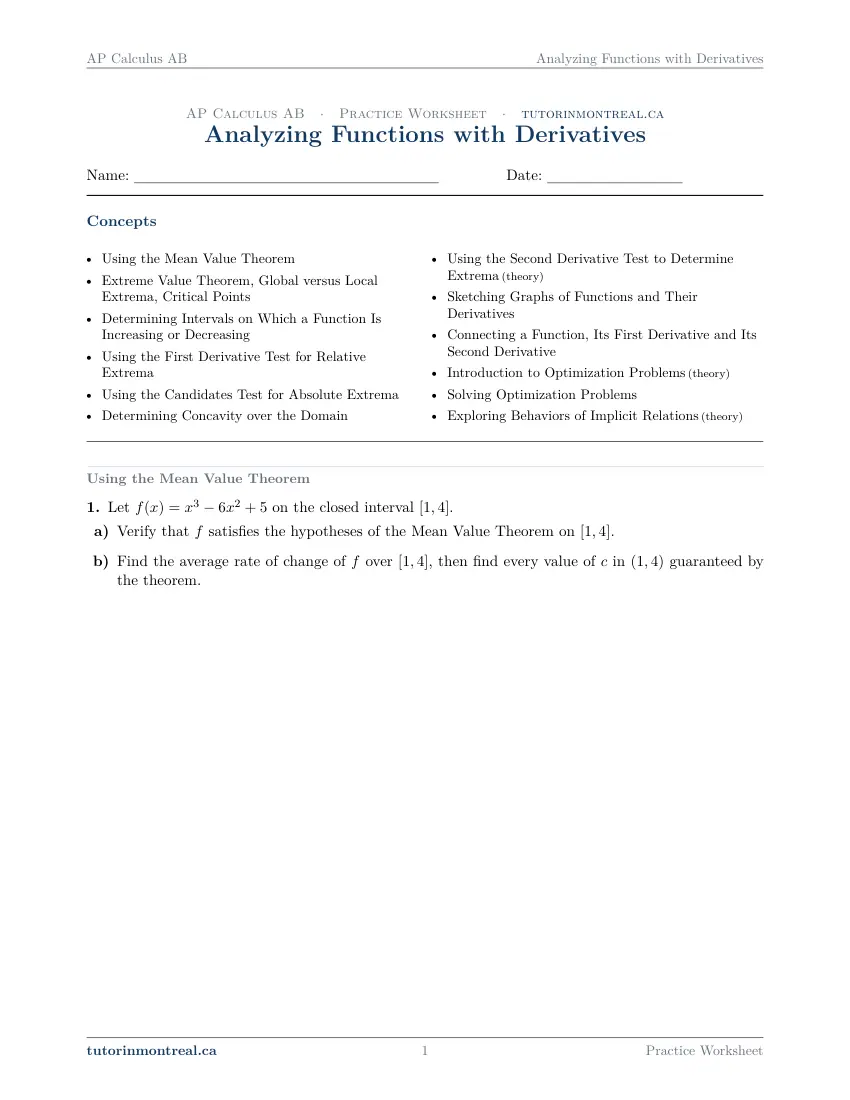
Q1Using the Mean Value Theorem
Let on the closed interval .
- Verify that satisfies the hypotheses of the Mean Value Theorem on .
- Find the average rate of change of over , then find every value of in guaranteed by the theorem.
-
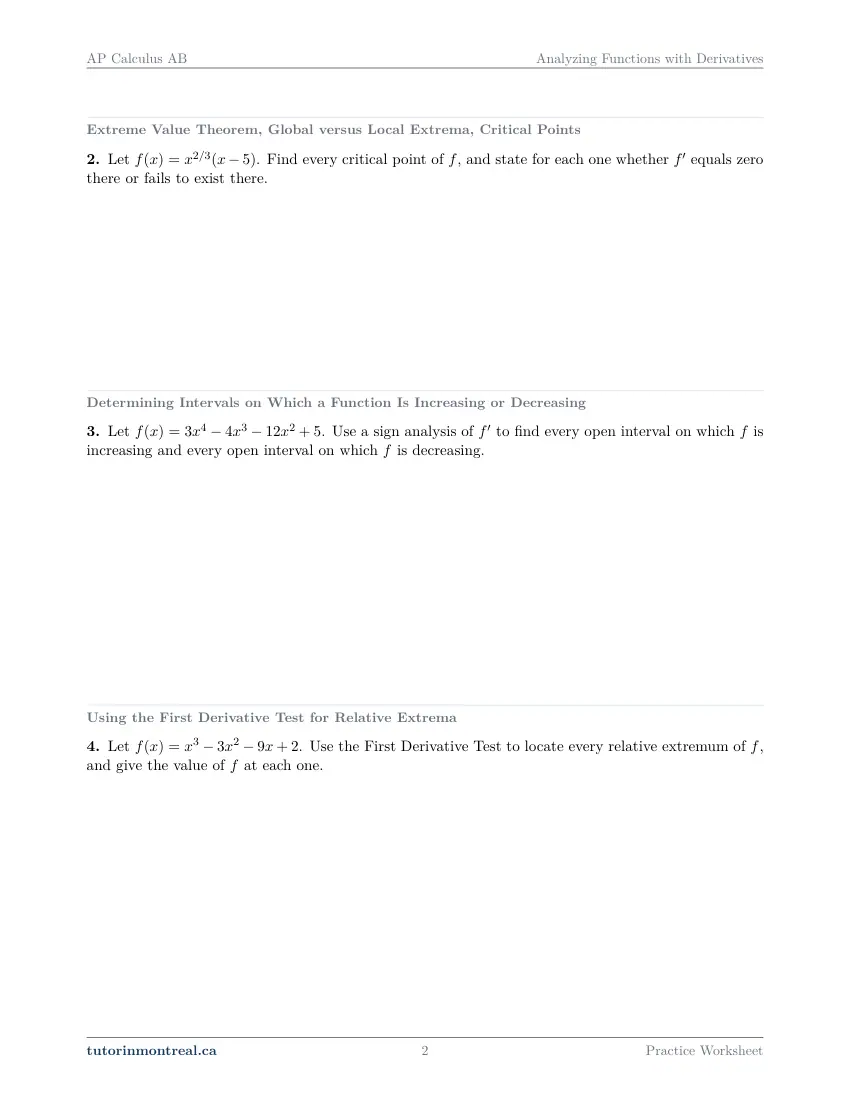
Q2Extreme Value Theorem, Global versus Local Extrema, Critical Points
Let . Find every critical point of , and state for each one whether equals zero there or fails to exist there.
-
Q3Determining Intervals on Which a Function Is Increasing or Decreasing
Let . Use a sign analysis of to find every open interval on which is increasing and every open interval on which is decreasing.
-
Q4Using the First Derivative Test for Relative Extrema
Let . Use the First Derivative Test to locate every relative extremum of , and give the value of at each one.
-
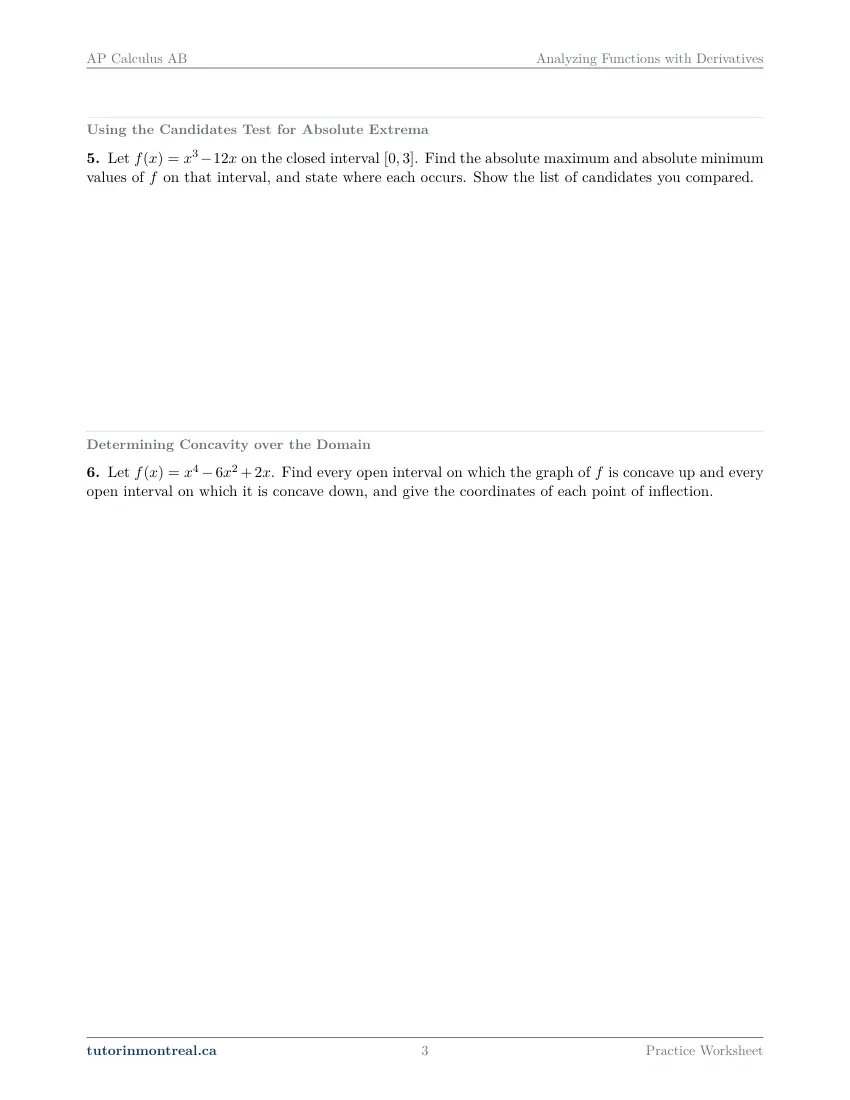
Q5Using the Candidates Test for Absolute Extrema
Let on the closed interval . Find the absolute maximum and absolute minimum values of on that interval, and state where each occurs. Show the list of candidates you compared.
-
Q6Determining Concavity over the Domain
Let . Find every open interval on which the graph of is concave up and every open interval on which it is concave down, and give the coordinates of each point of inflection.
-
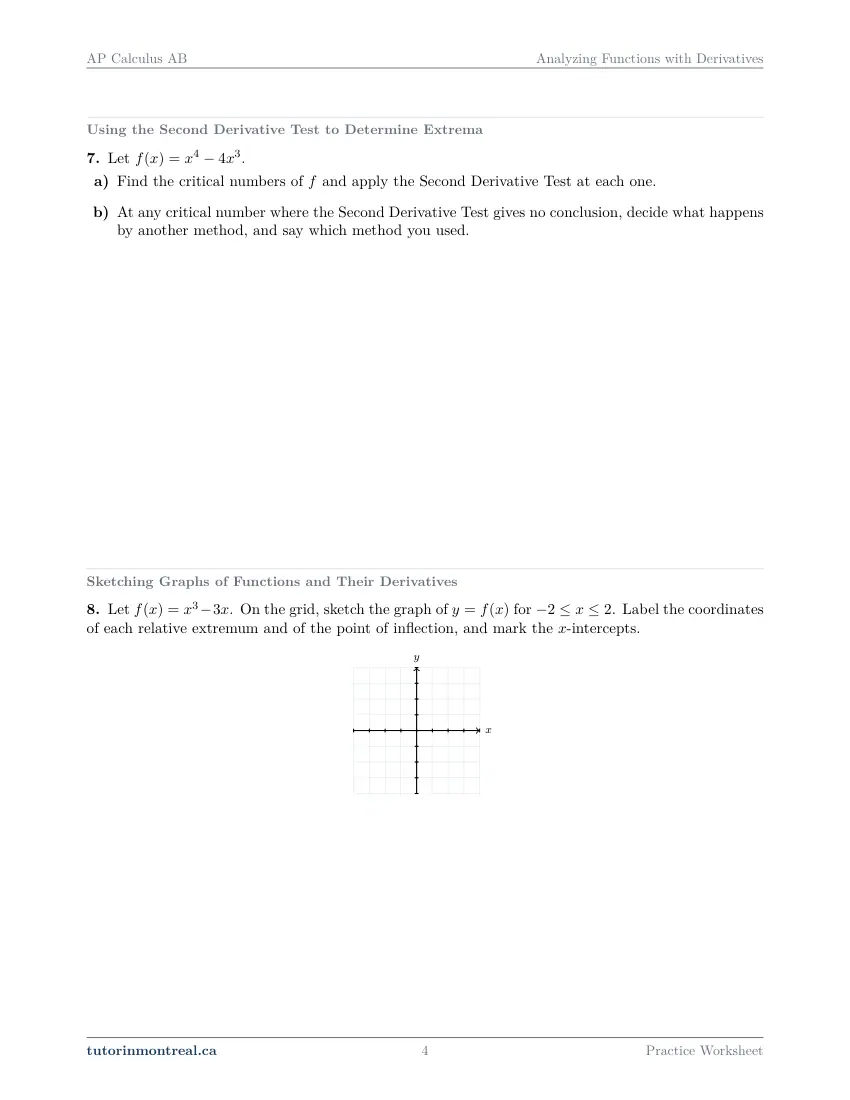
Q7Using the Second Derivative Test to Determine Extrema
Let .
- Find the critical numbers of and apply the Second Derivative Test at each one.
- At any critical number where the Second Derivative Test gives no conclusion, decide what happens by another method, and say which method you used.
-
Q8Sketching Graphs of Functions and Their Derivatives
Let . On the grid, sketch the graph of for . Label the coordinates of each relative extremum and of the point of inflection, and mark the -intercepts.
A blank Cartesian grid for this question is on the printable PDF.
-
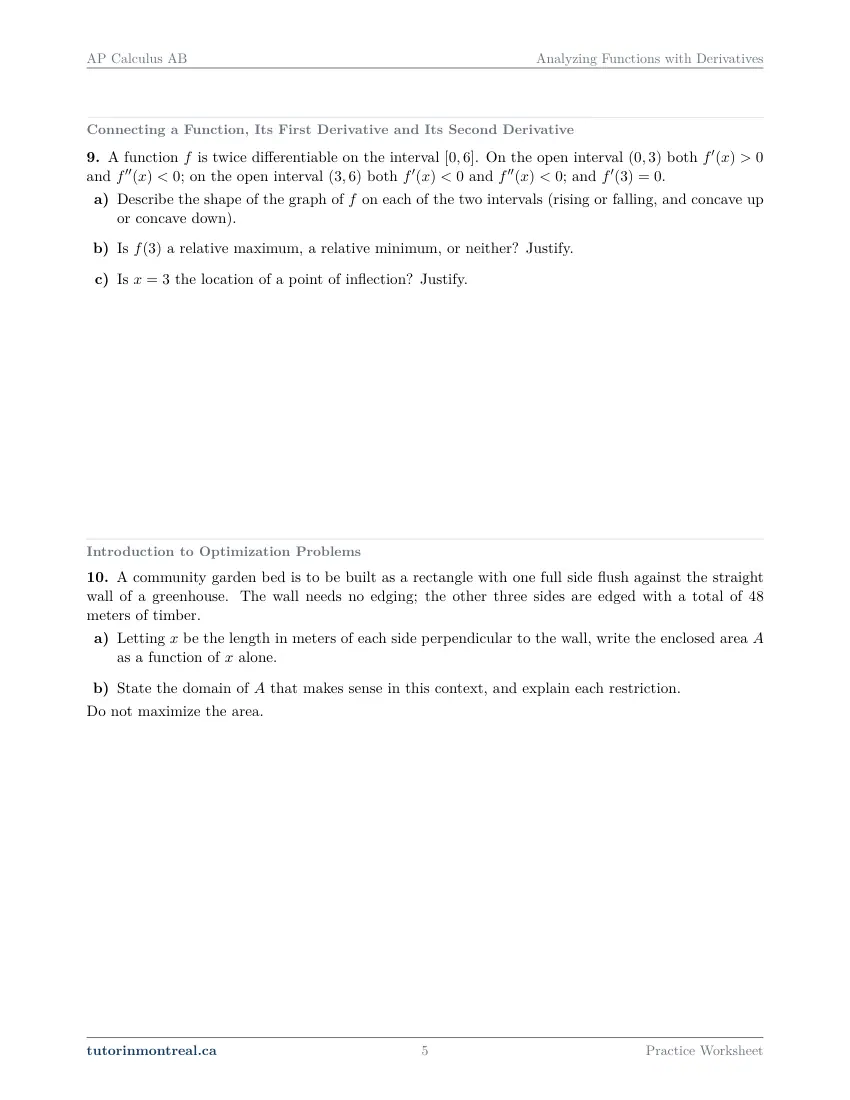
Q9Connecting a Function, Its First Derivative and Its Second Derivative
A function is twice differentiable on the interval . On the open interval both and ; on the open interval both and ; and .
- Describe the shape of the graph of on each of the two intervals (rising or falling, and concave up or concave down).
- Is a relative maximum, a relative minimum, or neither? Justify.
- Is the location of a point of inflection? Justify.
-
Q10Introduction to Optimization Problems
A community garden bed is to be built as a rectangle with one full side flush against the straight wall of a greenhouse. The wall needs no edging; the other three sides are edged with a total of meters of timber.
- Letting be the length in meters of each side perpendicular to the wall, write the enclosed area as a function of alone.
- State the domain of that makes sense in this context, and explain each restriction.
Do not maximize the area.
-
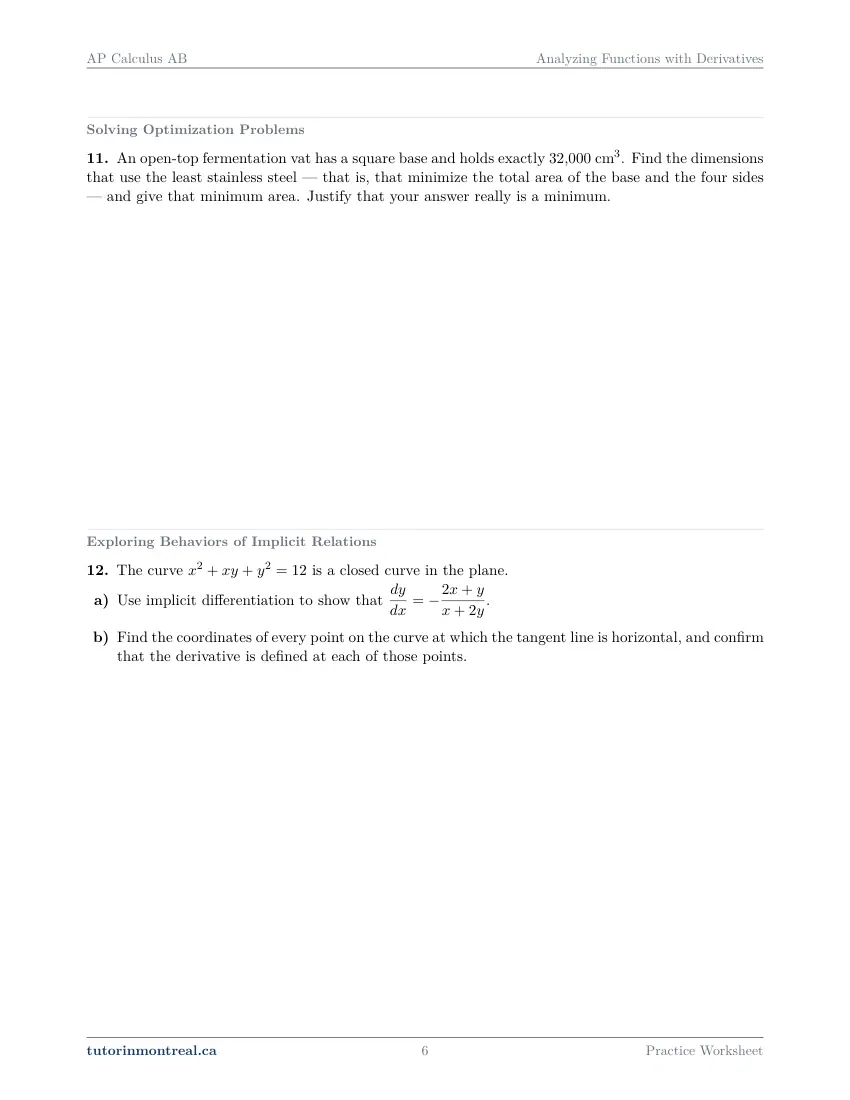
Q11Solving Optimization Problems
An open-top fermentation vat has a square base and holds exactly . Find the dimensions that use the least stainless steel — that is, that minimize the total area of the base and the four sides — and give that minimum area. Justify that your answer really is a minimum.
-
Q12Exploring Behaviors of Implicit Relations
The curve is a closed curve in the plane.
- Use implicit differentiation to show that .
- Find the coordinates of every point on the curve at which the tangent line is horizontal, and confirm that the derivative is defined at each of those points.
-
Q13Synthesis — drawing on several topics in this unit
Let on the closed interval .
- Find the open intervals on which is increasing and on which it is decreasing.
- Locate and classify every relative extremum of on , using the First Derivative Test.
- Find the open intervals of concavity and the coordinates of the point of inflection.
- Find the absolute maximum and absolute minimum values of on , and state where each occurs.
The 10 challenge problems for this topic are a separate, paid sheet and are not reproduced here.
Which stream is this for? This sheet is built for AP Calculus AB. Everything on it — the Mean Value Theorem, the Extreme Value Theorem, the first and second derivative tests, concavity and points of inflection, the candidates test, curve sketching, implicit relations and optimization — sits inside the AB course description. There is no BC-only material here: no parametric or polar curves, no vector functions, and nothing that needs series.
How to do every concept on this sheet
This is the part worksheet sites usually leave out. Below is the actual reasoning behind each group of questions — not a full solution set, the decisions that get you to one. Read it before you start, or after you get stuck.
A critical point is not just a place where f’(x) = 0
Q2 is on the sheet for exactly one reason, and it is the reason it catches almost everyone. Setting the derivative equal to zero finds some critical points. It does not find all of them.
The definition, in full: c is a critical point of f when c is in the domain of f and either f’(c) = 0 or f’(c) does not exist. Both halves count. A derivative written as a quotient fails to exist wherever its denominator vanishes — and if that x-value is still in the domain of f itself, it is a critical point you are required to list.
Two shapes produce it. At a cusp, the one-sided slopes run off to +∞ on one side and −∞ on the other — the graph comes to a point, and that point is very often a relative maximum or minimum. At a vertical tangent, both one-sided slopes blow up in the same direction, and the curve passes straight through with a vertical tangent line rather than turning around. A corner, where the two one-sided slopes are different finite numbers, is the third case. All three are critical points; only the sign of f’(x) on either side decides which are extrema.
So the habit to build is: differentiate, simplify to a single fraction, and then ask two questions of it, not one. Where is the numerator zero? Where is the denominator zero? Every answer to either question that lies in the domain of f goes on your list of critical numbers.
Reading f from the graph of f’
This is the most characteristic AB question there is, and Q9 is its written form: you are given information about f’ and f’’ and asked to describe f. The whole skill is keeping two different readings of the same graph apart.
Height of f’ tells you whether f rises. f’ above the x-axis means f is increasing; f’ below it means f is decreasing; f’ crossing the axis is where f turns around.
Slope of f’ tells you how f bends. f’ increasing — the graph of f’ going uphill, wherever it sits relative to the axis — means f’’ > 0 and f is concave up. f’ decreasing means f is concave down.
The classic error: reading “f’ is increasing” as “f is increasing”. They are unrelated facts. On the interval in Q9 where f’(x) < 0 and f’’(x) < 0, f is falling and getting steeper; f’ is negative and heading further down. A function can be decreasing while concave up (falling, but easing off) and increasing while concave down (rising, but flattening). Say the two words separately every time — rising or falling, then bending which way — and you will not merge them.
The same discipline settles the last part of Q9. A horizontal tangent has nothing whatever to do with concavity, so f’(c) = 0 is not evidence for a point of inflection; only a change in the sign of f’’ is. And a point where f’’ changes sign is where f’ itself is at its largest or smallest — the place the graph of f is rising, or falling, most steeply.
The sign chart, as a procedure
Q3, Q4 and Q6 all run on the same machine: split the number line at the interesting points, test one value in each piece, read the conclusion off the signs. Doing it the same way every time is what makes it fast.
Building a sign chart you can trust
The chart is for f’ when you want increasing or decreasing, and for f’’ when you want concavity. Same steps, different function.
- 1Factor completely
A factored derivative hands you the zeros and the sign of each piece for free. Q3 and Q4 both factor cleanly on purpose; if yours will not factor, you still need its zeros, so solve rather than guess.
- 2Mark every zero and every undefined point
Both kinds of critical number split the line. Skipping the undefined ones is how a sign chart quietly produces the wrong intervals.
- 3Test one convenient number per interval
Pick the easiest value, not the nearest. You want the sign, so count the negative factors rather than multiplying out: three negatives make a negative, and that is the whole computation.
- 4Write intervals open, and in the right language
f is increasing on an open interval where f’ > 0. Report them as intervals of x, never as y-values, and join two separate intervals with the word “and” rather than a union symbol if you want to be unambiguous.
- 5Read the conclusion at each mark, not in general
Positive to negative is a relative maximum; negative to positive is a relative minimum; concave down to concave up is a point of inflection. Then supply the y-value — an extremum is a value of f, and a point of inflection is a point, so both need f evaluated there.
No sign change means no extremum. Q7 is built on this. A zero of f’ where the sign does not flip is a critical point that is not an extremum — the graph merely flattens for an instant and carries on the way it was going. The identical rule governs inflection: f’’(c) = 0 by itself proves nothing, and Q6 wants the change of concavity checked, not just the zero found. In both cases the sign change is the fact; the zero is only where to look for it.
The candidates test — and the endpoints everyone forgets
Relative and absolute are different questions. A relative maximum only has to beat its immediate neighbours. An absolute maximum on a closed interval has to beat everything on that interval, endpoints included — and the endpoints are not critical numbers, so nothing in your sign chart will remind you of them.
The candidates test on [a, b]
Q5 asks for the list of candidates on purpose: the list is the method.
- 1Check continuity first
f continuous on the closed interval [a, b] is what the Extreme Value Theorem needs before it will promise you that an absolute maximum and an absolute minimum exist at all. Say so — for a polynomial, one clause does it.
- 2Find the critical numbers, then discard the ones outside
Solve f’(x) = 0 and find where f’ is undefined, then keep only the values lying in [a, b]. Write the discarded ones down and say they are outside the interval; that sentence is worth having.
- 3Evaluate f at every survivor and at both endpoints
f(a) and f(b) are always on the list. In Q5 the absolute maximum turns out to sit at an endpoint, not at the interior critical number — that is the point of the question.
- 4Compare the values and name both parts of the answer
“The absolute maximum value is M, and it occurs at x = c.” A bare x-value is not a maximum value, and a bare number is not a location. Give both.
The Second Derivative Test, and what to do when it says nothing
At a critical number c where f’(c) = 0: if f’’(c) > 0 the graph is concave up there and f has a relative minimum; if f’’(c) < 0 it is concave down and f has a relative maximum. It is quick, and it is the natural choice when the second derivative is easy to evaluate.
f’(c) = 0 and f’’(c) > 0 → relative minimum at cf’’(c) = 0 is not a verdict. When the second derivative comes out zero at a critical number, the test is inconclusive — it does not say there is an extremum and it does not say there is none. Writing “f’’(0) = 0, so there is no extremum” is a wrong statement, not a cautious one.
Fall back to the First Derivative Test. Look at the sign of f’ just left and just right of c and apply the sign-change rule. That is what Q7 asks you to do, and it never fails: the first derivative test settles every critical number, including the ones where f’ is undefined and the second derivative test cannot even be attempted.
Justification is the mark
This is the section to read twice. On the AP exam a correct answer with no reasoning attached routinely scores less than a partly wrong answer that reasons properly. When you invoke a named theorem or test, the reader is looking for two things: the name, and a check that the hypotheses hold in this problem.
Mean Value Theorem (Q1). Required: f continuous on the closed interval [a, b] and differentiable on the open interval (a, b). Then some c in (a, b) has f’(c) equal to the average rate of change [f(b) − f(a)] / (b − a). Say why both hypotheses hold — “f is a polynomial, so it is continuous on [1, 4] and differentiable on (1, 4)” is a complete check — and note that the c you produce must lie in the open interval, so a solution landing exactly on an endpoint is rejected.
Extreme Value Theorem. Required: f continuous on a closed interval. Then f attains both an absolute maximum and an absolute minimum on it. This is what entitles you to say the extreme values exist before you go looking for them.
First Derivative Test. Required: f continuous at c, with f’ defined on either side. Justify by the sign of f’, in words: “f’ changes from positive to negative at x = −1, so f has a relative maximum there.”
Candidates test. Required: f continuous on the closed interval, so the EVT applies. Justify by exhibiting the comparison — the values at the critical numbers and at both endpoints, side by side.
Two phrasings to keep. First, cite the derivative, not the picture: “f is increasing on (2, 5) because f’(x) > 0 there” scores, while “the graph goes up” does not. Second, when a theorem's hypotheses fail, say which one fails and where — that is the whole answer to the questions that hand you a function with a corner or a vertical asymptote and invite you to apply a theorem anyway.
Optimization: the setup is most of the work
Q10 asks you to build the function and stop — no maximizing — and that is deliberate, because the modelling is where the marks and the mistakes are. Q11 then runs the same setup through to an answer.
From a word problem to a justified extremum
Differentiating is step 4 of 6. Do not start there.
- 1Name the variables and say what each measures
Include the units. A sketch with the lengths marked on it does this job faster than a paragraph.
- 2Write the constraint, and the quantity to be optimized
Two separate equations. The constraint is the fixed condition — the 48 metres of timber in Q10, the fixed volume in Q11. The other is what you are actually maximizing or minimizing.
- 3Substitute down to one variable, and state the domain
Use the constraint to eliminate the second variable, then ask which x-values describe a real object. A side length must be positive, and so must the other side, which is what pins down the upper end. The domain is part of the answer in Q10 and it is what makes the candidates test available later.
- 4Differentiate and find the critical numbers
Include the values where the derivative is undefined, exactly as anywhere else in this unit.
- 5Prove it is the extremum you claim
Critical is not the same as maximal. On a closed interval, run the candidates test against the endpoints. On an open interval, use the first derivative test, or show f’’ > 0 on the whole domain so the function is concave up everywhere and the relative minimum is the absolute one. Q11 asks for this justification explicitly.
- 6Answer the question that was asked
If it asked for the dimensions, give the dimensions — not the value of x you happened to solve for. Then sanity-check against the constraint.
Sketching, and implicit curves
Q8 wants a curve carrying labelled information, not a shape: the coordinates of each relative extremum, the point of inflection, the intercepts. Work out the sign chart for f’ and the sign chart for f’’ first, plot only the points those charts produce, then join them with arcs that bend the way you just established. Any curve that turns around somewhere your sign chart said f’ keeps one sign is wrong regardless of how good it looks.
Q12 applies the same tangent-line thinking to a curve that is not a function. Differentiate implicitly, remembering that every y carries a factor of dy/dx and that a product like xy needs the product rule; collect the dy/dx terms on one side and factor. A horizontal tangent then needs the numerator of dy/dx to be zero and the denominator not to be — and the candidate points have to be checked against the original equation, since substitution can produce values that solve the derivative condition without lying on the curve.
Preview all 7 pages
Click any page to open the full PDF.
Getting the most out of it
Answer in sentences, from the start
The arithmetic in this unit is not hard; the writing is what is being tested. Every time you find a relative maximum, write the reason next to it in a clause — “f’ changes from + to − here” — even when nobody asked. By the exam it will be automatic, and it is the single highest-value habit on this sheet.
Do the sign chart before you look at anything else
Increasing, decreasing, extrema, concavity, inflection and the shape of the sketch all come out of two sign charts. Building them first turns four separate questions into one piece of work, which is exactly how Q13, the synthesis question that closes the sheet, is meant to be attacked.
Ask “is the domain closed?” every single time
Closed interval: the EVT guarantees the extrema exist, and the endpoints join the candidate list. Open interval or all real numbers: no guarantee, no endpoints, and you justify with a sign change or with concavity instead. Nearly every avoidable error in this unit is the wrong branch of that question.
Check your conclusion against the picture in your head
A relative minimum whose value beats the endpoint value, an inflection point where the concavity never changed, a maximum found without evaluating f — each of these survives the algebra and dies instantly if you sketch the shape you just described and look at it.
Want the solutions, or something more challenging?
The worksheet, the questions above and every explanation on this page stay free permanently. Three more PDFs exist for this topic — the worked answer key, a harder problem set, and the answer key to that. They come with the AP Calculus AB Solutions Bundle, which is what keeps the rest of the series free.
What else exists for Analyzing Functions with Derivatives
Three PDFs · 16 pages · all three are in the bundle below.
- Answer key — 4 pages. All 13 questions worked step by step, including the restrictions and the justifications. Not a list of final answers.
- Challenge problems — 8 pages, 10 problems. A separate sheet at exam-plus difficulty covering the same 12 concepts. Harder than anything on the free sheet.
- Challenge answer key — 4 pages. Every challenge problem worked to the same standard, with the checks shown.
- PDF, letter size, print-ready.
The one thing that's for sale
Every AP Calculus AB topic — the complete Solutions Bundle
One download, one payment, the whole program. Every answer key and every challenge set for all 8 AP Calculus AB worksheet sets — including this one.
- Worked solutions, not answer lists — every step written out
- Covers the whole year's program at this level
- Less than the price of one hour of tutoring — for the entire year's solutions
Taking Secondary 1 Math as well? The Secondary 1 Math bundle covers all 15 of its sets — 45 PDFs, 182 pages — on the same terms.
Taking Secondary 2 Math as well? The Secondary 2 Math bundle covers all 14 of its sets — 42 PDFs, 181 pages — on the same terms.
Taking Secondary 3 Math as well? The Secondary 3 Math bundle covers all 11 of its sets — 33 PDFs, 154 pages — on the same terms.
Taking Secondary 4 Math as well? The Secondary 4 Math bundle covers all 17 of its sets — 51 PDFs, 154 pages — on the same terms.
Taking Secondary 5 Math as well? The Secondary 5 Math bundle covers all 21 of its sets — 63 PDFs, 228 pages — on the same terms.
Taking CEGEP Calculus I as well? The CEGEP Calculus I bundle covers all 8 of its sets — 24 PDFs, 82 pages — on the same terms.
Taking CEGEP Calculus II as well? The CEGEP Calculus II bundle covers all 8 of its sets — 24 PDFs, 90 pages — on the same terms.
Taking CEGEP Linear Algebra as well? The CEGEP Linear Algebra bundle covers all 7 of its sets — 21 PDFs, 82 pages — on the same terms.
Common questions
Is this worksheet really free?
Yes — the questions are on this page to read, and the PDF downloads directly, no email and no account. The one paid item is optional: the complete AP Calculus AB Solutions Bundle, which covers every set at this level.
What exactly counts as a critical point?
A point c in the domain of f where f'(c) = 0 or where f'(c) does not exist. Both halves matter: a derivative written as a fraction fails to exist wherever its denominator is zero, and if that x-value is still in the domain of f it is a critical point you have to list. Cusps, corners and vertical tangents all arrive this way, and missing them is the most common single error in the unit.
How do I tell increasing from concave up on the graph of f'?
By height versus slope. Where the graph of f' sits above the x-axis, f is increasing; where it sits below, f is decreasing. Where the graph of f' is going uphill — whatever side of the axis it is on — f'' is positive and f is concave up. So f can be decreasing and concave up at the same time: falling, but easing off.
What do I do when the Second Derivative Test gives f''(c) = 0?
Treat it as no information and switch tests. f''(c) = 0 does not mean there is no extremum; it means this test cannot tell. Use the First Derivative Test instead — check the sign of f' just left and just right of c. If the sign changes there is an extremum, and the direction of the change tells you which kind; if it does not change, there is none.
Why do I have to check the endpoints on a closed interval?
Because an absolute maximum has to beat every value on the interval, and the endpoints are not critical numbers, so no derivative work will surface them. The candidates test says the absolute extrema of a continuous function on a closed interval occur at critical numbers or at endpoints, so you evaluate f at all of them and compare. The endpoint wins more often than students expect.
What does an AP justification actually have to say?
Name the theorem or test, state that its hypotheses hold here, and cite the derivative rather than the picture. For the Mean Value Theorem that means saying f is continuous on the closed interval and differentiable on the open one before you use it; for the First Derivative Test it means naming the sign change in f'. "The graph goes up" is not a justification; "f'(x) > 0 on that interval" is.
Is this AB or BC material?
Purely AB. Every topic here — the Mean Value and Extreme Value Theorems, the first and second derivative tests, concavity and inflection, the candidates test, curve sketching, implicit relations and optimization — is in the AP Calculus AB course description, and BC students cover the same unit. Nothing on the sheet is BC-only.
Can teachers use this in class?
Yes. Print and photocopy it for your own classes freely — I just ask that the tutorinmontreal.ca footer stays on the page.
I'm stuck on one question. Can you help?
Yes — through one-on-one tutoring, in Montreal or online. Get in touch to arrange a session, or see the current rates.
← All 8 AP Calculus AB worksheets · Secondary 1 Math series (15 sheets) → · Secondary 2 Math series (14 sheets) → · Secondary 3 Math series (11 sheets) → · Secondary 4 Math series (17 sheets) → · Secondary 5 Math series (21 sheets) → · CEGEP Calculus I series (8 sheets) → · CEGEP Calculus II series (8 sheets) → · CEGEP Linear Algebra series (7 sheets) →