AP Calculus AB Unit 4 — Rates of Change and Related Rates Worksheet
This is the unit where the derivative stops being a formula and starts being a sentence about something real: how fast the water is leaving, whether the cart is speeding up, how quickly the balloon's radius grows when helium arrives at a fixed rate. The calculus here is mostly the chain rule; the marks are in the units, the signs and the justification. Have a look on this page, then print the free PDF when you want to write on it.
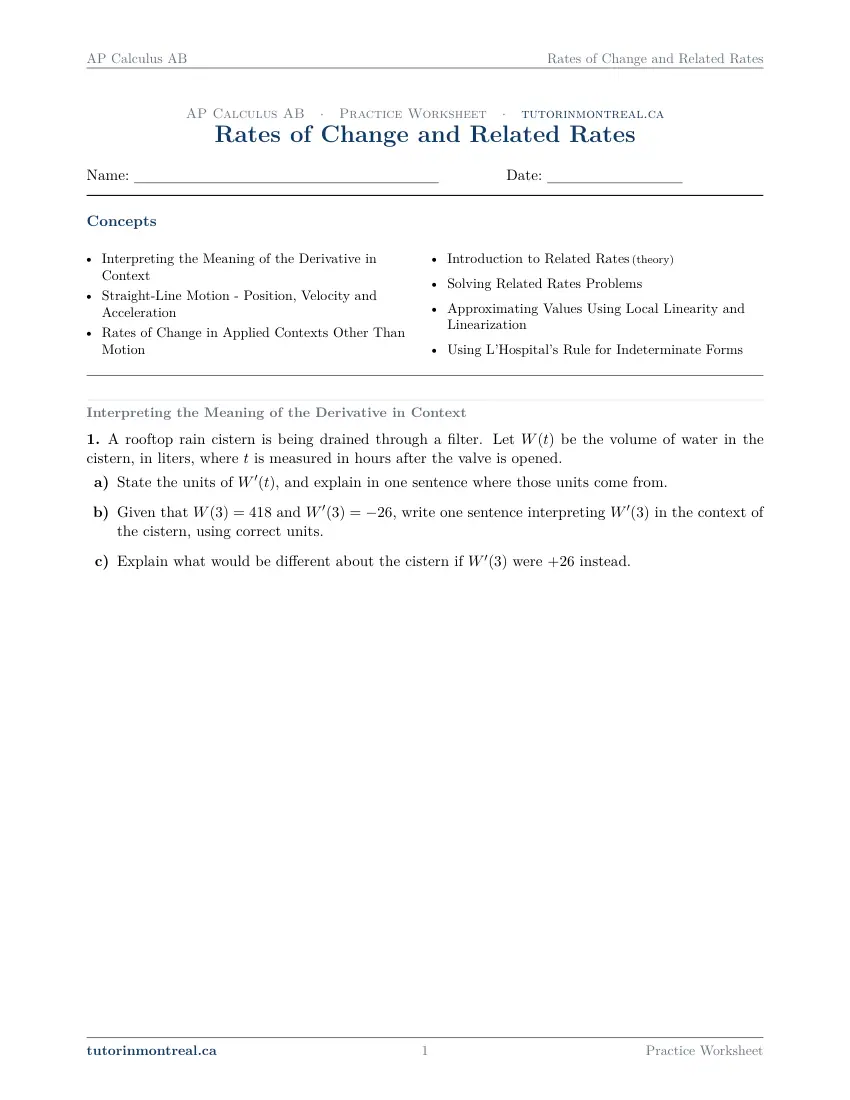
Practice worksheet — free PDF
No email, no account, no watermark. Teachers: photocopy it for your classes freely. Worked solutions and 7 harder problems come with the AP Calculus AB bundle.
All 8 questions
Each question targets one named concept from the sheet. Read them here, or print the PDF — it has working space under each one.
-
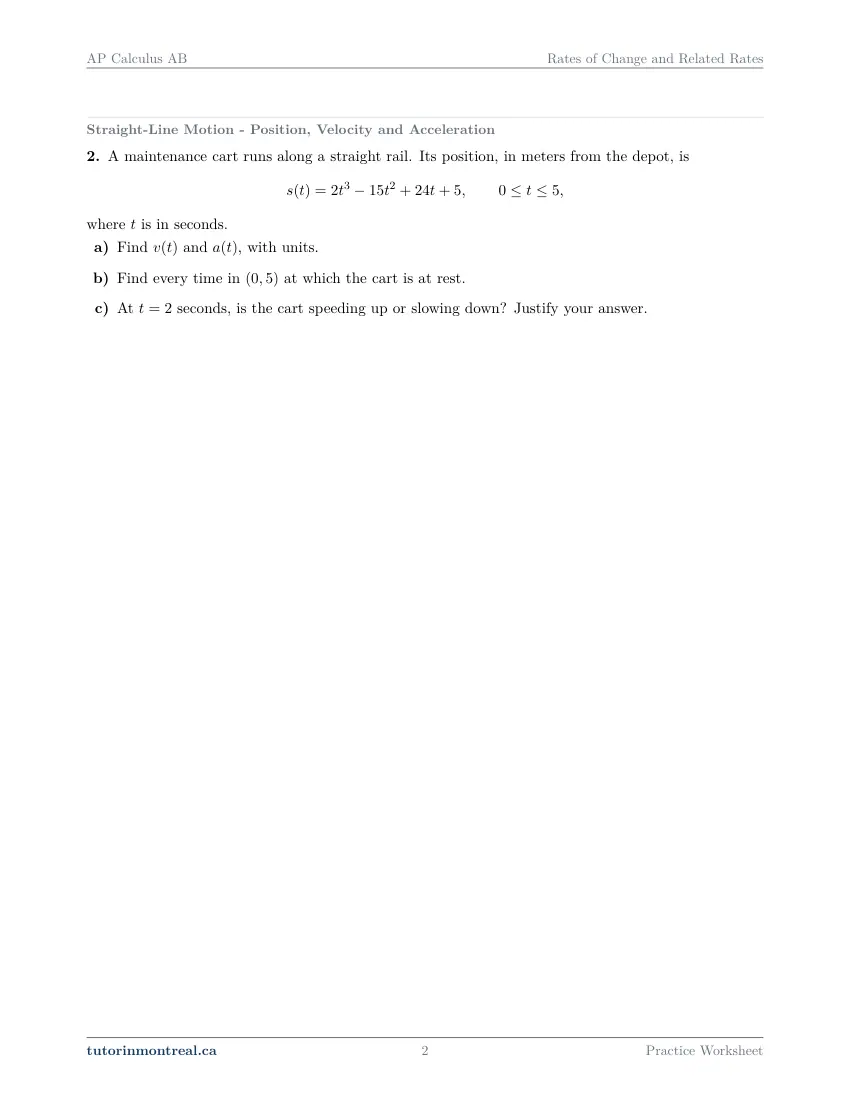
Q1Interpreting the Meaning of the Derivative in Context
A rooftop rain cistern is being drained through a filter. Let be the volume of water in the cistern, in liters, where is measured in hours after the valve is opened.
- State the units of , and explain in one sentence where those units come from.
- Given that and , write one sentence interpreting in the context of the cistern, using correct units.
- Explain what would be different about the cistern if were instead.
-
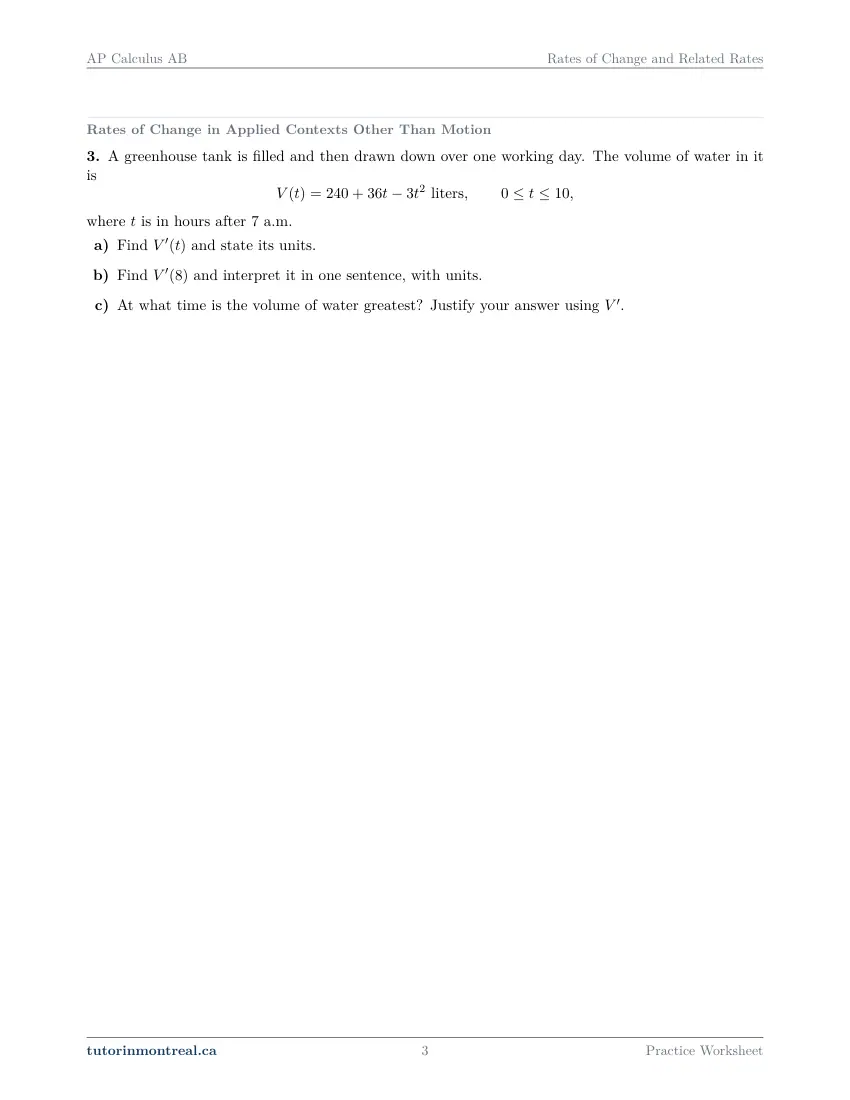
Q2Straight-Line Motion - Position, Velocity and Acceleration
A maintenance cart runs along a straight rail. Its position, in meters from the depot, is where is in seconds.
- Find and , with units.
- Find every time in at which the cart is at rest.
- At seconds, is the cart speeding up or slowing down? Justify your answer.
-
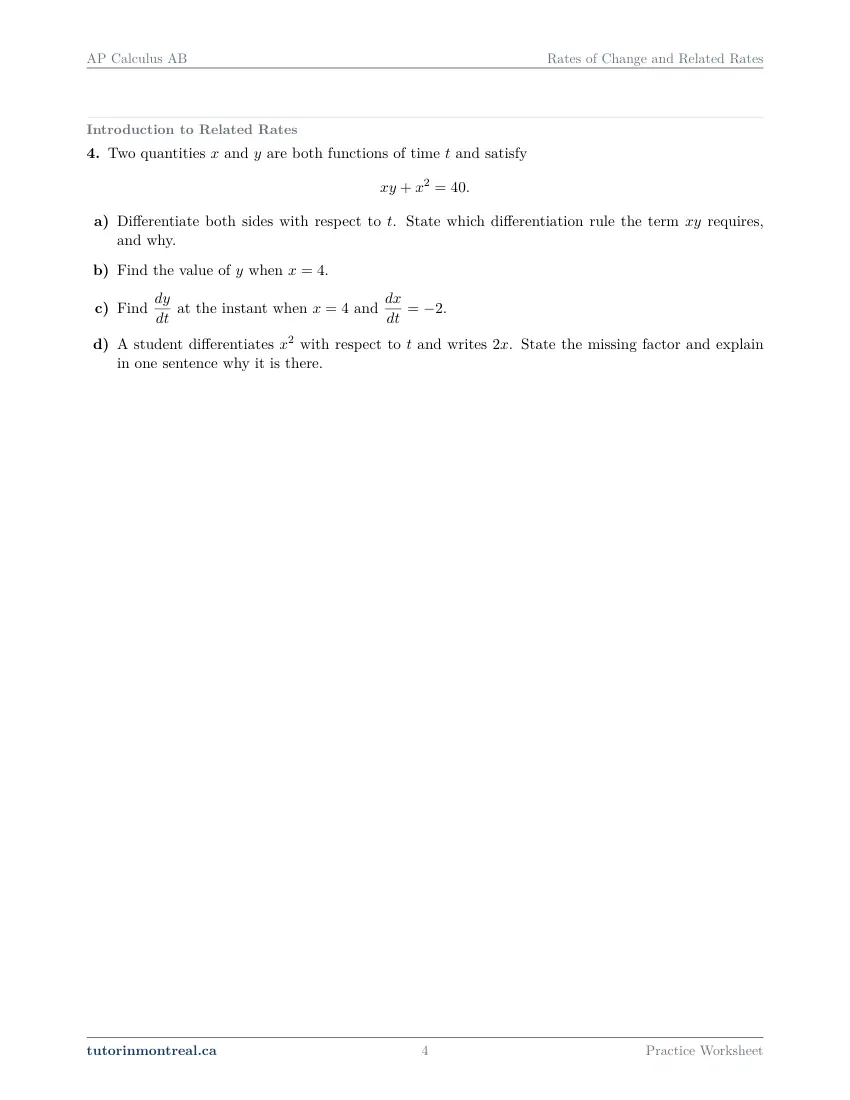
Q3Rates of Change in Applied Contexts Other Than Motion
A greenhouse tank is filled and then drawn down over one working day. The volume of water in it is where is in hours after 7 a.m.
- Find and state its units.
- Find and interpret it in one sentence, with units.
- At what time is the volume of water greatest? Justify your answer using .
-
Q4Introduction to Related Rates
Two quantities and are both functions of time and satisfy
- Differentiate both sides with respect to . State which differentiation rule the term requires, and why.
- Find the value of when .
- Find at the instant when and .
- A student differentiates with respect to and writes . State the missing factor and explain in one sentence why it is there.
-
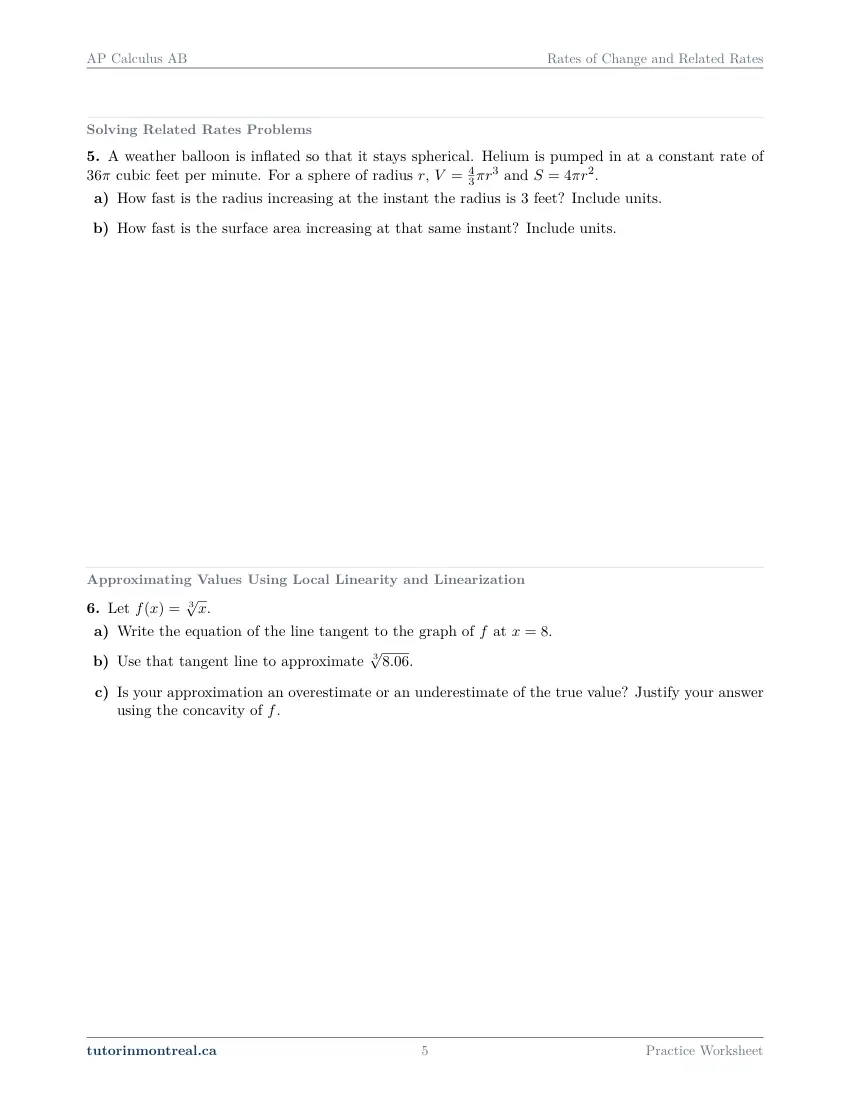
Q5Solving Related Rates Problems
A weather balloon is inflated so that it stays spherical. Helium is pumped in at a constant rate of cubic feet per minute. For a sphere of radius , and .
- How fast is the radius increasing at the instant the radius is feet? Include units.
- How fast is the surface area increasing at that same instant? Include units.
-
Q6Approximating Values Using Local Linearity and Linearization
Let .
- Write the equation of the line tangent to the graph of at .
- Use that tangent line to approximate .
- Is your approximation an overestimate or an underestimate of the true value? Justify your answer using the concavity of .
-
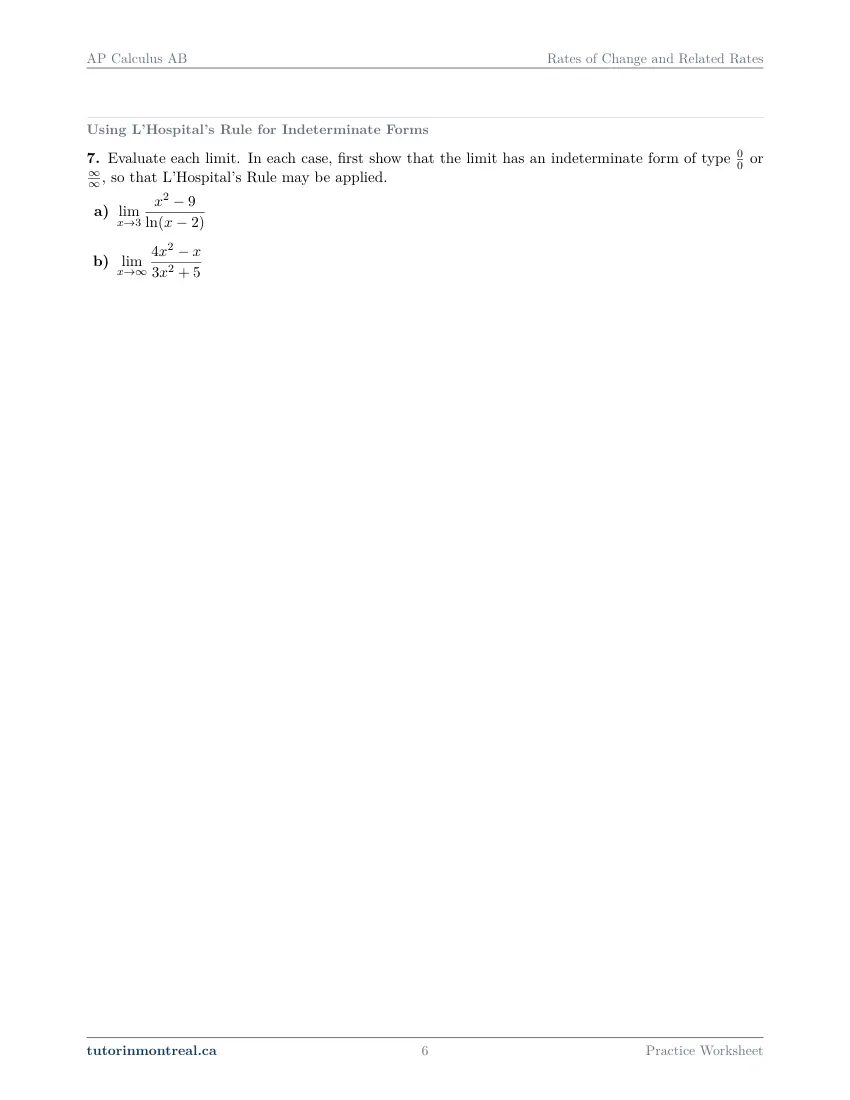
Q7Using L'Hospital's Rule for Indeterminate Forms
Evaluate each limit. In each case, first show that the limit has an indeterminate form of type or , so that L'Hospital's Rule may be applied.
-
Q8Synthesis — drawing on several topics in this unit
A test sled is fired along a straight horizontal track. Let be its position in meters from the launch point, with in seconds. Instruments record , and .
- Interpret in one sentence in the context of the sled, with units.
- Use the line tangent to the graph of at to approximate , with units.
- Is the sled speeding up or slowing down at ? Justify your answer.
- Assuming for all near , is your answer to (b) an overestimate or an underestimate of the true position? Justify.
The 7 challenge problems for this topic are a separate, paid sheet and are not reproduced here.
Which stream is this for? This sheet is built for AP Calculus AB. Everything on it sits inside the AB course description — no BC material, so no parametric or vector motion, no polar rates and no series. A BC student can use it as revision; an AB student needs all of it.
How to do every concept on this sheet
This is the part worksheet sites usually leave out. Below is the actual reasoning behind each group of questions — not a full solution set, the decisions that get you to one. Read it before you start, or after you get stuck.
The interpretation sentence — this is where the free marks are
Q1 and Q8(a) both ask you to say what a derivative means. Readers of AP responses are not looking for the number, which you were given; they are looking for a sentence that names the quantity, the direction, the rate, the moment and the units. Miss one of the five and the sentence stops earning.
Building the sentence, in order
Write it the same way every time and it stops being a thinking problem.
- 1Name the quantity, not the letter
Not "W is changing" but "the volume of water in the cistern". The letter is your notation; the reader wants the thing.
- 2Read the sign as a direction
Negative means decreasing, positive means increasing. Then quote the rate as a positive size: "decreasing at 26 liters per hour" reads better than "changing at −26 liters per hour", and both are accepted — "is −26 liters" is not.
- 3Attach the units
The units of f'(a) are always the units of f divided by the units of the input. Liters over hours gives liters per hour; meters over seconds gives meters per second. You can write the units before you have done any thinking at all.
- 4Anchor the instant
"At t = 3 hours after the valve is opened". A derivative is a rate at one moment, not an average over the interval, and the phrase that says so is part of the answer.
The single most common lost mark: reporting f'(a) as though it were f(a). In Q1 the cistern holds 418 liters at t = 3 and its volume is falling by 26 liters per hour at that same instant. Those are two different quantities with two different units. If your sentence would still make sense with the word "per" deleted, you have written an amount where a rate belongs.
Reading a model for when a quantity peaks
Q3 gives the volume in a tank as a function of time and asks when it is greatest. The justification has to be about V', not about V:
V'(t) = 0 and V' changes from positive to negative ⇒ V has a maximum thereFinding the t that makes V' zero is half a mark; saying what V' does on each side of it is the other half. "Volume rising before, falling after, so the turning point is a maximum" is the whole argument in one line. Plugging a couple of t values into V and comparing them is not — a maximum is a claim about every nearby point, and only the sign of the derivative can support it.
Straight-line motion: v, a, and what "speeding up" actually means
Position, velocity and acceleration are one chain of derivatives:
v(t) = s'(t) a(t) = v'(t) = s''(t)"At rest" means v(t) = 0 — solve it, keep only the times inside the given interval, and factor rather than expand, since the factored form is what you will need for signs a moment later. Q2 asks whether the cart is speeding up at a particular instant, and that is a question about speed, which is |v|, not about velocity.
The rule: the object is speeding up when v and a have the same sign, and slowing down when their signs are opposite. Acceleration is pushing in the direction of travel, or against it. That is the entire test, and it works whether the motion is forwards or backwards.
The trap is the negative case. With v < 0 and a < 0, the object is speeding up — it is moving backwards, faster and faster. Students read "acceleration is negative" as "slowing down" and lose the mark, because in everyday English "decelerating" and "negative acceleration" sound like the same thing. They are not. Never decide this from the sign of a alone: compute v and a at the instant, compare their signs, and say in your justification that they match (or don't). A negative velocity means moving in the negative direction, nothing more.
Displacement and total distance are two different questions
Displacement over [a, b] is the net change in position, s(b) − s(a): one subtraction, sign included, direction included. Total distance is how far the object actually travelled, and it ignores direction entirely.
They agree only when the object never turns around. So the work is to find where it turns: solve v(t) = 0, keep the times strictly inside the interval, and check that v really changes sign there. Then split the interval at those times, take the change in position across each piece separately, and add the sizes of those changes.
Why you cannot fix this at the end: if you compute s(b) − s(a) first, the outward leg and the return leg have already cancelled inside that single subtraction. Taking an absolute value afterwards makes the answer positive; it does not put back the distance that the cancellation destroyed. The absolute values have to go on the individual pieces, which means the interval has to be split before any subtracting happens.
Related rates: differentiate first, substitute last
Q4 is the mechanism stripped of any story, and Q5 is the same mechanism wearing one. Both come down to the fact that every variable is secretly a function of t, so differentiating the relation with respect to t turns a statement about quantities into a statement about their rates. The order below is not a style preference — swapping the last two steps is the single most common way these problems go wrong.
The five steps, in this order
Every related-rates problem, from the balloon to anything the exam invents.
- 1Name the variables and the rates
Write "r = radius in feet, t = time in minutes, dV/dt = 36π ft³/min, find dr/dt when r = 3". Now you know what you have and what you want, and you have committed to units.
- 2Write the relation between the quantities
An equation with no derivatives in it — a volume formula, a Pythagorean relation, a similar-triangles ratio, or an equation the question simply hands you. This step is the geometry; nothing after it is.
- 3Differentiate both sides with respect to t
Not with respect to r or x. Every variable picks up its own rate factor by the chain rule, and a product of two variables needs the product rule first.
- 4Now substitute the instant's values
Put in the numbers that describe this one moment — r = 3, dV/dt = 36π — only once the differentiating is finished.
- 5Solve, and state units
Feet per minute for a radius rate, square feet per minute for an area rate. The units of dQ/dt are always the units of Q per unit of time, so you can write them before solving.
Substituting early freezes something that is moving. Put r = 3 into V = (4/3)πr³ before differentiating and you get a constant, whose derivative is zero — you have accidentally told the calculus that the balloon is not inflating. A number is safe to substitute early only if the quantity is constant for all t, not just at the instant you care about, and a genuinely constant quantity is exactly the one whose derivative is zero. When in doubt, keep it a letter.
The chain rule factor that gets dropped
Q4(d) is built around it directly. Differentiating x² with respect to x gives 2x; differentiating it with respect to t gives
d/dt (x²) = 2x · dx/dtbecause x is itself a function of t and the chain rule asks for the derivative of the inside. The same reasoning puts a dy/dt on any y term and, in a product like xy, gives the product rule with a rate factor on each piece. A quick check on any related-rates line you have written: every variable term should carry exactly one d(something)/dt. A term with none of them is a term you differentiated as if t were not there.
Linearization, and which side of the curve the tangent line is on
The tangent line at x = a is the best straight-line stand-in for f near a:
L(x) = f(a) + f'(a)(x − a), and f(x) ≈ L(x) for x near aQ6 builds it for the cube-root function and uses it near x = 8; Q8(b) does the same for a sled's position. Choose a to be the nearby point where f and f' are easy — 8 for a cube root, the instant the instruments reported for the sled — and then the arithmetic is one multiplication.
The follow-up, "is this an over- or an underestimate?", is always settled by the concavity, and the argument is one sentence:
Concave up (f'' > 0): the graph bends away above the tangent line, so the
line sits below the curve and L(x) is an underestimate.
Concave down (f'' < 0): the graph bends below the tangent line, so the line
sits above the curve and L(x) is an overestimate.
Write the justification with the second derivative in it — "f''(x) < 0 near x = 8, so f is concave down there and its graph lies below the tangent line" — because that is what is being marked.
It is not about the direction you moved. Approximating at x = 8.06 rather than 7.94 does not flip the answer, and neither does the object travelling forwards rather than backwards. A concave-down curve lies below its tangent line on both sides of the point of tangency. The only thing that changes the verdict is the sign of f''. And remember that "near" is doing real work: the error grows with the distance from a, so an estimate made far from the tangency point can be the right side of the curve and still be useless.
L'Hospital's rule: check the form before you use it
Q7 asks you to first show that each limit is indeterminate, and that instruction is the question. The rule licenses differentiating the numerator and the denominator separately — not as a quotient — and it applies to exactly two forms:
0 ⁄ 0 and ∞ ⁄ ∞So the first line of your solution substitutes the target value into the top and the bottom and reports what each one tends to. Only then does the rule come out. If one application leaves you with 0/0 again, apply it again, saying so each time.
A nonzero number over zero is not indeterminate. A form such as 3/0 has no ambiguity in it at all — the quotient grows without bound, and the only real question left is the sign, which you settle by looking at the two sides separately. Using L'Hospital's rule on it produces a number, and the number is wrong, because the hypothesis of the rule was never met. The same goes for 0/5, which is simply 0. Substituting first costs you ten seconds and is the difference between a valid solution and a confident wrong one.
Preview all 7 pages
Click any page to open the full PDF.
Getting the most out of it
Write the units before you write the number
You can fill in "liters per hour" or "meters per second squared" the moment you have read the question, long before you have differentiated anything. Doing it in that order means the units are never the thing you forget under time pressure, and a rate whose units you cannot name is usually a rate you have set up wrong.
Make a sign line for v before answering anything about motion
Factor v(t), mark its zeros on a number line, and note the sign of v on each stretch. That one picture answers "when is it at rest", "which way is it moving", "when does it turn around" and — once you add the sign of a — "is it speeding up", without you having to re-derive anything.
Keep everything a letter until the last possible line
In related rates, do the differentiation entirely in symbols and substitute the instant's values only into the finished derivative equation. It is slower to type and far faster to fix: if a number appears in your working before the d/dt line, it is worth checking whether the quantity it stands for was actually constant.
Say the answer back as a sentence
"The radius is growing by one foot every minute at the moment it reaches three feet." If the sentence sounds like nonsense, the arithmetic probably is. This is also exactly the sentence the interpretation parts want, so you have written the answer twice for the price of once.
Want the solutions, or something more challenging?
The worksheet, the questions above and every explanation on this page stay free permanently. Three more PDFs exist for this topic — the worked answer key, a harder problem set, and the answer key to that. They come with the AP Calculus AB Solutions Bundle, which is what keeps the rest of the series free.
What else exists for Rates of Change and Related Rates
Three PDFs · 13 pages · all three are in the bundle below.
- Answer key — 3 pages. All 8 questions worked step by step, including the restrictions and the justifications. Not a list of final answers.
- Challenge problems — 7 pages, 7 problems. A separate sheet at exam-plus difficulty covering the same 7 concepts. Harder than anything on the free sheet.
- Challenge answer key — 3 pages. Every challenge problem worked to the same standard, with the checks shown.
- PDF, letter size, print-ready.
The one thing that's for sale
Every AP Calculus AB topic — the complete Solutions Bundle
One download, one payment, the whole program. Every answer key and every challenge set for all 8 AP Calculus AB worksheet sets — including this one.
- Worked solutions, not answer lists — every step written out
- Covers the whole year's program at this level
- Less than the price of one hour of tutoring — for the entire year's solutions
Taking Secondary 1 Math as well? The Secondary 1 Math bundle covers all 15 of its sets — 45 PDFs, 182 pages — on the same terms.
Taking Secondary 2 Math as well? The Secondary 2 Math bundle covers all 14 of its sets — 42 PDFs, 181 pages — on the same terms.
Taking Secondary 3 Math as well? The Secondary 3 Math bundle covers all 11 of its sets — 33 PDFs, 154 pages — on the same terms.
Taking Secondary 4 Math as well? The Secondary 4 Math bundle covers all 17 of its sets — 51 PDFs, 154 pages — on the same terms.
Taking Secondary 5 Math as well? The Secondary 5 Math bundle covers all 21 of its sets — 63 PDFs, 228 pages — on the same terms.
Taking CEGEP Calculus I as well? The CEGEP Calculus I bundle covers all 8 of its sets — 24 PDFs, 82 pages — on the same terms.
Taking CEGEP Calculus II as well? The CEGEP Calculus II bundle covers all 8 of its sets — 24 PDFs, 90 pages — on the same terms.
Taking CEGEP Linear Algebra as well? The CEGEP Linear Algebra bundle covers all 7 of its sets — 21 PDFs, 82 pages — on the same terms.
Common questions
Is this worksheet really free?
Yes — the questions are on this page to read, and the PDF downloads directly, no email and no account. The one paid item is optional: the complete AP Calculus AB Solutions Bundle, which covers every set at this level.
How do I interpret f'(a) in a sentence, and what do the units have to be?
Name the quantity in words, say whether it is increasing or decreasing according to the sign, give the rate, and anchor it to the instant. The units are always the units of the output divided by the units of the input — liters per hour, degrees per minute, meters per second. Reporting a rate as if it were an amount is the most common way this mark is lost.
How do I tell whether an object is speeding up or slowing down?
Compute both v and a at that instant and compare their signs. Same sign means speeding up, opposite signs mean slowing down. A negative acceleration on its own tells you nothing — with a negative velocity it means the object is moving backwards and getting faster.
What is the difference between displacement and total distance?
Displacement is the net change in position, so travel in opposite directions cancels. Total distance ignores direction. To get it you must locate the times where v changes sign, split the interval there, and add the sizes of the position changes on each piece — an absolute value applied at the end cannot undo a cancellation that has already happened.
Why do I have to differentiate before substituting in a related rates problem?
Because substituting a value for a moving quantity turns it into a constant, and constants differentiate to zero — you would be telling the calculus that something which is changing is not. Differentiate the relation with respect to t in symbols, then put in the instant's values. Only quantities that are constant for all t may be substituted early.
When is a tangent-line approximation an overestimate?
When the curve is concave down near the point of tangency, since the graph then lies below its tangent line. Concave up gives an underestimate. The verdict comes from the sign of the second derivative, not from whether you moved left or right of the point, and it holds on both sides.
When am I allowed to use L'Hospital's rule?
Only after substituting and finding the form 0/0 or infinity over infinity. A form like a nonzero number over zero is not indeterminate, so the rule does not apply and using it gives a wrong answer. Show the check first, then differentiate numerator and denominator separately — never as a quotient.
Does this cover BC material as well?
No. It is built for AP Calculus AB and stays inside the AB course description, so there is no parametric or vector motion, no polar rates and no series. BC students can use it as revision of the shared material.
Can teachers use this in class?
Yes. Print and photocopy it for your own classes freely — I just ask that the tutorinmontreal.ca footer stays on the page.
I'm stuck on one question. Can you help?
Yes — through one-on-one tutoring, in Montreal or online. Get in touch to arrange a session, or see the current rates.
← All 8 AP Calculus AB worksheets · Secondary 1 Math series (15 sheets) → · Secondary 2 Math series (14 sheets) → · Secondary 3 Math series (11 sheets) → · Secondary 4 Math series (17 sheets) → · Secondary 5 Math series (21 sheets) → · CEGEP Calculus I series (8 sheets) → · CEGEP Calculus II series (8 sheets) → · CEGEP Linear Algebra series (7 sheets) →