AP Calculus AB Unit 2 — Definition of the Derivative and the Basic Rules
Unit 2 is where the derivative stops being a limit you compute by hand and becomes a rule you apply — but only after you can do it the slow way. These questions run that whole arc: average versus instantaneous rate, the definition itself in both of its forms, an estimate read off a table, the one place differentiability fails while continuity survives, and then the power, constant-multiple, product and quotient rules on polynomials, radicals, sin x, cos x, e^x and ln x. Have a look on this page, then print the free PDF when you want to write on it.
Practice worksheet — free PDF
No email, no account, no watermark. Teachers: photocopy it for your classes freely. Worked solutions and 9 harder problems come with the AP Calculus AB bundle.
All 11 questions
Each question targets one named concept from the sheet. Read them here, or print the PDF — it has working space under each one.
-
Q1Average and Instantaneous Rates of Change at a Point
A camera drone rises straight up from a rooftop. Its height above the roof, in meters, is , where is measured in seconds and .
- Find the average rate of change of on the interval , with units.
- Use the limit to find the instantaneous rate of change of at , with units.
-
Q2Defining the Derivative and Using Derivative Notation
Let .
- Use the definition to find .
- If , write the value found in part (a) in Leibniz notation.
-
Q3Estimating the Derivative of a Function at a Point
The water temperature , in degrees Celsius, inside a solar collector is recorded every four minutes after sunrise: , , , , , where is in minutes.
- Use the two recorded values on either side of to estimate . Give units.
- Interpret your estimate in one sentence a technician would understand.
-
Q4Connecting Differentiability and Continuity
Let .
- Show that is continuous at .
- Using one-sided limits of the difference quotient at , show that does not exist.
- State, in one sentence, what this pair of results shows about the relationship between continuity and differentiability.
-
Q5Applying the Power Rule
Find for , and state the domain of .
-
Q6Constant, Sum, Difference and Constant Multiple Rules
The functions and are differentiable, and and . Let . Find , and name the derivative rule that justifies each step.
-
Q7Derivatives of cos x, sin x, e^x and ln x
Find for , and state the domain of .
-
Q8The Product Rule
Let .
- Find using the product rule.
- Expand first and differentiate the result, and check that the two answers agree.
-
Q9The Quotient Rule
Find for , and simplify the numerator.
-
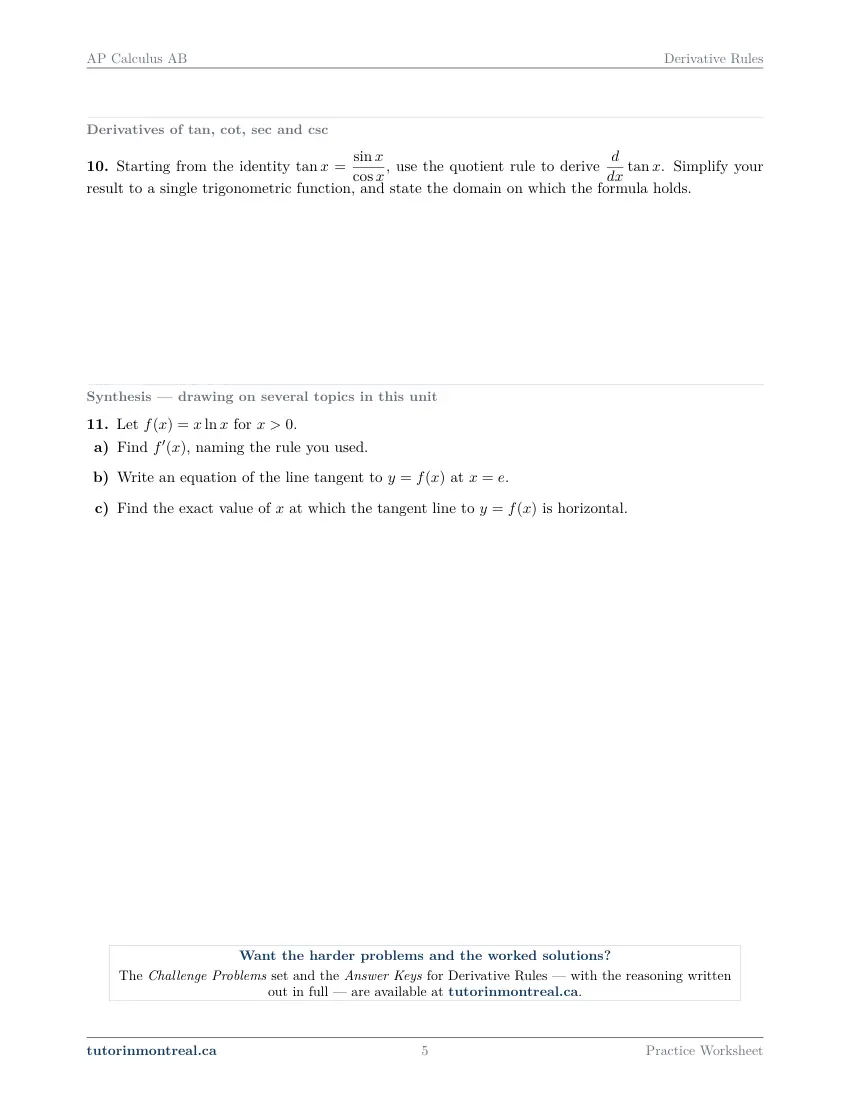
Q10Derivatives of tan, cot, sec and csc
Starting from the identity , use the quotient rule to derive . Simplify your result to a single trigonometric function, and state the domain on which the formula holds.
-
Q11Synthesis — drawing on several topics in this unit
Let for .
- Find , naming the rule you used.
- Write an equation of the line tangent to at .
- Find the exact value of at which the tangent line to is horizontal.
The 9 challenge problems for this topic are a separate, paid sheet and are not reproduced here.
Which stream is this for? This is AP Calculus AB, built against the College Board Unit 2 framework — Differentiation: Definition and Fundamental Properties. It is not BC material, and it deliberately contains no chain rule: every function here is a sum, a constant multiple, a product or a quotient of things you can differentiate directly, never a composite. Composites arrive in Unit 3, so if you are looking for something like sin(3x) or e to the power of a function of x, that is the next sheet, not this one.
How to do every concept on this sheet
This is the part worksheet sites usually leave out. Below is the actual reasoning behind each group of questions — not a full solution set, the decisions that get you to one. Read it before you start, or after you get stuck.
The difference quotient has two forms — pick the convenient one
Both compute the same number, the slope of the tangent to y = f(x) at x = a. They differ only in what the variable is, and that decides which is easier to work with.
f′(a) = limh→0 (f(a+h) − f(a)) ⁄ h or f′(a) = limx→a (f(x) − f(a)) ⁄ (x − a)Use the h form when you are handed a specific function and a specific point and asked to grind it out: you expand f(a+h), the constant terms cancel against −f(a), every surviving term carries a factor of h, and the h divides out. Expanding is mechanical, which is exactly what you want under time pressure.
Use the x → a form when the quotient is already written with a denominator like x − 3 and you can see a factor waiting to cancel. It is also the form that lets you recognise a limit as a derivative in disguise — see the last section below. The letter naming the increment is not sacred, by the way: a question may call it k rather than h, and nothing changes.
Why the limit is not optional
Substitute h = 0 into (f(a+h) − f(a))⁄h before simplifying and you get 0⁄0 — an indeterminate form, which is a label for a situation, not a value. It decides nothing. The whole procedure is: simplify while h is still nonzero, which is what makes the cancellation legal, and only then let h → 0.
Computing f′(a) from the definition
Four steps, in this order. Skipping straight to the answer is where the algebra marks are lost.
- 1Write f(a+h) out in full
Expand every bracket and collect like terms before you do anything else. Squaring a binomial in your head is the single most common source of a wrong derivative here.
- 2Subtract f(a) and watch the constants die
If the constant terms do not cancel, you have made an arithmetic error — they must, because f(a+0) = f(a). This is a free check, so use it.
- 3Factor h out and cancel it
Every remaining term contains h. Write the cancellation as valid for h ≠ 0, which is the honest statement: the two expressions agree everywhere except at the one point you are approaching.
- 4Now take the limit
With h gone from the denominator, substitution is finally legal. Then answer the question asked: a rate of change needs units, and in Leibniz notation the value at a point is written dy⁄dx evaluated at x = a, not just dy⁄dx.
Average rate of change and instantaneous rate of change are different objects, and a question that asks for both in one breath is testing that you know it. The average rate over [a, b] compares two endpoints and says nothing about what happened between them; the instantaneous rate is the limit of those averages as the interval shrinks to a point. A quantity can return to exactly where it started — average rate zero — while changing at every instant in between.
Estimating f′(a) from a table
When you are given data rather than a formula, there is no limit to take. The best you can do is a difference quotient over a short interval — and the choice of interval is the question.
Prefer the two entries that straddle a: one before, one after. A straddling estimate averages the behaviour on both sides, so it does not inherit the bias of a curve that is bending. A one-sided estimate — the entry at a and the next one along — systematically overshoots or undershoots depending on which way the graph is curving, and on a table with unevenly spaced rows it can be badly off.
Then state the units. The units of f′ are always the units of f divided by the units of the input, and an interpretation sentence that omits them has not interpreted anything.
A quick sanity test costs nothing: compute the one-sided estimates on either side as well. Your straddling value should land between them. If it does not, you have used the wrong rows or subtracted in the wrong order.
Differentiable ⇒ continuous, and never the reverse
This implication runs one way only. If f′(a) exists then f is continuous at a — no exceptions. The converse is false, and the sheet asks you to demonstrate it rather than assert it: a function can be perfectly continuous at a point and still have no derivative there.
The two failures worth recognising. At a corner, both one-sided limits of the difference quotient exist but disagree — the classic case is an absolute value, where the quotient reduces to |h|⁄h, equal to +1 on the right and −1 on the left. At a vertical tangent, the two sides agree in behaviour but the quotient grows without bound, so there is no slope at all; a cube-root shape does this. Both are continuous. Neither is differentiable.
The contrapositive is the useful direction in practice: if a function is not continuous at a — a jump, a hole, an asymptote — you do not need to test any difference quotient. It cannot be differentiable there.
Note what a proof of non-differentiability actually requires. Showing that the left-hand and right-hand limits of the difference quotient are different numbers is the argument; saying "the graph has a sharp point" is a description of the picture, not a reason.
The power rule, and the rewriting that has to happen first
The power rule differentiates xn to n·xn−1 for any real n — but it only applies to something already written as a power. Radicals and reciprocals must be rewritten before you touch them: √x is x1⁄2, and 1⁄x2 is x−2.
Two places marks disappear. The first is the sign on a negative exponent: differentiating −3x−2 multiplies −3 by −2 and gives +6x−3. Two negatives, one positive answer, and it is easy to carry the minus sign through by reflex.
The second is the domain. The domain of f′ is not automatically the domain of f. Differentiating a square root puts x in a denominator, so a function defined at x = 0 can have a derivative that is not — and when a question asks for the domain of f′, that gap is the whole point of asking.
The constant, sum, difference and constant-multiple rules are the easy ones, but name them when a question says to. Splitting a derivative across added terms is the sum and difference rule; pulling a coefficient out front is the constant multiple rule; sending a lone number to zero is the constant rule. Notice too that these rules relate derivatives only: to find the derivative of 3f − 2g at a point you need f′ and g′ there, and the values of f and g themselves are irrelevant.
sin x, cos x, ex and ln x
Four facts to know cold: sin x differentiates to cos x, cos x differentiates to −sin x, ex differentiates to itself, and ln x differentiates to 1⁄x.
(sin x)′ = cos x (cos x)′ = −sin x (ex)′ = ex (ln x)′ = 1⁄xThe minus sign on the cosine is the one that gets lost, and it gets lost twice over when the term already carries a negative coefficient: −4 cos x differentiates to +4 sin x. Also remember that ln x restricts the domain to x > 0 before you differentiate anything — a question asking for the domain of f is asking about ln, not about the derivative.
The remaining trig derivatives are not memorisation if you would rather not memorise them. Writing tan x as sin x ⁄ cos x and applying the quotient rule produces (cos²x + sin²x)⁄cos²x, which the Pythagorean identity collapses to 1⁄cos²x = sec²x. The same rewrite-then-quotient-rule route gives cot, sec and csc. And the formula holds exactly where the original function is defined — for tan x, wherever cos x ≠ 0.
The product rule is not the product of the derivatives
This is worth saying flatly because it is the most common wrong instinct in the unit. The derivative of a product has two terms, not one:
(uv)′ = u′v + uv′Writing u′v′ loses a whole term, and the loss is not cosmetic — it changes where the derivative is zero, so it changes the answer to any question about horizontal tangents. When both factors are polynomials you can check yourself for free by expanding first and differentiating the expansion; the two routes must agree. That check is unavailable the moment one factor is ex, ln x or a trig function, which is precisely when the product rule stops being optional.
One consequence to keep in mind when you interpret an answer: because the two terms can have opposite signs, the sign of (uv)′ is not determined by the sign of u′ alone. A decreasing factor multiplied by a fast-growing one can still give an increasing product. Magnitudes decide, not signs.
The quotient rule, and the order that is not symmetric
Swapping the two products in the product rule changes nothing — addition commutes. Swapping them in the quotient rule changes the sign of your entire answer, because subtraction does not.
(u⁄v)′ = (u′v − uv′) ⁄ v²Say it out loud as you write it: "low d-high minus high d-low, over low squared". The denominator goes first, the derivative of the numerator sits next to it, and the minus sign comes before the term containing v′. Getting the order backwards gives you exactly the negative of the right answer — which is why a slope that comes out with the wrong sign is nearly always this mistake and not an arithmetic slip.
Then distribute the minus sign across every term of the second product, not just the first. And do not cancel anything into v² before you have simplified the numerator; the factor you are tempted to cancel usually is not a factor of the whole numerator.
Two habits pay off afterwards. Simplify the numerator and leave the denominator factored — the questions that follow ask where f′ = 0, and only the numerator can supply those answers, since a fraction is zero only where its top is. And check the restrictions: whatever value makes v zero is excluded from the domain of f, and it must be excluded from the domain of f′ too. A point outside the domain of f cannot be in the domain of its derivative.
Recognising a limit that is secretly a derivative
A limit that gives 0⁄0 on substitution, whose numerator is a difference of two values of one function and whose denominator is the matching difference of inputs, is a derivative — and evaluating it by the rules of this unit takes one line instead of a page of algebra.
Read the numerator first. If it looks like f(something + h) minus a number, ask whether that number is f(something) — a limit whose numerator is cos(π⁄3 + h) − ½ is exactly this, because cos(π⁄3) is ½. Then f is cos and a is π⁄3, and the limit is f′(a) = −sin(π⁄3). Name the function and the point explicitly in your answer; that identification is what earns the mark, not the final number.
The same reading applies to the x → a form: a denominator of x − a with a numerator vanishing at x = a is the second difference quotient. Where the expression is a polynomial you can usually confirm your value a second way, by factoring out (x − a) and substituting — and a question that offers you a second method is telling you it wants the check.
Tangent lines, once you have f′(a)
A tangent line question needs two numbers, and students routinely compute only one. You need f′(a) for the slope and f(a) for a point on the line. Write it in point-slope form first — y − f(a) = f′(a)(x − a) — then simplify if you want to. "Horizontal tangent" means solve f′(x) = 0, and the question usually wants the points, so feed each x back into f, not into f′.
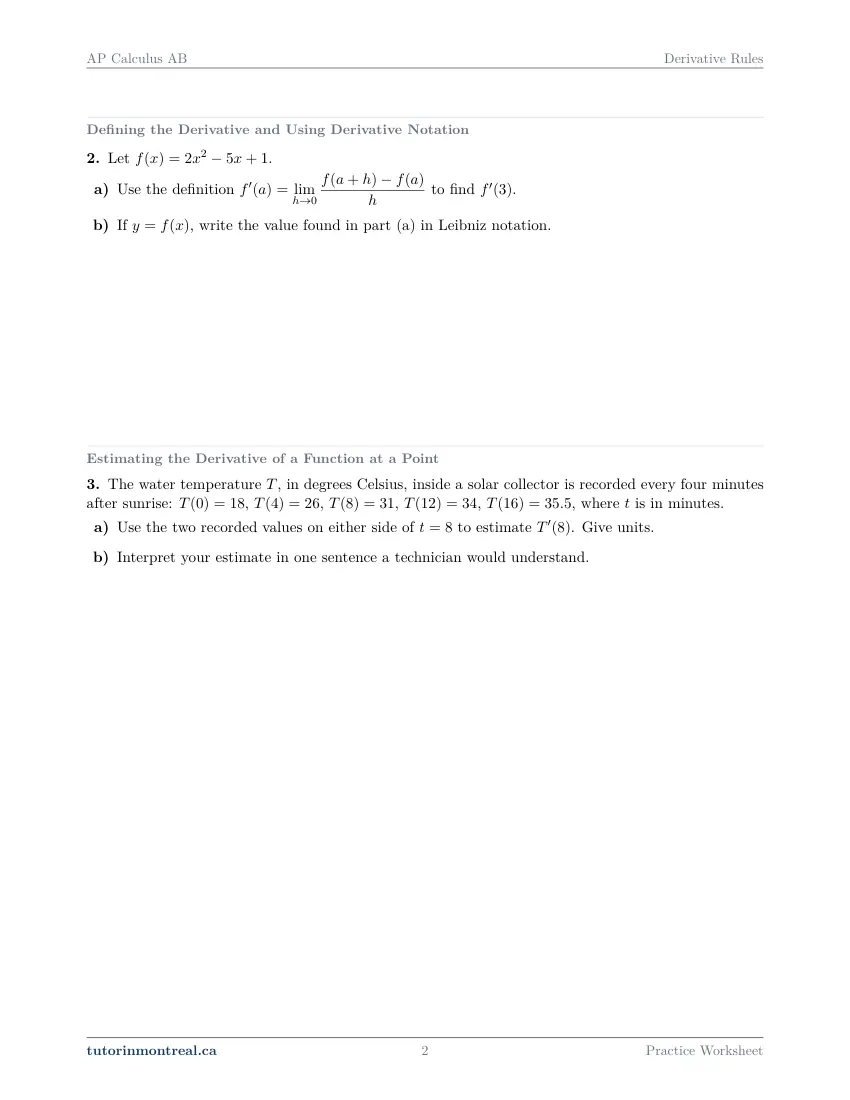
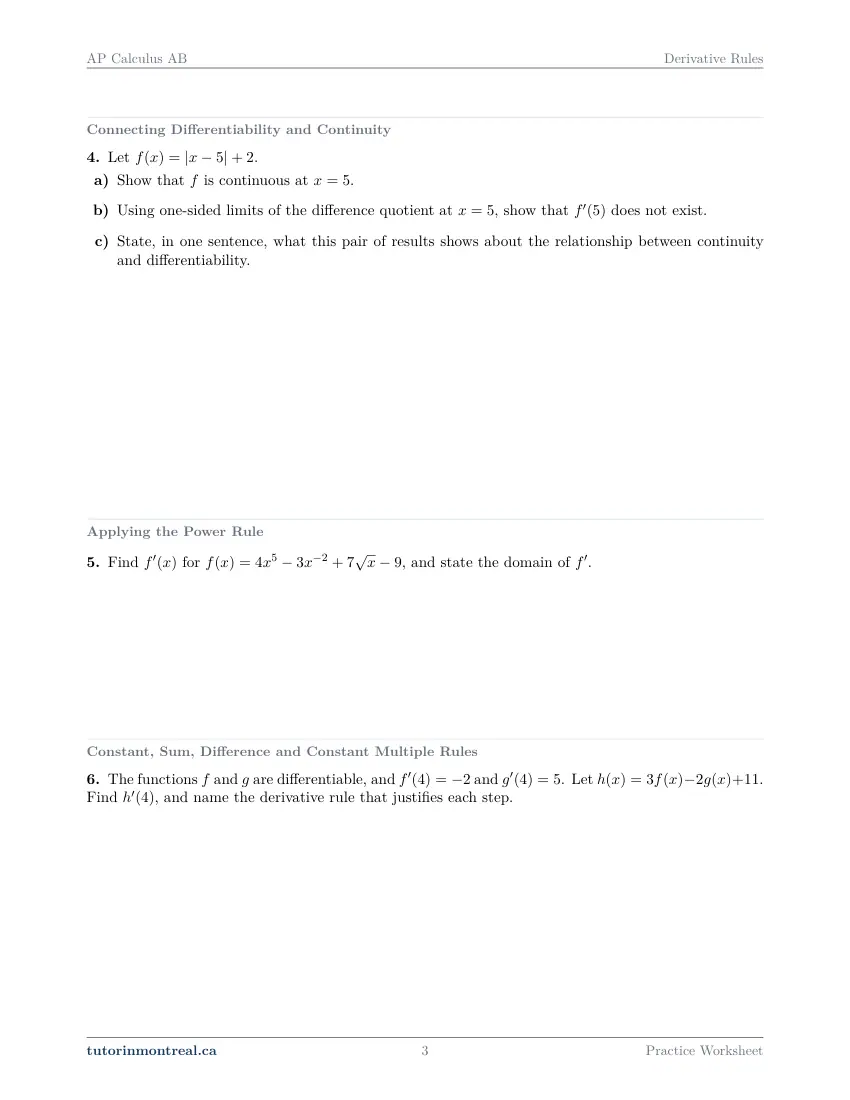
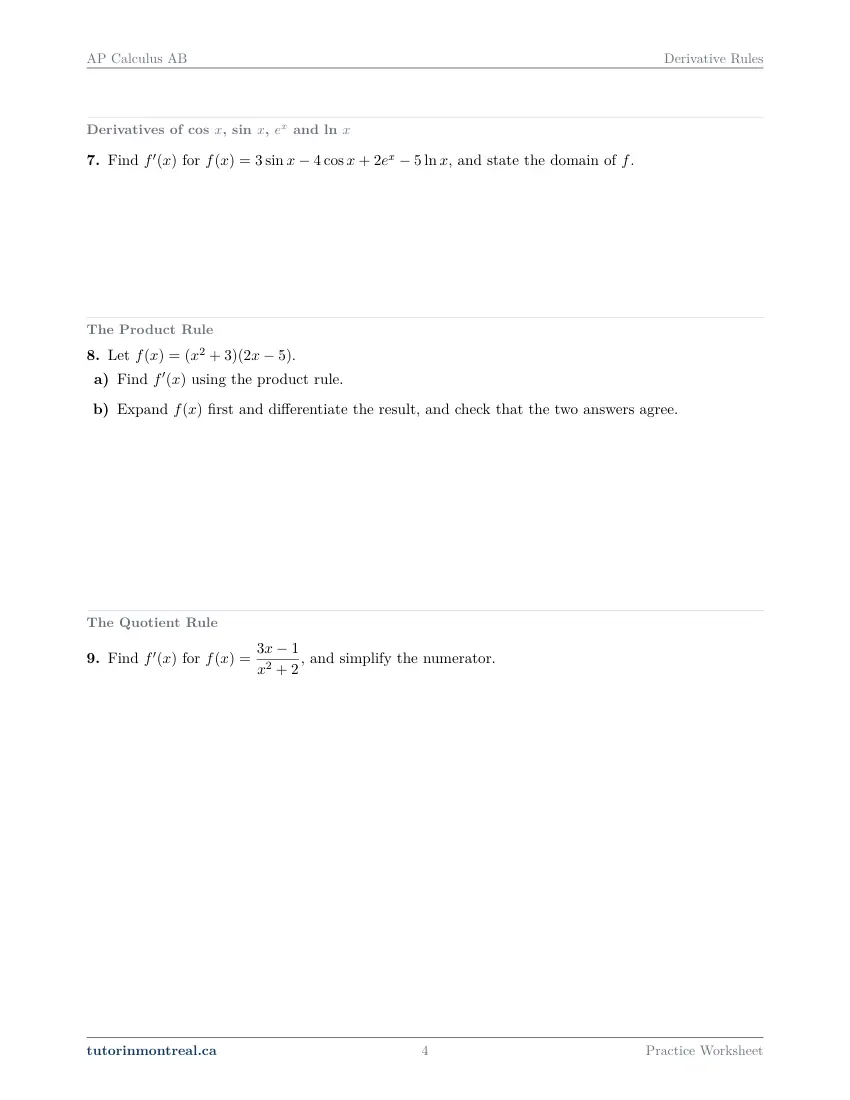
Preview all 5 pages
Click any page to open the full PDF.
Getting the most out of it
Do it the slow way before you use the rules
The definition questions come first on purpose. Once the power rule is in your hands it is tempting to answer everything with it, but AP questions ask for the limit definition by name — and when they do, an answer that quotes a rule earns nothing, however correct the number is.
Check every derivative against a second route
A product of polynomials can be expanded and differentiated instead. A quotient evaluated at a convenient x can be sanity-checked against the shape of the graph. A table estimate should sit between the two one-sided estimates. Each check takes seconds, and each one catches the sign error that is otherwise invisible.
Answer the question that was asked
Rates of change need units. "State the domain" is a separate mark from "find f′(x)". "Name the rule you used" wants the words product rule or constant multiple rule written down. Interpretation sentences should be readable by someone who is not doing calculus. These are the cheapest marks on any AP free-response question and the ones most often left on the table.
Want the solutions, or something more challenging?
The worksheet, the questions above and every explanation on this page stay free permanently. Three more PDFs exist for this topic — the worked answer key, a harder problem set, and the answer key to that. They come with the AP Calculus AB Solutions Bundle, which is what keeps the rest of the series free.
What else exists for Derivative Rules
Three PDFs · 14 pages · all three are in the bundle below.
- Answer key — 3 pages. All 11 questions worked step by step, including the restrictions and the justifications. Not a list of final answers.
- Challenge problems — 8 pages, 9 problems. A separate sheet at exam-plus difficulty covering the same 10 concepts. Harder than anything on the free sheet.
- Challenge answer key — 3 pages. Every challenge problem worked to the same standard, with the checks shown.
- PDF, letter size, print-ready.
The one thing that's for sale
Every AP Calculus AB topic — the complete Solutions Bundle
One download, one payment, the whole program. Every answer key and every challenge set for all 8 AP Calculus AB worksheet sets — including this one.
- Worked solutions, not answer lists — every step written out
- Covers the whole year's program at this level
- Less than the price of one hour of tutoring — for the entire year's solutions
Taking Secondary 1 Math as well? The Secondary 1 Math bundle covers all 15 of its sets — 45 PDFs, 182 pages — on the same terms.
Taking Secondary 2 Math as well? The Secondary 2 Math bundle covers all 14 of its sets — 42 PDFs, 181 pages — on the same terms.
Taking Secondary 3 Math as well? The Secondary 3 Math bundle covers all 11 of its sets — 33 PDFs, 154 pages — on the same terms.
Taking Secondary 4 Math as well? The Secondary 4 Math bundle covers all 17 of its sets — 51 PDFs, 154 pages — on the same terms.
Taking Secondary 5 Math as well? The Secondary 5 Math bundle covers all 21 of its sets — 63 PDFs, 228 pages — on the same terms.
Taking CEGEP Calculus I as well? The CEGEP Calculus I bundle covers all 8 of its sets — 24 PDFs, 82 pages — on the same terms.
Taking CEGEP Calculus II as well? The CEGEP Calculus II bundle covers all 8 of its sets — 24 PDFs, 90 pages — on the same terms.
Taking CEGEP Linear Algebra as well? The CEGEP Linear Algebra bundle covers all 7 of its sets — 21 PDFs, 82 pages — on the same terms.
Common questions
Is this worksheet really free?
Yes — the questions are on this page to read, and the PDF downloads directly, no email and no account. The one paid item is optional: the complete AP Calculus AB Solutions Bundle, which covers every set at this level.
Do I need the chain rule for any of this?
No. This is Unit 2, and nothing on the sheet is a composite function — every expression is a sum, a constant multiple, a product or a quotient of functions you differentiate directly. The chain rule is Unit 3, and reaching for it here is a sign you have misread the function.
Which form of the difference quotient should I use?
Use the h form, with f(a+h) minus f(a) over h, when you are given a formula and a point and have to compute — expanding is mechanical. Use the x approaching a form, with f(x) minus f(a) over x minus a, when a factor is already waiting to cancel or when you are trying to recognise a limit as a derivative. They give the same number.
Can a function be continuous but not differentiable?
Yes, and that is exactly what the absolute-value question demonstrates. Differentiability forces continuity, but not the other way round: at a corner the two one-sided limits of the difference quotient exist and disagree, and at a vertical tangent the quotient grows without bound. Both functions are continuous; neither has a derivative at that point.
Why isn't the derivative of a product just the product of the derivatives?
Because a product changes for two reasons at once — the first factor is changing and so is the second — and the product rule adds both contributions, u prime v plus u v prime. Keeping only one term drops a whole source of change and typically moves the points where the derivative is zero, so the error is not a small one.
Which two rows of a table should I use to estimate f'(a)?
The two closest entries that sit on opposite sides of a. A straddling estimate averages the behaviour on both sides rather than inheriting the bias of one; a one-sided estimate systematically over- or undershoots depending on how the graph is curving. Give the answer in the units of f divided by the units of the input.
Can teachers use this in class?
Yes. Print and photocopy it for your own classes freely — I just ask that the tutorinmontreal.ca footer stays on the page.
I'm stuck on one question. Can you help?
Yes — through one-on-one tutoring, in Montreal or online. Get in touch to arrange a session, or see the current rates.
← All 8 AP Calculus AB worksheets · Secondary 1 Math series (15 sheets) → · Secondary 2 Math series (14 sheets) → · Secondary 3 Math series (11 sheets) → · Secondary 4 Math series (17 sheets) → · Secondary 5 Math series (21 sheets) → · CEGEP Calculus I series (8 sheets) → · CEGEP Calculus II series (8 sheets) → · CEGEP Linear Algebra series (7 sheets) →