AP Calculus AB Unit 6 — Integration and Accumulation Worksheet
Unit 6 is where the integral stops being a picture and becomes a number you can justify: estimating with Riemann sums and naming the property that makes your estimate an over- or underestimate, running the Fundamental Theorem in both directions, reading an accumulation function off the graph of its rate, moving limits around with the definite-integral properties, and finding antiderivatives by substitution, long division or completing the square. Have a look on this page, then print the free PDF when you want to write on it.
Practice worksheet — free PDF
No email, no account, no watermark. Teachers: photocopy it for your classes freely. Worked solutions and 10 harder problems come with the AP Calculus AB bundle.
11 of the 12 questions
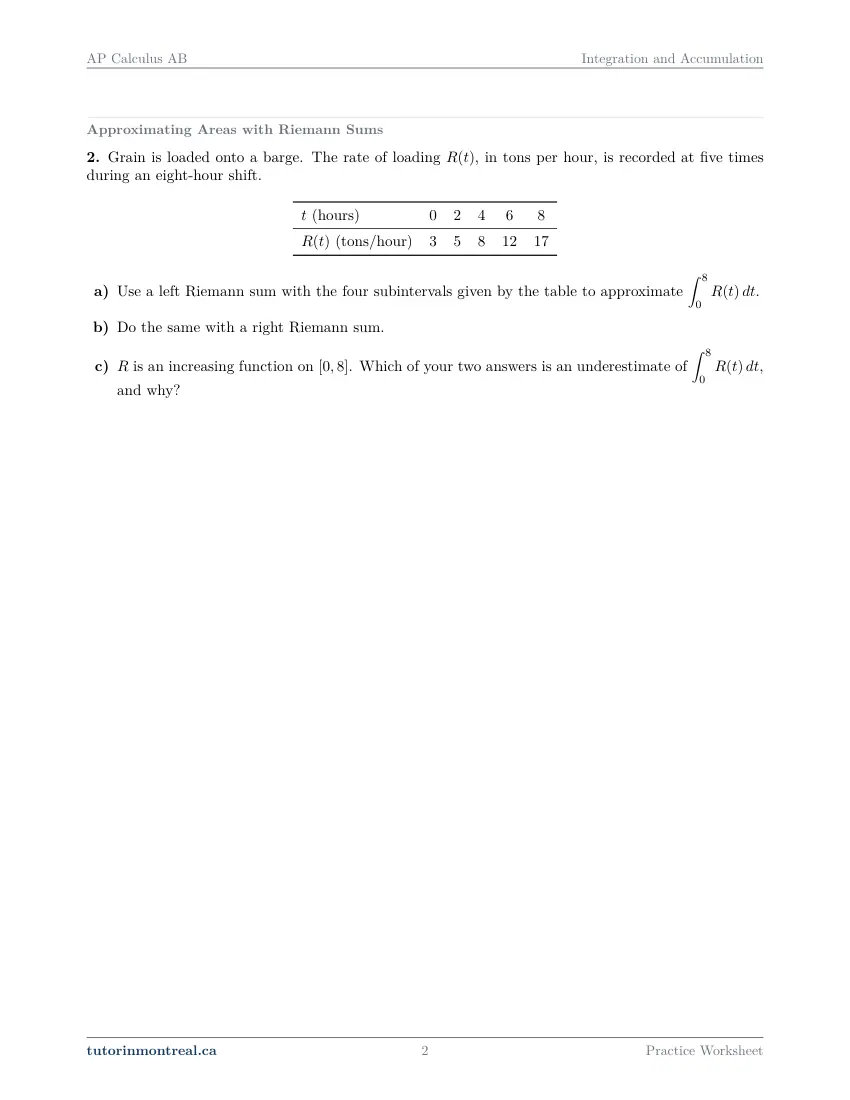
Each question targets one named concept from the sheet. Read them here, or print the PDF — it has working space under each one. 11 of the 12 questions are printed below. The other 1 is built on a diagram or a table of values that does not translate to the page, so it is in the free PDF — marked below where it would have come.
-
Q1Exploring Accumulations of Change
Meltwater runs off a glacier into a catch basin. For hours it enters at a rate , measured in liters per hour, and the graph of consists of two line segments: one from to , and one from to .
- Using geometry, find .
- State what this number represents about the basin, with units, and explain how the units of the answer follow from the units of and of .
-
Q2Approximating Areas with Riemann Sums
This question is built around a diagram or a table of values. Open it in the PDF.
-
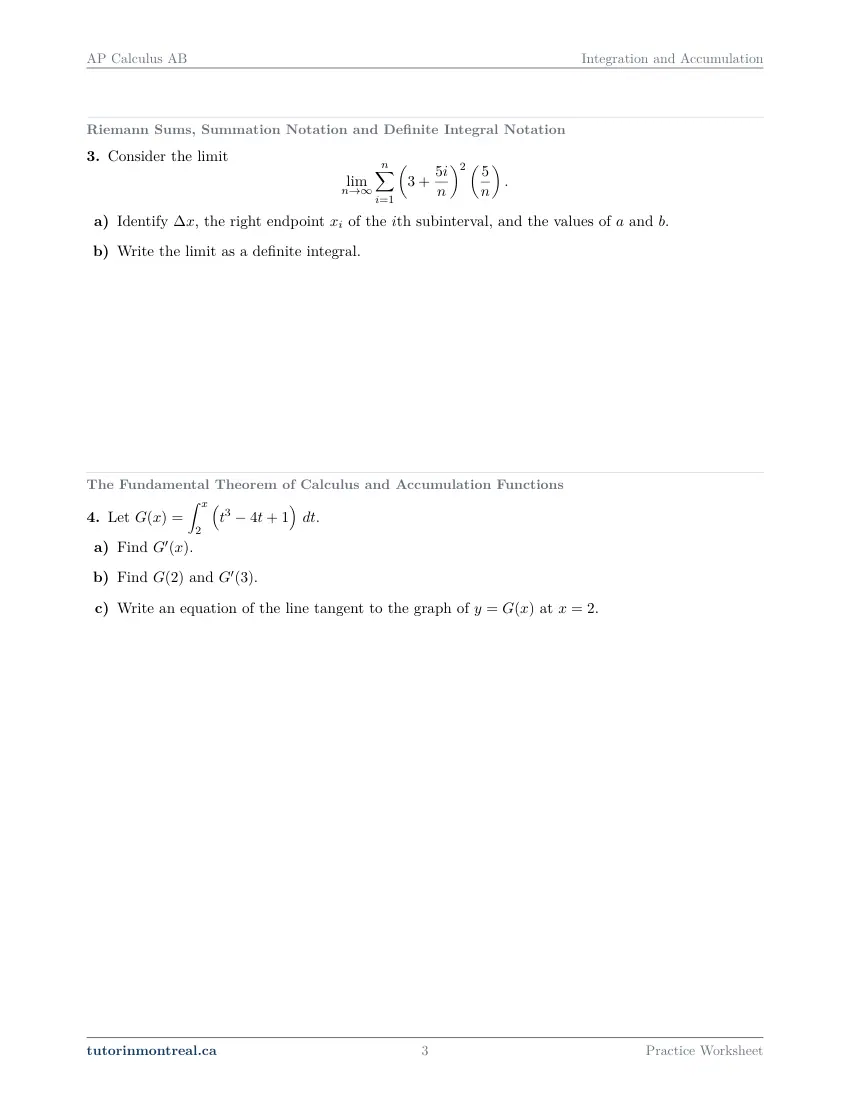
Q3Riemann Sums, Summation Notation and Definite Integral Notation
Consider the limit
- Identify , the right endpoint of the th subinterval, and the values of and .
- Write the limit as a definite integral.
-
Q4The Fundamental Theorem of Calculus and Accumulation Functions
Let .
- Find .
- Find and .
- Write an equation of the line tangent to the graph of at .
-
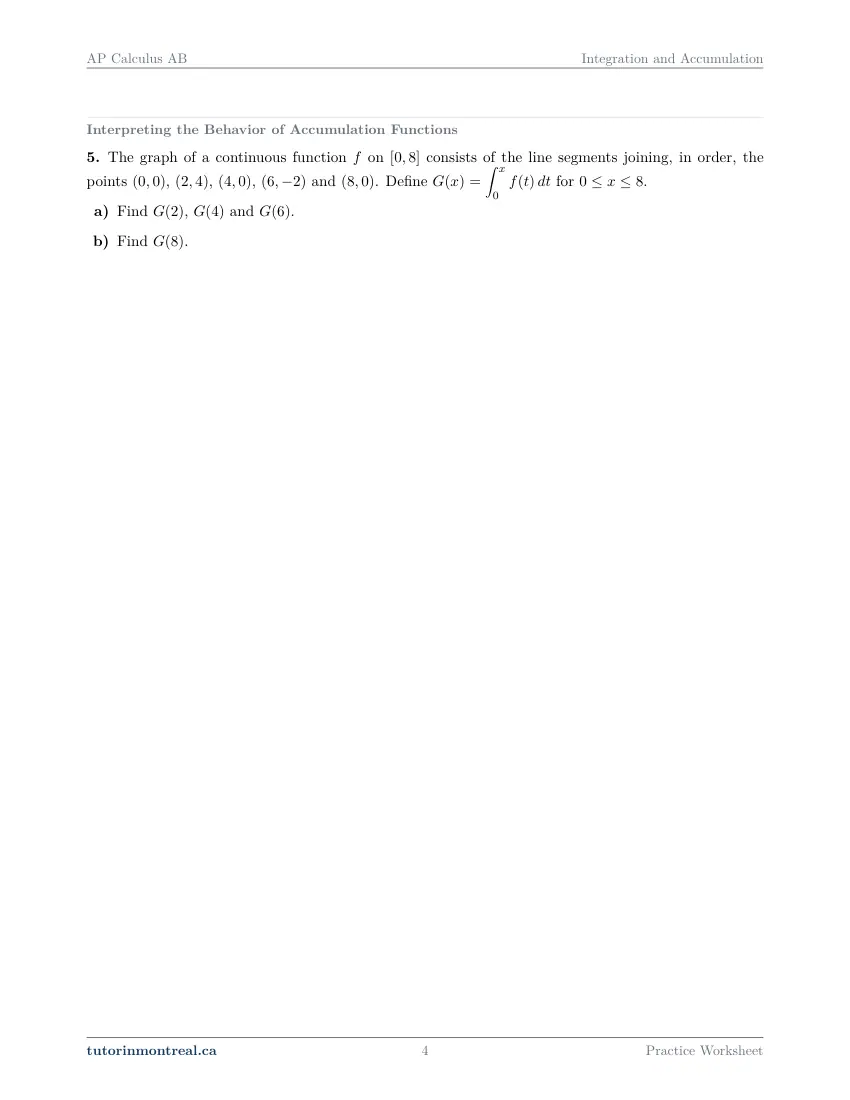
Q5Interpreting the Behavior of Accumulation Functions
The graph of a continuous function on consists of the line segments joining, in order, the points , , , and . Define for .
- Find , and .
- Find .
-
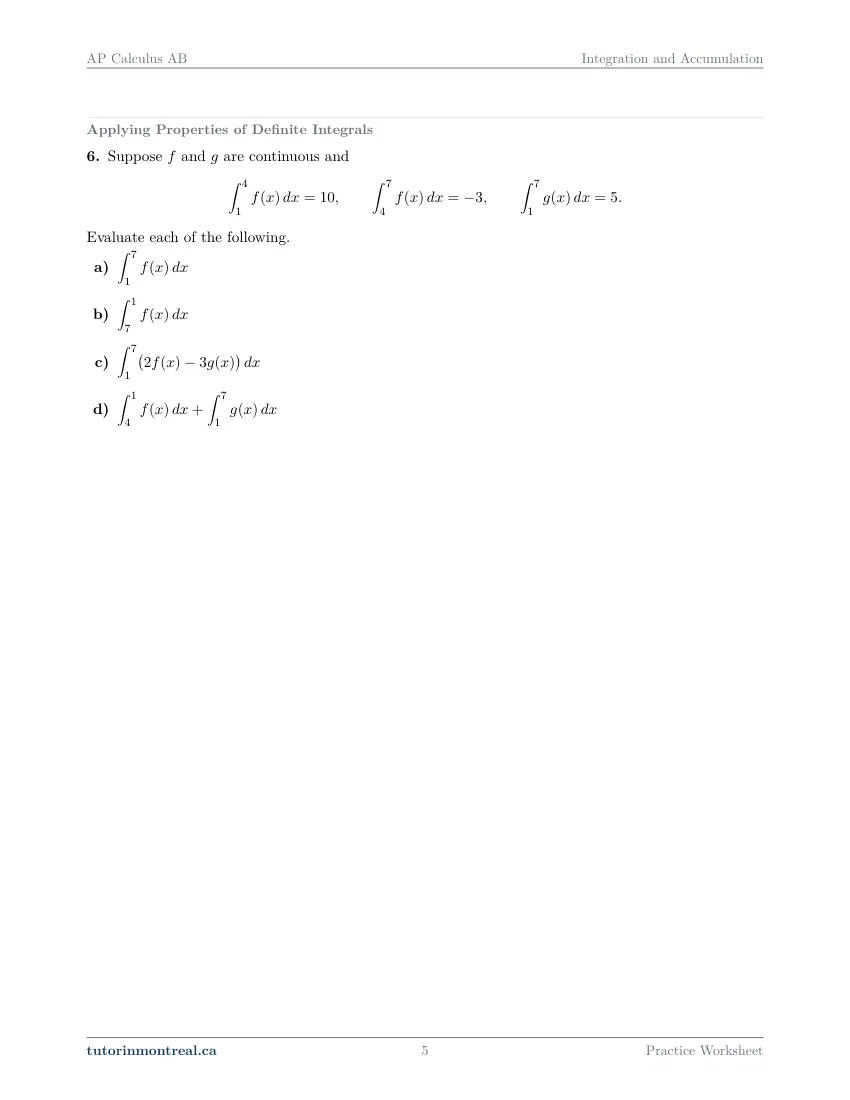
Q6Applying Properties of Definite Integrals
Suppose and are continuous and Evaluate each of the following.
-
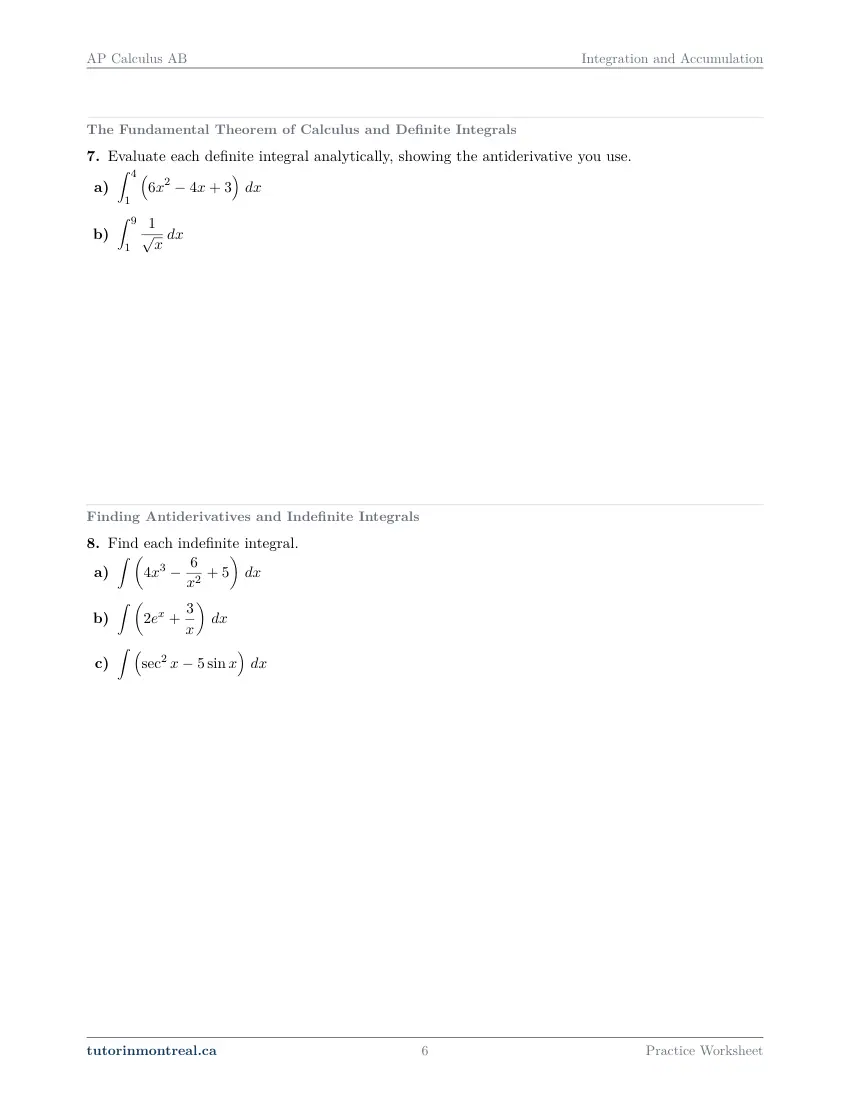
Q7The Fundamental Theorem of Calculus and Definite Integrals
Evaluate each definite integral analytically, showing the antiderivative you use.
-
Q8Finding Antiderivatives and Indefinite Integrals
Find each indefinite integral.
-
Q9Integrating Using Substitution
- Find .
- Evaluate , converting the limits of integration to the new variable.
-
Q10Integrating Using Long Division and Completing the Square
Each integrand must be rewritten before any antidifferentiation rule applies. Find each indefinite integral, showing the rewriting step.
-
Q11Selecting Techniques for Antidifferentiation
For each integral below, name the technique you would use — a basic antiderivative rule after algebraic rewriting, substitution, long division, or completing the square — and give the feature of the integrand that told you so. Then evaluate all four integrals.
- , where
-
Q12Synthesis — drawing on several topics in this unit
A rainwater cistern holds cubic meters of water at time . Water enters and leaves the cistern simultaneously, so that for hours the net rate at which its volume changes is cubic meters per hour. The volume in the cistern at time hours is therefore
- Find , and state which theorem you used.
- Find the time at which the volume of water is greatest, and justify that your answer gives the absolute maximum on .
- Find the volume of water in the cistern at that time, and the volume at . Give three-decimal accuracy where the answer is not exact.
- Using correct units, explain what represents in this context, and state its value.
The 10 challenge problems for this topic are a separate, paid sheet and are not reproduced here.
Which stream is this for? This sheet is built for AP Calculus AB. The antidifferentiation techniques in scope are substitution, long division and completing the square — there is no integration by parts, no partial fractions and no improper integrals, since those belong to BC. Everything here is fair game on the AB exam.
How to do every concept on this sheet
This is the part worksheet sites usually leave out. Below is the actual reasoning behind each group of questions — not a full solution set, the decisions that get you to one. Read it before you start, or after you get stuck.
A definite integral of a rate is an amount
Q1 and Q12 both hand you a rate — liters per hour, cubic meters per hour — and then ask what its integral means. The answer always has the same shape: the integral of a rate of change over an interval is the net change in the quantity over that interval, and the units prove it to you.
∫ from a to b of r(t) dt = (liters ⁄ hour) × (hours) = litersQ1(b) is marked on exactly that sentence, so write the sentence: not "the area under the curve", which is a picture, but "the total volume of meltwater that entered the basin during the first ten hours, in liters". When the rate is drawn as straight segments you never need an antiderivative at all — the region is triangles and trapezoids, and plain geometry finishes the job.
Net change, not total amount. A definite integral counts area below the axis as negative, so what it reports is the net change. In Q12 the net rate turns negative partway through, so the integral over the later stretch comes out negative and the honest reading is "the cistern lost about that much water". Say "net change in the volume, in cubic meters", and let the sign carry the direction.
Riemann sums: name the property, not just the direction
When a rate is only known at a handful of times, you estimate the integral by rectangles or trapezoids. An AP answer that says "the left sum is an underestimate" and stops there is half an answer. The mark is for the property of the function that forces it, and different comparisons need different properties.
Monotonicity and concavity are not interchangeable. Whether a left or right rectangle sum runs low or high is settled by whether the function is increasing or decreasing: on an increasing function the smallest value on each subinterval sits at its left endpoint, so every left rectangle falls under the graph and the left sum is the underestimate — the right sum is the overestimate. Whether a trapezoidal sum runs low or high is settled by concavity: a trapezoid replaces the graph on each subinterval by the chord through its endpoints, and a concave up graph lies below all of its chords, so the trapezoidal sum overestimates. Concave down reverses it. Citing concavity to justify a left-sum comparison, or increasing/decreasing to justify a trapezoid comparison, loses the justification mark even when the direction you picked happens to be right.
One arithmetic trap goes with these: the subintervals a table gives you are often not the same width. There is no single Δt to factor out. Each rectangle uses its own width, and each trapezoid contributes the average of its two endpoint values times its own width. Write the widths down before you write the sum.
Reading a limit of sums backwards into an integral
Q3 gives you a limit of Riemann sums and wants the definite integral it converges to. Nothing here is guesswork; the sum tells you every piece if you take it apart in order.
From a limit of sums to ∫ from a to b of f(x) dx
Take the pieces in this order. Each one pins down the next.
- 1Find Δx first
It is the lone factor multiplying the function value, and it has no other job in the expression. Since Δx = (b − a) ⁄ n, reading Δx off tells you the length b − a immediately, before you know either endpoint.
- 2Find x i next
It is whatever the function is being applied to. Match it against the pattern a + i·Δx: the constant sitting out front is a. Now b = a + (b − a) from step 1.
- 3Name f last
Whatever is done to x i — squared, square-rooted, put in a denominator — is what f does to x. Replace x i by x and you have f.
- 4Check at i = n
With right endpoints, x n should come out to b exactly. If it does not, you have mis-split the expression and the a you found is wrong.
The Fundamental Theorem runs in two directions
Students meet two statements under one name and blur them. They do opposite jobs, and the sheet asks for both — Q7 uses the first, Q4 and Q12(a) use the second.
∫ from a to b of f(x) dx = F(b) − F(a), where F′ = f d⁄dx [ ∫ from a to x of f(t) dt ] = f(x)The first turns an antiderivative into a number. The second says that an accumulation function is an antiderivative of its integrand — differentiating undoes the integrating, and you simply replace the dummy variable by the upper limit. Nothing else changes, and no antiderivative ever has to be found.
A variable upper limit that is not plain x picks up a chain-rule factor. The theorem differentiates with respect to the upper limit. If that limit is g(x) rather than x, then d⁄dx [ ∫ from a to g(x) of f(t) dt ] = f(g(x)) · g′(x), and the factor g′(x) is the single most-forgotten thing in this unit. Write the accumulation function as F(g(x)) first and the chain rule becomes unavoidable rather than optional.
Two small facts fall straight out of the definition and both are worth a mark. First, F(a) = ∫ from a to a of f(t) dt = 0 because the limits agree — which is why Q4 can ask for a tangent line at the lower limit without giving you a value of F. Second, the letter inside must differ from the letter in the limit: you write F(x) = ∫ from a to x of f(t) dt, with t as the dummy variable. The integral has already used up its variable — t is consumed by the integration and is gone from the answer, while x survives as the input of F. Writing ∫ from a to x of f(x) dx uses one letter for two different things and makes the next line unreadable.
Reading an accumulation function off the graph of f
In Q5 you are given a graph of f built from line segments and asked for values of F(x) = ∫ from 0 to x of f(t) dt. Each value is a running signed area: add the area of each piece as you sweep right, counting anything below the axis as negative. Do it one segment at a time and keep the running total — F(6) is F(4) plus whatever happens on [4, 6], not a fresh computation.
The pairing that trips up students and answer keys alike. F increases where f is positive — not where f is increasing. And F is concave up where f is increasing — not where f is positive. The reason is just F′ = f and F″ = f′: a question about whether F rises is a question about the sign of f, and a question about the shape of F is a question about the slope of f. It follows that a zero of f is a critical point of F, never by itself an inflection point of F — for an inflection point, f has to switch between increasing and decreasing.
Q12(b) is the same reasoning wearing a context. To locate the maximum of an accumulating quantity, find where its rate crosses from positive to negative, then justify: the quantity rises while the rate is positive and falls once it is negative, so that crossing gives the absolute maximum on the interval. Backing it with a candidates test — the critical point and both endpoints, values compared — is what makes the justification complete.
The properties that let you move limits around
Q6 gives you three integrals and asks for four more, with no function ever named. That is the point: these are structural rules, and you evaluate by rearranging, not by integrating.
Additivity over adjacent intervals: ∫ from a to b + ∫ from b to c =
∫ from a to c, so a missing piece is always a subtraction away.
Reversing the limits flips the sign: ∫ from b to a of f = − ∫ from a to b
of f. An integral written "backwards" is not an error to fix, it is a minus sign to
collect.
Equal limits give zero: ∫ from a to a of f = 0.
Linearity: constants come out front and sums split, so
∫ (2f − 3g) = 2∫f − 3∫g over the same interval.
What linearity does not cover is the absolute value: ∫ from a to b of |f(x)| dx is not | ∫ from a to b of f(x) dx | The integral of |f| reflects every negative piece upward and measures total area, in which nothing cancels; the absolute value of the integral takes the net signed area and only then drops its sign. So an integrand wrapped in absolute-value bars is never integrated straight through: split the interval at every point where the inside changes sign, integrate each piece with the sign it actually has, and add. And use the obvious check — an integral of a non-negative integrand cannot come out negative.
Choosing an antidifferentiation technique
Q8, Q9, Q10 and Q11 build one skill: looking at an integrand and knowing which move to make before trying anything. Q11 asks you to name the technique and the feature that settled it, so practise the diagnosis out loud.
Which technique, and what tells you
Ask these in order and stop at the first yes.
- 1Is the numerator a constant multiple of the derivative of the inside?
Then it is substitution. Set u to the inside, compute du, and check that what is left over is a constant times du. This covers the ∫ f′⁄f patterns that give a logarithm, and anything of the form (inside)ⁿ times its own derivative.
- 2Is the fraction improper — numerator degree at least the denominator's?
Then it is long division. No substitution can even start on an improper rational function. Divide until the remainder has lower degree, integrate the polynomial part directly and deal with what is left.
- 3Is the denominator an irreducible quadratic with a constant numerator?
Then it is completing the square, aiming at ∫ du ⁄ (u² + a²) = (1⁄a)·arctan(u⁄a) + C. Check the discriminant to confirm it really does not factor, and do not lose the 1⁄a out front — that is the usual slip.
- 4Can plain algebra split it up?
Then rewrite first. Splitting a numerator over the denominator, or turning 1⁄√x into x−1 ⁄ 2, converts the whole thing into power-rule pieces. Rewriting is a technique, not a failure to find one.
In a definite integral, choose one substitution route and commit. Once you change the variable, the old limits belong to the old variable. Either convert the limits to u as you substitute and evaluate entirely in u, or keep the original limits, find the antiderivative and convert back to x before evaluating. Both are correct. Evaluating a function of u at the limits that were written for x is the single most common wrong answer in this unit, and it is invisible in your working — the arithmetic is all valid, only the meaning is wrong. Whichever route you take, say so on the page: "u = …, so x = 1 gives u = 4 and x = 2 gives u = 7".
Two habits finish the section. Every indefinite integral ends in + C — it is part of the answer, not decoration, and Q8 loses marks without it. A definite integral never carries one, because the constant cancels in F(b) − F(a). And every antiderivative can be checked in one line by differentiating it: if you do not get the integrand back, you have your answer before the exam does.
Preview all 9 pages
Click any page to open the full PDF.
Getting the most out of it
Answer the "why" in the language of the property
Several questions here ask for a justification, and the justification is where the marks sit. Train the two sentences: "the left sum underestimates because the rate is increasing, so every left endpoint gives the smallest value on its subinterval", and "the trapezoidal sum overestimates because the rate is concave up, so the graph lies below each chord". Direction plus property, every time.
Differentiate your antiderivative before moving on
Every indefinite integral on this sheet can be verified in one line. It costs ten seconds and it catches the classic slips: the missing chain-rule factor, the sign on ∫ sin x dx, the missing 1⁄a on an arctan, the dropped + C.
Interpret every number in a sentence with units
On the accumulation questions, once you have the value, translate it: "the cistern held about that many cubic meters at hour nine". A stated interpretation with correct units is a mark of its own on the AP exam, and it is also the fastest check you have — an interpretation that sounds absurd usually is.
Want the solutions, or something more challenging?
The worksheet, the questions above and every explanation on this page stay free permanently. Three more PDFs exist for this topic — the worked answer key, a harder problem set, and the answer key to that. They come with the AP Calculus AB Solutions Bundle, which is what keeps the rest of the series free.
What else exists for Integration and Accumulation
Three PDFs · 19 pages · all three are in the bundle below.
- Answer key — 4 pages. All 12 questions worked step by step, including the restrictions and the justifications. Not a list of final answers.
- Challenge problems — 10 pages, 10 problems. A separate sheet at exam-plus difficulty covering the same 11 concepts. Harder than anything on the free sheet.
- Challenge answer key — 5 pages. Every challenge problem worked to the same standard, with the checks shown.
- PDF, letter size, print-ready.
The one thing that's for sale
Every AP Calculus AB topic — the complete Solutions Bundle
One download, one payment, the whole program. Every answer key and every challenge set for all 8 AP Calculus AB worksheet sets — including this one.
- Worked solutions, not answer lists — every step written out
- Covers the whole year's program at this level
- Less than the price of one hour of tutoring — for the entire year's solutions
Taking Secondary 1 Math as well? The Secondary 1 Math bundle covers all 15 of its sets — 45 PDFs, 182 pages — on the same terms.
Taking Secondary 2 Math as well? The Secondary 2 Math bundle covers all 14 of its sets — 42 PDFs, 181 pages — on the same terms.
Taking Secondary 3 Math as well? The Secondary 3 Math bundle covers all 11 of its sets — 33 PDFs, 154 pages — on the same terms.
Taking Secondary 4 Math as well? The Secondary 4 Math bundle covers all 17 of its sets — 51 PDFs, 154 pages — on the same terms.
Taking Secondary 5 Math as well? The Secondary 5 Math bundle covers all 21 of its sets — 63 PDFs, 228 pages — on the same terms.
Taking CEGEP Calculus I as well? The CEGEP Calculus I bundle covers all 8 of its sets — 24 PDFs, 82 pages — on the same terms.
Taking CEGEP Calculus II as well? The CEGEP Calculus II bundle covers all 8 of its sets — 24 PDFs, 90 pages — on the same terms.
Taking CEGEP Linear Algebra as well? The CEGEP Linear Algebra bundle covers all 7 of its sets — 21 PDFs, 82 pages — on the same terms.
Common questions
Is this worksheet really free?
Yes — the questions are on this page to read, and the PDF downloads directly, no email and no account. The one paid item is optional: the complete AP Calculus AB Solutions Bundle, which covers every set at this level.
Is a left Riemann sum always an underestimate?
No — only when the function is increasing on the interval. On a decreasing function the left endpoint gives the largest value on each subinterval, so the left sum overestimates. The property that decides it is whether the function is increasing or decreasing, and an AP answer has to name that property, not just the direction.
Why does concavity decide the trapezoidal sum but not the left sum?
Because a trapezoid replaces the graph on each subinterval by the chord through its two endpoints, and whether the graph sits above or below its chords is exactly what concavity says: concave up means the graph lies below every chord, so the trapezoids hold more area and the sum overestimates. A rectangle uses only one endpoint value, so what matters there is whether the function is increasing or decreasing.
How do I differentiate an integral whose upper limit is x squared?
Write the accumulation function as F(g(x)), where F is the integral with a plain upper limit, so the chain rule applies: the derivative is the integrand evaluated at the upper limit, times the derivative of that limit. With an upper limit of x squared that extra factor is 2x, and leaving it out is the most common error in the unit.
Why is the variable inside an accumulation function t and not x?
Because the integration consumes it. In F(x) = the integral from a to x of f(t) dt, the t disappears when the integral is evaluated while x survives as the input of F, so the two need different letters. Using x for both makes the upper limit and the variable of integration look like the same quantity, and the next line stops meaning anything.
Do I have to change the limits when I use u-substitution?
You have to do one of two things, and mixing them is what goes wrong. Either convert the limits to the new variable and finish entirely in u, or keep the original limits, convert the antiderivative back to x and only then evaluate. Evaluating a function of u at limits that were written for x gives a wrong answer that looks perfectly reasonable on the page.
Are integration by parts and partial fractions on this sheet?
No. This is AP Calculus AB, where the antidifferentiation techniques in scope are substitution, long division and completing the square. Integration by parts, partial fractions and improper integrals are BC material, so nothing here needs them.
Can teachers use this in class?
Yes. Print and photocopy it for your own classes freely — I just ask that the tutorinmontreal.ca footer stays on the page.
I'm stuck on one question. Can you help?
Yes — through one-on-one tutoring, in Montreal or online. Get in touch to arrange a session, or see the current rates.
← All 8 AP Calculus AB worksheets · Secondary 1 Math series (15 sheets) → · Secondary 2 Math series (14 sheets) → · Secondary 3 Math series (11 sheets) → · Secondary 4 Math series (17 sheets) → · Secondary 5 Math series (21 sheets) → · CEGEP Calculus I series (8 sheets) → · CEGEP Calculus II series (8 sheets) → · CEGEP Linear Algebra series (7 sheets) →