AP Calculus AB Unit 3 — Chain Rule and Implicit Differentiation Worksheet
Unit 3 is where a derivative stops being a formula you look up. Composites have to be taken apart layer by layer, curves that are not functions still have tangent lines, the derivative of an inverse is read off the original function at a different input, and every one of these can be differentiated a second and a third time. The questions below run through the whole unit in CED order, from a first composite to a curve where implicit differentiation and a second derivative are used together. Read them here, then print the free PDF when you want to write on it.
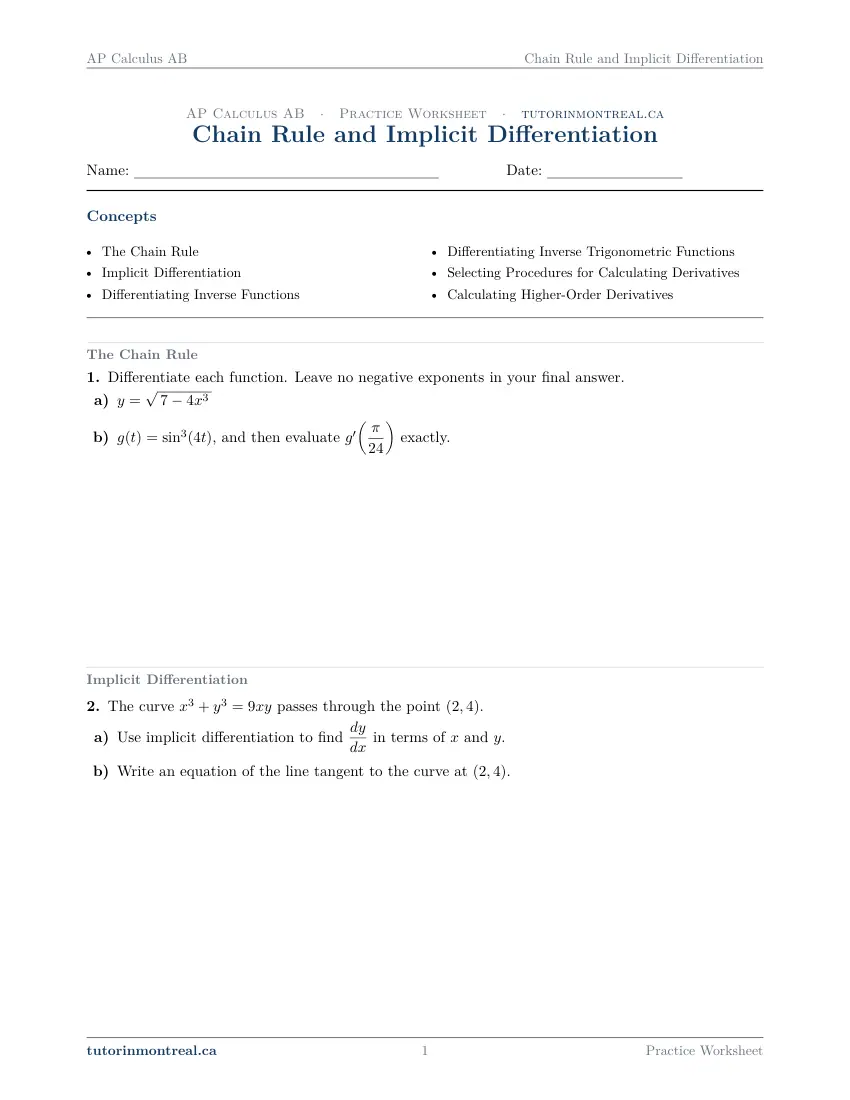
Practice worksheet — free PDF
No email, no account, no watermark. Teachers: photocopy it for your classes freely. Worked solutions and 7 harder problems come with the AP Calculus AB bundle.
All 7 questions
Each question targets one named concept from the sheet. Read them here, or print the PDF — it has working space under each one.
-
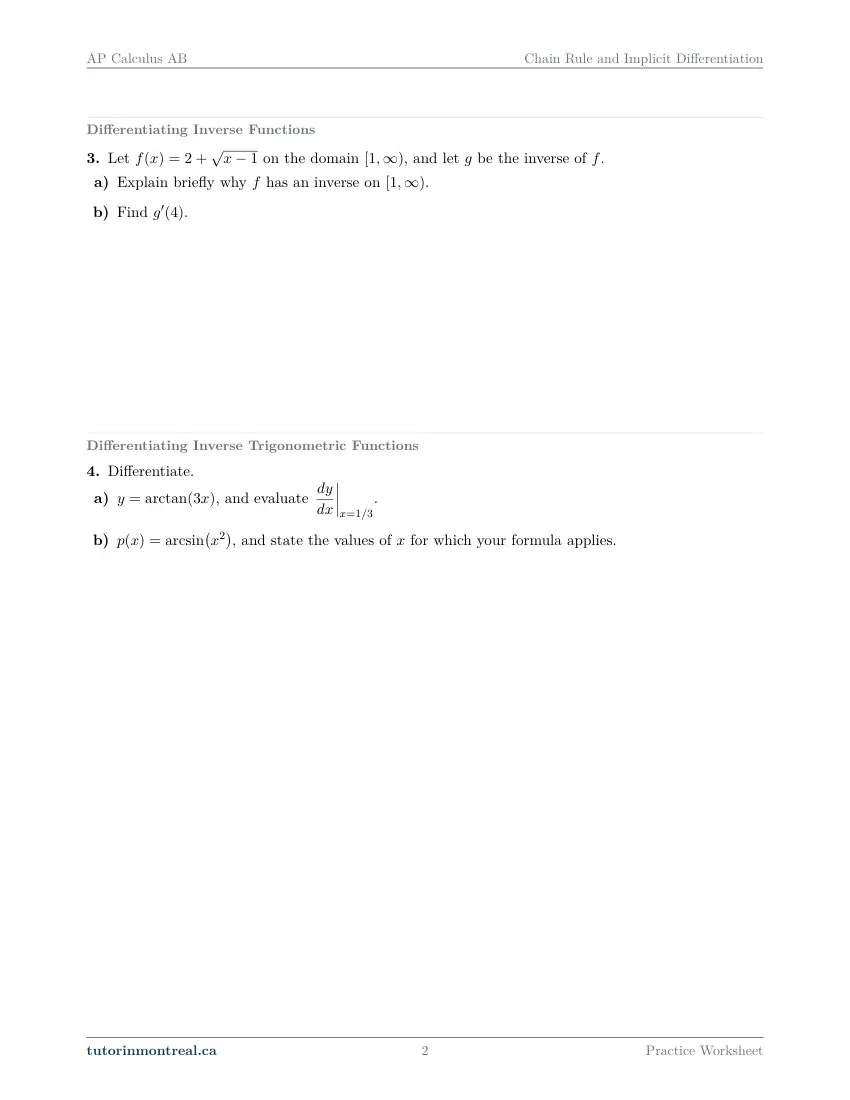
Q1The Chain Rule
Differentiate each function. Leave no negative exponents in your final answer.
- , and then evaluate exactly.
-
Q2Implicit Differentiation
The curve passes through the point .
- Use implicit differentiation to find in terms of and .
- Write an equation of the line tangent to the curve at .
-
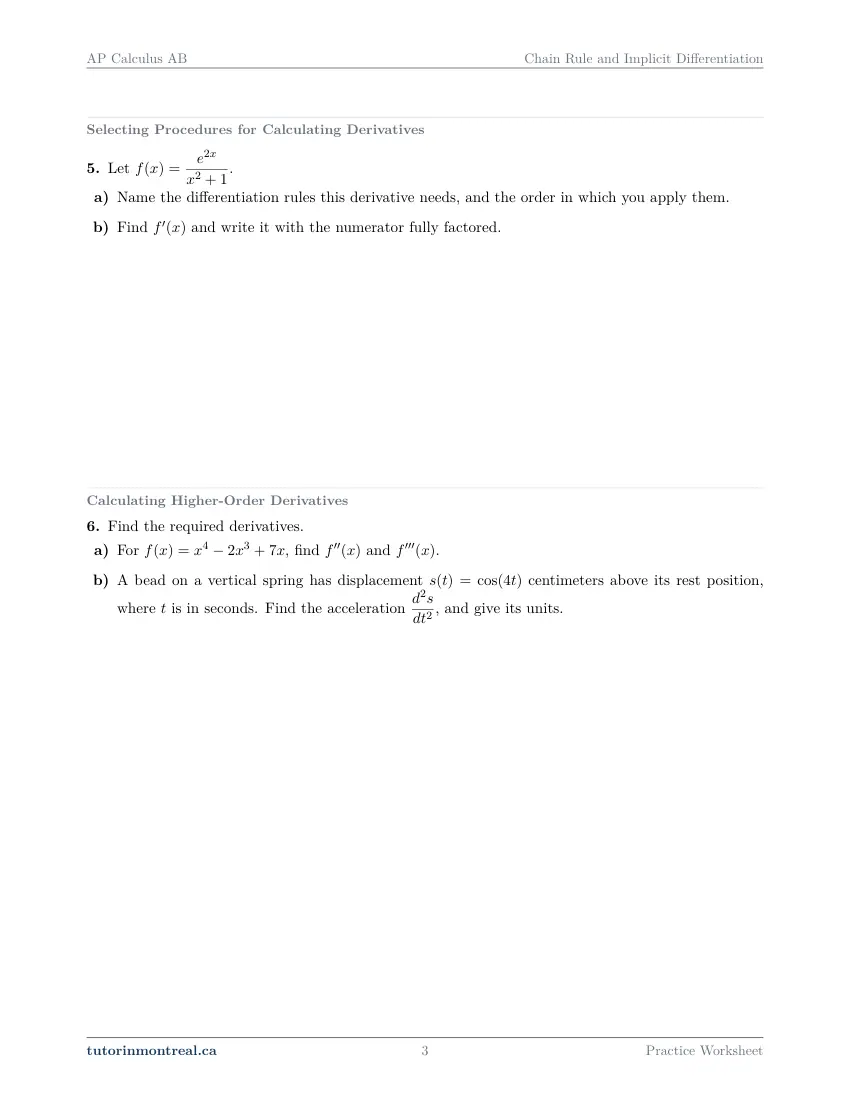
Q3Differentiating Inverse Functions
Let on the domain , and let be the inverse of .
- Explain briefly why has an inverse on .
- Find .
-
Q4Differentiating Inverse Trigonometric Functions
Differentiate.
- , and evaluate .
- , and state the values of for which your formula applies.
-
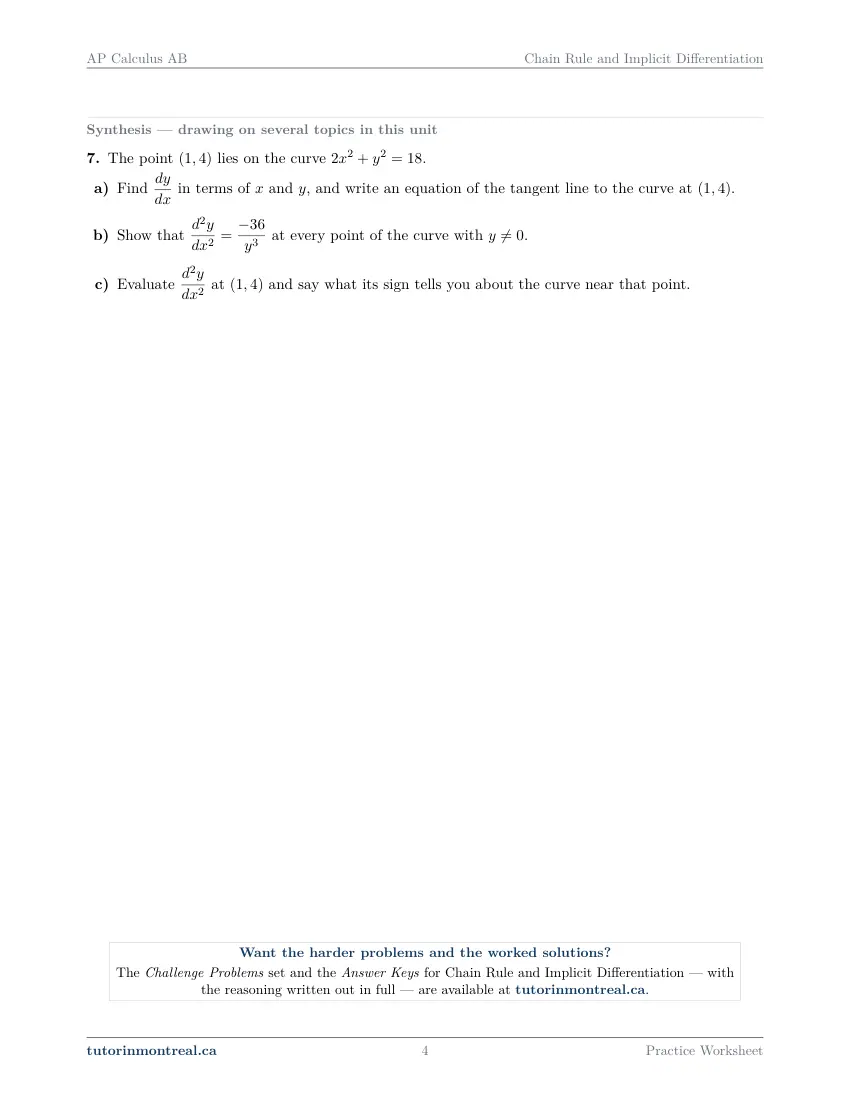
Q5Selecting Procedures for Calculating Derivatives
Let .
- Name the differentiation rules this derivative needs, and the order in which you apply them.
- Find and write it with the numerator fully factored.
-
Q6Calculating Higher-Order Derivatives
Find the required derivatives.
- For , find and .
- A bead on a vertical spring has displacement centimeters above its rest position, where is in seconds. Find the acceleration , and give its units.
-
Q7Synthesis — drawing on several topics in this unit
The point lies on the curve .
- Find in terms of and , and write an equation of the tangent line to the curve at .
- Show that at every point of the curve with .
- Evaluate at and say what its sign tells you about the curve near that point.
The 7 challenge problems for this topic are a separate, paid sheet and are not reproduced here.
Which stream is this for? This sheet is AP Calculus AB — Unit 3 of the College Board framework, topics 3.1 through 3.6. Nothing on it is BC-only: no parametric or vector-valued derivatives, no polar curves. BC students still need every technique here, since the BC units assume it, but the sheet stops where AB stops.
How to do every concept on this sheet
This is the part worksheet sites usually leave out. Below is the actual reasoning behind each group of questions — not a full solution set, the decisions that get you to one. Read it before you start, or after you get stuck.
The chain rule: the outer derivative is evaluated at the inner output
A composite is a function fed to another function. If h(x) = f(g(x)), then g runs first and hands its output to f, and the derivative follows that same order:
h(x) = f(g(x)) → h'(x) = f'(g(x)) · g'(x)Read the right-hand side literally. It is not f'(x) · g'(x). The first factor is the outer derivative with the whole inner function still sitting inside it, and only the second factor is the inner derivative. In Q1(a) that is why the answer keeps 7 − 4x³ under the root instead of replacing it with x; in Q1(b) it is why cos(4t) appears rather than cos(t).
The single most common error in this unit: evaluating the outer derivative at x instead of at the inner output. It is invisible when the inner function is simple, and fatal the moment you work from numbers rather than a formula. If h(x) = f(g(x)) and you want h'(0), you do not want f'(0) — you want f' at whatever number g(0) happens to be. Write the inner value down as a separate line before you look anything up, and the mistake becomes impossible to make.
The same slip explains why f(g(x)) and g(f(x)) have different derivatives at the same x: different outer functions, fed different inputs. Composition is not commutative, and neither is its derivative.
Taking a nested composite apart
Q1(b) has three layers, not two: something is multiplied by 4, its sine is taken, and the result is cubed. Each layer contributes one factor, and the factors come out in the order you peel them.
Peeling the layers in order
Work outside in, and write one factor per layer before you simplify anything.
- 1Ask what you would do last
If you had a number for x and a calculator, which operation would you perform last? That operation is the outermost layer. For sin³(4t) you would cube last, so the outer function is "cube it".
- 2Differentiate that layer, and change nothing inside it
The cube gives 3(inner)². Copy the inner expression across untouched — sin(4t), not sin(t), not t. Resist simplifying; the inner expression is doing bookkeeping for you.
- 3Multiply by the derivative of what is inside
Now repeat the question on the inner expression. Its outer layer is the sine, giving cos(4t), and inside that is 4t, giving 4. Three layers, three factors, all multiplied.
- 4Count your factors against your layers
Three layers must produce three factors. A missing constant — the 4 from the innermost function — is the classic dropped factor, and it is the one that changes the numerical answer without changing the shape of the expression.
A radical is a composite too. Rewriting a root as a power before you start, as Q1(a) invites you to, turns "derivative of a square root" into the power rule plus one chain-rule factor, which is a rule you already trust.
Implicit differentiation: why every y carries a dy/dx
An equation like the one in Q2 does not define y as a single function of x — the curve fails the vertical line test — but near most of its points y still varies with x. That is the whole assumption: y is a function of x, you just do not have a formula for it. So differentiating a term containing y is differentiating a composite, and the chain rule attaches the factor dy/dx:
d/dx (y³) = 3y² · dy/dx d/dx (xy) = 1·y + x · dy/dxThe second one is the product rule with a chain-rule factor inside it, and it is where most of the lost marks in Q2 live. Any term holding both x and y needs the product rule; any factor of y then needs its dy/dx.
The routine, once and for all. Differentiate both sides with respect to x, attaching dy/dx to every y-term. Move every term containing dy/dx to one side and everything else to the other. Factor dy/dx out. Divide. The result is an expression in both x and y — that is correct and expected, not an unfinished answer, because a single x can sit under two different points of the curve with two different slopes.
Because the slope needs both coordinates, a tangent-line question hands you a point rather than just an x. Confirm the point actually satisfies the equation before you use it: substituting a point that is not on the curve produces a confident, wrong number.
Horizontal and vertical tangents, and the case that is neither
Implicit differentiation almost always leaves dy/dx as a quotient. Once it does, the two special tangents are conditions on the two halves of that quotient — and each condition has two parts:
horizontal: numerator = 0 and denominator ≠ 0 vertical: denominator = 0 and numerator ≠ 0Finding the points is a system: set the relevant half to zero, substitute that relation back into the equation of the curve, solve for the coordinates, then go back and check the other half at each point you found.
"The tangent is vertical wherever the denominator is zero" is not true, and the missing half is worth marks on every exam that asks. If the numerator vanishes at the same point, the expression is 0/0 — which is not a slope of zero, not an infinite slope, and not evidence of anything at all. The quotient has simply stopped reporting. Always check the other half of the fraction before you name a tangent, even on curves where the check turns out to cost nothing.
The derivative of an inverse function
Q3 asks for the derivative of an inverse without ever writing a formula for that inverse. The identity that makes it possible is:
(f⁻¹)'(a) = 1 ⁄ f'( f⁻¹(a) )The graph of f⁻¹ is the graph of f reflected across y = x, which swaps rise and run — hence the reciprocal. But the reflection also swaps the coordinates, so the point where you measure the slope of f is not at x = a. Writing 1/f'(a) is the same error as the chain-rule one above, in a different costume: the input to f' has to be the inverse's own output.
Computing (f⁻¹)'(a) in four moves
Never differentiate first. Locate the point first.
- 1Justify that the inverse exists
Show f' keeps one sign on the interval, so f is strictly monotonic, so it is one-to-one, so it is invertible. This is a marked step in its own right, and one line of derivative sign analysis earns it.
- 2Find the input, not the output
You need the number b with f(b) = a — that is what f⁻¹(a) means. Solve the equation f(x) = a. Monotonicity from step 1 guarantees the solution you find is the only one.
- 3Differentiate f and evaluate at b
Compute f'(x) once, then substitute b. The number a never enters f'. If a is the number you plugged in, you have made the standard mistake.
- 4Take the reciprocal, and sanity-check it
(f⁻¹)'(a) = 1/f'(b). A small f'(b) gives a steep inverse and a large one gives a flat inverse — reciprocals, as the reflection demands. If f is increasing, both derivatives must be positive.
A tangent line to y = f⁻¹(x) at x = a needs the point (a, b), not (a, a) and not (b, a): the input is a and the output is the b you found in step 2.
Inverse trigonometric derivatives, and the domain that comes with them
The inverse trig derivatives are just the identity above, already worked out for you, and each one arrives with a chain-rule factor when the argument is not a bare x:
d/dx arctan(u) = u' ⁄ (1 + u²) d/dx arcsin(u) = u' ⁄ √(1 − u²)Q4 asks you to state where the arcsine formula applies, and that is not a decoration. The denominator must be a positive number under a real square root, so the formula lives only where 1 − u² > 0 — and u is the inner function, not x, so the restriction has to be solved for x. Note also that arcsin is defined at the endpoints of its domain while its derivative is not: a function can be perfectly well defined at a point where the tangent line stands vertical.
Two quick checks. The arctangent derivative is positive everywhere, which matches an increasing function with a horizontal asymptote in each direction. And every inverse trig derivative is an algebraic expression — no trig functions survive. If a trig function is still sitting in your answer, a chain-rule factor went in the wrong place.
Choosing the rule, and the order to apply it
By Q5 the rules are no longer given to you one at a time. The habit that saves time is the same question from the peeling steps: what would you compute last? That operation names the outer rule, and every rule you need inside it goes inside it.
A quotient whose numerator is a composite is a quotient-rule problem with a chain rule living in one slot — not a chain-rule problem, and not two separate exercises. Naming the rules and their order before writing anything, as Q5(a) makes you do, is worth the thirty seconds: it is the step that stops a product rule from being applied to a composite.
Sometimes the best first move is not a rule at all. An expression can often be rewritten — a trigonometric identity applied, a logarithm expanded, a radical turned into a power — into something with fewer layers. Rewriting is legitimate and usually faster, with one caution: check whether the rewrite changed the domain. Cancelling a factor or splitting a logarithm can quietly admit inputs the original expression never accepted, and the derivative you produce then belongs to a different function.
Second derivatives, and the pattern in the nth
Higher-order derivatives are not a new technique — you differentiate, then differentiate the result. What changes is the bookkeeping. Two things are worth being deliberate about:
Meaning and units. If s(t) is a displacement in centimetres and t is in seconds, then s'(t) is a velocity in cm/s and s''(t) is an acceleration in cm/s². Q6(b) asks for the units because they are part of the answer, and because they are a check: an acceleration whose units come out as centimetres means a differentiation went missing.
Differentiating a chain-rule result. Each pass through a composite contributes its own inner-derivative factor, so the constants grow in a regular way. Watching how the sign, the coefficient and the exponent each change from one derivative to the next is exactly how you conjecture a formula for the nth derivative — and a conjecture is only worth writing once you can say where each of those three ingredients came from.
Q7 combines the two halves of the unit: differentiate implicitly, then differentiate the resulting quotient again. Two things make the second pass work. The first is remembering that dy/dx appears inside it and must itself be differentiated — you already have an expression for it, so substitute that expression in rather than leaving the symbol standing. The second is that the equation of the curve is still available: substituting it back into the second derivative is what collapses a two-variable mess into something clean. Then read the sign. A negative second derivative means concave down at that point, with the tangent line lying above the curve — a conclusion you can check against the shape the curve is supposed to have.
Preview all 4 pages
Click any page to open the full PDF.
Getting the most out of it
Write the inner value on its own line
Before you evaluate any composite derivative, write down what the inner function equals at the point in question, as a separate labelled line. Nearly every chain-rule and inverse-function error in this unit is a wrong input to a correct formula, and a number sitting on its own line is hard to substitute in the wrong place.
Do the implicit questions twice
Where a curve can also be solved for y explicitly, do it both ways once. Getting the same slope from implicit differentiation and from the explicit formula is the fastest way to convince yourself that the dy/dx factors are not a ritual — and it is a check you can run on an exam when a slope looks wrong.
Say what rule you are about to use, out loud
"Quotient rule on the outside, chain rule in the numerator." One sentence before you write anything catches the misapplied rule while it is still free to fix. The exam asks for this explicitly on some questions, but the habit pays on all of them.
Want the solutions, or something more challenging?
The worksheet, the questions above and every explanation on this page stay free permanently. Three more PDFs exist for this topic — the worked answer key, a harder problem set, and the answer key to that. They come with the AP Calculus AB Solutions Bundle, which is what keeps the rest of the series free.
What else exists for Chain Rule and Implicit Differentiation
Three PDFs · 13 pages · all three are in the bundle below.
- Answer key — 3 pages. All 7 questions worked step by step, including the restrictions and the justifications. Not a list of final answers.
- Challenge problems — 7 pages, 7 problems. A separate sheet at exam-plus difficulty covering the same 6 concepts. Harder than anything on the free sheet.
- Challenge answer key — 3 pages. Every challenge problem worked to the same standard, with the checks shown.
- PDF, letter size, print-ready.
The one thing that's for sale
Every AP Calculus AB topic — the complete Solutions Bundle
One download, one payment, the whole program. Every answer key and every challenge set for all 8 AP Calculus AB worksheet sets — including this one.
- Worked solutions, not answer lists — every step written out
- Covers the whole year's program at this level
- Less than the price of one hour of tutoring — for the entire year's solutions
Taking Secondary 1 Math as well? The Secondary 1 Math bundle covers all 15 of its sets — 45 PDFs, 182 pages — on the same terms.
Taking Secondary 2 Math as well? The Secondary 2 Math bundle covers all 14 of its sets — 42 PDFs, 181 pages — on the same terms.
Taking Secondary 3 Math as well? The Secondary 3 Math bundle covers all 11 of its sets — 33 PDFs, 154 pages — on the same terms.
Taking Secondary 4 Math as well? The Secondary 4 Math bundle covers all 17 of its sets — 51 PDFs, 154 pages — on the same terms.
Taking Secondary 5 Math as well? The Secondary 5 Math bundle covers all 21 of its sets — 63 PDFs, 228 pages — on the same terms.
Taking CEGEP Calculus I as well? The CEGEP Calculus I bundle covers all 8 of its sets — 24 PDFs, 82 pages — on the same terms.
Taking CEGEP Calculus II as well? The CEGEP Calculus II bundle covers all 8 of its sets — 24 PDFs, 90 pages — on the same terms.
Taking CEGEP Linear Algebra as well? The CEGEP Linear Algebra bundle covers all 7 of its sets — 21 PDFs, 82 pages — on the same terms.
Common questions
Is this worksheet really free?
Yes — the questions are on this page to read, and the PDF downloads directly, no email and no account. The one paid item is optional: the complete AP Calculus AB Solutions Bundle, which covers every set at this level.
Why is the chain rule f'(g(x))·g'(x) and not f'(x)·g'(x)?
Because the outer function never sees x — it sees whatever the inner function produced. The outer derivative therefore has to be evaluated at that inner output, with the whole inner expression left sitting inside it. Replacing it with x differentiates a different function, and the error only becomes visible when you work from a table of numbers rather than a formula.
Why does every y get a dy/dx when I differentiate implicitly?
Because y is being treated as an unknown function of x, so any term containing y is a composite and the chain rule applies. Differentiating y³ gives 3y² times dy/dx, exactly as differentiating u³ would give 3u² times u'. A term holding both x and y needs the product rule first, and each y inside it still carries its dy/dx.
How do I find where an implicit curve has a vertical tangent?
Set the denominator of dy/dx to zero, substitute the relation that gives back into the equation of the curve to find the actual points, then check that the numerator is not also zero at each of them. If both vanish the expression is 0/0 and tells you nothing about the tangent, so the point does not qualify. Horizontal tangents are the mirror image: numerator zero, denominator non-zero.
Why is the derivative of an inverse 1/f'(f⁻¹(a)) and not 1/f'(a)?
Because reflecting the graph across y = x swaps the coordinates as well as rise and run. The slope you need is the slope of f at the point that corresponds to a, which is the point whose x-coordinate is f⁻¹(a) — the inverse's output, not a itself. So find the number b with f(b) = a first, then compute 1/f'(b).
Is any of this AP Calculus BC material?
No. This is Unit 3 of AP Calculus AB, topics 3.1 to 3.6, and everything on it is examinable on both the AB and BC exams. The BC-only differentiation topics — parametric, vector-valued and polar derivatives — build on these techniques but are not on this sheet.
Can teachers use this in class?
Yes. Print and photocopy it for your own classes freely — I just ask that the tutorinmontreal.ca footer stays on the page.
I'm stuck on one question. Can you help?
Yes — through one-on-one tutoring, in Montreal or online. Get in touch to arrange a session, or see the current rates.
← All 8 AP Calculus AB worksheets · Secondary 1 Math series (15 sheets) → · Secondary 2 Math series (14 sheets) → · Secondary 3 Math series (11 sheets) → · Secondary 4 Math series (17 sheets) → · Secondary 5 Math series (21 sheets) → · CEGEP Calculus I series (8 sheets) → · CEGEP Calculus II series (8 sheets) → · CEGEP Linear Algebra series (7 sheets) →