AP Calculus AB Unit 1 — Limits and Continuity Worksheet
The unit that decides how the rest of the course reads. What a limit actually claims, how to get one from a graph, a table or algebra, when 0/0 means factor and when it means conjugate, the three conditions for continuity at a point and the three ways they fail, why a vertical asymptote is an infinite limit while a horizontal one is a limit at infinity, and what the Intermediate Value Theorem does and does not promise. Have a look on this page, then print the free PDF when you want to write on it.
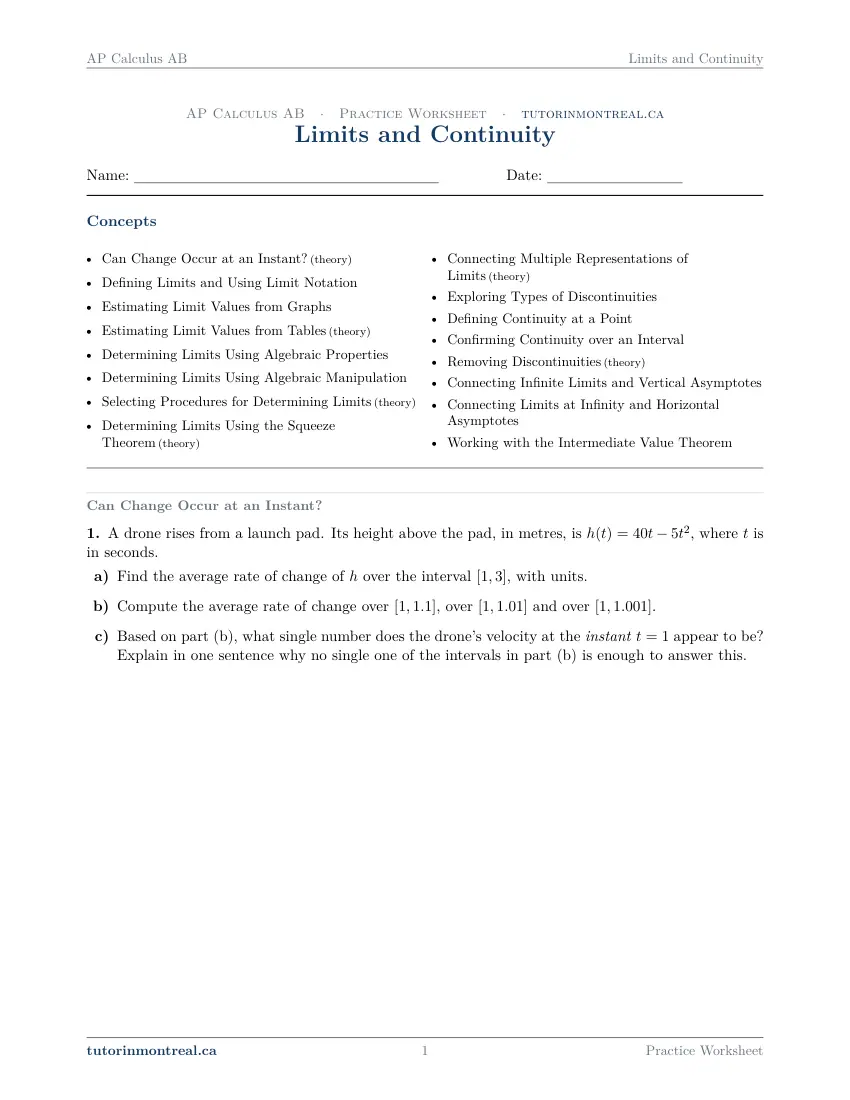
Practice worksheet — free PDF
No email, no account, no watermark. Teachers: photocopy it for your classes freely. Worked solutions and 11 harder problems come with the AP Calculus AB bundle.
All 17 questions
Each question targets one named concept from the sheet. Read them here, or print the PDF — it has working space under each one.
-
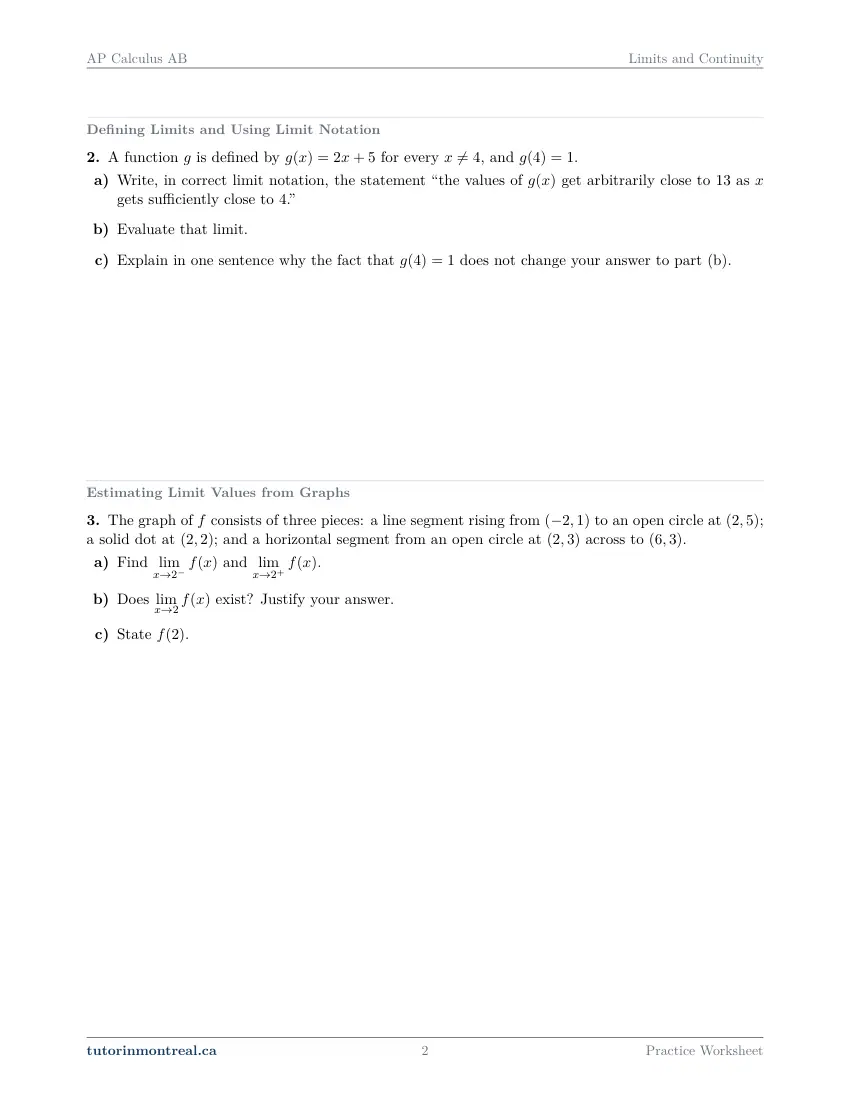
Q1Can Change Occur at an Instant?
A drone rises from a launch pad. Its height above the pad, in metres, is , where is in seconds.
- Find the average rate of change of over the interval , with units.
- Compute the average rate of change over , over and over .
- Based on part (b), what single number does the drone's velocity at the instant appear to be? Explain in one sentence why no single one of the intervals in part (b) is enough to answer this.
-
Q2Defining Limits and Using Limit Notation
A function is defined by for every , and .
- Write, in correct limit notation, the statement “the values of get arbitrarily close to as gets sufficiently close to .”
- Evaluate that limit.
- Explain in one sentence why the fact that does not change your answer to part (b).
-
Q3Estimating Limit Values from Graphs
The graph of consists of three pieces: a line segment rising from to an open circle at ; a solid dot at ; and a horizontal segment from an open circle at across to .
- Find and .
- Does exist? Justify your answer.
- State .
-
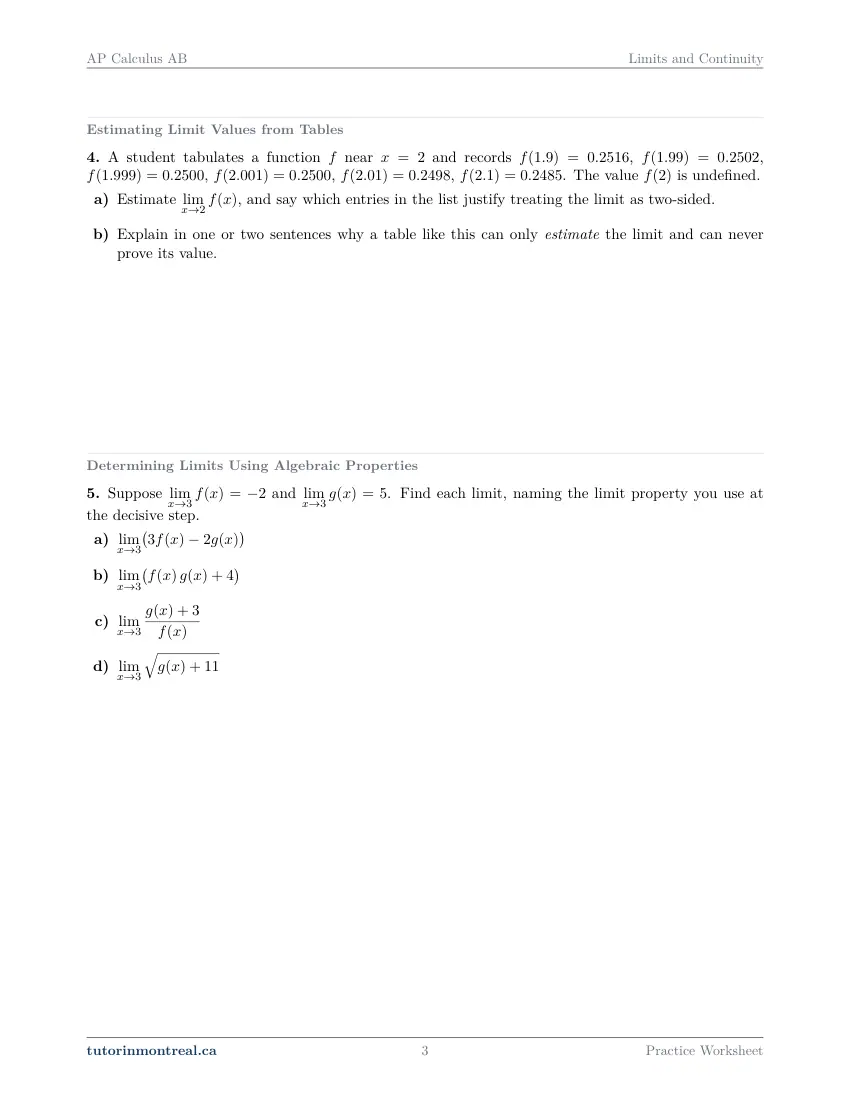
Q4Estimating Limit Values from Tables
A student tabulates a function near and records , , , , , . The value is undefined.
- Estimate , and say which entries in the list justify treating the limit as two-sided.
- Explain in one or two sentences why a table like this can only estimate the limit and can never prove its value.
-
Q5Determining Limits Using Algebraic Properties
Suppose and . Find each limit, naming the limit property you use at the decisive step.
-
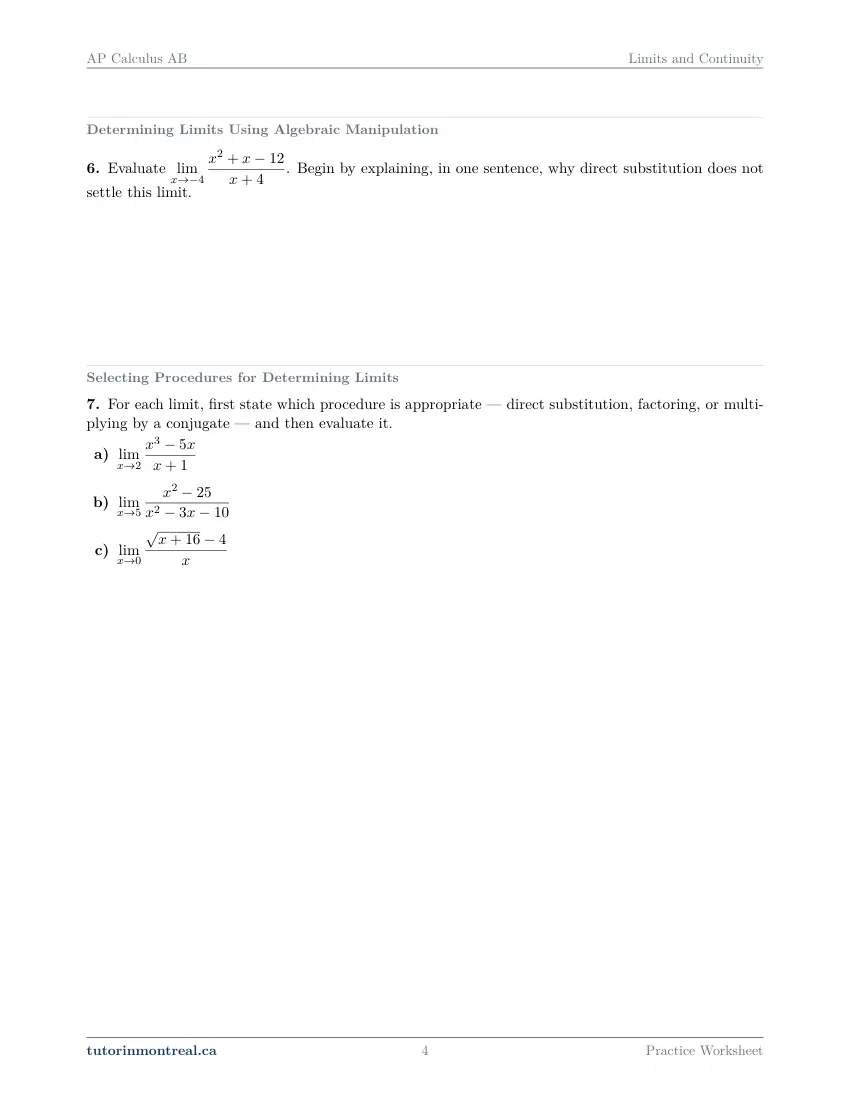
Q6Determining Limits Using Algebraic Manipulation
Evaluate . Begin by explaining, in one sentence, why substituting does not settle this limit.
-
Q7Selecting Procedures for Determining Limits
For each limit, first state which procedure is appropriate — substitution, factoring, or multiplying by a conjugate — and then evaluate it.
-
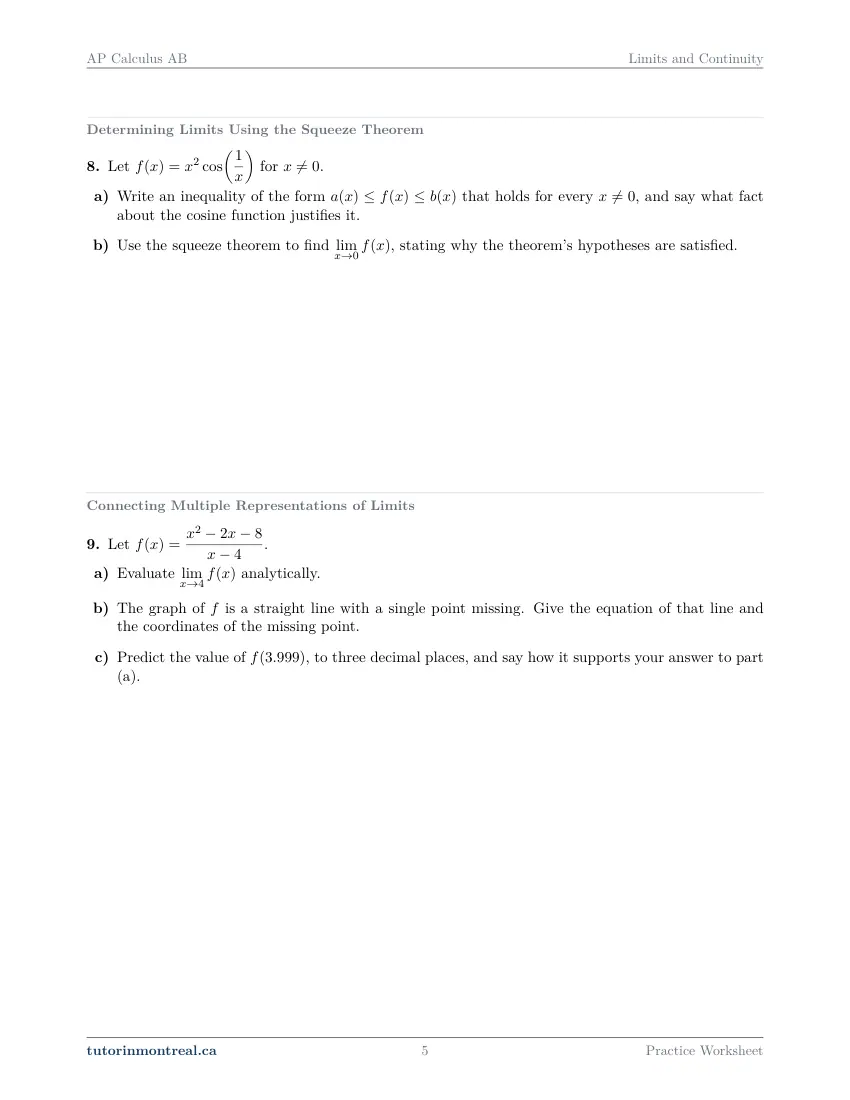
Q8Determining Limits Using the Squeeze Theorem
Let for .
- Write an inequality of the form that holds for every , and say what fact about the cosine function justifies it.
- Use the squeeze theorem to find , stating why the theorem's hypotheses are satisfied.
-
Q9Connecting Multiple Representations of Limits
Let .
- Evaluate analytically.
- The graph of is a straight line with a single point missing. Give the equation of that line and the coordinates of the missing point.
- Predict the value of , to three decimal places, and say how it supports your answer to part (a).
-
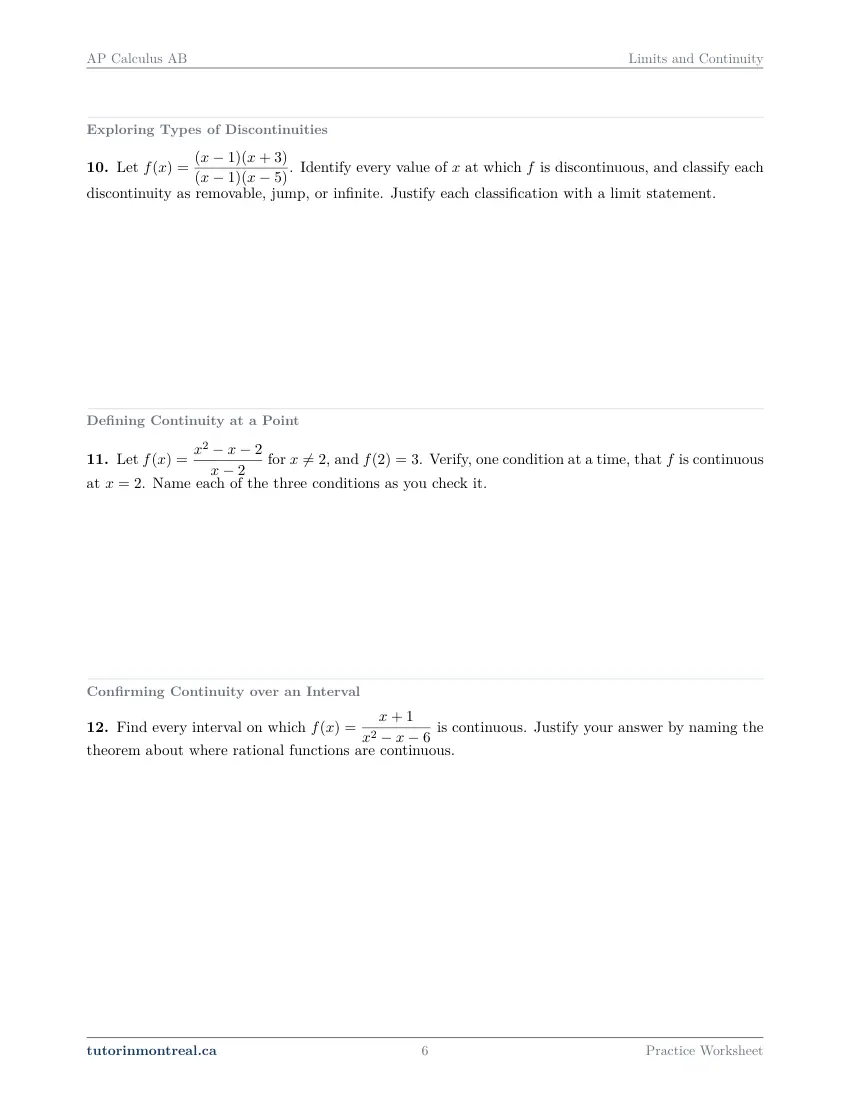
Q10Exploring Types of Discontinuities
Let . Identify every value of at which is discontinuous, and classify each discontinuity as removable, jump, or infinite. Justify each classification with a limit statement.
-
Q11Defining Continuity at a Point
Let for , and . Verify, one condition at a time, that is continuous at . Name each of the three conditions as you check it.
-
Q12Confirming Continuity over an Interval
Find every interval on which is continuous. Justify your answer by naming the theorem about where rational functions are continuous.
-
Q13Removing Discontinuities
Let Find the value of that makes continuous at , and explain why exactly one value works.
-
Q14Connecting Infinite Limits and Vertical Asymptotes
Let .
- Find and , showing the sign reasoning for each.
- State the equation of the vertical asymptote, and explain how part (a) establishes it.
- Does exist? Justify your answer.
-
Q15Connecting Limits at Infinity and Horizontal Asymptotes
- Evaluate and .
- Evaluate and .
- State every horizontal asymptote of each of the two functions above.
-
Q16Working with the Intermediate Value Theorem
Let .
- Compute and .
- Show that there is a number in the open interval with . Name the theorem you use and verify that each of its hypotheses is satisfied.
-
Q17Synthesis — drawing on several topics in this unit
Let .
- Write in lowest terms, stating the values of excluded from its domain.
- Find and , and give the equation of the vertical asymptote.
- Find and give the equation of the horizontal asymptote.
- Classify the discontinuity at , and state every interval on which is continuous.
The 11 challenge problems for this topic are a separate, paid sheet and are not reproduced here.
Which stream is this for? This is AP Calculus AB, Unit 1. Everything on the sheet is examinable on the AB exam, and nothing BC-only appears — no series, no parametric or polar curves, no Euler's method. BC students sit the same Unit 1, so the sheet suits them equally; it simply stops where AB stops.
How to do every concept on this sheet
This is the part worksheet sites usually leave out. Below is the actual reasoning behind each group of questions — not a full solution set, the decisions that get you to one. Read it before you start, or after you get stuck.
What a limit claims — and what it never claims
Q2 defines a function by one rule at every input except 4, then deliberately assigns a different value at 4 itself. The limit as x → 4 is unaffected. A limit is a statement about the values of the function at inputs near the point, and the definition excludes the point itself, so whatever is sitting there is not evidence about the limit — not even when it happens to be the right number.
Three questions, one location. The limit from the left, the limit from the right, and the function value are three different quantities that a graph answers in three different places. Q3 hands you a rising segment ending in an open circle, a solid dot at another height, and a horizontal segment starting at a third — deliberately, so that reading the wrong mark gives the wrong answer. Open circle: the height the graph is heading for. Solid dot: the value. Only the first kind of mark answers a limit question.
Q1 is where the whole idea comes from. You compute an average rate of change over [1, 3], then over [1, 1.1], [1, 1.01], [1, 1.001]. Every one of those intervals still has positive width, so every answer is still an average — never a velocity at an instant. The instantaneous value is what the averages approach as the width shrinks toward zero, and it is not any one of them. That gap is the reason the course opens here rather than with derivatives.
Q4 makes the point in reverse. Six tabulated values closing in on a number are strong evidence and no proof: a limit is a claim about every input sufficiently close to the point, and a finite list cannot rule out the function doing something else between the entries you happened to sample. On the AP exam, a table supports a conjecture — write "the table suggests", then confirm it algebraically.
A two-sided limit needs both sides to agree
lim(x→a) f(x) = L exactly when lim(x→a⁻) f(x) = L and lim(x→a⁺) f(x) = LBoth one-sided limits must exist and be equal. If they exist and disagree, the two-sided limit does not exist — that is a jump, and no amount of algebra repairs it. This is why Q3 asks for the one-sided limits first: they are the evidence, and the two-sided answer is the conclusion drawn from them.
Say "does not exist", and say why. "DNE" on its own earns nothing. The justification is a comparison: the left-hand limit is this, the right-hand limit is that, they are unequal, therefore the two-sided limit does not exist. And notice the reverse never follows — a limit can fail to exist while a function built from it behaves perfectly well, so "f has no limit" is not an argument about anything except f.
0/0 is a question, not an answer
Substituting and getting 0/0 tells you the expression must be rewritten before the limit is readable. It tells you nothing about the answer — 0/0 is indeterminate precisely because different functions with that form have different limits. Which rewrite you need is written on the face of the expression.
Choosing the manipulation
Q6, Q7, Q9 and Q13 all start the same way. Work down this list — the first line that matches is the move.
- 1Substitute first, always
If the denominator does not vanish, direct substitution is the method and the work is over — Q7(a) is there to make sure you check before you start factoring. A nonzero result means no manipulation was ever needed.
- 2Polynomials over polynomials → factor
Getting 0/0 from two polynomials means (x − a) divides both. Factor, cancel that shared factor, substitute into what is left. The cancellation is legal because the two expressions agree at every input except a, and a limit only ever looks at the others.
- 3A difference involving a square root → conjugate
Something like √(x + 16) − 4 in a numerator cannot be factored, so multiply top and bottom by √(x + 16) + 4. The product of conjugates clears the radical and produces the factor that cancels the denominator.
- 4A fraction inside a fraction → common denominator
When the numerator is itself a difference of fractions stacked over x, combine it over one denominator first. The compound fraction then collapses to a single quotient with the cancelling factor visible.
- 5Write the restriction as you cancel
After cancelling, the new expression is equal to the old one for x ≠ a — write that clause down. It is the sentence that justifies the whole move, and it is the difference between a cancellation and an erasure.
Q9 asks you to see the same limit three ways: analytically by factoring, graphically as a straight line with one point missing, and numerically at an input very close to the target. They are three views of one fact — and when a hole is what the algebra predicts, the graph has to show a hole exactly there.
Name the property, not just the number
Q5 gives you two limits and asks for four combinations, "naming the limit property you use at the decisive step". The arithmetic is trivial; the mark is on the naming, because two of the four have a hypothesis that must be checked.
The quotient property requires the limit of the denominator to be nonzero — check that before you divide, and say you checked it. Composing with a square root requires the inner limit to land in the domain of the root, i.e. to be non-negative. The sum, difference, constant-multiple and product properties carry no side conditions; those two do, and they are the two an examiner is looking at.
Every one of these properties runs in one direction only: if the pieces have limits, then the combination does. Nothing in them licenses the reverse, so a combination with a perfectly good limit tells you nothing about whether its pieces have any.
The squeeze theorem, and when you are forced into it
Q8 asks for the limit of x²cos(1/x) at 0. The product property is unavailable here, and that is the point: cos(1/x) oscillates faster and faster as x approaches 0, so it has no limit there and there is nothing to multiply. What it does have is a bound.
−1 ≤ cos(1/x) ≤ 1 ⟹ −x² ≤ x²cos(1/x) ≤ x² for every x ≠ 0Multiplying an inequality by x² is safe because x² is positive for x ≠ 0 — the direction of the inequalities survives. Then quote the theorem's two hypotheses explicitly: the inequality holds on an open interval around the point (except possibly at the point itself), and the two outer limits both exist and are equal. Only then does the middle function get trapped at that common value. Equal outer limits is the hypothesis students skip, and it is the one doing the work.
Continuity at a point: three conditions, three ways to fail
Q11 asks you to verify continuity "one condition at a time, naming each". Learn them as a numbered list, because the classification of a discontinuity is just a record of which one broke.
Checking continuity at x = a
In this order. The first failure is the answer.
- 1f(a) is defined
The point is in the domain. For a rational function this is the step that finds the zeros of the denominator.
- 2lim(x→a) f(x) exists
Both one-sided limits exist and agree. For a piecewise function this means evaluating the two branches separately — you cannot read this off one formula.
- 3The limit equals the value
Two numbers you have already computed, set equal. When a question asks you to solve for a constant, this equation is what you solve.
Removable: the limit exists but the value is missing or wrong — a hole. Only condition 1 or 3 failed, and redefining the single value at that point repairs it. Jump: both one-sided limits exist and disagree. Condition 2 failed; no choice of value can equal two different numbers at once, so it is unrepairable. Infinite: the function is unbounded near the point, so no one-sided limit is a real number at all. Q10 puts a removable and an infinite discontinuity in one rational function on purpose — the deciding test is whether the offending factor cancels.
Q13 is condition 3 turned into an equation: cancel, take the limit, and set the assigned value equal to it. Exactly one number works, because the limit is a single number — which is also the reason "removable" means removable in one specific way, not adjustable to taste.
Continuity on an interval, and why the answer is usually a union
Q12 wants every interval on which a rational function is continuous, justified by the theorem rather than by inspection. The theorem is short: a rational function is continuous at every point of its domain. So the work is entirely about the domain — factor the denominator, find its zeros, and remove them.
Answer with intervals, not with exclusions. "Continuous everywhere except x = 3 and x = −2" is the right idea in the wrong form; the expected answer is the union (−∞, −2) ∪ (−2, 3) ∪ (3, ∞). Continuity is defined on intervals, a domain with two punctures is three separate intervals, and the union bar is where that gets recorded. Polynomials, roots, exponentials, logarithms and the trigonometric functions are each continuous on their own domains, so for any expression built from them the question is always the same: what does the domain allow?
Both kinds of asymptote are limit statements
This is the sentence to memorise, because the two are constantly confused: a vertical asymptote is an infinite limit at a finite input, and a horizontal asymptote is a finite limit at infinity. Different limits, different questions, different method.
For a vertical asymptote (Q14, Q17) the technique is sign analysis, not substitution. Establish that the numerator tends to a nonzero number while the denominator tends to 0, then decide the sign of the denominator just to the left and just to the right of the point. Small negative denominator under a positive numerator gives −∞; small positive gives +∞. The two sides routinely differ, which is exactly why the question asks for both.
A zero of the denominator is not automatically an asymptote. Put the expression in lowest terms first. If the factor cancels, the limit is finite and you have a hole; if it survives, the function is unbounded and you have an asymptote. Q17 is built on this: a factor cancels once and one copy remains, so the discontinuity is infinite rather than removable. And on the AP convention, an unbounded limit does not exist — writing "= ∞" is an acceptable description of the behaviour, but ∞ is not a value the limit equals.
For a horizontal asymptote (Q15, Q17), divide the numerator and denominator by the highest power of x in the denominator and let every term with x underneath go to 0. Then check both ends. A horizontal asymptote is a claim about one end of the graph, so x → ∞ and x → −∞ are two questions, and a graph is allowed a different answer at each — or one at only one end.
Where the two ends genuinely part company: a square root of a squared term. √(x²) is |x|, not x, so it equals x at the right-hand end and −x at the left-hand end. Pull |x| out of the radical, then substitute the correct one for the end you are working on. Treating √(9x² + 4) as "3x" quietly assumes x is positive and hands you the same asymptote at both ends, which is how a graph with two horizontal asymptotes gets reported as having one.
What the Intermediate Value Theorem actually promises
Q16 asks you to name the theorem and verify each hypothesis. There are exactly two, and both have to be written down:
1. f is continuous on the closed interval [a, b] — and you must say why: it is a polynomial, or a rational function whose denominator has no zero there, or continuity was given in the problem. 2. The target value lies strictly between f(a) and f(b). Then the conclusion: there exists at least one c in the open interval (a, b) with f(c) = that value.
Read the conclusion carefully, because it is weaker than students expect and stronger than they use. It is an existence claim: it guarantees that such a c exists, never how many there are, and never where. Solving for c afterwards is fine as a check, but the theorem alone gave you only existence — and finding c by algebra is not a use of the IVT. Equally, the theorem never says a function that fails its hypotheses misses the value: drop continuity and the conclusion becomes unavailable, not false.
Preview all 9 pages
Click any page to open the full PDF.
Getting the most out of it
Try substitution before you do anything clever
Most limits on this sheet are settled by putting the number in. Substituting first costs one line and tells you which of the four cases you are in: a real number means done, 0/0 means rewrite, and a nonzero number over 0 means you are looking at an infinite limit and should switch to sign analysis.
Write the restriction every time you cancel
"= x + 2 for x ≠ 4" is not pedantry — it is the reason the cancellation is allowed, and it is what keeps the hole in your mental picture of the graph. Students who drop the clause are the ones who later declare a function continuous at a point that is not even in its domain.
Name the theorem out loud
Several questions here award the mark for the justification rather than the value: the limit property at the decisive step, the three conditions of continuity one at a time, the two hypotheses of the IVT. Practise writing the reason as a clause — "the quotient property, and the denominator's limit is nonzero", "continuous on [0, 1] because it is a polynomial". On the free-response section that clause is the point.
Want the solutions, or something more challenging?
The worksheet, the questions above and every explanation on this page stay free permanently. Three more PDFs exist for this topic — the worked answer key, a harder problem set, and the answer key to that. They come with the AP Calculus AB Solutions Bundle, which is what keeps the rest of the series free.
What else exists for Limits and Continuity
Three PDFs · 19 pages · all three are in the bundle below.
- Answer key — 5 pages. All 17 questions worked step by step, including the restrictions and the justifications. Not a list of final answers.
- Challenge problems — 9 pages, 11 problems. A separate sheet at exam-plus difficulty covering the same 16 concepts. Harder than anything on the free sheet.
- Challenge answer key — 5 pages. Every challenge problem worked to the same standard, with the checks shown.
- PDF, letter size, print-ready.
The one thing that's for sale
Every AP Calculus AB topic — the complete Solutions Bundle
One download, one payment, the whole program. Every answer key and every challenge set for all 8 AP Calculus AB worksheet sets — including this one.
- Worked solutions, not answer lists — every step written out
- Covers the whole year's program at this level
- Less than the price of one hour of tutoring — for the entire year's solutions
Taking Secondary 1 Math as well? The Secondary 1 Math bundle covers all 15 of its sets — 45 PDFs, 182 pages — on the same terms.
Taking Secondary 2 Math as well? The Secondary 2 Math bundle covers all 14 of its sets — 42 PDFs, 181 pages — on the same terms.
Taking Secondary 3 Math as well? The Secondary 3 Math bundle covers all 11 of its sets — 33 PDFs, 154 pages — on the same terms.
Taking Secondary 4 Math as well? The Secondary 4 Math bundle covers all 17 of its sets — 51 PDFs, 154 pages — on the same terms.
Taking Secondary 5 Math as well? The Secondary 5 Math bundle covers all 21 of its sets — 63 PDFs, 228 pages — on the same terms.
Taking CEGEP Calculus I as well? The CEGEP Calculus I bundle covers all 8 of its sets — 24 PDFs, 82 pages — on the same terms.
Taking CEGEP Calculus II as well? The CEGEP Calculus II bundle covers all 8 of its sets — 24 PDFs, 90 pages — on the same terms.
Taking CEGEP Linear Algebra as well? The CEGEP Linear Algebra bundle covers all 7 of its sets — 21 PDFs, 82 pages — on the same terms.
Common questions
Is this worksheet really free?
Yes — the questions are on this page to read, and the PDF downloads directly, no email and no account. The one paid item is optional: the complete AP Calculus AB Solutions Bundle, which covers every set at this level.
Why doesn't the value of f at a point affect the limit there?
Because the definition of a limit looks only at inputs near the point and explicitly excludes the point itself. A function can be undefined there, or defined to something entirely unrelated, and the limit is the same either way — which is exactly why a limit can exist at a point where the function is discontinuous.
When do I factor, and when do I use the conjugate?
Both are responses to 0/0, and the expression tells you which. Polynomials over polynomials factor, because getting 0/0 guarantees a shared linear factor. A difference involving a square root takes the conjugate, since a radical cannot be factored out. A fraction stacked inside a fraction needs a common denominator first.
How do I tell a removable discontinuity from a jump or an infinite one?
By the one-sided limits. If both exist and agree, the limit exists and only the value is wrong or missing — removable, and redefining that one value fixes it. If both exist and disagree, it is a jump and nothing fixes it. If the function is unbounded near the point, so neither side approaches a real number, it is infinite and there is a vertical asymptote.
Why can a graph have two different horizontal asymptotes?
Because a horizontal asymptote is a statement about one end of the graph, and the limits as x → ∞ and x → −∞ are separate questions. Square roots are where they most often differ: √(x²) is |x|, which is x at the right-hand end and −x at the left, so the quotient can change sign and the two ends settle at different heights.
What does the Intermediate Value Theorem actually let me conclude?
Only that at least one c exists in the open interval with the target value — not how many, and not where. It needs continuity on the closed interval and a target lying strictly between the two endpoint values, and both hypotheses have to be stated. Without continuity the theorem gives nothing either way.
Is this AB or BC material?
AB. This is AP Calculus AB Unit 1, and no BC-only topic appears — no series, no parametric or polar curves, no Euler's method. BC students take the same Unit 1, so the sheet works for them too; it just stops where AB stops.
Can teachers use this in class?
Yes. Print and photocopy it for your own classes freely — I just ask that the tutorinmontreal.ca footer stays on the page.
I'm stuck on one question. Can you help?
Yes — through one-on-one tutoring, in Montreal or online. Get in touch to arrange a session, or see the current rates.
← All 8 AP Calculus AB worksheets · Secondary 1 Math series (15 sheets) → · Secondary 2 Math series (14 sheets) → · Secondary 3 Math series (11 sheets) → · Secondary 4 Math series (17 sheets) → · Secondary 5 Math series (21 sheets) → · CEGEP Calculus I series (8 sheets) → · CEGEP Calculus II series (8 sheets) → · CEGEP Linear Algebra series (7 sheets) →
The same topic at the other level: CEGEP Calculus I · Limits and Continuity.