AP Calculus AB Unit 8 Applications of Integration Worksheet
Unit 8 is where the integral stops being an antiderivative exercise and starts measuring something: an average, a displacement, a net change, an area between two curves, and — for half the sheet — a volume, by cross sections, by discs and by washers, about the axes and about shifted lines. Almost every mark lost here is lost in the set-up rather than the antidifferentiation, so the questions below are built around the decisions: which variable to slice in, where the integral has to be split, and what exactly the radius is measured from. Read them on this page, then print the free PDF when you want room to draw.
Practice worksheet — free PDF
No email, no account, no watermark. Teachers: photocopy it for your classes freely. Worked solutions and 9 harder problems come with the AP Calculus AB bundle.
All 13 questions
Each question targets one named concept from the sheet. Read them here, or print the PDF — it has working space under each one.
-
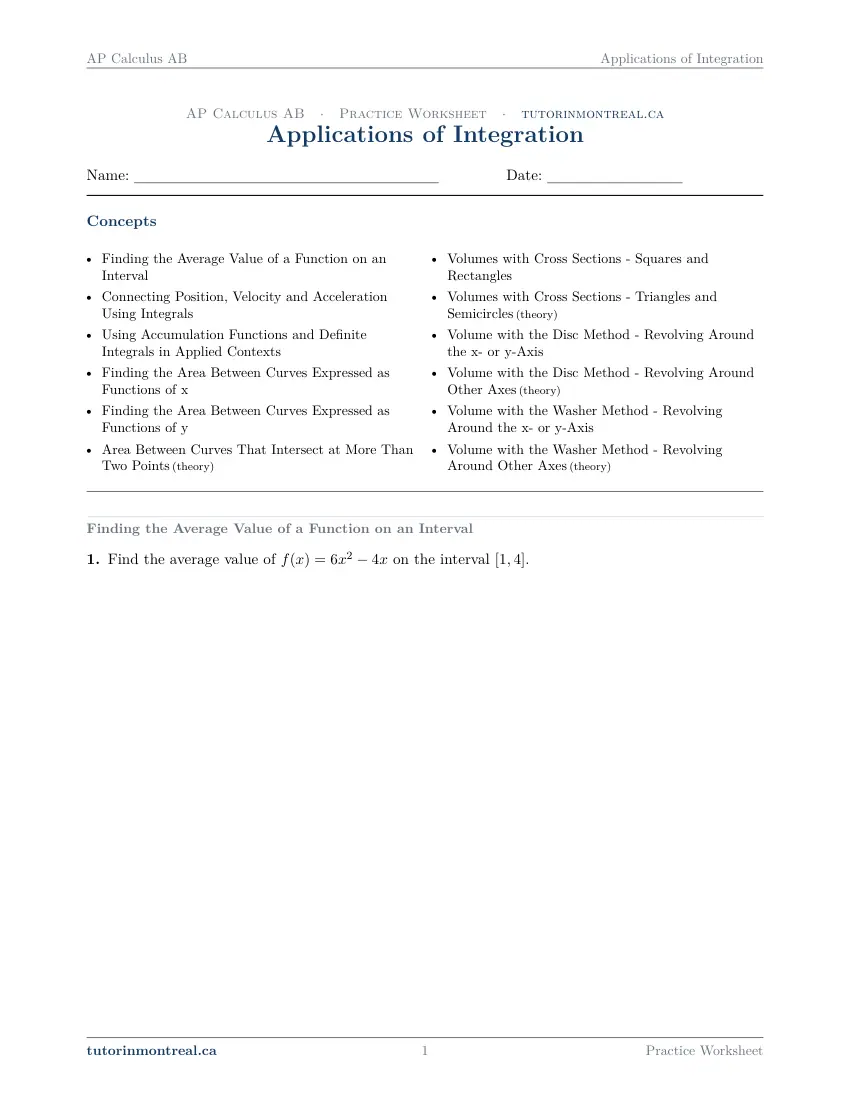
Q1Finding the Average Value of a Function on an Interval
Find the average value of on the interval .
-
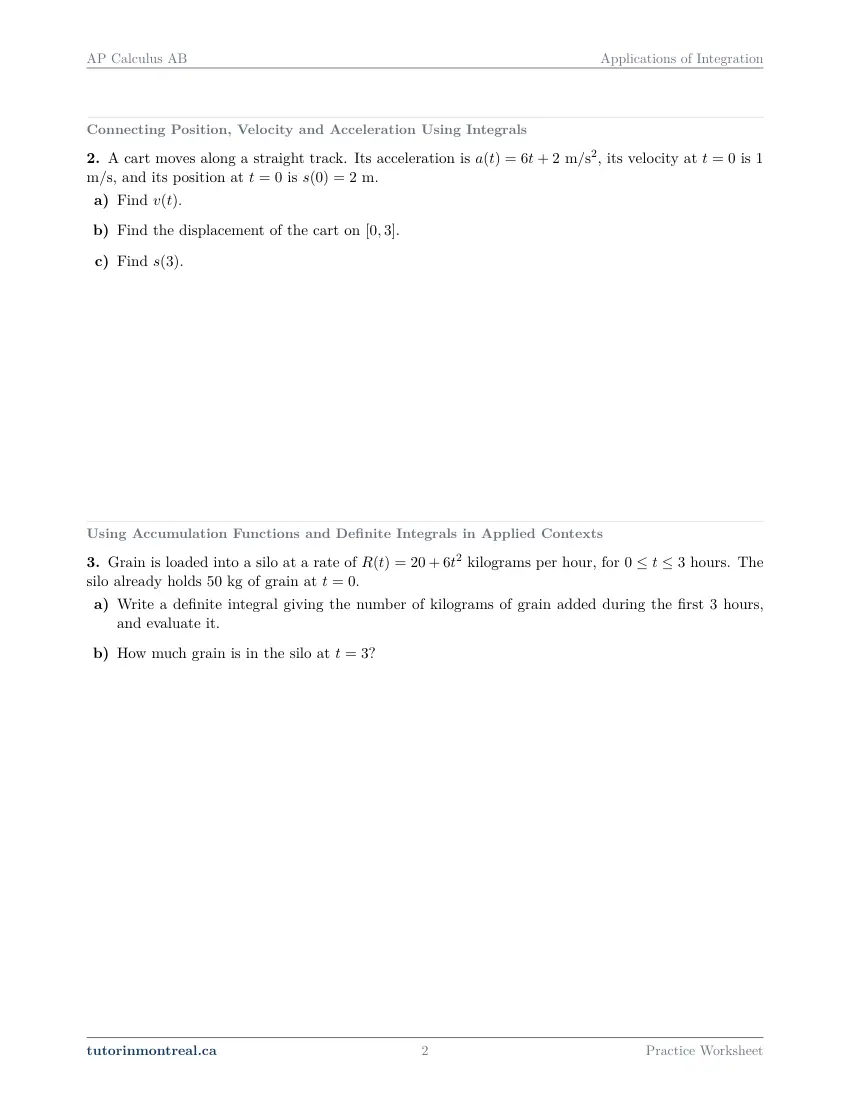
Q2Connecting Position, Velocity and Acceleration Using Integrals
A cart moves along a straight track. Its acceleration is , its velocity at is , and its position at is m.
- Find .
- Find the displacement of the cart on .
- Find .
-
Q3Using Accumulation Functions and Definite Integrals in Applied Contexts
Grain is loaded into a silo at a rate of kilograms per hour, for hours. The silo already holds kg of grain at .
- Write a definite integral giving the number of kilograms of grain added during the first hours, and evaluate it.
- How much grain is in the silo at ?
-
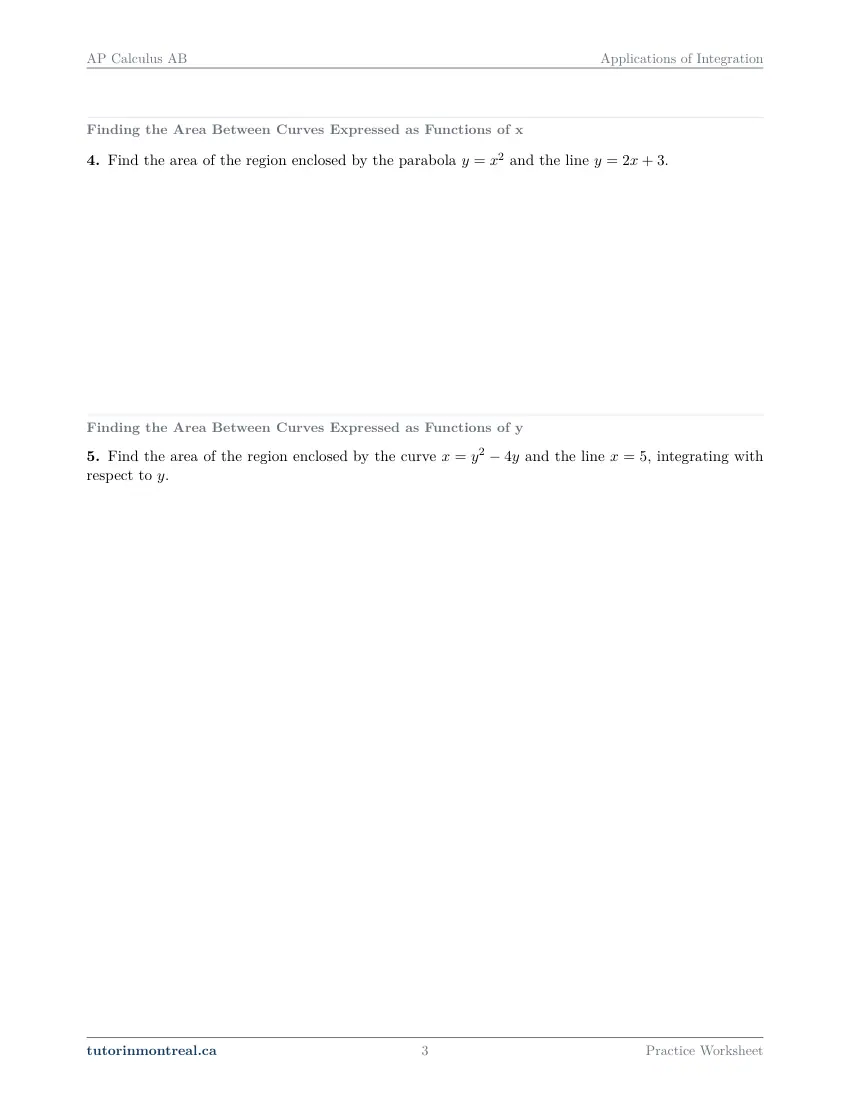
Q4Finding the Area Between Curves Expressed as Functions of x
Find the area of the region enclosed by the parabola and the line .
-
Q5Finding the Area Between Curves Expressed as Functions of y
Find the area of the region enclosed by the curve and the line , integrating with respect to .
-
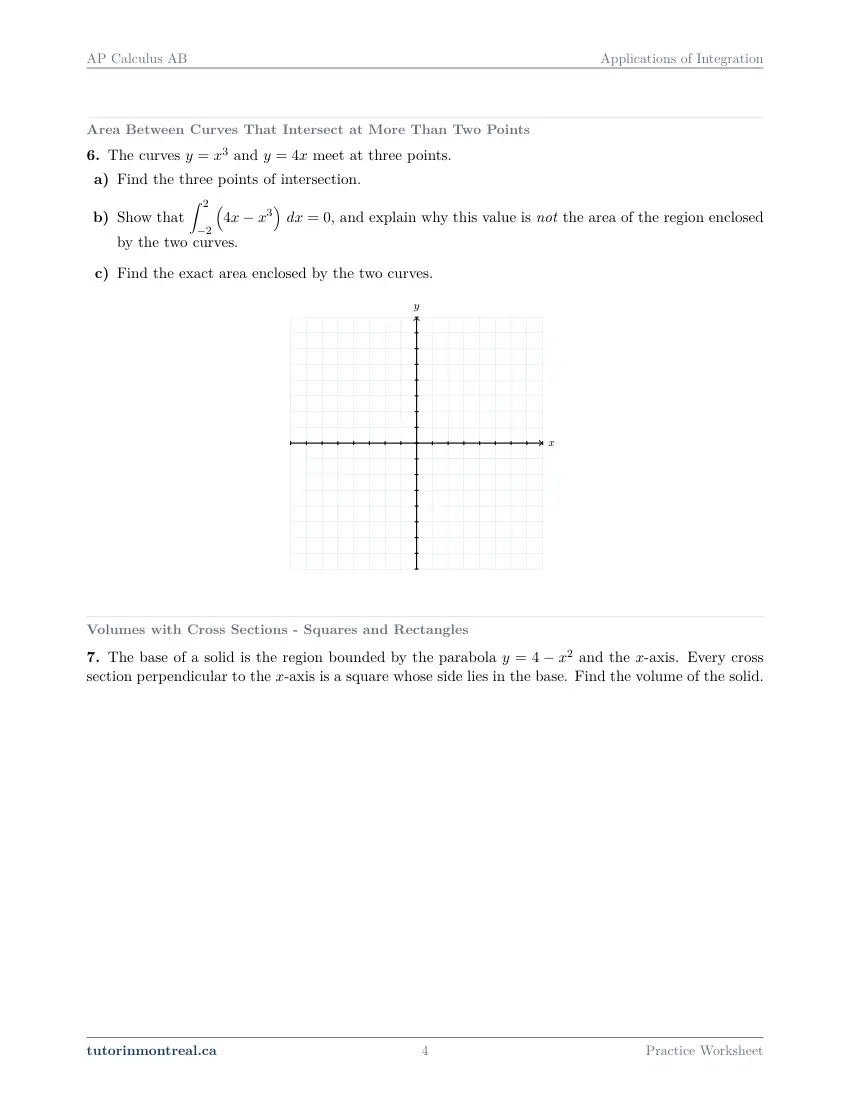
Q6Area Between Curves That Intersect at More Than Two Points
The curves and meet at three points.
- Find the three points of intersection.
- Show that , and explain why this value is not the area of the region enclosed by the two curves.
- Find the exact area enclosed by the two curves.
-
Q7Volumes with Cross Sections - Squares and Rectangles
The base of a solid is the region bounded by the parabola and the -axis. Every cross section perpendicular to the -axis is a square whose side lies in the base. Find the volume of the solid.
-
Q8Volumes with Cross Sections - Triangles and Semicircles
The base of a solid is the triangular region in the first quadrant bounded by the line , the -axis and the -axis. Cross sections perpendicular to the -axis are taken with one side (or the diameter) lying in the base.
- Find the volume if every cross section is a semicircle whose diameter lies in the base.
- Find the volume if every cross section is an equilateral triangle.
- Which solid is larger? Justify your answer by comparing the two cross-sectional area formulas, not by comparing decimals alone.
-
Q9Volume with the Disc Method - Revolving Around the x- or y-Axis
The region bounded by , the -axis and the line is revolved about the -axis. Find the volume of the resulting solid.
-
Q10Volume with the Disc Method - Revolving Around Other Axes
Let be the region bounded above by the horizontal line , below by the curve , and on the left by the -axis. is revolved about the line .
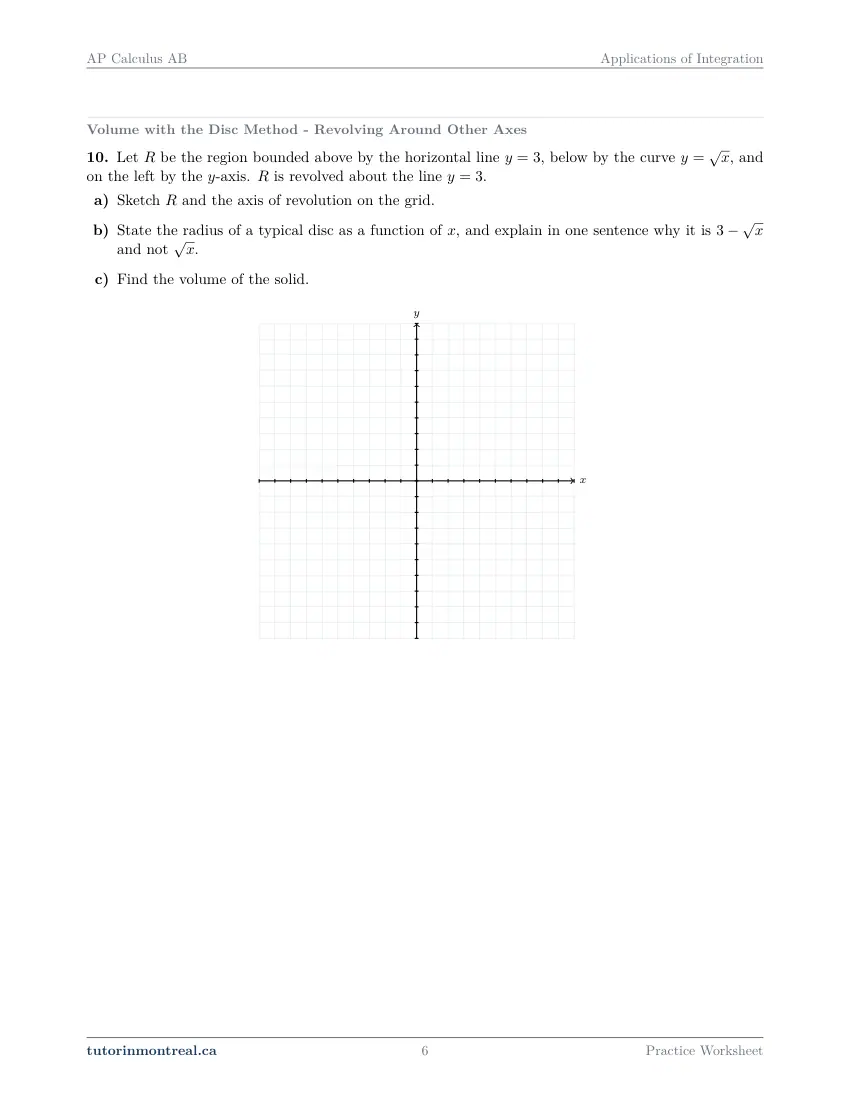
- Sketch and the axis of revolution on the grid.
- State the radius of a typical disc as a function of , and explain in one sentence why it is and not .
- Find the volume of the solid.
A blank Cartesian grid for this question is on the printable PDF.
-
Q11Volume with the Washer Method - Revolving Around the x- or y-Axis
Let be the region enclosed by the parabola and the line . Find the volume of the solid generated when is revolved about the -axis.
-
Q12Volume with the Washer Method - Revolving Around Other Axes
Let be the region bounded by , the -axis and the line . is revolved about the vertical line .
- Explain why the slices are washers and why the inner radius is , not .
- Write the outer and inner radii as functions of , and give the -limits.
- Find the volume.
-
Q13Synthesis — drawing on several topics in this unit
Let be the region enclosed by the curve and the line .
- Find the coordinates of the two points where the boundaries meet, and find the area of .
- Find the average value, on the interval between the two -coordinates found in part (a), of the vertical distance between the two boundaries of .
- is revolved about the -axis. Set up and evaluate an integral for the volume of the resulting solid.
- is the base of a solid whose cross sections perpendicular to the -axis are squares. Find the volume of that solid.
The 9 challenge problems for this topic are a separate, paid sheet and are not reproduced here.
Which stream is this for? This sheet is AP Calculus AB, and it stays inside the AB course description. Arc length is a BC topic and appears nowhere on it, and neither does integration by parts or an improper integral. Everything here is reachable with the substitution and the power-rule antiderivatives AB expects, so the difficulty lives in the geometry of the set-up.
How to do every concept on this sheet
This is the part worksheet sites usually leave out. Below is the actual reasoning behind each group of questions — not a full solution set, the decisions that get you to one. Read it before you start, or after you get stuck.
Average value and average rate of change are different quantities (Q1)
These two get swapped more often than any other pair in the unit, and the exam knows it. They average different things and they come out in different units.
average value of f on [a, b] = (1/(b−a)) ∫ f(x) dx average rate of change = (f(b) − f(a)) ⁄ (b − a)The average value integrates the function, so it is measured in the units of f itself: it is the constant height of the rectangle on [a, b] with the same area as the region under the curve. The average rate of change is the slope of the secant from (a, f(a)) to (b, f(b)) — it averages the derivative, and its units are units of f per unit of x. If a function measures a humidity in percent, one answer is a percentage and the other is percent per hour.
The connection worth remembering: the average value of a rate over an interval is the average rate of change of the quantity that rate belongs to. If V′ = R, then (1/(b−a)) ∫ R dt and (V(b) − V(a))/(b−a) are the same number by the Fundamental Theorem. That is the only case where the two coincide, and it is a case worth being able to explain rather than just assert.
Q13(b) puts this to work on a region: the average vertical distance between two boundaries, over the interval between their intersections, is just the area divided by the width. Same formula, geometry instead of physics.
Motion: displacement, position, and why total distance is a different question (Q2)
Integrating acceleration recovers velocity, and integrating velocity recovers position — but each antiderivative carries a constant, and the initial condition is what pins it down. Do that before evaluating anything, or the constant quietly disappears.
displacement on [a, b] = ∫ v(t) dt s(b) = s(a) + ∫ v(t) dt total distance = ∫ |v(t)| dt∫|v| is not |∫v|. The definite integral of a velocity adds signed contributions, so metres travelled backwards cancel metres travelled forwards. Taking an absolute value at the end cannot undo a cancellation that already happened inside the integral. For a total distance you must locate every time v changes sign, split the interval there, and add the sizes of the pieces. If a velocity never changes sign on the interval — a fact to check, by factoring or by the discriminant, rather than assume — then displacement and total distance agree. The moment it does change sign, they do not, and only the split integral gets the distance right.
A rate integrated over an interval is a net change (Q3)
Whenever a problem hands you a rate — kilograms per hour, litres per minute, cubic metres per hour — the integral of that rate over an interval is the amount accumulated over the interval, not the amount present at the end.
amount at time b = amount at time a + ∫ R(t) dtTwo habits pay for themselves here. First, write the integral before you evaluate it: many marks are for the expression alone. Second, carry the units through — (kg/h)·(h) = kg is the check that tells you whether the number you produced is an amount or a rate. A question that says "interpret the result, with units" is asking for a sentence in the context of the problem, not for the arithmetic again.
Area between curves, and the crossings that force a split (Q4, Q5, Q6)
The integrand is always the length of a slice, written so it is non-negative:
A = ∫ (top − bottom) dx or A = ∫ (right − left) dyQ4 is the standard vertical-slice case: solve for the intersections, test one interior point to see which curve is on top, integrate the difference. Q5 is the same idea turned on its side — a parabola opening sideways and a vertical line — where writing everything as a function of y and integrating (right − left) dy is far cheaper than splitting the region into two vertical pieces.
If the curves cross inside the interval, the integral must be split. Q6 makes this explicit: over an interval containing a crossing, the single integral can come out to zero even though the enclosed region plainly has area, because the piece where the order of the curves reverses contributes a negative amount that cancels the other. "Top minus bottom" is not a fixed pair of functions — it is a description that changes at every crossing. Find all the intersection points first, split there, and subtract in whichever order keeps each integrand non-negative. Equivalently, integrate the absolute value of the difference.
Volumes by cross section: the integrand is an area (Q7, Q8)
A cross-section solid is not made by revolving anything. It has a flat base region, and on every slice perpendicular to an axis sits a plane figure whose size is set by the width of the base at that point. So the recipe is short: get the segment length s across the base as a function of the slicing variable, write the area of the named shape in terms of s, and integrate that area.
V = ∫ A(x) dx square: A = s² equilateral triangle: A = (√3⁄4) s² semicircle on diameter s: A = (π⁄8) s²The semicircle constant is the one people rebuild wrongly under pressure. The base is the diameter, so the radius is s⁄2, and half a circle of that radius has area ½·π·(s/2)² = π s²⁄8. Notice that in Q8 both parts share the identical integral ∫ s² and differ only by a constant out front — which is exactly why part (c) can be settled by comparing √3⁄4 with π⁄8 rather than by comparing decimals.
No revolution, no π. A cross-section volume carries a π only if the named shape brings one — a semicircle or a circle does, a square, rectangle or triangle does not. Putting a π in front of the integral in Q7, where the cross sections are squares, is the single most common wrong answer to it. The mirror-image error is just as costly: squaring the two boundary functions separately, s = (top)² − (bottom)², instead of squaring the length of the segment as a whole, (top − bottom)². A difference of squares belongs to the washer method, where the two squares are radii of an annulus — a different solid entirely.
Discs and washers: square first, subtract after (Q9, Q11)
Now something is revolved, so every slice perpendicular to the axis is a circle or an annulus and a π appears legitimately. A disc when the region touches the axis of revolution along the whole slice; a washer when a gap is left between the region and the axis.
disc: V = π ∫ R² dx washer: V = π ∫ (R² − r²) dxπ ∫ (R² − r²) dx, never π ∫ (R − r)² dx. This is the most expensive error in the unit, and it is expensive because it looks reasonable. The area of an annulus is the big circle minus the small circle, πR² − πr² — you subtract two areas, and each radius is squared on its own before the subtraction. (R − r)² is the square of the difference of the radii, which is the area of nothing in this picture, and it is smaller. Q11 is built to catch it: write the bracket as (outer)² − (inner)², expand inside the integral, and only then antidifferentiate.
Which curve is the outer radius is not a property of the curves — it is a property of the axis. Revolved about a horizontal axis the radius is a vertical distance, so the higher curve is the outer one; revolved about a vertical axis the radius is a horizontal distance, so the curve further to the right is the outer one. The same two curves can swap roles when the axis changes, and the two solids have genuinely different volumes.
Revolving about a shifted axis (Q10, Q12)
The moment the axis is a line like y = 3 or x = 3 instead of a coordinate axis, the radius is no longer just the function value. A radius is the distance from the axis to the boundary, which makes it a subtraction — and for a washer the inner radius is very often a non-zero constant, because the near edge of the region sits a fixed distance from the axis.
Finding the radius, every time
Four steps, done on a sketch. Guessing the radius from the algebra is what produces the wrong solid.
- 1Draw the axis of revolution
Put the line itself on the sketch, not just the region. In Q10 that line is y = 3, the top edge of the region; in Q12 it is x = 3, which lies entirely outside the region.
- 2Draw one representative slice, perpendicular to that axis
Perpendicular to a horizontal axis means a vertical slice, so you integrate in x. Perpendicular to a vertical axis means a horizontal slice, so everything must be rewritten as a function of y and you integrate in y. This one choice decides the whole set-up.
- 3Measure outward from the axis
Read the outer radius as (axis) − (far boundary) or (far boundary) − (axis), whichever is positive, and the inner radius as the distance from the axis to the near boundary. Q10 gives radius 3 − √x, not √x, because √x is measured from y = 0 and y = 0 is not the axis. Q12 gives an inner radius of 1, not 0: the closest the region ever comes to the line x = 3 is the line x = 2, so the solid has a cylindrical hole of radius 1 through it.
- 4Square each radius separately, then subtract
Expand (3 − √x)² as 9 − 6√x + x before integrating. If the region touches the axis along the whole slice, the inner radius is 0 and the washer collapses to a disc — but say so deliberately rather than by default.
Choosing dx or dy, and reading the question for the π (Q13)
Two decisions carry most of this unit, and the synthesis question asks for both on one region: which variable to slice in, and whether the solid was revolved at all.
Setting up any volume in this unit
The order matters — the variable is forced by the geometry, not chosen for convenience.
- 1Ask what made the solid
Revolution about a line, or plane cross sections on a base? Revolution means discs or washers and a π out front. Cross sections mean the area formula of the named shape, and a π only if that shape has a curved part.
- 2Let the axis fix the variable
Slices must be perpendicular to the axis of revolution — vertical slices (dx) for a horizontal axis, horizontal slices (dy) for a vertical one. For cross sections the problem states the direction outright: "perpendicular to the x-axis" means dx.
- 3Rewrite the boundaries in that variable
Integrating in y means solving each curve for x, and the limits become y-values. Mixing an x-integrand with y-limits is the failure mode here, and the answer it produces is not wrong by a little — it is the volume of a different solid.
- 4Write the integrand as one bracket, then expand
π[(outer)² − (inner)²] or [s(x)]², expanded into a polynomial before you antidifferentiate. Q13 asks for a washer volume and a square-cross-section volume on the same region, and the two answers differ by more than the π: one squares a difference of distances from the axis, the other squares the length of the segment.
Preview all 8 pages
Click any page to open the full PDF.
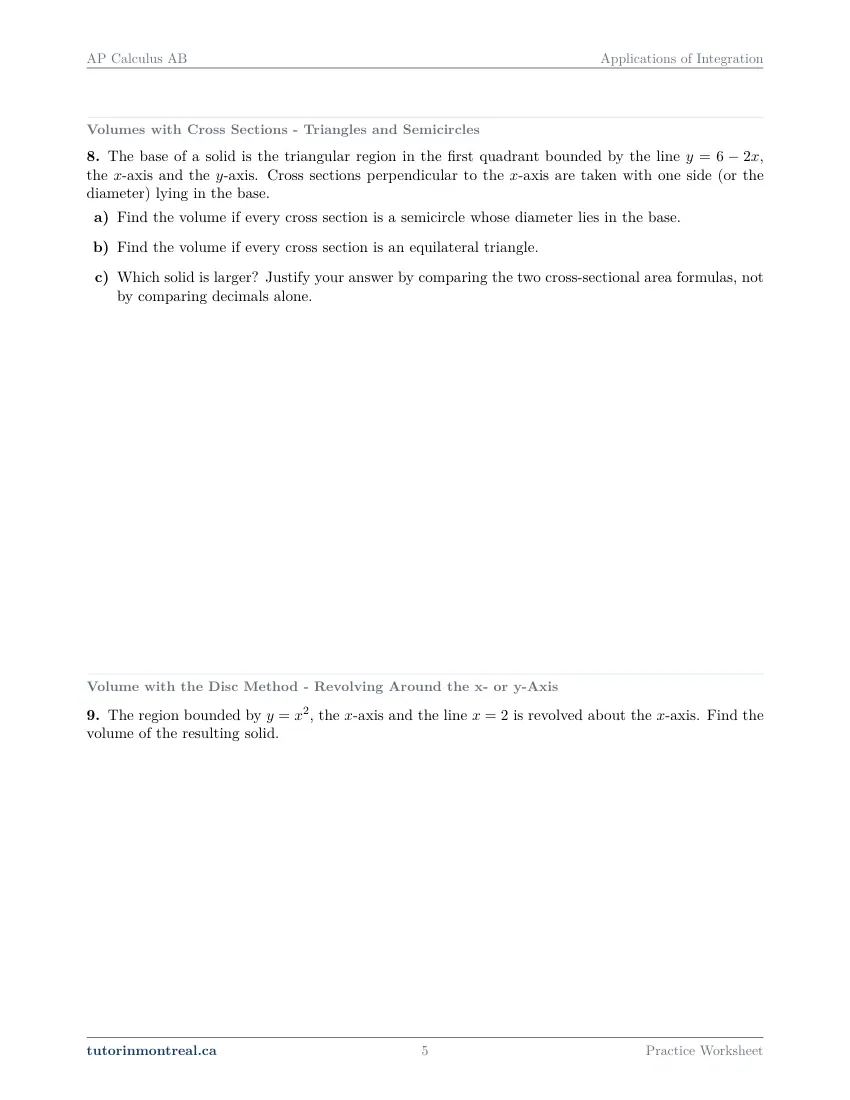
Getting the most out of it
Sketch the region and one slice before writing any integral
Every question in the volume half of this sheet is decided by a picture: which curve is on top, whether the region touches the axis, whether the slice is vertical or horizontal. Two of the questions supply a grid for exactly that reason. A sketch takes thirty seconds and settles the outer radius, the inner radius and the limits at once.
Set the integral up in full, even when you can see the answer
On the free-response part of the exam the set-up carries most of the credit, and a correct integral with an arithmetic slip scores far better than a bare number. Write the limits, the integrand and the differential — and if the question says "set up, do not evaluate", stop there.
Check the π, then check the units
Two five-second audits catch most of the damage in this unit. Did anything actually get revolved? If not, a π in your answer is a mistake, and if the cross section is a semicircle, a missing π is a mistake. And for the applied questions, say the answer back in words with its units — "that many kilograms were added during the first three hours", not "that is the rate" — because a number that is really a rate will not survive the sentence, and neither will an accumulation mistaken for a total.
Redo one question with the other variable
Take Q5 or Q11 and set it up again the other way round. Sometimes you will get the same answer through more work, and sometimes you will find the set-up simply does not go through without splitting — which is the fastest way to learn to spot in advance which variable a region wants.
Want the solutions, or something more challenging?
The worksheet, the questions above and every explanation on this page stay free permanently. Three more PDFs exist for this topic — the worked answer key, a harder problem set, and the answer key to that. They come with the AP Calculus AB Solutions Bundle, which is what keeps the rest of the series free.
What else exists for Applications of Integration
Three PDFs · 18 pages · all three are in the bundle below.
- Answer key — 4 pages. All 13 questions worked step by step, including the restrictions and the justifications. Not a list of final answers.
- Challenge problems — 10 pages, 9 problems. A separate sheet at exam-plus difficulty covering the same 12 concepts. Harder than anything on the free sheet.
- Challenge answer key — 4 pages. Every challenge problem worked to the same standard, with the checks shown.
- PDF, letter size, print-ready.
The one thing that's for sale
Every AP Calculus AB topic — the complete Solutions Bundle
One download, one payment, the whole program. Every answer key and every challenge set for all 8 AP Calculus AB worksheet sets — including this one.
- Worked solutions, not answer lists — every step written out
- Covers the whole year's program at this level
- Less than the price of one hour of tutoring — for the entire year's solutions
Taking Secondary 1 Math as well? The Secondary 1 Math bundle covers all 15 of its sets — 45 PDFs, 182 pages — on the same terms.
Taking Secondary 2 Math as well? The Secondary 2 Math bundle covers all 14 of its sets — 42 PDFs, 181 pages — on the same terms.
Taking Secondary 3 Math as well? The Secondary 3 Math bundle covers all 11 of its sets — 33 PDFs, 154 pages — on the same terms.
Taking Secondary 4 Math as well? The Secondary 4 Math bundle covers all 17 of its sets — 51 PDFs, 154 pages — on the same terms.
Taking Secondary 5 Math as well? The Secondary 5 Math bundle covers all 21 of its sets — 63 PDFs, 228 pages — on the same terms.
Taking CEGEP Calculus I as well? The CEGEP Calculus I bundle covers all 8 of its sets — 24 PDFs, 82 pages — on the same terms.
Taking CEGEP Calculus II as well? The CEGEP Calculus II bundle covers all 8 of its sets — 24 PDFs, 90 pages — on the same terms.
Taking CEGEP Linear Algebra as well? The CEGEP Linear Algebra bundle covers all 7 of its sets — 21 PDFs, 82 pages — on the same terms.
Common questions
Is this worksheet really free?
Yes — the questions are on this page to read, and the PDF downloads directly, no email and no account. The one paid item is optional: the complete AP Calculus AB Solutions Bundle, which covers every unit in the series.
What is the difference between average value and average rate of change?
Average value is (1/(b−a)) times the integral of f over [a, b] — it averages the function itself, so it comes out in the units of f, and it is the height of the rectangle with the same area as the region under the curve. Average rate of change is (f(b) − f(a))/(b − a), the slope of the secant line, which averages the derivative and comes out in units of f per unit of x. The two agree only when the function being averaged is itself the rate of change of some quantity.
Why is the washer integrand π(R² − r²) and not π(R − r)²?
Because a washer is a big circle with a small circle removed, and its area is πR² − πr² — two areas subtracted, so each radius is squared before the subtraction. (R − r)² squares the gap between the radii, which is not the area of anything in the picture, and it always gives a smaller number. Write the bracket as (outer)² − (inner)² and expand it inside the integral.
When should I integrate with respect to y instead of x?
When horizontal slices describe the region more simply than vertical ones. For a revolution the rule is forced: slices have to be perpendicular to the axis, so a vertical axis means horizontal slices and dy. For an area, integrate in y when the left and right boundaries are single curves all the way up but the top or bottom boundary changes partway across — that change is what would force the x-integral to be split.
Does a volume by cross sections ever have a π in it?
Only when the cross section itself is curved. A semicircle on a diameter s has area (π/8)s², so it brings a π; a square (s²), a rectangle or an equilateral triangle ((√3/4)s²) do not. Nothing is revolved in a cross-section problem, so there is no other source of a π — and conversely, a disc or washer volume always has one.
Is arc length on this worksheet?
No. Arc length is a BC topic, and this sheet is AP Calculus AB, so it is not here — and neither are integration by parts or improper integrals. The unit covers average value, motion from integrals, accumulation in context, area between curves, volumes by cross section, and the disc and washer methods.
Can teachers use this in class?
Yes. Print and photocopy it for your own classes freely — I just ask that the tutorinmontreal.ca footer stays on the page.
I'm stuck on one question. Can you help?
Yes — through one-on-one tutoring, in Montreal or online. Get in touch to arrange a session, or see the current rates.
← All 8 AP Calculus AB worksheets · Secondary 1 Math series (15 sheets) → · Secondary 2 Math series (14 sheets) → · Secondary 3 Math series (11 sheets) → · Secondary 4 Math series (17 sheets) → · Secondary 5 Math series (21 sheets) → · CEGEP Calculus I series (8 sheets) → · CEGEP Calculus II series (8 sheets) → · CEGEP Linear Algebra series (7 sheets) →
The same topic at the other level: CEGEP Calculus II · Applications of Integration.