University Linear Algebra — Change of Basis and Matrix Representations Worksheet
The set that separates a linear map from the matrix you happen to write for it. The matrix that converts coordinates from one basis to another, and its inverse going back; the matrix of a transformation when neither space uses its standard basis; the same idea on polynomial spaces, where a well-chosen basis makes the matrix almost trivial; the formula P⁻¹AP that rewrites an operator's matrix in a new basis; and similar matrices, which are one operator seen two ways, with the numbers that cannot change. Have a look on this page, then print the free PDF when you want to write on it.
Practice worksheet — free PDF
No email, no account, no watermark. Teachers: photocopy it for your classes freely. Worked solutions and 6 harder problems come with the University Linear Algebra bundle.
All 9 questions
Each question targets one named concept from the sheet. Read them here, or print the PDF — it has working space under each one.
-
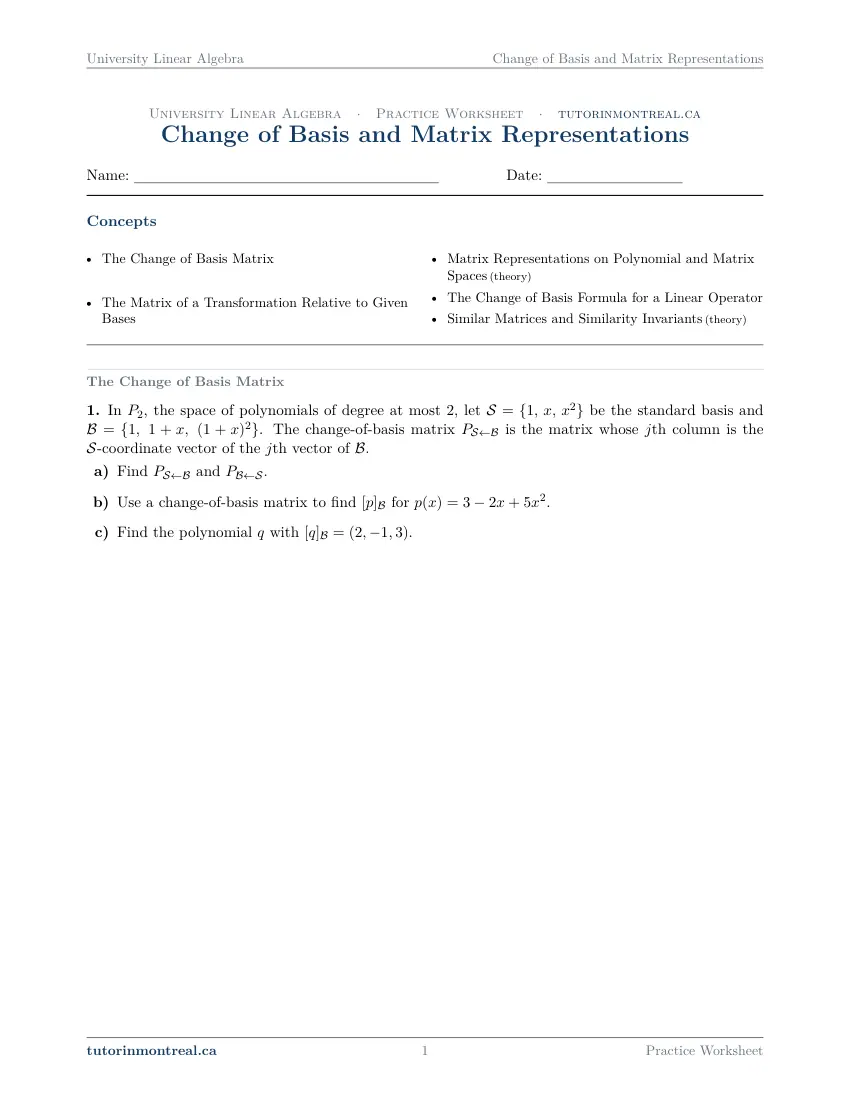
Q1The Change of Basis Matrix
In , the space of polynomials of degree at most , let be the standard basis and . The change-of-basis matrix is the matrix whose th column is the -coordinate vector of the th vector of .
- Find and .
- Use a change-of-basis matrix to find for .
- Find the polynomial with .
-
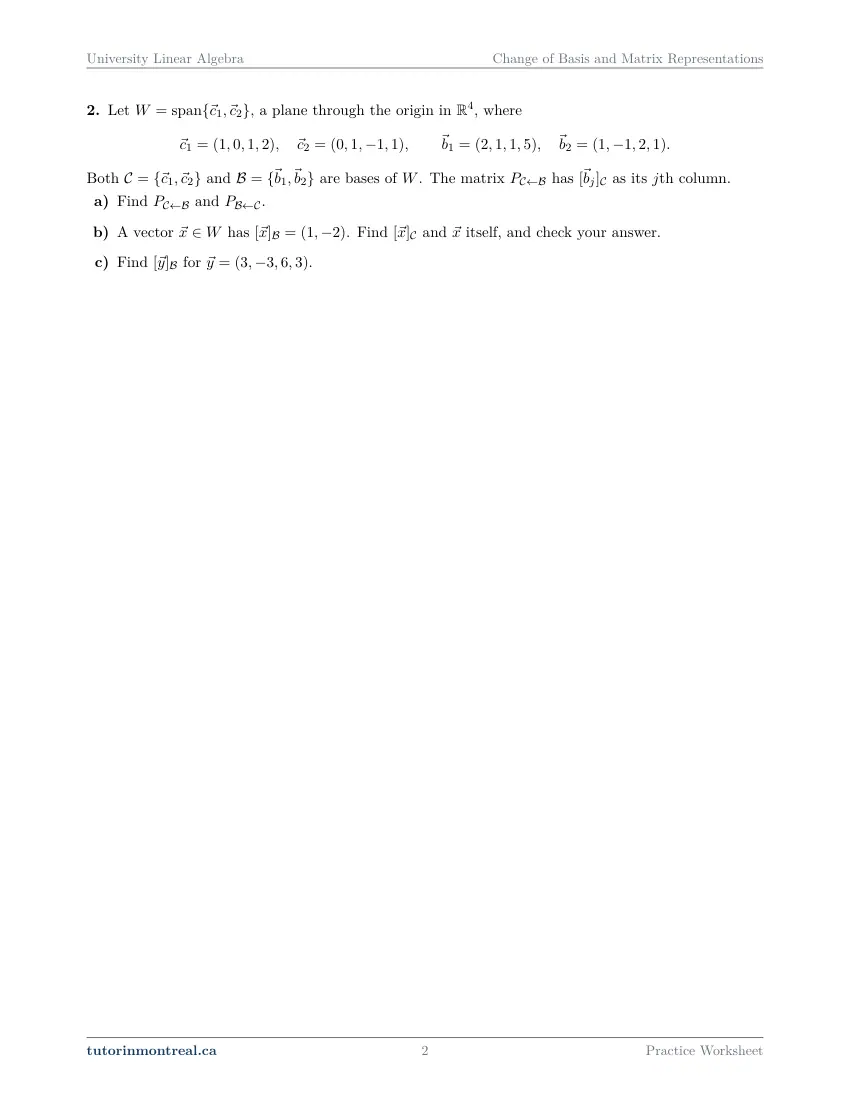
Q2The Change of Basis Matrix
Let , a plane through the origin in , where Both and are bases of . The matrix has as its th column.
- Find and .
- A vector has . Find and itself, and check your answer.
- Find for .
-
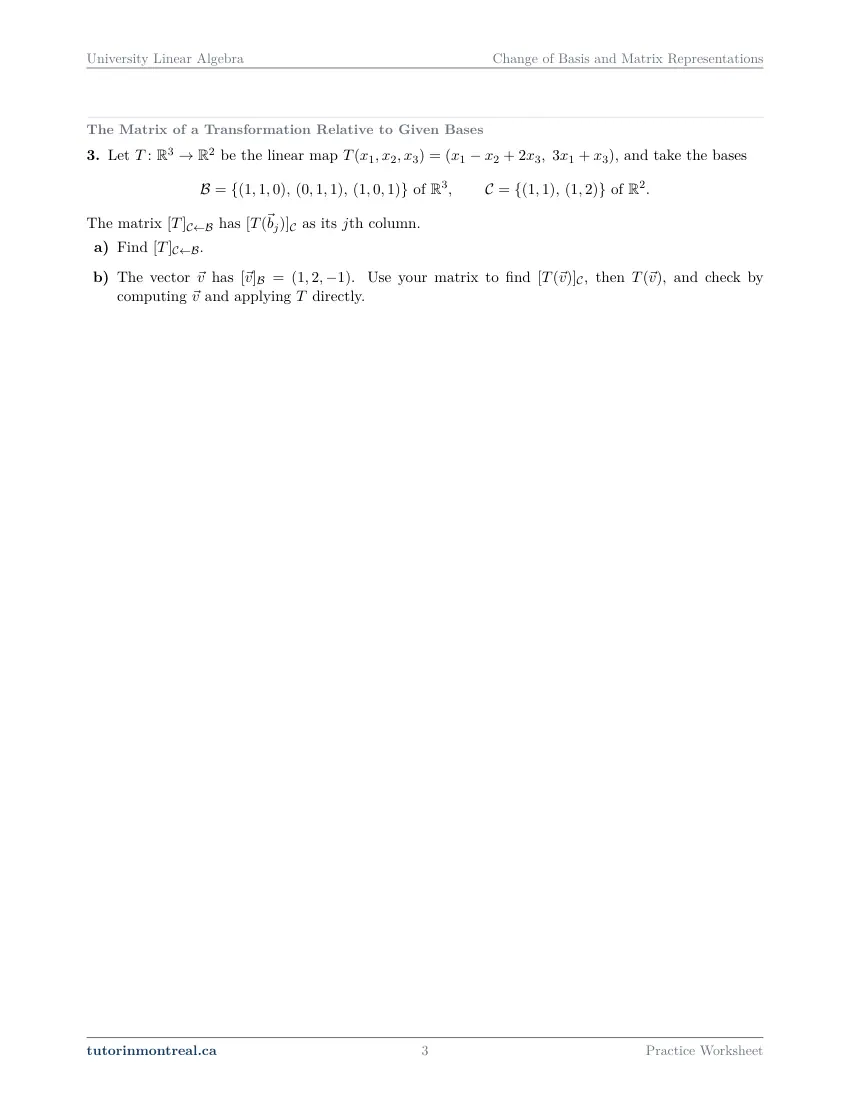
Q3The Matrix of a Transformation Relative to Given Bases
Let be the linear map , and take the bases The matrix has as its th column.
- Find .
- The vector has . Use your matrix to find , then , and check by computing and applying directly.
-
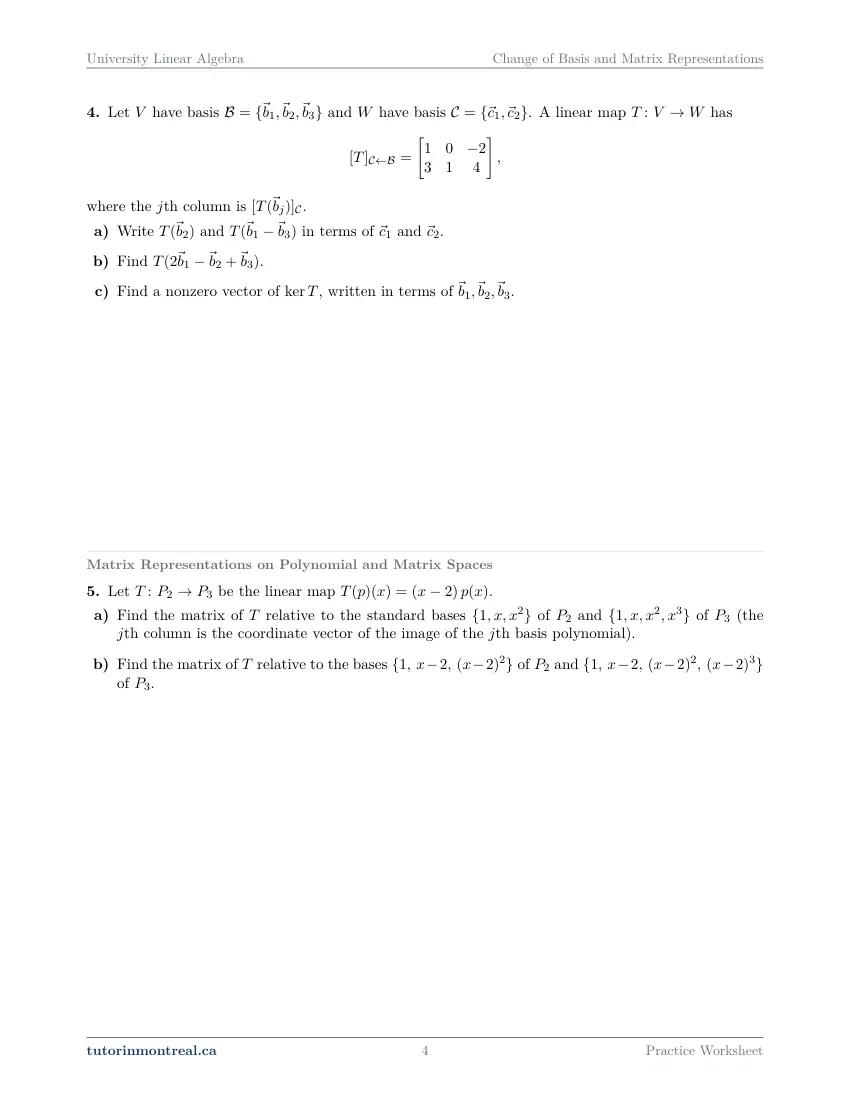
Q4The Matrix of a Transformation Relative to Given Bases
Let have basis and have basis . A linear map has where the th column is .
- Write and in terms of and .
- Find .
- Find a nonzero vector of , written in terms of .
-
Q5Matrix Representations on Polynomial and Matrix Spaces
Let be the linear map .
- Find the matrix of relative to the standard bases of and of (the th column is the coordinate vector of the image of the th basis polynomial).
- Find the matrix of relative to the bases of and of .
-
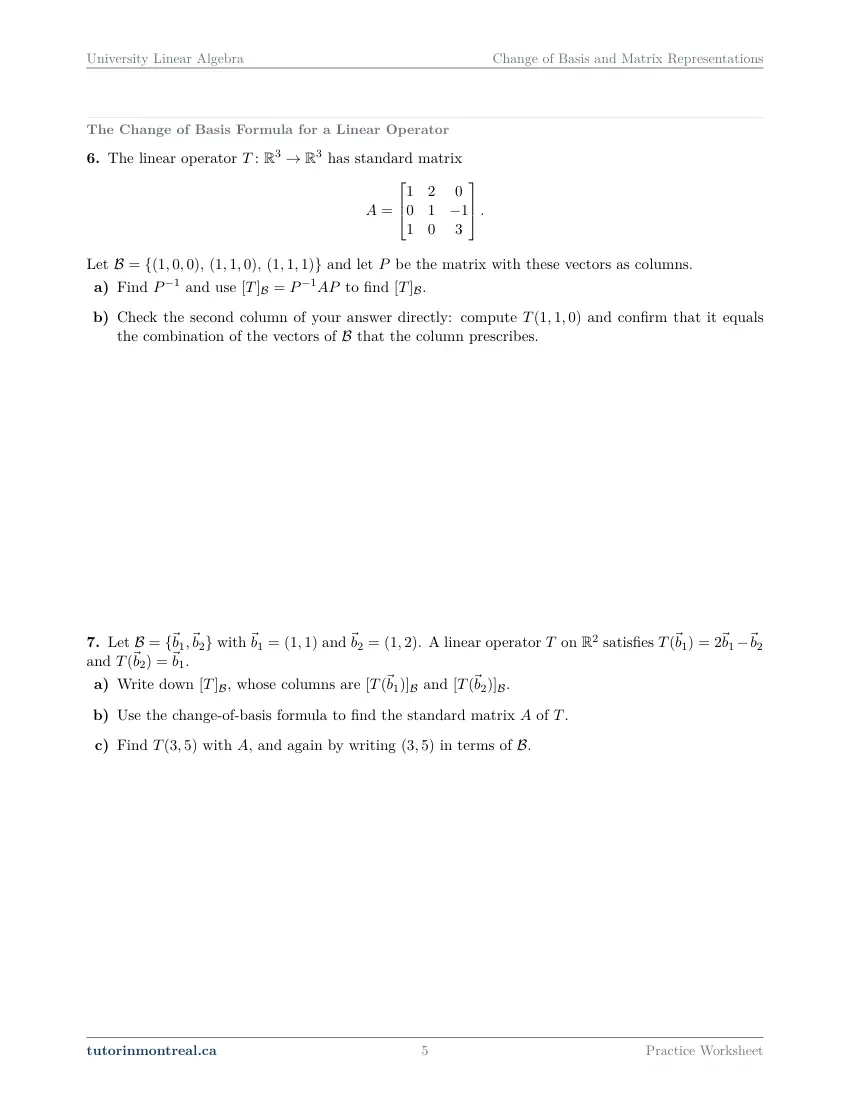
Q6The Change of Basis Formula for a Linear Operator
The linear operator has standard matrix Let and let be the matrix with these vectors as columns.
- Find and use to find .
- Check the second column of your answer directly: compute and confirm that it equals the combination of the vectors of that the column prescribes.
-
Q7The Change of Basis Formula for a Linear Operator
Let with and . A linear operator on satisfies and .
- Write down , whose columns are and .
- Use the change-of-basis formula to find the standard matrix of .
- Find with , and again by writing in terms of .
-
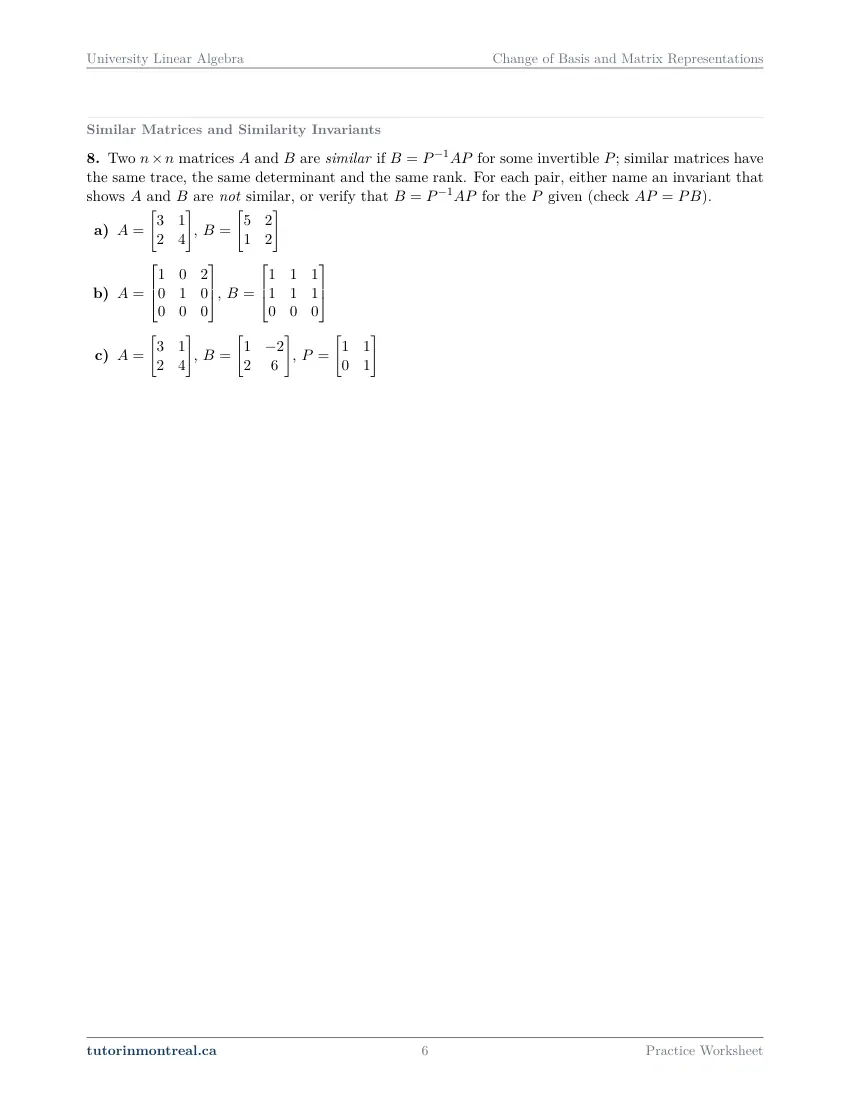
Q8Similar Matrices and Similarity Invariants
Two matrices and are similar if for some invertible ; similar matrices have the same trace, the same determinant and the same rank. For each pair, either name an invariant that shows and are not similar, or verify that for the given (check ).
- ,
- ,
- , ,
-
Q9Synthesis — drawing on several topics in this unit
Let be the linear operator , let and let . For an operator, has as its th column.
- Find .
- Find (columns ) and , and use to find .
- Check the third column of by computing directly.
- Name two numbers that and must share, and confirm that they do.
The 6 challenge problems for this topic are a separate, paid sheet and are not reproduced here.
What does this set assume? This set stands on CEGEP Linear Algebra — matrix products, inverses, determinants — and on the earlier sets of this course, above all coordinate vectors relative to a basis (from Basis, Dimension and Coordinates) and the standard matrix of a linear transformation (from Linear Transformations). Every matrix here is built the same way: its columns are coordinate vectors. Scope is the change-of-basis matrix, the matrix of a map relative to given bases, matrix representations on polynomial and matrix spaces, the change-of-basis formula for an operator, and similarity with its invariants. Choosing a basis that makes the matrix diagonal is the next set, Eigenvalues and Diagonalization; the Jordan form is not part of this course.
Which course is this for? In the public course calendars of Montreal universities, this material is part of the courses numbered MATH 223, MATH 251, MAST 234, MAT1250, MAT1260 and MAT472. Each course orders and weights the topics its own way, so check your own outline for what your exam covers. Which sets match your course.
The rest of this unit
The worksheet is the practice, and it is free. Two more printable documents cover the same unit and come with the University Linear Algebra bundle: read the notes first, work this sheet, then sit the test closed-book. See what each one covers.
What the Change of Basis and Matrix Representations notes cover About the Change of Basis and Matrix Representations unit test
How to do every concept on this sheet
This is the part worksheet sites usually leave out. Below is the actual reasoning behind each group of questions — not a full solution set, the decisions that get you to one. Read it before you start, or after you get stuck.
The change-of-basis matrix
Given two bases of the same space, the change-of-basis matrix from B to S converts B-coordinates into S-coordinates. Q1 states the rule for building it: its columns are the S-coordinates of the vectors of B.
[x]S = PS←B [x]B and PB←S = (PS←B)⁻¹In Q1 the target basis is the standard basis of the quadratics, so each column is just the coefficients of one basis polynomial — expand the square first. The matrix in the other direction is the inverse. Part (b) converts standard coordinates into B-coordinates, so use the matrix whose arrow points toward B; part (c) runs the other way.
Read the arrow. PS←B takes B-coordinates in and gives S-coordinates out. Using the wrong one of the pair is the most common error in this set, and it produces an answer that looks perfectly reasonable. Before multiplying, say out loud which coordinates you have and which you want.
Q2 has two bases of a plane inside four-space, and neither is standard. Column j of the matrix from B to C is the C-coordinates of the j-th vector of B, so you solve a small system for each bj — both at once, with the two vectors augmented side by side.
Part (b) asks you to check, so do it twice. Build x from its B-coordinates and from its C-coordinates. Both must give the same vector of four-space. If they differ, the change-of-basis matrix has a wrong column.
The matrix of a transformation relative to given bases
A linear map from V to W has one matrix for every choice of basis B of V and C of W. Q3 gives the rule: column j is the C-coordinates of T applied to the j-th vector of B.
Building [T]C←B
Apply, then convert, one column at a time.
- 1Apply T to each vector of B
These images live in W, in ordinary coordinates.
- 2Write each image in C-coordinates
Solve for its weights on the vectors of C — all images at once, augmented side by side.
- 3Stack them as columns
The matrix has as many columns as B has vectors and as many rows as C has.
Q3(b) is what the matrix is for: multiplying B-coordinates of v by it gives C-coordinates of T(v). The question then asks for the check that makes the whole construction trustworthy — compute v itself, apply T directly, and compare.
Q4 gives only the matrix, with abstract bases, and asks you to read it. Column two is the image of the second basis vector; a combination of basis vectors maps to the same combination of columns. Part (c) asks for a non-zero kernel vector: find a non-zero solution of the matrix times a coordinate vector equal to zero, then translate the coordinates back into a combination of b₁, b₂, b₃.
Matrix representations on polynomial spaces
Q5 is a map from quadratics to cubics that multiplies by a fixed linear factor. Part (a) uses the standard bases: multiply each of 1, x and x² by the factor, expand, and record the coefficients as columns. Part (b) uses bases built from powers of the same factor.
Choose the basis that suits the map. In part (b), apply the map to each basis polynomial before expanding anything. Multiplying a power of the factor by the factor gives the next power, which is already a member of the second basis — so each coordinate vector is immediate. The comparison between parts (a) and (b) is the reason for this whole set: the same map, a much simpler matrix.
The change-of-basis formula for an operator
An operator maps a space to itself, so one basis serves for both sides. If A is its standard matrix and P has the vectors of B as columns, the matrix relative to B is:
[T]B = P⁻¹ A PRead it from right to left: P converts B-coordinates to standard ones, A applies the map, and P⁻¹ converts back. Q6 applies the formula, then asks you to confirm one column by the definition — compute the image of the second basis vector and check that it is the combination of B that the column says.
Q7 runs the formula backwards. The map is described by what it does to the basis vectors, so its matrix relative to B can be written down with no computation; solving the formula for A gives the standard matrix.
A = P [T]B P⁻¹Two routes, one answer. Part (c) computes the same image twice: with A, and by writing the input in B-coordinates, applying [T]B, and converting back. Agreement confirms A.
Similar matrices
Two square matrices are similar when one is P⁻¹ times the other times P for some invertible P — that is, when they are matrices of the same operator in two bases. Q8 lists three numbers similar matrices always share, and asks you to use them.
Invariants only work in one direction. Different trace, determinant or rank proves two matrices are not similar. Equal values prove nothing — matrices can agree on all three and still not be similar. That is why part (c) gives you P: to show similarity you must exhibit it and check. Check AP = PB rather than computing P⁻¹; it avoids an inverse and is equivalent.
The synthesis question
Q9 follows one operator on quadratics — x times the derivative — through the set. Part (a) is Q5(a): apply the operator to 1, x and x² and record coefficients. Part (b) is Q1 and Q6 together: build P from the second basis in standard coordinates, invert it, and apply the formula. Part (c) is Q6(b)'s check, on the third column. Part (d) returns to Q8: the two matrices are similar by construction, so name two of the invariants Q8 lists and compute them for both.
Preview all 7 pages
Click any page to open the full PDF.
Getting the most out of it
Label every matrix with its arrow
Write PC←B or [T]C←B, never just P. When you multiply, the inner labels must match — coordinates in B go into a matrix whose right-hand label is B. This one habit prevents most errors in the set.
Columns are coordinate vectors
Every matrix in this set is built the same way: apply something to a basis vector, write the result in coordinates, make it a column. When you are unsure how to start, go back to that sentence.
Check one column by the definition
After using a formula, pick one basis vector, apply the map directly, and confirm the matching column. It takes a minute and catches a wrong inverse or a transposed product.
Avoid inverses when you can
To check B = P⁻¹AP, check AP = PB. To convert into the standard basis, multiply by the matrix of basis vectors directly. Invert only when the question needs the other direction.
Want the solutions, or something more challenging?
The worksheet, the questions above and every explanation on this page stay free permanently. Three more PDFs exist for this topic — the worked answer key, a harder problem set, and the answer key to that. They come with the University Linear Algebra Solutions Bundle, beside the unit notes and the unit test, which is what keeps the rest of the series free.
What else exists for Change of Basis and Matrix Representations
Three PDFs · 12 pages · all three are in the bundle below.
- Answer key — 3 pages. All 9 questions worked step by step, including the restrictions and the justifications. Not a list of final answers.
- Challenge problems — 6 pages, 6 problems. A separate sheet at exam-plus difficulty covering the same 5 concepts. Harder than anything on the free sheet.
- Challenge answer key — 3 pages. Every challenge problem worked to the same standard, with the checks shown.
- PDF, letter size, print-ready.
The one thing that's for sale
Every University Linear Algebra topic — the complete Solutions Bundle
One download, one payment, the whole program. For all 9 University Linear Algebra units: the worksheet, the reference notes, the challenge set, the unit test and every answer key — including this one.
- Worked solutions, not answer lists — every step written out
- Covers the whole year's program at this level
- Less than the price of one hour of tutoring — for the entire year's solutions
Taking Secondary 1 Math as well? The Secondary 1 Math bundle covers all 15 of its units — 106 PDFs, 474 pages — on the same terms.
Taking Secondary 2 Math as well? The Secondary 2 Math bundle covers all 14 of its units — 98 PDFs, 449 pages — on the same terms.
Taking Secondary 3 Math as well? The Secondary 3 Math bundle covers all 11 of its units — 77 PDFs, 367 pages — on the same terms.
Taking Secondary 4 Math as well? The Secondary 4 Math bundle covers all 17 of its units — 122 PDFs, 466 pages — on the same terms.
Taking Secondary 5 Math as well? The Secondary 5 Math bundle covers all 21 of its units — 147 PDFs, 589 pages — on the same terms.
Taking CEGEP Calculus I as well? The CEGEP Calculus I bundle covers all 9 of its units — 72 PDFs, 371 pages — on the same terms.
Taking CEGEP Calculus II as well? The CEGEP Calculus II bundle covers all 8 of its units — 64 PDFs, 335 pages — on the same terms.
Taking CEGEP Linear Algebra as well? The CEGEP Linear Algebra bundle covers all 7 of its units — 56 PDFs, 298 pages — on the same terms.
Taking University Calculus III as well? The University Calculus III bundle covers all 9 of its units — 72 PDFs, 516 pages — on the same terms.
Taking University Differential Equations as well? The University Differential Equations bundle covers all 9 of its units — 36 PDFs, 182 pages — on the same terms.
Taking University Business Math as well? The University Business Math bundle covers all 9 of its units — 36 PDFs, 190 pages — on the same terms.
Taking University Introductory Statistics as well? The University Introductory Statistics bundle covers all 9 of its units — 36 PDFs, 186 pages — on the same terms.
Taking University Discrete Math as well? The University Discrete Math bundle covers all 9 of its units — 36 PDFs, 155 pages — on the same terms.
Taking AP Calculus AB as well? The AP Calculus AB bundle covers all 8 of its units — 64 PDFs, 527 pages — on the same terms.
Common questions
Is this worksheet really free?
Yes — the questions are on this page to read, and the PDF downloads directly, no email and no account. The one paid item is optional: the complete University Linear Algebra Solutions Bundle, which covers every set at this level.
Which university courses is this for?
The course codes listed on this page are taken from the public course calendars of universities that teach linear algebra after CEGEP. Each course orders and weights the topics its own way — some introduce change of basis with coordinates, others only after linear transformations — so check the outline for your own section to see where this set falls in your term.
What do I need to know before starting this set?
Coordinate vectors relative to a basis, from Basis, Dimension and Coordinates, and the standard matrix of a linear transformation, from Linear Transformations — plus matrix inverses from CEGEP Linear Algebra.
Why is it P⁻¹AP and not PAP⁻¹?
It depends on what P converts. If the columns of P are the new basis vectors in standard coordinates, P turns new coordinates into standard ones, so to act on a vector given in the new basis you apply P first, then A, then P⁻¹ to return — which, written as a product, is P⁻¹AP. Some courses define P the other way round and get the other formula, so always check what P converts.
If two matrices have the same trace, determinant and rank, are they similar?
Not necessarily. Those invariants can prove two matrices are not similar, but agreeing on them does not prove similarity. To show two matrices are similar you exhibit an invertible P and check.
Why would I want a basis other than the standard one?
Because the matrix of a map can be much simpler in a basis suited to it. This set shows a map on polynomials whose matrix becomes almost trivial in the right basis; the next set finds the basis that makes an operator's matrix diagonal.
Can teachers use this in class?
Yes. Print and photocopy it for your own classes freely — I just ask that the tutorinmontreal.ca footer stays on the page.
I'm stuck on one question. Can you help?
Yes — through one-on-one tutoring, in Montreal or online. Get in touch to arrange a session, or see the current rates.
← All 9 University Linear Algebra worksheets · Secondary 1 Math series (15 sheets) → · Secondary 2 Math series (14 sheets) → · Secondary 3 Math series (11 sheets) → · Secondary 4 Math series (17 sheets) → · Secondary 5 Math series (21 sheets) → · CEGEP Calculus I series (9 sheets) → · CEGEP Calculus II series (8 sheets) → · CEGEP Linear Algebra series (7 sheets) → · University Calculus III series (9 sheets) → · University Differential Equations series (9 sheets) → · University Business Math series (9 sheets) → · University Introductory Statistics series (9 sheets) → · University Discrete Math series (9 sheets) → · AP Calculus AB series (8 sheets) →