University Linear Algebra — Eigenvalues and Diagonalization Worksheet
The set every linear algebra course builds toward. Recognising an eigenvector from the definition, before any polynomial is computed, for a matrix and for the derivative; the characteristic polynomial, factored, and checked against the trace and the determinant; an eigenspace as a null space, with a basis and a dimension; diagonalizing a matrix and a map on polynomials; deciding when diagonalization is impossible, from the multiplicities alone; the payoff, a formula for every power of a matrix; and the real matrix whose eigenvalues are not real. Have a look on this page, then print the free PDF when you want to write on it.
Practice worksheet — free PDF
No email, no account, no watermark. Teachers: photocopy it for your classes freely. Worked solutions and 9 harder problems come with the University Linear Algebra bundle.
All 13 questions
Each question targets one named concept from the sheet. Read them here, or print the PDF — it has working space under each one.
-
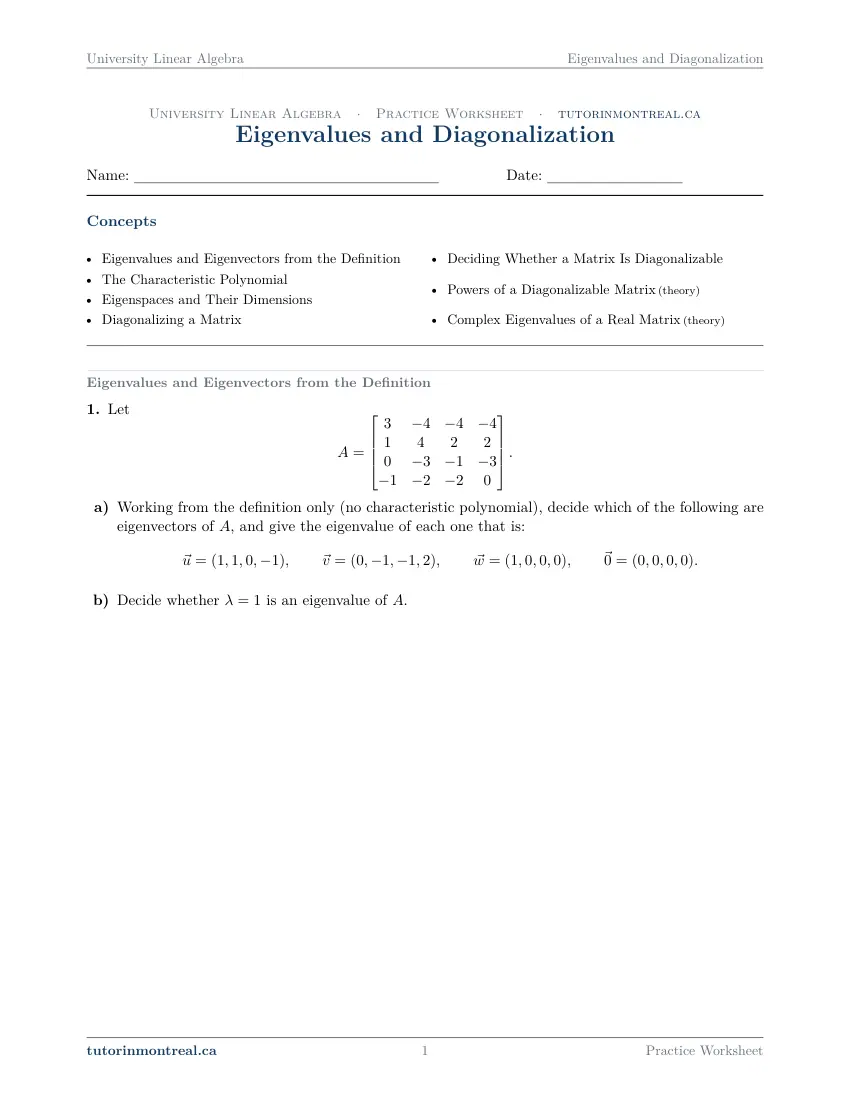
Q1Eigenvalues and Eigenvectors from the Definition
Let
- Working from the definition only (no characteristic polynomial), decide which of the following are eigenvectors of , and give the eigenvalue of each one that is:
- Decide whether is an eigenvalue of .
-
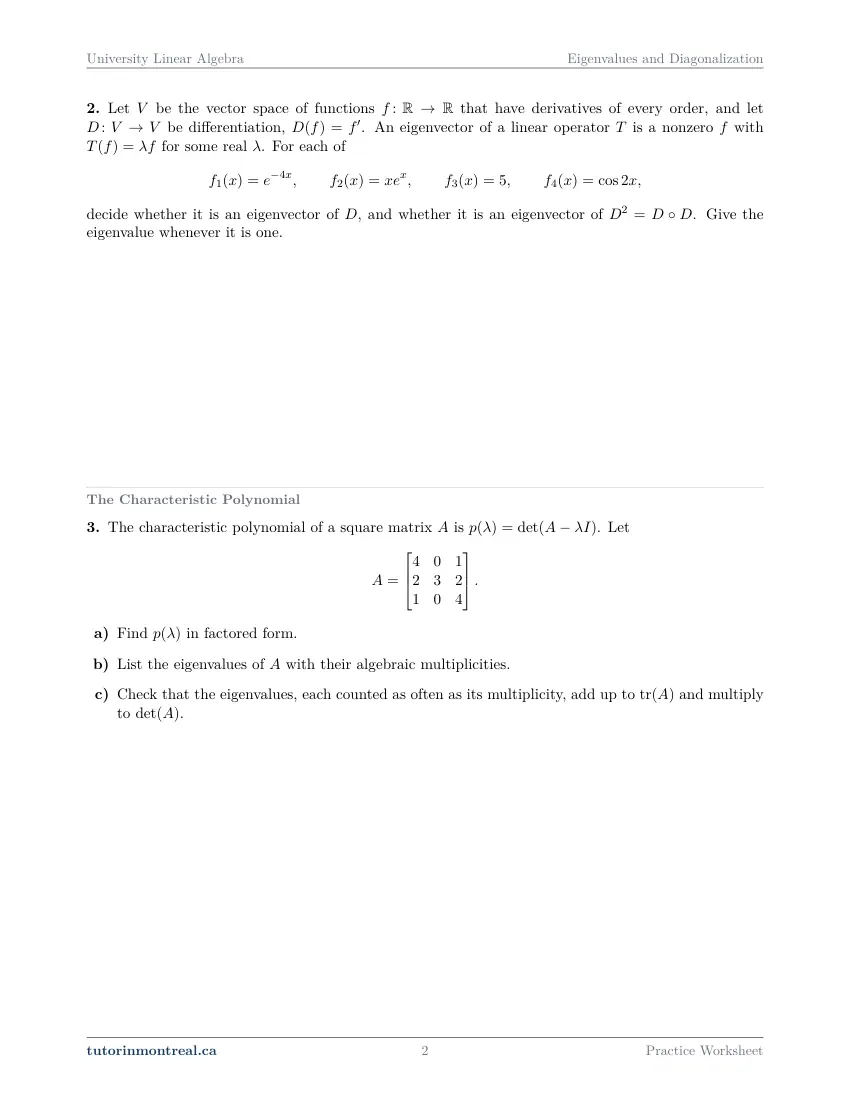
Q2Eigenvalues and Eigenvectors from the Definition
Let be the vector space of functions that have derivatives of every order, and let be differentiation, . An eigenvector of a linear operator is a nonzero with for some real . For each of decide whether it is an eigenvector of , and whether it is an eigenvector of . Give the eigenvalue whenever it is one.
-
Q3The Characteristic Polynomial
The characteristic polynomial of a square matrix is . Let
- Find in factored form.
- List the eigenvalues of with their algebraic multiplicities.
- Check that the eigenvalues, each counted as often as its multiplicity, add up to and multiply to .
-
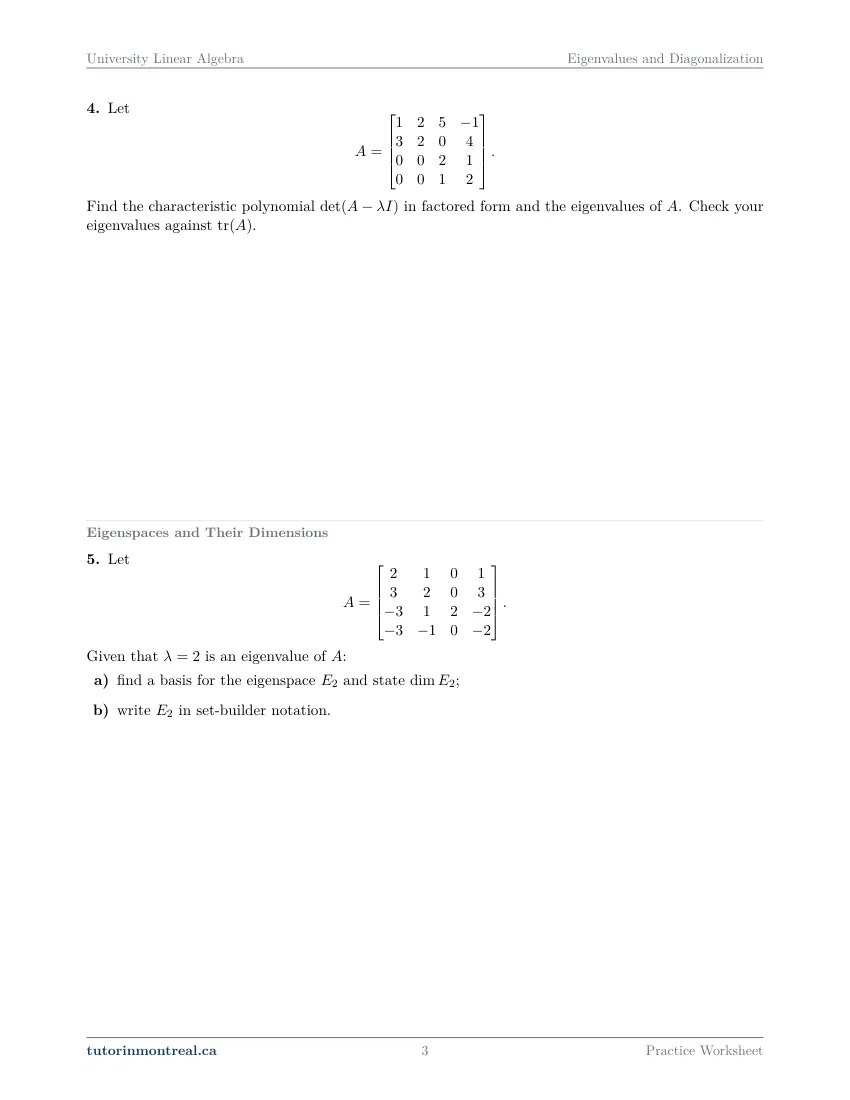
Q4The Characteristic Polynomial
Let Find the characteristic polynomial in factored form and the eigenvalues of . Check your eigenvalues against .
-
Q5Eigenspaces and Their Dimensions
Let Given that is an eigenvalue of :
- find a basis for the eigenspace and state ;
- write in set-builder notation.
-
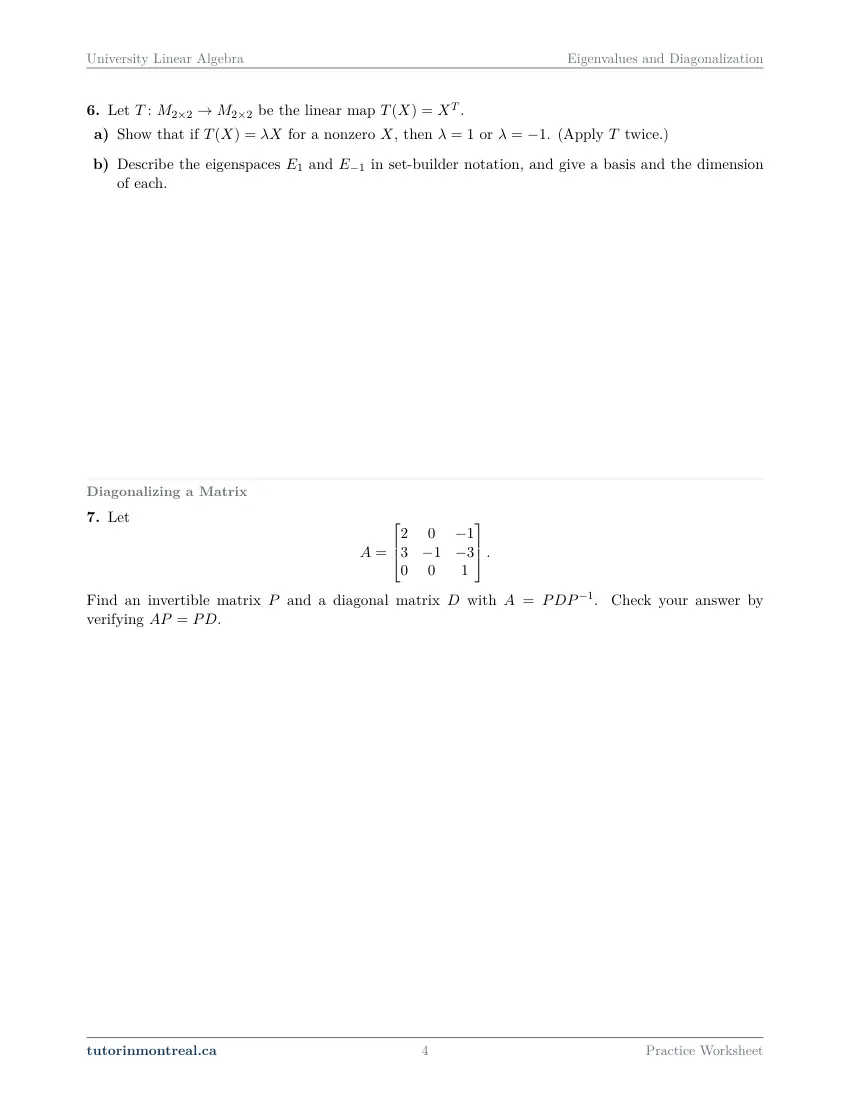
Q6Eigenspaces and Their Dimensions
Let be the linear map .
- Show that if for a nonzero , then or . (Apply twice.)
- Describe the eigenspaces and in set-builder notation, and give a basis and the dimension of each.
-
Q7Diagonalizing a Matrix
Let Find an invertible matrix and a diagonal matrix with . Check your answer by verifying .
-
Q8Diagonalizing a Matrix
Let be the linear map , where is the space of polynomials of degree at most .
- Find the matrix of relative to the basis , and its eigenvalues.
- Find a basis of consisting of eigenvectors of , and write down .
-
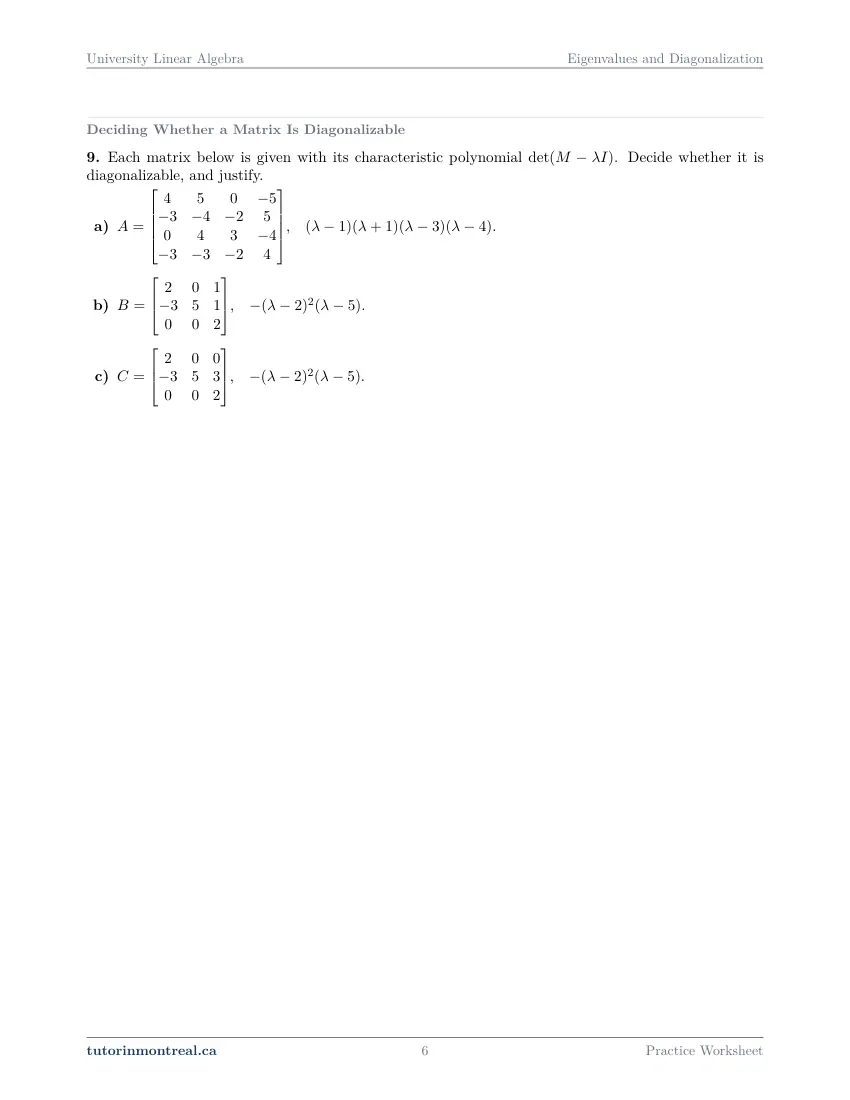
Q9Deciding Whether a Matrix Is Diagonalizable
Each matrix below is given with its characteristic polynomial . Decide whether it is diagonalizable, and justify.
- , .
- , .
- , .
-
Q10Deciding Whether a Matrix Is Diagonalizable
For which real numbers is diagonalizable? Justify.
-
Q11Powers of a Diagonalizable Matrix
Let .
- Diagonalize .
- Find a formula for , , and use it to write down .
-
Q12Complex Eigenvalues of a Real Matrix
Let , and work with real scalars.
- Find the roots of the characteristic polynomial .
- Does have a real eigenvector? Is diagonalizable over ?
- Is there a line through the origin in that multiplication by maps into itself? Explain.
-
Q13Synthesis — drawing on several topics in this unit
Let
- Find the characteristic polynomial , and the eigenvalues with their algebraic multiplicities.
- Find a basis for each eigenspace.
- Decide whether is diagonalizable; if it is, give and with .
- Use (c) to find .
The 9 challenge problems for this topic are a separate, paid sheet and are not reproduced here.
What does this set assume? This set stands on CEGEP Linear Algebra — determinants by cofactors and by row reduction, and inverses — and on the sets before it: null spaces and rank, linear transformations, and the change-of-basis formula P⁻¹AP from the previous set, which is exactly what diagonalization uses. Scope is eigenvalues and eigenvectors from the definition, the characteristic polynomial, eigenspaces, diagonalizing a matrix or an operator, the test for diagonalizability, powers of a diagonalizable matrix, and a single look at complex eigenvalues of a real 2 × 2 matrix, with no complex arithmetic beyond solving a quadratic. Symmetric matrices and orthogonal diagonalization are the last set of the course. The Cayley-Hamilton theorem, the minimal polynomial, the Jordan form, the matrix exponential and systems of differential equations are not part of this course.
Which course is this for? In the public course calendars of Montreal universities, this material is part of the courses numbered MATH 133, MATH 223, MATH 204, MATH 251, MATH 252, MAST 234, MAST 235, MAT1600, MAT1250, MAT1260 and MAT472. Each course orders and weights the topics its own way, so check your own outline for what your exam covers. Which sets match your course.
The rest of this unit
The worksheet is the practice, and it is free. Two more printable documents cover the same unit and come with the University Linear Algebra bundle: read the notes first, work this sheet, then sit the test closed-book. See what each one covers.
What the Eigenvalues and Diagonalization notes cover About the Eigenvalues and Diagonalization unit test
How to do every concept on this sheet
This is the part worksheet sites usually leave out. Below is the actual reasoning behind each group of questions — not a full solution set, the decisions that get you to one. Read it before you start, or after you get stuck.
Eigenvectors from the definition
A non-zero vector v is an eigenvector of A when Av is a multiple of v; the multiple is the eigenvalue. Q1 asks you to decide for four vectors without computing any polynomial. That means multiplying: compute Av and compare it with v, entry by entry.
Av = λv, v ≠ 0The zero vector is never an eigenvector. A times zero is a multiple of zero for every λ, which is exactly why the definition excludes it. Say so, rather than calling it an eigenvector for every eigenvalue.
Q1(b) asks whether a given number is an eigenvalue. That is the question of whether A − λI has a non-trivial null space — equivalently, whether it fails to be invertible. Row reduce it and look for a free variable, or compute its determinant.
Q2 asks the same question of differentiation, acting on functions. A function is an eigenvector of D when its derivative is a constant multiple of itself — differentiate each one and see whether the result is a multiple of the original. For D², differentiate twice. A function can be an eigenvector of D² without being one of D, so decide the two questions separately for each function.
A multiple means a constant multiple. If the derivative is the function times something that still contains x, it is not an eigenvector. The eigenvalue must be a single real number.
The characteristic polynomial
The eigenvalues are the roots of det(A − λI). Q3 asks for it in factored form, and the choice of expansion decides how much work that is.
Expand along the row or column with the most zeros, and keep factors. In Q3, one column of A − λI has a single non-zero entry; expanding along it gives a linear factor times a 2 × 2 determinant straight away. Never multiply the polynomial out and then try to factor a cubic — factor as you go.
Q3(c) is a check you should use every time: counted with multiplicity, the eigenvalues add to the trace and multiply to the determinant.
λ₁ + ⋯ + λₙ = tr(A) λ₁ ⋯ λₙ = det(A)Q4 is a 4 × 4 matrix with a block of zeros in its lower left corner. A block triangular matrix has determinant equal to the product of the determinants of its diagonal blocks, and that applies to A − λI too — so the characteristic polynomial is the product of two quadratics.
Eigenspaces
The eigenspace of λ is the null space of A − λI: every eigenvector for λ, together with zero. Q5 gives the eigenvalue and asks for a basis and the dimension. Form A − 2I, reduce, and read off one vector per free variable, exactly as in the rank set. Part (b) writes the same space as a set defined by conditions — the equations of the reduced system.
Q6 is an operator on 2 × 2 matrices: the transpose. Part (a) uses the hint — applying the transpose twice gives the original matrix, so if T(X) = λX then applying T again gives λ²X, which must equal X. Part (b) asks which matrices satisfy XT = X and which satisfy XT = −X; describe each set by conditions on the entries, then find a basis by the method of the Basis set.
Diagonalizing
A matrix is diagonalizable when it has enough independent eigenvectors to form a basis. Then A = PDP⁻¹, where the columns of P are those eigenvectors and D has the matching eigenvalues on its diagonal. It is the change-of-basis formula from the previous set, with the eigenvector basis chosen so that the new matrix is diagonal.
Diagonalizing A
Eigenvalues, then eigenspaces, then assemble — in matching order.
- 1Find the eigenvalues
Factor the characteristic polynomial; note each multiplicity.
- 2Find a basis of each eigenspace
The null space of A − λI, one eigenvalue at a time.
- 3Count
If the eigenspace bases together have n vectors, A is diagonalizable. If not, stop — it is not.
- 4Assemble and check
Eigenvectors as columns of P, eigenvalues on the diagonal of D in the same order. Check AP = PD, which avoids computing P⁻¹.
Q7 is the procedure on a 3 × 3 matrix. Q8 applies it to a map on quadratics: build its matrix relative to the standard basis as in the previous set, find the eigenvalues — the matrix is triangular, so they are on its diagonal — then find eigenvectors and translate each back into a polynomial. Relative to a basis of those polynomials, the matrix of the map is diagonal.
When is a matrix diagonalizable?
Q9 gives three matrices with their characteristic polynomials and asks for a verdict with a justification. The polynomial alone decides some cases; others need an eigenspace dimension.
The test. If an n × n matrix has n distinct real eigenvalues, it is diagonalizable — no further work. If an eigenvalue is repeated, compare its algebraic multiplicity (its power in the polynomial) with its geometric multiplicity (the dimension of its eigenspace). The matrix is diagonalizable exactly when these agree for every eigenvalue.
Same polynomial, different verdicts are possible. Two matrices can share a characteristic polynomial and still differ on diagonalizability, because the polynomial fixes the algebraic multiplicities but not the eigenspaces. Where an eigenvalue repeats, compute the rank of A − λI; the eigenspace dimension is n minus that rank.
Q10 puts a parameter into the same test. The matrix is triangular, so its eigenvalues can be read from the diagonal, and one of them repeats. The question is how the entry k changes the rank of A − λI for that repeated eigenvalue — compute the rank as a function of k, and split into cases.
Powers of a diagonalizable matrix
If A = PDP⁻¹, then in any power of A the inner P⁻¹P pairs cancel, and a power of a diagonal matrix is just the powers of its diagonal entries.
Aⁿ = P Dⁿ P⁻¹Q11 asks for the diagonalization of a 2 × 2 matrix, then a formula for its n-th power valid for every n, then a specific power from the formula. Keep n as a letter until the last step — the question wants a formula, not a number. A quick check: your formula must give A itself when n = 1.
Complex eigenvalues of a real matrix
Q12 is a real 2 × 2 matrix whose characteristic polynomial is a quadratic. Part (a) is the quadratic formula; look at the discriminant first. Parts (b) and (c) ask what happens when the roots are not real numbers.
Work with real scalars, as the question says. An eigenvector over the reals needs a real eigenvalue. Part (c) is the same question in geometric language: a line through the origin mapped into itself is spanned by a real eigenvector. Answer both parts with the same reason.
The synthesis question
Q13 runs the whole set on one 3 × 3 matrix. Part (a) is Q3 — expand along a line with zeros, keep factors, and check the trace. Part (b) is Q5 for each eigenvalue. Part (c) is Q9's test: compare, for the repeated eigenvalue, the multiplicity with the dimension you just found, then assemble P and D if the test passes. Part (d) is Q11 — use the diagonal form, and notice what happens to powers of the eigenvalues in D before multiplying anything out.
Preview all 9 pages
Click any page to open the full PDF.

Getting the most out of it
Check every eigenvector by multiplying
Whatever method produced it, an eigenvector is correct exactly when Av = λv. The check is one matrix-vector product, and it catches both a wrong eigenvalue and a wrong null-space vector.
Use trace and determinant as a checksum
After factoring a characteristic polynomial, add the roots and compare with the trace. It takes seconds and catches most sign errors in the determinant.
Keep P and D in matching order
Write the eigenvalues in D in the same order as their eigenvectors in P. Any order works, but the two must match — a mismatch gives a matrix that is not A.
Count before you assemble
Before building P, add up the eigenspace dimensions. If they fall short of n, the matrix is not diagonalizable, and the question is answered.
Want the solutions, or something more challenging?
The worksheet, the questions above and every explanation on this page stay free permanently. Three more PDFs exist for this topic — the worked answer key, a harder problem set, and the answer key to that. They come with the University Linear Algebra Solutions Bundle, beside the unit notes and the unit test, which is what keeps the rest of the series free.
What else exists for Eigenvalues and Diagonalization
Three PDFs · 17 pages · all three are in the bundle below.
- Answer key — 5 pages. All 13 questions worked step by step, including the restrictions and the justifications. Not a list of final answers.
- Challenge problems — 8 pages, 9 problems. A separate sheet at exam-plus difficulty covering the same 7 concepts. Harder than anything on the free sheet.
- Challenge answer key — 4 pages. Every challenge problem worked to the same standard, with the checks shown.
- PDF, letter size, print-ready.
The one thing that's for sale
Every University Linear Algebra topic — the complete Solutions Bundle
One download, one payment, the whole program. For all 9 University Linear Algebra units: the worksheet, the reference notes, the challenge set, the unit test and every answer key — including this one.
- Worked solutions, not answer lists — every step written out
- Covers the whole year's program at this level
- Less than the price of one hour of tutoring — for the entire year's solutions
Taking Secondary 1 Math as well? The Secondary 1 Math bundle covers all 15 of its units — 106 PDFs, 474 pages — on the same terms.
Taking Secondary 2 Math as well? The Secondary 2 Math bundle covers all 14 of its units — 98 PDFs, 449 pages — on the same terms.
Taking Secondary 3 Math as well? The Secondary 3 Math bundle covers all 11 of its units — 77 PDFs, 367 pages — on the same terms.
Taking Secondary 4 Math as well? The Secondary 4 Math bundle covers all 17 of its units — 122 PDFs, 466 pages — on the same terms.
Taking Secondary 5 Math as well? The Secondary 5 Math bundle covers all 21 of its units — 147 PDFs, 589 pages — on the same terms.
Taking CEGEP Calculus I as well? The CEGEP Calculus I bundle covers all 9 of its units — 72 PDFs, 371 pages — on the same terms.
Taking CEGEP Calculus II as well? The CEGEP Calculus II bundle covers all 8 of its units — 64 PDFs, 335 pages — on the same terms.
Taking CEGEP Linear Algebra as well? The CEGEP Linear Algebra bundle covers all 7 of its units — 56 PDFs, 298 pages — on the same terms.
Taking University Calculus III as well? The University Calculus III bundle covers all 9 of its units — 72 PDFs, 516 pages — on the same terms.
Taking University Differential Equations as well? The University Differential Equations bundle covers all 9 of its units — 36 PDFs, 182 pages — on the same terms.
Taking University Business Math as well? The University Business Math bundle covers all 9 of its units — 36 PDFs, 190 pages — on the same terms.
Taking University Introductory Statistics as well? The University Introductory Statistics bundle covers all 9 of its units — 36 PDFs, 186 pages — on the same terms.
Taking University Discrete Math as well? The University Discrete Math bundle covers all 9 of its units — 36 PDFs, 155 pages — on the same terms.
Taking AP Calculus AB as well? The AP Calculus AB bundle covers all 8 of its units — 64 PDFs, 527 pages — on the same terms.
Common questions
Is this worksheet really free?
Yes — the questions are on this page to read, and the PDF downloads directly, no email and no account. The one paid item is optional: the complete University Linear Algebra Solutions Bundle, which covers every set at this level.
Which university courses is this for?
The course codes listed on this page are taken from the public course calendars of universities that teach linear algebra after CEGEP. Each course orders and weights the topics its own way — some end the term on diagonalization, others open a second course with it — so check the outline for your own section to see where this set falls in your term.
What do I need to know before starting this set?
Determinants from CEGEP Linear Algebra, null spaces and rank, and the change-of-basis formula P⁻¹AP from the previous set of this course.
Can an eigenvalue be zero?
Yes. Zero is an eigenvalue exactly when Av = 0 has a non-zero solution — that is, when A is not invertible. It is the eigenvector that can never be zero.
Is every matrix diagonalizable?
No. A matrix fails when, for some repeated eigenvalue, the eigenspace has smaller dimension than the eigenvalue's multiplicity, and a real matrix can also fail over the reals when its eigenvalues are not real. This set has examples of both.
Do I need to compute P⁻¹ to check a diagonalization?
No. A = PDP⁻¹ is equivalent to AP = PD when P is invertible, and the second needs only two matrix products. Compute P⁻¹ only when the question needs it, as for powers of A.
Is the Jordan form in this set?
No. This course recognises a matrix that is not diagonalizable but does not reduce it further. The Jordan form, the Cayley-Hamilton theorem and the minimal polynomial belong to a later course.
Can teachers use this in class?
Yes. Print and photocopy it for your own classes freely — I just ask that the tutorinmontreal.ca footer stays on the page.
I'm stuck on one question. Can you help?
Yes — through one-on-one tutoring, in Montreal or online. Get in touch to arrange a session, or see the current rates.
← All 9 University Linear Algebra worksheets · Secondary 1 Math series (15 sheets) → · Secondary 2 Math series (14 sheets) → · Secondary 3 Math series (11 sheets) → · Secondary 4 Math series (17 sheets) → · Secondary 5 Math series (21 sheets) → · CEGEP Calculus I series (9 sheets) → · CEGEP Calculus II series (8 sheets) → · CEGEP Linear Algebra series (7 sheets) → · University Calculus III series (9 sheets) → · University Differential Equations series (9 sheets) → · University Business Math series (9 sheets) → · University Introductory Statistics series (9 sheets) → · University Discrete Math series (9 sheets) → · AP Calculus AB series (8 sheets) →