University Linear Algebra — Rank and the Fundamental Subspaces Worksheet
The set that turns a matrix into three subspaces and one number. The solution set of a system written as a particular solution plus a span; the null space, the column space and the row space, what each lives in and how to test membership; a basis of all three read from a single echelon form, with the trap that catches almost everyone; rank and nullity, and the theorem that ties them to the number of columns; and rank as the test that decides whether a system has a solution. Have a look on this page, then print the free PDF when you want to write on it.
Practice worksheet — free PDF
No email, no account, no watermark. Teachers: photocopy it for your classes freely. Worked solutions and 8 harder problems come with the University Linear Algebra bundle.
All 11 questions
Each question targets one named concept from the sheet. Read them here, or print the PDF — it has working space under each one.
-
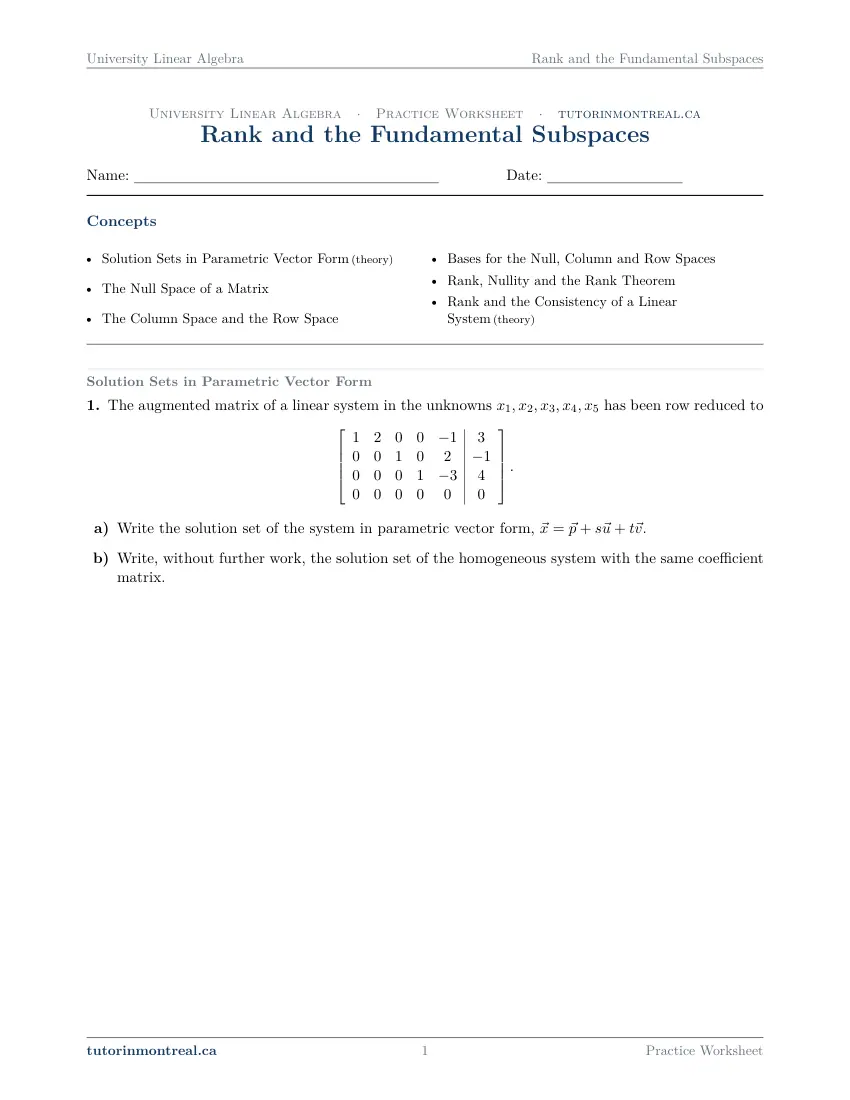
Q1Solution Sets in Parametric Vector Form
The augmented matrix of a linear system in the unknowns has been row reduced to
- Write the solution set of the system in parametric vector form, .
- Write, without further work, the solution set of the homogeneous system with the same coefficient matrix.
-
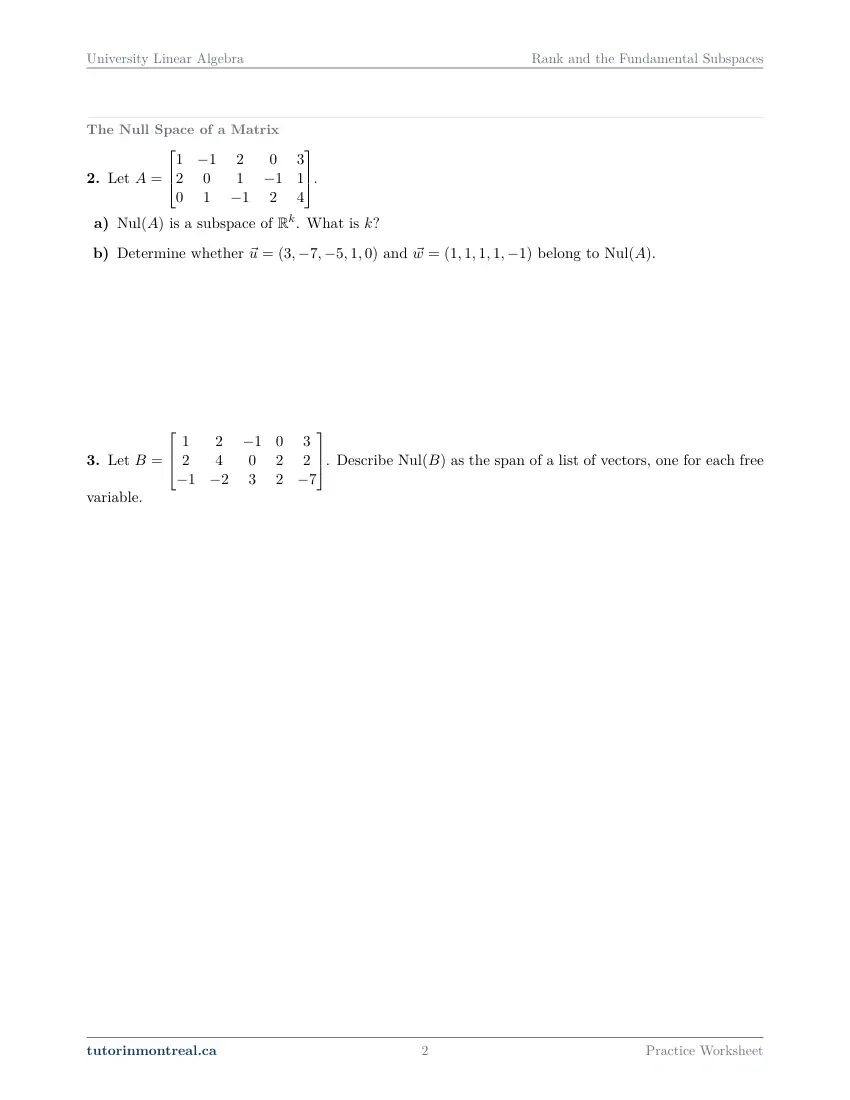
Q2The Null Space of a Matrix
Let .
- is a subspace of . What is ?
- Determine whether and belong to .
-
Q3The Null Space of a Matrix
Let . Describe as the span of a list of vectors, one for each free variable.
-
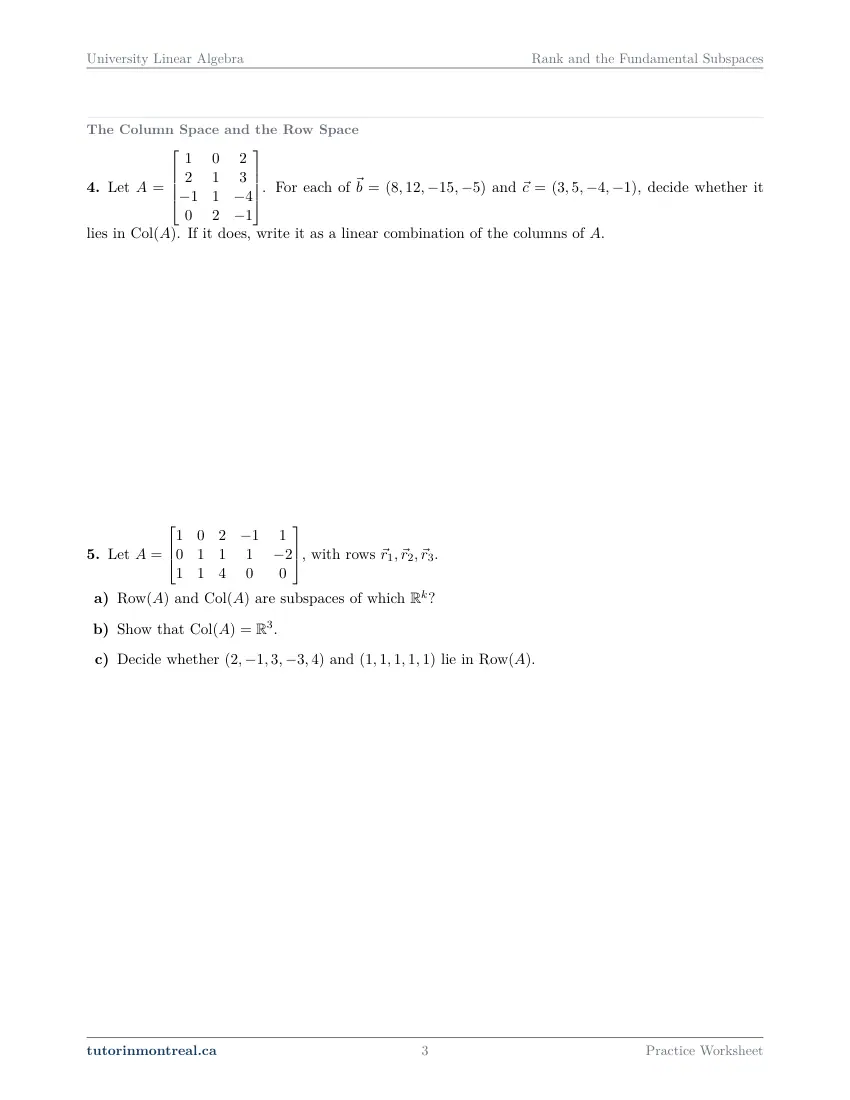
Q4The Column Space and the Row Space
Let . For each of and , decide whether it lies in . If it does, write it as a linear combination of the columns of .
-
Q5The Column Space and the Row Space
Let , with rows .
- and are subspaces of which ?
- Show that .
- Decide whether and lie in .
-
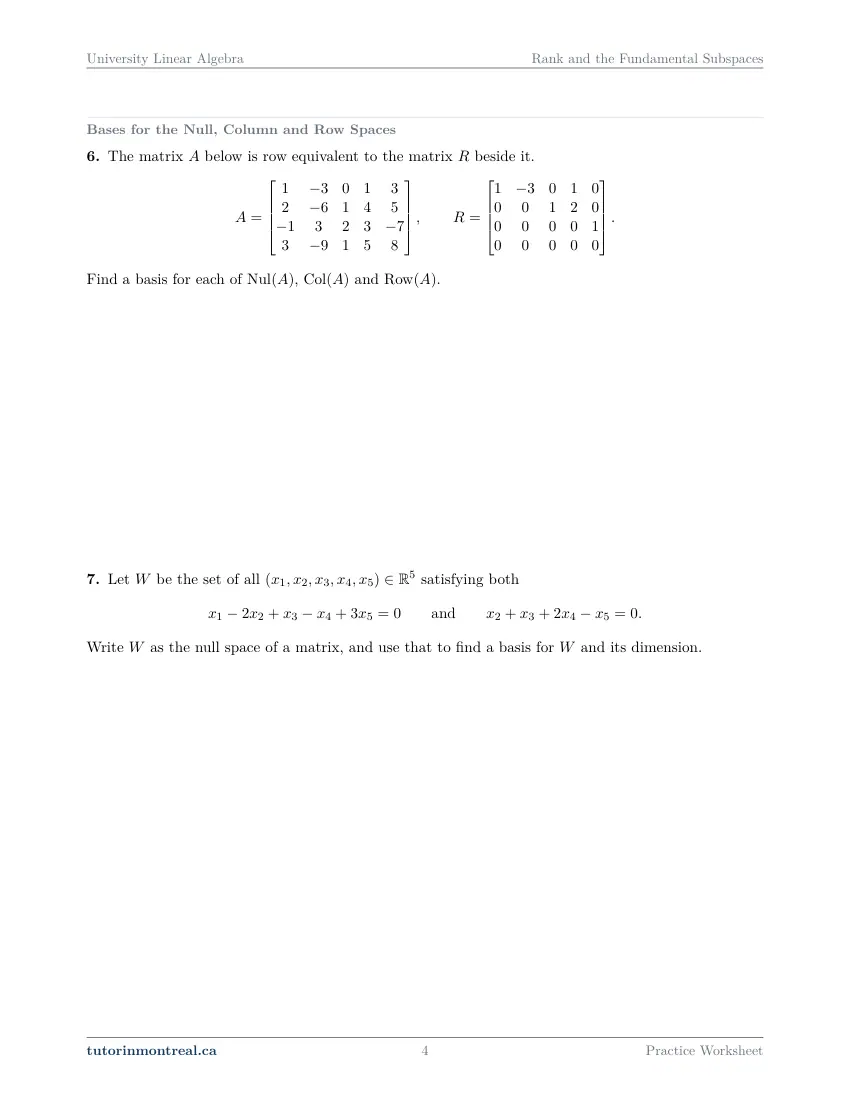
Q6Bases for the Null, Column and Row Spaces
The matrix below is row equivalent to the matrix beside it. Find a basis for each of , and .
-
Q7Bases for the Null, Column and Row Spaces
Let be the set of all satisfying both Write as the null space of a matrix, and use that to find a basis for and its dimension.
-
Q8Rank, Nullity and the Rank Theorem
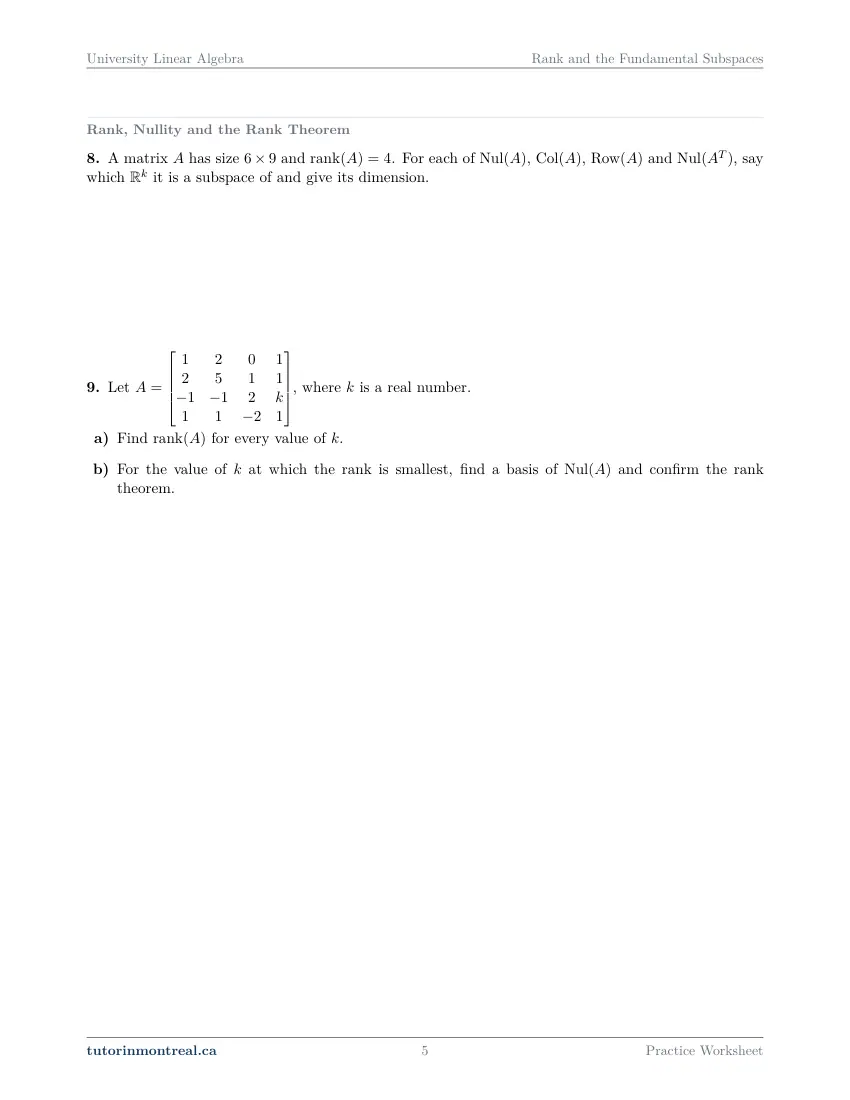
A matrix has size and . For each of , , and , say which it is a subspace of and give its dimension.
-
Q9Rank, Nullity and the Rank Theorem
Let , where is a real number.
- Find for every value of .
- For the value of at which the rank is smallest, find a basis of and confirm the rank theorem.
-
Q10Rank and the Consistency of a Linear System
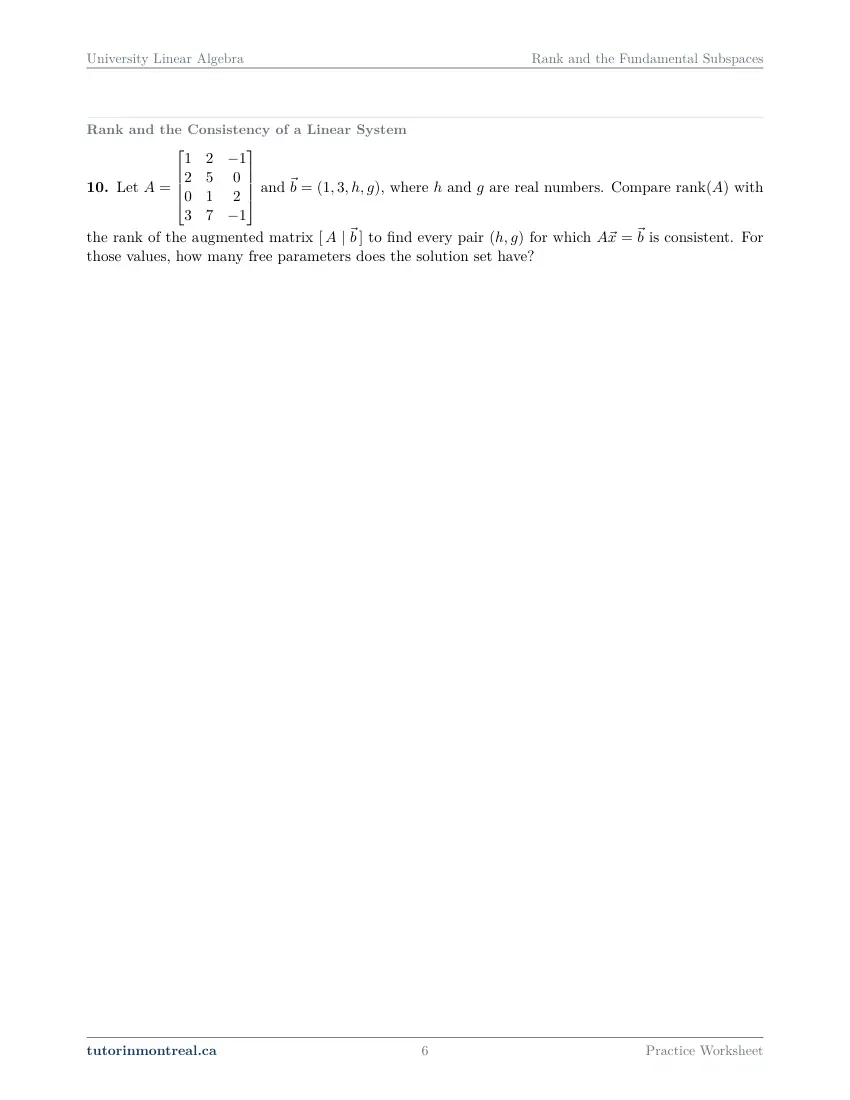
Let and , where and are real numbers. Compare with the rank of the augmented matrix to find every pair for which is consistent. For those values, how many free parameters does the solution set have?
-
Q11Synthesis — drawing on several topics in this unit
Let
- Find and a basis of , and check the rank theorem.
- Verify that solves , and write the full solution set in parametric vector form.
- Is consistent for every ? If not, give one for which it is not.
The 8 challenge problems for this topic are a separate, paid sheet and are not reproduced here.
What does this set assume? This set stands on CEGEP Linear Algebra — row reduction to echelon and reduced echelon form, pivots and free variables, the transpose — and on the first three sets of this course: subspaces, span, linear independence, bases and dimension. Row reduction is used freely but is never the point; every question asks what an echelon form says about a subspace. Scope is parametric vector form, the null, column and row spaces with bases for each, rank and nullity with the rank theorem, and rank as the test for consistency. The same ideas for a linear transformation — kernel, range and the dimension theorem — are the next set. LU factorisation is not part of this course, and scalars are real throughout.
Which course is this for? In the public course calendars of Montreal universities, this material is part of the courses numbered MATH 251, MAST 234 and MAT1250. Each course orders and weights the topics its own way, so check your own outline for what your exam covers. Which sets match your course.
The rest of this unit
The worksheet is the practice, and it is free. Two more printable documents cover the same unit and come with the University Linear Algebra bundle: read the notes first, work this sheet, then sit the test closed-book. See what each one covers.
What the Rank and the Fundamental Subspaces notes cover About the Rank and the Fundamental Subspaces unit test
How to do every concept on this sheet
This is the part worksheet sites usually leave out. Below is the actual reasoning behind each group of questions — not a full solution set, the decisions that get you to one. Read it before you start, or after you get stuck.
Parametric vector form
Q1 gives a reduced augmented matrix and asks for the solution set as one vector plus a combination of others. Solve each pivot variable in terms of the free ones, write the whole solution vector, and split it into a constant part and one part per free variable.
x = p + s u + t v — p solves the system, and s u + t v runs over the solutions of Ax = 0Part (b) is free. The homogeneous system with the same coefficients has the same free variables and the same direction vectors; only the constant part changes. That is the geometry of a solution set: the homogeneous solutions, shifted by one particular solution.
Free variables are the non-pivot columns. A column of zeros in the middle of a reduced matrix still belongs to a variable, and that variable is free. Count the columns before you name the parameters.
The null space
The null space of A is the set of solutions of Ax = 0. Q2 asks two things that need no row reduction at all. Part (a) is about sizes: x must have as many entries as A has columns. Part (b) is a membership test, and membership in a null space is checked by multiplying — compute Au and Aw and see whether each is the zero vector.
Q3 asks for the null space as a span. That is Q1's parametric form with no constant part: reduce B fully, write the general solution, and read off one vector per free variable. Those vectors are automatically independent, so they are also a basis.
The column space and the row space
The column space is the span of the columns — the set of all b for which Ax = b has a solution. Q4 is the membership test from the span set, now named: augment A with each target, reduce, and check consistency. When the answer is yes, the solution gives the weights on the columns.
Q5 contrasts the two spaces. Part (a) is about sizes again, and the two answers differ when A is not square: rows have as many entries as there are columns, and columns as many as there are rows. Part (b) asks you to show the column space is all of three-space; think about how many pivots that needs, and in which rows. Part (c) is membership in the row space, which is the span of the rows.
Membership in the row space is a column question in disguise. A vector lies in Row(A) exactly when it is a combination of the rows — that is, when it lies in the column space of the transpose. Put the rows in as columns, augment with the target vector, and test consistency as in Q4.
Bases for all three from one echelon form
Q6 gives A and its reduced form R together and asks for a basis of each space. One reduced matrix answers all three, but not in the same way.
Reading three bases from A and R
Know which matrix each basis comes from.
- 1Null space: solve Rx = 0
One vector per free variable, as in Q3.
- 2Column space: the pivot columns of A
Locate the pivot positions in R, then take those columns from the original matrix A.
- 3Row space: the non-zero rows of R
The row space survives row operations unchanged, so the non-zero rows of the echelon form are a basis.
The classic mistake is to take the columns of R. Row operations change the column space — the pivot columns of R usually span something else. They preserve the dependence relations among the columns, which is why R tells you which columns of A to take, but the vectors themselves must come from A. For the row space it is the other way round.
Q7 describes a subspace by two equations and asks you to see it as a null space. The two equations are the rows of a 2 × 5 matrix; the subspace is its null space; Q3's method gives the basis, and the number of free variables gives the dimension.
Rank, nullity and the rank theorem
The rank of A is the dimension of its column space, which is also the dimension of its row space — both equal the number of pivots. The nullity is the dimension of the null space, the number of free variables. Every column is either a pivot column or a free one, which is the whole proof of the theorem.
rank(A) + dim Nul(A) = number of columns of AQ8 asks for the ambient space and the dimension of four subspaces of a matrix you are only told the size and rank of. Everything follows from the theorem above, applied to A and to its transpose, plus the fact that A and its transpose have the same rank.
Two sizes, two theorems. For A, the columns count; for the transpose, the rows of A do. Write both versions of the rank theorem before you fill in the four answers.
Q9 has a parameter k in one entry. Row reduce with k in place, and watch for the step where the next pivot depends on k: that entry either is or is not zero, and the two cases give different ranks. Part (b) uses the exceptional value, finds the null space, and checks that rank plus nullity gives the number of columns.
Never divide by an expression in k without splitting cases. Dividing a row by something that could be zero silently discards the case that the question is really about.
Rank decides consistency
Q10 asks for every pair of parameter values that makes a system consistent. A system Ax = b is consistent exactly when adding b as an extra column does not raise the rank — when no row of zeros in A meets a non-zero entry in b.
Ax = b consistent ⇔ rank[A | b] = rank(A)Reduce the augmented matrix with h and g in the last column. The rows whose coefficient part becomes zero give conditions on h and g that must hold; those conditions are the answer. The second part is the rank theorem again: the number of free parameters is the number of columns minus the rank.
The synthesis question
Q11 puts the set together on one 4 × 5 matrix. Part (a) is Q6 and Q8: reduce, count pivots, find the null space, and check the theorem. Part (b) is Q1 read backwards — you are given one particular solution, so the full solution set is that vector plus the null space you already have. Part (c) asks whether every right-hand side works, which is a question about the rank compared with the number of rows; if the answer is no, the reduction tells you how to build a right-hand side that fails.
Preview all 7 pages
Click any page to open the full PDF.
Getting the most out of it
Write the sizes first
For every matrix, write m × n and say which space each subspace lives in before you compute. Null space and row space live in the space with one coordinate per column; the column space lives in the space with one coordinate per row. Most mix-ups start here.
Circle the pivots
Rank, nullity, the basis of the column space, and consistency all come from the pivot positions. Mark them on the echelon form before reading anything else from it.
Say which matrix each basis came from
Label your column-space basis "pivot columns of A" and your row-space basis "non-zero rows of R". The label is a check on yourself, and a marker looks for it.
Check the rank theorem every time
After finding a rank and a null-space basis, add them. If they do not give the number of columns, there is an error somewhere, and it is cheaper to find it now.
Want the solutions, or something more challenging?
The worksheet, the questions above and every explanation on this page stay free permanently. Three more PDFs exist for this topic — the worked answer key, a harder problem set, and the answer key to that. They come with the University Linear Algebra Solutions Bundle, beside the unit notes and the unit test, which is what keeps the rest of the series free.
What else exists for Rank and the Fundamental Subspaces
Three PDFs · 13 pages · all three are in the bundle below.
- Answer key — 4 pages. All 11 questions worked step by step, including the restrictions and the justifications. Not a list of final answers.
- Challenge problems — 6 pages, 8 problems. A separate sheet at exam-plus difficulty covering the same 6 concepts. Harder than anything on the free sheet.
- Challenge answer key — 3 pages. Every challenge problem worked to the same standard, with the checks shown.
- PDF, letter size, print-ready.
The one thing that's for sale
Every University Linear Algebra topic — the complete Solutions Bundle
One download, one payment, the whole program. For all 9 University Linear Algebra units: the worksheet, the reference notes, the challenge set, the unit test and every answer key — including this one.
- Worked solutions, not answer lists — every step written out
- Covers the whole year's program at this level
- Less than the price of one hour of tutoring — for the entire year's solutions
Taking Secondary 1 Math as well? The Secondary 1 Math bundle covers all 15 of its units — 106 PDFs, 474 pages — on the same terms.
Taking Secondary 2 Math as well? The Secondary 2 Math bundle covers all 14 of its units — 98 PDFs, 449 pages — on the same terms.
Taking Secondary 3 Math as well? The Secondary 3 Math bundle covers all 11 of its units — 77 PDFs, 367 pages — on the same terms.
Taking Secondary 4 Math as well? The Secondary 4 Math bundle covers all 17 of its units — 122 PDFs, 466 pages — on the same terms.
Taking Secondary 5 Math as well? The Secondary 5 Math bundle covers all 21 of its units — 147 PDFs, 589 pages — on the same terms.
Taking CEGEP Calculus I as well? The CEGEP Calculus I bundle covers all 9 of its units — 72 PDFs, 371 pages — on the same terms.
Taking CEGEP Calculus II as well? The CEGEP Calculus II bundle covers all 8 of its units — 64 PDFs, 335 pages — on the same terms.
Taking CEGEP Linear Algebra as well? The CEGEP Linear Algebra bundle covers all 7 of its units — 56 PDFs, 298 pages — on the same terms.
Taking University Calculus III as well? The University Calculus III bundle covers all 9 of its units — 72 PDFs, 516 pages — on the same terms.
Taking University Differential Equations as well? The University Differential Equations bundle covers all 9 of its units — 36 PDFs, 182 pages — on the same terms.
Taking University Business Math as well? The University Business Math bundle covers all 9 of its units — 36 PDFs, 190 pages — on the same terms.
Taking University Introductory Statistics as well? The University Introductory Statistics bundle covers all 9 of its units — 36 PDFs, 186 pages — on the same terms.
Taking University Discrete Math as well? The University Discrete Math bundle covers all 9 of its units — 36 PDFs, 155 pages — on the same terms.
Taking AP Calculus AB as well? The AP Calculus AB bundle covers all 8 of its units — 64 PDFs, 527 pages — on the same terms.
Common questions
Is this worksheet really free?
Yes — the questions are on this page to read, and the PDF downloads directly, no email and no account. The one paid item is optional: the complete University Linear Algebra Solutions Bundle, which covers every set at this level.
Which university courses is this for?
The course codes listed on this page are taken from the public course calendars of universities that teach linear algebra after CEGEP. Each course orders and weights the topics its own way — some teach rank with systems early in the term, others reach it only through linear transformations — so check the outline for your own section to see where this set falls in your term.
What do I need to know before starting this set?
Row reduction from CEGEP Linear Algebra, and the first three sets of this course: subspaces, span and independence, bases and dimension.
Why do I take the pivot columns from A and not from the reduced matrix?
Because row operations change the column space. They do keep the relations among the columns, so the reduced matrix tells you which columns are independent, but the basis must be made of the original columns. The row space is the opposite: it survives row operations unchanged, so the rows of the echelon form are a valid basis.
Are the row rank and the column rank always equal?
Yes. Both equal the number of pivots in an echelon form, so a matrix and its transpose always have the same rank. That is why the course speaks of "the" rank.
What is the difference between the null space and the kernel?
For a matrix they are the same set, the solutions of Ax = 0. "Kernel" is the word used for a linear transformation, in the next set; when the transformation is multiplication by A, its kernel is the null space of A.
Is LU factorisation in this set?
No. It is taught by few of the courses this set serves and is not part of this course.
Can teachers use this in class?
Yes. Print and photocopy it for your own classes freely — I just ask that the tutorinmontreal.ca footer stays on the page.
I'm stuck on one question. Can you help?
Yes — through one-on-one tutoring, in Montreal or online. Get in touch to arrange a session, or see the current rates.
← All 9 University Linear Algebra worksheets · Secondary 1 Math series (15 sheets) → · Secondary 2 Math series (14 sheets) → · Secondary 3 Math series (11 sheets) → · Secondary 4 Math series (17 sheets) → · Secondary 5 Math series (21 sheets) → · CEGEP Calculus I series (9 sheets) → · CEGEP Calculus II series (8 sheets) → · CEGEP Linear Algebra series (7 sheets) → · University Calculus III series (9 sheets) → · University Differential Equations series (9 sheets) → · University Business Math series (9 sheets) → · University Introductory Statistics series (9 sheets) → · University Discrete Math series (9 sheets) → · AP Calculus AB series (8 sheets) →