University Linear Algebra — Inner Products and Orthogonality Worksheet
The set that gives a vector space lengths and angles. The dot product, norm, distance and angle in five coordinates; a weighted inner product that changes which vectors count as perpendicular; an inner product on polynomials, built from an integral; orthogonal and orthonormal sets in n-space and among matrices; the reason an orthogonal basis makes coordinates free, with no system to solve; and the orthogonal complement of a subspace. Have a look on this page, then print the free PDF when you want to write on it.
Practice worksheet — free PDF
No email, no account, no watermark. Teachers: photocopy it for your classes freely. Worked solutions and 6 harder problems come with the University Linear Algebra bundle.
All 9 questions
Each question targets one named concept from the sheet. Read them here, or print the PDF — it has working space under each one.
-
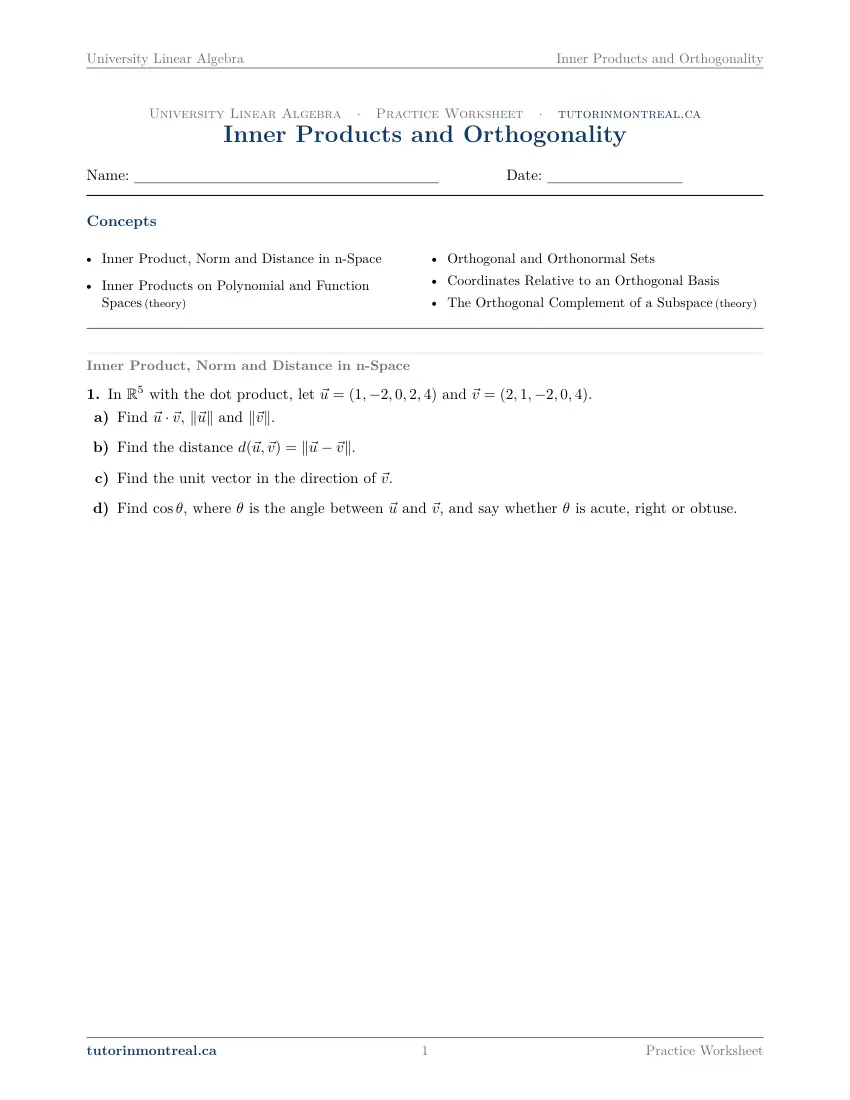
Q1Inner Product, Norm and Distance in n-Space
In with the dot product, let and .
- Find , and .
- Find the distance .
- Find the unit vector in the direction of .
- Find , where is the angle between and , and say whether is acute, right or obtuse.
-
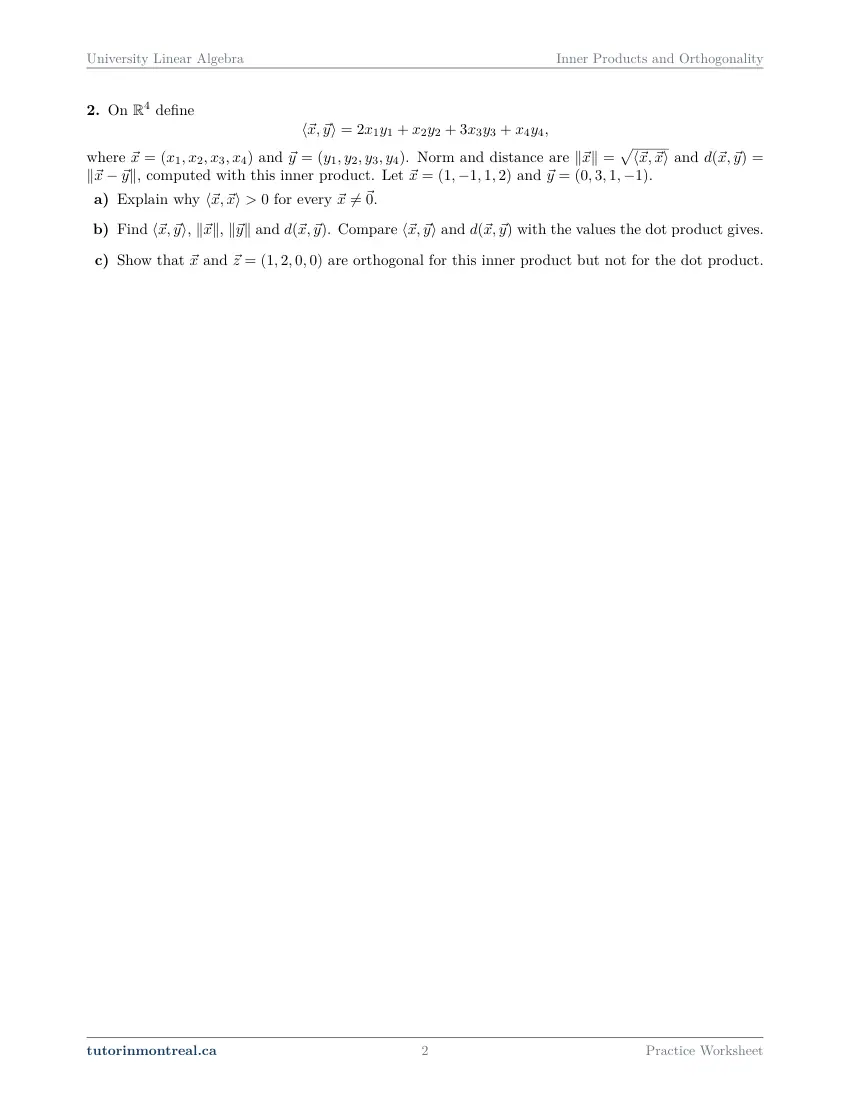
Q2Inner Product, Norm and Distance in n-Space
On define where and . Norm and distance are and , computed with this inner product. Let and .
- Explain why for every .
- Find , , and . Compare and with the values the dot product gives.
- Show that and are orthogonal for this inner product but not for the dot product.
-
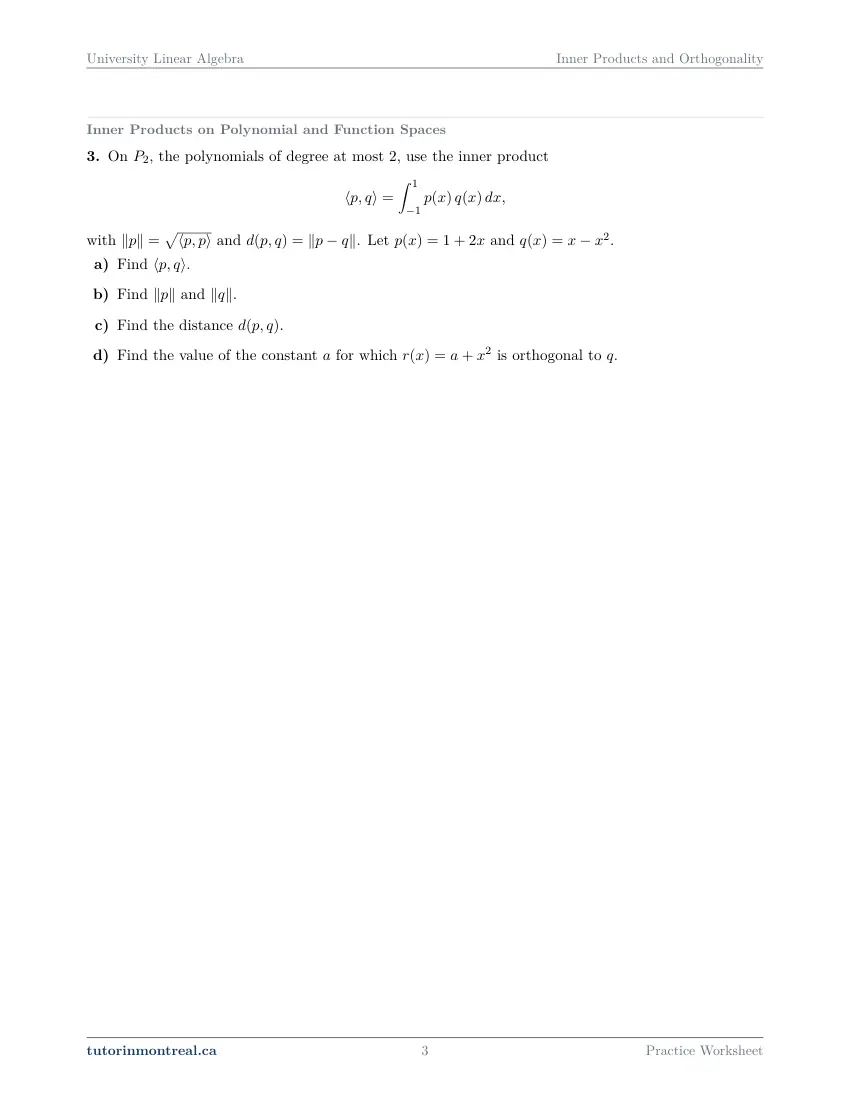
Q3Inner Products on Polynomial and Function Spaces
On , the polynomials of degree at most , use the inner product with and . Let and .
- Find .
- Find and .
- Find the distance .
- Find the value of the constant for which is orthogonal to .
-
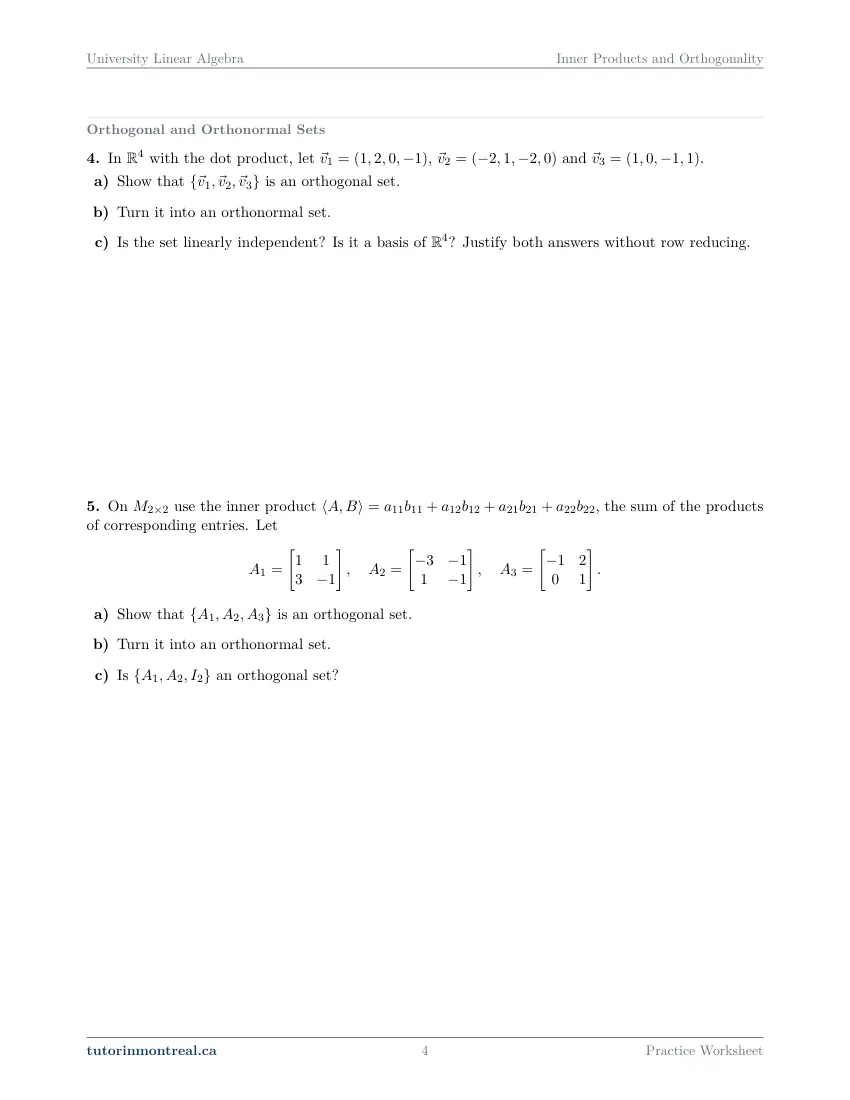
Q4Orthogonal and Orthonormal Sets
In with the dot product, let , and .
- Show that is an orthogonal set.
- Turn it into an orthonormal set.
- Is the set linearly independent? Is it a basis of ? Justify both answers without row reducing.
-
Q5Orthogonal and Orthonormal Sets
On use the inner product , the sum of the products of corresponding entries. Let
- Show that is an orthogonal set.
- Turn it into an orthonormal set.
- Is an orthogonal set?
-
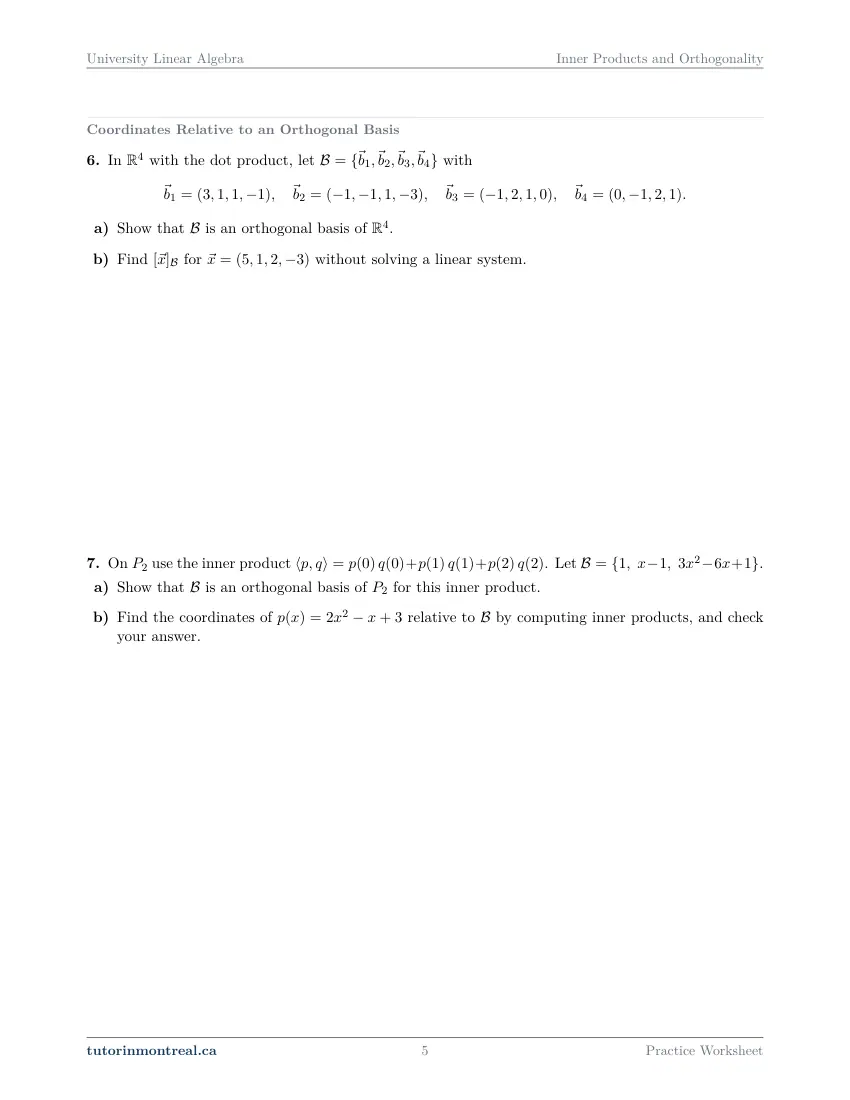
Q6Coordinates Relative to an Orthogonal Basis
In with the dot product, let with
- Show that is an orthogonal basis of .
- Find for without solving a linear system.
-
Q7Coordinates Relative to an Orthogonal Basis
On use the inner product . Let .
- Show that is an orthogonal basis of for this inner product.
- Find the coordinates of relative to by computing inner products, and check your answer.
-
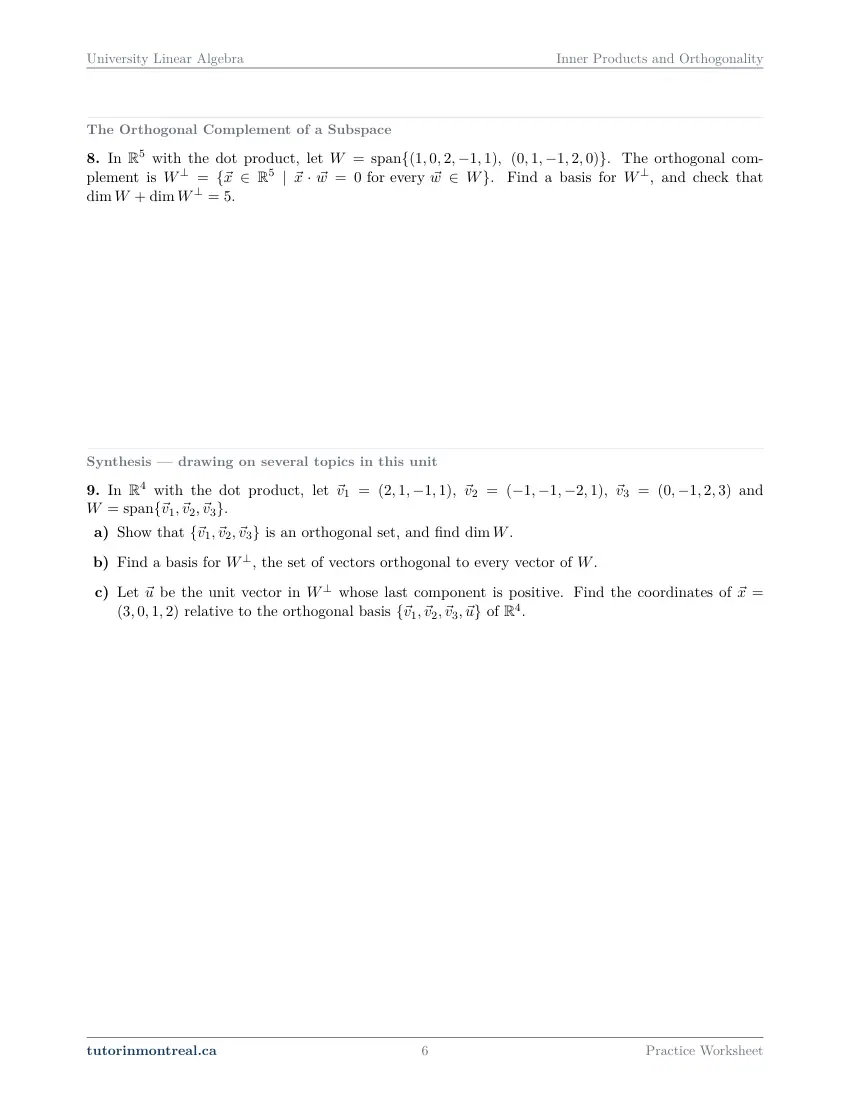
Q8The Orthogonal Complement of a Subspace
In with the dot product, let . The orthogonal complement is . Find a basis for , and check that .
-
Q9Synthesis — drawing on several topics in this unit
In with the dot product, let , , and .
- Show that is an orthogonal set, and find .
- Find a basis for , the set of vectors orthogonal to every vector of .
- Let be the unit vector in whose last component is positive. Find the coordinates of relative to the orthogonal basis of .
The 6 challenge problems for this topic are a separate, paid sheet and are not reproduced here.
What does this set assume? This set stands on CEGEP Linear Algebra — the dot product, length and angle in the plane and in space — and on the earlier sets of this course: bases, dimension and coordinates, and the null space of a matrix. The definite integral of a polynomial from CEGEP Calculus is used as one example of an inner product and needs nothing beyond the power rule. Scope is inner product, norm and distance in n-space and on polynomial and matrix spaces, orthogonal and orthonormal sets, coordinates relative to an orthogonal basis, and the orthogonal complement. Projection onto a subspace, Gram-Schmidt, least squares and symmetric matrices are the next set, the last of the course. The Cauchy-Schwarz and triangle inequalities are not drilled here, and scalars are real throughout, so there are no complex inner products.
Which course is this for? In the public course calendars of Montreal universities, this material is part of the courses numbered MATH 223, MATH 252, MAST 235, MAT1600 and MAT1260. Each course orders and weights the topics its own way, so check your own outline for what your exam covers. Which sets match your course.
The rest of this unit
The worksheet is the practice, and it is free. Two more printable documents cover the same unit and come with the University Linear Algebra bundle: read the notes first, work this sheet, then sit the test closed-book. See what each one covers.
What the Inner Products and Orthogonality notes cover About the Inner Products and Orthogonality unit test
How to do every concept on this sheet
This is the part worksheet sites usually leave out. Below is the actual reasoning behind each group of questions — not a full solution set, the decisions that get you to one. Read it before you start, or after you get stuck.
Norm, distance and angle in n-space
Q1 is the dot product in five coordinates, and everything else follows from it: the norm is the square root of a vector's dot product with itself, the distance between two vectors is the norm of their difference, and the angle comes from the dot product divided by the two norms.
‖u‖ = √(u · u) d(u, v) = ‖u − v‖ cos θ = (u · v) / (‖u‖ ‖v‖)The sign of the dot product decides the angle. For part (d), you do not need the angle itself to say whether it is acute, right or obtuse: positive, zero or negative dot product. Say that, then give the cosine.
An inner product is a choice
The dot product is one inner product among many. Q2 defines a weighted one on four-space, with different positive weights on the four coordinate products. Part (a) asks why it still gives every non-zero vector a positive length: write out the inner product of x with itself and look at what kind of terms it adds.
Compute with the rule you are given. In part (b), every norm and every distance uses the weighted inner product, including inside the square root. The comparison the question asks for is the point: the same two vectors have a different inner product and a different distance once the weights change.
Part (c) makes the point sharper. Orthogonal means inner product zero, so whether two vectors are orthogonal depends on which inner product you use. Compute both and say which is which.
Inner products on polynomials
Q3 uses an integral from −1 to 1 of the product of two polynomials as the inner product on quadratics. Each part is an integral of a polynomial: multiply out, integrate term by term, and evaluate.
Use symmetry to save work. Over an interval symmetric about zero, every odd power of x integrates to zero. After multiplying out, cross out the odd powers before integrating — it halves the arithmetic and removes most sign errors.
Part (c) is a distance, so it is the norm of the difference: subtract the two polynomials first, then take the inner product of the difference with itself. Part (d) sets an inner product to zero and solves for the unknown constant — one linear equation.
Orthogonal and orthonormal sets
A set is orthogonal when every pair of distinct vectors in it has inner product zero, and orthonormal when, in addition, every vector has norm 1. Q4 asks you to check a set of three in four-space, then normalise it.
Check every pair. Three vectors make three pairs, four make six. Showing that each vector is orthogonal to the next one is not enough.
Q4(c) asks two questions without row reducing. Orthogonal sets are independent as long as none of their vectors is zero — pair a vanishing combination with each vector in turn and every weight is forced to zero. Whether they form a basis is then a question of counting, as in the Basis set.
Q5 is the same work on 2 × 2 matrices, with the inner product that multiplies corresponding entries and adds. Part (c) replaces one matrix by the identity and asks again — compute the pairs that involve the new matrix.
Coordinates relative to an orthogonal basis
This is the practical reason orthogonal bases matter. When a basis is orthogonal, each coordinate is one ratio of inner products, with no system to solve.
x = Σ cᵢ bᵢ with cᵢ = ⟨x, bᵢ⟩ / ⟨bᵢ, bᵢ⟩Pair both sides of x = c₁b₁ + ⋯ + cₙbₙ with one bᵢ in the inner product: every other term vanishes by orthogonality, leaving one equation in one unknown. Q6 asks you first to show the basis is orthogonal — six pairs, and then a count — and then to find coordinates with that formula.
Q7 is the same idea on quadratics with an inner product built from values at three points. Part (a) is six inner products — three pairs to show orthogonality plus the three norms you will need in part (b) — and the count that makes three independent quadratics a basis. Part (b) applies the formula and then asks for the check: rebuild p from its coordinates.
Divide by the squared norm, not the norm. The denominator is the inner product of bᵢ with itself. Only when the basis is orthonormal is it 1, and forgetting that is the usual error.
The orthogonal complement
The orthogonal complement of a subspace W is every vector orthogonal to all of W. Q8 gives W as the span of two vectors in five-space. A vector is orthogonal to all of W exactly when it is orthogonal to each spanning vector, so the complement is the solution set of two equations — the null space of the matrix whose rows are the spanning vectors.
W = span of the rows of A ⇒ W⊥ = Nul(A)Solve, read off a basis with one vector per free variable, and check that the two dimensions add up to five. That check is the rank theorem from the rank set, in a new setting.
The synthesis question
Q9 puts the set together in four-space. Part (a) is Q4: check the three pairs, then use the independence of orthogonal sets without a zero vector to read off the dimension. Part (b) is Q8: the complement is the null space of the matrix with the three vectors as rows. Part (c) normalises the complement's basis vector — the sign condition picks one of the two unit vectors — and then uses Q6's formula with four orthogonal basis vectors, remembering that for the unit vector the denominator is 1.
Preview all 7 pages
Click any page to open the full PDF.
Getting the most out of it
Write down the inner product before every computation
Several inner products appear in this set. Before computing a norm, a distance or an angle, write down which one the question uses. A correct dot product is a wrong answer when the question asked for a weighted inner product.
Keep norms squared until the end
Most formulas use ‖v‖², not ‖v‖. Carry the squared norm and take a square root only when the question asks for a length or a unit vector.
Count pairs
For an orthogonal-set question, list every pair before you compute. For n vectors there are n(n − 1)/2 pairs, and a missed pair is a missing mark.
Rebuild the vector
After finding coordinates relative to an orthogonal basis, add the weighted basis vectors back up. The result must be the vector you started with.
Want the solutions, or something more challenging?
The worksheet, the questions above and every explanation on this page stay free permanently. Three more PDFs exist for this topic — the worked answer key, a harder problem set, and the answer key to that. They come with the University Linear Algebra Solutions Bundle, beside the unit notes and the unit test, which is what keeps the rest of the series free.
What else exists for Inner Products and Orthogonality
Three PDFs · 12 pages · all three are in the bundle below.
- Answer key — 3 pages. All 9 questions worked step by step, including the restrictions and the justifications. Not a list of final answers.
- Challenge problems — 6 pages, 6 problems. A separate sheet at exam-plus difficulty covering the same 5 concepts. Harder than anything on the free sheet.
- Challenge answer key — 3 pages. Every challenge problem worked to the same standard, with the checks shown.
- PDF, letter size, print-ready.
The one thing that's for sale
Every University Linear Algebra topic — the complete Solutions Bundle
One download, one payment, the whole program. For all 9 University Linear Algebra units: the worksheet, the reference notes, the challenge set, the unit test and every answer key — including this one.
- Worked solutions, not answer lists — every step written out
- Covers the whole year's program at this level
- Less than the price of one hour of tutoring — for the entire year's solutions
Taking Secondary 1 Math as well? The Secondary 1 Math bundle covers all 15 of its units — 106 PDFs, 474 pages — on the same terms.
Taking Secondary 2 Math as well? The Secondary 2 Math bundle covers all 14 of its units — 98 PDFs, 449 pages — on the same terms.
Taking Secondary 3 Math as well? The Secondary 3 Math bundle covers all 11 of its units — 77 PDFs, 367 pages — on the same terms.
Taking Secondary 4 Math as well? The Secondary 4 Math bundle covers all 17 of its units — 122 PDFs, 466 pages — on the same terms.
Taking Secondary 5 Math as well? The Secondary 5 Math bundle covers all 21 of its units — 147 PDFs, 589 pages — on the same terms.
Taking CEGEP Calculus I as well? The CEGEP Calculus I bundle covers all 9 of its units — 72 PDFs, 371 pages — on the same terms.
Taking CEGEP Calculus II as well? The CEGEP Calculus II bundle covers all 8 of its units — 64 PDFs, 335 pages — on the same terms.
Taking CEGEP Linear Algebra as well? The CEGEP Linear Algebra bundle covers all 7 of its units — 56 PDFs, 298 pages — on the same terms.
Taking University Calculus III as well? The University Calculus III bundle covers all 9 of its units — 72 PDFs, 516 pages — on the same terms.
Taking University Differential Equations as well? The University Differential Equations bundle covers all 9 of its units — 36 PDFs, 182 pages — on the same terms.
Taking University Business Math as well? The University Business Math bundle covers all 9 of its units — 36 PDFs, 190 pages — on the same terms.
Taking University Introductory Statistics as well? The University Introductory Statistics bundle covers all 9 of its units — 36 PDFs, 186 pages — on the same terms.
Taking University Discrete Math as well? The University Discrete Math bundle covers all 9 of its units — 36 PDFs, 155 pages — on the same terms.
Taking AP Calculus AB as well? The AP Calculus AB bundle covers all 8 of its units — 64 PDFs, 527 pages — on the same terms.
Common questions
Is this worksheet really free?
Yes — the questions are on this page to read, and the PDF downloads directly, no email and no account. The one paid item is optional: the complete University Linear Algebra Solutions Bundle, which covers every set at this level.
Which university courses is this for?
The course codes listed on this page are taken from the public course calendars of universities that teach linear algebra after CEGEP. Each course orders and weights the topics its own way — some reach inner products only at the end of a first course, others open a second course with them — so check the outline for your own section to see where this set falls in your term.
What do I need to know before starting this set?
The dot product from CEGEP Linear Algebra, and from this course bases, dimension, coordinates and the null space of a matrix. For the polynomial inner product, integrating a polynomial.
What makes something an inner product?
It must be symmetric, linear in each argument, and give every non-zero vector a strictly positive inner product with itself. Any rule with those properties defines lengths, distances and angles, and the dot product is only one example.
Is every orthogonal set linearly independent?
Every orthogonal set without the zero vector in it is. A set containing the zero vector can be orthogonal — zero is orthogonal to everything — but it is never independent.
Why are orthogonal bases so useful?
Because coordinates relative to them need no linear system: each coordinate is one ratio of inner products. The next set uses the same idea to project onto a subspace.
Where are Gram-Schmidt and projections?
In the next set, Projections, Least Squares and Symmetric Matrices. This set works with orthogonal sets that are given; the next one builds them.
Can teachers use this in class?
Yes. Print and photocopy it for your own classes freely — I just ask that the tutorinmontreal.ca footer stays on the page.
I'm stuck on one question. Can you help?
Yes — through one-on-one tutoring, in Montreal or online. Get in touch to arrange a session, or see the current rates.
← All 9 University Linear Algebra worksheets · Secondary 1 Math series (15 sheets) → · Secondary 2 Math series (14 sheets) → · Secondary 3 Math series (11 sheets) → · Secondary 4 Math series (17 sheets) → · Secondary 5 Math series (21 sheets) → · CEGEP Calculus I series (9 sheets) → · CEGEP Calculus II series (8 sheets) → · CEGEP Linear Algebra series (7 sheets) → · University Calculus III series (9 sheets) → · University Differential Equations series (9 sheets) → · University Business Math series (9 sheets) → · University Introductory Statistics series (9 sheets) → · University Discrete Math series (9 sheets) → · AP Calculus AB series (8 sheets) →