University Linear Algebra — Vector Spaces and Subspaces Worksheet
The set where linear algebra stops being about arrows in the plane. Vectors with five coordinates, and a linear system rewritten as one equation between vectors; the list of axioms that says what a vector space is, tested on operations that look reasonable and are not; a two-line proof that uses nothing but those axioms; polynomials, matrices and functions treated as vectors, with the same arithmetic; the three-condition subspace test, and the sets that fail it; and the solution set of a homogeneous system as the first subspace you meet in the wild. Have a look on this page, then print the free PDF when you want to write on it.
Practice worksheet — free PDF
No email, no account, no watermark. Teachers: photocopy it for your classes freely. Worked solutions and 8 harder problems come with the University Linear Algebra bundle.
All 11 questions
Each question targets one named concept from the sheet. Read them here, or print the PDF — it has working space under each one.
-
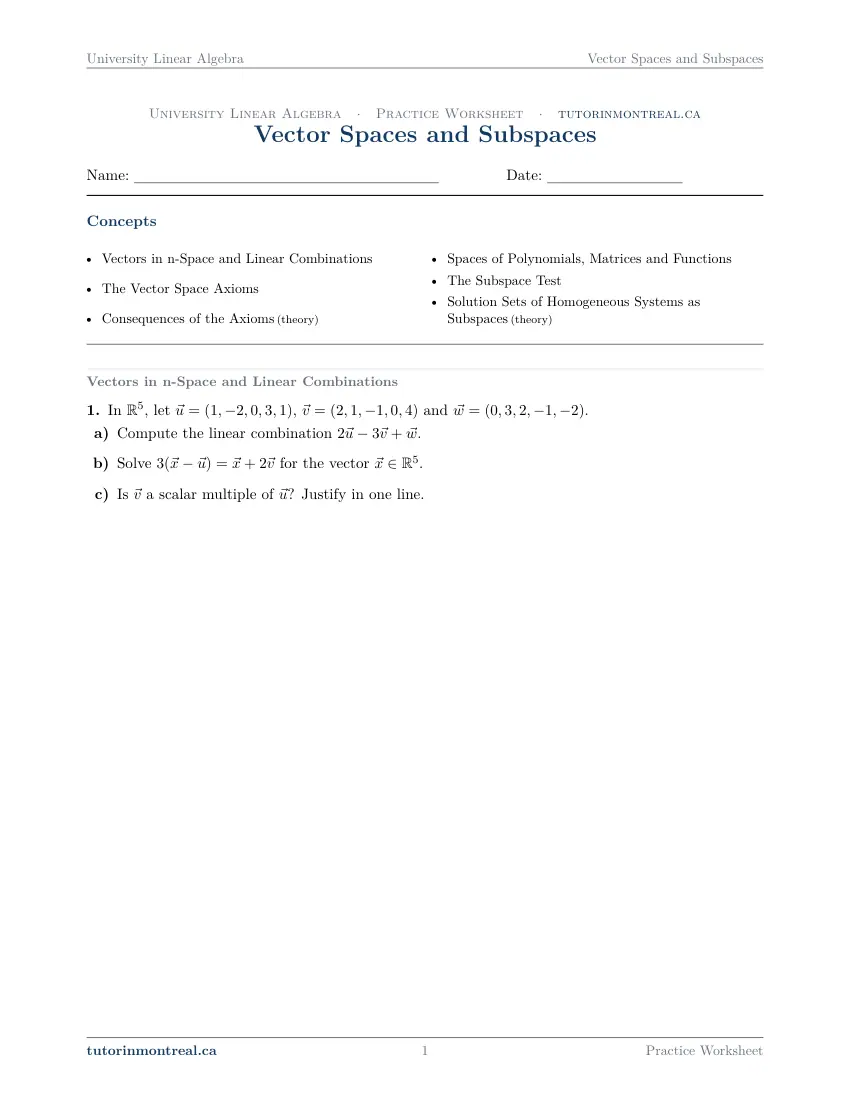
Q1Vectors in n-Space and Linear Combinations
In , let , and .
- Compute the linear combination .
- Solve for the vector .
- Is a scalar multiple of ? Justify in one line.
-
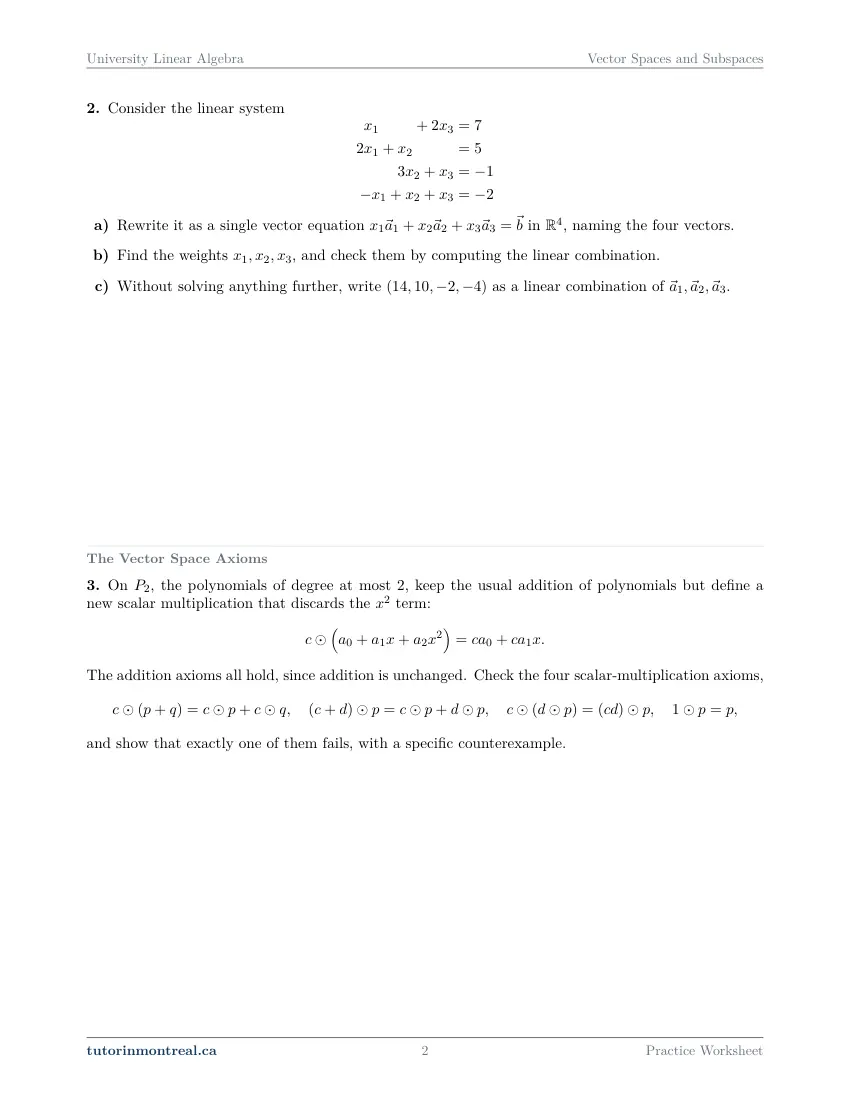
Q2Vectors in n-Space and Linear Combinations
Consider the linear system
- Rewrite it as a single vector equation in , naming the four vectors.
- Find the weights , and check them by computing the linear combination.
- Without solving anything further, write as a linear combination of .
-
Q3The Vector Space Axioms
On , the polynomials of degree at most , keep the usual addition of polynomials but define a new scalar multiplication that discards the term: The addition axioms all hold, since addition is unchanged. Check the four scalar-multiplication axioms, and show that exactly one of them fails, with a specific counterexample.
-
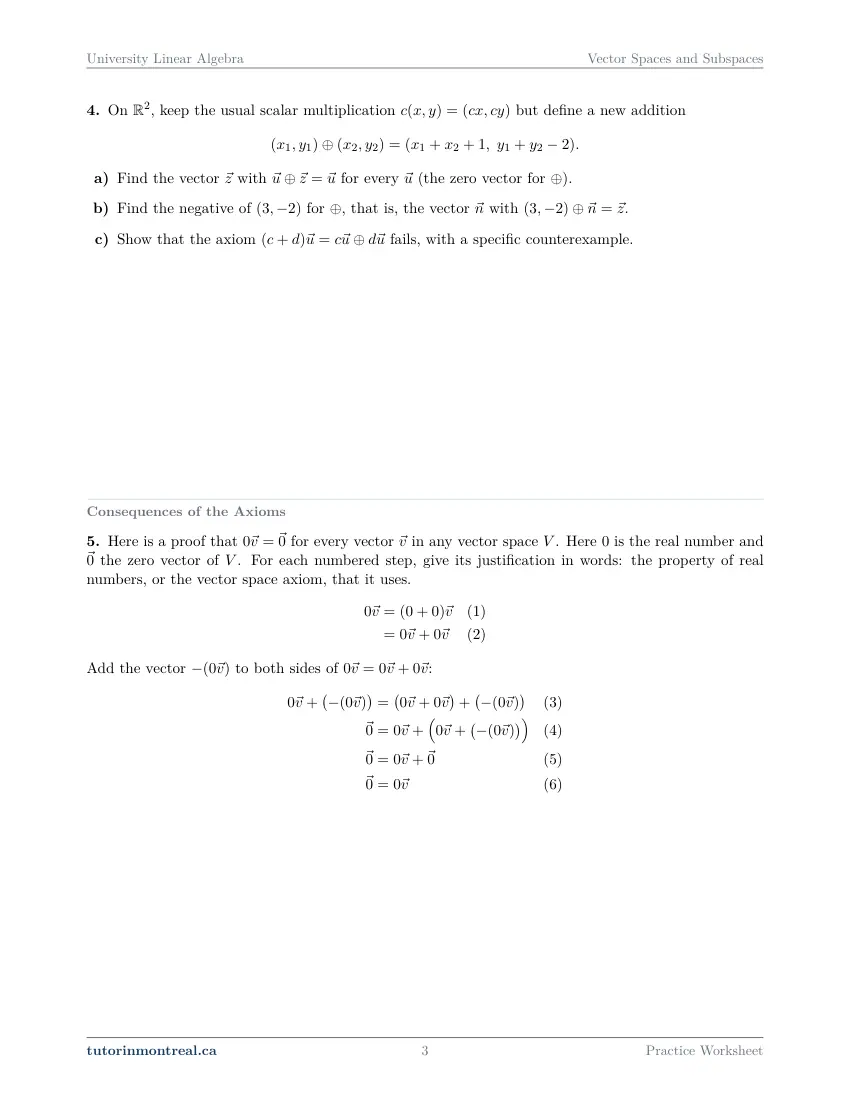
Q4The Vector Space Axioms
On , keep the usual scalar multiplication but define a new addition
- Find the vector with for every (the zero vector for ).
- Find the negative of for , that is, the vector with .
- Show that the axiom fails, with a specific counterexample.
-
Q5Consequences of the Axioms
Here is a proof that for every vector in any vector space . Here is the real number and the zero vector of . For each numbered step, give its justification in words: the property of real numbers, or the vector space axiom, that it uses. Add the vector to both sides of :
-
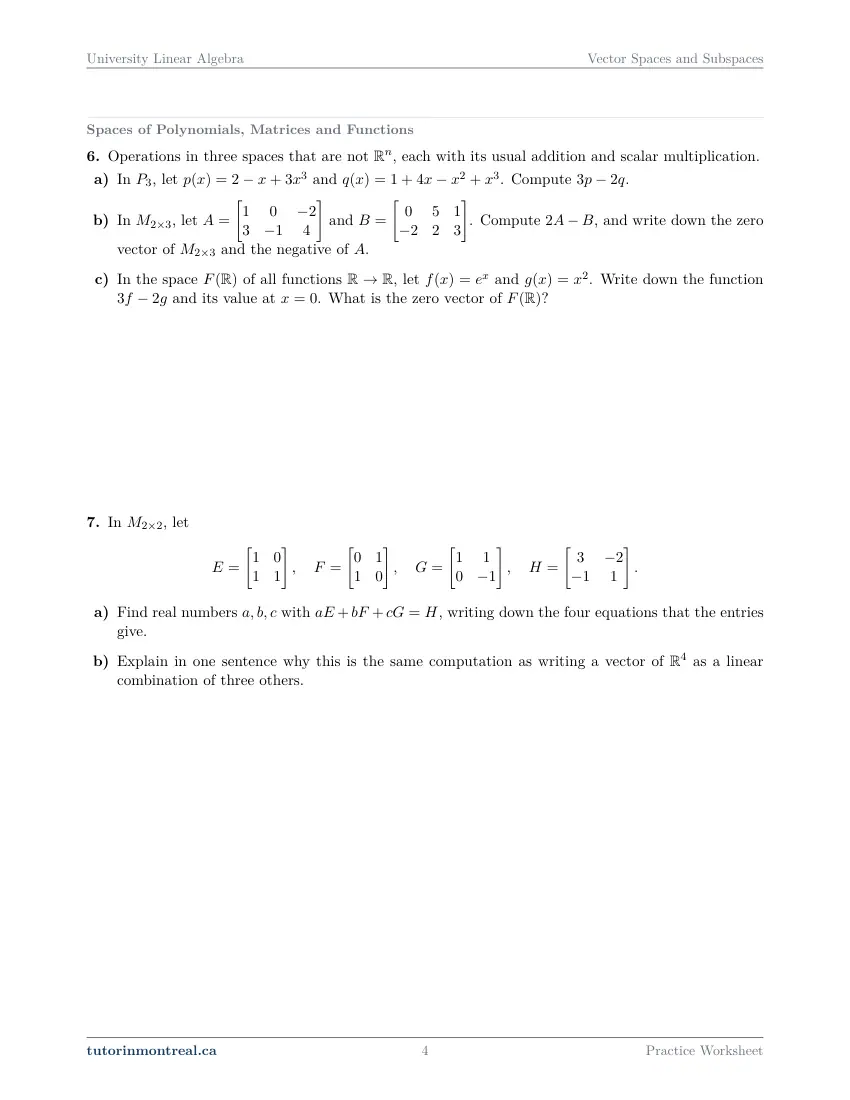
Q6Spaces of Polynomials, Matrices and Functions
Operations in three spaces that are not , each with its usual addition and scalar multiplication.
- In , let and . Compute .
- In , let and . Compute , and write down the zero vector of and the negative of .
- In the space of all functions , let and . Write down the function and its value at . What is the zero vector of ?
-
Q7Spaces of Polynomials, Matrices and Functions
In , let
- Find real numbers with , writing down the four equations that the entries give.
- Explain in one sentence why this is the same computation as writing a vector of as a linear combination of three others.
-
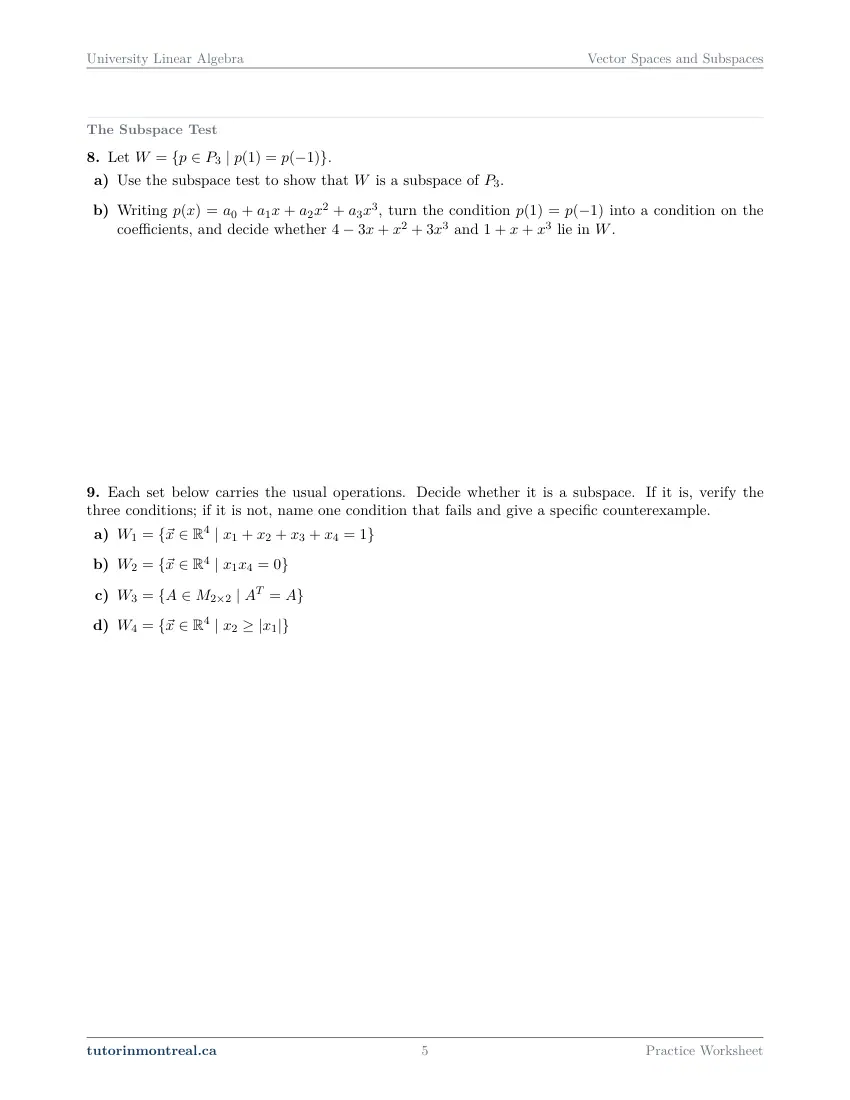
Q8The Subspace Test
Let .
- Use the subspace test to show that is a subspace of .
- Writing , turn the condition into a condition on the coefficients, and decide whether and lie in .
-
Q9The Subspace Test
Each set below carries the usual operations. Decide whether it is a subspace. If it is, verify the three conditions; if it is not, name one condition that fails and give a specific counterexample.
-
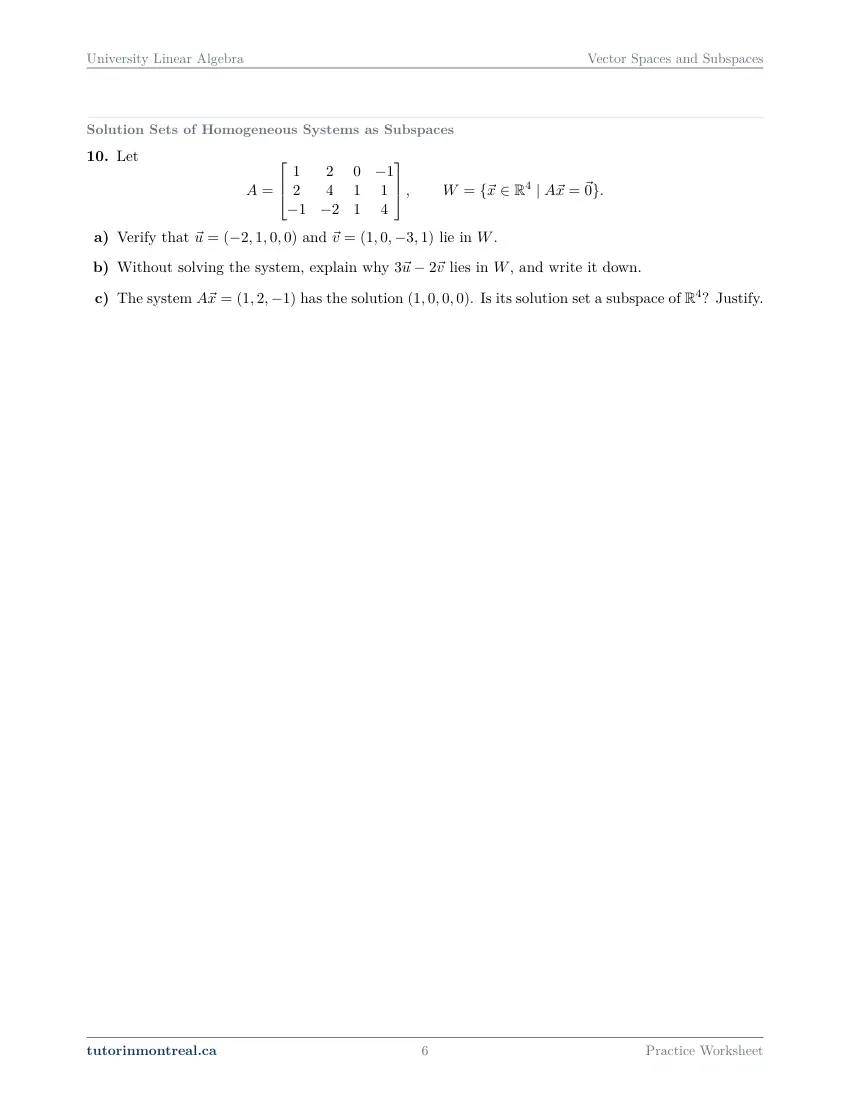
Q10Solution Sets of Homogeneous Systems as Subspaces
Let
- Verify that and lie in .
- Without solving the system, explain why lies in , and write it down.
- The system has the solution . Is its solution set a subspace of ? Justify.
-
Q11Synthesis — drawing on several topics in this unit
Let , where is the derivative of .
- Use the subspace test to show that is a subspace of .
- Writing , turn the two conditions into a homogeneous linear system in and solve it.
- Deduce that every is a linear combination of and .
- Decide whether and lie in ; for any that does, give its weights on and .
The 8 challenge problems for this topic are a separate, paid sheet and are not reproduced here.
What does this set assume? This is the first set of University Linear Algebra, and it stands on CEGEP Linear Algebra: matrix arithmetic, the transpose, row reduction to echelon form, and vectors in the plane and in space are used without comment. Row reduction appears here only as a tool — no question is about how to reduce a matrix. Scope is what every university course opens with: vectors in n-space with n of four or more, the vector space axioms and a first proof from them, polynomial, matrix and function spaces as examples, the subspace test, and homogeneous solution sets as subspaces. Span, linear independence, bases and dimension are the next two sets; the null space and column space of a matrix come with rank. Scalars are real throughout, and sums and direct sums of subspaces are not part of this course.
Which course is this for? In the public course calendars of Montreal universities, this material is part of the courses numbered MATH 133, MATH 223, MATH 204, MATH 251, MAST 234, MAT1600, MAT1250, MAT1260 and MAT472. Each course orders and weights the topics its own way, so check your own outline for what your exam covers. Which sets match your course.
The rest of this unit
The worksheet is the practice, and it is free. Two more printable documents cover the same unit and come with the University Linear Algebra bundle: read the notes first, work this sheet, then sit the test closed-book. See what each one covers.
What the Vector Spaces and Subspaces notes cover About the Vector Spaces and Subspaces unit test
How to do every concept on this sheet
This is the part worksheet sites usually leave out. Below is the actual reasoning behind each group of questions — not a full solution set, the decisions that get you to one. Read it before you start, or after you get stuck.
Vectors in n-space, and a system as one vector equation
Q1 is arithmetic in five coordinates, and its point is that nothing new happens there: a linear combination is computed one coordinate at a time, and an equation between vectors is solved with the same algebra as an equation between numbers — collect the unknown vector on one side, divide by its coefficient. Part (c) asks for a one-line justification, and the cleanest one compares a single pair of coordinates that no scalar can match.
A zero coordinate is a strong witness. If one vector has a zero where the other does not, no multiple of the first can equal the second. Look for that before comparing ratios.
Q2 is the reading that the whole course is built on. A system of four equations in three unknowns is the same statement as "b can be built from the three columns, and the unknowns are the weights".
x₁a₁ + x₂a₂ + x₃a₃ = b ⇔ the matrix equation with those columns ⇔ the original systemPart (c) is a scaling, not a new system. Compare the new target vector with b before you do anything. If one is a multiple of the other, the weights scale by the same factor — which is why the question says "without solving anything further".
The axioms, tested on operations that are not the usual ones
A vector space is a set with an addition and a scalar multiplication satisfying a fixed list of axioms. Q3 and Q4 each change one operation and ask which axioms survive. The method is the same in both: write each axiom out for the new operation, compute both sides separately, and compare.
Checking one axiom for a new operation
Two sides, computed independently, then compared.
- 1Write the axiom with the new symbol
Every "+" or scalar product the axiom contains becomes the new operation where it acts on vectors, and stays ordinary where it acts on numbers.
- 2Compute the left side
Apply the definition exactly as written, innermost operation first.
- 3Compute the right side
Separately — do not rearrange it to look like the left.
- 4Agree for all inputs, or give one counterexample
A proof that an axiom holds is general; a proof that it fails is one specific choice of scalars and vectors with the numbers written out.
Watch which "+" is which. In an axiom like (c + d)u = cu ⊕ du, the plus on the left adds two real numbers and the one on the right is the new vector addition. Treating them as the same operation is the usual way a check goes wrong.
Q4 also asks for the zero vector and a negative under the new addition. Neither is necessarily the one you expect. Find the zero vector from its defining property — the vector that leaves every u unchanged — by solving for its coordinates, and find the negative the same way, as the vector that brings (3, −2) to that zero.
A proof from the axioms
Q5 gives a complete proof that zero times any vector is the zero vector, and asks only for the reason behind each numbered step. It is the model for every short proof in the course: each line is licensed by exactly one axiom or one property of real numbers, and naming it is the whole job.
Two kinds of justification. Some steps are facts about real numbers — the scalar 0 plus 0 is 0. Others are axioms about vectors — distributivity, associativity of addition, the additive inverse, the zero vector. Say which kind each step is, and name the specific axiom rather than "algebra".
Polynomials, matrices and functions are vectors too
Q6 does the same arithmetic in three spaces that are not n-space: polynomials of degree at most 3, 2 × 3 matrices, and all functions from the reals to the reals. The questions about the zero vector are the ones to pause on — the zero of a matrix space is a matrix, and the zero of a function space is a function, not the number 0.
Q7 sets up a linear combination of four 2 × 2 matrices and asks for the weights. Matching the four entries gives four equations in three unknowns. Part (b) is the idea behind coordinates, which the course develops two sets later: a 2 × 2 matrix is four numbers in a fixed order, so the question is a linear-combination question in four coordinates in disguise.
The subspace test
A subspace is a subset that is a vector space in its own right under the operations it inherits. You do not re-check every axiom; three conditions are enough.
contains the zero vector · closed under addition · closed under scalar multiplicationQ8 applies the test to the polynomials that take the same value at 1 and at −1. The verification must be general: take two arbitrary members and an arbitrary scalar, and show the defining condition still holds. Part (b) translates the condition into a statement about the coefficients — substitute 1 and −1 into the general cubic and see which coefficients survive the comparison — and then uses it to classify two specific polynomials.
Q9 gives four sets and asks you to decide. This is where the decision matters more than the algebra, and there are recognisable signs.
Explore before you verify. For each set, test the zero vector first, then try a couple of small members for each closure condition — include a negative scalar, and members with zeros in different places. If a quick example breaks a condition, it is your counterexample. If nothing breaks, that is your cue to write the general verification. Decide first; a general proof started on a set that is not a subspace goes nowhere.
A failure needs numbers. "It is not closed under addition" is a claim, not a proof. Name two specific members of the set and show that their sum is not in it — or a specific member and a specific scalar for multiplication.
The homogeneous solution set is a subspace
Q10 connects the subspace test to systems. Part (a) is a substitution check. Part (b) is the reason homogeneous systems matter in this course: because A(su + tv) = sAu + tAv, any linear combination of solutions of Ax = 0 is again a solution — no solving needed. Part (c) asks the same question for a system with a non-zero right-hand side; settle it with the subspace test, starting from the condition that is quickest to check.
The synthesis question
Q11 follows one subset of the cubic polynomials through the whole set. Part (a) is Q8's subspace test with two conditions instead of one — the derivative condition behaves under addition and scaling because differentiation does. Part (b) is Q8(b) extended: turn both conditions into equations in the four coefficients and solve the homogeneous system, leaving the free coefficients as parameters. Part (c) reads that parametric solution as a linear combination, as in Q2 and Q10. Part (d) tests membership against the conditions and, where a polynomial is in the subspace, reads its weights off the free coefficients.
Preview all 7 pages
Click any page to open the full PDF.
Getting the most out of it
Write the definition down before you test it
Every question in this set is decided by a definition — of a linear combination, of an axiom, of a subspace. Write it out in the notation of the question before you compute, and most of the work is choosing what to substitute.
Prove "always" in general, disprove it with one example
To show a condition holds, use arbitrary vectors and scalars. To show it fails, pick the simplest specific ones you can — small integers, a negative scalar — and write the numbers out. Mixing the two is the most common way to lose marks on a subspace question.
Check the zero vector first
It is the fastest of the three conditions, and it rules out a whole family of sets — anything defined by an equation with a non-zero constant, and the solution set of any system that is not homogeneous.
Translate to coefficients
A condition on a polynomial or a matrix becomes a condition on its coefficients or entries. Once it is written that way, it is a linear system, and the tools from CEGEP apply.
Want the solutions, or something more challenging?
The worksheet, the questions above and every explanation on this page stay free permanently. Three more PDFs exist for this topic — the worked answer key, a harder problem set, and the answer key to that. They come with the University Linear Algebra Solutions Bundle, beside the unit notes and the unit test, which is what keeps the rest of the series free.
What else exists for Vector Spaces and Subspaces
Three PDFs · 12 pages · all three are in the bundle below.
- Answer key — 3 pages. All 11 questions worked step by step, including the restrictions and the justifications. Not a list of final answers.
- Challenge problems — 6 pages, 8 problems. A separate sheet at exam-plus difficulty covering the same 6 concepts. Harder than anything on the free sheet.
- Challenge answer key — 3 pages. Every challenge problem worked to the same standard, with the checks shown.
- PDF, letter size, print-ready.
The one thing that's for sale
Every University Linear Algebra topic — the complete Solutions Bundle
One download, one payment, the whole program. For all 9 University Linear Algebra units: the worksheet, the reference notes, the challenge set, the unit test and every answer key — including this one.
- Worked solutions, not answer lists — every step written out
- Covers the whole year's program at this level
- Less than the price of one hour of tutoring — for the entire year's solutions
Taking Secondary 1 Math as well? The Secondary 1 Math bundle covers all 15 of its units — 106 PDFs, 474 pages — on the same terms.
Taking Secondary 2 Math as well? The Secondary 2 Math bundle covers all 14 of its units — 98 PDFs, 449 pages — on the same terms.
Taking Secondary 3 Math as well? The Secondary 3 Math bundle covers all 11 of its units — 77 PDFs, 367 pages — on the same terms.
Taking Secondary 4 Math as well? The Secondary 4 Math bundle covers all 17 of its units — 122 PDFs, 466 pages — on the same terms.
Taking Secondary 5 Math as well? The Secondary 5 Math bundle covers all 21 of its units — 147 PDFs, 589 pages — on the same terms.
Taking CEGEP Calculus I as well? The CEGEP Calculus I bundle covers all 9 of its units — 72 PDFs, 371 pages — on the same terms.
Taking CEGEP Calculus II as well? The CEGEP Calculus II bundle covers all 8 of its units — 64 PDFs, 335 pages — on the same terms.
Taking CEGEP Linear Algebra as well? The CEGEP Linear Algebra bundle covers all 7 of its units — 56 PDFs, 298 pages — on the same terms.
Taking University Calculus III as well? The University Calculus III bundle covers all 9 of its units — 72 PDFs, 516 pages — on the same terms.
Taking University Differential Equations as well? The University Differential Equations bundle covers all 9 of its units — 36 PDFs, 182 pages — on the same terms.
Taking University Business Math as well? The University Business Math bundle covers all 9 of its units — 36 PDFs, 190 pages — on the same terms.
Taking University Introductory Statistics as well? The University Introductory Statistics bundle covers all 9 of its units — 36 PDFs, 186 pages — on the same terms.
Taking University Discrete Math as well? The University Discrete Math bundle covers all 9 of its units — 36 PDFs, 155 pages — on the same terms.
Taking AP Calculus AB as well? The AP Calculus AB bundle covers all 8 of its units — 64 PDFs, 527 pages — on the same terms.
Common questions
Is this worksheet really free?
Yes — the questions are on this page to read, and the PDF downloads directly, no email and no account. The one paid item is optional: the complete University Linear Algebra Solutions Bundle, which covers every set at this level.
Which university courses is this for?
The course codes listed on this page are taken from the public course calendars of universities that teach linear algebra after CEGEP. Each course orders and weights the topics its own way — some open with abstract spaces and axioms, others reach them after several weeks in n-space — so check the outline for your own section to see where this set falls in your term.
What do I need to know before starting this set?
CEGEP Linear Algebra: matrix arithmetic, the transpose, and solving a linear system by row reduction. Nothing from this course is assumed — this is its first set.
Why do I need the axioms if I already know how vectors work?
Because the course applies the same ideas to polynomials, matrices and functions, where your intuition about arrows no longer helps. The axioms are the list of properties that every one of those settings shares, and anything proved from them holds in all of them at once.
What is the quickest way to show a set is not a subspace?
Check whether it contains the zero vector. If it does not, you are done. If it does, look for a failure of closure and prove it with a specific counterexample, written out in numbers.
Is every subset that contains the zero vector a subspace?
No. Containing the zero vector is necessary, not sufficient. A set can contain it and still fail to be closed under addition or under multiplication by a negative scalar, and this set has examples of both.
Where are span, linear independence and bases?
In the next two sets. This one sets up the spaces and subspaces those ideas are about; span and independence come next, then bases, dimension and coordinates.
Do I need complex numbers?
No. Scalars are real throughout this course. Vector spaces over the complex numbers, or over a general field, are not part of it.
Can teachers use this in class?
Yes. Print and photocopy it for your own classes freely — I just ask that the tutorinmontreal.ca footer stays on the page.
I'm stuck on one question. Can you help?
Yes — through one-on-one tutoring, in Montreal or online. Get in touch to arrange a session, or see the current rates.
← All 9 University Linear Algebra worksheets · Secondary 1 Math series (15 sheets) → · Secondary 2 Math series (14 sheets) → · Secondary 3 Math series (11 sheets) → · Secondary 4 Math series (17 sheets) → · Secondary 5 Math series (21 sheets) → · CEGEP Calculus I series (9 sheets) → · CEGEP Calculus II series (8 sheets) → · CEGEP Linear Algebra series (7 sheets) → · University Calculus III series (9 sheets) → · University Differential Equations series (9 sheets) → · University Business Math series (9 sheets) → · University Introductory Statistics series (9 sheets) → · University Discrete Math series (9 sheets) → · AP Calculus AB series (8 sheets) →