University Business Mathematics — Counting and Probability Worksheet
Counting first, then probability built on the counts. The addition and multiplication principles; permutations, factorial notation and arrangements with repeated items; combinations and the mixed problems where order matters in one part and not in the next; sample spaces of equally likely outcomes; the algebra of unions, intersections and complements; and conditional probability, probability trees and the test for independence — every one of them in a business setting, from product codes to project teams to loan files. Have a look on this page, then print the free PDF when you want to write on it.
Practice worksheet — free PDF
No email, no account, no watermark. Teachers: photocopy it for your classes freely. Worked solutions and 7 harder problems come with the University Business Math bundle.
All 11 questions
Each question targets one named concept from the sheet. Read them here, or print the PDF — it has working space under each one.
-
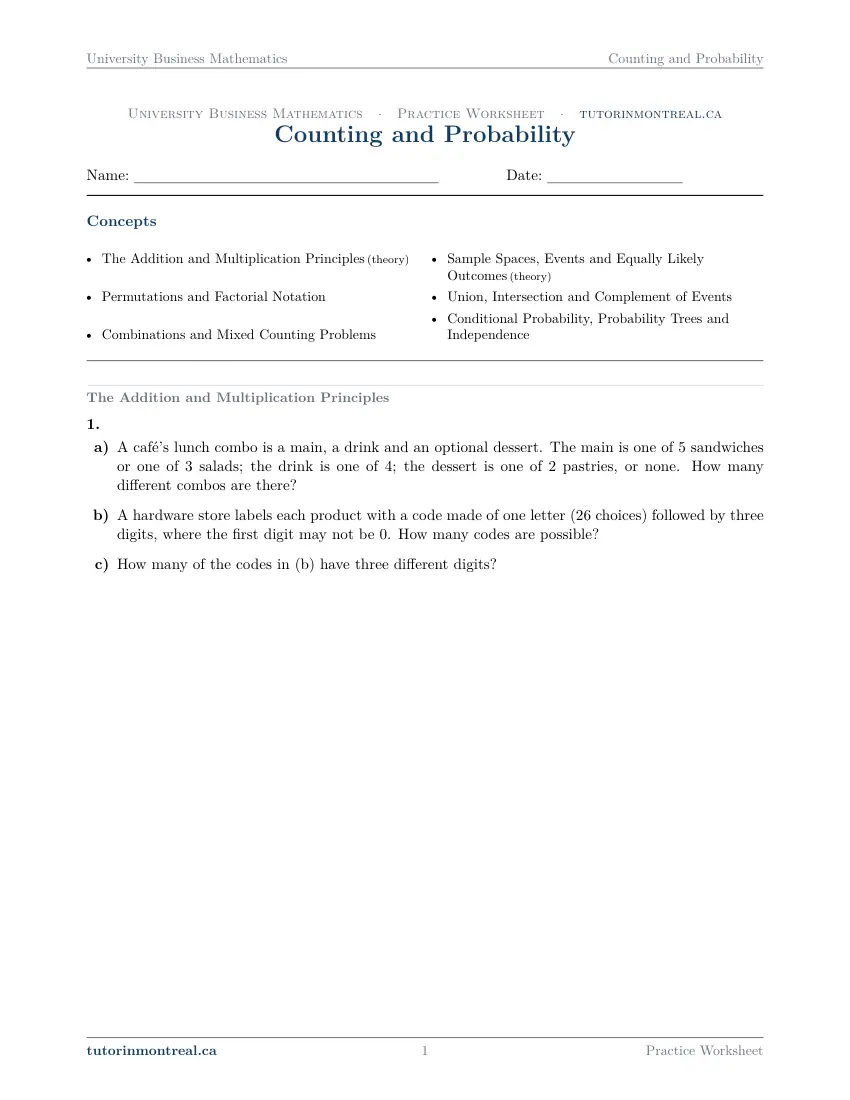
Q1The Addition and Multiplication Principles
- A café's lunch combo is a main, a drink and an optional dessert. The main is one of sandwiches or one of salads; the drink is one of ; the dessert is one of pastries, or none. How many different combos are there?
- A hardware store labels each product with a code made of one letter ( choices) followed by three digits, where the first digit may not be . How many codes are possible?
- How many of the codes in (b) have three different digits?
-
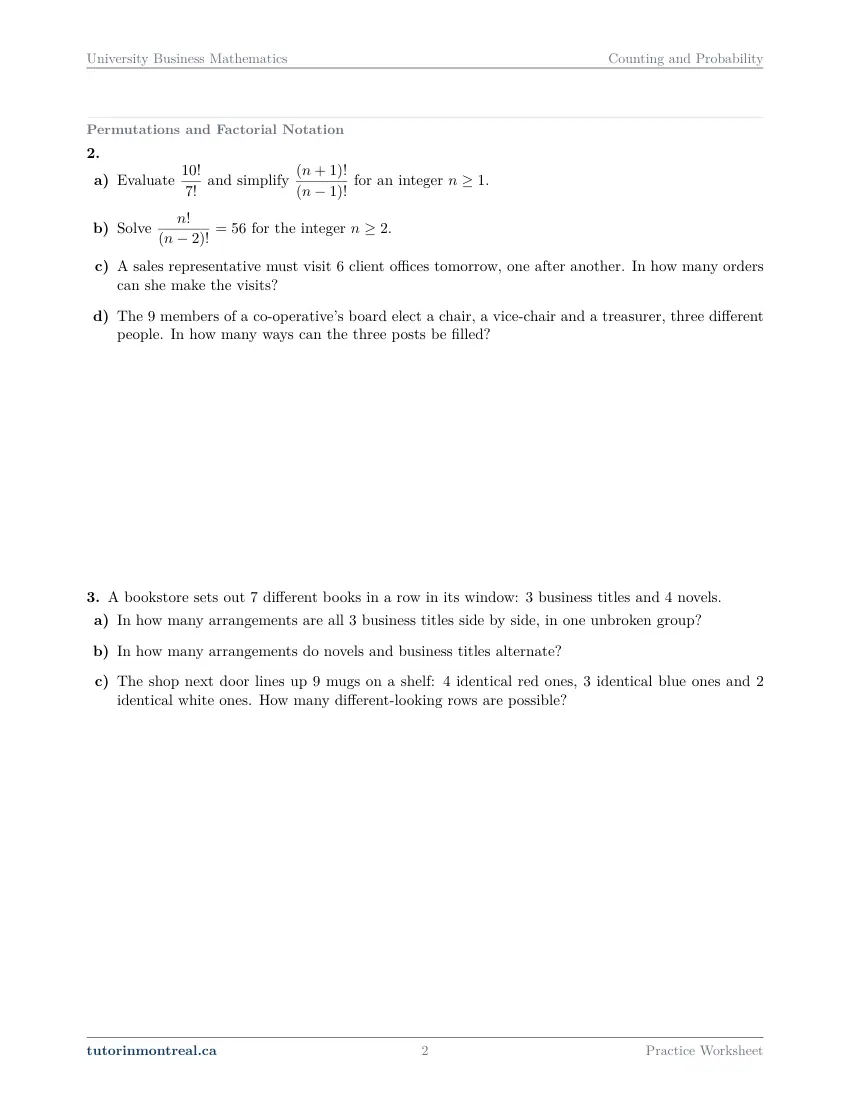
Q2Permutations and Factorial Notation
- Evaluate and simplify for an integer .
- Solve for the integer .
- A sales representative must visit client offices tomorrow, one after another. In how many orders can she make the visits?
- The members of a co-operative's board elect a chair, a vice-chair and a treasurer, three different people. In how many ways can the three posts be filled?
-
Q3Permutations and Factorial Notation
A bookstore sets out different books in a row in its window: business titles and novels.
- In how many arrangements are all business titles side by side, in one unbroken group?
- In how many arrangements do novels and business titles alternate?
- The shop next door lines up mugs on a shelf: identical red ones, identical blue ones and identical white ones. How many different-looking rows are possible?
-
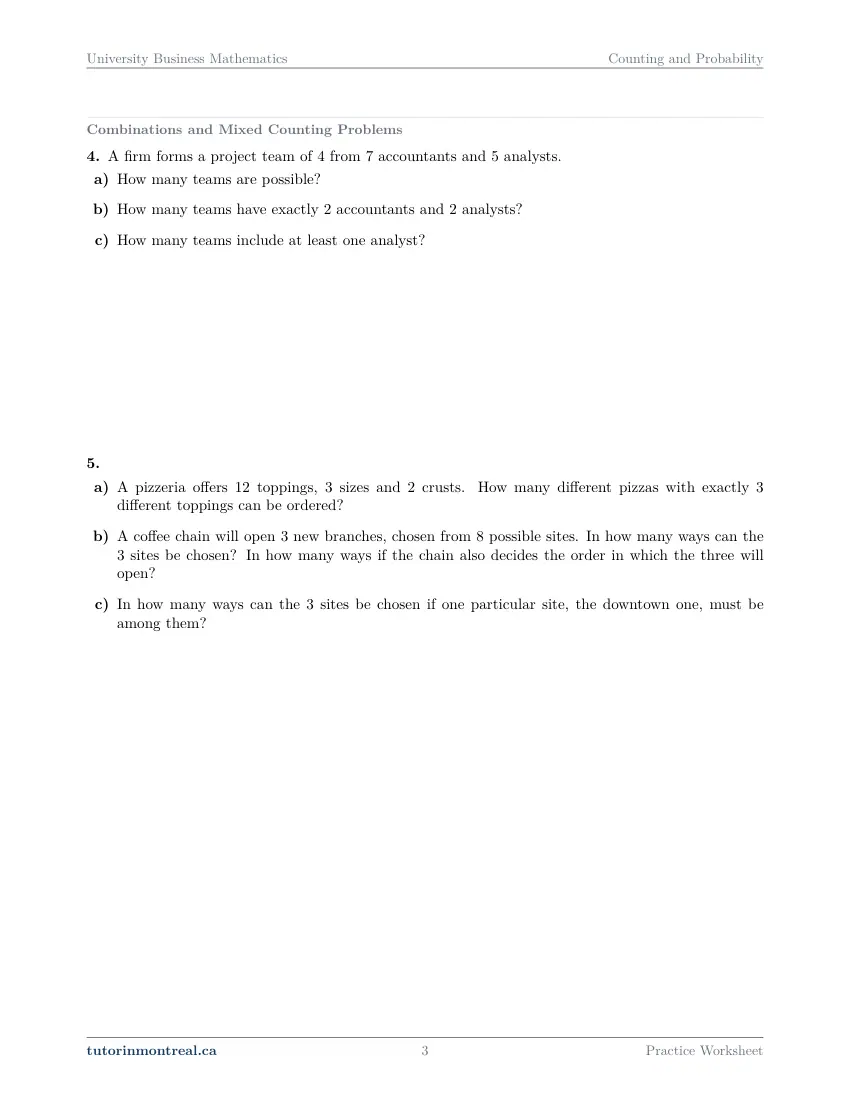
Q4Combinations and Mixed Counting Problems
A firm forms a project team of from accountants and analysts.
- How many teams are possible?
- How many teams have exactly accountants and analysts?
- How many teams include at least one analyst?
-
Q5Combinations and Mixed Counting Problems
- A pizzeria offers toppings, sizes and crusts. How many different pizzas with exactly different toppings can be ordered?
- A coffee chain will open new branches, chosen from possible sites. In how many ways can the sites be chosen? In how many ways if the chain also decides the order in which the three will open?
- In how many ways can the sites be chosen if one particular site, the downtown one, must be among them?
-
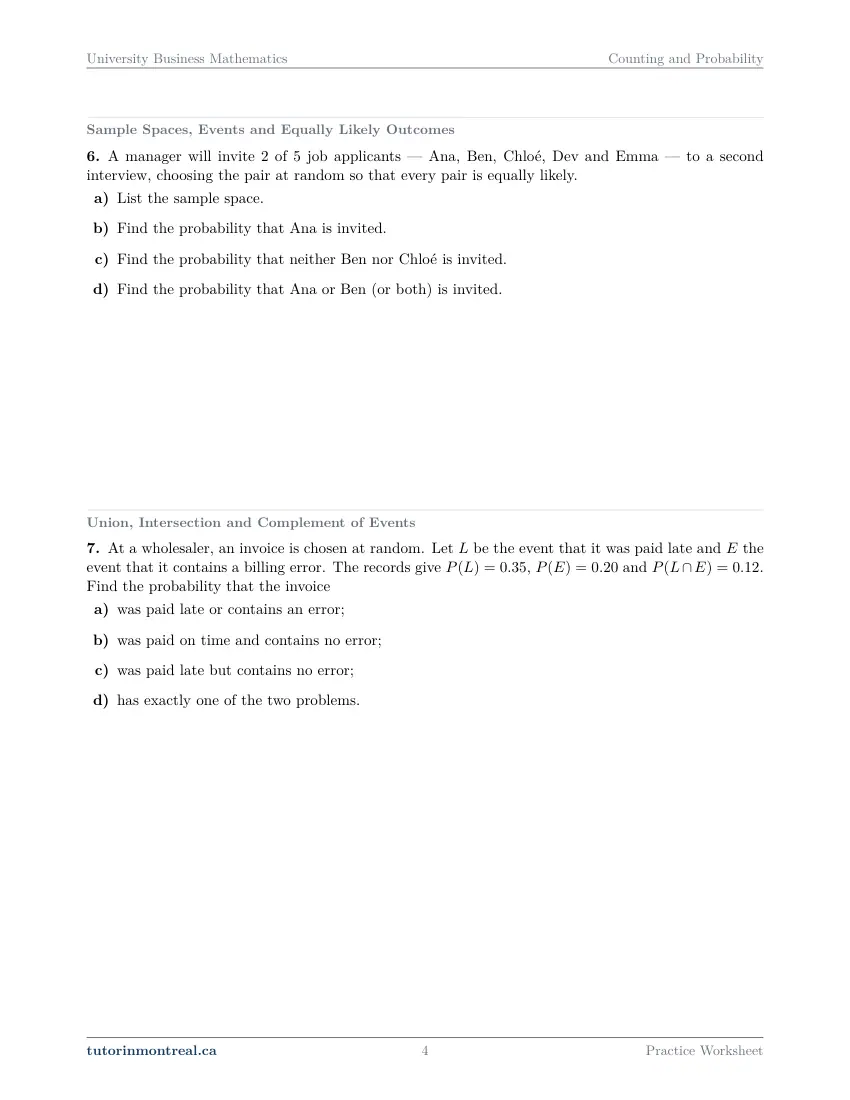
Q6Sample Spaces, Events and Equally Likely Outcomes
A manager will invite of job applicants — Ana, Ben, Chloé, Dev and Emma — to a second interview, choosing the pair at random so that every pair is equally likely.
- List the sample space.
- Find the probability that Ana is invited.
- Find the probability that neither Ben nor Chloé is invited.
- Find the probability that Ana or Ben (or both) is invited.
-
Q7Union, Intersection and Complement of Events
At a wholesaler, an invoice is chosen at random. Let be the event that it was paid late and the event that it contains a billing error. The records give , and . Find the probability that the invoice
- was paid late or contains an error;
- was paid on time and contains no error;
- was paid late but contains no error;
- has exactly one of the two problems.
-
Q8Union, Intersection and Complement of Events
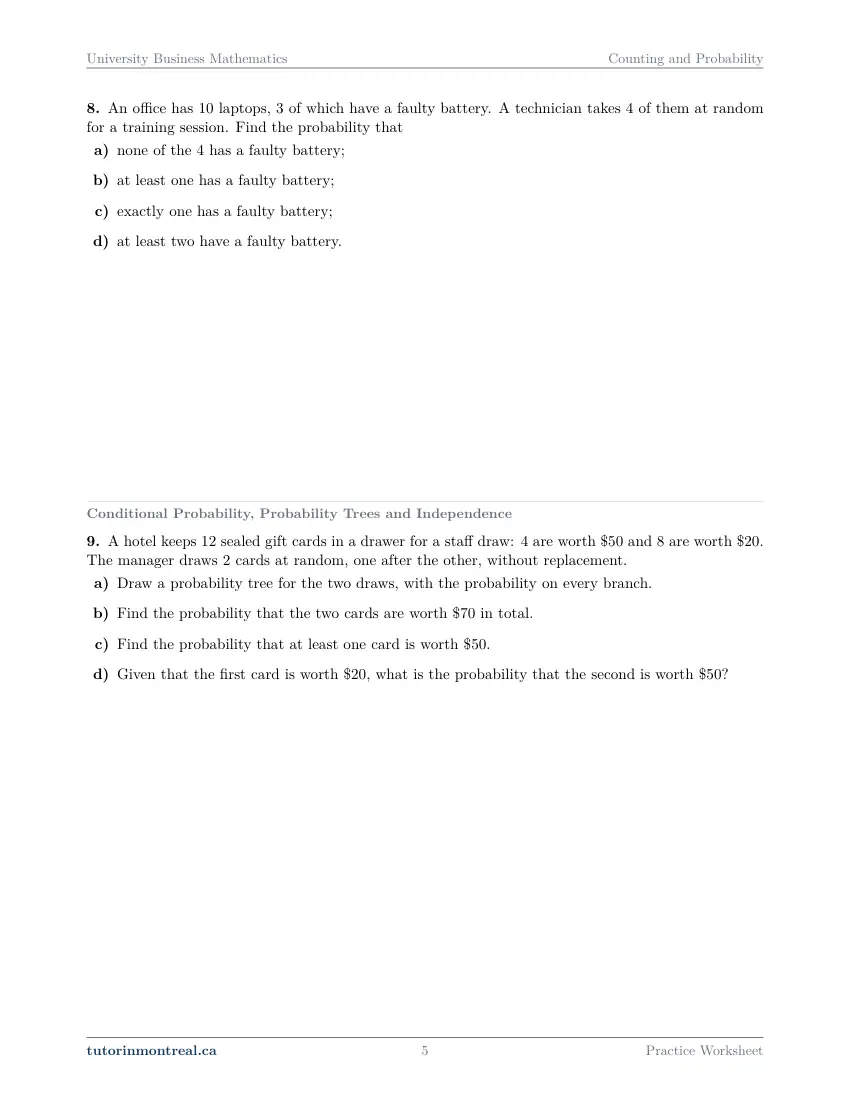
An office has laptops, of which have a faulty battery. A technician takes of them at random for a training session. Find the probability that
- none of the has a faulty battery;
- at least one has a faulty battery;
- exactly one has a faulty battery;
- at least two have a faulty battery.
-
Q9Conditional Probability, Probability Trees and Independence
A hotel keeps sealed gift cards in a drawer for a staff draw: are worth $50 and are worth $20. The manager draws cards at random, one after the other, without replacement.
- Draw a probability tree for the two draws, with the probability on every branch.
- Find the probability that the two cards are worth $70 in total.
- Find the probability that at least one card is worth $50.
- Given that the first card is worth $20, what is the probability that the second is worth $50?
-
Q10Conditional Probability, Probability Trees and Independence
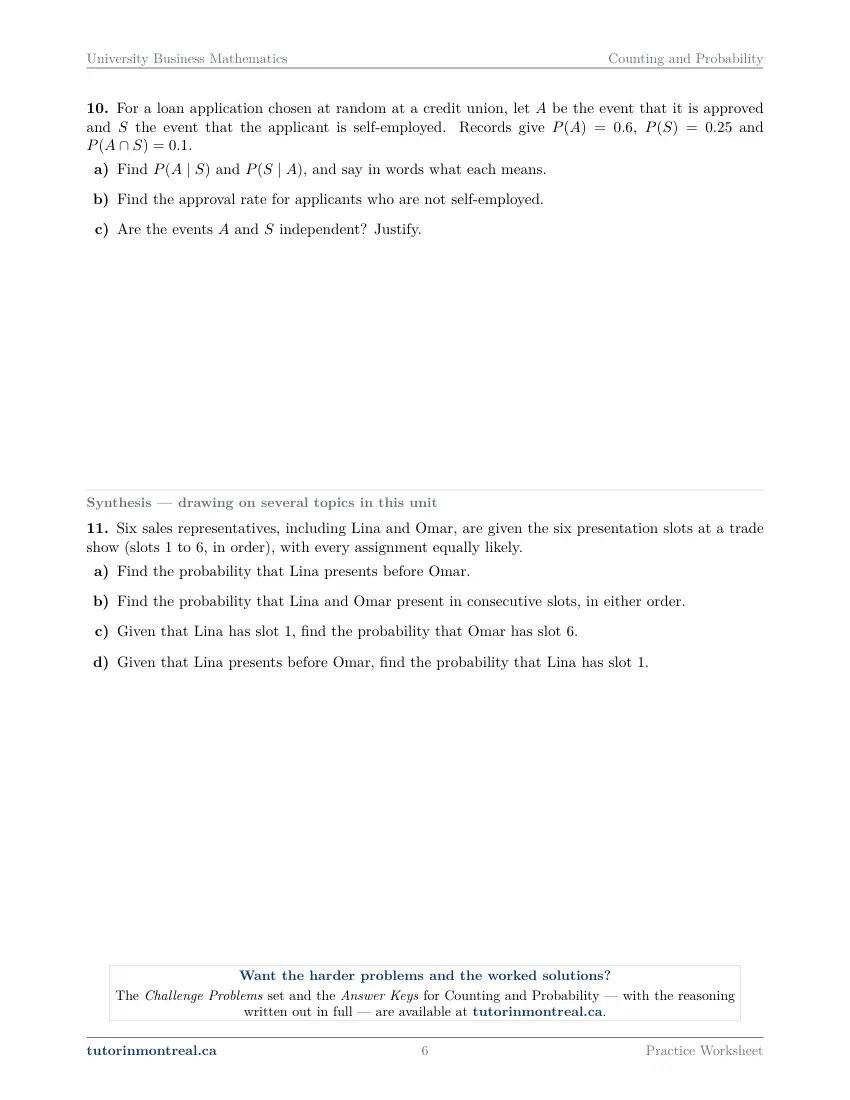
For a loan application chosen at random at a credit union, let be the event that it is approved and the event that the applicant is self-employed. Records give , and .
- Find and , and say in words what each means.
- Find the approval rate for applicants who are not self-employed.
- Are the events and independent? Justify.
-
Q11Synthesis — drawing on several topics in this unit
Six sales representatives, including Lina and Omar, are given the six presentation slots at a trade show (slots to , in order), with every assignment equally likely.
- Find the probability that Lina presents before Omar.
- Find the probability that Lina and Omar present in consecutive slots, in either order.
- Given that Lina has slot , find the probability that Omar has slot .
- Given that Lina presents before Omar, find the probability that Lina has slot .
The 7 challenge problems for this topic are a separate, paid sheet and are not reproduced here.
What does this set assume? This set assumes Secondary 5 mathematics only: fractions and decimals handled comfortably, and the probability vocabulary of the Quebec secondary program — outcomes, events, drawing with and without replacement. It leans on none of the earlier University Business Mathematics sets (Functions for Business Models; Mathematics of Finance; Matrices and Input-Output Models; Linear Inequalities and Linear Programming), and it closes the finite-mathematics half of the course before the calculus begins in Limits, Derivatives and Marginal Analysis. It stops deliberately at conditional probability and independence. Bayes' rule as a named formula, random variables, expectation and variance, and the binomial and normal distributions belong to University Introductory Statistics; counting as proof — the pigeonhole principle, inclusion–exclusion beyond two sets, the binomial theorem — belongs to University Discrete Mathematics. Here counting is computational: how many, and then how likely.
Which course is this for? In the public course calendars of Montreal universities, this material is part of the courses numbered MATH 123 and MATH 208. Each course orders and weights the topics its own way, so check your own outline for what your exam covers. Which sets match your course.
How to do every concept on this sheet
This is the part worksheet sites usually leave out. Below is the actual reasoning behind each group of questions — not a full solution set, the decisions that get you to one. Read it before you start, or after you get stuck.
The addition and multiplication principles
Every count on this sheet starts with one question: is the task done in stages, one after another, or does it split into separate cases, exactly one of which happens? Stages multiply; cases add.
Setting up a count
Three moves, before any arithmetic.
- 1List the stages
Write one blank per decision, in order: main, drink, dessert; letter, digit, digit, digit.
- 2Fill each blank with its number of choices
If a stage itself splits into cases (one kind of item or another), add the cases to get that blank's number.
- 3Multiply the blanks
That is the multiplication principle: each choice at one stage can be paired with every choice at the next.
Q1(a) has both principles in one line: the main is a choice between two kinds of item, so its blank is a sum, and the dessert is optional. "None" is a legitimate outcome of that stage and counts as one more choice — leaving it out is the usual slip. Q1(b) is the same shape with a restriction on one position: fill the restricted blank first, from what it is allowed to be.
"Different" changes the later blanks. Q1(c) asks for three different digits, so each digit placed removes a choice from the ones after it. Start with the most restricted position — the first digit, which may not be 0 — then count the choices left for the second and third given that the earlier digits are used up.
Permutations and factorial notation
A permutation is an ordered arrangement. n! counts the orders of n different objects; P(n, r) = n!/(n − r)! counts the ordered selections of r of them.
n! = n(n − 1)(n − 2)···2·1, P(n, r) = n!/(n − r)!Q2(a) and (b) are about the notation itself. Never expand a large factorial: write the bigger one as a product that stops at the smaller one, and let the smaller one cancel. The same move turns the quotient in Q2(b) into a short product in n, which is then an ordinary equation — keep only the root the condition on n allows. Q2(c) orders every object; Q2(d) fills three distinct posts from a larger group, which is a P(n, r) because a chair and a treasurer are different jobs.
Glue a block, then unglue it. When items must stay together, as in Q3(a), treat the group as one object and arrange the objects; then multiply by the number of orders inside the group. For an alternating pattern, as in Q3(b), compare the sizes of the two kinds first: they decide which kind must stand at the ends, and after that each kind is arranged in its own positions independently.
Q3(c) is the arrangement of items that are not all different. Arrange them as if every item were distinguishable, then divide by the orders of each group of identical items, because swapping two identical mugs produces the same-looking row.
n!/(n₁! n₂! n₃!) with n₁ + n₂ + n₃ = nCombinations and mixed counting problems
A combination is an unordered selection: C(n, r) = n!/(r!(n − r)!). The whole decision is one question — would rearranging the chosen items give a different result? A team of four is the same team in any order, so Q4 is combinations throughout.
Reading the conditions
The wording decides the structure of the count.
- 1No condition
One combination from the whole pool, as in Q4(a).
- 2"Exactly so many of each kind"
Choose from each kind separately and multiply, as in Q4(b).
- 3"At least one"
Count the complement — selections with none of that kind — and subtract from the total, as in Q4(c). Adding the cases "exactly one, exactly two, …" works but is longer and easier to get wrong.
Q5 mixes the two kinds of count. In Q5(a) the toppings are a combination, since a pizza with the same three toppings is the same pizza whatever order they were named in, while size and crust are further stages of the multiplication principle. Q5(b) asks the same selection twice, once without order and once with an opening order, and the comparison between the two answers is the point: each unordered selection corresponds to r! ordered ones.
A forced item leaves a smaller choice. When one particular item must be in the selection, as in Q5(c), put it in first; what remains is to choose the rest of the selection from the items not yet used.
Sample spaces and equally likely outcomes
When every outcome is equally likely, a probability is a ratio of two counts:
P(E) = (outcomes in E) / (outcomes in the sample space)Q6 asks you to list the sample space before using it. A pair of applicants is unordered, so list each pair once — fix the first name and run through the later ones — and check the length of the list against C(5, 2). Then Q6(b), (c) and (d) are counts on that list. "Neither Ben nor Chloé" means the pair avoids both names; "Ana or Ben (or both)" is an inclusive or, so a pair holding both names is counted once, not twice.
Union, intersection and complement
Two events split the sample space into four regions: in both, in the first only, in the second only, in neither. Q7 gives P(L), P(E) and P(L ∩ E); fill the four regions of a Venn diagram from the centre outward, and every part is read off it.
P(A ∪ B) = P(A) + P(B) − P(A ∩ B), P(Aᶜ) = 1 − P(A)Translate each phrase before computing. "Late or contains an error" is the union. "On time and no error" is the region outside both circles, which is the complement of the union. "Late but no error" is the first circle with the overlap removed. "Exactly one of the two" is the union without the overlap. Q7(a) to (d) are these four readings in turn.
The four regions must add to 1. Once the diagram is filled, add the four numbers. If they do not make 1, a region has been subtracted twice or not at all.
Q8 brings counting back into probability. Choosing 4 laptops from 10 is a combination, and each event is a count of selections: choose the faulty ones from the faulty and the good ones from the good, multiply, and divide by the total number of selections. Q8(a) and (c) are direct counts; Q8(b) and (d) are "at least" questions, where the complement of an event you have already found is the short route.
Conditional probability and probability trees
P(A | B) is the probability of A once B is known to have happened: the sample space shrinks to B, and A is measured inside it.
P(A | B) = P(A ∩ B) / P(B), so P(A ∩ B) = P(B) · P(A | B)Building a tree for draws without replacement
Q9(a) asks for every branch labelled.
- 1First draw
One branch per kind of card, each with its share of the full drawer.
- 2Second draw, on each branch separately
One card has gone, so both the count of that kind and the total drop by one along the branch where it was drawn. The second-level probabilities are conditional ones.
- 3Multiply along a path, add across paths
The product along a path is the probability of that sequence; an event reached by several paths gets the sum of their products. The probabilities out of any one node add to 1.
For Q9(b), translate the total into the combinations of card values that produce it, then find every path that gives one of them — order matters on a tree, so check whether more than one path leads to the same pair of values. Q9(c) is an "at least one", and the complement is a single path. Q9(d) is read straight off the second level of the tree: the condition names the branch you stand on.
Reading conditional probability from given values
Q10 gives the same information as Q7 — two probabilities and their intersection — and asks for conditional ones. P(A | S) divides by P(S); P(S | A) divides by P(A). The numerator is the same for both, and only the condition changes, which is exactly why the two are different numbers with different meanings. Say each in words starting from the condition: "among self-employed applicants, the proportion approved" is not "among approved applications, the proportion that are self-employed".
Q10(b) conditions on the complement. Find P(A ∩ Sᶜ) first — the approved applications with the self-employed ones removed — then divide by P(Sᶜ).
The independence test. A and B are independent when knowing one does not change the probability of the other: P(A | B) = P(A), or equivalently P(A ∩ B) = P(A) · P(B). Q10(c) asks you to justify, so compute one side and the other and state the comparison. A verdict without both numbers written next to each other earns nothing.
Independent is not the same as disjoint. Disjoint events cannot happen together, so P(A ∩ B) = 0; independent events carry no information about each other. Two events that both have positive probability and are disjoint are never independent — knowing one happened rules the other out.
The synthesis question
Q11 puts all of it together: the sample space is the set of all orders of six people, so it is counted with a factorial, and each event is a count of orders. For Q11(a), look for a way to pair every order where Lina is first of the two with an order where she is second — a pairing between two events of the same size settles a probability without a long count. Q11(b) is Q3(a)'s block method: glue the two into one object and remember the two orders inside it.
Q11(c) and (d) are conditional. A condition that fixes someone's slot shrinks the sample space to the orders consistent with it; count inside that smaller space. In Q11(d), before dividing, ask whether one event contains the other: when it does, the intersection is simply the smaller event, and the definition of conditional probability becomes one division.
Preview all 6 pages
Click any page to open the full PDF.
Getting the most out of it
Decide "order or no order" out loud
Before writing P or C, say whether rearranging the chosen items gives a different outcome. Posts, slots and codes: yes. Teams, pairs and sets of toppings: no. Nearly every counting error is this decision made silently and wrongly.
Reach for the complement
"At least one", "at least two", "not both": write the complement next to the event and ask which of the two is quicker to count. It is usually the complement, and the subtraction from 1 or from the total is one line.
Check a small count by listing
When a count is small enough, list it, as Q6(a) asks. A list that disagrees with the formula shows which assumption about order or repetition was wrong, and that habit carries into the counts too large to list.
Make every table, diagram and tree add up
The four regions of a Venn diagram, the branches out of a node, the ends of all paths of a tree: each set adds to 1. It is the cheapest check in probability and it catches a missed region or a replacement handled wrongly.
Want the solutions, or something more challenging?
The worksheet, the questions above and every explanation on this page stay free permanently. Three more PDFs exist for this topic — the worked answer key, a harder problem set, and the answer key to that. They come with the University Business Math Solutions Bundle, beside the unit notes and the unit test, which is what keeps the rest of the series free.
What else exists for Counting and Probability
Three PDFs · 13 pages · all three are in the bundle below.
- Answer key — 3 pages. All 11 questions worked step by step, including the restrictions and the justifications. Not a list of final answers.
- Challenge problems — 7 pages, 7 problems. A separate sheet at exam-plus difficulty covering the same 6 concepts. Harder than anything on the free sheet.
- Challenge answer key — 3 pages. Every challenge problem worked to the same standard, with the checks shown.
- PDF, letter size, print-ready.
The one thing that's for sale
Every University Business Math topic — the complete Solutions Bundle
One download, one payment, the whole program. For all 9 University Business Math units: the worksheet, the reference notes, the challenge set, the unit test and every answer key — including this one.
- Worked solutions, not answer lists — every step written out
- Covers the whole year's program at this level
- Less than the price of one hour of tutoring — for the entire year's solutions
Taking Secondary 1 Math as well? The Secondary 1 Math bundle covers all 15 of its units — 106 PDFs, 474 pages — on the same terms.
Taking Secondary 2 Math as well? The Secondary 2 Math bundle covers all 14 of its units — 98 PDFs, 449 pages — on the same terms.
Taking Secondary 3 Math as well? The Secondary 3 Math bundle covers all 11 of its units — 77 PDFs, 367 pages — on the same terms.
Taking Secondary 4 Math as well? The Secondary 4 Math bundle covers all 17 of its units — 122 PDFs, 466 pages — on the same terms.
Taking Secondary 5 Math as well? The Secondary 5 Math bundle covers all 21 of its units — 147 PDFs, 589 pages — on the same terms.
Taking CEGEP Calculus I as well? The CEGEP Calculus I bundle covers all 9 of its units — 72 PDFs, 371 pages — on the same terms.
Taking CEGEP Calculus II as well? The CEGEP Calculus II bundle covers all 8 of its units — 64 PDFs, 335 pages — on the same terms.
Taking CEGEP Linear Algebra as well? The CEGEP Linear Algebra bundle covers all 7 of its units — 56 PDFs, 298 pages — on the same terms.
Taking University Calculus III as well? The University Calculus III bundle covers all 9 of its units — 72 PDFs, 516 pages — on the same terms.
Taking University Linear Algebra as well? The University Linear Algebra bundle covers all 9 of its units — 72 PDFs, 496 pages — on the same terms.
Taking University Differential Equations as well? The University Differential Equations bundle covers all 9 of its units — 36 PDFs, 182 pages — on the same terms.
Taking University Introductory Statistics as well? The University Introductory Statistics bundle covers all 9 of its units — 36 PDFs, 186 pages — on the same terms.
Taking University Discrete Math as well? The University Discrete Math bundle covers all 9 of its units — 36 PDFs, 155 pages — on the same terms.
Taking AP Calculus AB as well? The AP Calculus AB bundle covers all 8 of its units — 64 PDFs, 527 pages — on the same terms.
Common questions
Is this worksheet really free?
Yes — the questions are on this page to read, and the PDF downloads directly, no email and no account. The one paid item is optional: the complete University Business Mathematics Solutions Bundle, which covers every set at this level.
Which university courses is this for?
The course codes listed on this page are taken from the public course calendars of universities that teach mathematics to management and commerce students. Each course orders and weights the chapters its own way, and some reach a chapter later or not at all — so check the outline for your own section to see where this set falls in your term.
What do I need to know before starting this set?
Secondary 5 mathematics: fractions, decimals and the probability vocabulary of the secondary program. None of the earlier University Business Mathematics sets is needed, so this set can be worked on its own.
How do I know whether to use a permutation or a combination?
Ask whether swapping two of the chosen items changes the outcome. If a chair and a treasurer trade places, the result is different, so order matters and it is a permutation. If two members of a team trade places, it is the same team, so it is a combination.
Why does 'at least one' so often use the complement?
The complement of "at least one" is "none", which is a single case, while "at least one" splits into exactly one, exactly two, and so on. Counting one case and subtracting is shorter and leaves less room for a missed case.
Is P(A | B) the same as P(B | A)?
No. Both have P(A ∩ B) on top, but one divides by P(B) and the other by P(A). They answer different questions — the proportion of B's that are A's, and the proportion of A's that are B's — and are equal only when P(A) = P(B).
Where is Bayes' rule?
Not in this course. A reversed condition can be found here from the definition of conditional probability or by reading a tree backwards, but Bayes' rule as a named formula, together with random variables, expectation and the binomial and normal distributions, belongs to University Introductory Statistics.
Can teachers use this in class?
Yes. Print and photocopy it for your own classes freely — I just ask that the tutorinmontreal.ca footer stays on the page.
I'm stuck on one question. Can you help?
Yes — through one-on-one tutoring, in Montreal or online. Get in touch to arrange a session, or see the current rates.
← All 9 University Business Math worksheets · Secondary 1 Math series (15 sheets) → · Secondary 2 Math series (14 sheets) → · Secondary 3 Math series (11 sheets) → · Secondary 4 Math series (17 sheets) → · Secondary 5 Math series (21 sheets) → · CEGEP Calculus I series (9 sheets) → · CEGEP Calculus II series (8 sheets) → · CEGEP Linear Algebra series (7 sheets) → · University Calculus III series (9 sheets) → · University Linear Algebra series (9 sheets) → · University Differential Equations series (9 sheets) → · University Introductory Statistics series (9 sheets) → · University Discrete Math series (9 sheets) → · AP Calculus AB series (8 sheets) →