University Business Mathematics — Matrices and Input-Output Models Worksheet
The finite-mathematics chapter where a business problem becomes a grid of numbers. Writing a production plan or a ticket-sales problem as a linear system; the augmented matrix and the three row operations; Gauss-Jordan elimination carried all the way to reduced row echelon form; recognising a system with no solution or with infinitely many, and writing the second kind with a parameter; adding, scaling and multiplying matrices while keeping track of what each entry measures; the inverse matrix and what it buys you when the same system must be solved twice; and the Leontief input-output model of an economy. Have a look on this page, then print the free PDF when you want to write on it.
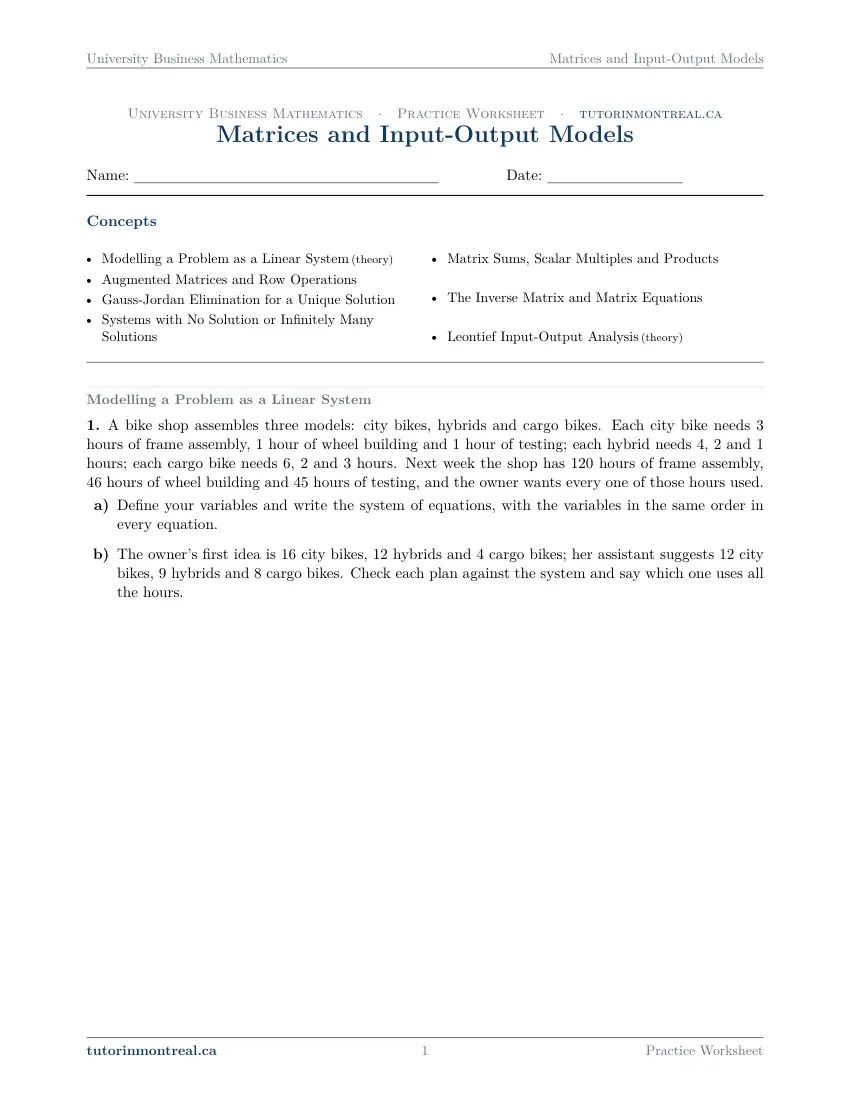
Practice worksheet — free PDF
No email, no account, no watermark. Teachers: photocopy it for your classes freely. Worked solutions and 8 harder problems come with the University Business Math bundle.
All 13 questions
Each question targets one named concept from the sheet. Read them here, or print the PDF — it has working space under each one.
-
Q1Modelling a Problem as a Linear System
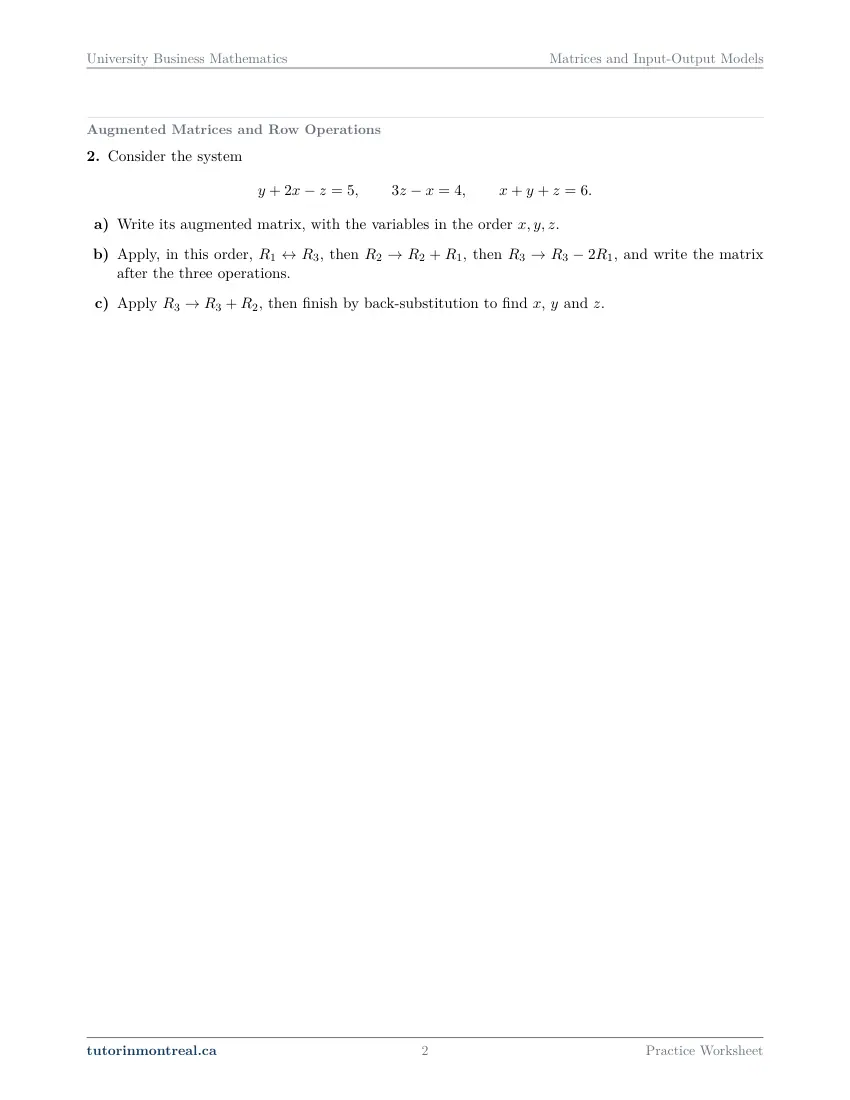
A bike shop assembles three models: city bikes, hybrids and cargo bikes. Each city bike needs hours of frame assembly, hour of wheel building and hour of testing; each hybrid needs , and hours; each cargo bike needs , and hours. Next week the shop has hours of frame assembly, hours of wheel building and hours of testing, and the owner wants every one of those hours used.
- Define your variables and write the system of equations, with the variables in the same order in every equation.
- The owner's first idea is city bikes, hybrids and cargo bikes; her assistant suggests city bikes, hybrids and cargo bikes. Check each plan against the system and say which one uses all the hours.
-
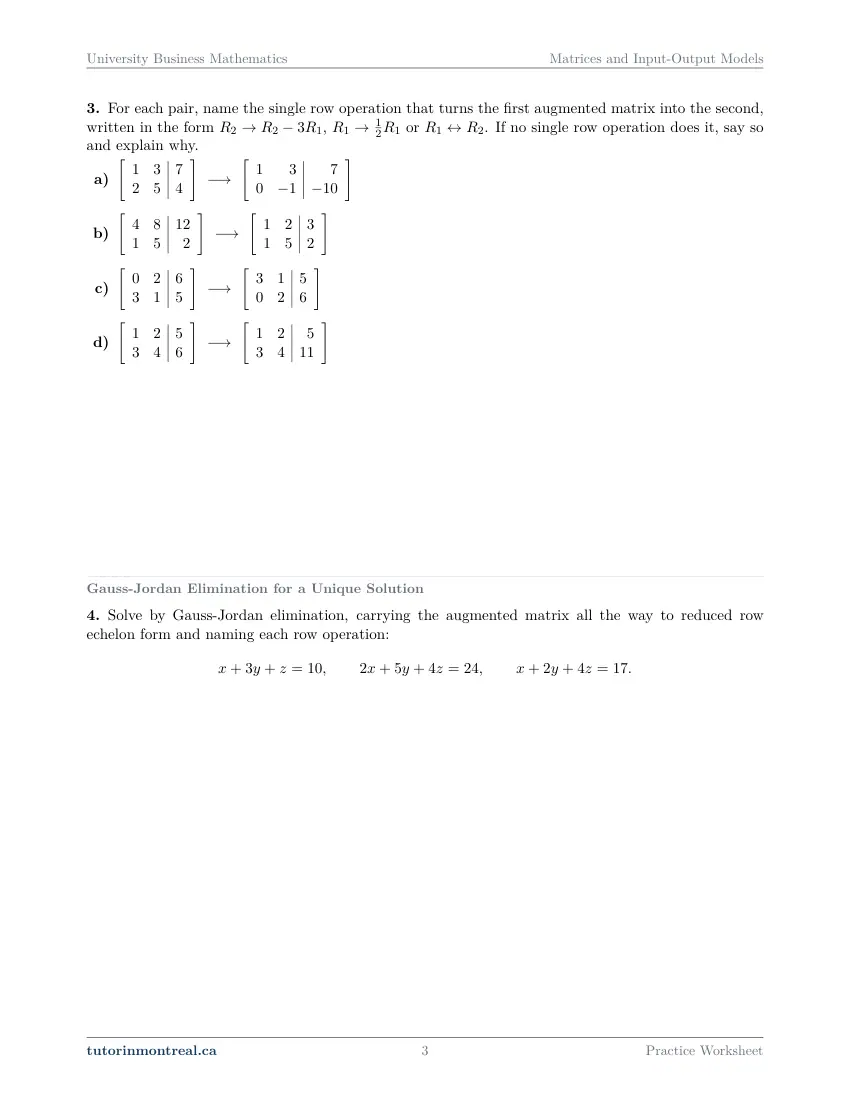
Q2Augmented Matrices and Row Operations
Consider the system
- Write its augmented matrix, with the variables in the order .
- Apply, in this order, , then , then , and write the matrix after the three operations.
- Apply , then finish by back-substitution to find , and .
-
Q3Augmented Matrices and Row Operations
For each pair, name the single row operation that turns the first augmented matrix into the second, written in the form , or . If no single row operation does it, say so and explain why.
-
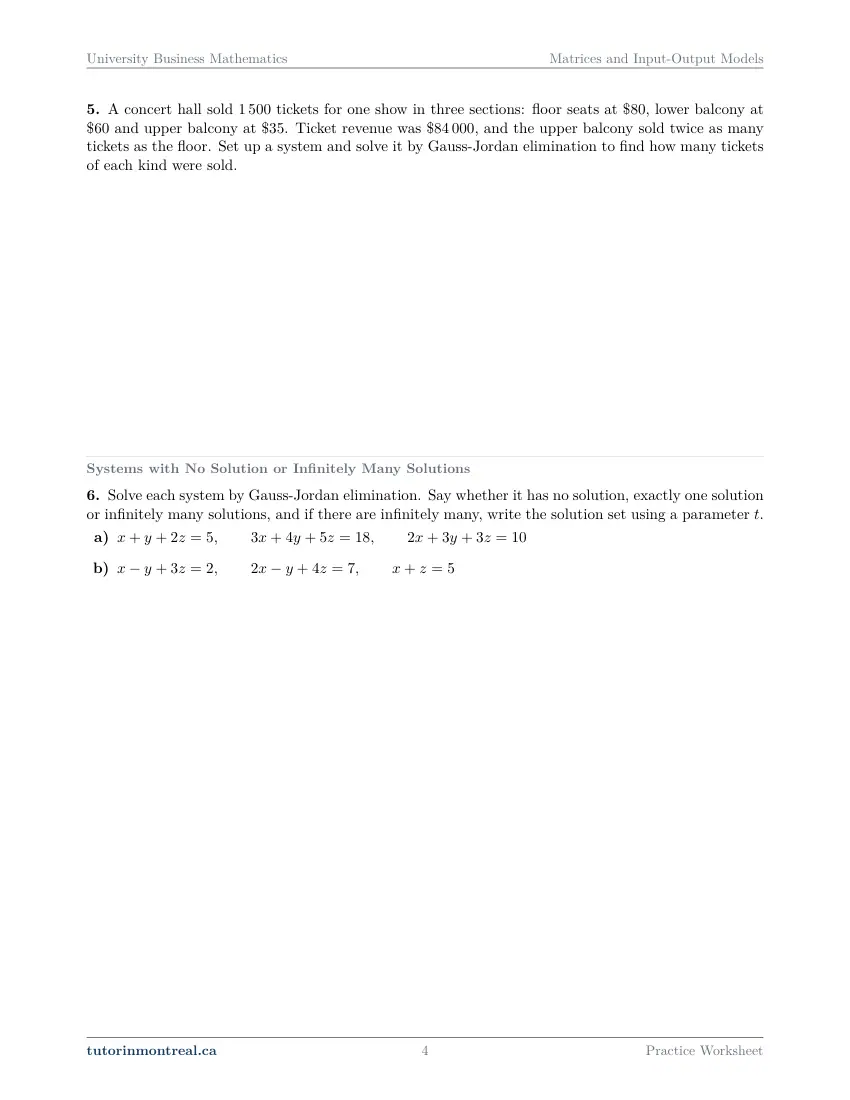
Q4Gauss-Jordan Elimination for a Unique Solution
Solve by Gauss-Jordan elimination, carrying the augmented matrix all the way to reduced row echelon form and naming each row operation:
-
Q5Gauss-Jordan Elimination for a Unique Solution
A concert hall sold tickets for one show in three sections: floor seats at $80, lower balcony at $60 and upper balcony at $35. Ticket revenue was $84 000, and the upper balcony sold twice as many tickets as the floor. Set up a system and solve it by Gauss-Jordan elimination to find how many tickets of each kind were sold.
-
Q6Systems with No Solution or Infinitely Many Solutions
Solve each system by Gauss-Jordan elimination. Say whether it has no solution, exactly one solution or infinitely many solutions, and if there are infinitely many, write the solution set using a parameter .
-
Q7Systems with No Solution or Infinitely Many Solutions
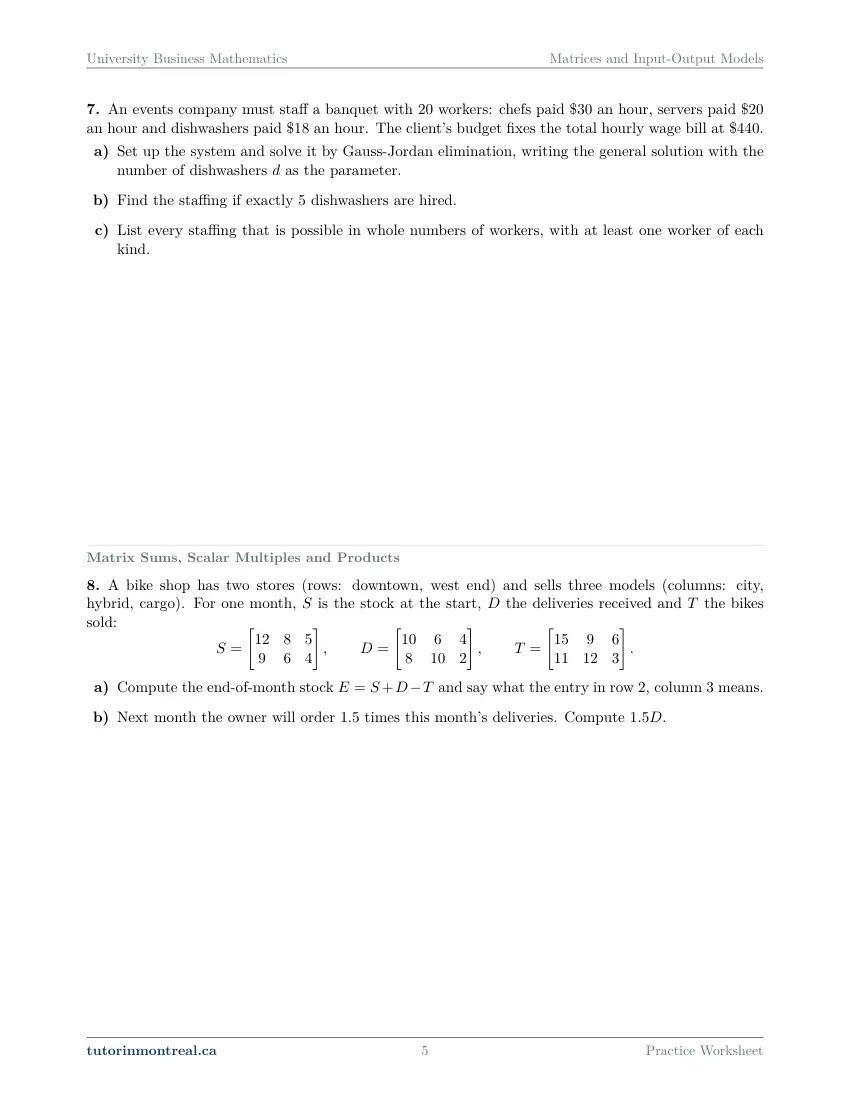
An events company must staff a banquet with workers: chefs paid $30 an hour, servers paid $20 an hour and dishwashers paid $18 an hour. The client's budget fixes the total hourly wage bill at $440.
- Set up the system and solve it by Gauss-Jordan elimination, writing the general solution with the number of dishwashers as the parameter.
- Find the staffing if exactly dishwashers are hired.
- List every staffing that is possible in whole numbers of workers, with at least one worker of each kind.
-
Q8Matrix Sums, Scalar Multiples and Products
A bike shop has two stores (rows: downtown, west end) and sells three models (columns: city, hybrid, cargo). For one month, is the stock at the start, the deliveries received and the bikes sold:
- Compute the end-of-month stock and say what the entry in row 2, column 3 means.
- Next month the owner will order times this month's deliveries. Compute .
-
Q9Matrix Sums, Scalar Multiples and Products
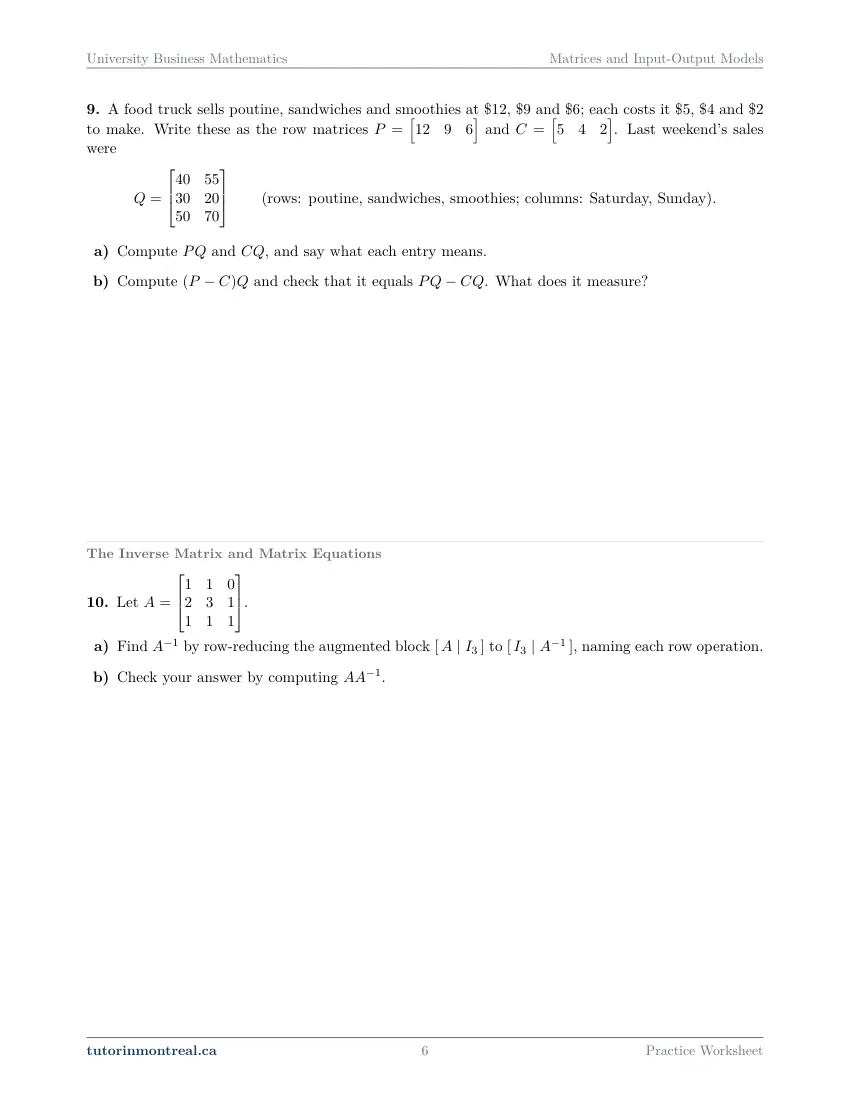
A food truck sells poutine, sandwiches and smoothies at $12, $9 and $6; each costs it $5, $4 and $2 to make. Write these as the row matrices and . Last weekend's sales were
- Compute and , and say what each entry means.
- Compute and check that it equals . What does it measure?
-
Q10The Inverse Matrix and Matrix Equations
Let .
- Find by row-reducing the augmented block to , naming each row operation.
- Check your answer by computing .
-
Q11The Inverse Matrix and Matrix Equations
A sign shop makes two products: banners and vinyl decals. Each banner needs hours of design and hour of printing; each decal order needs hours of design and hours of printing. With banners and decal orders, the hours used are , where For a matrix, if then .
- Find .
- In week 1 the shop has design hours and printing hours; in week 2, and . Use to find the production that uses all the hours in each week.
-
Q12Leontief Input-Output Analysis
A regional economy has two sectors, farming and food processing. Its technology matrix is where column lists the dollar value of each sector's output used up in producing $1 of sector 's output. If is the total output and the final (outside) demand, both in millions of dollars, then , that is .
- Say in one sentence what the entry means.
- Find the total output of each sector needed to meet a final demand of .
-
Q13Synthesis — drawing on several topics in this unit
A bakery makes batches of bread, croissants and cookies. The flour, butter and sugar (in kg) that one batch of each uses are the columns of Its stock is kg of flour, butter and sugar.
- The manager plans batches of bread, of croissants and of cookies. Compute the ingredients this uses and the stock left over.
- Find, by Gauss-Jordan elimination, the numbers of batches that would use the whole stock exactly.
The 8 challenge problems for this topic are a separate, paid sheet and are not reproduced here.
What does this set assume? This set assumes Secondary 5 mathematics only: solving a system of two linear equations by substitution or elimination, working with decimals and fractions without a slip, and reading a word problem for its unknowns. From Functions for Business Models it borrows nothing but the habit of naming a variable with its units; no calculus is needed, and none of Mathematics of Finance. Systems are solved here by row reduction and by the inverse only, at sizes up to three equations in three unknowns. Determinants, Cramer's rule, rank, linear independence and vectors are deliberately not part of this course — the one appearance of the quantity ad − bc is inside a formula the question hands you. Readers who need determinants or Cramer's rule will find them in the CEGEP Linear Algebra sets Determinants and The Inverse of a Matrix. The Leontief model is the open one, solved as a linear system; there is no closed model and nothing about eigenvectors. The next set, Linear Inequalities and Linear Programming, reuses the modelling habits built here.
Which course is this for? In the public course calendars of Montreal universities, this material is part of the courses numbered MATH 123, MATH 208 and MATH 10601. Each course orders and weights the topics its own way, so check your own outline for what your exam covers. Which sets match your course.
How to do every concept on this sheet
This is the part worksheet sites usually leave out. Below is the actual reasoning behind each group of questions — not a full solution set, the decisions that get you to one. Read it before you start, or after you get stuck.
Modelling a problem as a linear system
Every question on this sheet that wears a business context starts the same way: decide what the unknowns are, give each a letter and a unit, and write one equation for each resource or condition the problem fixes. Q1 is that step on its own. Three bike models share three workshops, and every workshop's hours must be used exactly, so each workshop gives one equation: hours per bike of each model, times the number of bikes of that model, summed, equals the hours available.
Same order, every equation. Q1(a) asks for the variables in the same order in every equation, and that is not tidiness for its own sake: the moment the system becomes a matrix, the column a number sits in is the only thing that says which variable it belongs to. A table with one row per resource and one column per product, filled in before you write any equation, makes the order automatic.
Q1(b) then gives two candidate plans and asks which uses all the hours. Checking a plan means substituting it into every equation. A plan that satisfies two of the three is not a solution — it leaves some workshop idle or over-booked — so write out all three checks for both plans before you give a verdict.
Augmented matrices and the three row operations
An augmented matrix is the system with the letters stripped out: one row per equation, one column per variable, and a last column, after the bar, for the constants. Q2 starts from a system whose equations are written with the terms in scrambled order and with a variable missing from one of them, which is exactly where transcription goes wrong.
From equations to matrix
Three checks before any row operation.
- 1Rearrange each equation
Variables on the left in the order x, y, z; the constant alone on the right.
- 2Write the zeros
A variable that does not appear in an equation has coefficient 0, and the 0 goes in its column.
- 3Carry the signs
A term like −x in the middle of an equation puts −1, not 1, in the x column.
The three operations are the only moves allowed: swap two rows (R₁ ↔ R₃), multiply a row by a nonzero number (R₁ → ½R₁), and replace a row by itself plus a multiple of another row (R₂ → R₂ − 3R₁). None of them changes the solutions of the system. Q2(b) and (c) give you the operations in order and ask you to carry them out; apply each one to the matrix the previous one produced, not to the original, and finish with back-substitution from the last row up.
Q3 runs the idea backwards: given a before-and-after pair, name the operation. Compare the two matrices row by row. If one row is unchanged and the other changed, the changed row was either scaled or had a multiple of the unchanged row added to it — and a scaling multiplies every entry of the row by the same number, while an addition shifts each entry by a multiple of the matching entry in the other row. If both rows moved, look for a swap.
Not every pair is one operation apart. Q3 allows the answer "no single row operation does it", with a reason. The reason has to come from the definitions: show which of the three kinds of operation could produce the change, and why the entries of the new row are not consistent with it. Two rows that look similar are not enough.
Gauss-Jordan elimination for a unique solution
Gauss-Jordan elimination is row reduction with a fixed plan, carried past echelon form until the coefficient part is the identity matrix. Then the last column simply reads off the solution.
Reduced row echelon form, column by column
Work on one column at a time, left to right.
- 1Get a leading 1
In the current column, put a 1 in the pivot position — by a swap if a row below already has one, otherwise by scaling.
- 2Clear the column
Use row replacement to make every other entry of that column 0, above the pivot as well as below it.
- 3Move right and down
Repeat for the next column, never touching the columns already finished.
- 4Read and check
Read x, y, z from the last column, then substitute them into the original equations.
Q4 is the method on a bare system, and it asks you to name each row operation. That record is worth the time: it is how a marker gives part marks, and it is how you find your own slip. Q5 puts the same method inside a ticket-sales problem. Three unknowns need three equations, and the problem supplies them in three different shapes — a total count, a total revenue, and a comparison between two sections.
A comparison is an equation too. "One quantity is twice another" becomes an equation with a zero on the right once everything is moved to the left, in the same variable order as the other two. Write it that way before building the matrix, and the ticket prices, given in dollars, become the coefficients of the revenue equation.
Systems with no solution or infinitely many solutions
Row reduction does not always end at the identity. What the last rows look like tells you which of the three cases you are in, and Q6 asks you to decide for two systems that look equally ordinary before you start.
Reading the reduced matrix. A row of the form [0 0 0 | c] with c ≠ 0 says 0 = c: no solution, whatever the other rows say. A row that is entirely zero says 0 = 0 and carries no information, which leaves fewer equations than unknowns; if no contradictory row appears, the system has infinitely many solutions. A pivot in every variable column means exactly one solution.
When there are infinitely many, the variable whose column has no pivot is free. Set it equal to the parameter t, then use each nonzero row to write a pivot variable in terms of t. The solution set is the list of all three variables as expressions in t, and substituting any value of t back into the original system is the check.
Q7 is the business version. Twenty workers and a fixed hourly wage bill give two equations for three kinds of worker, so the elimination cannot end with a unique answer, and part (a) names the free variable for you: the number of dishwashers, d. Part (b) is one substitution into the general solution. Part (c) is where the context takes over from the algebra.
The parameter is not free in the real problem. Workers come in whole numbers, and Q7(c) asks for at least one of each kind. Each of those conditions, applied to the expression for chefs, for servers and for dishwashers, is an inequality in d. Solve all of them together, then keep only whole values of d, and check that each staffing it gives really is whole.
Matrix sums, scalar multiples and products
Adding or subtracting matrices works entry by entry and needs matrices of the same size; a scalar multiple multiplies every entry. In Q8 the rows are stores and the columns are bike models in all three matrices, so an entry of S + D − T combines stock, deliveries and sales for one store and one model. Part (a) asks what one entry of the result means: say it with its row label, its column label and the time it refers to. Part (b) is the scalar multiple: every entry of D is multiplied by the same number, and the result keeps the rows and columns of D.
(m × n) times (n × p) gives (m × p)A product is defined only when the inside sizes match, and each entry is a row of the left matrix times a column of the right one: multiply matching entries and add. Q9 uses a one-row price matrix and a one-row cost matrix against a sales matrix whose rows are products and whose columns are days.
Units tell you what a product means. A row-times-column entry sums (amount per item) × (items) over the products, so its unit is the row's unit times the column's unit, and its label is the column of the right-hand matrix. Q9(a) asks for exactly that reading. In Q9(b), compute (P − C)Q directly, compute PQ − CQ from part (a), and compare; the agreement is the distributive law, and what the entries measure follows from what one entry of P − C means for a single item.
Order matters. PQ and QP are different products, and usually only one of them is even defined. Check the sizes before you multiply, every time.
The inverse matrix and matrix equations
A square matrix A has an inverse A⁻¹ when AA⁻¹ = A⁻¹A = I. The way to find one here is row reduction: put A beside the identity and row-reduce the whole block until the left half is I.
[ A | I ] → row operations → [ I | A⁻¹ ]Q10 asks for that on a 3 × 3 matrix, naming each operation, and then for the check AA⁻¹ = I. Every operation acts on all six columns of the block at once; the most common mistake is to reduce the left half and forget to apply the same move to the right half. If the left half ever produces a row of zeros, there is no inverse, and the method tells you so on its own.
Q11 shows why an inverse is worth having. The shop's hours used are AX, so a production plan that uses all the hours solves AX = B. Multiplying both sides on the left by A⁻¹ gives X = A⁻¹B. Part (a) is the 2 × 2 formula printed in the question: check that ad − bc is not zero, swap the diagonal entries, change the signs of the other two, and divide by ad − bc. Part (b) has two different weeks with the same A, and that is the point of the question — once A⁻¹ is known, each week is one matrix product rather than a new elimination.
A⁻¹B, not BA⁻¹. The inverse must multiply on the same side A was on. With B a column, the product in the wrong order is not even defined, which is a useful alarm.
Leontief input-output analysis
An economy's sectors use one another's output to produce their own. The technology matrix M records that: column j lists how many dollars of each sector's output are used up in making one dollar of sector j's output. So a column belongs to the sector doing the consuming, and a row to the sector doing the supplying.
Reading an entry. Find its column first — that is the sector producing one dollar of output — then its row, the sector supplying the input. Q12(a) asks for one sentence about one entry; a sentence that names both sectors, says which one is buying, and keeps the "per dollar of output" is the whole answer.
Total output X has to cover two uses: what the sectors consume from each other, MX, and the final demand D from outside. That balance is X = MX + D, which rearranges to (I − M)X = D. Q12(b) is then a linear system. Form I − M by subtracting each entry of M from the identity — the diagonal becomes one minus the entry, the off-diagonal entries change sign — and solve, either by the 2 × 2 inverse formula from Q11 or by Gauss-Jordan elimination.
Sense-check the output. Every sector must produce at least its own final demand, because some of its output is used up inside the economy. A total output smaller than the demand it serves means a sign has gone wrong in I − M. Keep the units in mind too: D is in millions of dollars, so X is as well.
The synthesis question
Q13 uses both halves of the set on one bakery. The columns of A are recipes, so A times a column of batch counts is a column of ingredients used. Part (a) is that product for the manager's plan, followed by a subtraction from the stock B, and each entry of the leftover column should be stated in kilograms of a named ingredient. Part (b) asks for the batches that use the stock exactly, which is the system AX = B, solved by Gauss-Jordan elimination on the augmented matrix [A | B]. Before you trust the answer, ask whether it makes sense as batches of baking, and check it by multiplying A by it.
Preview all 9 pages
Click any page to open the full PDF.
Getting the most out of it
Build the table before the equations
For every word problem, draw a small grid — resources down the side, products across the top — and fill it from the text. The equations, the augmented matrix and the matrix product all come straight off that grid, in the same order.
Name every row operation
Write R₂ → R₂ − 2R₁ beside the matrix it produced. It costs seconds, it is what earns part marks, and it lets you find the one line where an arithmetic slip crept in instead of starting over.
Check by substitution or by multiplication
A solution goes back into the original equations; an inverse is multiplied by the matrix it came from. Both checks are faster than the work they verify, and an elimination answer is never finished without one.
Say what every entry means
Whenever a matrix is the answer, pick one entry and say what it measures, with units and labels. If you cannot, the product was probably taken in the wrong order or the matrices were set up with rows and columns swapped.
Want the solutions, or something more challenging?
The worksheet, the questions above and every explanation on this page stay free permanently. Three more PDFs exist for this topic — the worked answer key, a harder problem set, and the answer key to that. They come with the University Business Math Solutions Bundle, beside the unit notes and the unit test, which is what keeps the rest of the series free.
What else exists for Matrices and Input-Output Models
Three PDFs · 16 pages · all three are in the bundle below.
- Answer key — 4 pages. All 13 questions worked step by step, including the restrictions and the justifications. Not a list of final answers.
- Challenge problems — 8 pages, 8 problems. A separate sheet at exam-plus difficulty covering the same 7 concepts. Harder than anything on the free sheet.
- Challenge answer key — 4 pages. Every challenge problem worked to the same standard, with the checks shown.
- PDF, letter size, print-ready.
The one thing that's for sale
Every University Business Math topic — the complete Solutions Bundle
One download, one payment, the whole program. For all 9 University Business Math units: the worksheet, the reference notes, the challenge set, the unit test and every answer key — including this one.
- Worked solutions, not answer lists — every step written out
- Covers the whole year's program at this level
- Less than the price of one hour of tutoring — for the entire year's solutions
Taking Secondary 1 Math as well? The Secondary 1 Math bundle covers all 15 of its units — 106 PDFs, 474 pages — on the same terms.
Taking Secondary 2 Math as well? The Secondary 2 Math bundle covers all 14 of its units — 98 PDFs, 449 pages — on the same terms.
Taking Secondary 3 Math as well? The Secondary 3 Math bundle covers all 11 of its units — 77 PDFs, 367 pages — on the same terms.
Taking Secondary 4 Math as well? The Secondary 4 Math bundle covers all 17 of its units — 122 PDFs, 466 pages — on the same terms.
Taking Secondary 5 Math as well? The Secondary 5 Math bundle covers all 21 of its units — 147 PDFs, 589 pages — on the same terms.
Taking CEGEP Calculus I as well? The CEGEP Calculus I bundle covers all 9 of its units — 72 PDFs, 371 pages — on the same terms.
Taking CEGEP Calculus II as well? The CEGEP Calculus II bundle covers all 8 of its units — 64 PDFs, 335 pages — on the same terms.
Taking CEGEP Linear Algebra as well? The CEGEP Linear Algebra bundle covers all 7 of its units — 56 PDFs, 298 pages — on the same terms.
Taking University Calculus III as well? The University Calculus III bundle covers all 9 of its units — 72 PDFs, 516 pages — on the same terms.
Taking University Linear Algebra as well? The University Linear Algebra bundle covers all 9 of its units — 72 PDFs, 496 pages — on the same terms.
Taking University Differential Equations as well? The University Differential Equations bundle covers all 9 of its units — 36 PDFs, 182 pages — on the same terms.
Taking University Introductory Statistics as well? The University Introductory Statistics bundle covers all 9 of its units — 36 PDFs, 186 pages — on the same terms.
Taking University Discrete Math as well? The University Discrete Math bundle covers all 9 of its units — 36 PDFs, 155 pages — on the same terms.
Taking AP Calculus AB as well? The AP Calculus AB bundle covers all 8 of its units — 64 PDFs, 527 pages — on the same terms.
Common questions
Is this worksheet really free?
Yes — the questions are on this page to read, and the PDF downloads directly, no email and no account. The one paid item is optional: the complete University Business Mathematics Solutions Bundle, which covers every set at this level.
Which university courses is this for?
The course codes listed on this page are taken from the public course calendars of universities that teach mathematics to management and commerce students. Each course orders and weights the chapters its own way, and some reach a chapter later or not at all — so check the outline for your own section to see where this set falls in your term.
What do I need to know before starting this set?
Secondary 5 mathematics: solving two linear equations in two unknowns, and confident arithmetic with fractions and decimals. No calculus and nothing from the finance set is used.
Do I need determinants or Cramer's rule for this set?
No. This course solves systems by Gauss-Jordan elimination and by the inverse matrix. The only place the quantity ad − bc appears is inside the 2 × 2 inverse formula, which the question gives you. Determinants and Cramer's rule are covered in the CEGEP Linear Algebra sets.
What is the difference between Gaussian and Gauss-Jordan elimination?
Gaussian elimination stops at row echelon form, with zeros below each pivot, and finishes by back-substitution. Gauss-Jordan keeps going until every pivot is 1 with zeros above and below it, so the solution can be read straight from the last column. This set asks for Gauss-Jordan unless a question says otherwise.
How do I know whether a system has no solution or infinitely many?
Reduce the augmented matrix and look at its rows. A row with zeros in every coefficient column and a nonzero constant is a contradiction, so there is no solution. Otherwise, if some variable column has no pivot, that variable is free and there are infinitely many solutions.
Why does the order of matrix multiplication matter?
Each entry of AB is a row of A times a column of B, so swapping the factors pairs different rows with different columns — and often the swapped product is not even defined because the sizes no longer match. Checking the sizes first settles which order makes sense.
Can teachers use this in class?
Yes. Print and photocopy it for your own classes freely — I just ask that the tutorinmontreal.ca footer stays on the page.
I'm stuck on one question. Can you help?
Yes — through one-on-one tutoring, in Montreal or online. Get in touch to arrange a session, or see the current rates.
← All 9 University Business Math worksheets · Secondary 1 Math series (15 sheets) → · Secondary 2 Math series (14 sheets) → · Secondary 3 Math series (11 sheets) → · Secondary 4 Math series (17 sheets) → · Secondary 5 Math series (21 sheets) → · CEGEP Calculus I series (9 sheets) → · CEGEP Calculus II series (8 sheets) → · CEGEP Linear Algebra series (7 sheets) → · University Calculus III series (9 sheets) → · University Linear Algebra series (9 sheets) → · University Differential Equations series (9 sheets) → · University Introductory Statistics series (9 sheets) → · University Discrete Math series (9 sheets) → · AP Calculus AB series (8 sheets) →