University Business Mathematics — Differentiation Techniques and Elasticity Worksheet
The second half of the derivative toolkit, and the business question it was built to answer. Derivatives of exponential and logarithmic functions; the product and quotient rules; the chain rule with powers, exponentials and logarithms; implicit differentiation of a demand relation; related rates of price, sales and revenue over time; and the relative rate of change, which becomes elasticity of demand and the test for what a price change does to revenue. A closing question puts the rules and the elasticity test together on one demand function. Have a look on this page, then print the free PDF when you want to write on it.
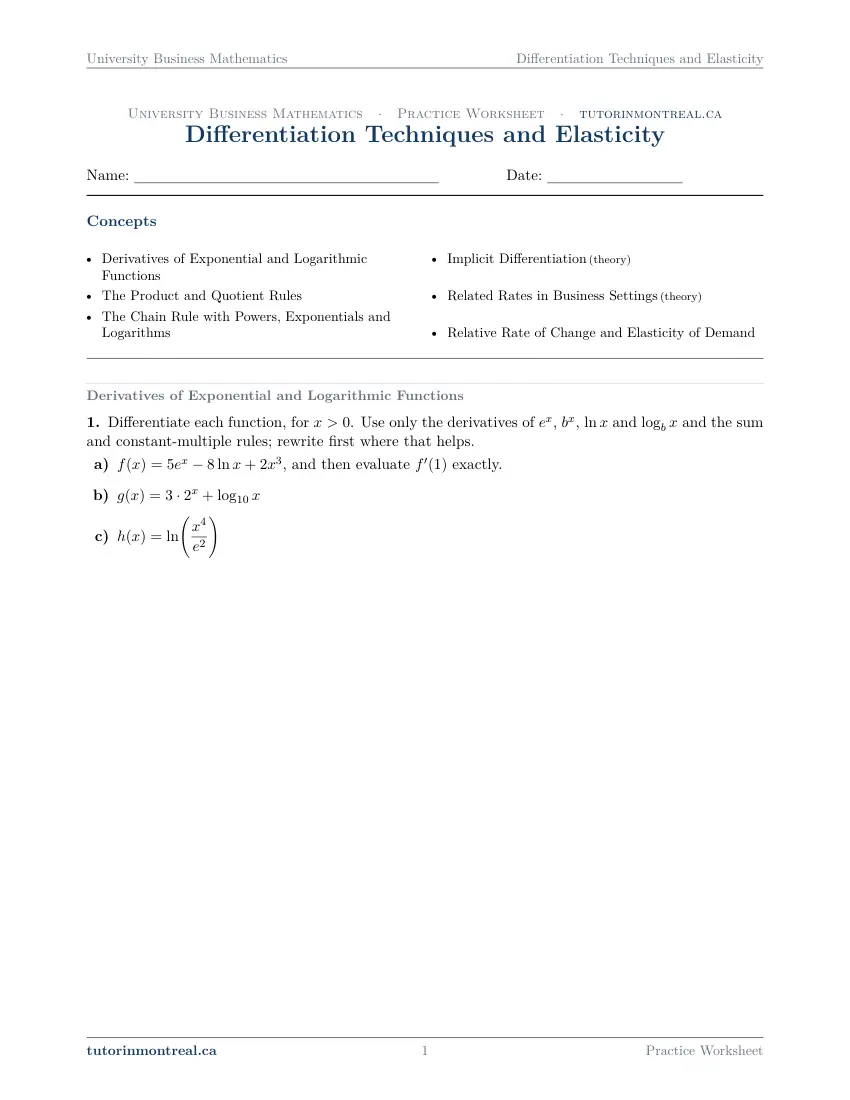
Practice worksheet — free PDF
No email, no account, no watermark. Teachers: photocopy it for your classes freely. Worked solutions and 7 harder problems come with the University Business Math bundle.
All 11 questions
Each question targets one named concept from the sheet. Read them here, or print the PDF — it has working space under each one.
-
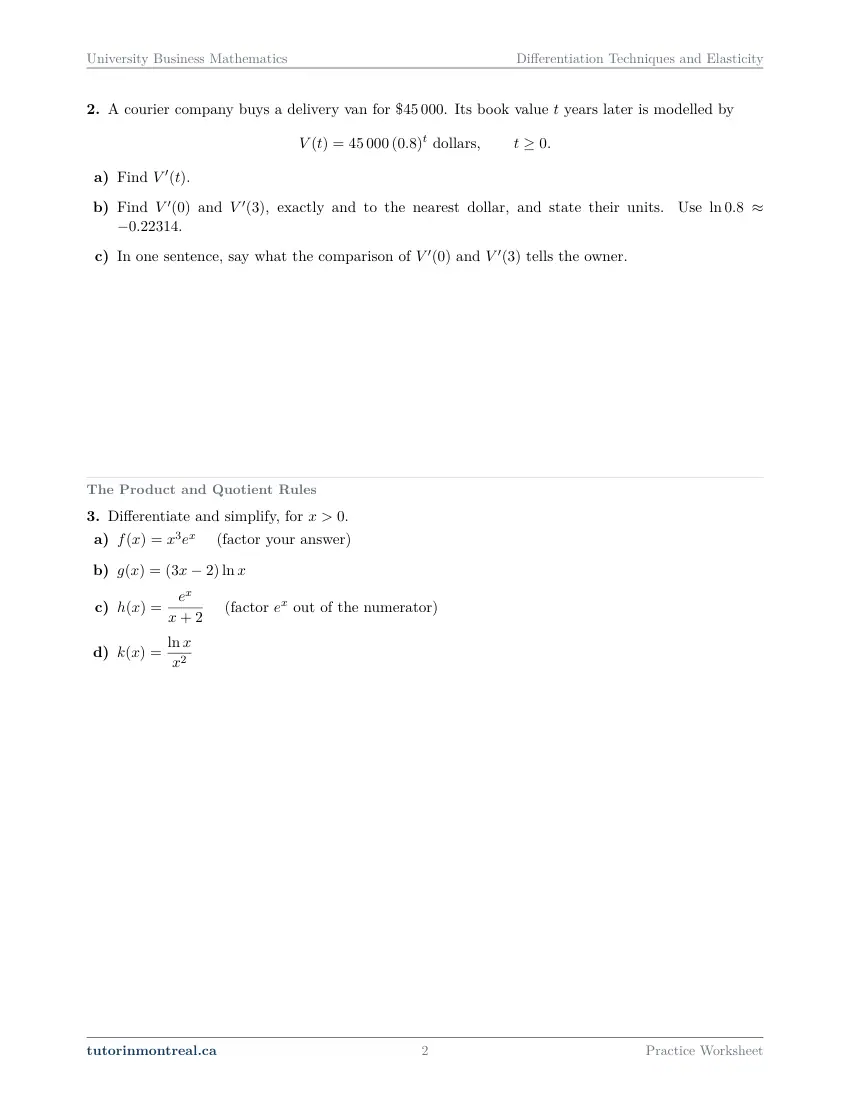
Q1Derivatives of Exponential and Logarithmic Functions
Differentiate each function, for . Use only the derivatives of , , and and the sum and constant-multiple rules; rewrite first where that helps.
- , and then evaluate exactly.
-
Q2Derivatives of Exponential and Logarithmic Functions
A courier company buys a delivery van for $45 000. Its book value years later is modelled by
- Find .
- Find and , exactly and to the nearest dollar, and state their units. Use .
- In one sentence, say what the comparison of and tells the owner.
-
Q3The Product and Quotient Rules
Differentiate and simplify, for .
- (factor your answer)
- (factor out of the numerator)
-
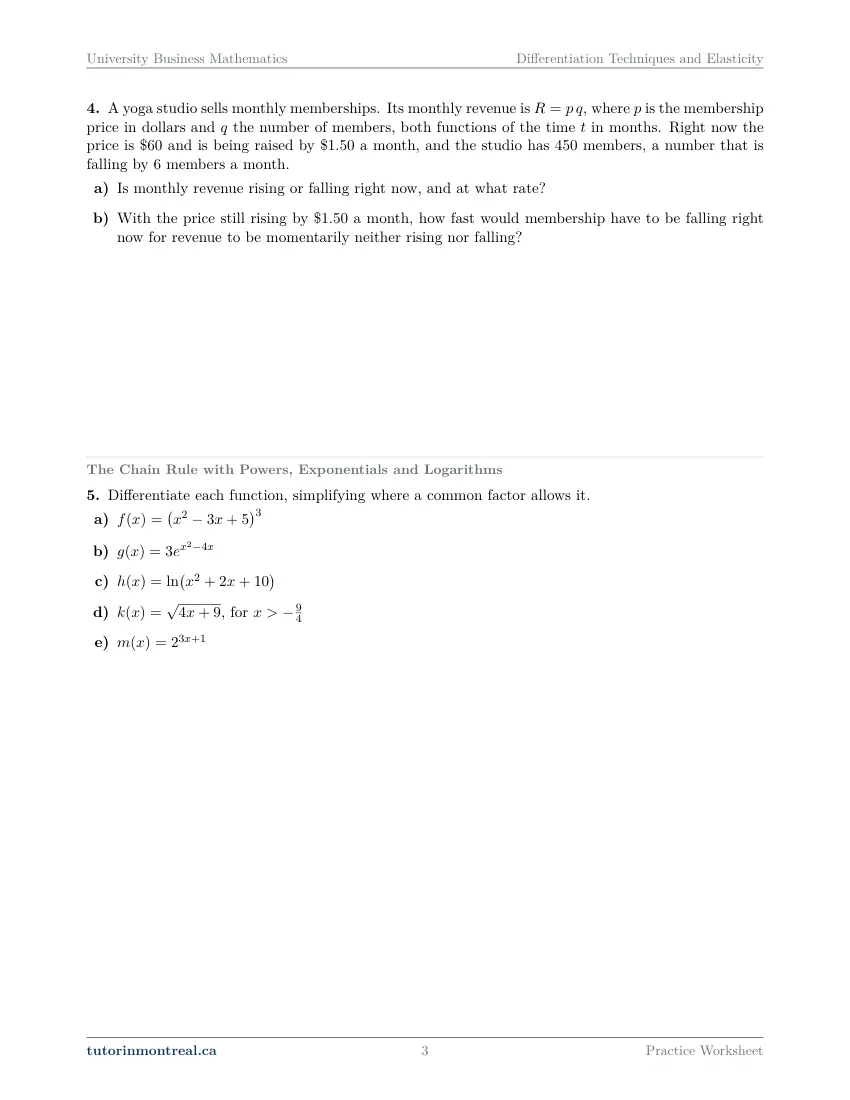
Q4The Product and Quotient Rules
A yoga studio sells monthly memberships. Its monthly revenue is , where is the membership price in dollars and the number of members, both functions of the time in months. Right now the price is $60 and is being raised by $1.50 a month, and the studio has members, a number that is falling by members a month.
- Is monthly revenue rising or falling right now, and at what rate?
- With the price still rising by $1.50 a month, how fast would membership have to be falling right now for revenue to be momentarily neither rising nor falling?
-
Q5The Chain Rule with Powers, Exponentials and Logarithms
Differentiate each function, simplifying where a common factor allows it.
- , for
-
Q6The Chain Rule with Powers, Exponentials and Logarithms
A maker of board games finds that to sell copies a week it must set the price
- Find exactly and to four decimal places, with units, using .
- Write the weekly revenue and show that .
- Find and exactly and to the cent, using and , and say what the sign of each tells the maker.
-
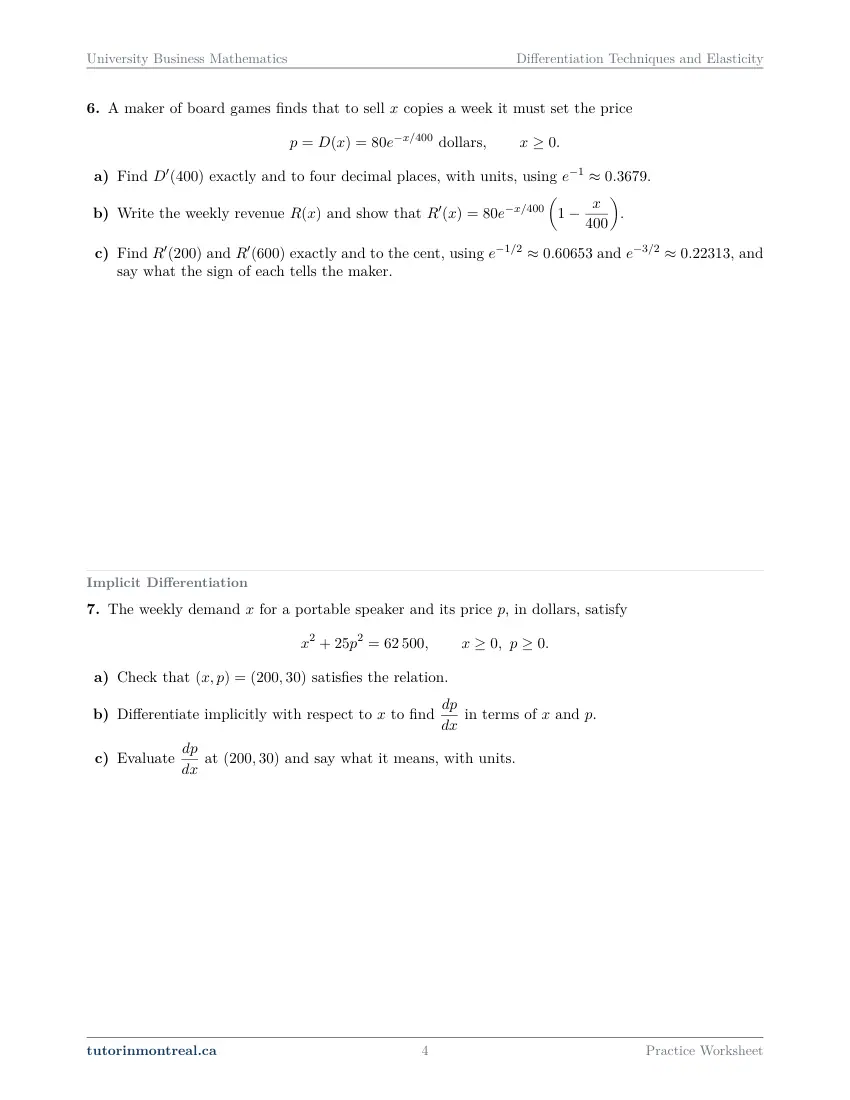
Q7Implicit Differentiation
The weekly demand for a portable speaker and its price , in dollars, satisfy
- Check that satisfies the relation.
- Differentiate implicitly with respect to to find in terms of and .
- Evaluate at and say what it means, with units.
-
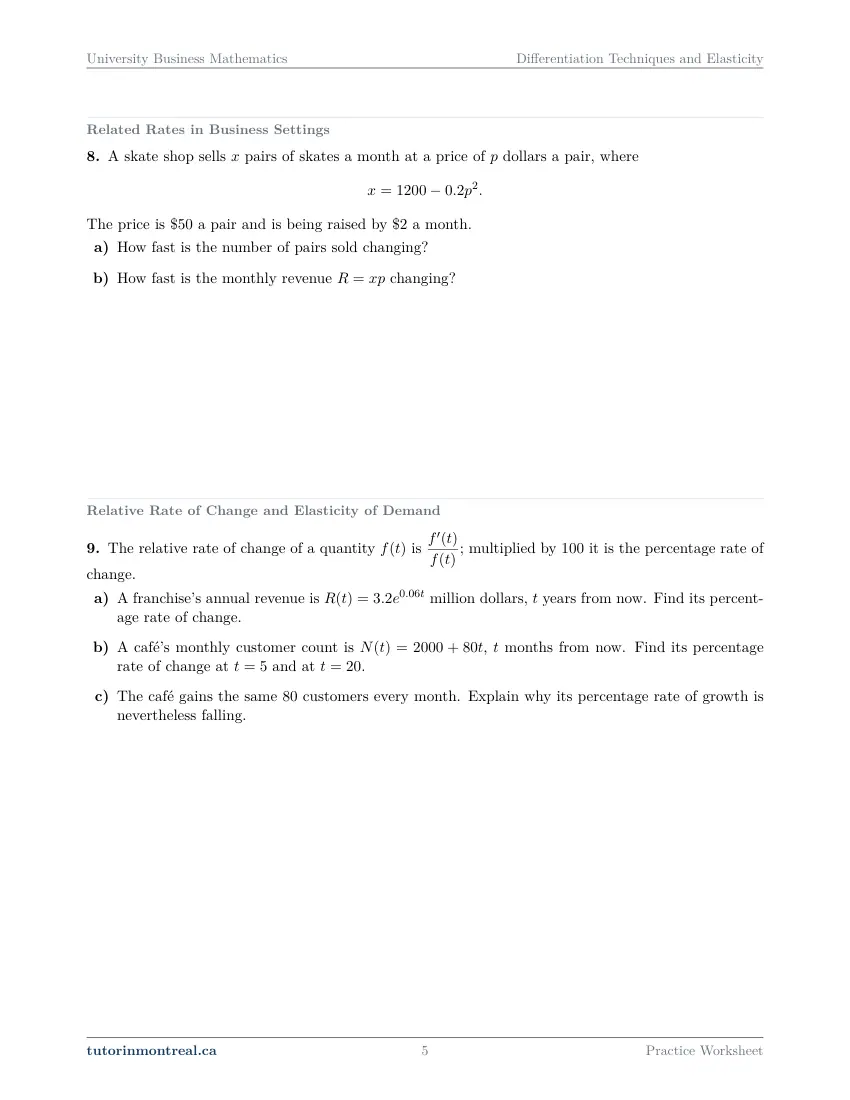
Q8Related Rates in Business Settings
A skate shop sells pairs of skates a month at a price of dollars a pair, where The price is $50 a pair and is being raised by $2 a month.
- How fast is the number of pairs sold changing?
- How fast is the monthly revenue changing?
-
Q9Relative Rate of Change and Elasticity of Demand
The relative rate of change of a quantity is ; multiplied by it is the percentage rate of change.
- A franchise's annual revenue is million dollars, years from now. Find its percentage rate of change.
- A café's monthly customer count is , months from now. Find its percentage rate of change at and at .
- The café gains the same customers every month. Explain why its percentage rate of growth is nevertheless falling.
-
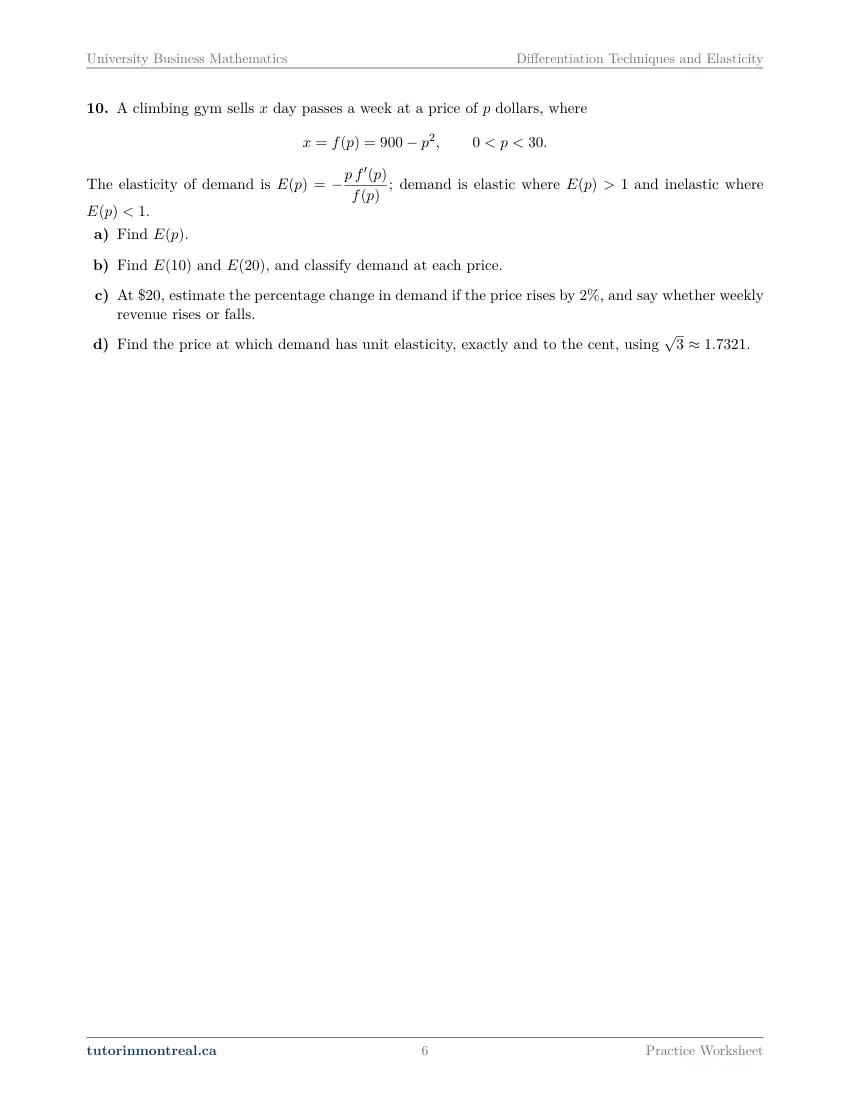
Q10Relative Rate of Change and Elasticity of Demand
A climbing gym sells day passes a week at a price of dollars, where The elasticity of demand is ; demand is elastic where and inelastic where .
- Find .
- Find and , and classify demand at each price.
- At $20, estimate the percentage change in demand if the price rises by , and say whether weekly revenue rises or falls.
- Find the price at which demand has unit elasticity, exactly and to the cent, using .
-
Q11Synthesis — drawing on several topics in this unit
A meal-kit company sells boxes a week at a price of dollars a box, where The elasticity of demand is .
- Find .
- Show that .
- Classify demand at $10 and at $40, and say for each whether a small price increase raises or lowers weekly revenue.
- Find the price at which demand has unit elasticity, and the number of boxes sold there.
The 7 challenge problems for this topic are a separate, paid sheet and are not reproduced here.
What does this set assume? This is a first calculus course, running beside the CEGEP calculus courses rather than after them, and this set is its second chapter of derivatives. It leans on the previous set, Limits, Derivatives and Marginal Analysis — the derivative as a rate, the first differentiation rules for powers, sums and constant multiples, and the marginal reading of a derivative — and on Functions for Business Models for the exponential and logarithmic functions, the laws of logarithms, and the demand and revenue models that return here. Beyond that it needs only Secondary 5 functions and the exponent and logarithm laws. There is no trigonometry anywhere in the course, and no logarithmic differentiation, no differentials and no L'Hospital's rule; related rates are rates of price, sales and revenue, never ladders or cones. Using a derivative to locate a maximum is the next set, Curve Analysis and Business Optimization — here a derivative is computed, evaluated and read, and elasticity is worked from its defining formula.
Which course is this for? In the public course calendars of Montreal universities, this material is part of the courses numbered MATH 122, MATH 209 and MATH 10600. Each course orders and weights the topics its own way, so check your own outline for what your exam covers. Which sets match your course.
How to do every concept on this sheet
This is the part worksheet sites usually leave out. Below is the actual reasoning behind each group of questions — not a full solution set, the decisions that get you to one. Read it before you start, or after you get stuck.
Derivatives of exponential and logarithmic functions
Four new formulas carry the whole first sheet. The natural pair is the simplest: eˣ is its own derivative, and ln x differentiates to 1/x. Any other base brings in its natural logarithm, as a factor for the exponential and as a divisor for the logarithm.
(eˣ)′ = eˣ (bˣ)′ = bˣ ln b (ln x)′ = 1/x (base-b log of x)′ = 1/(x ln b)Q1 restricts you to those four formulas and the sum and constant-multiple rules, which is why it says to rewrite first. Part (a) mixes an exponential, a logarithm and a power, then asks for f′(1) exactly — so keep e and ln 1 as symbols until the last line and simplify them there. Part (b) is the other-base pair. Part (c) looks like it needs a rule this sheet has not given you; it does not.
Simplify the logarithm before you differentiate it. The log of a quotient is a difference of logs, the log of a power brings the exponent down as a factor, and ln of a power of e is just the exponent. Applied first, those laws turn Q1(c) into a sum of terms the four formulas already cover.
Q2 is the first formula in a business setting: a van losing value by a fixed percentage each year, written as a constant times 0.8 to the power t. The derivative is the other-base formula with the constant carried along, and ln 0.8 is given to you. Two points need care. The units of V′(t) are dollars per year — a rate, not a value — and the sign of ln 0.8 tells you before any arithmetic which way the value is moving. Part (c) asks for one sentence comparing the rate at purchase with the rate three years on: say what the comparison means for the owner, in terms of how fast the van is losing value, not just which number is larger.
The product and quotient rules
Neither a product nor a quotient differentiates factor by factor. The product rule keeps one factor and differentiates the other, twice; the quotient rule has a fixed order in its numerator, and that order is where the sign errors come from.
(uv)′ = u′v + uv′ (u/v)′ = (u′v − uv′)/v²Q3 gives two products and two quotients, each built from a power or linear factor and an exponential or logarithm. The instructions are part of the question: (a) asks for a factored answer and (c) tells you to pull eˣ out of the numerator. Both are the same habit — the common factor is what later sets will need when they ask where a derivative is zero. In (b) and (d) the derivative of ln x is 1/x, so expect a term with an x in the denominator and clear it before you call the answer simplified.
Low d-high minus high d-low, and the order matters. Swapping the two terms of the quotient-rule numerator changes the sign of the whole derivative. Write u, v, u′ and v′ in a small table before you assemble anything.
Q4 is the product rule in its most useful business form. Revenue is price times quantity, and both are changing with time, so the rate of change of revenue has two parts: the change in price applied to the current members, and the change in members applied to the current price.
dR/dt = (dp/dt)·q + p·(dq/dt)Put the four numbers the question states into that line, with the correct sign on each rate — a number that is falling has a negative rate. Part (a) asks for the direction as well as the size, and the sign of your result is the direction. Part (b) turns the same equation around: set dR/dt equal to zero, keep the price rate as it was, and solve for the membership rate. Then say it as the question asks, as a speed of falling.
The chain rule with powers, exponentials and logarithms
A composite function is differentiated from the outside in: differentiate the outer function with the inside left alone, then multiply by the derivative of the inside. The general forms below are the four this course uses.
Outer function, then inner derivative
Name the inside u first; the rest follows.
- 1A power of u
(uⁿ)′ = n uⁿ⁻¹ · u′. A square root is the power one half.
- 2e to the u
(eᵘ)′ = eᵘ · u′. The exponential survives unchanged; only the factor is new.
- 3ln of u
(ln u)′ = u′/u. The derivative of the inside sits over the inside itself.
- 4b to the u
(bᵘ)′ = bᵘ ln b · u′. The other-base factor and the chain factor both appear.
Q5 gives one function of each kind plus a square root, and asks you to simplify where a common factor allows it. Parts (a) to (e) are a check that you can name the inside of each function in one glance: a quadratic under a cube, a quadratic in an exponent, a quadratic inside a logarithm, a linear expression under a root, a linear expression in the exponent of a base-2 power. In (d) the stated domain is exactly the set where the root is defined and its derivative exists — the derivative has the root in its denominator.
The inside does not get differentiated twice, or not at all. The most common slip in Q5 is to take the outer step and stop, with no inner factor at all. The next most common is to differentiate the inside and then also change what is inside the outer function.
Q6 puts the chain rule into a demand function: price as a function of weekly sales, with sales divided by 400 in the exponent. Part (a) is the chain rule on eᵘ with u = −x/400; state the units as dollars of price per copy, and use the sign to say which way price moves as sales rise. Part (b) builds revenue as price times quantity — so x times the demand function — and asks you to show a given form of R′. That needs the product rule with a chain rule inside it, then eˣ-style factoring to reach the stated shape. Part (c) evaluates R′ at two sales levels; the question wants the meaning of each sign, which is whether selling one more copy a week would raise or lower revenue at that level.
Implicit differentiation
Sometimes demand is given as a relation between x and p rather than as p = f(x). Differentiating both sides with respect to x treats p as a function of x, so every term containing p picks up a factor dp/dx by the chain rule.
Differentiating a relation
The same three steps every time.
- 1Differentiate every term with respect to x
A term in x only is differentiated as usual; a term in p gets its ordinary derivative times dp/dx; a constant goes to zero.
- 2Collect and isolate
Move every term without dp/dx to the other side and divide by what multiplies dp/dx.
- 3Evaluate at a point on the relation
The answer contains both x and p, so it needs both coordinates.
Q7 follows that order. Part (a) is a substitution check — a point that is not on the relation would make everything after it meaningless. Part (b) is steps 1 and 2 applied to a sum of squares. Part (c) evaluates at the given point and asks for the meaning with units: dp/dx is in dollars per speaker, and it says how the price that clears the market changes as weekly sales rise by one unit.
Related rates in business settings
A related-rates question gives one rate with respect to time and asks for another. The link is an equation between the quantities, differentiated with respect to t, so every quantity that changes with time brings its own rate.
Four moves
Substitute numbers only after differentiating.
- 1List what is known and what is asked
Write each as a value or a rate: p now, dp/dt now, and which of dx/dt or dR/dt is wanted.
- 2Write the relation
The demand equation for sales; R = xp for revenue.
- 3Differentiate with respect to t
The chain rule on every changing quantity; the product rule on R = xp.
- 4Substitute and read the sign
A negative rate means the quantity is falling; say it in words with units per month.
Q8 runs the moves twice on one skate shop. Part (a) differentiates the demand equation with respect to time — the p² term gives 2p times dp/dt — and substitutes the current price and its rate. Part (b) needs the number of pairs sold right now as well as its rate, so compute x from the demand equation at the current price before you use the product rule on R = xp. The answer to (a) feeds (b); that is why the two parts are in this order.
Substituting too early freezes the rate. If the current price is put into the demand equation before it is differentiated, p becomes a constant and its rate disappears. Differentiate the general relation first, then substitute.
Relative rate of change
A rate of change on its own does not say whether it is large: 80 new customers a month means something different to a small shop and a large one. The relative rate divides the rate by the size of the quantity, and times 100 it is a percentage rate of change.
relative rate = f′(t)/f(t) percentage rate = 100·f′(t)/f(t)Q9 compares the two kinds of growth from the first group of the course. Part (a) is an exponential model: differentiate with the chain rule, divide by the function itself, and simplify before you multiply by 100. Part (b) is a linear model, evaluated at two times. Part (c) asks you to explain the pattern in (b): look separately at what happens to the numerator f′(t) and to the denominator f(t) as t grows, and say which one is changing.
Elasticity of demand
Elasticity is a relative rate with a price on both sides: the percentage change in demand divided by the percentage change in price that caused it. With demand x = f(p), the definition the worksheet uses is the one below. The minus sign is there because demand falls as price rises, so f′(p) is negative and E(p) comes out positive.
E(p) = −p·f′(p) / f(p)Reading E(p)
Three cases, and each says what a price rise does to revenue.
- 1E(p) > 1: elastic
Demand changes by a larger percentage than price. A small price rise loses more in sales than it gains in price, so revenue falls; a small price cut raises it.
- 2E(p) < 1: inelastic
Demand changes by a smaller percentage than price. A small price rise raises revenue.
- 3E(p) = 1: unit elasticity
The two percentages balance, and revenue is momentarily neither rising nor falling with price.
Why the test works. Revenue is R(p) = p·f(p). By the product rule, R′(p) = f(p) + p·f′(p), and factoring out f(p) gives R′(p) = f(p)·(1 − E(p)). Since f(p) is positive, the sign of R′(p) is the sign of 1 − E(p) — which is the whole test in one line.
Q10 works the definition from scratch on a quadratic demand function. Part (a) is f′(p), then the formula, then one simplification. Part (b) evaluates at two prices and classifies each by comparing the value with 1. Part (c) uses the meaning of E as a ratio of percentages: to first order, the percentage change in demand is about −E(p) times the percentage change in price, so multiply and keep the sign; then use the elasticity test above to decide the revenue question, rather than computing revenue twice. Part (d) sets E(p) = 1 and solves for p in the stated interval, checking each root against the interval before you keep it.
Elastic is about the percentage, not the slope. A steep demand curve is not automatically elastic, and elasticity usually changes along a single demand curve. That is why Q10 asks at two prices rather than once.
The synthesis question
Q11 carries the whole set on one meal-kit demand function with (p + 20)² in the denominator. Part (a) is the chain rule on a negative power — rewrite the quotient as a constant times (p + 20)⁻² first, and the quotient rule is not needed. Part (b) substitutes into the elasticity formula and asks you to show the stated form: the powers of p + 20 cancel down to a single factor. Part (c) is Q10's classification and the revenue test at two prices. Part (d) sets the given E equal to 1, solves for the price, and puts it back into the demand function for the weekly sales at that price.
Preview all 7 pages
Click any page to open the full PDF.
Getting the most out of it
Name the structure before you pick a rule
Before writing a derivative, say what the function is at its outermost level: a sum, a product, a quotient or a composite. That one word chooses the rule, and a function that fits none of them usually needs a logarithm law or an exponent law first, as Q1(c) and Q11(a) do.
Write u, v and their derivatives in a table
For every product, quotient and chain rule, list the pieces and their derivatives before assembling anything. It takes four short lines and removes almost every sign and order error the quotient rule produces.
Give every rate its units and its sign
Dollars per year, dollars per copy, members per month, pairs per month: the units say what the derivative measures, and the sign says which way the quantity is moving. Most "say what it means" parts in this set are marked on exactly those two things.
Differentiate first, substitute second
In implicit differentiation and related rates, keep the letters until the derivative is taken. Put the numbers in at the end, and check the point actually satisfies the relation.
Learn one formula for elasticity and one line for revenue
E(p) = −p·f′(p)/f(p) and R′(p) = f(p)·(1 − E(p)). With those two, every elasticity question is a derivative, a comparison with 1, and a sentence.
Want the solutions, or something more challenging?
The worksheet, the questions above and every explanation on this page stay free permanently. Three more PDFs exist for this topic — the worked answer key, a harder problem set, and the answer key to that. They come with the University Business Math Solutions Bundle, beside the unit notes and the unit test, which is what keeps the rest of the series free.
What else exists for Differentiation Techniques and Elasticity
Three PDFs · 13 pages · all three are in the bundle below.
- Answer key — 3 pages. All 11 questions worked step by step, including the restrictions and the justifications. Not a list of final answers.
- Challenge problems — 7 pages, 7 problems. A separate sheet at exam-plus difficulty covering the same 6 concepts. Harder than anything on the free sheet.
- Challenge answer key — 3 pages. Every challenge problem worked to the same standard, with the checks shown.
- PDF, letter size, print-ready.
The one thing that's for sale
Every University Business Math topic — the complete Solutions Bundle
One download, one payment, the whole program. For all 9 University Business Math units: the worksheet, the reference notes, the challenge set, the unit test and every answer key — including this one.
- Worked solutions, not answer lists — every step written out
- Covers the whole year's program at this level
- Less than the price of one hour of tutoring — for the entire year's solutions
Taking Secondary 1 Math as well? The Secondary 1 Math bundle covers all 15 of its units — 106 PDFs, 474 pages — on the same terms.
Taking Secondary 2 Math as well? The Secondary 2 Math bundle covers all 14 of its units — 98 PDFs, 449 pages — on the same terms.
Taking Secondary 3 Math as well? The Secondary 3 Math bundle covers all 11 of its units — 77 PDFs, 367 pages — on the same terms.
Taking Secondary 4 Math as well? The Secondary 4 Math bundle covers all 17 of its units — 122 PDFs, 466 pages — on the same terms.
Taking Secondary 5 Math as well? The Secondary 5 Math bundle covers all 21 of its units — 147 PDFs, 589 pages — on the same terms.
Taking CEGEP Calculus I as well? The CEGEP Calculus I bundle covers all 9 of its units — 72 PDFs, 371 pages — on the same terms.
Taking CEGEP Calculus II as well? The CEGEP Calculus II bundle covers all 8 of its units — 64 PDFs, 335 pages — on the same terms.
Taking CEGEP Linear Algebra as well? The CEGEP Linear Algebra bundle covers all 7 of its units — 56 PDFs, 298 pages — on the same terms.
Taking University Calculus III as well? The University Calculus III bundle covers all 9 of its units — 72 PDFs, 516 pages — on the same terms.
Taking University Linear Algebra as well? The University Linear Algebra bundle covers all 9 of its units — 72 PDFs, 496 pages — on the same terms.
Taking University Differential Equations as well? The University Differential Equations bundle covers all 9 of its units — 36 PDFs, 182 pages — on the same terms.
Taking University Introductory Statistics as well? The University Introductory Statistics bundle covers all 9 of its units — 36 PDFs, 186 pages — on the same terms.
Taking University Discrete Math as well? The University Discrete Math bundle covers all 9 of its units — 36 PDFs, 155 pages — on the same terms.
Taking AP Calculus AB as well? The AP Calculus AB bundle covers all 8 of its units — 64 PDFs, 527 pages — on the same terms.
Common questions
Is this worksheet really free?
Yes — the questions are on this page to read, and the PDF downloads directly, no email and no account. The one paid item is optional: the complete University Business Mathematics Solutions Bundle, which covers every set at this level.
Which university courses is this for?
The course codes listed on this page are taken from the public course calendars of universities that teach mathematics to management and commerce students. Each course orders and weights the chapters its own way, and some reach a chapter later or not at all — so check the outline for your own section to see where this set falls in your term.
What do I need to know before starting this set?
The previous set, Limits, Derivatives and Marginal Analysis — the derivative as a rate and the power, sum and constant multiple rules — plus the exponential and logarithmic functions and the laws of logarithms from Functions for Business Models.
Why is there a minus sign in the elasticity formula?
For an ordinary demand function, demand falls as price rises, so f′(p) is negative. The minus sign makes E(p) positive, so that elastic and inelastic can be read as "greater than 1" and "less than 1".
Is a demand curve elastic or inelastic?
Usually neither, as a whole. Elasticity is measured at a price, and on most demand curves it changes as the price changes — elastic over one range of prices and inelastic over another, with unit elasticity where the two meet.
How is elasticity connected to maximum revenue?
Revenue changes at the rate R′(p) = f(p)·(1 − E(p)), so it stops rising or falling with price exactly where E(p) = 1. Showing that such a price actually gives the largest revenue is the work of the next set, Curve Analysis and Business Optimization.
When do I need implicit differentiation instead of the ordinary rules?
When the relation between the two quantities is given as an equation that is awkward or impossible to solve for one of them. You can still differentiate it term by term, treating the dependent quantity as a function and applying the chain rule to it.
Can teachers use this in class?
Yes. Print and photocopy it for your own classes freely — I just ask that the tutorinmontreal.ca footer stays on the page.
I'm stuck on one question. Can you help?
Yes — through one-on-one tutoring, in Montreal or online. Get in touch to arrange a session, or see the current rates.
← All 9 University Business Math worksheets · Secondary 1 Math series (15 sheets) → · Secondary 2 Math series (14 sheets) → · Secondary 3 Math series (11 sheets) → · Secondary 4 Math series (17 sheets) → · Secondary 5 Math series (21 sheets) → · CEGEP Calculus I series (9 sheets) → · CEGEP Calculus II series (8 sheets) → · CEGEP Linear Algebra series (7 sheets) → · University Calculus III series (9 sheets) → · University Linear Algebra series (9 sheets) → · University Differential Equations series (9 sheets) → · University Introductory Statistics series (9 sheets) → · University Discrete Math series (9 sheets) → · AP Calculus AB series (8 sheets) →