University Business Mathematics — Limits, Derivatives and Marginal Analysis Worksheet
The first calculus set of the course, and the one every later one builds on. Reading limits off a graph, including the two one-sided limits at a jump; removing a 0/0 form by factoring, by a conjugate or by clearing a fraction; what average cost does for very large and very small production runs; telling a hole from a vertical asymptote; sign charts for a rational inequality; the derivative built from its definition and then from the power rule; and what marginal cost, marginal revenue and marginal profit say about the next unit made or sold. Have a look on this page, then print the free PDF when you want to write on it.
Practice worksheet — free PDF
No email, no account, no watermark. Teachers: photocopy it for your classes freely. Worked solutions and 8 harder problems come with the University Business Math bundle.
11 of the 12 questions
Each question targets one named concept from the sheet. Read them here, or print the PDF — it has working space under each one. 11 of the 12 questions are printed below. The other 1 is built on a diagram or a table of values that does not translate to the page, so it is in the free PDF — marked below where it would have come.
-
Q1Limits from Graphs and by Algebra
This question is built around a diagram or a table of values. Open it in the PDF.
-
Q2Limits from Graphs and by Algebra
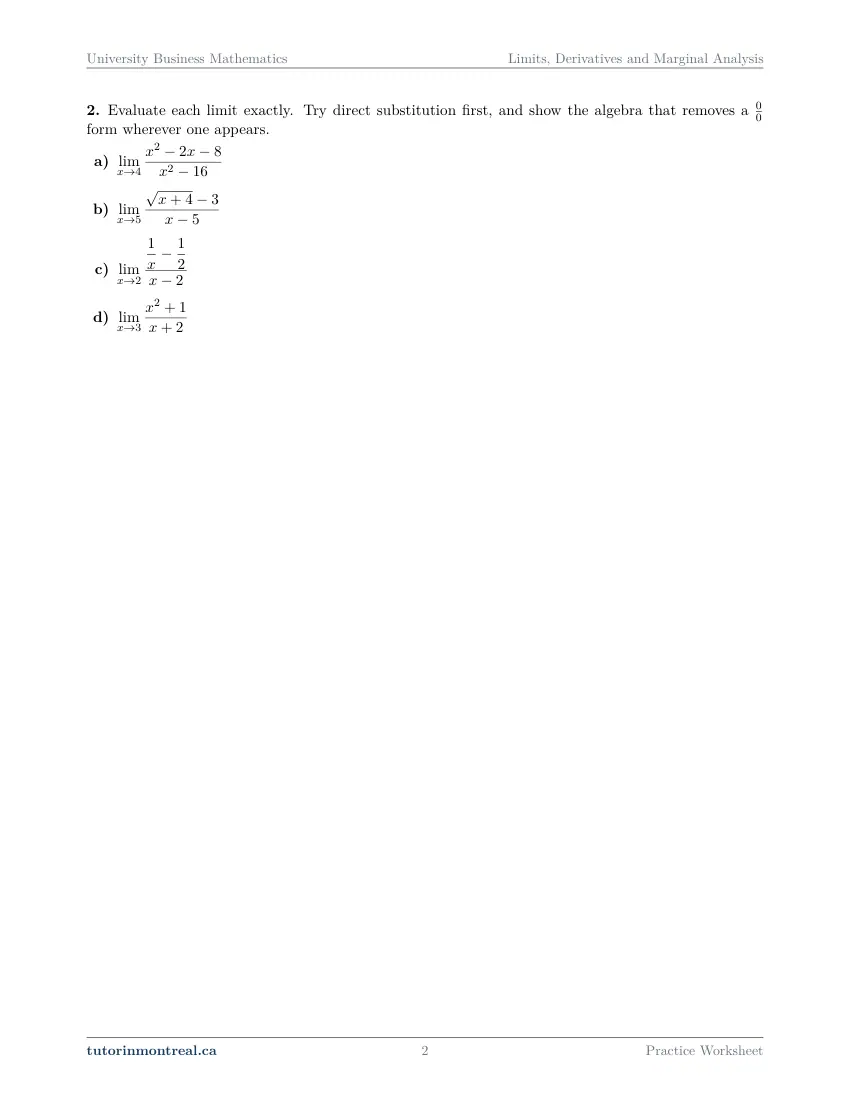
Evaluate each limit exactly. Try direct substitution first, and show the algebra that removes a form wherever one appears.
-
Q3Infinite Limits, Limits at Infinity and Asymptotes
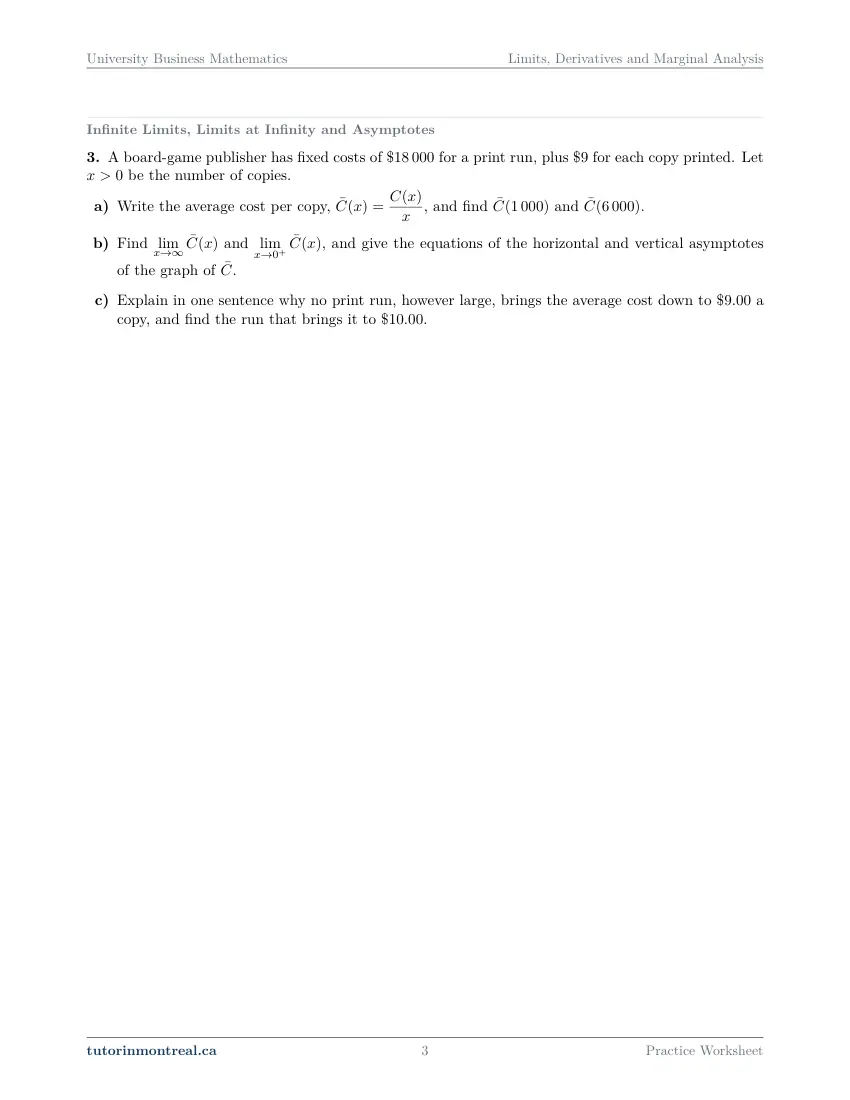
A board-game publisher has fixed costs of $18 000 for a print run, plus $9 for each copy printed. Let be the number of copies.
- Write the average cost per copy, , and find and .
- Find and , and give the equations of the horizontal and vertical asymptotes of the graph of .
- Explain in one sentence why no print run, however large, brings the average cost down to $9.00 a copy, and find the run that brings it to $10.00.
-
Q4Infinite Limits, Limits at Infinity and Asymptotes
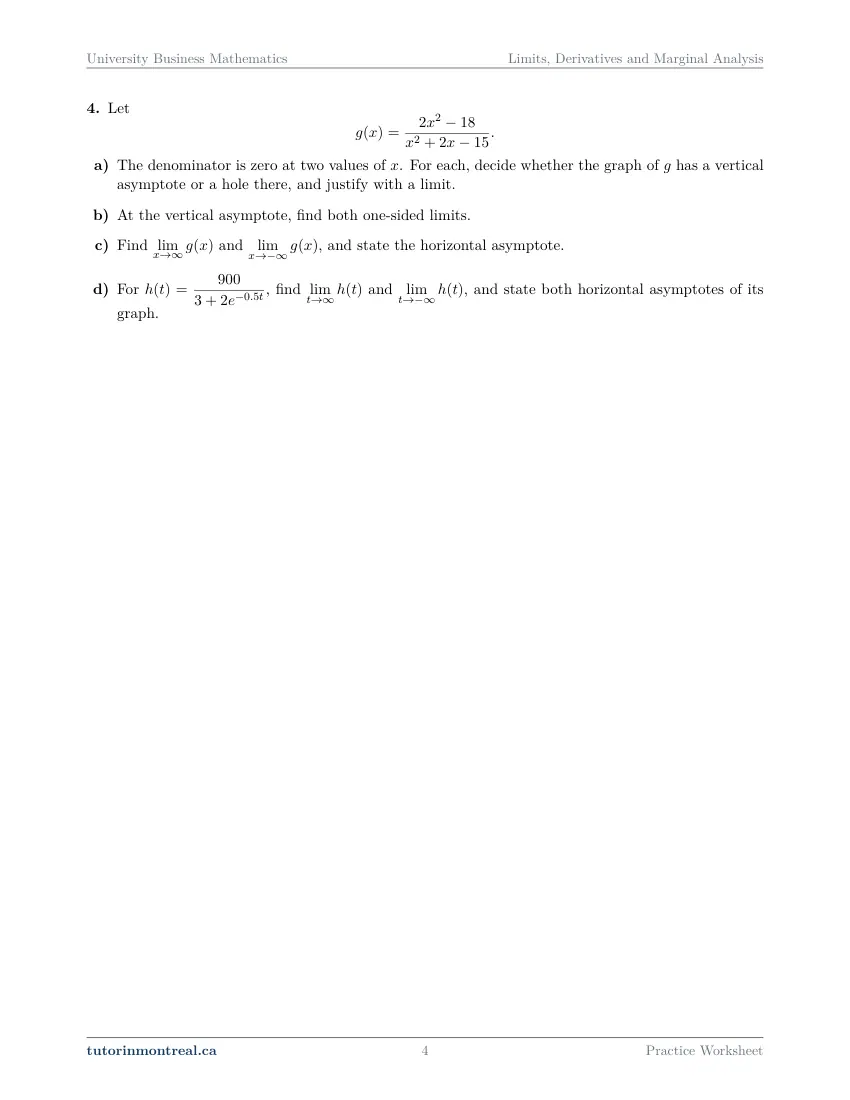
Let
- The denominator is zero at two values of . For each, decide whether the graph of has a vertical asymptote or a hole there, and justify with a limit.
- At the vertical asymptote, find both one-sided limits.
- Find and , and state the horizontal asymptote.
- For , find and , and state both horizontal asymptotes of its graph.
-
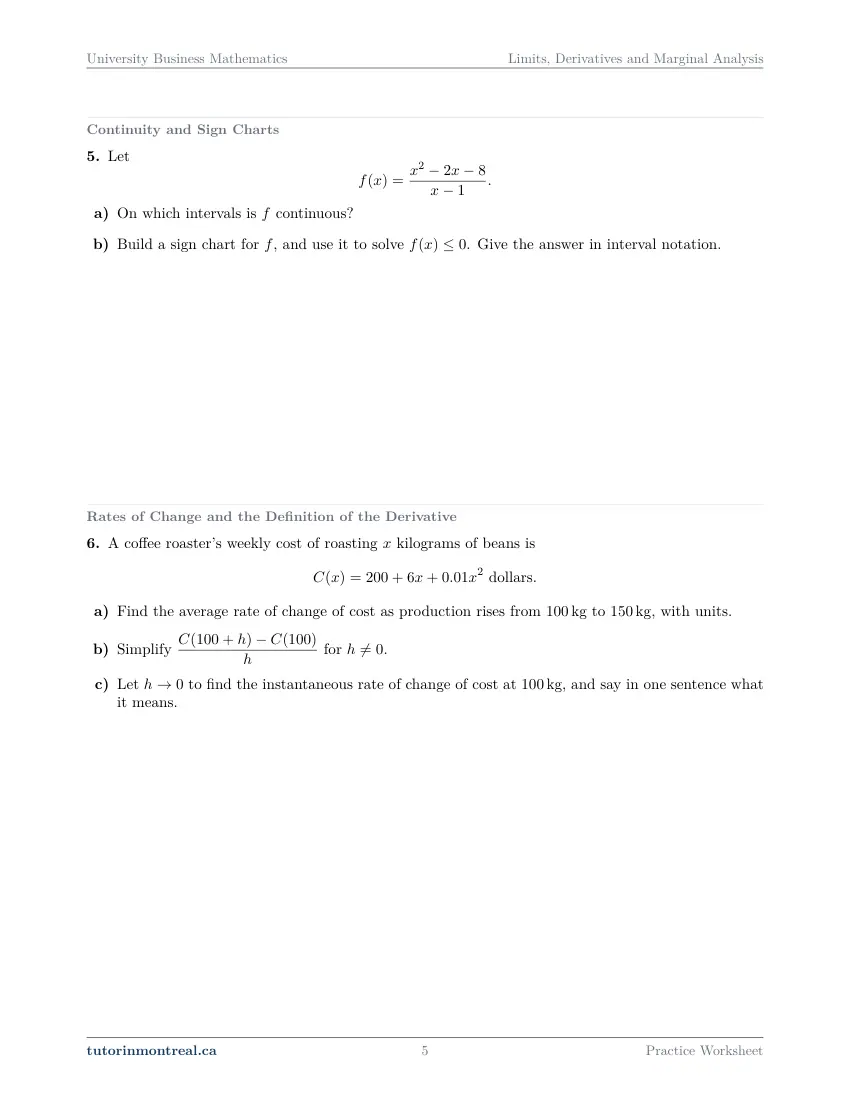
Q5Continuity and Sign Charts
Let
- On which intervals is continuous?
- Build a sign chart for , and use it to solve . Give the answer in interval notation.
-
Q6Rates of Change and the Definition of the Derivative
A coffee roaster's weekly cost of roasting kilograms of beans is
- Find the average rate of change of cost as production rises from kg to kg, with units.
- Simplify for .
- Let to find the instantaneous rate of change of cost at kg, and say in one sentence what it means.
-
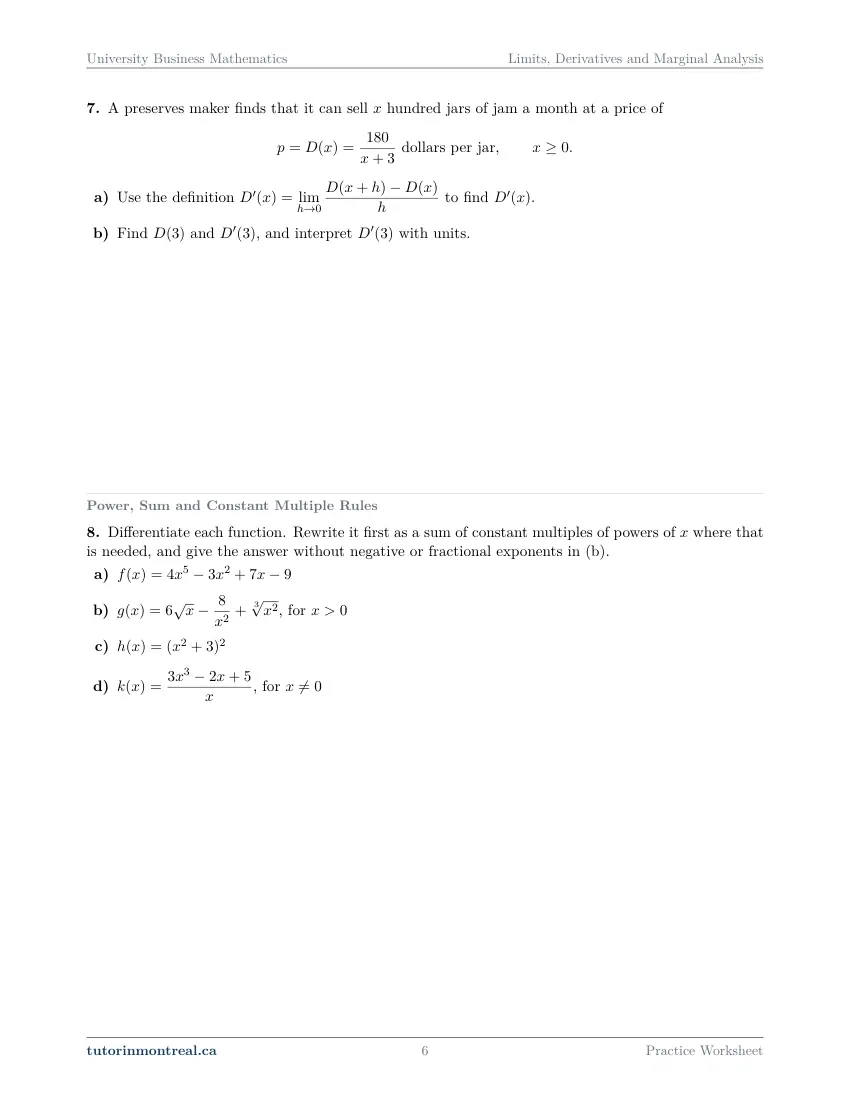
Q7Rates of Change and the Definition of the Derivative
A preserves maker finds that it can sell hundred jars of jam a month at a price of
- Use the definition to find .
- Find and , and interpret with units.
-
Q8Power, Sum and Constant Multiple Rules
Differentiate each function. Rewrite it first as a sum of constant multiples of powers of where that is needed, and give the answer without negative or fractional exponents in (b).
- , for
- , for
-
Q9Power, Sum and Constant Multiple Rules
Let .
- Find every point on the graph of at which the tangent line is horizontal.
- Find the equation of the tangent line at .
-
Q10Marginal Cost, Revenue and Profit
A candle maker's weekly cost of making candles is
- Find the marginal cost function .
- Find and interpret it.
- Find the exact cost of making the st candle, and compare it with .
-
Q11Marginal Cost, Revenue and Profit
A small workshop sells yoga mats. At a price of dollars it sells mats a week, where for . Its weekly cost is dollars.
- Write the revenue and the profit , and find the marginal revenue and the marginal profit .
- Find , and , and interpret each.
-
Q12Synthesis — drawing on several topics in this unit
A ski-rental shop can rent ski packages a week at a price of dollars each, for . Its weekly cost is dollars.
- Write the weekly profit .
- Use a sign chart to find the numbers of weekly rentals at which the shop makes a profit, that is, at which .
- Find the marginal profit , and use its sign to say for which numbers of rentals one more rental raises profit and for which it lowers it.
The 8 challenge problems for this topic are a separate, paid sheet and are not reproduced here.
What does this set assume? This set assumes Secondary 5 mathematics and nothing beyond it in calculus: it is where the course starts limits and derivatives, and it teaches them from the beginning rather than reviewing them. It leans on Secondary 5 functions and their graphs, factoring quadratics, rational expressions, radicals and exponent laws, and on the cost, revenue, profit and demand models set up in Functions for Business Models; one part uses an exponential, as in that same set. Limits are handled intuitively — from a graph, by algebra, or by dividing by the highest power — so there is no formal epsilon–delta definition, no L'Hospital's rule, and no theorem of rigour. Differentials are not used: the next unit's cost is approximated by the marginal function itself and compared with the exact change. The product, quotient and chain rules and the derivatives of exponentials and logarithms come in the next set, Differentiation Techniques and Elasticity, and maximising profit waits for Curve Analysis and Business Optimization.
Which course is this for? In the public course calendars of Montreal universities, this material is part of the courses numbered MATH 122, MATH 209 and MATH 10600. Each course orders and weights the topics its own way, so check your own outline for what your exam covers. Which sets match your course.
How to do every concept on this sheet
This is the part worksheet sites usually leave out. Below is the actual reasoning behind each group of questions — not a full solution set, the decisions that get you to one. Read it before you start, or after you get stuck.
Reading a limit off a graph with a jump
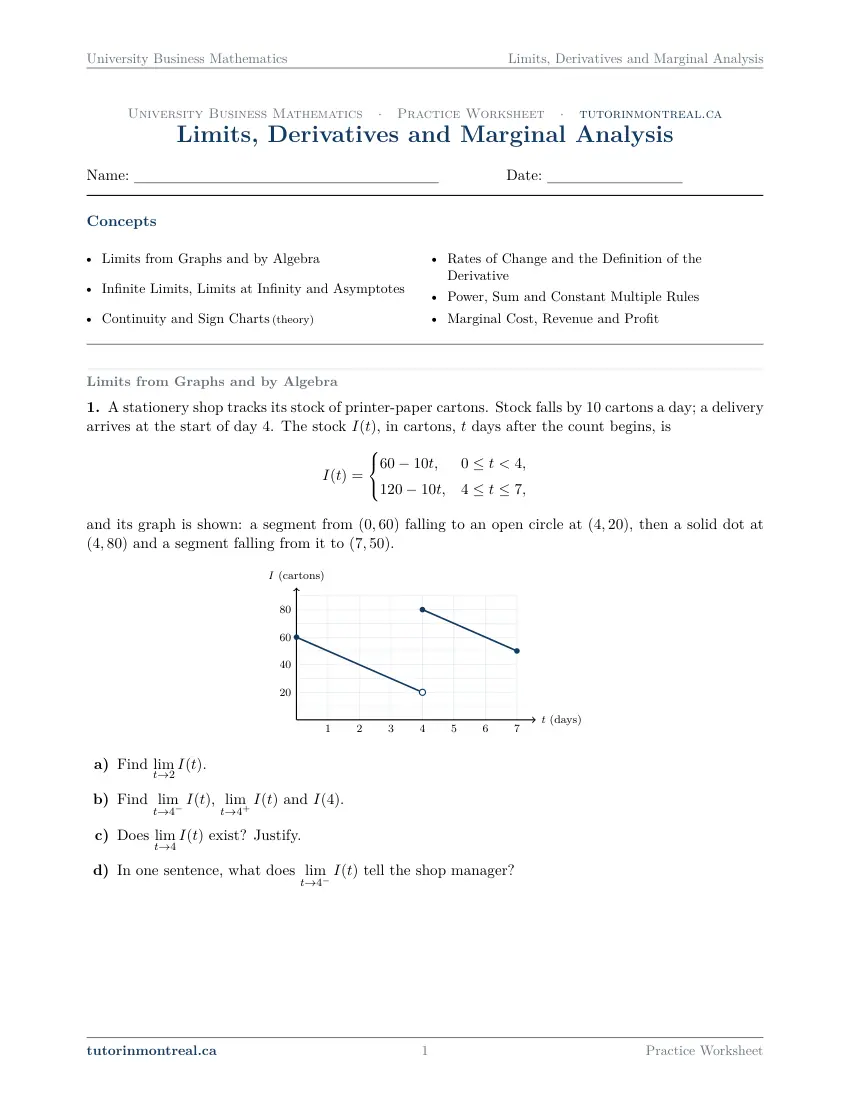
Q1 models a stock of cartons that runs down steadily and then jumps when a delivery lands. The graph has an open circle and a solid dot above the same day, and each mark answers a different question. The open circle is where one branch is heading; the solid dot is the value the function actually takes on that day.
A limit asks about the approach, not the arrival. For part (a), the day is in the middle of one branch, so the formula on that branch is all you need. For part (b), approach from the left along the first branch and from the right along the second, and read the function value separately from the formula whose interval includes that day.
Part (c) is a test of that rule and nothing else: compare the two numbers from part (b) and say which condition they meet or fail. Part (d) turns a left-hand limit into plain language for a manager — say what quantity it describes and at what moment, in the units of the problem.
0/0 is a signal, not an answer
Q2 asks for four limits and tells you the order of work: substitute first. If substitution gives a number, that number is the limit and you are done. If it gives 0/0, the expression is hiding a common factor, and the job is to expose and cancel it before substituting again.
Which algebra removes the 0/0
Look at what the expression is made of.
- 1Polynomials over polynomials
Factor the top and the bottom completely. The factor that vanishes at the point appears in both; cancel it.
- 2A square root minus a number
Multiply top and bottom by the conjugate. The difference of squares clears the root from the numerator and uncovers the factor to cancel.
- 3A fraction inside a fraction
Combine the small fractions over one common denominator first; the factor to cancel then shows up in the numerator.
- 4Substitute again
Only after cancelling. If the new substitution still gives 0/0, look for another factor.
Keep writing "lim" until you substitute. Each line before the last is still a limit, not a number. Dropping the symbol halfway through is the error most often marked down, even when the final value is right.
Average cost and limits at infinity
Q3 builds a cost function from a fixed cost and a cost per copy, and asks for the average cost per copy, cost divided by quantity. Write C(x) first, then divide it by x and split the result into separate terms: one term that still contains x and one that does not.
For part (b), ask what each term does as x grows without bound, and again as x shrinks toward zero from the right. A constant divided by an ever-larger number shrinks toward zero; a positive constant divided by an ever-smaller positive number grows without bound. A limit at infinity that is a number gives a horizontal asymptote; an infinite limit at a finite x gives a vertical one. Part (c) wants a reason in one sentence that follows from part (b), then an equation: set the average cost equal to the target and solve for x.
Read the model before the algebra. Say in words what the fixed cost does when it is shared by a very large run, and by a very small one. The limits in Q3 are that sentence written in symbols.
Hole or vertical asymptote
Q4(a) gives a rational function whose denominator vanishes at two values of x and asks you to classify each. The decision comes from factoring numerator and denominator completely.
factor cancels ⇒ hole factor stays in the denominator ⇒ vertical asymptoteJustify each classification with a limit, as the question asks: at a hole the limit is a finite number after cancelling; at a vertical asymptote it grows without bound. For part (b), test the sign of the simplified expression just to the left and just to the right of the asymptote: the sign of each factor decides whether each side heads up or down.
For part (c), divide every term of the numerator and the denominator by the highest power of x in the denominator and let x → ∞, then x → −∞; every term with x left in a denominator fades to zero. Part (d) is a different shape: an exponential in the denominator. There, ask what e^(−0.5t) does as t → ∞ and what it does as t → −∞. The two behaviours are opposite, which is why the question asks for two horizontal asymptotes.
Continuity and sign charts
Q5(a) uses the fact that a rational function is continuous everywhere its denominator is not zero, so its intervals of continuity are read straight off the denominator. Q5(b) turns that fact into a method for inequalities.
A sign chart in four steps
The sign can only change where the function is zero or undefined.
- 1Factor fully
Top and bottom, into linear factors where possible.
- 2Mark the cut points
Every zero of the numerator and every zero of the denominator, in order on a number line.
- 3One test value per interval
Or record the sign of each factor in a row and multiply down the columns.
- 4Read the inequality
With ≤, include the zeros of the numerator; never include a zero of the denominator, where the function is not defined.
Continuity is what makes the method honest: between two neighbouring cut points the function is continuous and never zero, so it cannot change sign there, and one test value speaks for the whole interval.
Average rate, then instantaneous rate
Q6 walks the definition of the derivative in three steps on a roaster's cost. Part (a) is the slope between two production levels, in dollars per kilogram. Part (b) is the same slope with the second point left general: expand C(100 + h), subtract C(100), and notice that every surviving term has a factor h, which is what lets you divide by h. Part (c) lets h → 0 in what remains.
f′(a) = lim(h→0) [f(a + h) − f(a)] / hThe interpretation sentence carries the marks as much as the number: name the quantity, the production level, and the units — dollars per kilogram — and say that it describes how fast cost is rising at that level, not the cost itself.
Q7 applies the same definition to a demand function with x in the denominator, and asks for D′(x) as a function rather than at one point. Write D(x + h) − D(x) over a single common denominator, simplify the numerator until a factor h appears, cancel it, and only then let h → 0. Part (b) evaluates both D and D′ at one quantity; the interpretation must keep the units straight, since x counts hundreds of jars and p is dollars per jar.
The power, sum and constant multiple rules
Once the definition has been used, the rules take over. The power rule works for any real exponent, so the skill Q8 drills is rewriting before differentiating.
d/dx [c·xⁿ] = c·n·xⁿ⁻¹ (f + g)′ = f′ + g′Rewrite first. A root becomes a fractional power (√x = x^(1/2), the cube root of x² is x^(2/3)), a power in the denominator becomes a negative power (1/x² = x⁻²), a square of a binomial is expanded, and a polynomial over a single power of x is split term by term. Q8(a) needs no rewriting; parts (b), (c) and (d) each need one of these moves. Part (b) then asks you to rewrite the answer back without negative or fractional exponents.
There is no rule for a square or a quotient yet. Differentiating (x² + 3)² as 2(x² + 3), or a quotient as the quotient of the derivatives, is the classic error of this set. Until the next set supplies the chain and quotient rules, expand or divide first.
Q9 connects the derivative to the tangent line. A horizontal tangent is a point where f′(x) = 0: differentiate, set the derivative to zero, factor, and then substitute each x back into f, not into f′, to get the points. For part (b), the slope is f′(1), the point is (1, f(1)), and the line is y − f(1) = f′(1)(x − 1).
Marginal cost, revenue and profit
In business language, the derivative of cost is marginal cost, and it approximates the cost of producing one more unit. Q10 asks for the marginal cost function, its value at one production level, and then the exact cost of the next candle, so that the approximation and the exact figure can be set side by side.
exact cost of unit (n + 1) = C(n + 1) − C(n) approximation = C′(n)Which unit is "the 251st"? Making the 251st candle takes production from 250 to 251, so the exact cost is C(251) − C(250), not C(251). Compare that difference with C′(250), and say how far apart they are.
Q11 starts from a price–demand equation. Revenue is the number sold times the price each one sells at, R(x) = x·p, with p written in terms of x first; profit is revenue minus cost, P(x) = R(x) − C(x). Differentiate each with the power rule. Part (b) is about reading signs: a positive marginal profit means one more mat sold adds to profit, a negative one means it takes away, and the size says roughly by how much. Every interpretation names the quantity, the level and the units.
The synthesis question
Q12 puts the set together on a ski-rental shop. Part (a) is Q11's construction: revenue from the price equation, then subtract the cost. Part (b) is Q5's method on a polynomial: write P(x) = 0, find its roots, place them on a number line together with the ends of the allowed interval, and test the sign on each piece. Part (c) is a sign chart for P′(x): find where marginal profit is zero, then read off where it is positive and where it is negative, and translate each sign into a sentence about one more rental.
Two different sign questions. The sign of P says whether the shop is making money at all; the sign of P′ says whether the next rental helps. They are answered by two separate charts with different cut points, so do not read one off the other.
Preview all 9 pages
Click any page to open the full PDF.
Getting the most out of it
Substitute before you do any algebra
Every limit starts with direct substitution. A number ends the question; 0/0 tells you to factor, rationalise or combine fractions; a nonzero number over zero tells you to look at the one-sided behaviour. Decide from the result, not from how the expression looks.
Say every result in the units of the problem
A limit of average cost is dollars per copy; a marginal cost is dollars per unit at a given level. Finish each business question with one sentence naming the quantity, the level and the units. That sentence is where most of the marks in this course sit.
Rewrite, then differentiate
Before using the power rule, put every term in the form c·xⁿ. Most errors in this set are a root or a denominator differentiated as it stood, not a slip in the rule itself.
Draw the number line
For continuity, inequalities and the sign of a marginal function, the same picture does the work: cut points in order, one sign per interval. Draw it every time; it is faster than reasoning in your head and easier to check.
Want the solutions, or something more challenging?
The worksheet, the questions above and every explanation on this page stay free permanently. Three more PDFs exist for this topic — the worked answer key, a harder problem set, and the answer key to that. They come with the University Business Math Solutions Bundle, beside the unit notes and the unit test, which is what keeps the rest of the series free.
What else exists for Limits, Derivatives and Marginal Analysis
Three PDFs · 15 pages · all three are in the bundle below.
- Answer key — 4 pages. All 12 questions worked step by step, including the restrictions and the justifications. Not a list of final answers.
- Challenge problems — 8 pages, 8 problems. A separate sheet at exam-plus difficulty covering the same 6 concepts. Harder than anything on the free sheet.
- Challenge answer key — 3 pages. Every challenge problem worked to the same standard, with the checks shown.
- PDF, letter size, print-ready.
The one thing that's for sale
Every University Business Math topic — the complete Solutions Bundle
One download, one payment, the whole program. For all 9 University Business Math units: the worksheet, the reference notes, the challenge set, the unit test and every answer key — including this one.
- Worked solutions, not answer lists — every step written out
- Covers the whole year's program at this level
- Less than the price of one hour of tutoring — for the entire year's solutions
Taking Secondary 1 Math as well? The Secondary 1 Math bundle covers all 15 of its units — 106 PDFs, 474 pages — on the same terms.
Taking Secondary 2 Math as well? The Secondary 2 Math bundle covers all 14 of its units — 98 PDFs, 449 pages — on the same terms.
Taking Secondary 3 Math as well? The Secondary 3 Math bundle covers all 11 of its units — 77 PDFs, 367 pages — on the same terms.
Taking Secondary 4 Math as well? The Secondary 4 Math bundle covers all 17 of its units — 122 PDFs, 466 pages — on the same terms.
Taking Secondary 5 Math as well? The Secondary 5 Math bundle covers all 21 of its units — 147 PDFs, 589 pages — on the same terms.
Taking CEGEP Calculus I as well? The CEGEP Calculus I bundle covers all 9 of its units — 72 PDFs, 371 pages — on the same terms.
Taking CEGEP Calculus II as well? The CEGEP Calculus II bundle covers all 8 of its units — 64 PDFs, 335 pages — on the same terms.
Taking CEGEP Linear Algebra as well? The CEGEP Linear Algebra bundle covers all 7 of its units — 56 PDFs, 298 pages — on the same terms.
Taking University Calculus III as well? The University Calculus III bundle covers all 9 of its units — 72 PDFs, 516 pages — on the same terms.
Taking University Linear Algebra as well? The University Linear Algebra bundle covers all 9 of its units — 72 PDFs, 496 pages — on the same terms.
Taking University Differential Equations as well? The University Differential Equations bundle covers all 9 of its units — 36 PDFs, 182 pages — on the same terms.
Taking University Introductory Statistics as well? The University Introductory Statistics bundle covers all 9 of its units — 36 PDFs, 186 pages — on the same terms.
Taking University Discrete Math as well? The University Discrete Math bundle covers all 9 of its units — 36 PDFs, 155 pages — on the same terms.
Taking AP Calculus AB as well? The AP Calculus AB bundle covers all 8 of its units — 64 PDFs, 527 pages — on the same terms.
Common questions
Is this worksheet really free?
Yes — the questions are on this page to read, and the PDF downloads directly, no email and no account. The one paid item is optional: the complete University Business Mathematics Solutions Bundle, which covers every set at this level.
Which university courses is this for?
The course codes listed on this page are taken from the public course calendars of universities that teach mathematics to management and commerce students. Each course orders and weights the chapters its own way, and some reach a chapter later or not at all — so check the outline for your own section to see where this set falls in your term.
What do I need to know before starting this set?
Secondary 5 mathematics: factoring, rational expressions, radicals, exponent laws and the graphs of basic functions, plus the cost, revenue, profit and demand models from Functions for Business Models. No calculus is assumed.
Is this the same as CEGEP Calculus I?
The topic names overlap, but the treatment differs. This course uses no trigonometric functions, no L'Hospital's rule and no theorems of rigour, and it puts every idea in a business setting: average cost, demand, and marginal cost, revenue and profit.
What does 0/0 mean when I substitute into a limit?
It means the substitution has told you nothing yet. The numerator and the denominator share a factor that vanishes at that point; remove it by factoring, a conjugate or a common denominator, then substitute again.
How is a hole different from a vertical asymptote?
Both happen where a denominator is zero. If the factor causing it cancels with one in the numerator, the graph has a hole and the limit is a finite number; if it does not cancel, the function grows without bound near that x and the graph has a vertical asymptote.
Is marginal cost the cost of the next unit?
Approximately. C′(x) is the rate at which cost rises at production level x, and it is close to C(x + 1) − C(x), the exact cost of the next unit. The two are usually near each other but not equal, which is why questions ask you to compute both and compare.
Can teachers use this in class?
Yes. Print and photocopy it for your own classes freely — I just ask that the tutorinmontreal.ca footer stays on the page.
I'm stuck on one question. Can you help?
Yes — through one-on-one tutoring, in Montreal or online. Get in touch to arrange a session, or see the current rates.
← All 9 University Business Math worksheets · Secondary 1 Math series (15 sheets) → · Secondary 2 Math series (14 sheets) → · Secondary 3 Math series (11 sheets) → · Secondary 4 Math series (17 sheets) → · Secondary 5 Math series (21 sheets) → · CEGEP Calculus I series (9 sheets) → · CEGEP Calculus II series (8 sheets) → · CEGEP Linear Algebra series (7 sheets) → · University Calculus III series (9 sheets) → · University Linear Algebra series (9 sheets) → · University Differential Equations series (9 sheets) → · University Introductory Statistics series (9 sheets) → · University Discrete Math series (9 sheets) → · AP Calculus AB series (8 sheets) →