University Business Mathematics — Functions for Business Models Worksheet
The functions the rest of the course is built on, each one met as a business model. Linear cost, revenue and profit with a break-even point; supply and demand lines found from two observations and set against each other; a quadratic revenue function from a price-demand rule and its maximum; a depreciation model written with a percentage and again with the base e; the laws of logarithms, used to rewrite expressions and to read a sales model; and exponential and logarithmic equations solved exactly, with every candidate checked. Have a look on this page, then print the free PDF when you want to write on it.
Practice worksheet — free PDF
No email, no account, no watermark. Teachers: photocopy it for your classes freely. Worked solutions and 6 harder problems come with the University Business Math bundle.
All 9 questions
Each question targets one named concept from the sheet. Read them here, or print the PDF — it has working space under each one.
-
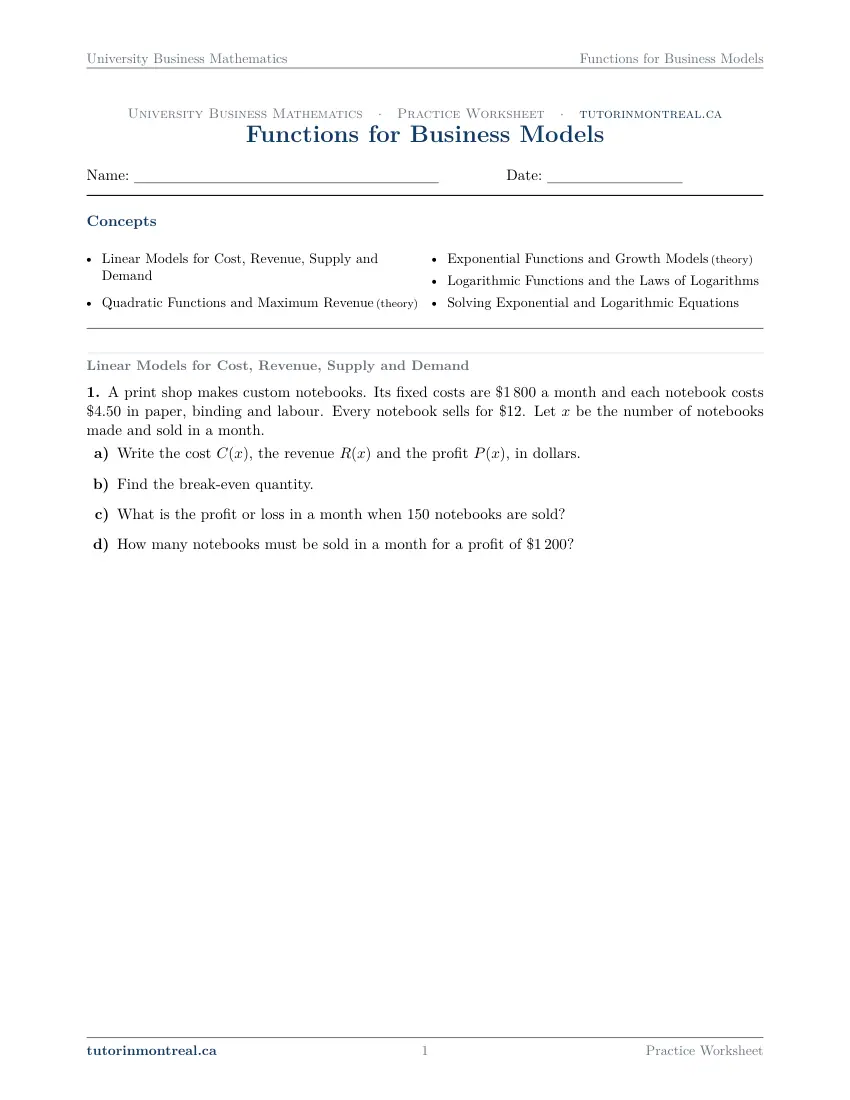
Q1Linear Models for Cost, Revenue, Supply and Demand
A print shop makes custom notebooks. Its fixed costs are $1 800 a month and each notebook costs $4.50 in paper, binding and labour. Every notebook sells for $12. Let be the number of notebooks made and sold in a month.
- Write the cost , the revenue and the profit , in dollars.
- Find the break-even quantity.
- What is the profit or loss in a month when notebooks are sold?
- How many notebooks must be sold in a month for a profit of $1 200?
-
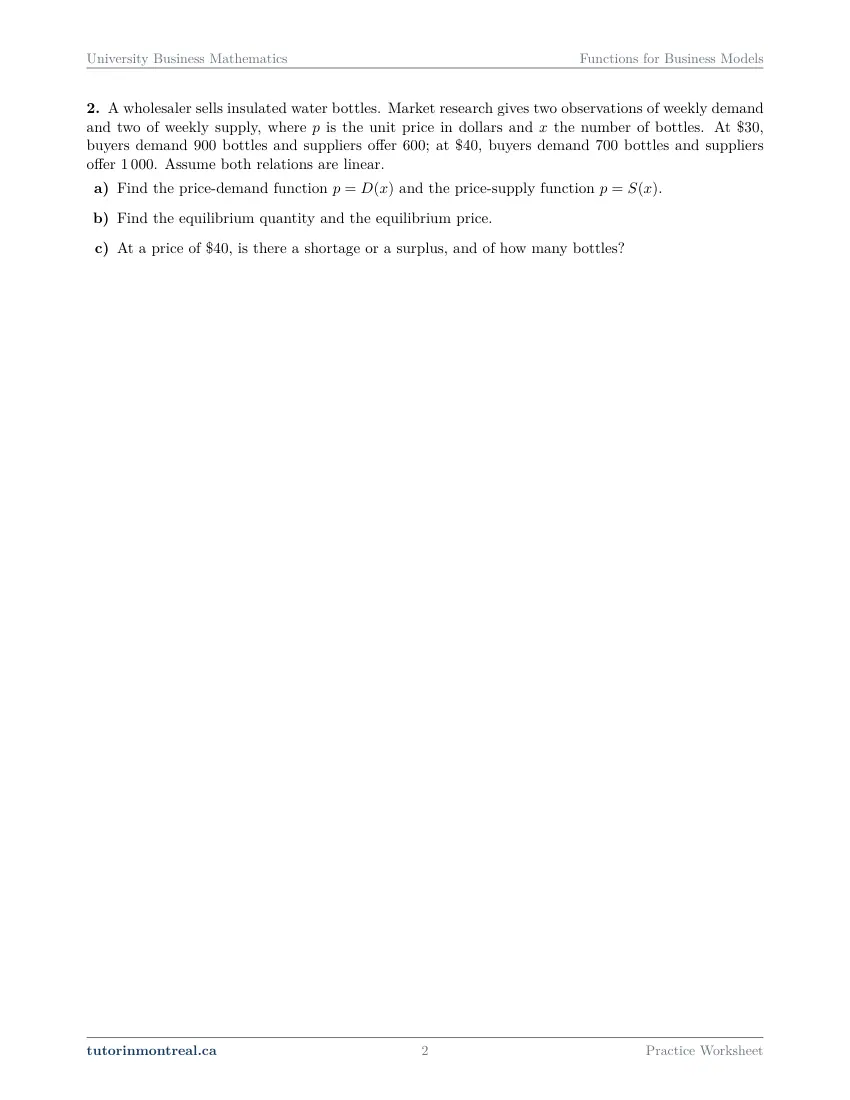
Q2Linear Models for Cost, Revenue, Supply and Demand
A wholesaler sells insulated water bottles. Market research gives two observations of weekly demand and two of weekly supply, where is the unit price in dollars and the number of bottles. At $30, buyers demand bottles and suppliers offer ; at $40, buyers demand bottles and suppliers offer . Assume both relations are linear.
- Find the price-demand function and the price-supply function .
- Find the equilibrium quantity and the equilibrium price.
- At a price of $40, is there a shortage or a surplus, and of how many bottles?
-
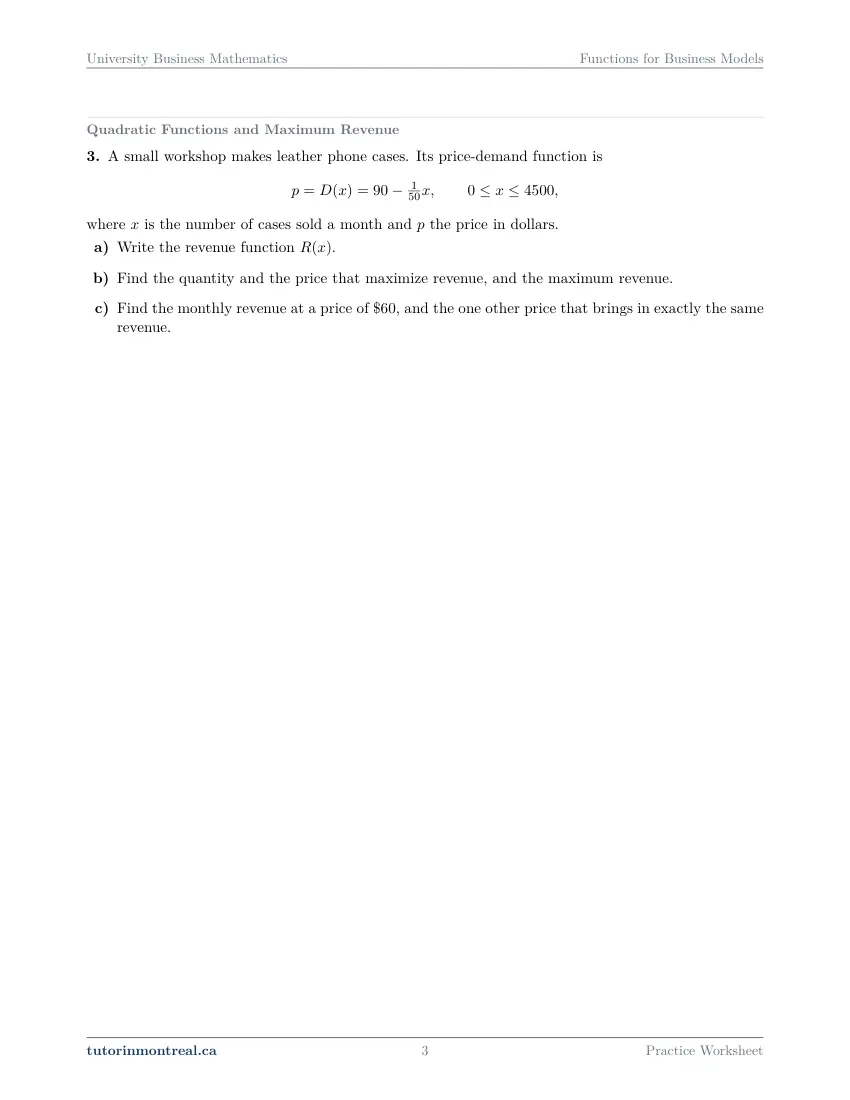
Q3Quadratic Functions and Maximum Revenue
A small workshop makes leather phone cases. Its price-demand function is where is the number of cases sold a month and the price in dollars.
- Write the revenue function .
- Find the quantity and the price that maximize revenue, and the maximum revenue.
- Find the monthly revenue at a price of $60, and the one other price that brings in exactly the same revenue.
-
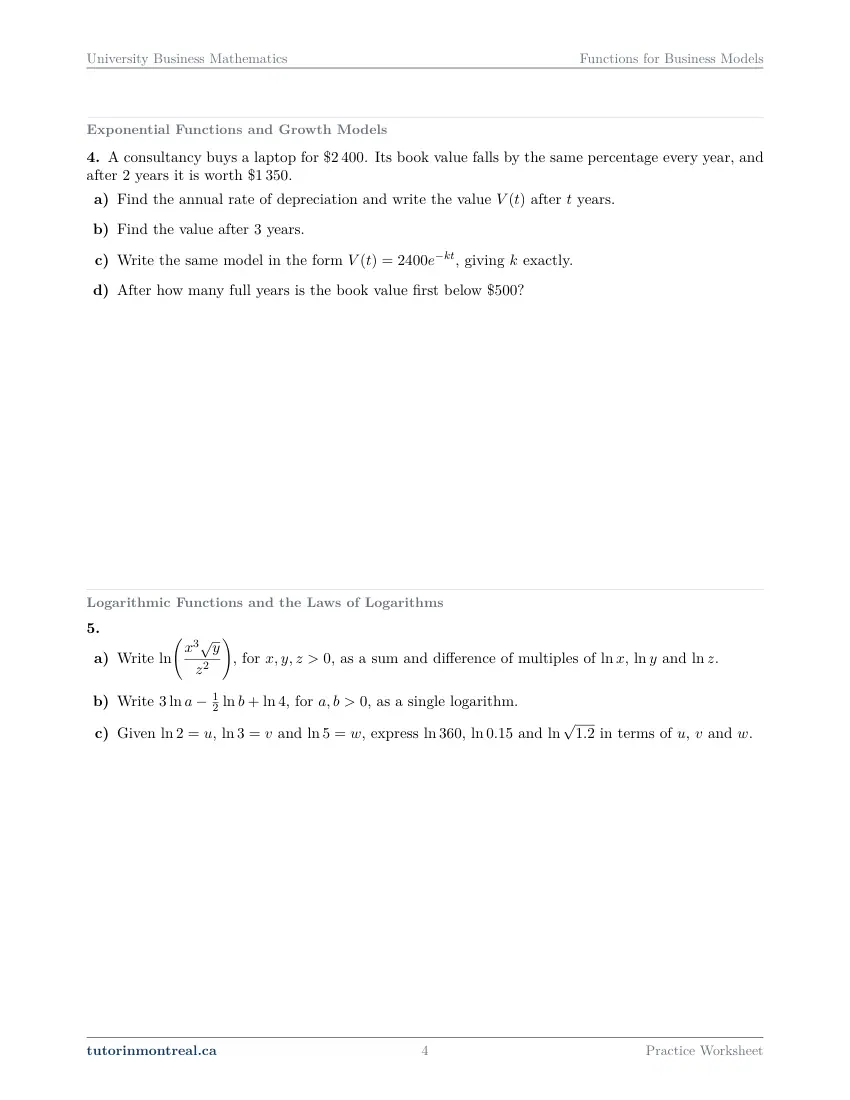
Q4Exponential Functions and Growth Models
A consultancy buys a laptop for $2 400. Its book value falls by the same percentage every year, and after years it is worth $1 350.
- Find the annual rate of depreciation and write the value after years.
- Find the value after years.
- Write the same model in the form , giving exactly.
- After how many full years is the book value first below $500?
-
Q5Logarithmic Functions and the Laws of Logarithms
- Write , for , as a sum and difference of multiples of , and .
- Write , for , as a single logarithm.
- Given , and , express , and in terms of , and .
-
Q6Logarithmic Functions and the Laws of Logarithms
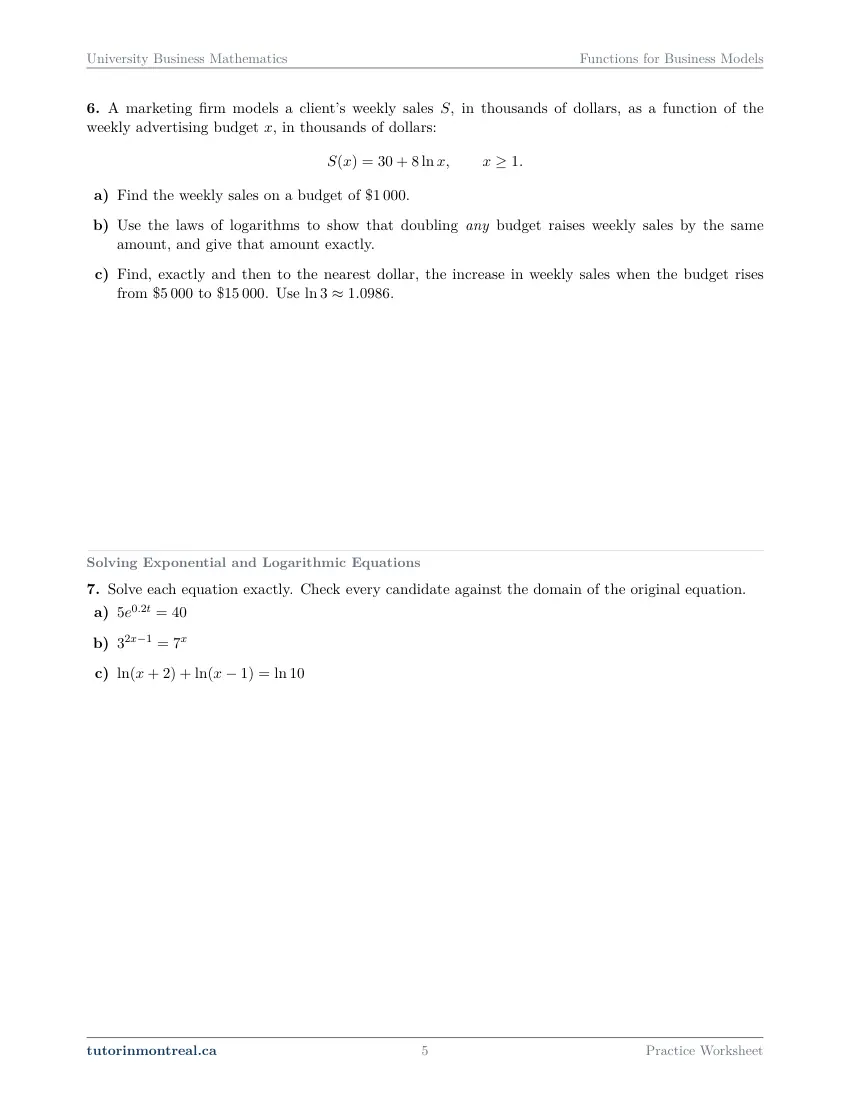
A marketing firm models a client's weekly sales , in thousands of dollars, as a function of the weekly advertising budget , in thousands of dollars:
- Find the weekly sales on a budget of $1 000.
- Use the laws of logarithms to show that doubling any budget raises weekly sales by the same amount, and give that amount exactly.
- Find, exactly and then to the nearest dollar, the increase in weekly sales when the budget rises from $5 000 to $15 000. Use .
-
Q7Solving Exponential and Logarithmic Equations
Solve each equation exactly. Check every candidate against the domain of the original equation.
-
Q8Solving Exponential and Logarithmic Equations
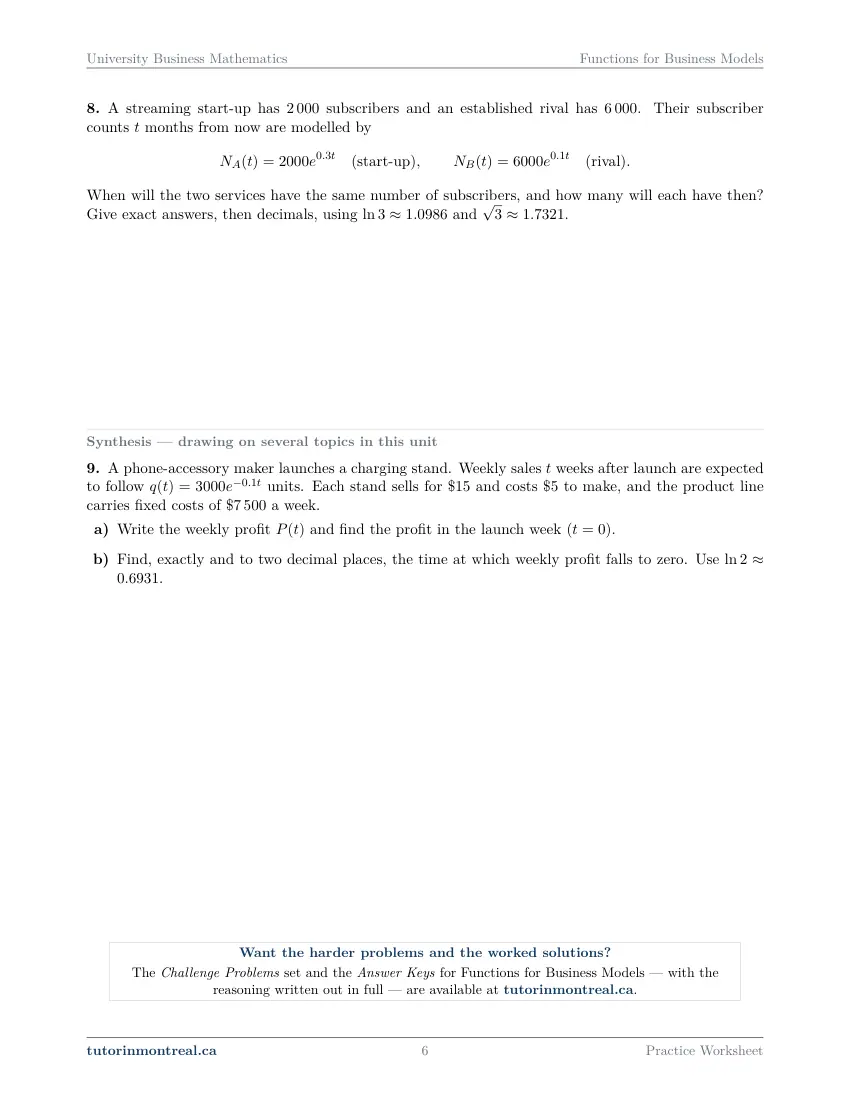
A streaming start-up has subscribers and an established rival has . Their subscriber counts months from now are modelled by When will the two services have the same number of subscribers, and how many will each have then? Give exact answers, then decimals, using and .
-
Q9Synthesis — drawing on several topics in this unit
A phone-accessory maker launches a charging stand. Weekly sales weeks after launch are expected to follow units. Each stand sells for $15 and costs $5 to make, and the product line carries fixed costs of $7 500 a week.
- Write the weekly profit and find the profit in the launch week ().
- Find, exactly and to two decimal places, the time at which weekly profit falls to zero. Use .
The 6 challenge problems for this topic are a separate, paid sheet and are not reproduced here.
What does this set assume? This is the first set of the course, and it is a working review rather than a new start. It assumes Secondary 5 mathematics: the equation of a line from two points, the vertex of a parabola, exponential and logarithmic functions, and the exponent laws, which get no sheet of their own. It uses no calculus — a maximum here comes from the vertex, not from a derivative, since limits and derivatives only arrive in Limits, Derivatives and Marginal Analysis. Interest is not here either: compound and continuous compounding, and solving for a time or a rate in a savings problem, belong to the next set, Mathematics of Finance. Growth is a function to evaluate and to solve with logarithms, never a differential equation, and the only functions in play are linear, quadratic, exponential and logarithmic.
Which course is this for? In the public course calendars of Montreal universities, this material is part of the courses numbered MATH 122, MATH 208, MATH 10600 and MAT1002. Each course orders and weights the topics its own way, so check your own outline for what your exam covers. Which sets match your course.
How to do every concept on this sheet
This is the part worksheet sites usually leave out. Below is the actual reasoning behind each group of questions — not a full solution set, the decisions that get you to one. Read it before you start, or after you get stuck.
Cost, revenue and profit as linear functions
A linear cost model has two parts: a fixed cost that is paid whether anything is made or not, and a variable cost that grows by the same amount with every unit. Revenue is price times quantity, and profit is always revenue minus cost — never the other way round. Q1(a) asks for all three in dollars as functions of the number of notebooks x.
C(x) = fixed cost + (cost per unit)·x R(x) = (price)·x profit = revenue − costEvery later part of Q1 is one of these functions read in a particular direction.
Reading a profit function
Three different questions, three different moves.
- 1Break-even: set R(x) = C(x)
Equivalently P(x) = 0. Q1(b) is this equation. A break-even quantity that is not a whole number is rounded up if the question is how many units must be sold to cover costs.
- 2Profit at a given quantity: evaluate
Q1(c) gives x and asks for P(x). The sign is the answer to "profit or loss": a negative value is a loss of that size, and it should be stated in words as a loss, not left as a minus sign.
- 3Quantity for a target profit: solve
Q1(d) sets P(x) equal to the target and solves for x. If the solution is not a whole number, round up to a whole notebook, since selling fewer falls short of the target.
The slope of profit has a name. Price minus variable cost per unit is how much each extra sale adds to profit. Seeing it as a single number makes the break-even equation a one-line division: the fixed cost has to be covered that many dollars at a time.
Supply, demand and equilibrium
Q2 gives two observations of demand and two of supply and asks for each as a line of the form p = D(x) and p = S(x). The convention matters: price is the output and quantity the input, so the points are written (x, p) — quantity first — before any slope is computed.
From two observations to equilibrium
The same method for both curves, then one equation.
- 1Write each observation as (quantity, price)
Two points for demand, two for supply. Swapping the coordinates gives the inverse function, which is a different line.
- 2Slope, then point-slope form
m = Δp/Δx. A demand line should slope down and a supply line up; if one does not, a pair of coordinates is reversed.
- 3Equilibrium: set D(x) = S(x)
Solve for the quantity, then substitute into either function for the price. Substituting into both is the check.
Q2(c) fixes a price and compares the two quantities at that price. Read each quantity off its own line at that price: when buyers want more than suppliers offer there is a shortage, when suppliers offer more than buyers want there is a surplus, and the size is the difference between the two quantities. Which one it is comes from where the price sits relative to the equilibrium price.
Quadratic revenue and its maximum
When the price depends on how many units are sold, revenue is no longer a line. In Q3 the price-demand function gives p in terms of x, and revenue is x times that price — a quadratic in x that opens downward.
R(x) = x · D(x)Q3(b) asks for the maximum without any calculus: the maximum of a downward parabola is its vertex. Put R(x) in the form ax² + bx, take x = −b/(2a), and then the question wants three things — the quantity, the price that produces it (from the demand function, not from the revenue function), and the revenue itself. Check that the quantity lies inside the stated domain.
Quantity and price are different answers. The vertex gives the quantity. The price that goes with it comes from D(x). Quoting the vertex as a price is the most common slip on this kind of question.
Q3(c) starts from a price instead of a quantity: find the quantity that price sells from the demand function, then the revenue. The one other price with the same revenue follows from symmetry — a parabola takes each value below its maximum at two points equally far from the vertex. Find the partner quantity on the other side of the vertex, then convert it to a price. Solving R(x) equal to the given revenue as a quadratic equation gives the same pair and is the check.
Exponential models: a percentage and the base e
"Falls by the same percentage every year" means each year's value is the previous one times a fixed factor 1 − r. After t years the starting value has been multiplied by that factor t times.
V(t) = V₀ (1 − r)ᵗQ4(a) gives the starting value and the value after two years. Divide one by the other to get (1 − r)², take the square root for the yearly factor, and read the rate off it. Q4(b) is then an evaluation.
Q4(c) rewrites the same model with the base e. Two forms describe the same function when their bases agree, so set e⁻ᵏ equal to the yearly factor and take the natural logarithm of both sides. The question asks for k exactly, so leave it as a logarithm rather than a decimal.
A rate and a constant are not the same number. The percentage r and the constant k in e⁻ᵏᵗ are related by a logarithm, and they are close only when both are small. Do not write one where the other belongs.
Q4(d) asks when the value first drops below a threshold. Write the inequality, isolate the power, take logarithms and solve for t. Two things decide the final answer: dividing by the logarithm of a factor smaller than 1 divides by a negative number, which reverses the inequality; and "after how many full years" means the first whole number of years that satisfies it, which is a rounding up, not a rounding to the nearest.
The laws of logarithms
Three laws do all the work, and each one is an exponent law read backwards.
ln(AB) = ln A + ln B ln(A/B) = ln A − ln B ln(Aⁿ) = n ln AQ5(a) expands: split the quotient first, then the product, then bring each power down — a square root is the power one half. Q5(b) runs the laws the other way: move each coefficient back up as a power, then combine sums into products and differences into quotients. Q5(c) asks for three logarithms in terms of the logarithms of 2, 3 and 5. Factor each number into powers of 2, 3 and 5; a decimal becomes a fraction first, and a root becomes a power of one half.
There is no law for a sum inside. ln(A + B) does not split. And ln A / ln B is not ln(A/B). Every step of Q5 should match one of the three laws exactly.
Q6 puts the same laws to work in a sales model with a logarithm in it. Q6(a) is a substitution; watch the units, since both the budget and the sales are measured in thousands of dollars. Q6(b) asks you to show that doubling any budget adds the same amount: write S(2x) − S(x) and use the product law on ln(2x). The x has to disappear from the difference — that disappearance is the proof. Q6(c) is the same move with a different ratio: the difference of two logarithms is the logarithm of their quotient, and the approximation given in the question is used only at the end.
Solving exponential and logarithmic equations
Which move each equation calls for
Look at where the unknown is, then pick the matching step.
- 1Unknown in one exponent
Isolate the power first — divide away the coefficient — and only then take ln of both sides. Q7(a) is this case.
- 2Unknown in exponents on two different bases
Take ln of both sides, bring the exponents down, and collect the x-terms on one side before factoring x out. Q7(b) is this case.
- 3A sum of logarithms equal to a logarithm
Combine into one logarithm with the product law, then drop the logarithms on both sides and solve what is left. Q7(c) is this case.
Check every candidate in the original equation. Combining logarithms can produce a candidate that makes one of the original arguments zero or negative. Q7 tells you to check against the domain of the original equation: each logarithm's argument must be positive at the candidate, and a candidate that fails is rejected with a sentence saying which argument fails.
Q8 asks when two exponential models are equal. Set them equal and gather the exponentials on one side and the constants on the other, so that one exponential equals one number; then take the natural logarithm. The question wants an exact time first, then a decimal from the values it supplies, and then the subscriber count — which should come out the same from both models, so compute it from both as the check. The exact form is easiest to evaluate if you use the exponent laws before reaching for decimals.
The synthesis question
Q9 puts Q1 and Q4 together. Weekly sales now decay exponentially over time, so profit becomes a function of time: the profit on each unit times the number of units sold that week, minus the fixed costs. Q9(a) writes that function and evaluates it in the launch week. Q9(b) sets it to zero, which isolates an exponential equal to a number — the Q7(a) method — and asks for the exact time and a decimal to two places using the approximation supplied.
Before solving, notice what the profit function does: the exponential term shrinks and the fixed cost does not, so profit only decreases. That tells you the zero is a single crossing and what the sign of profit is on each side of it.
Preview all 6 pages
Click any page to open the full PDF.
Getting the most out of it
Name the input and the output before writing a formula
Quantity or price? Months or years? Dollars or thousands of dollars? Q2 and Q6 both turn on this. Write "x is … and p is …" at the top of the question, as Q1 does for you.
Answer in the question's words
A break-even quantity is a number of units; "profit or loss" is answered with the word; "shortage or surplus" is answered with the word and a size. A bare number does not answer a business question.
Stay exact until the last line
When a question says "exactly", leave logarithms as logarithms. Round once, at the end, and round in the direction the context demands — up for "at least" and "first below".
Check with a second route
Substitute an equilibrium quantity into both lines, compute a crossing time's value from both models, confirm a symmetric price by solving the quadratic. Every question on this sheet has a second route, and it is usually one line long.
Want the solutions, or something more challenging?
The worksheet, the questions above and every explanation on this page stay free permanently. Three more PDFs exist for this topic — the worked answer key, a harder problem set, and the answer key to that. They come with the University Business Math Solutions Bundle, beside the unit notes and the unit test, which is what keeps the rest of the series free.
What else exists for Functions for Business Models
Three PDFs · 10 pages · all three are in the bundle below.
- Answer key — 2 pages. All 9 questions worked step by step, including the restrictions and the justifications. Not a list of final answers.
- Challenge problems — 6 pages, 6 problems. A separate sheet at exam-plus difficulty covering the same 5 concepts. Harder than anything on the free sheet.
- Challenge answer key — 2 pages. Every challenge problem worked to the same standard, with the checks shown.
- PDF, letter size, print-ready.
The one thing that's for sale
Every University Business Math topic — the complete Solutions Bundle
One download, one payment, the whole program. For all 9 University Business Math units: the worksheet, the reference notes, the challenge set, the unit test and every answer key — including this one.
- Worked solutions, not answer lists — every step written out
- Covers the whole year's program at this level
- Less than the price of one hour of tutoring — for the entire year's solutions
Taking Secondary 1 Math as well? The Secondary 1 Math bundle covers all 15 of its units — 106 PDFs, 474 pages — on the same terms.
Taking Secondary 2 Math as well? The Secondary 2 Math bundle covers all 14 of its units — 98 PDFs, 449 pages — on the same terms.
Taking Secondary 3 Math as well? The Secondary 3 Math bundle covers all 11 of its units — 77 PDFs, 367 pages — on the same terms.
Taking Secondary 4 Math as well? The Secondary 4 Math bundle covers all 17 of its units — 122 PDFs, 466 pages — on the same terms.
Taking Secondary 5 Math as well? The Secondary 5 Math bundle covers all 21 of its units — 147 PDFs, 589 pages — on the same terms.
Taking CEGEP Calculus I as well? The CEGEP Calculus I bundle covers all 9 of its units — 72 PDFs, 371 pages — on the same terms.
Taking CEGEP Calculus II as well? The CEGEP Calculus II bundle covers all 8 of its units — 64 PDFs, 335 pages — on the same terms.
Taking CEGEP Linear Algebra as well? The CEGEP Linear Algebra bundle covers all 7 of its units — 56 PDFs, 298 pages — on the same terms.
Taking University Calculus III as well? The University Calculus III bundle covers all 9 of its units — 72 PDFs, 516 pages — on the same terms.
Taking University Linear Algebra as well? The University Linear Algebra bundle covers all 9 of its units — 72 PDFs, 496 pages — on the same terms.
Taking University Differential Equations as well? The University Differential Equations bundle covers all 9 of its units — 36 PDFs, 182 pages — on the same terms.
Taking University Introductory Statistics as well? The University Introductory Statistics bundle covers all 9 of its units — 36 PDFs, 186 pages — on the same terms.
Taking University Discrete Math as well? The University Discrete Math bundle covers all 9 of its units — 36 PDFs, 155 pages — on the same terms.
Taking AP Calculus AB as well? The AP Calculus AB bundle covers all 8 of its units — 64 PDFs, 527 pages — on the same terms.
Common questions
Is this worksheet really free?
Yes — the questions are on this page to read, and the PDF downloads directly, no email and no account. The one paid item is optional: the complete University Business Mathematics Solutions Bundle, which covers every set at this level.
Which university courses is this for?
The course codes listed on this page are taken from the public course calendars of universities that teach mathematics to management and commerce students. Each course orders and weights the chapters its own way, and some reach a chapter later or not at all — so check the outline for your own section to see where this set falls in your term.
What do I need to know before starting this set?
Secondary 5 mathematics: lines from two points, the vertex of a parabola, exponential and logarithmic functions, and the exponent laws. No calculus is needed — this is the opening set of the course.
Why is revenue a quadratic when cost is a line?
Because the price is not fixed. When selling more requires a lower price, revenue is quantity times a price that falls as quantity grows, and that product is a quadratic that opens downward. With a fixed price, as in Q1, revenue is a line.
Can I find the maximum revenue without derivatives?
Yes. A downward parabola has its maximum at the vertex, x = −b/(2a). Derivatives give the same point later in the course, and they are needed only once revenue stops being a quadratic.
Should I use ln or log?
Either works for solving an equation, as long as you use the same one on both sides. The natural logarithm is the usual choice here because the base-e models on this sheet undo it directly, and the approximations the questions supply are natural logarithms.
Why do I have to check solutions of a logarithmic equation?
Combining logarithms with the product law assumes each argument is positive, but the combined equation does not remember that. A candidate can satisfy the combined equation and still make one of the original logarithms undefined, so it has to be tested in the original.
What is the difference between a percentage rate and the constant in e^(kt)?
They describe the same growth or decay in two notations. A yearly factor of 1 + r equals eᵏ, so k = ln(1 + r). The two numbers are close when both are small, but they are not equal.
Can teachers use this in class?
Yes. Print and photocopy it for your own classes freely — I just ask that the tutorinmontreal.ca footer stays on the page.
I'm stuck on one question. Can you help?
Yes — through one-on-one tutoring, in Montreal or online. Get in touch to arrange a session, or see the current rates.
← All 9 University Business Math worksheets · Secondary 1 Math series (15 sheets) → · Secondary 2 Math series (14 sheets) → · Secondary 3 Math series (11 sheets) → · Secondary 4 Math series (17 sheets) → · Secondary 5 Math series (21 sheets) → · CEGEP Calculus I series (9 sheets) → · CEGEP Calculus II series (8 sheets) → · CEGEP Linear Algebra series (7 sheets) → · University Calculus III series (9 sheets) → · University Linear Algebra series (9 sheets) → · University Differential Equations series (9 sheets) → · University Introductory Statistics series (9 sheets) → · University Discrete Math series (9 sheets) → · AP Calculus AB series (8 sheets) →