University Business Mathematics — Integral Calculus for Business Worksheet
The last chapter of the course runs the derivative backwards. A marginal cost or marginal revenue becomes a cost or revenue function again, once the constant of integration is pinned down by something the business knows; a definite integral becomes the total change in cost over a range of output; and an area becomes a number an economist quotes — the surplus buyers and sellers keep at the market price, and the Gini index of how unequally a payroll is shared. Substitution is the one technique, and every question says what its answer means. Have a look on this page, then print the free PDF when you want to write on it.
Practice worksheet — free PDF
No email, no account, no watermark. Teachers: photocopy it for your classes freely. Worked solutions and 8 harder problems come with the University Business Math bundle.
All 12 questions
Each question targets one named concept from the sheet. Read them here, or print the PDF — it has working space under each one.
-
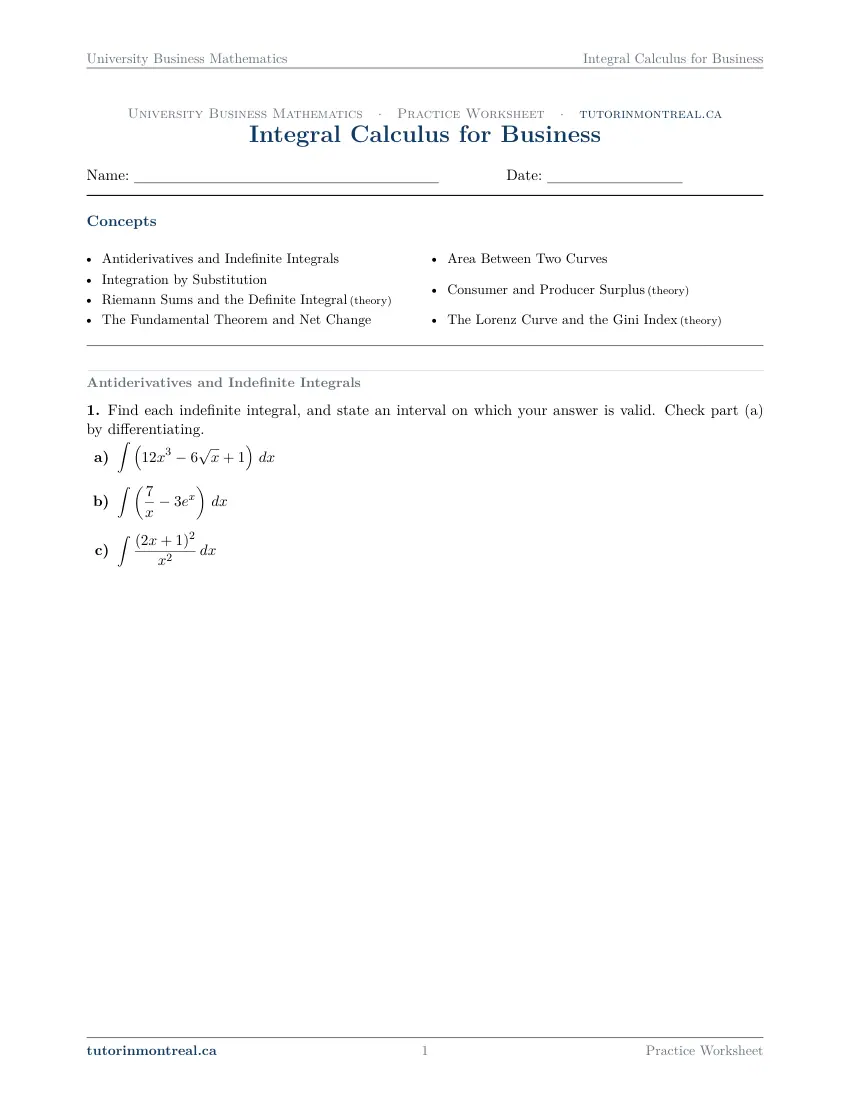
Q1Antiderivatives and Indefinite Integrals
Find each indefinite integral, and state an interval on which your answer is valid. Check part (a) by differentiating.
-
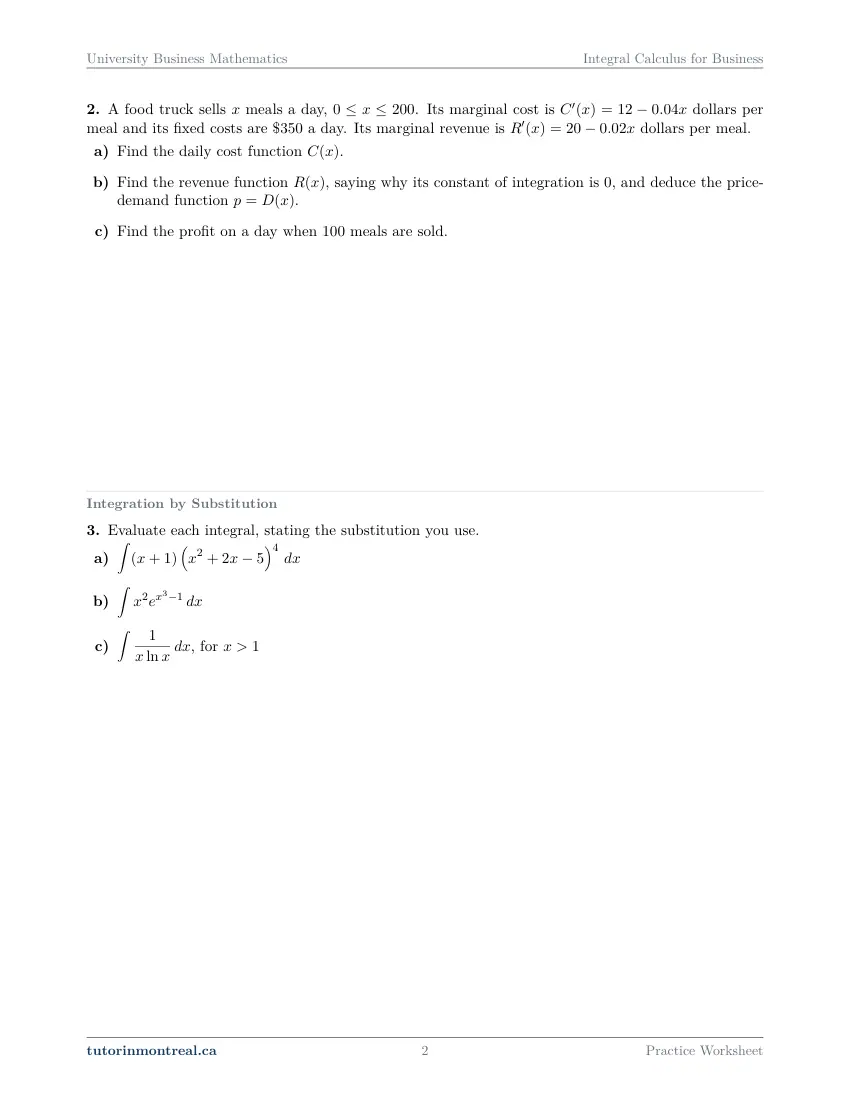
Q2Antiderivatives and Indefinite Integrals
A food truck sells meals a day, . Its marginal cost is dollars per meal and its fixed costs are $350 a day. Its marginal revenue is dollars per meal.
- Find the daily cost function .
- Find the revenue function , saying why its constant of integration is , and deduce the price-demand function .
- Find the profit on a day when meals are sold.
-
Q3Integration by Substitution
Evaluate each integral, stating the substitution you use.
- , for
-
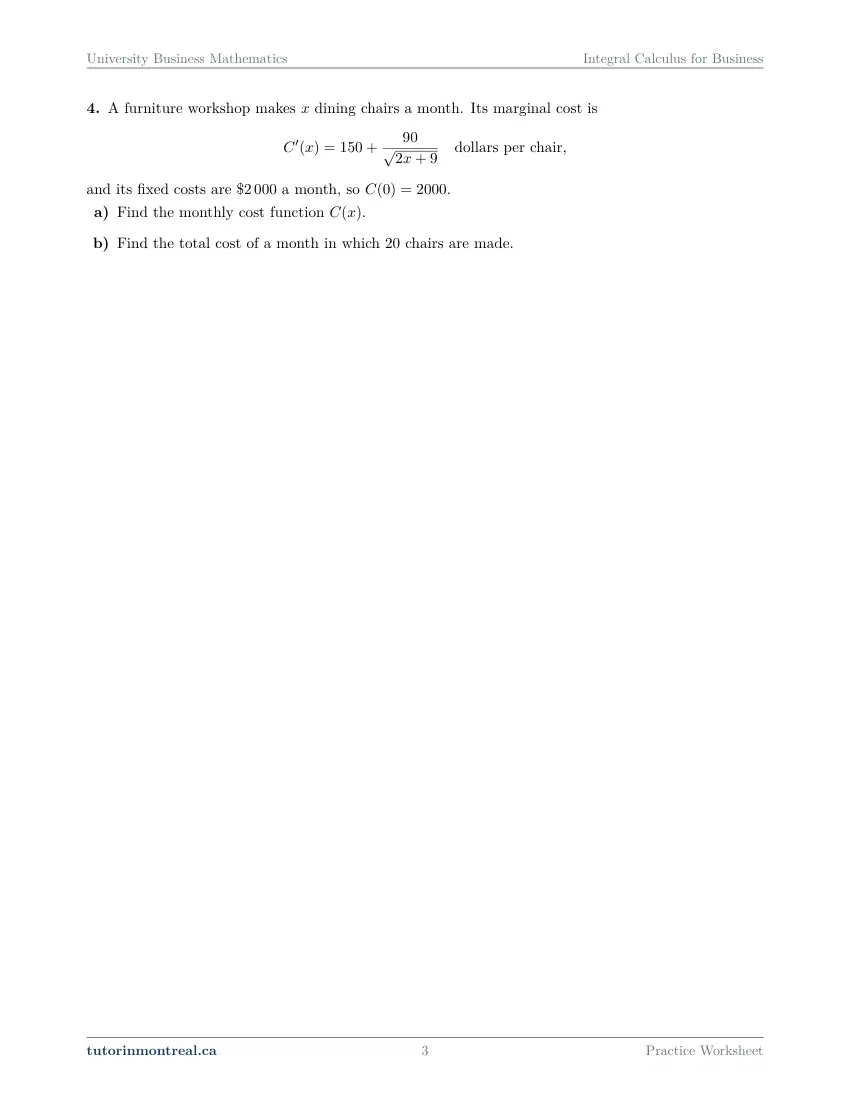
Q4Integration by Substitution
A furniture workshop makes dining chairs a month. Its marginal cost is and its fixed costs are $2 000 a month, so .
- Find the monthly cost function .
- Find the total cost of a month in which chairs are made.
-
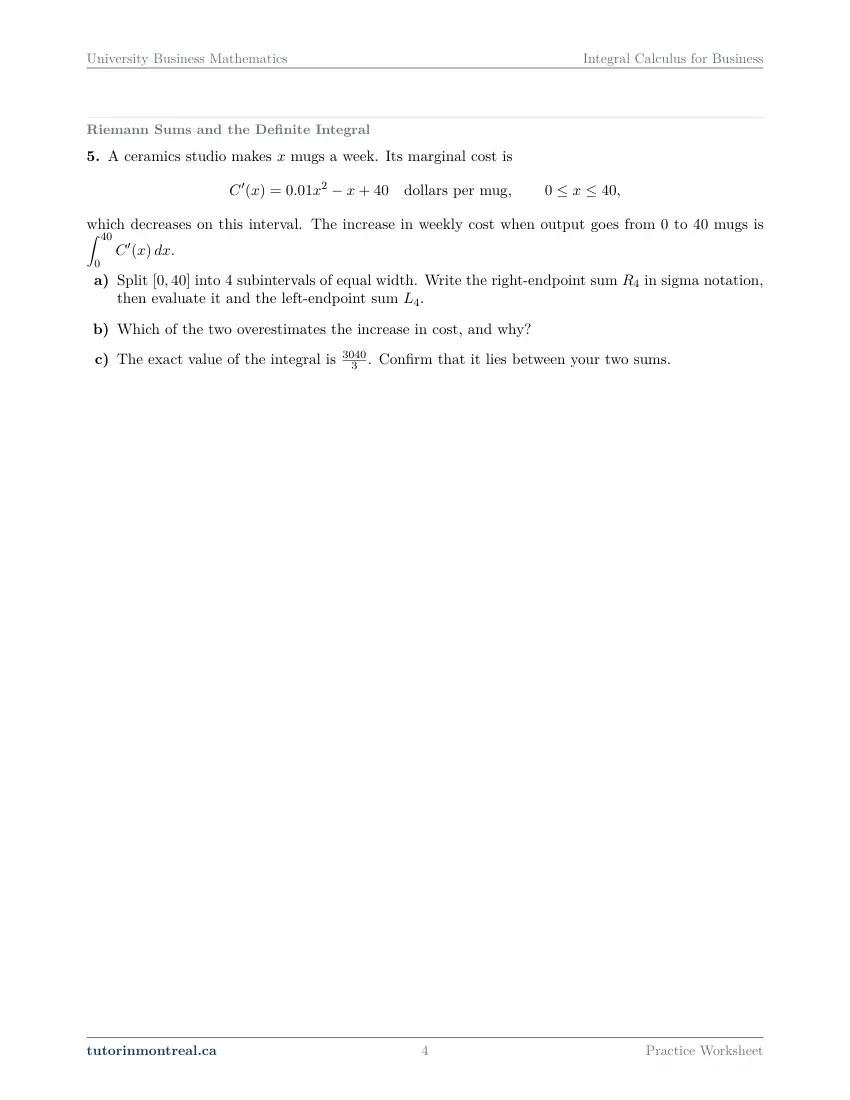
Q5Riemann Sums and the Definite Integral
A ceramics studio makes mugs a week. Its marginal cost is which decreases on this interval. The increase in weekly cost when output goes from to mugs is .
- Split into subintervals of equal width. Write the right-endpoint sum in sigma notation, then evaluate it and the left-endpoint sum .
- Which of the two overestimates the increase in cost, and why?
- The exact value of the integral is . Confirm that it lies between your two sums.
-
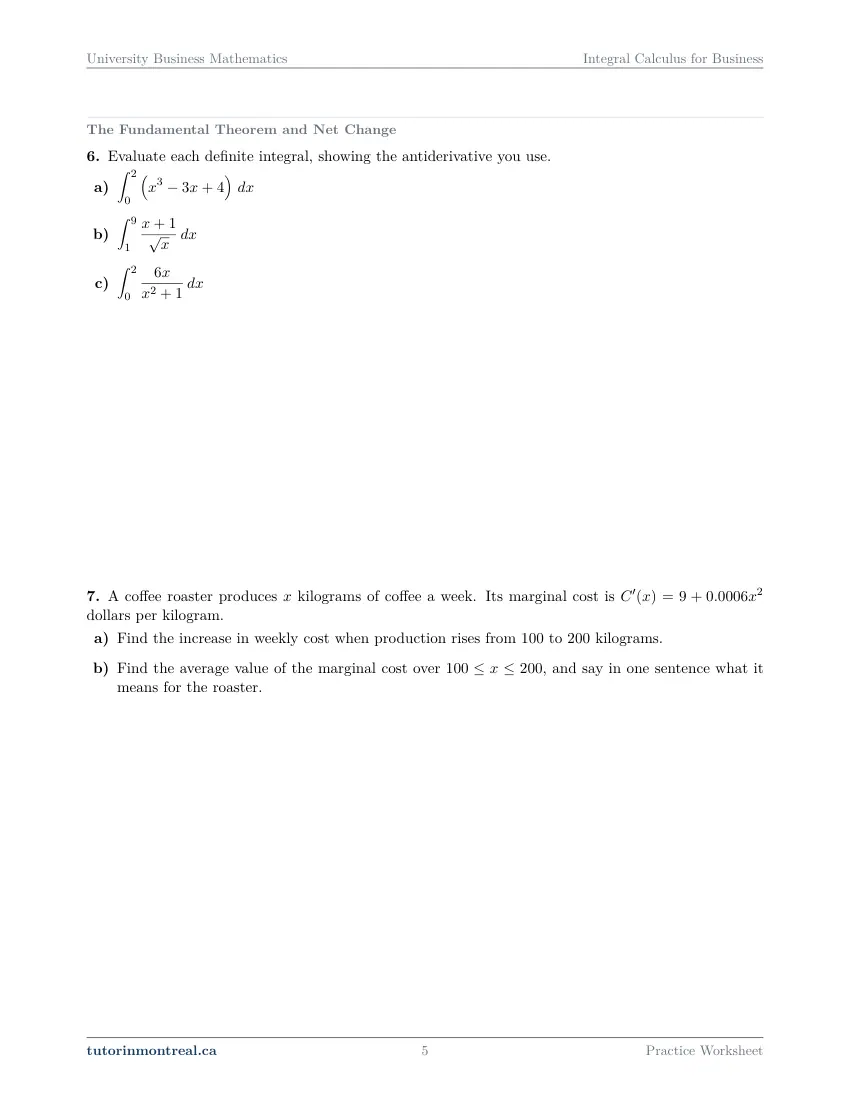
Q6The Fundamental Theorem and Net Change
Evaluate each definite integral, showing the antiderivative you use.
-
Q7The Fundamental Theorem and Net Change
A coffee roaster produces kilograms of coffee a week. Its marginal cost is dollars per kilogram.
- Find the increase in weekly cost when production rises from to kilograms.
- Find the average value of the marginal cost over , and say in one sentence what it means for the roaster.
-
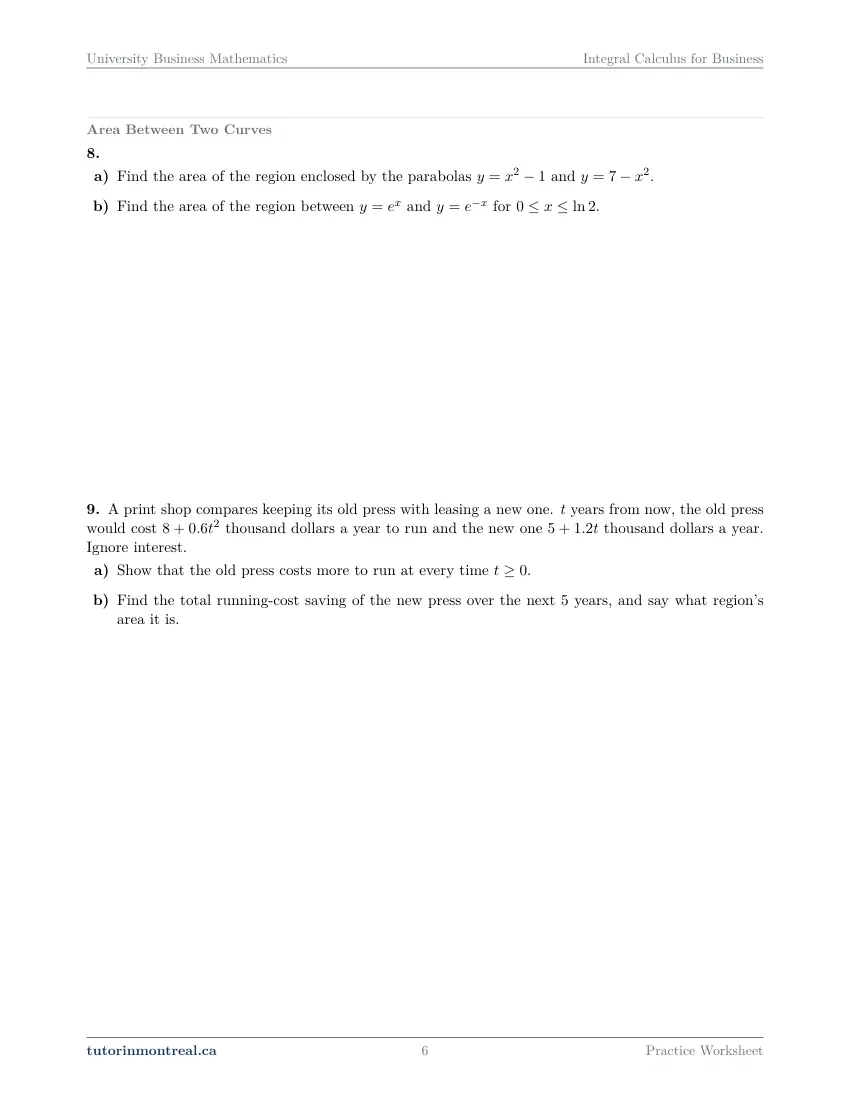
Q8Area Between Two Curves
- Find the area of the region enclosed by the parabolas and .
- Find the area of the region between and for .
-
Q9Area Between Two Curves
A print shop compares keeping its old press with leasing a new one. years from now, the old press would cost thousand dollars a year to run and the new one thousand dollars a year. Ignore interest.
- Show that the old press costs more to run at every time .
- Find the total running-cost saving of the new press over the next years, and say what region's area it is.
-
Q10Consumer and Producer Surplus
In a regional market for wireless earbuds, the price-demand and price-supply functions are where is the number of pairs in hundreds and the price in dollars. At the equilibrium the consumer surplus is and the producer surplus is .
- Find the equilibrium quantity and price.
- Find the consumer surplus and the producer surplus, exactly and in dollars. Use .
-
Q11The Lorenz Curve and the Gini Index
The distribution of annual pay among the employees of a retail chain is described by the Lorenz curve meaning that the lowest-paid fraction of employees receives the fraction of the total payroll. The Gini index is .
- Check that , and on .
- What percentage of the payroll goes to the lowest-paid half of employees?
- Find the Gini index.
-
Q12Synthesis — drawing on several topics in this unit
In a harbour-cruise market, the price-demand function is where is the number of tickets sold in a season, in thousands, and the ticket price in dollars. The market price settles where thousand tickets are sold.
- Find the market price.
- Find the consumer surplus at that price, in dollars.
The 8 challenge problems for this topic are a separate, paid sheet and are not reproduced here.
What does this set assume? This course assumes Secondary 5 mathematics only, and it is a first calculus course: its students met limits and derivatives for the first time three sets ago. This set leans on all three of those calculus sets — Limits, Derivatives and Marginal Analysis for the idea of a marginal function; Differentiation Techniques and Elasticity for the chain rule, which substitution undoes, and for the derivatives of eˣ and ln x; and Curve Analysis and Business Optimization for reading where a function rises and falls. From Functions for Business Models it takes the cost, revenue, profit and price-demand vocabulary, and the exponent and logarithm laws. Substitution is the only integration technique in the course: there is no integration by parts, no partial fractions, no improper integral, no continuous income stream and no differential equation, and no trigonometric function appears anywhere.
Which course is this for? In the public course calendars of Montreal universities, this material is part of the courses numbered MATH 122, MATH 209, MATH 10600 and MATH 10602. Each course orders and weights the topics its own way, so check your own outline for what your exam covers. Which sets match your course.
How to do every concept on this sheet
This is the part worksheet sites usually leave out. Below is the actual reasoning behind each group of questions — not a full solution set, the decisions that get you to one. Read it before you start, or after you get stuck.
Antiderivatives, and where an answer is valid
An indefinite integral is a whole family of functions, all with the same derivative, and the + C is how you write the family down. Integration here means reading the differentiation rules backwards: raise a power by one and divide by the new power, remember that the power rule stops working at exactly one exponent, and recognise eˣ and 1/x as derivatives you already know.
∫ xⁿ dx = xⁿ⁺¹ / (n + 1) + C (n ≠ −1) ∫ (1/x) dx = ln|x| + C ∫ eˣ dx = eˣ + CQ1 asks for three of these and adds two demands. First, an interval on which each answer is valid: look at the integrand, not the answer, and ask where it is defined. A square root, a 1/x and a division by x² each rule something out, and an interval must stay on one side of any point that is excluded. Second, part (a) is to be checked by differentiating — which is the check for every indefinite integral you will ever write.
There is no quotient rule for integrals. A fraction whose denominator is a single power of x, as in Q1(c), is not integrated as it stands. Expand the numerator, divide each term by the denominator, and you have a sum of powers — each of which the power rule handles. Rewrite √x as x^(1/2) before you integrate it, too.
A cost function from its marginal cost
Every business reading in this chapter starts from one sentence: the marginal cost is the derivative of the cost, so the cost is an antiderivative of the marginal cost. The integral alone gives a family; the business situation picks out one member of it.
From a marginal function to the function
Three steps, and the second is the one that gets skipped.
- 1Integrate
Antidifferentiate the marginal function and keep the + C.
- 2Find the known value
For cost, the cost of producing nothing is the fixed cost. For revenue, ask what the business takes in when it sells nothing.
- 3Solve for C and use the function
Substitute the known value, solve for the constant, then answer the question with the finished function.
Q2 does this twice, for a food truck. Part (a) builds the daily cost from its marginal cost and fixed costs. Part (b) builds revenue the same way, and asks you to say why its constant is what it is — a reason from the situation, not from algebra — and then to recover the price-demand function. Revenue is price times quantity, R = xp, so once R(x) is known the price is what you get by dividing by x. Part (c) needs both functions: profit is revenue minus cost, evaluated at the given number of meals.
Integration by substitution
Substitution is the chain rule read backwards. It works when the integrand contains a function and, as a factor, the derivative of that function — up to a constant multiple, which you can adjust for. Name the inside function u, and the integral becomes one of the basic forms in u.
The substitution routine
The same five moves each time.
- 1Choose u
Usually the expression inside a power, an exponent or a logarithm — whichever has its derivative sitting elsewhere in the integrand.
- 2Differentiate
Write du = u′(x) dx, and compare with what is left of the integrand.
- 3Fix the constant
If du matches up to a number, multiply and divide by that number. If an x is left over that is not part of du, the choice of u is wrong.
- 4Integrate in u
Every x must be gone before you integrate.
- 5Return to x
Replace u, keep the + C, and check by differentiating.
Q3 gives three integrals and asks you to state the substitution you use, so the choice is part of what is marked. Part (a) is a power of a polynomial times a factor that is a multiple of its derivative; part (b) is an exponential whose exponent is a polynomial; part (c) mixes a logarithm with 1/x, and the stated domain x > 1 is there to keep the logarithm, and the answer, meaningful.
Q4 puts substitution in a furniture workshop. The marginal cost has a square root of a linear expression in a denominator, which is a power in disguise: rewrite it with a negative fractional exponent before choosing u.
The fixed cost is not automatically the constant. After a substitution, the antiderivative you find is usually not zero at x = 0. Q4 says C(0) = 2000 in so many words: substitute x = 0 into your whole antiderivative, set it equal to the fixed cost, and solve for the constant. Writing the fixed cost straight in as + C is the most common error on this question, and it is invisible unless you check C(0).
Riemann sums, and which way an estimate leans
A definite integral of a marginal cost over a range of output is the increase in cost across that range, and before the Fundamental Theorem the way to reach it is to add up rectangles. Split the interval into n pieces of equal width Δx = (b − a)/n, take one height per piece, and add height times width.
R₄ = Σ C′(xᵢ) Δx, summed for i = 1 to 4, with xᵢ the right endpoint of the i-th pieceQ5 does this for a ceramics studio. Part (a) wants the right-endpoint sum written in sigma notation first and then evaluated, together with the left-endpoint sum. List the five endpoints before you compute anything: the left sum uses the first four, the right sum the last four, and reaching for the wrong list is the usual slip.
Deciding which sum runs high. Part (b) asks which estimate is too large, and why — and the why is the mark. Do not compare the two numbers; argue from the shape. On each piece, ask at which end the function is taller. On an increasing function that is the right end, so right rectangles overshoot their strips and left ones fall short. The question tells you which way this marginal cost moves on the interval: say so, name the endpoint where each piece is tallest, and the answer follows in one sentence.
Part (c) gives the exact value of the integral and asks you to confirm it lies between your two sums. That is the check that your part (b) reasoning and your arithmetic agree.
The Fundamental Theorem and net change
The theorem replaces the limit of sums with one subtraction: find any antiderivative F of f, and the integral over [a, b] is F(b) − F(a). No + C is needed, because it would cancel.
∫ₐᵇ f(x) dx = F(b) − F(a) ∫ₐᵇ C′(x) dx = C(b) − C(a)Q6 asks for three definite integrals, showing the antiderivative each time. Part (a) is a polynomial. Part (b) is a fraction over √x: split it into two powers of x first, exactly as in Q1(c). Part (c) needs a substitution, and a definite integral gives you a choice — change the limits to values of u and never return to x, or return to x and use the original limits. Do one or the other; mixing them, with u-limits on an x-antiderivative, is the error.
Q7 is the business reading. For the coffee roaster, the integral of the marginal cost between two production levels is the extra weekly cost of producing the extra coffee — no fixed cost is needed, because it cancels in the subtraction. Part (b) asks for the average value of the marginal cost over the same range.
average value of f on [a, b] = (1 / (b − a)) ∫ₐᵇ f(x) dxSay what it means in the units. An average of a marginal cost is measured in dollars per kilogram, and it is an average over a range of output, not over time. The one-sentence interpretation Q7(b) asks for should name the units and the range, and connect the number to the total you found in part (a).
Area between two curves
The area between two curves is the integral of the top curve minus the bottom one. Everything that can go wrong goes wrong in deciding the interval or deciding which curve is on top.
Setting up an area
Decide, then integrate.
- 1The interval
If the region is enclosed by the curves, its ends are where they meet: set the two expressions equal and solve. If the interval is given, use it.
- 2Top and bottom
Evaluate both functions at one point strictly inside the interval. If they do not cross inside it, the one that is larger there is larger throughout.
- 3Integrate the difference
∫ₐᵇ (top − bottom) dx. An area is never negative; a negative result means top and bottom were swapped.
Q8(a) is an enclosed region between two parabolas, so its limits come from solving for the points of intersection. Q8(b) gives the interval, with an upper limit written as a logarithm: evaluate eˣ and e⁻ˣ at that limit with the law e^(ln a) = a rather than with a calculator, and test a point to find which exponential is on top.
Q9 is the same idea for a print shop comparing two presses. Part (a) asks you to show that one running cost is larger at every time t ≥ 0: subtract the two, and show the difference is positive for every t — a quadratic that never reaches zero is the tool, and either its discriminant or completing the square settles it. Part (b) asks for the saving over a period and for the region whose area it is; that region is bounded by the two cost curves and two vertical lines, and the answer should say which.
Consumer and producer surplus
At the market equilibrium, supply meets demand at a quantity x̄ and a price p̄. Consumers who would have paid more than p̄ keep the difference, and the total of what they keep is the area between the demand curve and the horizontal line at p̄. Producers who would have sold for less keep the area between that line and the supply curve.
CS = ∫₀^x̄ (D(x) − p̄) dx PS = ∫₀^x̄ (p̄ − S(x)) dxQ10 sets up a market for wireless earbuds. Part (a) finds the equilibrium by setting D(x) = S(x): clear the denominator, and the equation becomes a quadratic. A quantity sold cannot be negative, so only one root is the equilibrium. The price then comes from either function — compute it from both, as a check.
Read the units before you answer. In Q10 the quantity is measured in hundreds of pairs, so an integral of price times quantity comes out in dollars times hundreds. Part (b) asks for each surplus exactly and in dollars, which means converting at the end. The demand function is a constant over a linear expression, so its integral is a logarithm, and the question supplies the value of the logarithm you need.
The Lorenz curve and the Gini index
A Lorenz curve L(x) says what fraction of the total the lowest-paid fraction x of people receives. Perfect equality is the line L(x) = x, and the further a curve sags below that line the more unequal the distribution. The Gini index doubles the region that lies under the line of equality and over the Lorenz curve, which puts it between 0 (perfect equality) and 1.
Q11 describes a retail chain's payroll. Part (a) checks that the given L is a legitimate Lorenz curve: evaluate at both ends, then show L(x) ≤ x on [0, 1] by writing x − L(x) as one polynomial, factoring it, and reading its sign from the factors. Part (b) is a reading of the definition — the lowest-paid half means x = 0.5 — converted to a percentage. Part (c) is the integral in the formula given, a polynomial integral with no technique needed.
Check the Gini index against the picture. It must lie between 0 and 1. A value outside that range means the curve and the line were swapped or the factor 2 was dropped; a value very close to 0 should match a Lorenz curve that hugs the line.
The synthesis question
Q12 brings the set together in a harbour-cruise market with a demand function that is a constant over a square root. Part (a) reads the market price off the demand function at the given quantity. Part (b) is the consumer surplus integral — and D(x) is exactly the kind of function Q4 taught you to integrate: rewrite the root as a power, substitute for the linear expression under it, and either change the limits or return to x, as in Q6(c). The quantity is in thousands of tickets, so the last step, as in Q10, is a conversion to dollars.
Preview all 9 pages
Click any page to open the full PDF.
Getting the most out of it
Differentiate every indefinite integral you write
It takes a few seconds and it catches a wrong power, a lost constant from a substitution and a sign error all at once. Q1 asks for it once; make it a habit on every question.
Pin the constant with the business, not with a guess
Before integrating a marginal function, write down the one value you know — the fixed cost, the revenue at zero sales — and after integrating, substitute it into the whole antiderivative. Q2 and Q4 are both decided at this step.
Draw the region before you write an integral
For an area, a surplus or a Gini index, a rough sketch tells you the limits and which curve is on top, and it tells you whether your final number is plausible. Three minutes on the sketch saves an integral of the wrong difference.
Finish with the units
Every applied question here measures quantity in some unit — meals, chairs, kilograms, hundreds of pairs, thousands of tickets — and wants a total in dollars. State the units of the number you found before you decide it is the answer.
Want the solutions, or something more challenging?
The worksheet, the questions above and every explanation on this page stay free permanently. Three more PDFs exist for this topic — the worked answer key, a harder problem set, and the answer key to that. They come with the University Business Math Solutions Bundle, beside the unit notes and the unit test, which is what keeps the rest of the series free.
What else exists for Integral Calculus for Business
Three PDFs · 14 pages · all three are in the bundle below.
- Answer key — 3 pages. All 12 questions worked step by step, including the restrictions and the justifications. Not a list of final answers.
- Challenge problems — 8 pages, 8 problems. A separate sheet at exam-plus difficulty covering the same 7 concepts. Harder than anything on the free sheet.
- Challenge answer key — 3 pages. Every challenge problem worked to the same standard, with the checks shown.
- PDF, letter size, print-ready.
The one thing that's for sale
Every University Business Math topic — the complete Solutions Bundle
One download, one payment, the whole program. For all 9 University Business Math units: the worksheet, the reference notes, the challenge set, the unit test and every answer key — including this one.
- Worked solutions, not answer lists — every step written out
- Covers the whole year's program at this level
- Less than the price of one hour of tutoring — for the entire year's solutions
Taking Secondary 1 Math as well? The Secondary 1 Math bundle covers all 15 of its units — 106 PDFs, 474 pages — on the same terms.
Taking Secondary 2 Math as well? The Secondary 2 Math bundle covers all 14 of its units — 98 PDFs, 449 pages — on the same terms.
Taking Secondary 3 Math as well? The Secondary 3 Math bundle covers all 11 of its units — 77 PDFs, 367 pages — on the same terms.
Taking Secondary 4 Math as well? The Secondary 4 Math bundle covers all 17 of its units — 122 PDFs, 466 pages — on the same terms.
Taking Secondary 5 Math as well? The Secondary 5 Math bundle covers all 21 of its units — 147 PDFs, 589 pages — on the same terms.
Taking CEGEP Calculus I as well? The CEGEP Calculus I bundle covers all 9 of its units — 72 PDFs, 371 pages — on the same terms.
Taking CEGEP Calculus II as well? The CEGEP Calculus II bundle covers all 8 of its units — 64 PDFs, 335 pages — on the same terms.
Taking CEGEP Linear Algebra as well? The CEGEP Linear Algebra bundle covers all 7 of its units — 56 PDFs, 298 pages — on the same terms.
Taking University Calculus III as well? The University Calculus III bundle covers all 9 of its units — 72 PDFs, 516 pages — on the same terms.
Taking University Linear Algebra as well? The University Linear Algebra bundle covers all 9 of its units — 72 PDFs, 496 pages — on the same terms.
Taking University Differential Equations as well? The University Differential Equations bundle covers all 9 of its units — 36 PDFs, 182 pages — on the same terms.
Taking University Introductory Statistics as well? The University Introductory Statistics bundle covers all 9 of its units — 36 PDFs, 186 pages — on the same terms.
Taking University Discrete Math as well? The University Discrete Math bundle covers all 9 of its units — 36 PDFs, 155 pages — on the same terms.
Taking AP Calculus AB as well? The AP Calculus AB bundle covers all 8 of its units — 64 PDFs, 527 pages — on the same terms.
Common questions
Is this worksheet really free?
Yes — the questions are on this page to read, and the PDF downloads directly, no email and no account. The one paid item is optional: the complete University Business Mathematics Solutions Bundle, which covers every set at this level.
Which university courses is this for?
The course codes listed on this page are taken from the public course calendars of universities that teach mathematics to management and commerce students. Each course orders and weights the chapters its own way, and some reach a chapter later or not at all — so check the outline for your own section to see where this set falls in your term.
What do I need to know before starting this set?
Derivatives, including the chain rule and the derivatives of eˣ and ln x; marginal cost, revenue and profit; and the exponent and logarithm laws. The earlier sets of this course — Limits, Derivatives and Marginal Analysis and Differentiation Techniques and Elasticity — cover all of it.
Why does the + C matter if it disappears in a definite integral?
In a definite integral it cancels, because it appears in both F(b) and F(a). In an indefinite integral it is the whole difference between one cost function and another, so a business question fixes it with a known value such as the fixed cost.
How do I know when substitution will work?
Look for a function inside another one — inside a power, an exponent or a logarithm — whose derivative also appears in the integrand as a factor, up to a constant. If choosing u leaves an x behind that is not part of du, try a different u.
Is integration by parts in this course?
No. Substitution is the only technique, and every integral on this set is either a basic form or a substitution away from one. Integration by parts and partial fractions belong to CEGEP Calculus II.
What is the difference between a Riemann sum and a definite integral?
A Riemann sum is an estimate built from finitely many rectangles; the definite integral is the exact value those sums approach as the rectangles get thinner. The Fundamental Theorem then lets you compute the exact value from an antiderivative.
What does a Gini index actually measure?
How far a distribution of income or pay is from perfect equality. It is 0 when everyone receives the same share and grows towards 1 as the total is concentrated among fewer people, which is why it is twice the area between the Lorenz curve and the line of equality.
Can teachers use this in class?
Yes. Print and photocopy it for your own classes freely — I just ask that the tutorinmontreal.ca footer stays on the page.
I'm stuck on one question. Can you help?
Yes — through one-on-one tutoring, in Montreal or online. Get in touch to arrange a session, or see the current rates.
← All 9 University Business Math worksheets · Secondary 1 Math series (15 sheets) → · Secondary 2 Math series (14 sheets) → · Secondary 3 Math series (11 sheets) → · Secondary 4 Math series (17 sheets) → · Secondary 5 Math series (21 sheets) → · CEGEP Calculus I series (9 sheets) → · CEGEP Calculus II series (8 sheets) → · CEGEP Linear Algebra series (7 sheets) → · University Calculus III series (9 sheets) → · University Linear Algebra series (9 sheets) → · University Differential Equations series (9 sheets) → · University Introductory Statistics series (9 sheets) → · University Discrete Math series (9 sheets) → · AP Calculus AB series (8 sheets) →