University Business Mathematics — Mathematics of Finance Worksheet
The finance chapter from its foundation to its payoff. Arithmetic and geometric sequences and their finite sums, because every annuity formula is one of those sums; simple interest charged by the exact day, and a treasury bill priced from a yield; compound interest and the periodic rate; present value and the effective annual rate that makes two quoted rates comparable; continuous compounding, and logarithms to find the time a goal takes; the future value of a stream of deposits and the sinking fund that builds one; the present value of a stream of payments and the schedule that shows a loan being paid off. Have a look on this page, then print the free PDF when you want to write on it.
Practice worksheet — free PDF
No email, no account, no watermark. Teachers: photocopy it for your classes freely. Worked solutions and 9 harder problems come with the University Business Math bundle.
All 13 questions
Each question targets one named concept from the sheet. Read them here, or print the PDF — it has working space under each one.
-
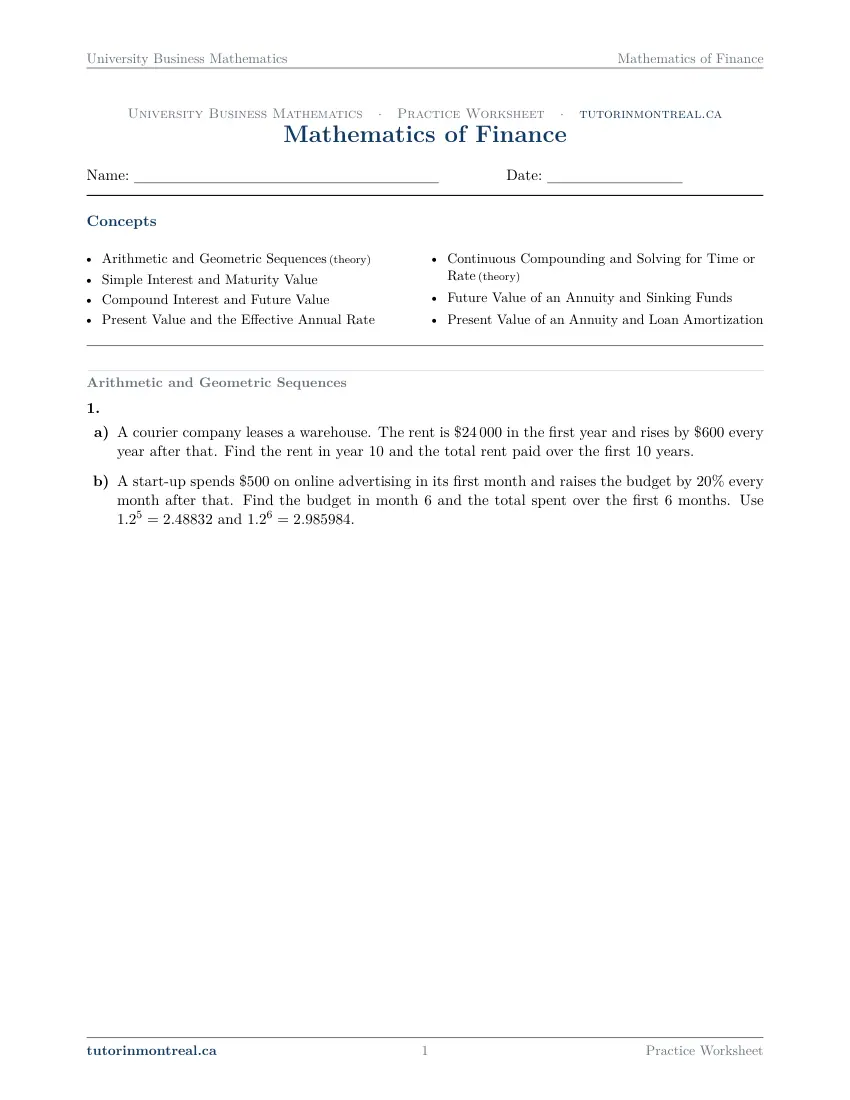
Q1Arithmetic and Geometric Sequences
- A courier company leases a warehouse. The rent is $24 000 in the first year and rises by $600 every year after that. Find the rent in year and the total rent paid over the first years.
- A start-up spends $500 on online advertising in its first month and raises the budget by every month after that. Find the budget in month and the total spent over the first months. Use and .
-
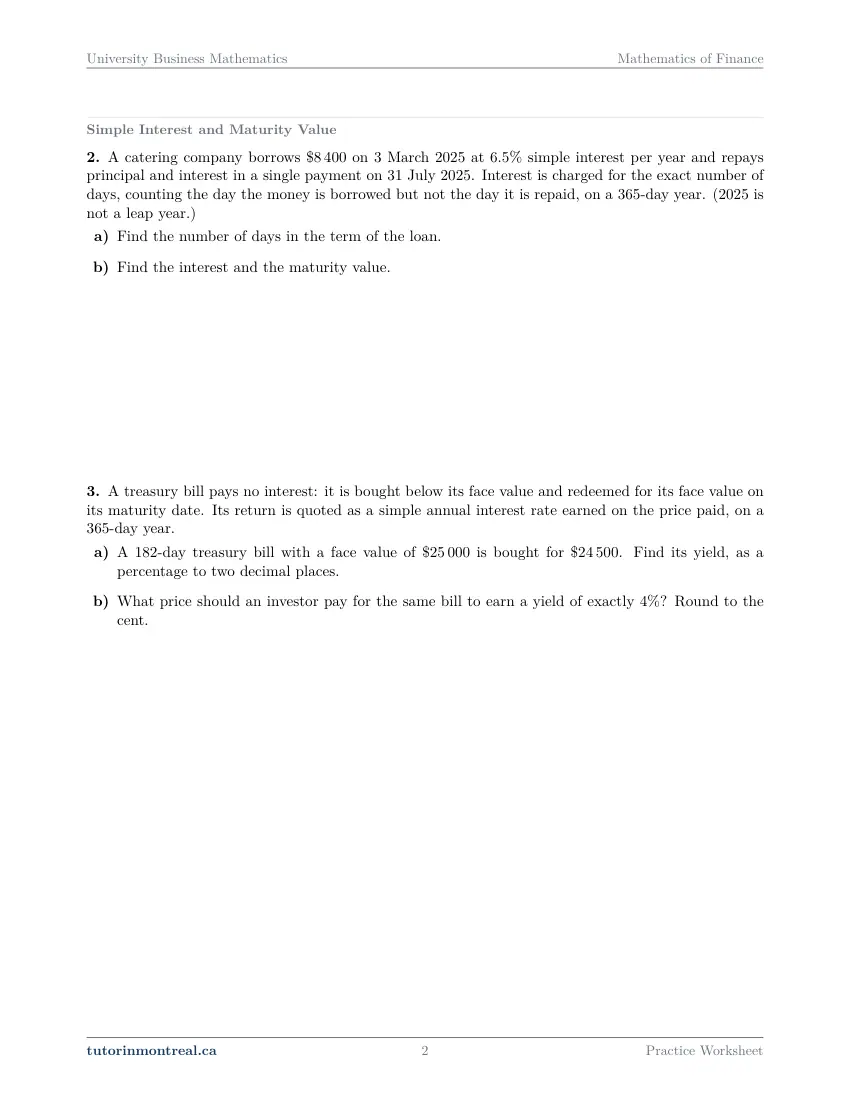
Q2Simple Interest and Maturity Value
A catering company borrows $8 400 on 3 March 2025 at simple interest per year and repays principal and interest in a single payment on 31 July 2025. Interest is charged for the exact number of days, counting the day the money is borrowed but not the day it is repaid, on a -day year. (2025 is not a leap year.)
- Find the number of days in the term of the loan.
- Find the interest and the maturity value.
-
Q3Simple Interest and Maturity Value
A treasury bill pays no interest: it is bought below its face value and redeemed for its face value on its maturity date. Its return is quoted as a simple annual interest rate earned on the price paid, on a -day year.
- A -day treasury bill with a face value of $25 000 is bought for $24 500. Find its yield, as a percentage to two decimal places.
- What price should an investor pay for the same bill to earn a yield of exactly ? Round to the cent.
-
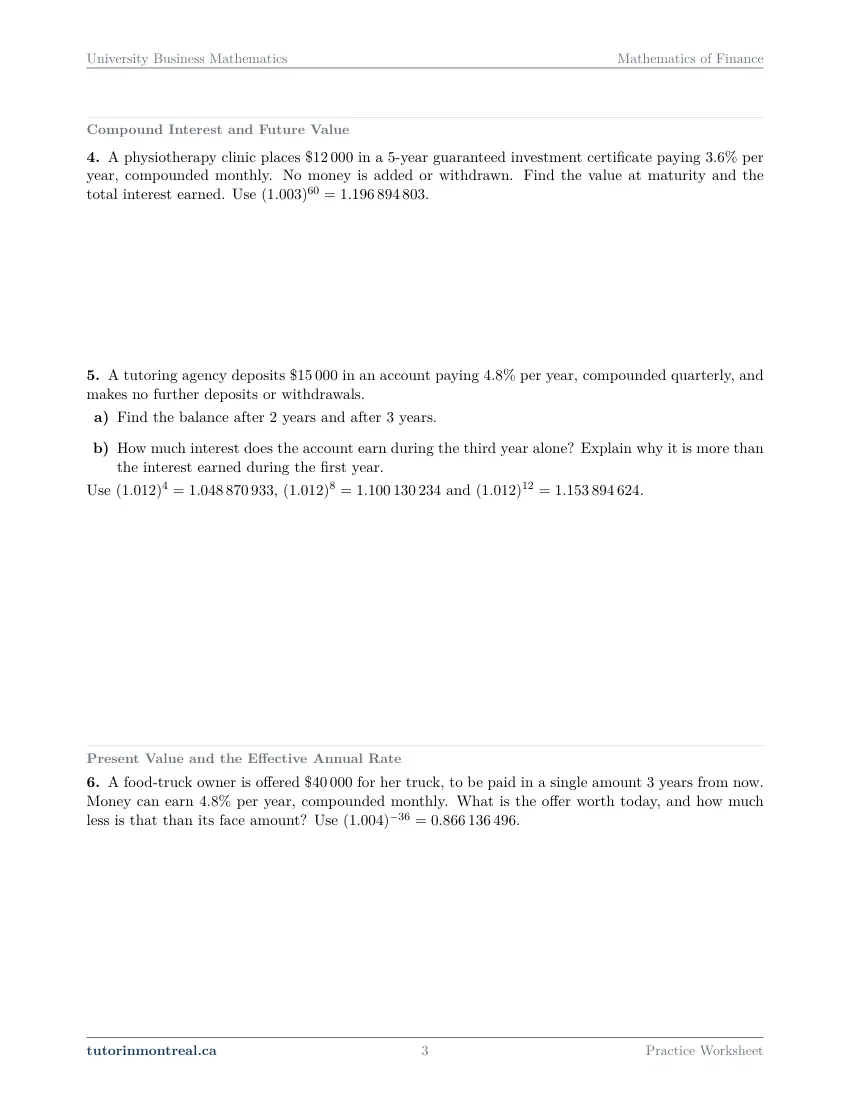
Q4Compound Interest and Future Value
A physiotherapy clinic places $12 000 in a -year guaranteed investment certificate paying per year, compounded monthly. No money is added or withdrawn. Find the value at maturity and the total interest earned. Use .
-
Q5Compound Interest and Future Value
A tutoring agency deposits $15 000 in an account paying per year, compounded quarterly, and makes no further deposits or withdrawals.
- Find the balance after years and after years.
- How much interest does the account earn during the third year alone? Explain why it is more than the interest earned during the first year.
Use , and .
-
Q6Present Value and the Effective Annual Rate
A food-truck owner is offered $40 000 for her truck, to be paid in a single amount years from now. Money can earn per year, compounded monthly. What is the offer worth today, and how much less is that than its face amount? Use .
-
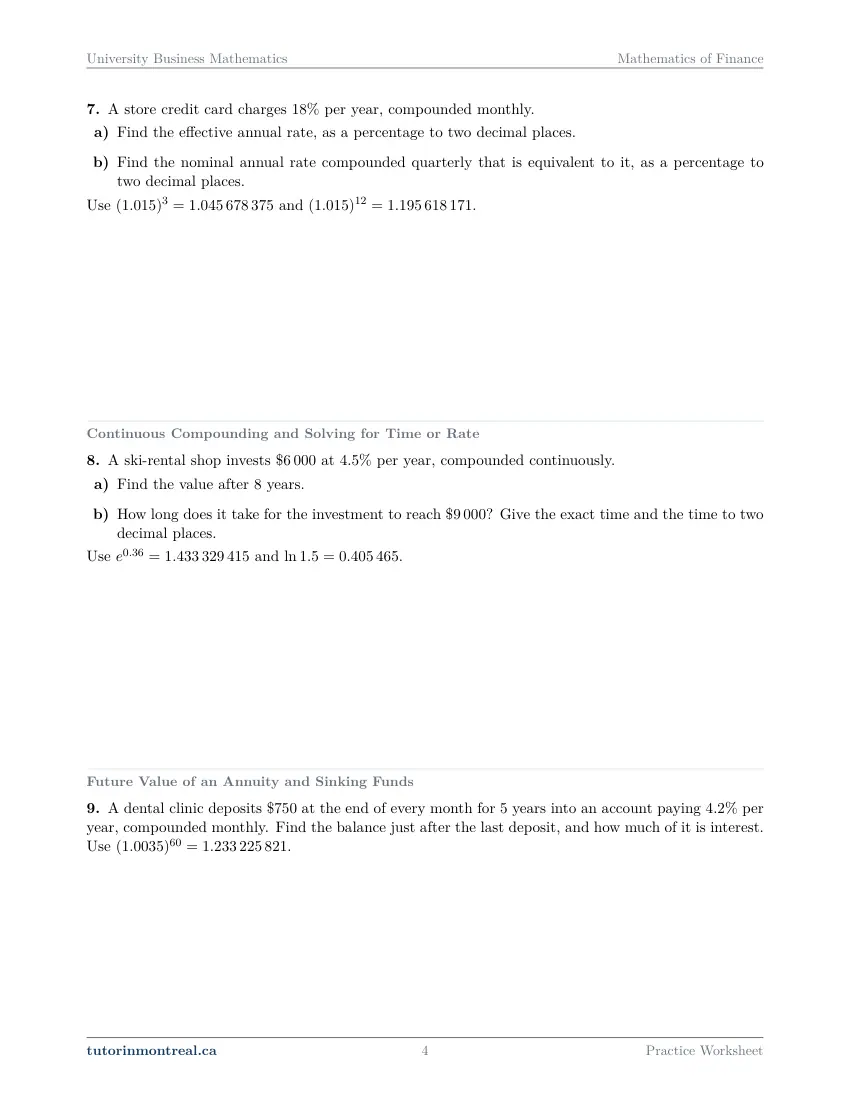
Q7Present Value and the Effective Annual Rate
A store credit card charges per year, compounded monthly.
- Find the effective annual rate, as a percentage to two decimal places.
- Find the nominal annual rate compounded quarterly that is equivalent to it, as a percentage to two decimal places.
Use and .
-
Q8Continuous Compounding and Solving for Time or Rate
A ski-rental shop invests $6 000 at per year, compounded continuously.
- Find the value after years.
- How long does it take for the investment to reach $9 000? Give the exact time and the time to two decimal places.
Use and .
-
Q9Future Value of an Annuity and Sinking Funds
A dental clinic deposits $750 at the end of every month for years into an account paying per year, compounded monthly. Find the balance just after the last deposit, and how much of it is interest. Use .
-
Q10Future Value of an Annuity and Sinking Funds
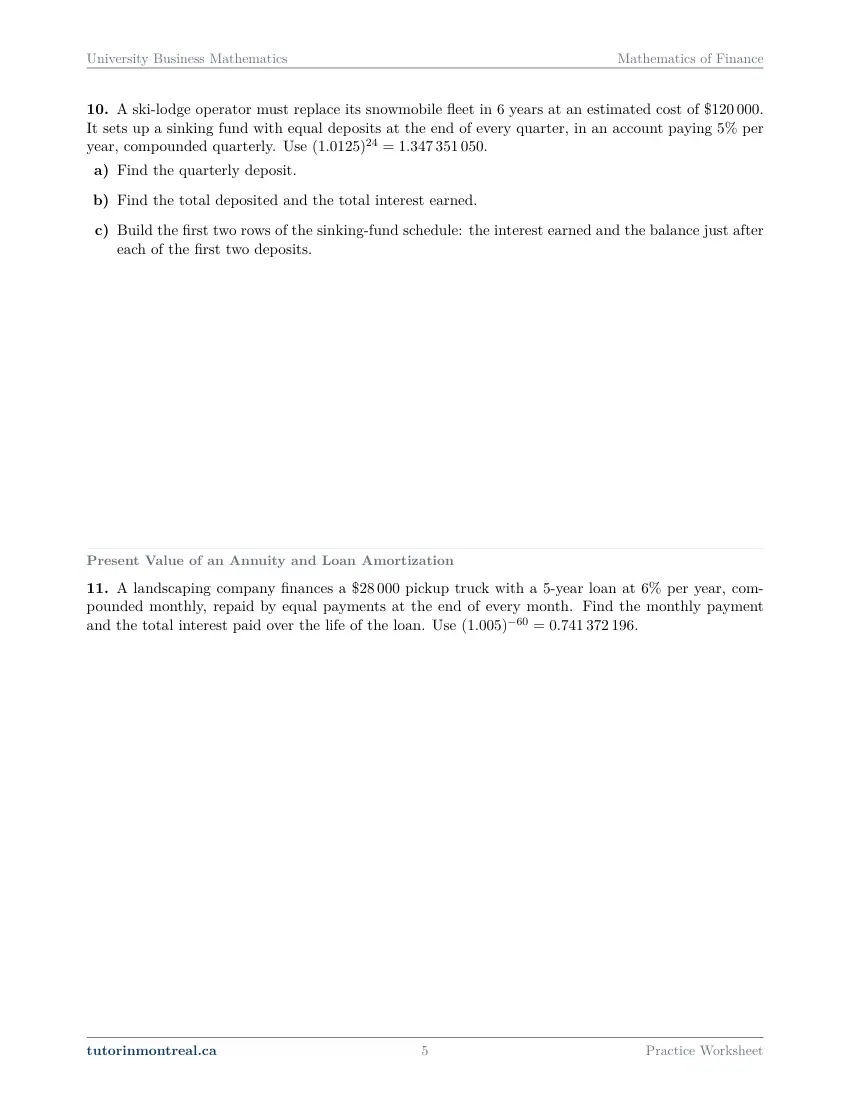
A ski-lodge operator must replace its snowmobile fleet in years at an estimated cost of $120 000. It sets up a sinking fund with equal deposits at the end of every quarter, in an account paying per year, compounded quarterly. Use .
- Find the quarterly deposit.
- Find the total deposited and the total interest earned.
- Build the first two rows of the sinking-fund schedule: the interest earned and the balance just after each of the first two deposits.
-
Q11Present Value of an Annuity and Loan Amortization
A landscaping company finances a $28 000 pickup truck with a -year loan at per year, compounded monthly, repaid by equal payments at the end of every month. Find the monthly payment and the total interest paid over the life of the loan. Use .
-
Q12Present Value of an Annuity and Loan Amortization
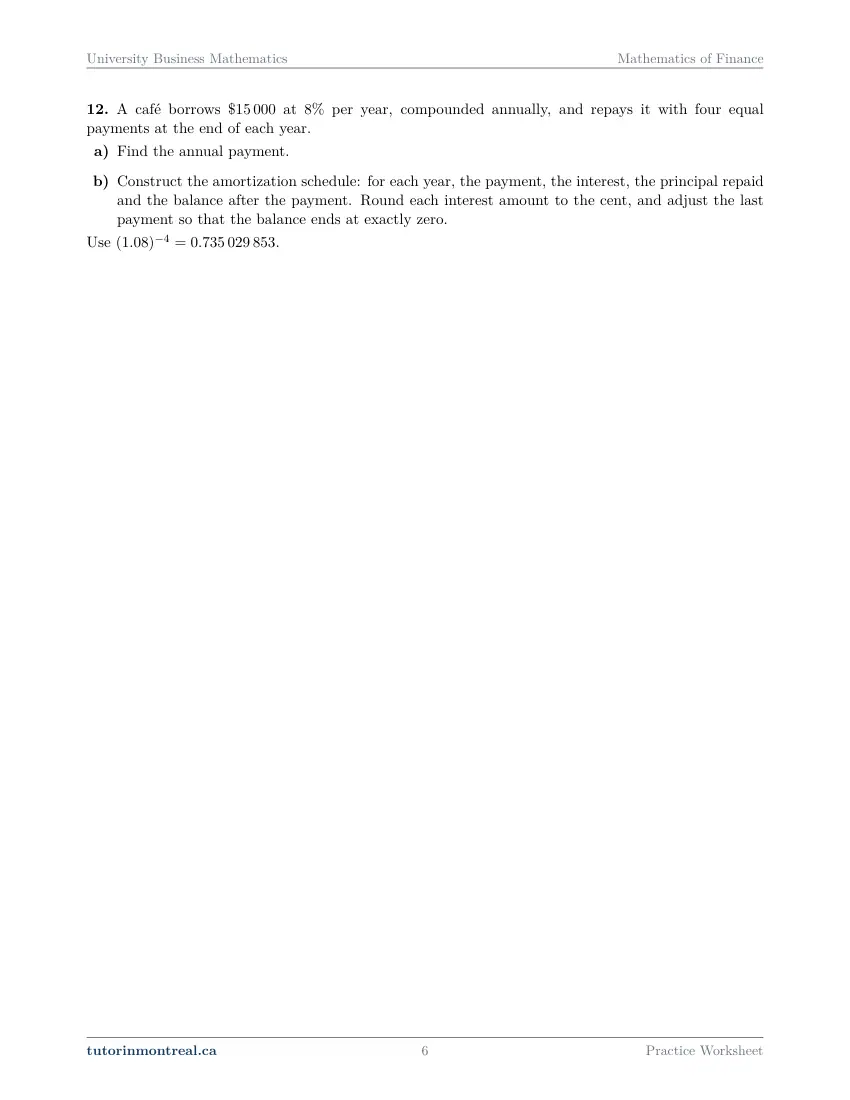
A café borrows $15 000 at per year, compounded annually, and repays it with four equal payments at the end of each year.
- Find the annual payment.
- Construct the amortization schedule: for each year, the payment, the interest, the principal repaid and the balance after the payment. Round each interest amount to the cent, and adjust the last payment so that the balance ends at exactly zero.
Use .
-
Q13Synthesis — drawing on several topics in this unit
A water-taxi operator saves for a down payment by depositing $3 000 at the end of every quarter for years in an account paying per year, compounded quarterly. Then it uses the whole balance as a down payment on a $180 000 boat and finances the rest with a -year loan at per year, compounded monthly, repaid by equal payments at the end of every month.
- Find the down payment.
- Find the amount financed and the monthly loan payment.
Use and .
The 9 challenge problems for this topic are a separate, paid sheet and are not reproduced here.
What does this set assume? This set assumes Secondary 5 mathematics and nothing past it — no limits and no derivatives, which this course only begins in Limits, Derivatives and Marginal Analysis. It leans on the laws of exponents, on percentages written as decimals, and on the first set, Functions for Business Models: exponential functions, the number e, the laws of logarithms and solving an exponential equation by taking a logarithm of both sides. Every question supplies the powers it needs, so the arithmetic is never the obstacle and the set-up is the whole exercise. Scope is deliberately ordinary: annuities pay at the end of each period, with the payment period equal to the compounding period. Annuities due, deferred annuities, bonds and perpetuities are not here, and sequences stop at finite sums — infinite series and convergence belong to CEGEP Calculus II. Exponential growth is a formula to evaluate and to solve with logarithms, never a differential equation.
Which course is this for? In the public course calendars of Montreal universities, this material is part of the courses numbered MATH 208, MATH 209, MATH 10602 and MAT1002. Each course orders and weights the topics its own way, so check your own outline for what your exam covers. Which sets match your course.
How to do every concept on this sheet
This is the part worksheet sites usually leave out. Below is the actual reasoning behind each group of questions — not a full solution set, the decisions that get you to one. Read it before you start, or after you get stuck.
Arithmetic and geometric sequences
Two kinds of pattern run through all of finance. In an arithmetic sequence the same amount is added each step; in a geometric one each term is the previous one multiplied by the same ratio. Q1 sets one of each in a business context: a rent that rises by a fixed amount each year, and an advertising budget that rises by a fixed percentage each month.
arithmetic: aₙ = a + (n − 1)d Sₙ = (n/2)[2a + (n − 1)d] geometric: aₙ = a·rⁿ⁻¹ Sₙ = a(rⁿ − 1)/(r − 1)A fixed amount or a fixed percentage decides the model. "Rises by" a number of dollars each year is a common difference d. "Rises by" a percentage is a common ratio r = 1 + the rate as a decimal — a 20% rise multiplies by 1.2, not by 0.2.
The nth term uses one power fewer than the sum. The first term has not been multiplied yet, so term n carries rⁿ⁻¹ while the sum of n terms carries rⁿ. Q1(b) hands you two powers of 1.2: decide which formula needs which before you substitute.
Simple interest and maturity value
Simple interest is earned on the original principal only, for the time the money is out, measured in years.
I = Prt S = P + I = P(1 + rt)Q2 gives the dates, not the time. Count the days first: the days left in the starting month, counting the day of borrowing, then every full month in between, then the days of the last month, not counting the day of repayment. Write the count month by month so it can be checked. Only then divide by 365 to get t in years, and find the interest and the maturity value.
Divide the days, not the rate. Keep r as the annual rate and turn the days into a fraction of a year. Rounding t to a decimal before multiplying loses cents; keep the fraction days/365 until the last step.
Q3 runs simple interest through a treasury bill, which pays no coupon: the whole return is the gap between the price paid and the face value received at maturity. Part (a) asks for the rate: the gain is the interest, the price is the principal, and t is the term in days over 365, so solve I = Prt for r. Part (b) runs the other way — the face value is the maturity value S, and the price is the principal that grows into it at the target yield, P = S/(1 + rt).
Compound interest and future value
Under compound interest the interest is added to the balance at the end of every period and earns interest from then on. Everything depends on getting the periodic rate and the number of periods right.
Setting up a compound-interest question
Three quantities, fixed before any arithmetic.
- 1The periodic rate i
The nominal annual rate divided by the number of compounding periods in a year: m = 12 for monthly, 4 for quarterly.
- 2The number of periods n
Periods per year times the number of years — never the number of years alone.
- 3The direction
Forward in time multiplies by (1 + i)ⁿ; backward in time multiplies by (1 + i)⁻ⁿ.
Q4 is the model at its cleanest: a monthly periodic rate, five years of months, and the power supplied. Check that the power you were given is the one your i and n call for — that match is your confirmation the set-up is right.
Q5 asks for the balance at two dates and then for the interest earned in one year only. The interest in the third year is the balance at the end of the third year minus the balance at the end of the second — not the interest on the original deposit. For the explanation in part (b), compare what the first year's interest is calculated on with what the third year's is calculated on.
Present value
Present value runs the compound-interest model backwards: the amount that, invested today at the given rate, grows into a stated future amount. It is how money promised at different dates is compared — only amounts at the same date can be added or compared.
P = S(1 + i)⁻ⁿQ6 values an offer paid in one amount three years away. Set up i and n exactly as for a future value, discount with the supplied negative power, and then compare today's value with the face amount — the difference is the cost of waiting.
The effective annual rate and equivalent rates
A nominal rate compounded monthly and the same nominal rate compounded quarterly do not grow money equally. The effective annual rate is the rate compounded once a year that does the same thing as the quoted rate — the common yardstick.
effective rate = (1 + r/m)ᵐ − 1Q7(a) is the formula with m = 12. Q7(b) runs it the other way: two rates are equivalent when they grow one dollar to the same amount in one year, so set (1 + j/4)⁴ equal to the one-year growth factor at the monthly rate and solve for j. The powers supplied tell you how: a quarter is three months, so one quarter's growth factor at the monthly rate is a cube.
Equate growth factors, not rates. Two rates are compared through what they do to money over the same stretch of time. Dividing or multiplying a nominal rate by a number of periods never converts it to another compounding frequency.
Continuous compounding and solving for time or rate
As the compounding periods shrink, (1 + r/m)ᵐᵗ approaches eʳᵗ. Continuous compounding uses that limit directly, with r the annual rate as a decimal and t in years; there is no periodic rate and no n.
S = PeʳᵗQ8(a) is a substitution: rt is the exponent, and the power supplied is that value of e raised to it. Q8(b) turns it round: the unknown is in the exponent, so isolate the power of e first, dividing the target by the principal, then take the natural logarithm of both sides.
Solving for the time
The same three moves for continuous or discrete compounding.
- 1Isolate the growth factor
eʳᵗ = S/P, or (1 + i)ⁿ = S/P. Divide before you take a logarithm, never after.
- 2Take ln of both sides
ln(eʳᵗ) = rt; ln((1 + i)ⁿ) = n·ln(1 + i). The exponent comes down as a factor.
- 3Divide, and read the question
The exact answer keeps the logarithm unevaluated; the decimal comes from the value supplied. For discrete compounding, n counts periods, so convert to years at the end.
Solving for a rate uses the same isolation step, then a root or a logarithm, depending on whether the unknown is in the base or the exponent.
The future value of an annuity and sinking funds
An ordinary annuity is a string of equal payments R at the end of every period. Its future value is each payment carried forward to the date of the last one, and those amounts form a finite geometric sequence with ratio 1 + i — which is why Q1's sum formula comes first.
S = R·[(1 + i)ⁿ − 1]/iQ9 is the formula directly, with a monthly deposit, a monthly rate and five years of months. The interest is the balance minus the total deposited, and the total deposited is the payment times the number of payments.
A sinking fund reverses it: the target S is known and the deposit R is the unknown. In Q10(a) solve the annuity formula for R; part (b) compares the total deposited with the target. Part (c) builds the first two rows of the schedule, and it is where the timing of an ordinary annuity matters.
Interest is earned on the balance that was already there. For each quarter, ask what balance sat in the account during that quarter: the interest for the row is that balance times the quarterly rate, and the new balance is the old balance plus the interest plus the deposit made at the end of the quarter. Think about the first quarter before you write its row.
The present value of an annuity and loan amortization
A loan is an annuity seen from the start. The amount borrowed is the present value of all the payments, each discounted back to today, and those discounted amounts are again a finite geometric sum.
A = R·[1 − (1 + i)⁻ⁿ]/i so R = A·i/[1 − (1 + i)⁻ⁿ]Q11 finds the monthly payment on a five-year vehicle loan. The total interest over the life of the loan is everything paid, n times R, minus the amount borrowed.
One row of an amortization schedule
Four entries, always in this order.
- 1Interest
The outstanding balance at the start of the period times the periodic rate, rounded to the cent.
- 2Principal repaid
The payment minus that interest. Only this part reduces the debt.
- 3New balance
The old balance minus the principal repaid; it opens the next row.
- 4The last row
Rounding leaves a few cents over or short. The final payment is the balance still owing plus its interest, so the balance closes at exactly zero.
Q12 applies it to a four-year annual loan: part (a) is the payment formula, part (b) the full schedule. Two checks close it: the principal column must add to the amount borrowed, and the interest in each row must be smaller than in the row before, because the balance it is charged on keeps falling.
The synthesis question
Q13 chains two annuities. Part (a) is a savings plan: the down payment is the future value of the quarterly deposits at their own quarterly rate, Q9's formula. Part (b) is a loan: the amount financed is the price minus that down payment, and the monthly payment comes from Q11's formula at a different rate and a different compounding period.
Reset i and n at the change of stage. The two stages share nothing but the dollar amount handed from one to the other. Write i and n afresh for each stage, and check each against the power supplied for it.
Preview all 7 pages
Click any page to open the full PDF.
Getting the most out of it
Draw the time line first
Mark today, the dates of the deposits or payments, and the date the question asks about. Every question on this sheet is moving money along that line, forwards with (1 + i)ⁿ or backwards with (1 + i)⁻ⁿ, and the drawing decides the direction before any formula does.
Write i and n before anything else
The periodic rate and the number of periods are where almost every mark in this chapter is lost. Write both in a line of their own, with the compounding frequency beside them, and check them against the power the question supplies.
Name the formula by what it answers
One amount or a string of payments? Its value later or its value today? Those two questions choose among the four formulas — compound future value, present value, annuity future value, annuity present value — and they are worth answering in words before choosing.
Check with a schedule or a sum
A payment from a formula can be tested: two rows of a schedule show whether the balance moves the right way, and total paid minus amount borrowed must be positive and smaller than the total paid. A few seconds of that catches a wrong rate or a swapped formula.
Want the solutions, or something more challenging?
The worksheet, the questions above and every explanation on this page stay free permanently. Three more PDFs exist for this topic — the worked answer key, a harder problem set, and the answer key to that. They come with the University Business Math Solutions Bundle, beside the unit notes and the unit test, which is what keeps the rest of the series free.
What else exists for Mathematics of Finance
Three PDFs · 14 pages · all three are in the bundle below.
- Answer key — 3 pages. All 13 questions worked step by step, including the restrictions and the justifications. Not a list of final answers.
- Challenge problems — 8 pages, 9 problems. A separate sheet at exam-plus difficulty covering the same 7 concepts. Harder than anything on the free sheet.
- Challenge answer key — 3 pages. Every challenge problem worked to the same standard, with the checks shown.
- PDF, letter size, print-ready.
The one thing that's for sale
Every University Business Math topic — the complete Solutions Bundle
One download, one payment, the whole program. For all 9 University Business Math units: the worksheet, the reference notes, the challenge set, the unit test and every answer key — including this one.
- Worked solutions, not answer lists — every step written out
- Covers the whole year's program at this level
- Less than the price of one hour of tutoring — for the entire year's solutions
Taking Secondary 1 Math as well? The Secondary 1 Math bundle covers all 15 of its units — 106 PDFs, 474 pages — on the same terms.
Taking Secondary 2 Math as well? The Secondary 2 Math bundle covers all 14 of its units — 98 PDFs, 449 pages — on the same terms.
Taking Secondary 3 Math as well? The Secondary 3 Math bundle covers all 11 of its units — 77 PDFs, 367 pages — on the same terms.
Taking Secondary 4 Math as well? The Secondary 4 Math bundle covers all 17 of its units — 122 PDFs, 466 pages — on the same terms.
Taking Secondary 5 Math as well? The Secondary 5 Math bundle covers all 21 of its units — 147 PDFs, 589 pages — on the same terms.
Taking CEGEP Calculus I as well? The CEGEP Calculus I bundle covers all 9 of its units — 72 PDFs, 371 pages — on the same terms.
Taking CEGEP Calculus II as well? The CEGEP Calculus II bundle covers all 8 of its units — 64 PDFs, 335 pages — on the same terms.
Taking CEGEP Linear Algebra as well? The CEGEP Linear Algebra bundle covers all 7 of its units — 56 PDFs, 298 pages — on the same terms.
Taking University Calculus III as well? The University Calculus III bundle covers all 9 of its units — 72 PDFs, 516 pages — on the same terms.
Taking University Linear Algebra as well? The University Linear Algebra bundle covers all 9 of its units — 72 PDFs, 496 pages — on the same terms.
Taking University Differential Equations as well? The University Differential Equations bundle covers all 9 of its units — 36 PDFs, 182 pages — on the same terms.
Taking University Introductory Statistics as well? The University Introductory Statistics bundle covers all 9 of its units — 36 PDFs, 186 pages — on the same terms.
Taking University Discrete Math as well? The University Discrete Math bundle covers all 9 of its units — 36 PDFs, 155 pages — on the same terms.
Taking AP Calculus AB as well? The AP Calculus AB bundle covers all 8 of its units — 64 PDFs, 527 pages — on the same terms.
Common questions
Is this worksheet really free?
Yes — the questions are on this page to read, and the PDF downloads directly, no email and no account. The one paid item is optional: the complete University Business Mathematics Solutions Bundle, which covers every set at this level.
Which university courses is this for?
The course codes listed on this page are taken from the public course calendars of universities that teach mathematics to management and commerce students. Each course orders and weights the chapters its own way, and some reach a chapter later or not at all — so check the outline for your own section to see where this set falls in your term.
What do I need to know before starting this set?
Secondary 5 mathematics, the laws of exponents, and from the first set, Functions for Business Models, exponential functions, the number e and solving an equation by taking a logarithm. No calculus is used anywhere in this set.
What is the difference between the nominal rate and the periodic rate?
The nominal rate is the annual figure quoted, together with a compounding frequency. The periodic rate is the part of it applied at the end of each period: the nominal rate divided by the number of periods in a year. Only the periodic rate goes into (1 + i)ⁿ.
Why compare rates with the effective annual rate?
Two nominal rates with different compounding frequencies cannot be compared by their headline numbers. The effective annual rate converts each to the growth of one year, compounded once, so the larger effective rate is the one that grows money faster.
How do I know whether a question is an annuity?
An annuity has equal payments at equal intervals. A single deposit or a single amount due later is compound interest or present value; a regular deposit or a regular loan payment is an annuity. On this sheet every annuity pays at the end of each period, and the payment period matches the compounding period.
Why does the interest in an amortization schedule go down every period?
Each payment is split into interest on the balance still owing and principal. As the principal is repaid the balance falls, so the next period's interest is charged on less, and more of the same payment goes to reducing the debt.
Can teachers use this in class?
Yes. Print and photocopy it for your own classes freely — I just ask that the tutorinmontreal.ca footer stays on the page.
I'm stuck on one question. Can you help?
Yes — through one-on-one tutoring, in Montreal or online. Get in touch to arrange a session, or see the current rates.
← All 9 University Business Math worksheets · Secondary 1 Math series (15 sheets) → · Secondary 2 Math series (14 sheets) → · Secondary 3 Math series (11 sheets) → · Secondary 4 Math series (17 sheets) → · Secondary 5 Math series (21 sheets) → · CEGEP Calculus I series (9 sheets) → · CEGEP Calculus II series (8 sheets) → · CEGEP Linear Algebra series (7 sheets) → · University Calculus III series (9 sheets) → · University Linear Algebra series (9 sheets) → · University Differential Equations series (9 sheets) → · University Introductory Statistics series (9 sheets) → · University Discrete Math series (9 sheets) → · AP Calculus AB series (8 sheets) →