University Calculus III — Double Integrals Worksheet
The block where integration moves into the plane, and where almost every mark is won or lost on the limits rather than on the antiderivative. Evaluating a double integral over a rectangle as two single integrals in either order, and choosing the order that is shorter; describing a general region by vertical or horizontal strips, read off a sketch; reversing the order of integration to rescue an integral that cannot be started as written; writing curves and regions in polar coordinates, and integrating in them with the extra factor of r that the area element carries; and using all of it to find areas, volumes, the mass of a thin plate and the point where it balances. Have a look on this page, then print the free PDF when you want to write on it.
Practice worksheet — free PDF
No email, no account, no watermark. Teachers: photocopy it for your classes freely. Worked solutions and 8 harder problems come with the University Calculus III bundle.
11 of the 12 questions
Each question targets one named concept from the sheet. Read them here, or print the PDF — it has working space under each one. 11 of the 12 questions are printed below. The other 1 is built on a diagram or a table of values that does not translate to the page, so it is in the free PDF — marked below where it would have come.
-
Q1Double Integrals over Rectangles and Iterated Integrals
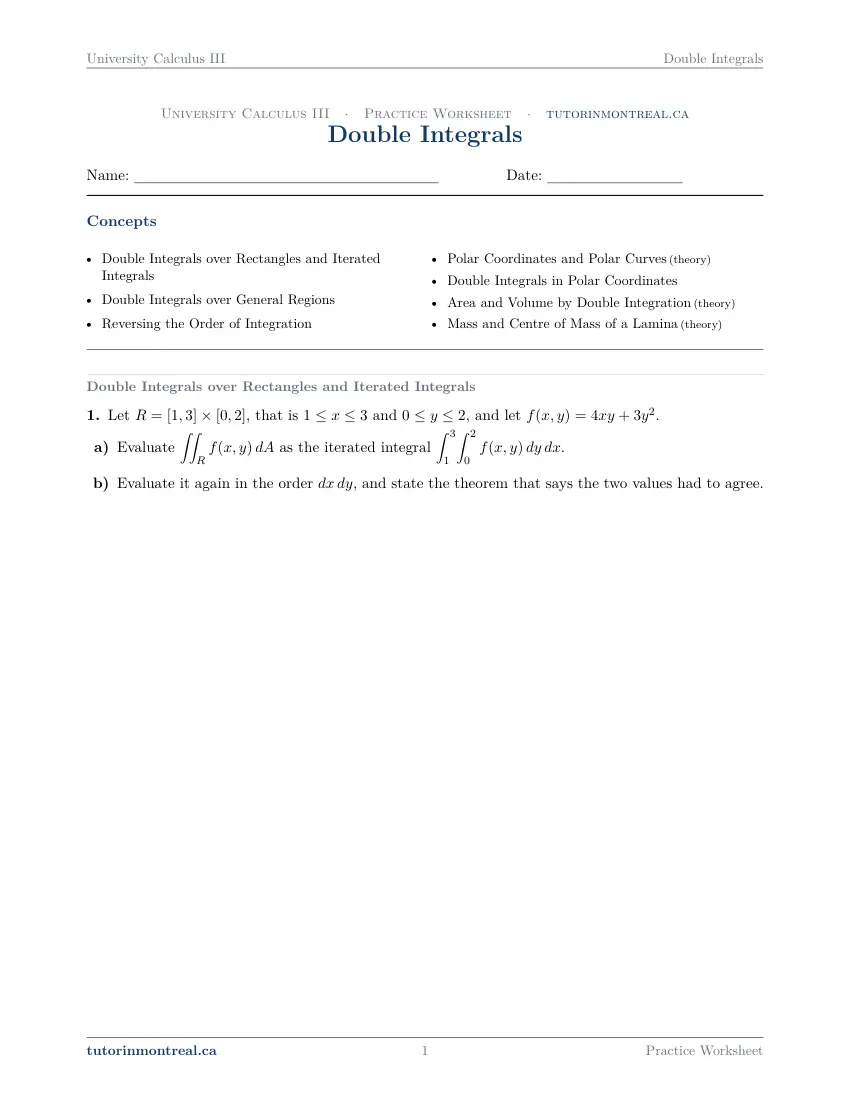
Let , that is and , and let .
- Evaluate as the iterated integral .
- Evaluate it again in the order , and state the theorem that says the two values had to agree.
-
Q2Double Integrals over Rectangles and Iterated Integrals
Evaluate One order of integration is much shorter than the other. Say which you chose and why.
-
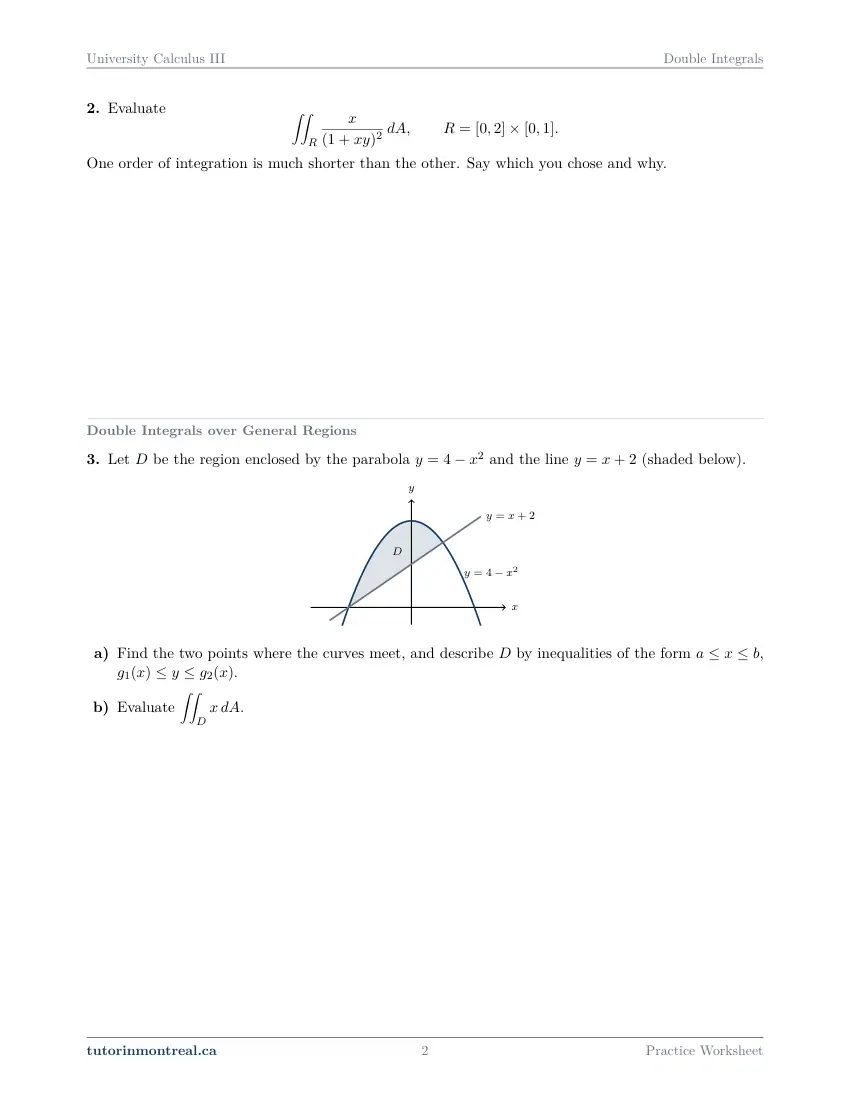
Q3Double Integrals over General Regions
This question is built around a diagram or a table of values. Open it in the PDF.
-
Q4Double Integrals over General Regions
Let be the triangle with vertices , and .
- Describe by inequalities of the form , , and explain in one sentence why this description is more convenient here than one using vertical strips.
- Evaluate .
-
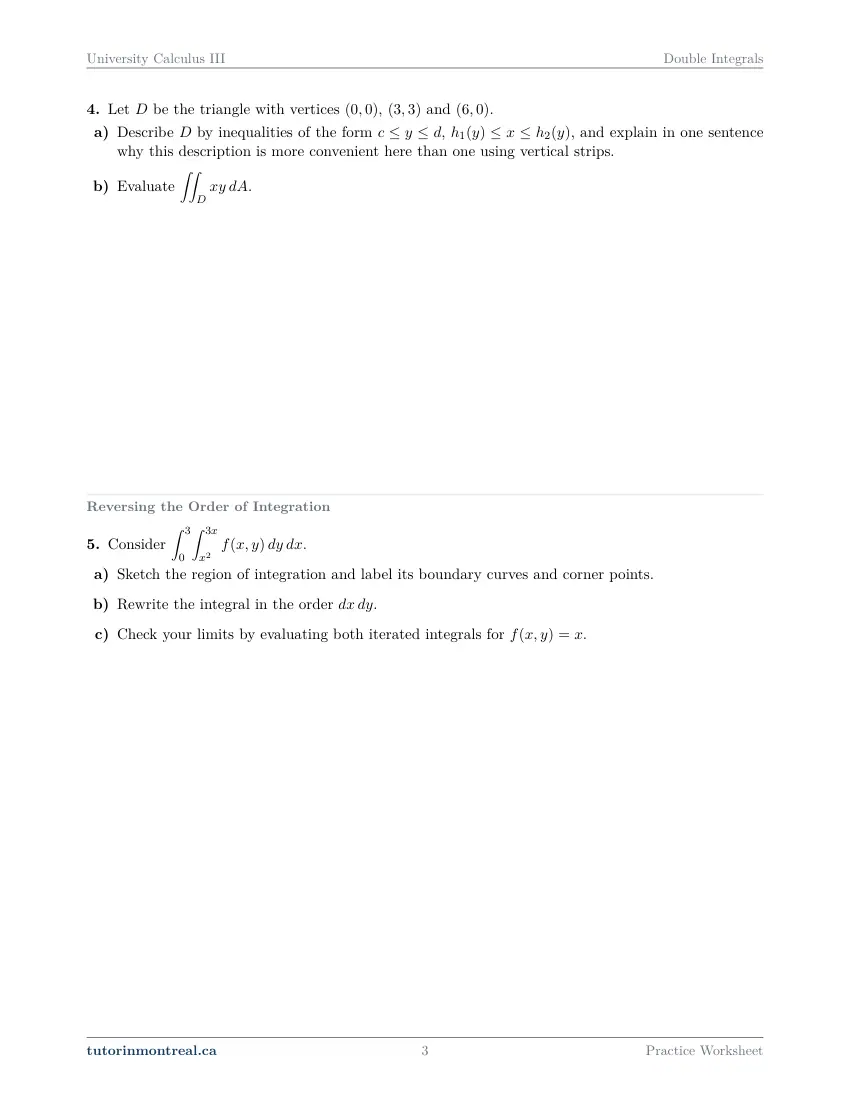
Q5Reversing the Order of Integration
Consider .
- Sketch the region of integration and label its boundary curves and corner points.
- Rewrite the integral in the order .
- Check your limits by evaluating both iterated integrals for .
-
Q6Reversing the Order of Integration
Evaluate The function has no antiderivative that can be written with elementary functions, so begin by reversing the order of integration.
-
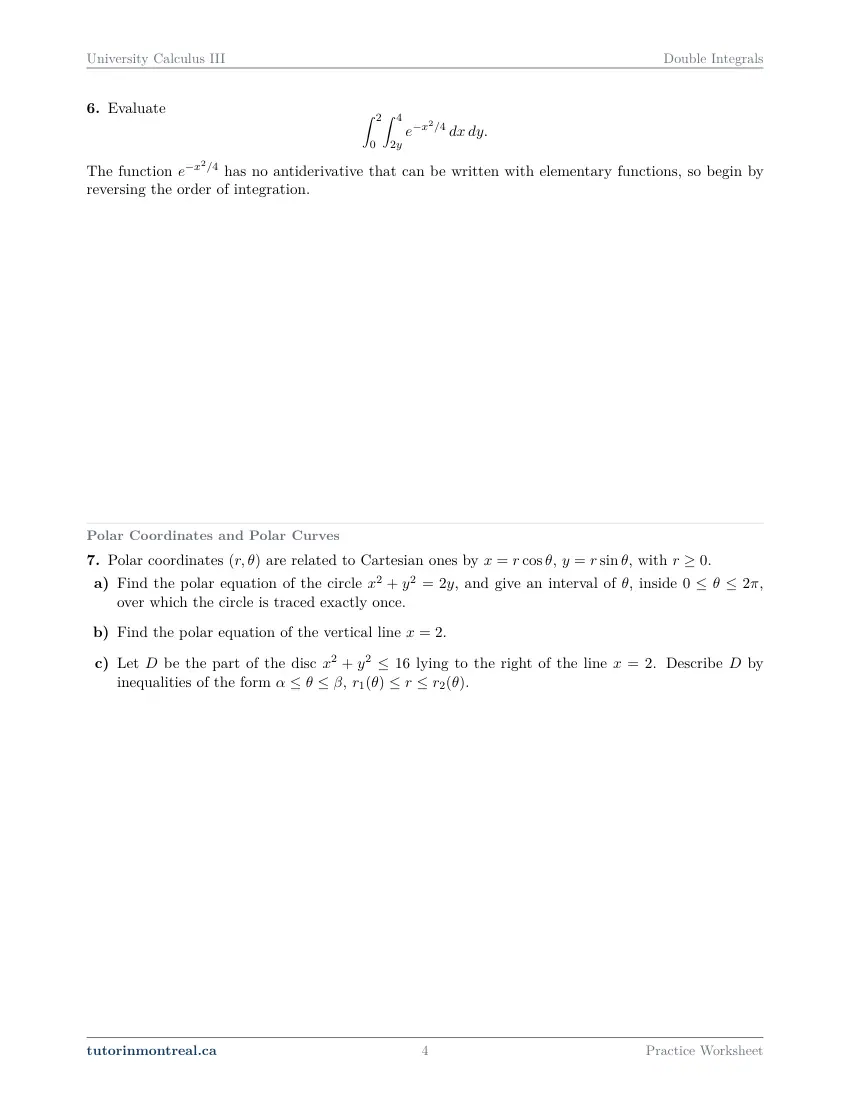
Q7Polar Coordinates and Polar Curves
Polar coordinates are related to Cartesian ones by , , with .
- Find the polar equation of the circle , and give an interval of , inside , over which the circle is traced exactly once.
- Find the polar equation of the vertical line .
- Let be the part of the disc lying to the right of the line . Describe by inequalities of the form , .
-
Q8Double Integrals in Polar Coordinates
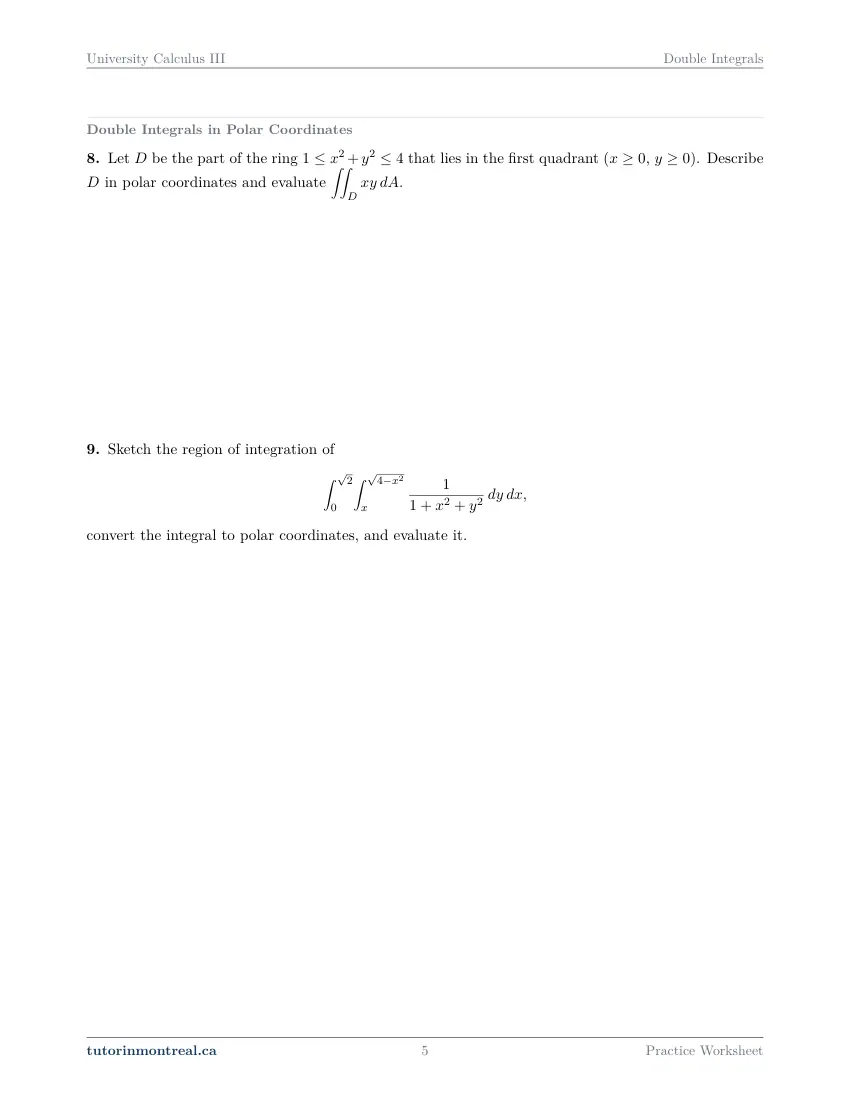
Let be the part of the ring that lies in the first quadrant (, ). Describe in polar coordinates and evaluate .
-
Q9Double Integrals in Polar Coordinates
Sketch the region of integration of convert the integral to polar coordinates, and evaluate it.
-
Q10Area and Volume by Double Integration
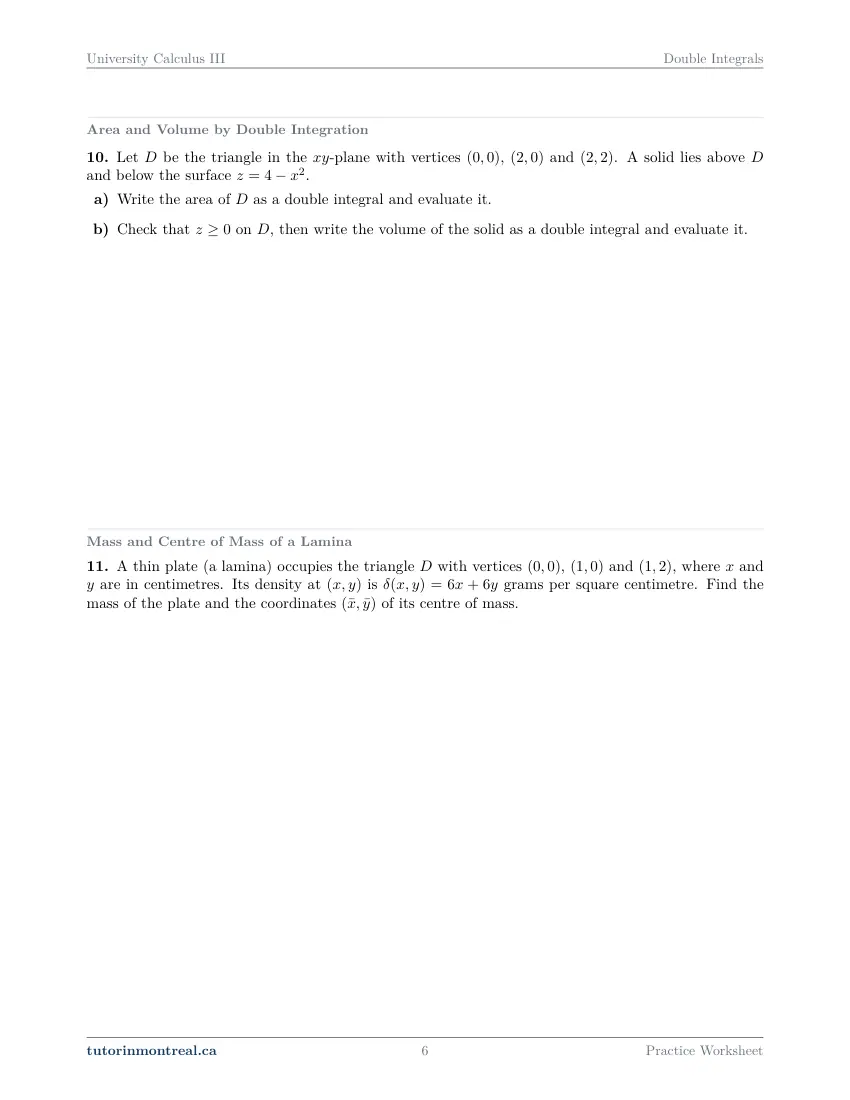
Let be the triangle in the -plane with vertices , and . A solid lies above and below the surface .
- Write the area of as a double integral and evaluate it.
- Check that on , then write the volume of the solid as a double integral and evaluate it.
-
Q11Mass and Centre of Mass of a Lamina
A thin plate (a lamina) occupies the triangle with vertices , and , where and are in centimetres. Its density at is grams per square centimetre. Find the mass of the plate and the coordinates of its centre of mass.
-
Q12Synthesis — drawing on several topics in this unit
A lamina occupies the region in the first quadrant that lies inside the circle and between the -axis and the line . Lengths are in centimetres and the density is grams per square centimetre.
- Describe in polar coordinates, and also by inequalities of the form , .
- Find the mass of the lamina using polar coordinates.
- Set up the mass as a Cartesian iterated integral using your second description, and evaluate it to confirm b).
The 8 challenge problems for this topic are a separate, paid sheet and are not reproduced here.
What does this set assume? This set stands on CEGEP Calculus I, CEGEP Calculus II and CEGEP Linear Algebra, and re-teaches none of them. Every inner and outer integral here is a one-variable integral you already know how to do — a power, a substitution, an exponential, a logarithm, the odd trigonometric integral — and the integrands are chosen so that those steps stay light: a question whose difficulty is the antiderivative belongs to Calculus II, not here. Sketching parabolas, lines and circles, and finding where two curves meet, are used without comment. Scope is the core that university multivariable courses share: iterated integrals over rectangles and general regions, reversing the order, polar coordinates as a tool and double integrals in polar form, area and volume, and the mass and centre of mass of a lamina. Improper double integrals, moments of inertia and probability densities are not in this course; the general change of variables and its Jacobian open the next set, after triple integrals; surface area waits for the surface-integral set; and polar area and arc length as single-variable topics are left out. Every question is settled by hand, with no calculator.
Which course is this for? In the public course calendars of Montreal universities, this material is part of the courses numbered MATH 222, MAST 219, ENGR 233, MAT1400, MAT1115 and MAT165. Each course orders and weights the topics its own way, so check your own outline for what your exam covers. Which sets match your course.
The rest of this unit
The worksheet is the practice, and it is free. Two more printable documents cover the same unit and come with the University Calculus III bundle: read the notes first, work this sheet, then sit the test closed-book. See what each one covers.
What the Double Integrals notes cover About the Double Integrals unit test
How to do every concept on this sheet
This is the part worksheet sites usually leave out. Below is the actual reasoning behind each group of questions — not a full solution set, the decisions that get you to one. Read it before you start, or after you get stuck.
A double integral over a rectangle is two single integrals
Q1 gives a polynomial on a rectangle and asks for the double integral twice: once integrating in y first, once in x first. The inner integral is a partial integration — the other variable is held constant, exactly as it was held constant for a partial derivative — and what it returns is a function of the outer variable alone, which the outer integral then finishes.
∫∫ f dy dx: integrate in y with x frozen → a function of x only → integrate in xPart (b) asks for a theorem, not just a second computation. The two orders agree because of a theorem with a hypothesis: when f is continuous on the rectangle, the double integral equals the iterated integral in either order. State the hypothesis and say why your integrand meets it. The agreement of your two numbers is a check on your arithmetic; the theorem is what says they had to agree.
Q2 takes that theorem as permission. Both orders give the same value, so the question is only which one is shorter — and it asks you to say which you chose and why. Before integrating anything, try each variable as the inner one: hold the other constant and ask whether the numerator is, up to a constant, the derivative of the bracket in the denominator with respect to the inner variable. In one order it is, and the inner integral is a one-line substitution; in the other it is not.
Frozen variables stay in the answer. After the inner integral, the variable you held constant is still there, in the limits you substitute and in the result. Substituting the inner limits for the wrong letter is the most common slip in this block.
General regions: the limits come from a sketch
Over a region that is not a rectangle, the inner limits are no longer numbers: they are the curves where a strip enters and leaves the region. Q3 is built on a figure — a parabola and a line enclosing a region, shown in the PDF — and part (a) asks for exactly the two facts the limits need: where the curves meet, and which one is on top in between.
Describing a region by vertical strips
Four decisions, every one of them made on the sketch.
- 1Find where the boundaries meet
Set the two equations equal and solve. The x-coordinates of those points are the outer limits.
- 2Decide which curve is on top
Pick one x strictly between the meeting points and evaluate both curves there. The larger is the upper limit throughout, as long as the curves do not cross in between.
- 3Write the inequalities
a ≤ x ≤ b, then lower curve ≤ y ≤ upper curve. The inner limits may contain x; the outer ones may not.
- 4Integrate inner, then outer
The inner integral in y leaves a function of x, exactly as over a rectangle.
A double integral of x is not an area. The integrand in Q3(b) is negative wherever x is negative, and part of the region lies on that side of the y-axis. Whatever sign your result has, look at the figure and ask whether it is the sign the region predicts before you trust it.
Q4 gives a triangle by its three vertices and asks for the other kind of strip: horizontal, with y on the outside and the left and right boundaries written as x in terms of y. It also asks you to explain in one sentence why that description is the convenient one here. Draw one vertical strip and one horizontal strip across the triangle, and count how many different formulas each needs for its two ends as it sweeps across the region. That count is the sentence.
Write each side as x = something before you start. The sides of a triangle are lines through two vertices; for horizontal strips, solve each line's equation for x. The left boundary is the one with the smaller x at every height, and the outer limits are the lowest and highest y in the region.
Reversing the order of integration
Q5 gives an iterated integral in the order dy dx and asks for the same integral in the order dx dy. The limits you are given are a description of a region; the job is to recover the region and describe it again the other way. Part (a) is the sketch, and it is not optional: every reliable reversal goes through one.
Reversing an iterated integral
From limits to picture to new limits.
- 1Read the region off the old limits
The outer limits bound x; the inner ones are the lower and upper curves. Draw both curves and shade what lies between them.
- 2Mark the corner points
Where the curves meet fixes the range of the new outer variable, y.
- 3Draw one horizontal strip
Ask which boundary it enters through on the left and which it leaves through on the right. Solve each for x.
- 4Check that one description covers every height
If the left or right end changes curve partway up, the reversed integral has to be split there.
Part (c) is the check the whole set leans on: choose a simple integrand, evaluate the integral in both orders, and see that they agree. If they do not, the limits are wrong, not the theorem.
Solving a boundary for x can lose a sign. A curve like y = x² gives two square roots when you solve for x. Look at the sketch to see which half of the curve bounds the region, and keep only that one.
Q6 shows why reversing is worth learning. The integrand has no elementary antiderivative in x, so the integral cannot even be started in the order it is written. Reverse it — same method, sketch first — and the inner integral becomes an integral in y of something that does not contain y at all. Look at what that inner integral multiplies the integrand by: it is exactly the factor a substitution in x needs.
Polar coordinates as a tool
Q7 is the preparation for integrating in polar coordinates: turning Cartesian curves and regions into polar ones. The conversion is always the same three facts — x = r cos θ, y = r sin θ, and x² + y² = r² — substituted into the equation and simplified until r is alone.
Dividing by r is allowed, but say what it costs. In part (a), an equation with r² on one side and a multiple of r on the other simplifies by dividing by r; the solution r = 0 that disappears is the origin, and you should check whether the curve passes through it anyway. The question also asks for an interval of θ that traces the circle once. With the convention r ≥ 0, that interval is decided by where your formula for r is non-negative.
Part (b) is a vertical line, which in polar form is not a constant: r depends on θ. Part (c) uses both. The region is part of a disc cut off by that line, and a ray from the origin at angle θ crosses the line first and the circle second. So the inner limits in r run from the line's polar equation to the circle's, and the outer limits in θ are the angles of the two points where the line meets the circle.
α ≤ θ ≤ β, r₁(θ) ≤ r ≤ r₂(θ): rays from the origin play the part that strips played beforeDouble integrals in polar coordinates
When a region is bounded by circles centred at the origin and by rays from it, polar coordinates turn it into a polar rectangle — constant limits in r and in θ. Q8 is that case: a quarter of a ring. Describe it, substitute for x and y, and replace dA.
dA = r dr dθThe extra r is not optional. A small polar piece at distance r from the origin has area close to r Δr Δθ: pieces far out are larger than pieces near the centre. Forgetting that factor is the single most common error with polar integrals, and it gives a wrong answer that looks perfectly reasonable. In Q8, count the powers of r in your integrand after substitution — one of them comes from dA.
Once the limits are constants and the integrand is a function of θ times a function of r, the double integral splits into a product of two single integrals, which is the quickest way to finish Q8.
Q9 hands you a Cartesian iterated integral and asks you to sketch its region, convert and evaluate. The limits describe a line through the origin and a circle; the line through the origin is a ray, θ = constant, and the circle centred at the origin is r = constant. Notice also where the x-range stops and what the left edge of the region is. Then look at the integrand: it depends on x and y only through x² + y², which is r², and together with the r from dA the inner integral becomes a one-line substitution.
Two signals that polar coordinates will help. The region is bounded by circles about the origin and rays from it, and the integrand involves x² + y². Q9 has both. When a boundary is a circle not centred at the origin, or a line that misses the origin, polar coordinates may still work — as in Q7(c) — but the limits in r become functions of θ.
Area and volume
Q10 uses one triangle twice. The area of a region is the double integral of 1 over it, and a triangle whose area you already know from geometry is a free check on your limits. The volume of the solid above the region and below a surface z = f(x, y) is the double integral of the height f, provided the surface is on or above the xy-plane throughout the region.
Check the sign of the height first. Part (b) asks you to check that z ≥ 0 on the triangle before you write the volume, and the reason is that a double integral counts the parts below the plane negatively. Use the range of x on the region to show that the height cannot be negative there, then integrate.
Mass and centre of mass of a lamina
A thin plate whose density varies from point to point is a double integral waiting to happen. Q11 gives a triangular plate, in centimetres, with a density δ(x, y) in grams per square centimetre that grows across it, and asks for its mass and the point where it balances.
Mass and centre of mass
Three integrals over the same region, then two divisions.
- 1Describe the region once
Write the limits from the vertices; all three integrals use them.
- 2Mass
m = ∬D δ dA, in grams.
- 3Moments
My = ∬D x δ dA and Mx = ∬D y δ dA. The moment about the y-axis carries the factor x.
- 4Divide
x̄ = My / m and ȳ = Mx / m, in centimetres.
Two checks that cost nothing. The centre of mass of a plate must lie inside a convex plate like this triangle, so test your point against the triangle's boundaries. And compare it with where a plate of the same shape and uniform density would balance: a density that increases in some direction pulls the balance point that way. If your answer moved the other way, look for a swapped moment.
The synthesis question
Q12 describes one lamina — the part of a disc in the first quadrant between the x-axis and a line through the origin, with density δ = y — and asks for its mass twice. Part (a) is Q7 and Q4 together: a polar description, which is a polar rectangle because the line through the origin is a ray, and a Cartesian one with horizontal strips, where each strip starts on the line and ends on the circle. Part (b) is Q8's method: substitute, include the r from dA, and split the integral as a product. Part (c) sets up the same mass in Cartesian form from your horizontal-strip description and evaluates it; the inner integral is in x of something that does not contain x, and the outer one needs a substitution. The two answers must agree — which is the whole point of doing it twice.
Preview all 7 pages
Click any page to open the full PDF.
Getting the most out of it
Sketch the region before you write a limit
Every question on this sheet that went wrong in someone's hands went wrong in the limits. A thirty-second sketch with the boundary curves labelled and the corner points marked settles which curve is on top, where a strip enters and leaves, and whether the region needs splitting.
Read the limits back as inequalities
Before integrating, write the region you think you have as a pair of inequalities and test one point you know is inside and one you know is outside. If the inequalities disagree with the sketch, the integral will too.
Check the order you chose with a second order
When you reverse the order or switch to polar coordinates, evaluate both versions with an easy integrand such as 1 or x. Equal answers mean the two descriptions are the same region; unequal answers find a wrong limit before it costs you a whole question.
Write dA out in full every time
Write dA = dy dx, dx dy or r dr dθ explicitly in each integral rather than leaving it implicit. It is the fastest way to remember the r in polar coordinates, and to keep the inner limits attached to the right variable.
Estimate before you trust
The integrand lies between its smallest and largest values on the region, so the integral lies between those values times the area. A one-line bound catches a missing factor, a wrong sign or a limit substituted for the wrong variable.
Want the solutions, or something more challenging?
The worksheet, the questions above and every explanation on this page stay free permanently. Three more PDFs exist for this topic — the worked answer key, a harder problem set, and the answer key to that. They come with the University Calculus III Solutions Bundle, beside the unit notes and the unit test, which is what keeps the rest of the series free.
What else exists for Double Integrals
Three PDFs · 17 pages · all three are in the bundle below.
- Answer key — 5 pages. All 12 questions worked step by step, including the restrictions and the justifications. Not a list of final answers.
- Challenge problems — 8 pages, 8 problems. A separate sheet at exam-plus difficulty covering the same 7 concepts. Harder than anything on the free sheet.
- Challenge answer key — 4 pages. Every challenge problem worked to the same standard, with the checks shown.
- PDF, letter size, print-ready.
The one thing that's for sale
Every University Calculus III topic — the complete Solutions Bundle
One download, one payment, the whole program. For all 9 University Calculus III units: the worksheet, the reference notes, the challenge set, the unit test and every answer key — including this one.
- Worked solutions, not answer lists — every step written out
- Covers the whole year's program at this level
- Less than the price of one hour of tutoring — for the entire year's solutions
Taking Secondary 1 Math as well? The Secondary 1 Math bundle covers all 15 of its units — 106 PDFs, 474 pages — on the same terms.
Taking Secondary 2 Math as well? The Secondary 2 Math bundle covers all 14 of its units — 98 PDFs, 449 pages — on the same terms.
Taking Secondary 3 Math as well? The Secondary 3 Math bundle covers all 11 of its units — 77 PDFs, 367 pages — on the same terms.
Taking Secondary 4 Math as well? The Secondary 4 Math bundle covers all 17 of its units — 122 PDFs, 466 pages — on the same terms.
Taking Secondary 5 Math as well? The Secondary 5 Math bundle covers all 21 of its units — 147 PDFs, 589 pages — on the same terms.
Taking CEGEP Calculus I as well? The CEGEP Calculus I bundle covers all 9 of its units — 72 PDFs, 371 pages — on the same terms.
Taking CEGEP Calculus II as well? The CEGEP Calculus II bundle covers all 8 of its units — 64 PDFs, 335 pages — on the same terms.
Taking CEGEP Linear Algebra as well? The CEGEP Linear Algebra bundle covers all 7 of its units — 56 PDFs, 298 pages — on the same terms.
Taking University Linear Algebra as well? The University Linear Algebra bundle covers all 9 of its units — 72 PDFs, 496 pages — on the same terms.
Taking University Differential Equations as well? The University Differential Equations bundle covers all 9 of its units — 36 PDFs, 182 pages — on the same terms.
Taking University Business Math as well? The University Business Math bundle covers all 9 of its units — 36 PDFs, 190 pages — on the same terms.
Taking University Introductory Statistics as well? The University Introductory Statistics bundle covers all 9 of its units — 36 PDFs, 186 pages — on the same terms.
Taking University Discrete Math as well? The University Discrete Math bundle covers all 9 of its units — 36 PDFs, 155 pages — on the same terms.
Taking AP Calculus AB as well? The AP Calculus AB bundle covers all 8 of its units — 64 PDFs, 527 pages — on the same terms.
Common questions
Is this worksheet really free?
Yes — the questions are on this page to read, and the PDF downloads directly, no email and no account. The one paid item is optional: the complete University Calculus III Solutions Bundle, which covers every set at this level.
Which university courses is this for?
The course codes listed on this page are taken from the public course calendars of universities that teach multivariable calculus after CEGEP. Each course orders and weights the topics its own way — some teach double integrals late in a first course, others open a second course with them, and some spend longer on polar coordinates than others — so check the outline for your own section to see where this set falls in your term.
What do I need to know before starting this set?
CEGEP Calculus I and II and CEGEP Linear Algebra. You should be comfortable with definite integrals by substitution, with exponential, logarithmic and trigonometric antiderivatives, and with sketching lines, parabolas and circles and finding where two curves meet.
How do I decide which order of integration to use?
Over a rectangle with a continuous integrand, both orders give the same value, so choose the one whose inner integral is easier to start. Over a general region, also look at the sketch: choose the strips whose two ends each stay on one curve, so that one iterated integral covers the whole region instead of two.
When should I switch to polar coordinates?
When the region is bounded by circles centred at the origin and rays from it, or when the integrand depends on x² + y². Either signal is a reason to try; both together almost always mean polar coordinates will be much shorter.
Why is there an extra r in polar double integrals?
Because a small polar piece does not have area Δr Δθ. Its area is close to r Δr Δθ: for the same change in r and θ, a piece far from the origin is larger than one near it. The r in dA = r dr dθ weights each piece by its true size.
Where are the Jacobian and change of variables?
In the next set, after triple integrals and cylindrical and spherical coordinates. This set uses polar coordinates as a tool and explains the factor r directly from the area of a small polar piece; the general change of variables, which explains that factor as a Jacobian, builds on it.
Are moments of inertia or surface area in this set?
No. Moments of inertia are not part of this course, and the area of a surface is taught with surface integrals near the end of the course. This set stops at mass and centre of mass.
Can teachers use this in class?
Yes. Print and photocopy it for your own classes freely — I just ask that the tutorinmontreal.ca footer stays on the page.
I'm stuck on one question. Can you help?
Yes — through one-on-one tutoring, in Montreal or online. Get in touch to arrange a session, or see the current rates.
← All 9 University Calculus III worksheets · Secondary 1 Math series (15 sheets) → · Secondary 2 Math series (14 sheets) → · Secondary 3 Math series (11 sheets) → · Secondary 4 Math series (17 sheets) → · Secondary 5 Math series (21 sheets) → · CEGEP Calculus I series (9 sheets) → · CEGEP Calculus II series (8 sheets) → · CEGEP Linear Algebra series (7 sheets) → · University Linear Algebra series (9 sheets) → · University Differential Equations series (9 sheets) → · University Business Math series (9 sheets) → · University Introductory Statistics series (9 sheets) → · University Discrete Math series (9 sheets) → · AP Calculus AB series (8 sheets) →