University Calculus III — Partial Derivatives Worksheet
The block where differentiation comes back, one variable at a time. Finding a partial derivative by holding every other variable constant, and saying what the number means about a real object, with units; second derivatives and mixed partials, and the theorem that lets you choose the order that costs least; the tangent plane to a surface z = f(x, y), written from two slopes and a point, and the same plane read as a linear approximation; differentials that turn two measurement errors into one worst-case error; the chain rule when a variable depends on another through several routes, organised by a tree diagram; and implicit differentiation done with partial derivatives instead of by hand. Have a look on this page, then print the free PDF when you want to write on it.
Practice worksheet — free PDF
No email, no account, no watermark. Teachers: photocopy it for your classes freely. Worked solutions and 8 harder problems come with the University Calculus III bundle.
All 12 questions
Each question targets one named concept from the sheet. Read them here, or print the PDF — it has working space under each one.
-
Q1First-Order Partial Derivatives
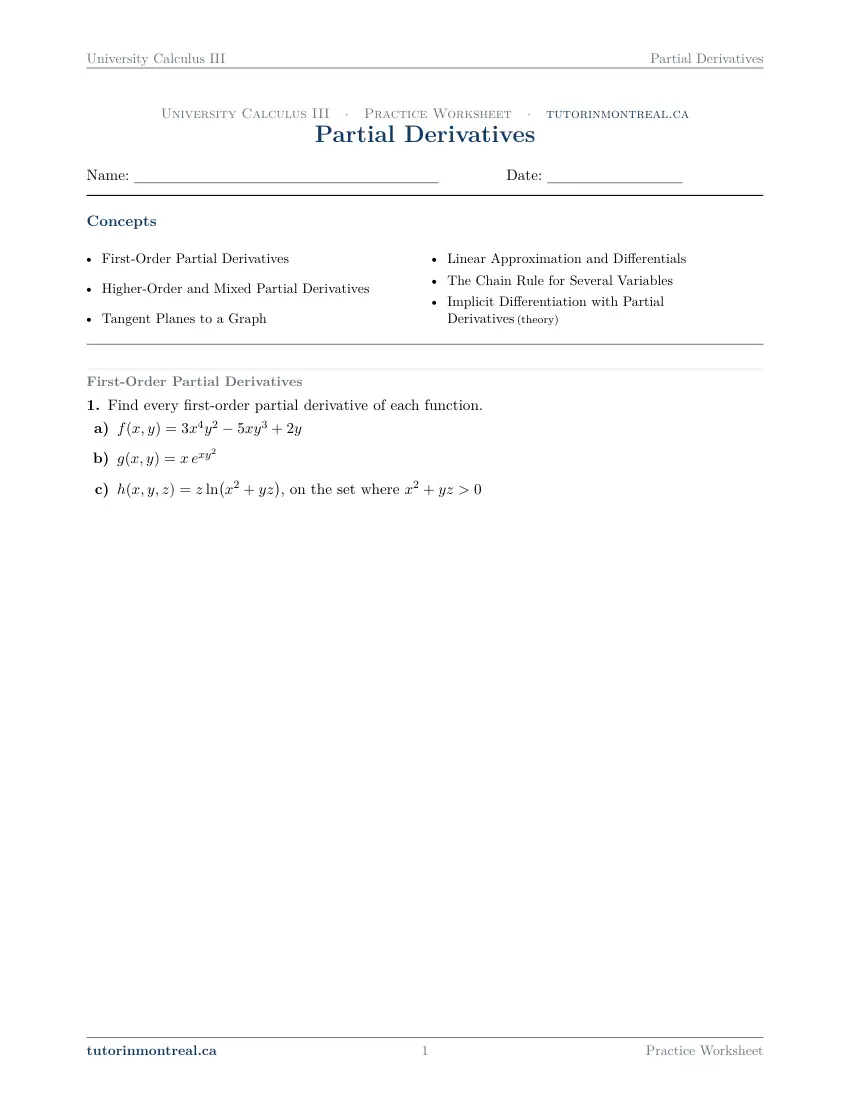
Find every first-order partial derivative of each function.
- , on the set where
-
Q2First-Order Partial Derivatives
The temperature of a thin metal plate at the point is with and measured in centimetres.
- Find and .
- State, with units, what each of the two numbers says about the plate.
- A probe at can be moved a short distance parallel to the -axis or the same distance parallel to the -axis. Which move changes its reading more, and by about what factor?
-
Q3Higher-Order and Mixed Partial Derivatives
Let . Find , , and , computing and separately, and state the relation between them that your answers confirm.
-
Q4Higher-Order and Mixed Partial Derivatives
Let Find , that is , with as little work as you can, and justify the order in which you chose to differentiate.
-
Q5Tangent Planes to a Graph
Find an equation of the tangent plane to the surface at the point where . Give your answer in the form .
-
Q6Tangent Planes to a Graph
Find every point on the surface at which the tangent plane is parallel to the plane , and give an equation of the tangent plane at each such point.
-
Q7Linear Approximation and Differentials
Let .
- Find the linearization of at .
- Use it to approximate .
-
Q8Linear Approximation and Differentials
The density of a solid ball of mass and radius is . The mass of a steel ball is measured with an error of at most and its radius with an error of at most . Use differentials to estimate the maximum percentage error in the computed density, and say which of the two measurements contributes more to it.
-
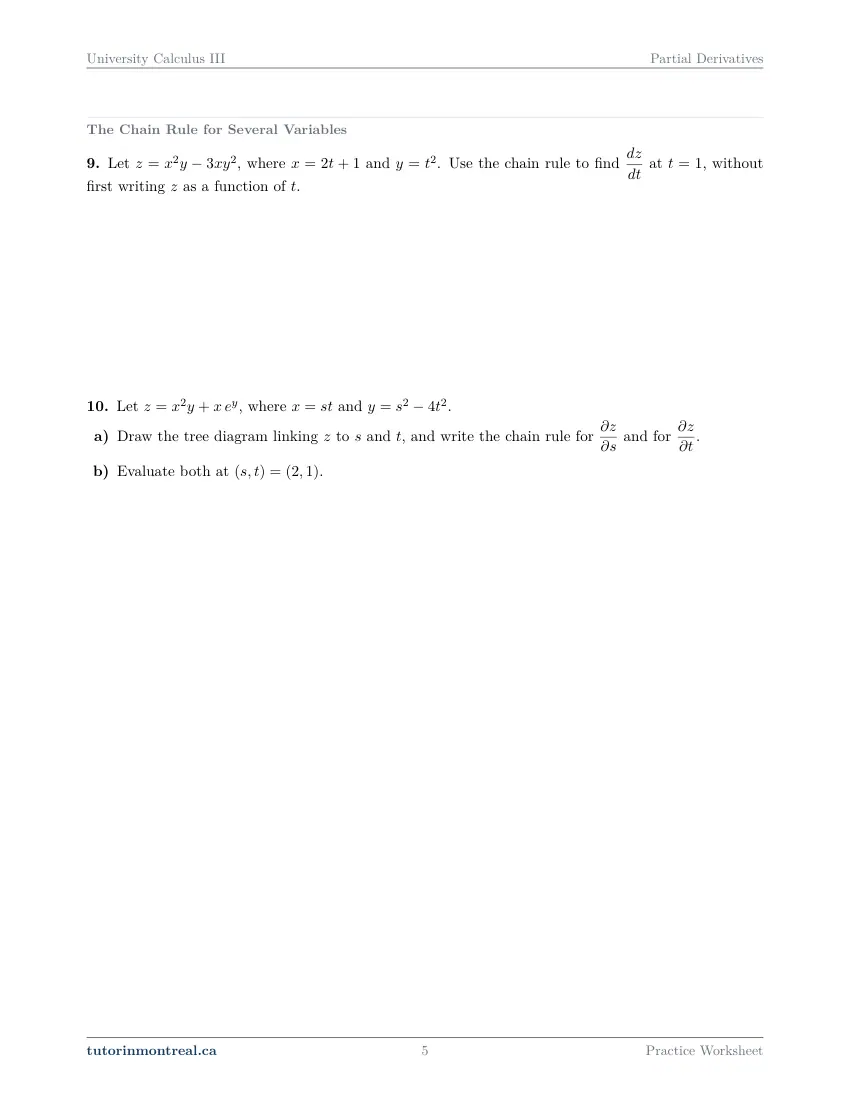
Q9The Chain Rule for Several Variables
Let , where and . Use the chain rule to find at , without first writing as a function of .
-
Q10The Chain Rule for Several Variables
Let , where and .
- Draw the tree diagram linking to and , and write the chain rule for and for .
- Evaluate both at .
-
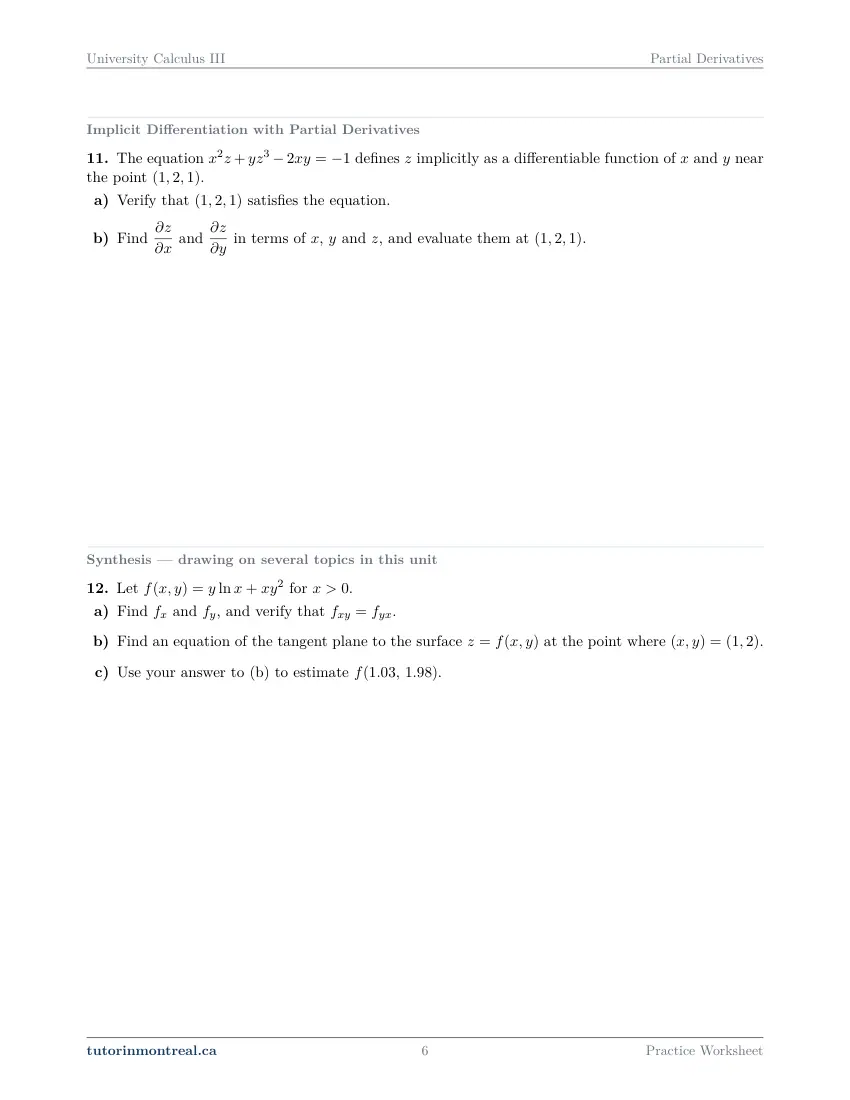
Q11Implicit Differentiation with Partial Derivatives
The equation defines implicitly as a differentiable function of and near the point .
- Verify that satisfies the equation.
- Find and in terms of , and , and evaluate them at .
-
Q12Synthesis — drawing on several topics in this unit
Let for .
- Find and , and verify that .
- Find an equation of the tangent plane to the surface at the point where .
- Use your answer to (b) to estimate .
The 8 challenge problems for this topic are a separate, paid sheet and are not reproduced here.
What does this set assume? This set stands on CEGEP Calculus I, CEGEP Calculus II and CEGEP Linear Algebra, and re-teaches none of them. The product, quotient and chain rules in one variable, the derivatives of exponentials, logarithms and trigonometric functions, the one-variable linearization, and the equation of a plane from a point and a normal vector are all used without comment; the previous set's functions of several variables and their domains are assumed too. Scope is the core that university multivariable courses share: first-order and higher-order partials, tangent planes to a graph, linear approximation and differentials, the chain rule and implicit differentiation. The gradient, directional derivatives and tangent planes to a level surface are the next set, and critical points and the second derivative test belong to the optimisation set. The implicit function theorem is not stated or proved anywhere in this course — implicit differentiation is used, the theorem behind it is not — and there are no differential equations.
Which course is this for? In the public course calendars of Montreal universities, this material is part of the courses numbered MATH 222, MAST 218, ENGR 233, MAT1400, MAT1115, MTH1101 and MAT165. Each course orders and weights the topics its own way, so check your own outline for what your exam covers. Which sets match your course.
The rest of this unit
The worksheet is the practice, and it is free. Two more printable documents cover the same unit and come with the University Calculus III bundle: read the notes first, work this sheet, then sit the test closed-book. See what each one covers.
What the Partial Derivatives notes cover About the Partial Derivatives unit test
How to do every concept on this sheet
This is the part worksheet sites usually leave out. Below is the actual reasoning behind each group of questions — not a full solution set, the decisions that get you to one. Read it before you start, or after you get stuck.
A partial derivative is an ordinary derivative with the other variables frozen
Q1 asks for every first-order partial derivative of three functions, and the only new idea is the one in the heading: to find the partial with respect to x, treat y (and z) as fixed numbers and differentiate exactly as in Calculus I. Everything difficult in the question is a one-variable rule you already know — the difficulty is recognising which rule applies once the other variables have become constants.
∂f/∂x: hold y constant → differentiate in x → the answer may still contain yThe same expression can need different rules for different variables. In part (b), a factor of x in front of an exponential is a product when you differentiate in x, and a constant multiple when you differentiate in y. In part (c), the factor z is a constant for the partials in x and y and a genuine variable for the partial in z. Before each derivative, decide which pieces contain the variable you are differentiating in — that decision picks the rule.
Frozen does not mean deleted. A term that does not contain x has x-derivative zero, but a factor that does not contain x stays in the answer as a constant multiple. Dropping a constant factor is the most common slip in Q1.
What the number says about the object
Q2 gives the temperature of a plate as a function of position. Part (a) is Q1's technique followed by an evaluation at one point; rewriting the quotient as a constant times a negative power turns each partial into a single chain-rule step. Part (b) is the part students skip, and it is the point of the question.
An interpretation has three parts. Say which direction you move in and which variable is held fixed while you do; give the rate with its units, here degrees per centimetre; and say whether the temperature rises or falls. A sign with no direction attached is not an interpretation. It is also an instantaneous rate at that point, not the change over a whole centimetre.
Part (c) compares two short moves of the same length. For a small step, the change in a reading is about the partial derivative times the step, so with equal steps the comparison is between the sizes of the two partials, and the factor is their ratio. Compare absolute values: the question asks which move changes the reading more, not which way.
Higher-order partials, and when the order does not matter
Q3 asks for all four second-order partials of one function and insists that the two mixed ones be computed separately: one by differentiating in x and then in y, the other in the opposite order. Keep the notation straight — in the subscript form, the letters are read left to right in the order you differentiate.
The relation the question asks you to state is a theorem, with a hypothesis. When the mixed partials are continuous, the order of differentiation does not change the result. Say that the functions here are built from polynomials, sines and exponentials, so the hypothesis holds everywhere, and then state what your two computations confirm.
Q4 turns that theorem into a strategy. It asks for a third-order partial written in an order that would have you differentiate an awkward quotient twice. The instruction "with as little work as you can" is an invitation to change the order: look at which variables each piece of the function contains, and ask which variable, differentiated first, makes the difficult piece disappear.
The reordering has to be justified, not just done. The question asks you to justify your order, so say why the equality of mixed partials applies to this function — check that nothing in it fails to be continuous, including the denominator — before you use it.
The tangent plane to a graph
Near a point, a smooth surface z = f(x, y) looks like a plane, and the two partial derivatives are that plane's slopes in the x- and y-directions. Q5 asks for its equation at a given point.
Writing the tangent plane to z = f(x, y)
Three numbers, one formula, one check.
- 1Find the point on the surface
You are given x and y only. Evaluate f there to get the height; the point of tangency has three coordinates.
- 2Evaluate both partials at the point
Differentiate first, then substitute. These are the slopes of the plane along the two axes.
- 3Assemble
z = f(a, b) + fx(a, b)(x − a) + fy(a, b)(y − b): the one-variable tangent line with a second slope term.
- 4Put it in the requested form and check
Q5 asks for ax + by + cz = d. Substitute the point of tangency into your final equation; it must satisfy it.
Q6 runs the idea backwards. Instead of a point, you are given a plane, and asked where the surface has a tangent plane parallel to it. The tool is the normal vector: rewriting the tangent plane with everything on one side shows that (fx, fy, −1) is normal to it.
parallel planes ⇔ parallel normals ⇔ one normal is a scalar multiple of the otherScale before you compare. The given plane's normal will not have −1 in the third place. Multiply it by the scalar that makes its third component −1, and only then set the first two components equal to fx and fy. That gives two equations in x and y; solve them, find the height, and write the plane at each point you find. The question says "every point", so say how you know there are no others.
Linear approximation: the tangent plane used as a formula
The tangent plane's equation, read as a function of x and y, is the linearization L(x, y). Q7 asks for it at a point where f is easy to evaluate, then uses it at a nearby point where it is not. This is the one-variable linearization from Calculus I with one more term.
Choose the base point so everything is exact there. The base point in Q7 makes the square root a whole number, and that is why it was chosen. In part (b), write the two small displacements Δx and Δy with their signs before substituting — one of them is negative.
Q8 uses the same idea to estimate an error. The density of a ball depends on its mass and its radius, each measured with a percentage error, and the question asks for the largest percentage error in the density. Write the total differential, then divide it by the density itself: for a product of powers, the relative error of the result becomes a combination of the relative errors of the inputs, each multiplied by the power that input carries.
dδ = (∂δ/∂m) dm + (∂δ/∂r) dr → divide by δ → relative errors, weighted by the exponentsA maximum error assumes the worst. Measurement errors can be in either direction, so the largest error in the density comes from the case where the two terms push the same way. Add their absolute values rather than letting a minus sign cancel them. The second half of the question — which measurement contributes more — is answered by the size of each weighted term, not by which measurement was less accurate.
The chain rule, one path at a time
When z depends on x and y, and x and y both depend on t, a change in t reaches z along two routes. Q9 asks for dz/dt at one value of t, and forbids the shortcut of substituting first.
dz/dt = (∂z/∂x)(dx/dt) + (∂z/∂y)(dy/dt)Evaluate at the right point. The partials of z are functions of x and y, so they must be evaluated at the values of x and y that the given t produces. Find those first, then evaluate each factor, then combine. Mixing a t-value into a formula that expects an x-value is the classic error.
Q10 has two independent variables, s and t, and asks you to draw the tree diagram before writing anything else. The tree is not decoration: z at the top, the intermediate variables x and y below it, and s and t at the bottom of every branch. A partial derivative of z with respect to s is a sum over the paths from z down to s, each path contributing the product of the derivatives along it.
Reading the chain rule off a tree
The diagram writes the formula for you.
- 1Draw every dependency
One branch from z to each variable it contains; one branch from each of those to each variable it depends on.
- 2Label each branch with its derivative
Partial where the upper variable has more than one input, ordinary where it has one.
- 3One term per path
Multiply down each path from z to the target variable, then add the paths.
- 4Evaluate last
Compute x and y at the given (s, t), then every factor, then the sums.
Implicit differentiation, done with partial derivatives
Q11 gives an equation in x, y and z that defines z as a function of x and y near a point, with no hope of solving for z. Part (a) is a substitution check. Part (b) is the method: write the equation as F(x, y, z) = constant, differentiate it in x by the chain rule with z depending on x, and solve for ∂z/∂x.
∂z/∂x = −Fx / Fz, ∂z/∂y = −Fy / Fz, wherever Fz ≠ 0Mind the sign and the condition. The minus sign comes from moving a term across the equals sign and is easy to lose. And the formula needs Fz to be non-zero at the point: check that it is before you divide, and say so.
The synthesis question
Q12 follows one function through three sheets. Part (a) is Q1 and Q3 together: two first partials, then both mixed partials computed in each order and compared. Part (b) is Q5's tangent plane at a given (x, y) — find the height first. Part (c) asks you to use part (b)'s answer, and the link is the one this set keeps returning to: the tangent plane is the graph of the linearization, so substituting the nearby point into the plane's equation is the estimate. Write the two displacements with their signs, as in Q7.
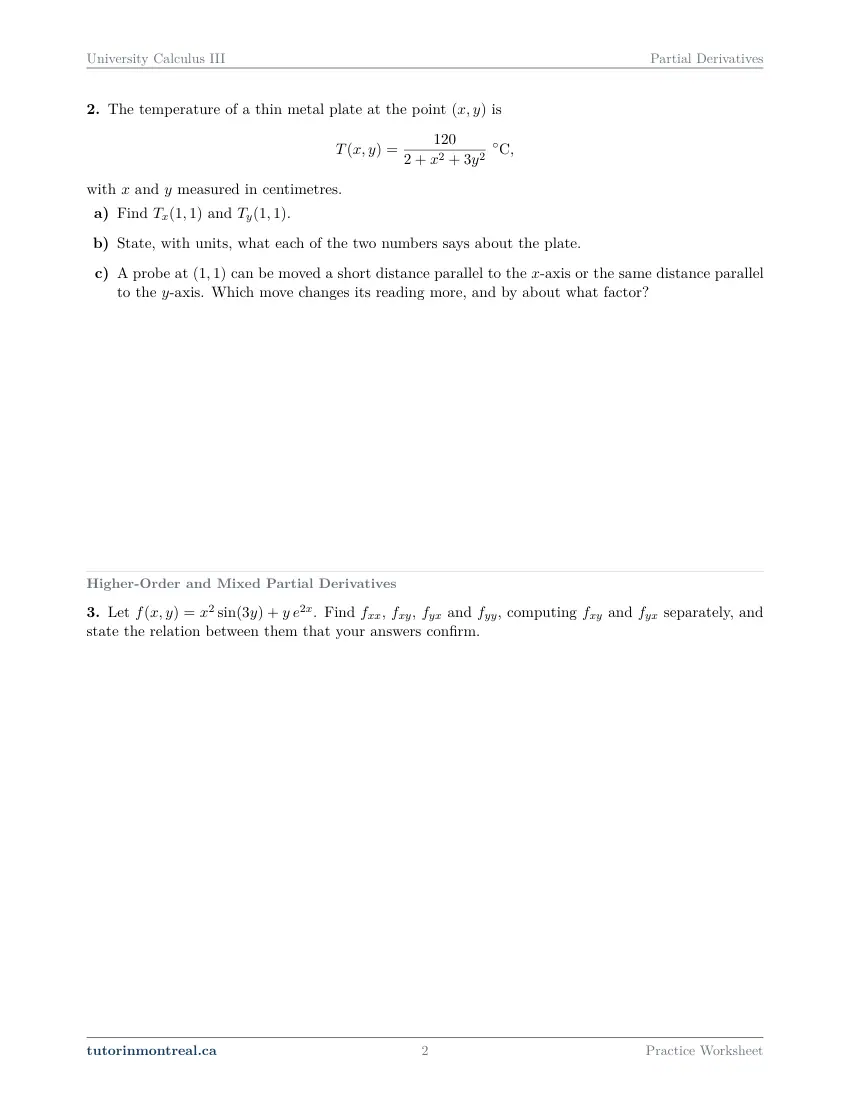
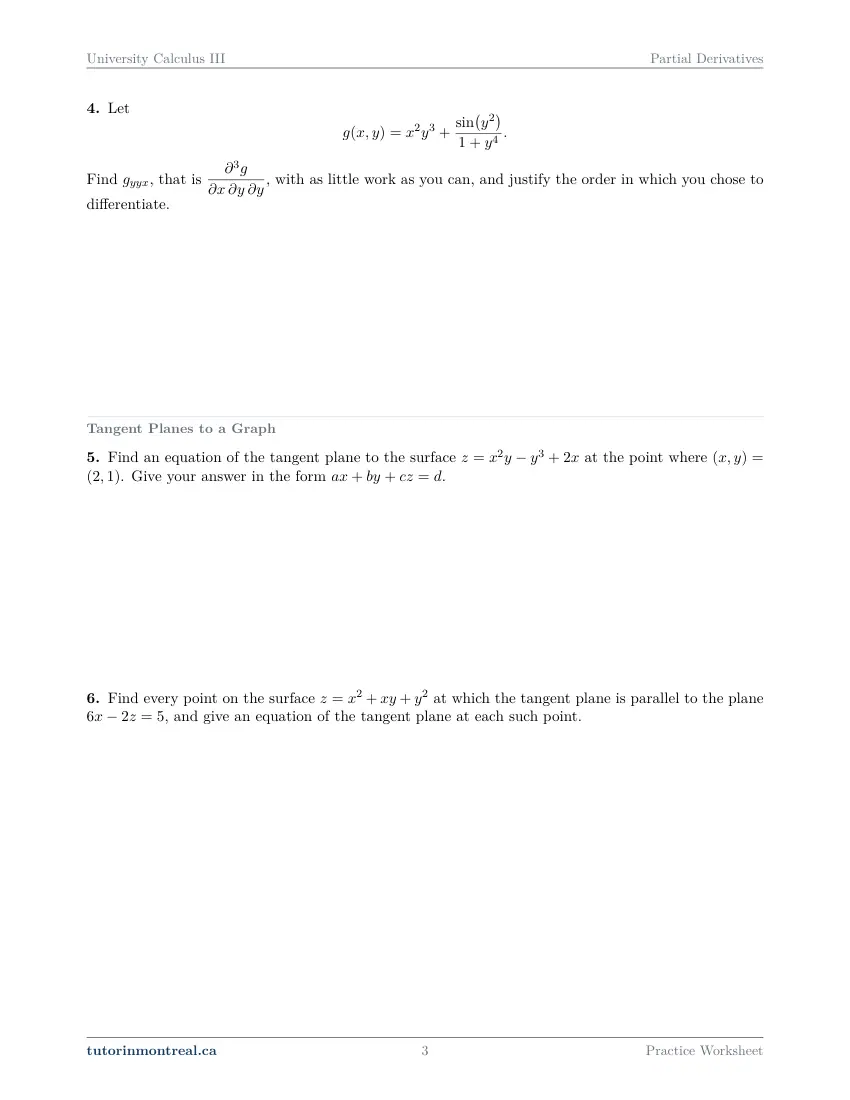
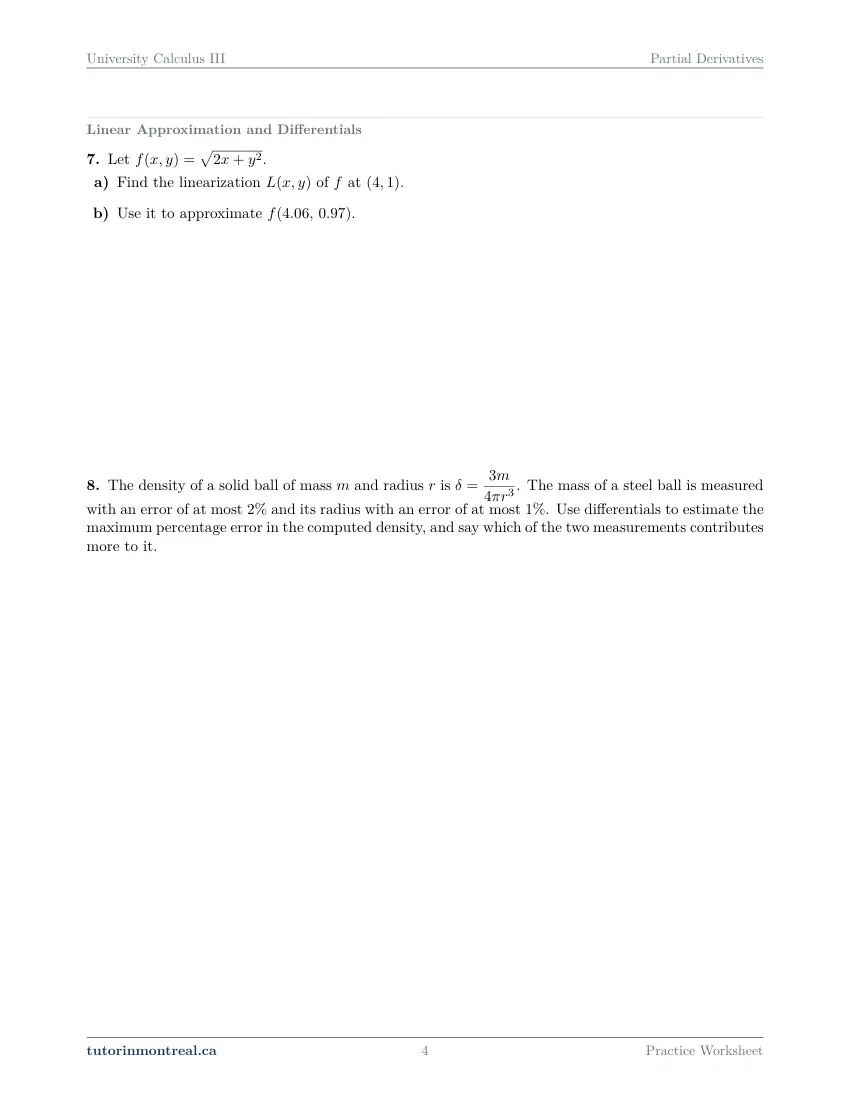
Preview all 7 pages
Click any page to open the full PDF.
Getting the most out of it
Circle the variable before you differentiate
Before each partial derivative, mark every factor and term that contains the variable you are differentiating in. Everything unmarked is a constant for this step. It takes seconds, and it decides whether you need the product rule, the chain rule, or neither.
Differentiate first, substitute second
Evaluating a function at a point before differentiating turns it into a number whose derivative is zero. Find each partial as a formula, then evaluate it. The same rule applies to the chain rule: build the formula, then find the intermediate values, then substitute.
Draw the tree every time
Even when a chain-rule problem looks simple enough to do in your head, draw the diagram. It shows how many terms each derivative has, and a missing path is the most common way to lose a chain-rule question.
Write units on every interpreted rate
A partial derivative of a physical quantity has the units of the output per unit of the input. Writing them down forces you to say which variable changed and which was held fixed, which is exactly what an interpretation question is marked on.
Want the solutions, or something more challenging?
The worksheet, the questions above and every explanation on this page stay free permanently. Three more PDFs exist for this topic — the worked answer key, a harder problem set, and the answer key to that. They come with the University Calculus III Solutions Bundle, beside the unit notes and the unit test, which is what keeps the rest of the series free.
What else exists for Partial Derivatives
Three PDFs · 16 pages · all three are in the bundle below.
- Answer key — 4 pages. All 12 questions worked step by step, including the restrictions and the justifications. Not a list of final answers.
- Challenge problems — 8 pages, 8 problems. A separate sheet at exam-plus difficulty covering the same 6 concepts. Harder than anything on the free sheet.
- Challenge answer key — 4 pages. Every challenge problem worked to the same standard, with the checks shown.
- PDF, letter size, print-ready.
The one thing that's for sale
Every University Calculus III topic — the complete Solutions Bundle
One download, one payment, the whole program. For all 9 University Calculus III units: the worksheet, the reference notes, the challenge set, the unit test and every answer key — including this one.
- Worked solutions, not answer lists — every step written out
- Covers the whole year's program at this level
- Less than the price of one hour of tutoring — for the entire year's solutions
Taking Secondary 1 Math as well? The Secondary 1 Math bundle covers all 15 of its units — 106 PDFs, 474 pages — on the same terms.
Taking Secondary 2 Math as well? The Secondary 2 Math bundle covers all 14 of its units — 98 PDFs, 449 pages — on the same terms.
Taking Secondary 3 Math as well? The Secondary 3 Math bundle covers all 11 of its units — 77 PDFs, 367 pages — on the same terms.
Taking Secondary 4 Math as well? The Secondary 4 Math bundle covers all 17 of its units — 122 PDFs, 466 pages — on the same terms.
Taking Secondary 5 Math as well? The Secondary 5 Math bundle covers all 21 of its units — 147 PDFs, 589 pages — on the same terms.
Taking CEGEP Calculus I as well? The CEGEP Calculus I bundle covers all 9 of its units — 72 PDFs, 371 pages — on the same terms.
Taking CEGEP Calculus II as well? The CEGEP Calculus II bundle covers all 8 of its units — 64 PDFs, 335 pages — on the same terms.
Taking CEGEP Linear Algebra as well? The CEGEP Linear Algebra bundle covers all 7 of its units — 56 PDFs, 298 pages — on the same terms.
Taking University Linear Algebra as well? The University Linear Algebra bundle covers all 9 of its units — 72 PDFs, 496 pages — on the same terms.
Taking University Differential Equations as well? The University Differential Equations bundle covers all 9 of its units — 36 PDFs, 182 pages — on the same terms.
Taking University Business Math as well? The University Business Math bundle covers all 9 of its units — 36 PDFs, 190 pages — on the same terms.
Taking University Introductory Statistics as well? The University Introductory Statistics bundle covers all 9 of its units — 36 PDFs, 186 pages — on the same terms.
Taking University Discrete Math as well? The University Discrete Math bundle covers all 9 of its units — 36 PDFs, 155 pages — on the same terms.
Taking AP Calculus AB as well? The AP Calculus AB bundle covers all 8 of its units — 64 PDFs, 527 pages — on the same terms.
Common questions
Is this worksheet really free?
Yes — the questions are on this page to read, and the PDF downloads directly, no email and no account. The one paid item is optional: the complete University Calculus III Solutions Bundle, which covers every set at this level.
Which university courses is this for?
The course codes listed on this page are taken from the public course calendars of universities that teach multivariable calculus after CEGEP. Each course orders and weights the topics its own way — some spend longer on the chain rule and implicit differentiation, some move quickly from tangent planes to the gradient — so check the outline for your own section to see where this set falls in your term.
What do I need to know before starting this set?
CEGEP Calculus I and II and CEGEP Linear Algebra. You should be fluent with the product, quotient and chain rules in one variable, the derivatives of exponential, logarithmic and trigonometric functions, one-variable linearization, and the equation of a plane through a point with a given normal vector.
Does the order of differentiation matter for mixed partials?
Not when the mixed partial derivatives are continuous, which is the case for every function built from polynomials, exponentials, logarithms and trigonometric functions on its domain. Then you may differentiate in whichever order is easier — and choosing that order well is a skill this set practises.
What is the difference between a tangent plane and a linearization?
They are the same object read two ways. The tangent plane is a surface in space; the linearization is the function whose graph is that surface. You use the first to describe geometry and the second to estimate values of the function near the point.
Why do I have to draw a tree diagram for the chain rule?
Because in several variables a change can reach the output along more than one route, and the chain rule is a sum with one term for each route. The tree shows every route, so you cannot leave one out, and it makes the formula for each partial derivative something you read off rather than remember.
Where are the gradient and directional derivatives?
In the next set. This one builds the partial derivatives themselves and the tangent plane to a graph; the gradient, directional derivatives and tangent planes to a level surface each build on it, and critical points and the second derivative test come in the optimisation set after that.
Do I need the implicit function theorem for this set?
No. You use implicit differentiation — the formulas built from the partial derivatives of F — and you check that the partial in z is non-zero at the point, but the theorem that guarantees the implicit function exists is not stated or proved in this course.
Can teachers use this in class?
Yes. Print and photocopy it for your own classes freely — I just ask that the tutorinmontreal.ca footer stays on the page.
I'm stuck on one question. Can you help?
Yes — through one-on-one tutoring, in Montreal or online. Get in touch to arrange a session, or see the current rates.
← All 9 University Calculus III worksheets · Secondary 1 Math series (15 sheets) → · Secondary 2 Math series (14 sheets) → · Secondary 3 Math series (11 sheets) → · Secondary 4 Math series (17 sheets) → · Secondary 5 Math series (21 sheets) → · CEGEP Calculus I series (9 sheets) → · CEGEP Calculus II series (8 sheets) → · CEGEP Linear Algebra series (7 sheets) → · University Linear Algebra series (9 sheets) → · University Differential Equations series (9 sheets) → · University Business Math series (9 sheets) → · University Introductory Statistics series (9 sheets) → · University Discrete Math series (9 sheets) → · AP Calculus AB series (8 sheets) →