University Calculus III — Triple Integrals and Change of Variables Worksheet
The block where integration moves into space, and where the work is almost entirely in describing the solid. Evaluating a triple integral over a box as three single integrals; reading a solid off an iterated integral and writing one down from a description, in more than one order; recognising when a cylinder, a cone or a paraboloid makes cylindrical coordinates the natural choice, and when a sphere or a cone about the z-axis calls for spherical ones, with the extra factor each volume element carries; finding the mass of a solid and the point where it balances; and, last, the Jacobian, which explains those factors and turns an awkward region of the plane into a rectangle. Have a look on this page, then print the free PDF when you want to write on it.
Practice worksheet — free PDF
No email, no account, no watermark. Teachers: photocopy it for your classes freely. Worked solutions and 9 harder problems come with the University Calculus III bundle.
All 12 questions
Each question targets one named concept from the sheet. Read them here, or print the PDF — it has working space under each one.
-
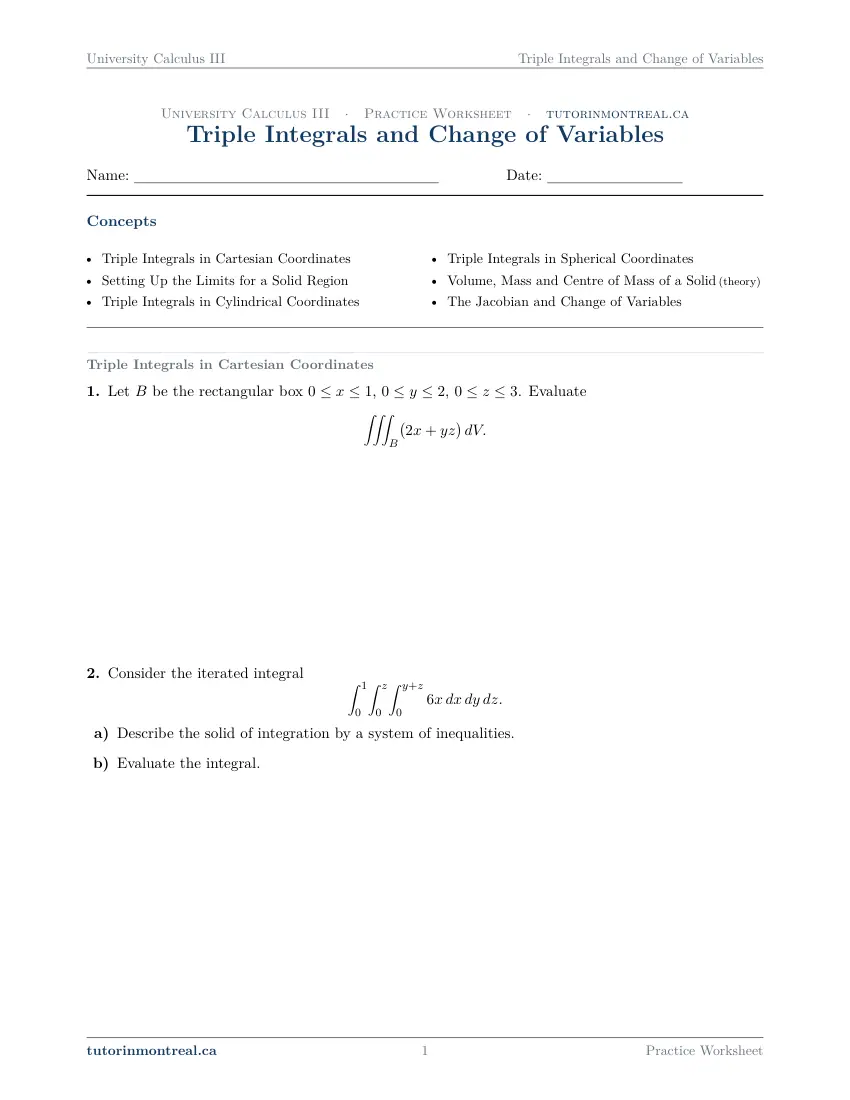
Q1Triple Integrals in Cartesian Coordinates
Let be the rectangular box , , . Evaluate
-
Q2Triple Integrals in Cartesian Coordinates
Consider the iterated integral
- Describe the solid of integration by a system of inequalities.
- Evaluate the integral.
-
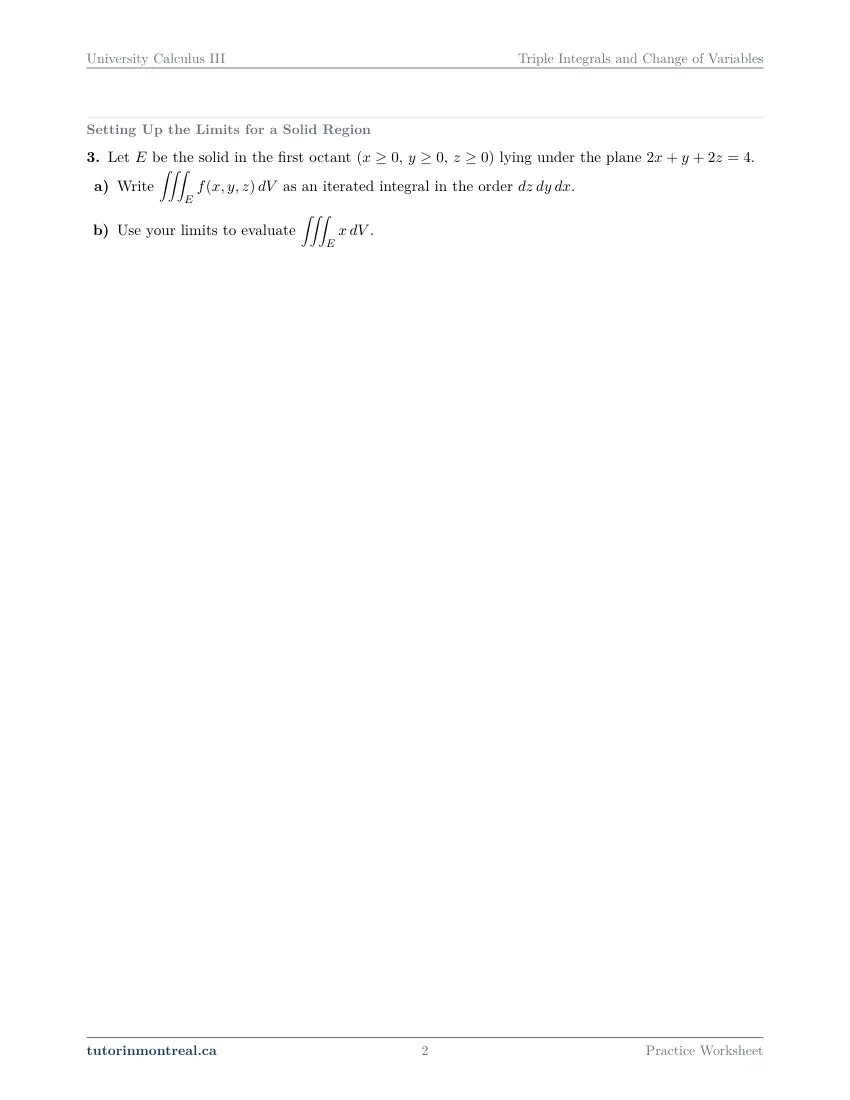
Q3Setting Up the Limits for a Solid Region
Let be the solid in the first octant (, , ) lying under the plane .
- Write as an iterated integral in the order .
- Use your limits to evaluate .
-
Q4Setting Up the Limits for a Solid Region
The solid is bounded by the parabolic cylinder and the planes , and ; that is, is the set of points with and .
- Write the volume of as an iterated integral in the order .
- Write it again in the order .
- Evaluate whichever of the two is easier.
-
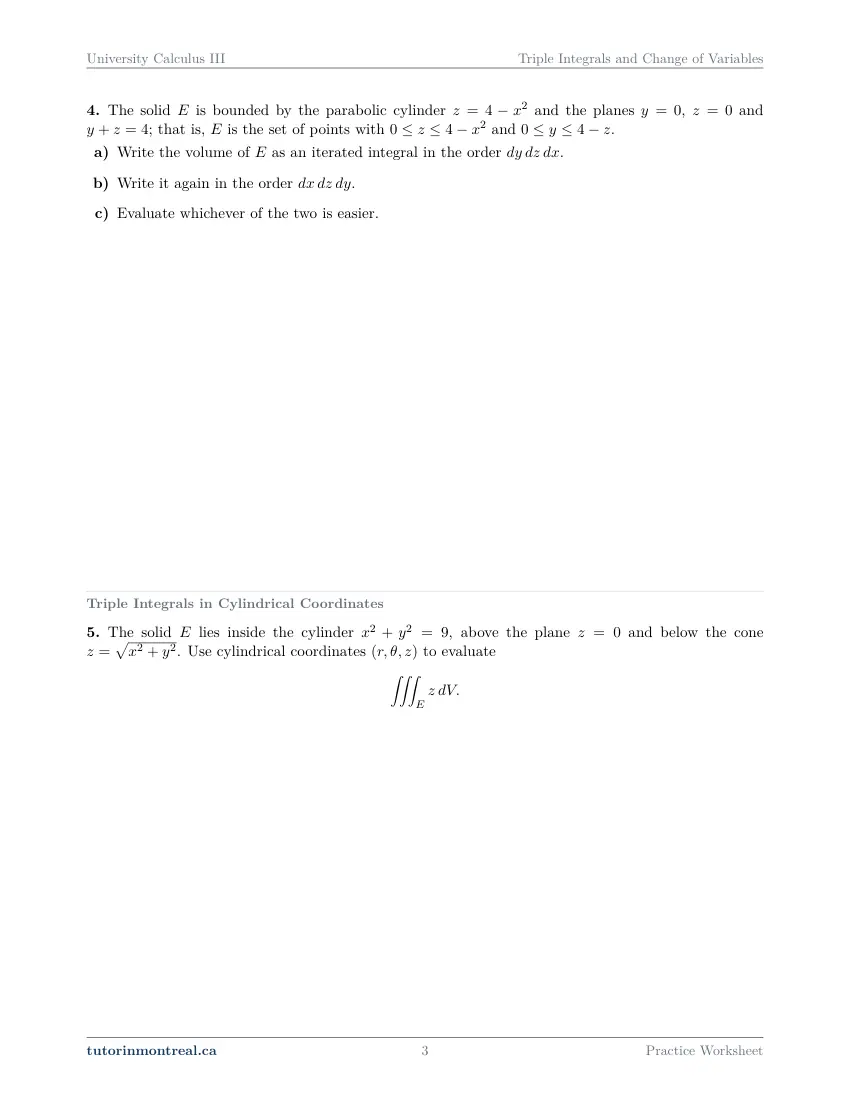
Q5Triple Integrals in Cylindrical Coordinates
The solid lies inside the cylinder , above the plane and below the cone . Use cylindrical coordinates to evaluate
-
Q6Triple Integrals in Cylindrical Coordinates
Convert the integral to cylindrical coordinates , stating the range of each variable, and evaluate it.
-
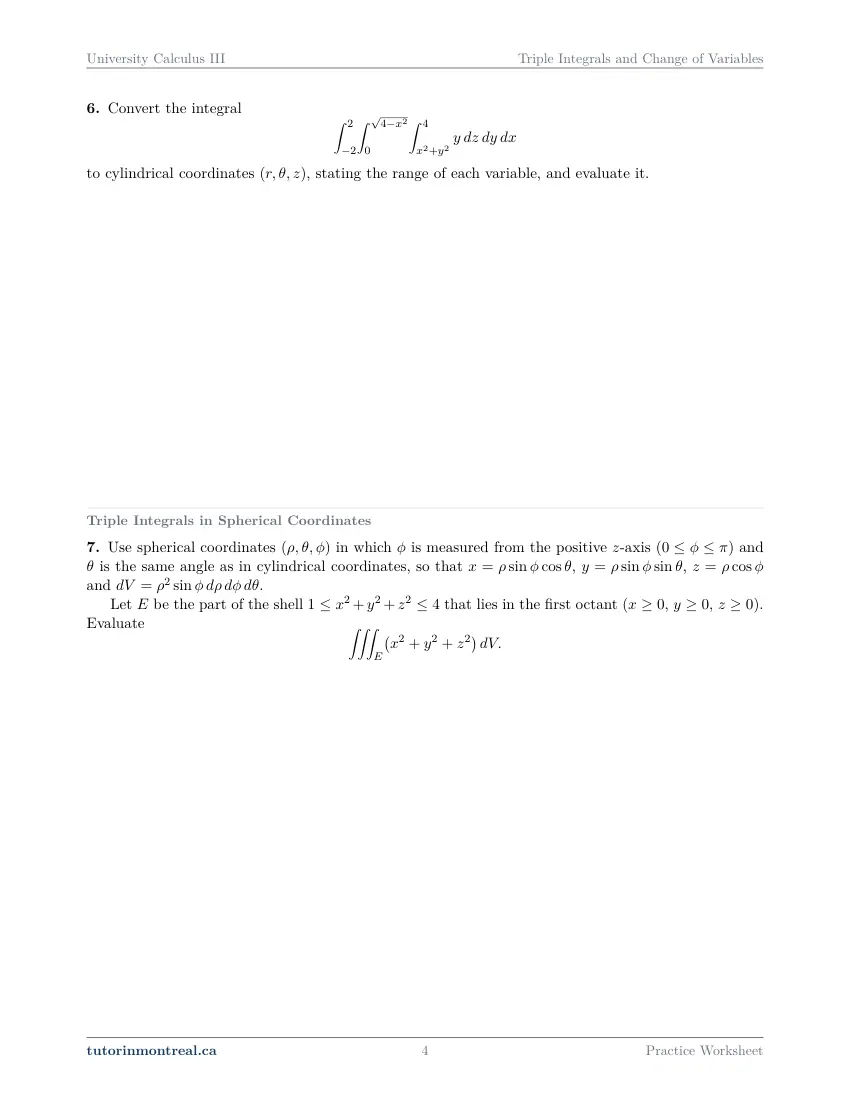
Q7Triple Integrals in Spherical Coordinates
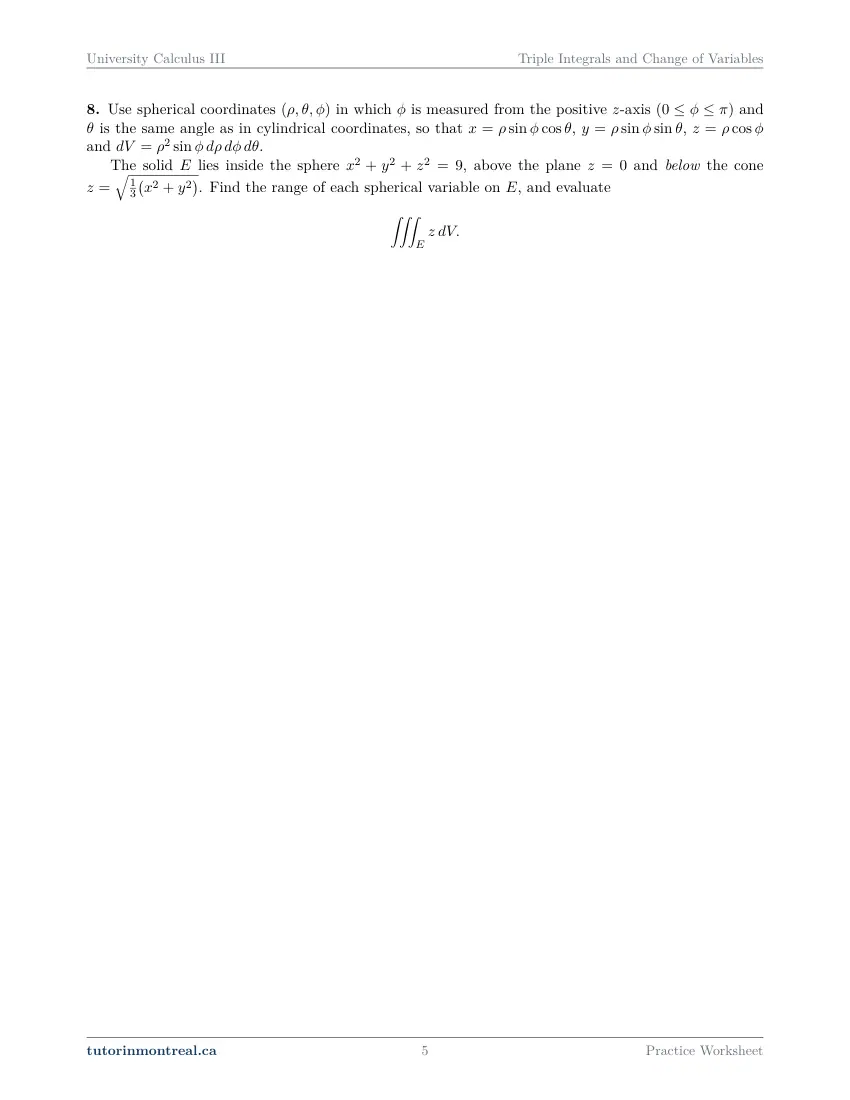
Use spherical coordinates in which is measured from the positive -axis () and is the same angle as in cylindrical coordinates, so that , , and .
Let be the part of the shell that lies in the first octant (, , ). Evaluate
-
Q8Triple Integrals in Spherical Coordinates
Use spherical coordinates in which is measured from the positive -axis () and is the same angle as in cylindrical coordinates, so that , , and .
The solid lies inside the sphere , above the plane and below the cone . Find the range of each spherical variable on , and evaluate
-
Q9Volume, Mass and Centre of Mass of a Solid
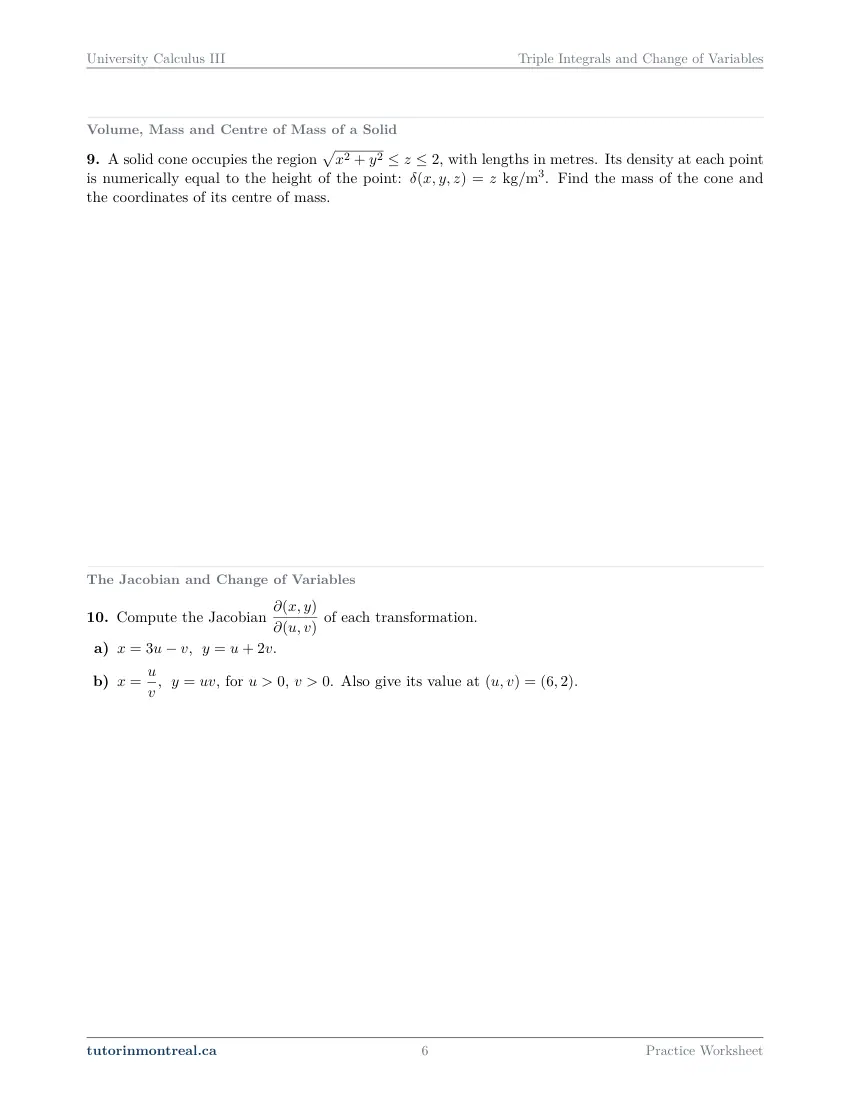
A solid cone occupies the region , with lengths in metres. Its density at each point is numerically equal to the height of the point: . Find the mass of the cone and the coordinates of its centre of mass.
-
Q10The Jacobian and Change of Variables
Compute the Jacobian of each transformation.
- , .
- , , for , . Also give its value at .
-
Q11The Jacobian and Change of Variables
Let be the parallelogram in the -plane bounded by the lines , , and . Use the change of variables , to evaluate
-
Q12Synthesis — drawing on several topics in this unit
The solid is enclosed between the two paraboloids and , with lengths in centimetres.
- Write the volume of as an iterated integral in Cartesian coordinates, in the order . Do not evaluate it.
- Convert to cylindrical coordinates and find the volume.
- The solid has density . Find its mass.
- State the centre of mass of the solid in part c), with a reason and without further integration.
The 9 challenge problems for this topic are a separate, paid sheet and are not reproduced here.
What does this set assume? This set stands on CEGEP Calculus I, CEGEP Calculus II and CEGEP Linear Algebra, and on the double-integral set before it, and re-teaches none of them. Every inner, middle and outer integral is a one-variable integral you already know how to do, and the integrands are chosen so those steps stay light; a question whose difficulty is the antiderivative belongs to Calculus II, not here. Recognising planes, cylinders, cones, spheres and paraboloids from their equations, and the two-by-two determinant, are used without comment. Scope is the core that university multivariable courses share: triple integrals in Cartesian, cylindrical and spherical coordinates, the limits for a solid region, volume, mass and centre of mass, and the Jacobian for maps of the plane. Moments of inertia, improper multiple integrals and probability densities are not in this course, and every vector-calculus topic waits for the two sets after this one. Every question is settled by hand, with no calculator.
Which course is this for? In the public course calendars of Montreal universities, this material is part of the courses numbered MATH 222, MAST 219, ENGR 233, MAT1400, MAT1115 and MAT165. Each course orders and weights the topics its own way, so check your own outline for what your exam covers. Which sets match your course.
The rest of this unit
The worksheet is the practice, and it is free. Two more printable documents cover the same unit and come with the University Calculus III bundle: read the notes first, work this sheet, then sit the test closed-book. See what each one covers.
What the Triple Integrals and Change of Variables notes cover About the Triple Integrals and Change of Variables unit test
How to do every concept on this sheet
This is the part worksheet sites usually leave out. Below is the actual reasoning behind each group of questions — not a full solution set, the decisions that get you to one. Read it before you start, or after you get stuck.
A triple integral over a box is three single integrals
Q1 gives a box with constant limits in x, y and z and a polynomial integrand. Exactly as over a rectangle, each integral is a partial integration: the variables not yet integrated are held constant, and each step leaves a function of the ones that remain. With constant limits any of the six orders works, so pick the one whose first step is shortest.
∭B f dV = ∫∫∫ f dx dy dz: innermost first, outermost lastA free check on a box. When the integrand is a sum, the integral is the sum of the integrals, and a term that is a product of a function of x, a function of y and a function of z splits into three single integrals multiplied together. Do Q1 one way, then split it the other way; if the two disagree, one of them has a limit substituted for the wrong letter.
Q2 hands you an iterated integral and asks, before any evaluation, for the solid it describes as a system of inequalities. Read the limits from the outside in, one differential at a time, and notice which variable is innermost: it is the one whose differential is written first, and it need not be z. Its limits may contain the other two variables; the middle limits may contain only the outer variable; the outer limits are numbers.
Match each pair of limits to its differential. The innermost integral sign belongs to the first differential written, the outermost to the last. Pairing them the other way round is the commonest slip in this block, and it produces an integral that still evaluates to a number — just not this one.
Setting up the limits for a solid region
Over a solid that is not a box, the inner limits are surfaces: where a line parallel to the innermost axis enters the solid and where it leaves. What remains is a double integral over the solid's shadow on the plane of the other two variables, and that shadow is described exactly as a region was in the double-integral set.
Limits for a solid, innermost variable first
Four decisions: two surfaces, one shadow, one region.
- 1Choose the innermost variable
Pick the axis along which every line through the solid enters through one surface and leaves through one surface.
- 2Write the bottom and top surfaces
Solve each bounding surface for the innermost variable. These are the inner limits, and they may contain the other two variables.
- 3Find the shadow
Project the solid onto the plane of the other two variables. Its edge is usually where the top and bottom surfaces meet, or where the top meets a coordinate plane.
- 4Describe the shadow by strips
A pair of curves for the middle variable, then numbers for the outer one — the double-integral method, unchanged.
Q3 is a solid in the first octant under a plane, to be written in the order dz dy dx. The top is the plane solved for z and the bottom is the floor z = 0. The shadow is a triangle in the xy-plane, and its slanted edge is the line where the plane meets that floor: set z = 0 in the plane's equation. Part (b) then uses the limits you wrote for a specific integrand.
A tetrahedron has a volume you already know. The solid in Q3 is a tetrahedron with three edges along the axes, and its volume is one sixth of the box those three edges span. Integrating 1 with your limits should give that number; it is the quickest test that the limits are right before you trust part (b).
Q4 describes a solid bounded by a parabolic cylinder and three planes, and gives its inequalities. It asks for the volume in two different orders and then leaves the choice of which to evaluate to you. The innermost variable is different in the two orders, so the shadow is on a different coordinate plane each time: draw both shadows.
Solving for the innermost variable can bring in a square root. When the innermost variable appears squared in a bounding surface, solving for it gives two roots with opposite signs, and the line through the solid runs from one to the other. Before evaluating Q4, look at what each order's inner limits are: that, not the number of integral signs, is what makes one order shorter than the other.
Triple integrals in cylindrical coordinates
Cylindrical coordinates are polar coordinates in the xy-plane with z left alone. They pay off when the solid is built around the z-axis: a cylinder x² + y² = a² is r = a, a cone z = √(x² + y²) is z = r, a paraboloid z = x² + y² is z = r². Q5 is a solid inside a cylinder, above the xy-plane and below a cone; write each surface in r and z and the limits follow.
x = r cos θ, y = r sin θ, z = z, dV = r dz dr dθThe r in dV is still not optional. It is the same factor as in a polar double integral, for the same reason: a small piece far from the z-axis is larger than one near it. In Q5, count the powers of r in the integrand after substitution — one of them is the r from dV.
Q6 hands you a Cartesian iterated integral and asks you to convert it, stating the range of each variable, and evaluate. The outer two integrals describe the shadow, so read them as a region in the xy-plane first. Notice what the lower limit for y is: a shadow whose edge is a circle does not always want the full turn in θ, and the range of θ is exactly the set of directions the shadow covers. The inner limits become two surfaces written in r, and the integrand y becomes r sin θ.
Two signals that cylindrical coordinates will help. The solid has the z-axis as an axis of symmetry — its walls are circles about that axis — and x and y appear in the bounding surfaces or the integrand only through x² + y². Q5 and Q6 have both. When the limits in r and θ are constants and the integrand is a product, the triple integral splits into single integrals multiplied together.
Triple integrals in spherical coordinates
Spherical coordinates locate a point by its distance ρ from the origin, the angle φ measured down from the positive z-axis, and the same angle θ as in cylindrical coordinates. A sphere centred at the origin is ρ = constant, and a cone with its vertex at the origin and its axis along the z-axis is φ = constant, which is why solids bounded by those two surfaces become boxes in (ρ, θ, φ).
x = ρ sin φ cos θ, y = ρ sin φ sin θ, z = ρ cos φ, dV = ρ² sin φ dρ dφ dθφ runs from 0 to π, not to 2π. It is measured from the positive z-axis, so φ = 0 points straight up, φ = π/2 is the xy-plane and φ = π points straight down. The half-space z ≥ 0 is 0 ≤ φ ≤ π/2; the full turn around the z-axis belongs to θ.
Q7 is a piece of a spherical shell — the region between two spheres centred at the origin — cut down to the first octant, with an integrand that is x² + y² + z². Each of the three inequalities that define the first octant fixes the range of one angle or narrows one; work out which inequality fixes which, and write the integrand in ρ before multiplying by the factor from dV.
Q8 is the question where most of the marks are in one decision. The solid is inside a sphere, above the xy-plane and below a cone, and it asks for the range of each spherical variable before the integral. Find the cone's angle by substituting the spherical formulas into its equation: ρ cancels, and what is left is an equation in φ alone.
Below a cone is not inside it. A cone that opens upward from the origin splits the upper half-space into the part near the z-axis and the part near the xy-plane. Decide which side the solid is on by testing one point you know is in it: compute its φ and compare with the cone's angle. The range of φ runs from the cone's angle to whichever of 0 or π/2 that point is on the side of.
Volume, mass and centre of mass of a solid
The formulas are the lamina's formulas with one more integral sign. The volume is the triple integral of 1; the mass is the triple integral of the density δ; and each coordinate of the centre of mass is a moment divided by the mass, where the moment about a coordinate plane carries the coordinate measured away from that plane.
Mass and centre of mass of a solid
Choose coordinates once, then four integrals over the same limits — fewer, with symmetry.
- 1Choose coordinates and describe the solid
The coordinates that fit the solid's shape; every integral below reuses these limits.
- 2Mass
m = ∭E δ dV, including the factor from dV.
- 3Moments
Myz = ∭ x δ dV, Mxz = ∭ y δ dV, Mxy = ∭ z δ dV.
- 4Divide
x̄ = Myz / m, ȳ = Mxz / m, z̄ = Mxy / m, in the length units of the question.
Q9 is a solid cone, in metres, whose density in kilograms per cubic metre equals the height of the point. Write the cone in cylindrical coordinates first — it is one of the surfaces that coordinate system was built for. Before integrating for x̄ and ȳ, ask what the symmetry of the cone and of its density about the z-axis says about them; an integral you can settle by an argument is one you do not have to compute, but the argument has to be stated.
Symmetry needs the solid and the density. A coordinate of the centre of mass can be read off a symmetry only when the solid is unchanged by it and the density is too. Then compare your z̄ with where a cone of the same shape and uniform density would balance: a density that grows with height pulls the balance point upward, and an answer that moved the other way has a swapped moment.
The Jacobian and change of variables
The r in polar and cylindrical coordinates and the ρ² sin φ in spherical ones are special cases of one idea. A map from the uv-plane to the xy-plane stretches small rectangles into small near-parallelograms, and the factor by which it multiplies area is the absolute value of a determinant of partial derivatives.
∂(x, y)/∂(u, v) = det [ xu xv ; yu yv ], dA = |∂(x, y)/∂(u, v)| du dvQ10 is the computation on its own, for two maps. In part (a) the map is linear, so every partial derivative is a constant and so is the Jacobian: every region has its area multiplied by the same number. In part (b) the partial derivatives depend on u and v, so the Jacobian is a function, and the question asks for its value at one point as well — which says how much a small rectangle near that point is stretched.
The order of the rows is the order of the letters. The first row holds the partial derivatives of x, the second those of y; the first column is with respect to u, the second with respect to v. Set the matrix out in that pattern before you differentiate anything, and the entries cannot land in the wrong place.
Q11 gives a parallelogram bounded by two pairs of parallel lines, and the substitution that goes with it. Each pair of lines is a pair of level sets of one of the new variables, so in the uv-plane the parallelogram is a rectangle with constant limits you can read straight off the four equations. The integrand is already written in terms of the two expressions the substitution names.
Two routes to the factor, and both are legitimate. The substitution is given as u and v in terms of x and y, but dA needs ∂(x, y)/∂(u, v). Either solve the two equations for x and y and differentiate, or compute ∂(u, v)/∂(x, y) directly and use the fact that the Jacobians of a map and its inverse are reciprocals. Doing it both ways is a check that costs one line.
The synthesis question
Q12 is one solid, in centimetres, enclosed between a paraboloid opening upward and one opening downward, and it is the whole set in four parts. Part (a) is the Cartesian set-up alone, in the order dz dy dx: the bottom and top are the two paraboloids, and the shadow's edge is where they meet, which you find by setting the two heights equal. Part (b) converts that set-up to cylindrical coordinates, where both surfaces and the shadow's edge become functions of r alone, and finds the volume. Part (c) adds a density that depends only on the distance from the z-axis and asks for the mass, which is the volume integral with δ written in r inside it. Part (d) asks for the centre of mass without further integration, with a reason. That reason is a symmetry, as in Q9: name every symmetry the solid has, and for each one check that the density is unchanged by it too before you use it.
Preview all 8 pages
Click any page to open the full PDF.
Getting the most out of it
Name the shadow before you write a limit
Every set-up on this sheet is two surfaces over a region of a coordinate plane. Say which plane the shadow lies in, sketch it, and mark where its edge comes from — usually where the top and bottom surfaces meet. The inner limits are then only the question of which surface is below and which is above.
Translate every surface before choosing coordinates
Write each bounding surface in cylindrical and in spherical form before you commit. The system in which most of the surfaces become "variable = constant" is the one whose limits will be constants, and it is usually the right choice even when the integrand looks worse in it.
Write dV out in full every time
Write dV = dz dy dx, r dz dr dθ or ρ² sin φ dρ dφ dθ explicitly in each integral. It keeps the factor from being forgotten and keeps each pair of limits attached to the right differential.
Check a set-up by computing a volume you know
Before integrating the function the question gives you, integrate 1 with the same limits whenever the solid is a tetrahedron, a cone, a cylinder or a piece of a ball. A volume that disagrees with geometry finds a wrong limit before it costs you a whole question.
Estimate before you trust
The solid sits inside a box you can write down, so its volume is less than the box's; a centre of mass must lie inside the solid's bounding box; and a density that grows in one direction pulls the balance point that way. One line of estimate catches a missing factor or a swapped moment.
Want the solutions, or something more challenging?
The worksheet, the questions above and every explanation on this page stay free permanently. Three more PDFs exist for this topic — the worked answer key, a harder problem set, and the answer key to that. They come with the University Calculus III Solutions Bundle, beside the unit notes and the unit test, which is what keeps the rest of the series free.
What else exists for Triple Integrals and Change of Variables
Three PDFs · 16 pages · all three are in the bundle below.
- Answer key — 3 pages. All 12 questions worked step by step, including the restrictions and the justifications. Not a list of final answers.
- Challenge problems — 9 pages, 9 problems. A separate sheet at exam-plus difficulty covering the same 6 concepts. Harder than anything on the free sheet.
- Challenge answer key — 4 pages. Every challenge problem worked to the same standard, with the checks shown.
- PDF, letter size, print-ready.
The one thing that's for sale
Every University Calculus III topic — the complete Solutions Bundle
One download, one payment, the whole program. For all 9 University Calculus III units: the worksheet, the reference notes, the challenge set, the unit test and every answer key — including this one.
- Worked solutions, not answer lists — every step written out
- Covers the whole year's program at this level
- Less than the price of one hour of tutoring — for the entire year's solutions
Taking Secondary 1 Math as well? The Secondary 1 Math bundle covers all 15 of its units — 106 PDFs, 474 pages — on the same terms.
Taking Secondary 2 Math as well? The Secondary 2 Math bundle covers all 14 of its units — 98 PDFs, 449 pages — on the same terms.
Taking Secondary 3 Math as well? The Secondary 3 Math bundle covers all 11 of its units — 77 PDFs, 367 pages — on the same terms.
Taking Secondary 4 Math as well? The Secondary 4 Math bundle covers all 17 of its units — 122 PDFs, 466 pages — on the same terms.
Taking Secondary 5 Math as well? The Secondary 5 Math bundle covers all 21 of its units — 147 PDFs, 589 pages — on the same terms.
Taking CEGEP Calculus I as well? The CEGEP Calculus I bundle covers all 9 of its units — 72 PDFs, 371 pages — on the same terms.
Taking CEGEP Calculus II as well? The CEGEP Calculus II bundle covers all 8 of its units — 64 PDFs, 335 pages — on the same terms.
Taking CEGEP Linear Algebra as well? The CEGEP Linear Algebra bundle covers all 7 of its units — 56 PDFs, 298 pages — on the same terms.
Taking University Linear Algebra as well? The University Linear Algebra bundle covers all 9 of its units — 72 PDFs, 496 pages — on the same terms.
Taking University Differential Equations as well? The University Differential Equations bundle covers all 9 of its units — 36 PDFs, 182 pages — on the same terms.
Taking University Business Math as well? The University Business Math bundle covers all 9 of its units — 36 PDFs, 190 pages — on the same terms.
Taking University Introductory Statistics as well? The University Introductory Statistics bundle covers all 9 of its units — 36 PDFs, 186 pages — on the same terms.
Taking University Discrete Math as well? The University Discrete Math bundle covers all 9 of its units — 36 PDFs, 155 pages — on the same terms.
Taking AP Calculus AB as well? The AP Calculus AB bundle covers all 8 of its units — 64 PDFs, 527 pages — on the same terms.
Common questions
Is this worksheet really free?
Yes — the questions are on this page to read, and the PDF downloads directly, no email and no account. The one paid item is optional: the complete University Calculus III Solutions Bundle, which covers every set at this level.
Which university courses is this for?
The course codes listed on this page are taken from the public course calendars of universities that teach multivariable calculus after CEGEP. Each course orders and weights the topics its own way — some reach triple integrals at the end of a first course, others in the middle of a second, and not every course teaches the general change of variables — so check the outline for your own section to see where this set falls in your term.
What do I need to know before starting this set?
CEGEP Calculus I and II, CEGEP Linear Algebra and the double-integral set. You should be comfortable with iterated double integrals and polar coordinates, with definite integrals by substitution and trigonometric antiderivatives, with two-by-two determinants, and with recognising planes, cylinders, cones, spheres and paraboloids from their equations.
How do I choose between Cartesian, cylindrical and spherical coordinates?
Look at the bounding surfaces first. Planes and a box suggest Cartesian coordinates; cylinders and paraboloids about the z-axis, and integrands in x² + y², suggest cylindrical ones; spheres centred at the origin and cones with their vertex there, and integrands in x² + y² + z², suggest spherical ones. Choose the system in which the most surfaces become a variable equal to a constant.
Which spherical convention does this set use?
The one every spherical question states in full: ρ is the distance from the origin, φ is the angle measured down from the positive z-axis, from 0 to π, and θ is the same angle as in cylindrical coordinates. Some books swap the roles of the two angles, so read the convention your own course uses before comparing answers.
Which changes of variables does this set practise?
Linear and simple nonlinear maps of the plane, where the Jacobian is a two-by-two determinant used as an area factor and the new region is a rectangle. In three dimensions the set works with the cylindrical and spherical volume factors directly.
Are moments of inertia in this set?
No. Moments of inertia are not part of this course, and neither are improper multiple integrals. This set stops at volume, mass and centre of mass.
Can teachers use this in class?
Yes. Print and photocopy it for your own classes freely — I just ask that the tutorinmontreal.ca footer stays on the page.
I'm stuck on one question. Can you help?
Yes — through one-on-one tutoring, in Montreal or online. Get in touch to arrange a session, or see the current rates.
← All 9 University Calculus III worksheets · Secondary 1 Math series (15 sheets) → · Secondary 2 Math series (14 sheets) → · Secondary 3 Math series (11 sheets) → · Secondary 4 Math series (17 sheets) → · Secondary 5 Math series (21 sheets) → · CEGEP Calculus I series (9 sheets) → · CEGEP Calculus II series (8 sheets) → · CEGEP Linear Algebra series (7 sheets) → · University Linear Algebra series (9 sheets) → · University Differential Equations series (9 sheets) → · University Business Math series (9 sheets) → · University Introductory Statistics series (9 sheets) → · University Discrete Math series (9 sheets) → · AP Calculus AB series (8 sheets) →