University Calculus III — Functions of Several Variables Worksheet
The block where a function stops having one input, and where every one-variable habit has to be checked before it is trusted. Recognising a surface in space from its traces in horizontal and vertical planes, and knowing why a surface with a missing variable is a cylinder; writing the domain of a function of two variables as a region, with the boundary drawn solid or dashed for a reason; the range, argued rather than guessed; level curves and level surfaces as the contour map of a function you cannot draw directly; limits at a point that can be approached from infinitely many directions, and the two-path argument that shows one does not exist; and continuity decided from the way a function is assembled. Have a look on this page, then print the free PDF when you want to write on it.
Practice worksheet — free PDF
No email, no account, no watermark. Teachers: photocopy it for your classes freely. Worked solutions and 7 harder problems come with the University Calculus III bundle.
All 9 questions
Each question targets one named concept from the sheet. Read them here, or print the PDF — it has working space under each one.
-
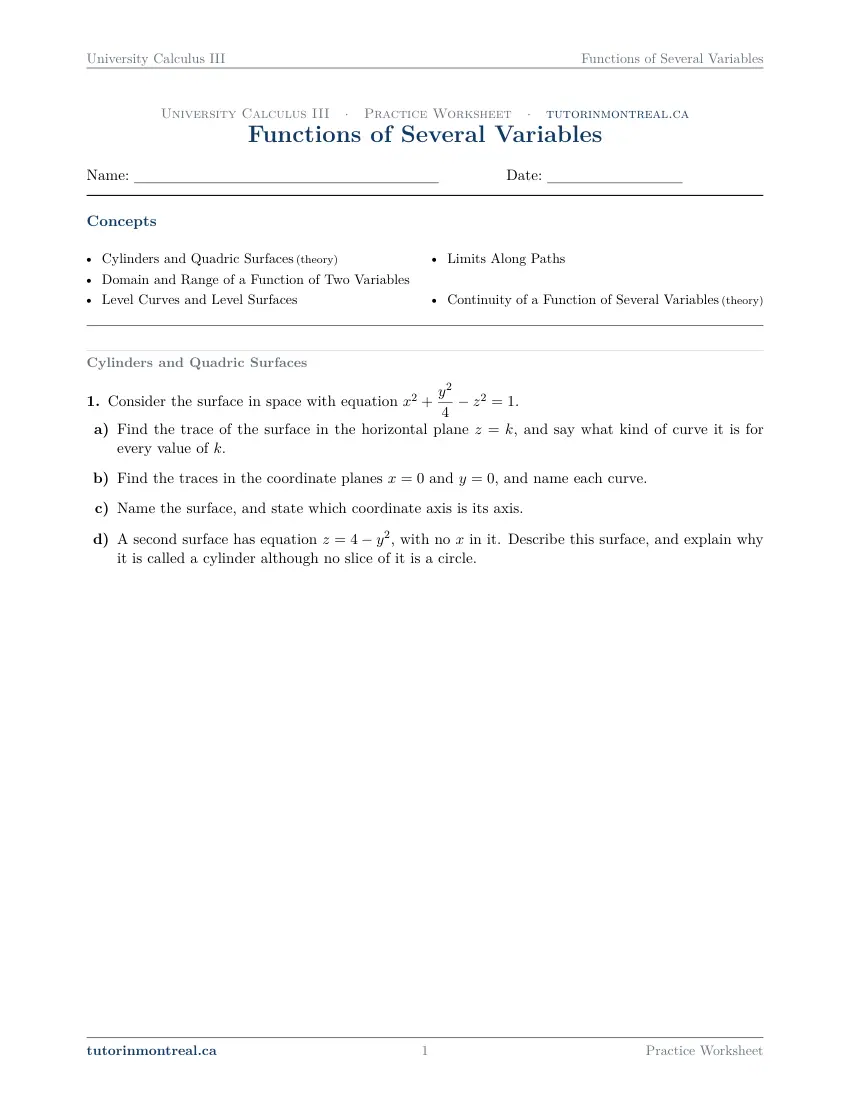
Q1Cylinders and Quadric Surfaces
Consider the surface in space with equation .
- Find the trace of the surface in the horizontal plane , and say what kind of curve it is for every value of .
- Find the traces in the coordinate planes and , and name each curve.
- Name the surface, and state which coordinate axis is its axis.
- A second surface has equation , with no in it. Describe this surface, and explain why it is called a cylinder although no slice of it is a circle.
-
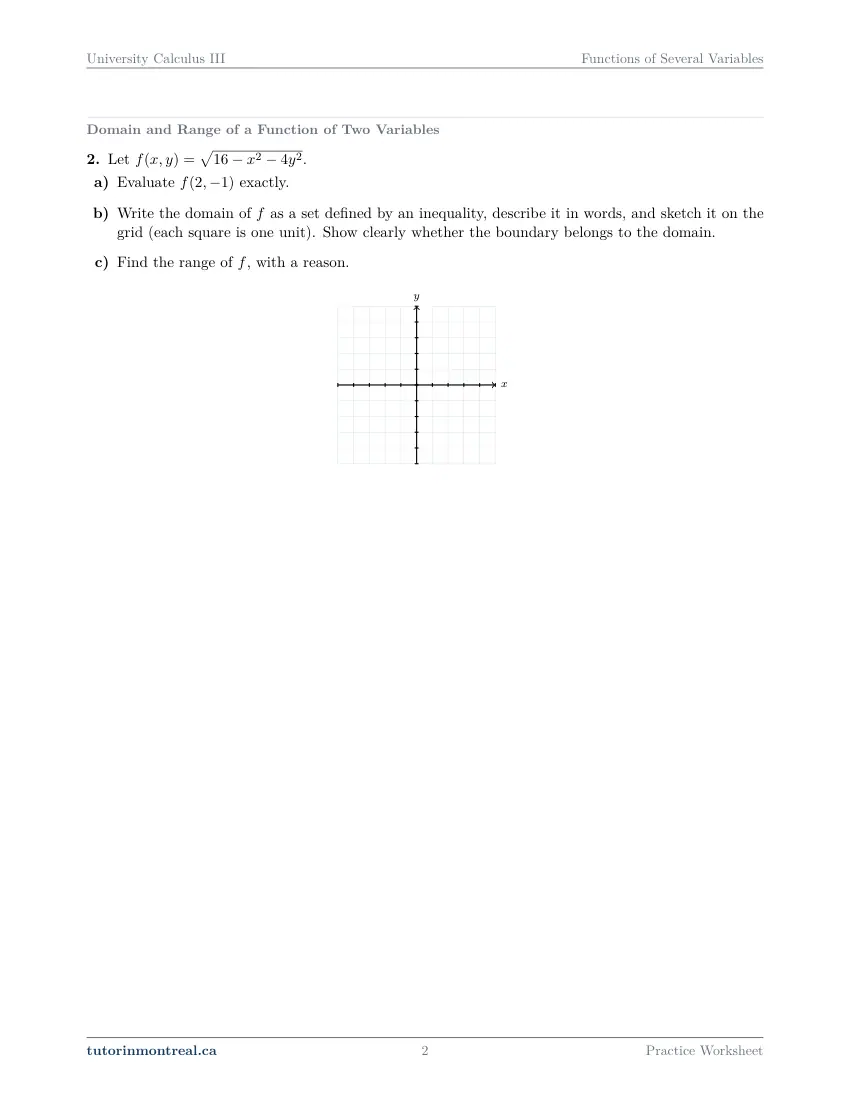
Q2Domain and Range of a Function of Two Variables
Let .
- Evaluate exactly.
- Write the domain of as a set defined by an inequality, describe it in words, and sketch it on the grid (each square is one unit). Show clearly whether the boundary belongs to the domain.
- Find the range of , with a reason.
A blank Cartesian grid for this question is on the printable PDF.
-
Q3Domain and Range of a Function of Two Variables
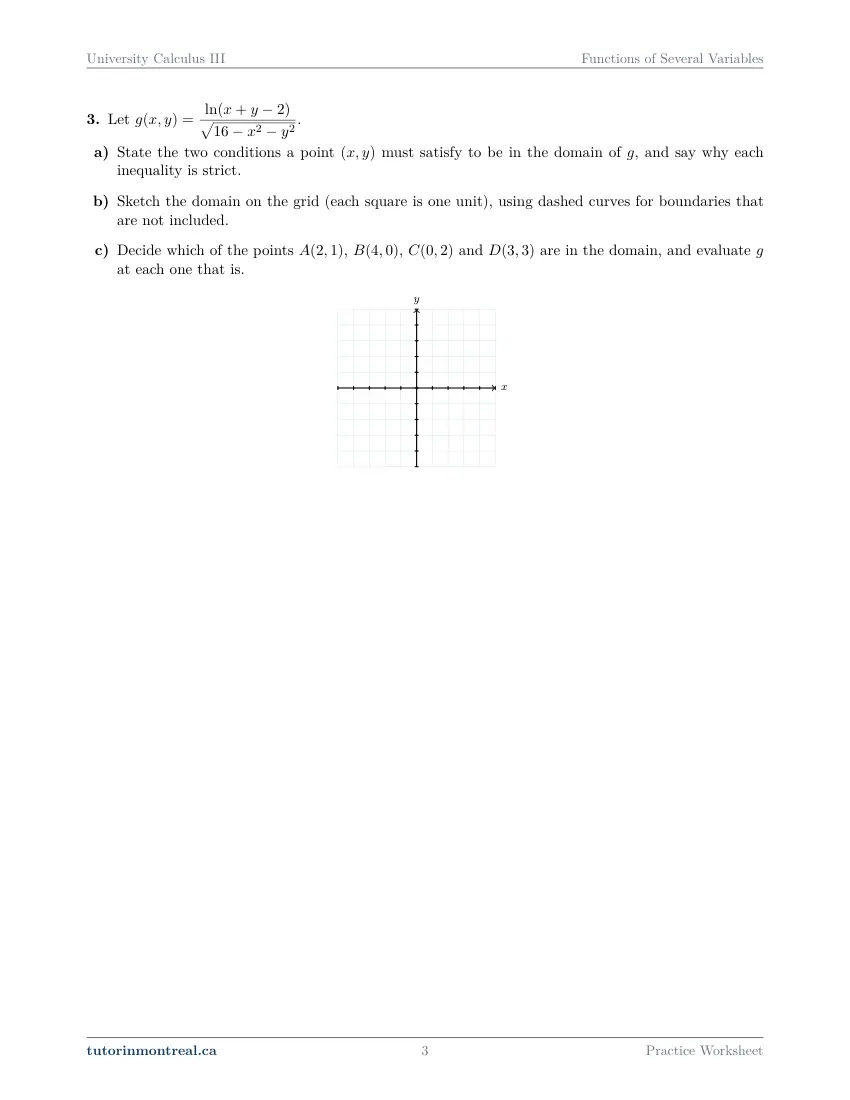
Let .
- State the two conditions a point must satisfy to be in the domain of , and say why each inequality is strict.
- Sketch the domain on the grid (each square is one unit), using dashed curves for boundaries that are not included.
- Decide which of the points , , and are in the domain, and evaluate at each one that is.
A blank Cartesian grid for this question is on the printable PDF.
-
Q4Level Curves and Level Surfaces
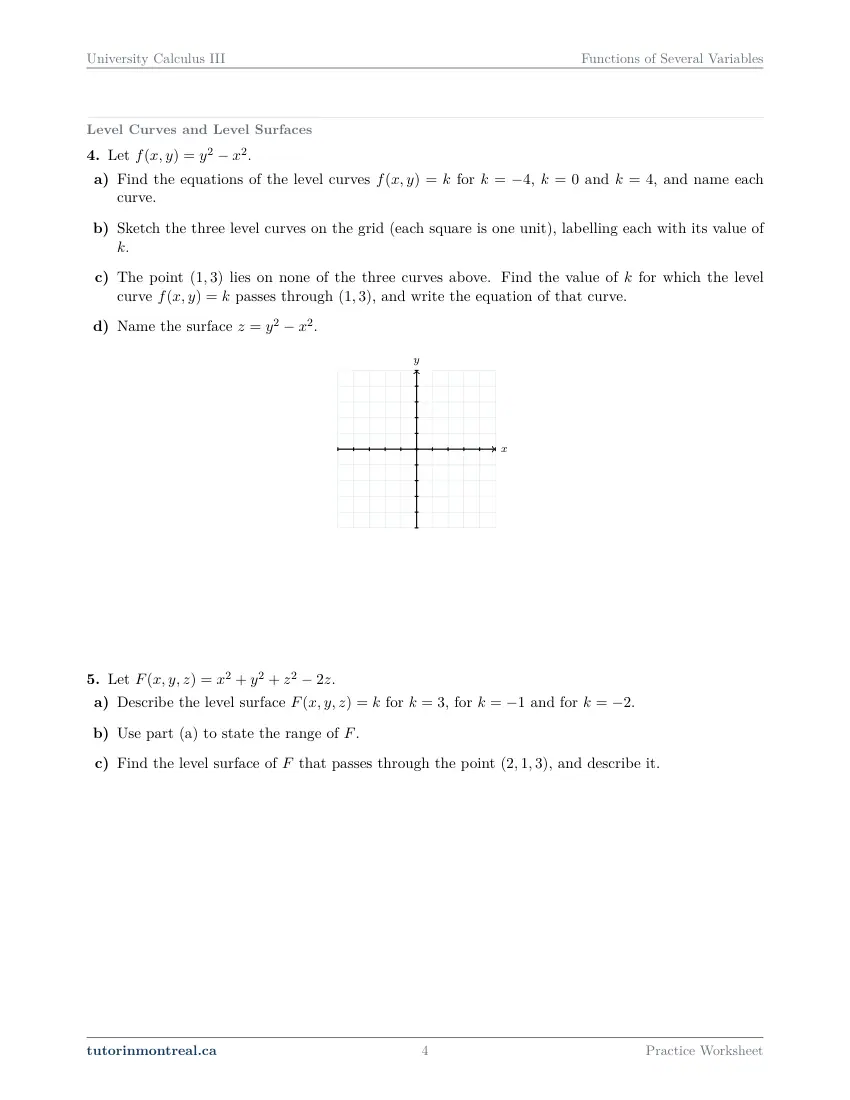
Let .
- Find the equations of the level curves for , and , and name each curve.
- Sketch the three level curves on the grid (each square is one unit), labelling each with its value of .
- The point lies on none of the three curves above. Find the value of for which the level curve passes through , and write the equation of that curve.
- Name the surface .
A blank Cartesian grid for this question is on the printable PDF.
-
Q5Level Curves and Level Surfaces
Let .
- Describe the level surface for , for and for .
- Use part (a) to state the range of .
- Find the level surface of that passes through the point , and describe it.
-
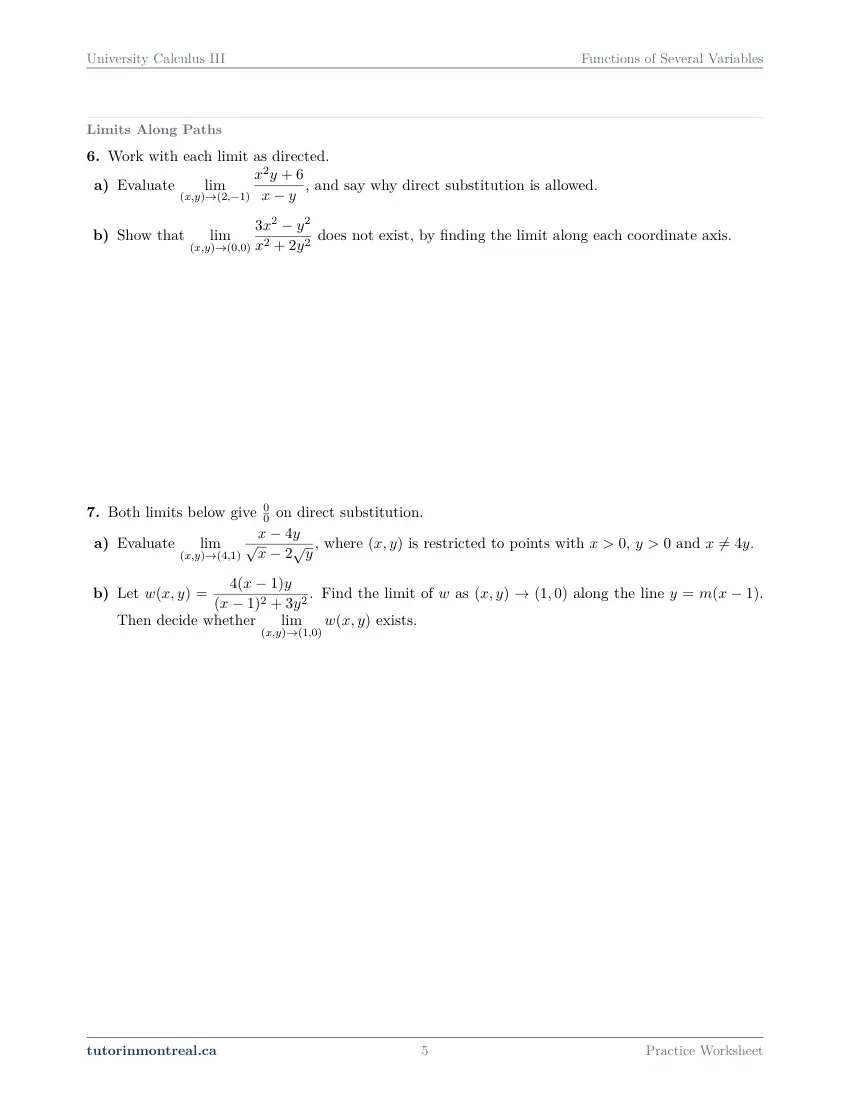
Q6Limits Along Paths
Work with each limit as directed.
- Evaluate , and say why direct substitution is allowed.
- Show that does not exist, by finding the limit along each coordinate axis.
-
Q7Limits Along Paths
Both limits below give on direct substitution.
- Evaluate , where is restricted to points with , and .
- Let . Find the limit of as along the line . Then decide whether exists.
-
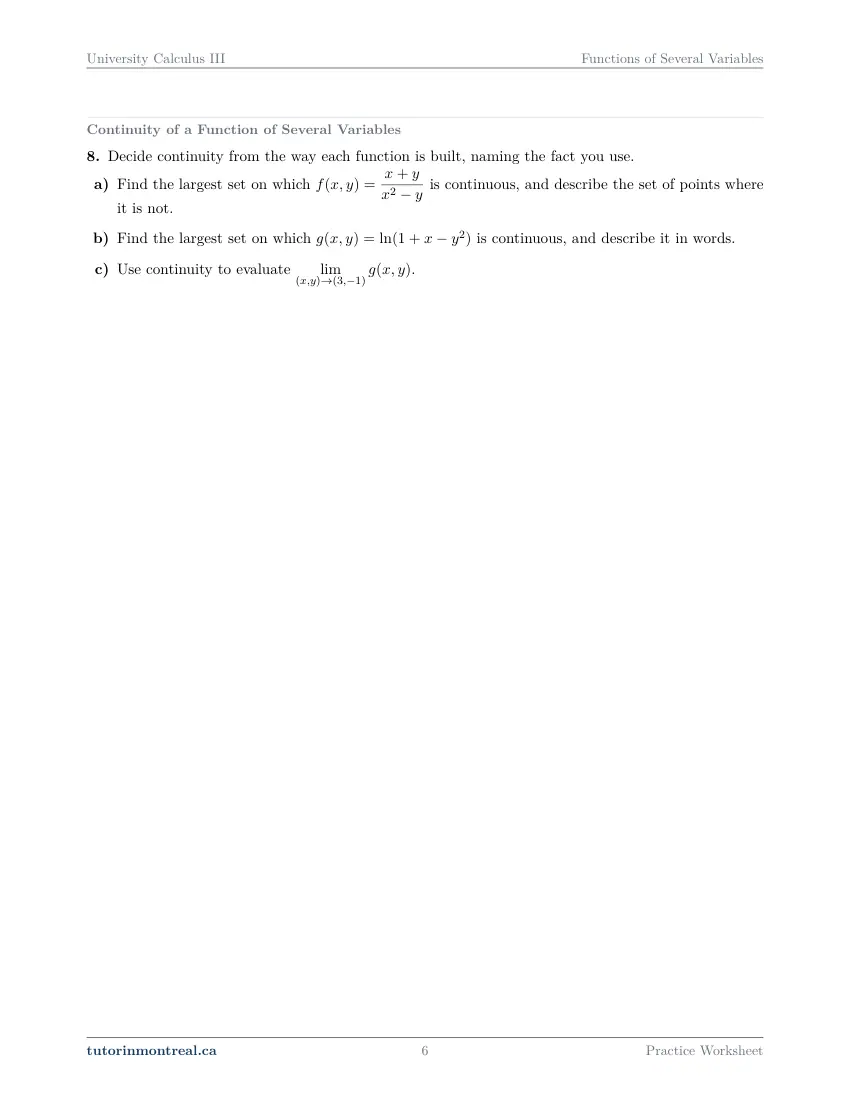
Q8Continuity of a Function of Several Variables
Decide continuity from the way each function is built, naming the fact you use.
- Find the largest set on which is continuous, and describe the set of points where it is not.
- Find the largest set on which is continuous, and describe it in words.
- Use continuity to evaluate .
-
Q9Synthesis — drawing on several topics in this unit
Let .
- Find the domain of and describe it in words. Is continuous at every point of its domain?
- Find the equations of the level curves and , and name them.
- The graph of is the set of points with . Show that every point of the graph lies on a quadric surface, name that quadric and its axis, and say which part of the quadric the graph is.
- State the range of , with a reason.
The 7 challenge problems for this topic are a separate, paid sheet and are not reproduced here.
What does this set assume? This set stands on CEGEP Calculus I, CEGEP Calculus II and CEGEP Linear Algebra, and re-teaches none of them. One-variable limits, factoring and rationalising a 0/0 form, the domain of a logarithm, a root and a quotient, and completing the square are all used without comment, and the equations of circles, ellipses, hyperbolas and parabolas in the plane are expected to be recognised on sight. Scope is the core that university multivariable courses share: quadric surfaces are recognised and sketched by their traces, limits are settled by direct substitution or shown not to exist along two paths, and there is no epsilon-delta argument anywhere in the course. Partial derivatives, the gradient and tangent planes are the next sets, not this one. Sequences and series are not part of this course at all; they belong to CEGEP Calculus II.
Which course is this for? In the public course calendars of Montreal universities, this material is part of the courses numbered MATH 222, MAST 218, ENGR 233, MAT1400, MAT1115, MTH1101 and MAT165. Each course orders and weights the topics its own way, so check your own outline for what your exam covers. Which sets match your course.
The rest of this unit
The worksheet is the practice, and it is free. Two more printable documents cover the same unit and come with the University Calculus III bundle: read the notes first, work this sheet, then sit the test closed-book. See what each one covers.
What the Functions of Several Variables notes cover About the Functions of Several Variables unit test
How to do every concept on this sheet
This is the part worksheet sites usually leave out. Below is the actual reasoning behind each group of questions — not a full solution set, the decisions that get you to one. Read it before you start, or after you get stuck.
A surface is recognised by slicing it
Q1 gives a surface as one equation in x, y and z and asks you to identify it without ever drawing it whole. The method is the one every quadric question uses: fix one variable at a constant, read the curve that is left in the plane, and let the family of curves tell you the shape. Part (a) slices with horizontal planes z = k, part (b) with the two vertical coordinate planes, and part (c) asks you to put the pictures together.
set z = k → a curve in x and y → ask how it changes as k changes"For every value of k" is part of the question. A horizontal trace can be a curve for some k, a single point for another, and empty for others, and which of these happens is exactly what separates one quadric from its neighbours. Look at the sign of the constant side of the trace equation as k varies: if it can be negative, some planes miss the surface altogether; if it never can, every horizontal plane cuts it. Then say which axis the traces are centred on — that is the axis part (c) asks for.
Part (d) is the other kind of surface in this sheet. When one variable is absent from the equation, a point satisfies it whatever that variable is, so the surface is the plane curve in the other two variables slid along lines parallel to the missing axis. Explaining the name means saying what a cylinder is in general — a surface swept out by parallel lines through a plane curve — rather than what it is in the circular case you met first.
A plane curve and a surface can have the same equation. An equation in two variables describes a curve when you are working in the plane and a cylinder when you are working in space. Say which setting you are in before you name the object.
The domain is a region, and its boundary is a decision
Q2 is a square root of an expression in x and y. The domain is every point where the radicand is non-negative, and the work is in turning that inequality into a region you can recognise: rearrange until the curve on the boundary is in a standard form, then decide which side of it the inequality keeps.
Writing and sketching a domain
One restriction per operation, then one region. Each line is one decision.
- 1List what each operation forbids
An even root needs a non-negative radicand; a logarithm needs a strictly positive argument; a denominator must not be zero. A root sitting in a denominator needs both, and so becomes strict.
- 2Turn each inequality into a boundary curve and a side
Replace the inequality with an equals sign to find the curve, recognise it, then test one point that is plainly on one side to see which side the inequality keeps.
- 3Intersect
The domain is the set of points that satisfies every restriction at once, so shade only where all of them overlap.
- 4Solid or dashed, for a stated reason
A boundary is included exactly when its inequality allows equality. Say which inequality that is: the question asks you to show it, not just to draw it.
Part (c) asks for the range, and "with a reason" means two halves. First bound the values: ask how small and how large the radicand can be on the domain, and where, and that gives an interval the function cannot leave. Then show that every value in the interval is actually reached — restricting to one line through the domain turns that into a one-variable question. An interval with only the first half argued is a guess.
Q3 combines two restrictions of different kinds, a logarithm in the numerator and a square root in the denominator, and part (a) asks why each inequality is strict. Each has its own reason, and the reasons are different: one is about the logarithm, the other is about dividing. Part (b) is the intersection of the two regions those conditions describe, with each boundary drawn according to step 4 above.
A point on a boundary is a test, not a borderline case. Part (c) gives four points. Check every one against both conditions, write down which condition a rejected point fails, and evaluate g only at a point that passes both. A point that satisfies one condition with equality fails it, since both are strict.
Level curves: the contour map of a surface
A function of two variables has a graph in three dimensions, which is hard to draw. Its level curves f(x, y) = k live in the plane, and a labelled set of them carries the same information the way a contour map carries a landscape. Q4 asks for three of them for a difference of two squares, one for a negative k, one for zero and one for a positive k.
k = 0 is usually the special case. For a nonzero k the equation is a curve you should be able to name, and the sign of k decides its orientation. At k = 0 the constant term disappears, so check whether the equation factors before you name it — a level set need not be the same kind of object as its neighbours. Name each one separately, and on the sketch notice how the zero level sits relative to the other two.
Part (c) runs the other way: given a point, find the level curve through it. There is nothing to solve — evaluate f at the point, and that number is the k of the curve that passes through it. Part (d) then asks you to name the surface whose contour map you have drawn, and the method is Q1's: its horizontal traces are the curves of part (a), and its vertical traces in x = c and y = c are what decide the name.
Level surfaces, and what an empty level set tells you
Q5 moves up one dimension. A function of three variables cannot be graphed at all, so its level surfaces F(x, y, z) = k are the only picture there is. Complete the square in the variable that carries a linear term, and every level set of this F reads as the same kind of equation with a different constant on the right.
sum of squares = constant → a surface, a single point, or nothing, by the sign of the constantFor each value of k in part (a), look at the sign of the constant first and let it tell you which case you are in before you describe anything. Part (b) is the payoff: a value belongs to the range of F exactly when its level set is non-empty, so the range is read off from the sign condition, with no further calculation. Part (c) is Q4(c) in three dimensions — evaluate F at the point to find which level surface passes through it — and a quick distance check from the centre confirms the description.
A limit in the plane has infinitely many directions
In one variable a point can be approached from two sides. In the plane it can be approached along any line, any curve, any spiral, and a limit exists only if every one of those paths leads to the same number. That changes which arguments are available, and Q6 sets the two basic ones side by side.
Q6(a): substitution is allowed because of continuity, and saying so is the answer. A rational function is continuous wherever its denominator is not zero, so check the denominator at the point, state that it is non-zero, and then substitute. The arithmetic is short; the sentence is what the question asks for.
Q6(b) is the standard way a limit fails. Approach the origin along the x-axis by setting y = 0, then along the y-axis by setting x = 0; each reduces the function to one variable, and the two one-variable limits are different numbers. Two paths with two different limits is a complete proof that the two-variable limit does not exist.
The argument only runs one way. Two paths that disagree prove the limit does not exist. Two paths that agree prove nothing, because some third path may disagree with both.
When both paths agree, try a family
Q7 opens with two limits that both give 0/0 on substitution and need different treatments. Part (a) is Calculus I in two variables: the numerator is a difference of squares in disguise, once each term is seen as the square of a root, and after the common factor cancels what is left is continuous at the point. Write down the restriction that makes the cancellation legal — the question states it for you.
Part (b) is built so that the method of Q6(b) does not decide it: the two coordinate axes give the same answer. So the question asks for the limit along a whole family of lines through the point at once, with the slope m left as a letter.
substitute y = m(x − 1), cancel the common power of (x − 1), and see whether m survivesIf the result still depends on m, different lines lead to different values, and the decision follows from Q6's rule. Write it with two specific values of m, so the two disagreeing paths are on the page as numbers, and do not stop at the two axes just because they happened to agree.
Continuity from the way a function is built
Q8 asks you to decide continuity without taking a single limit, by naming the fact that applies. Polynomials are continuous everywhere; a rational function is continuous wherever its denominator is non-zero; a composition of continuous functions is continuous wherever it is defined. Every function in the question is assembled from those pieces, so the work is in recognising the assembly and then finding where it breaks.
Part (a): name the curve where the denominator vanishes. Setting the denominator equal to zero gives the equation of a curve in the plane, and the function is continuous everywhere except on it. Describe that set as a curve you can sketch, not as an equation you left unsolved.
Part (b) is a logarithm of a polynomial, continuous on its whole domain, so the largest set of continuity is the domain, found the way Q3 found one and described in words. Part (c) is the reason continuity is worth knowing: at a point inside that set, the limit equals the value. Check that the point is in the set first — that check is the step that licenses the substitution.
The synthesis question, and why it is last
Q9 is one function, a square root, looked at four ways, and each part uses a different sheet. Part (a) is a domain as in Q2 — find the boundary curve, then test a point to see which side of it the inequality keeps, and do not assume it is the same side as before; the continuity half is Q8's composition argument. Part (b) is Q4's method, and it is worth writing down the level curve for a general k as well: part (d) will need it.
Part (c) is where the sheets meet. Setting z = f(x, y) and squaring both sides gives an equation in x, y and z, which you name by Q1's method of traces. But squaring lets in points the original equation did not have, so the graph is not the whole quadric: ask what sign z can take when it equals a square root, and say which part of the surface that leaves. Part (d) then reads the range the way Q5(b) did, from which level sets are non-empty.
Preview all 7 pages
Click any page to open the full PDF.
Getting the most out of it
Slice before you sketch
Every surface in this set is identified from its traces, never from a memory of a picture. Write the trace in z = k first, then in x = 0 and y = 0, name each curve, and only then name the surface. The traces are also the only way to draw a quadric by hand, so the work you do to identify it is the sketch.
Test a point on each side of a boundary
For a domain, pick one point that is plainly inside and one that is plainly outside each boundary curve and substitute them into the inequality. It takes seconds and it catches the most common error in this sheet, which is shading the wrong side of a correct curve.
Argue a range in two halves
A bound shows the function cannot go beyond an interval; a path or a level set shows it reaches every value inside it. Write both halves every time, and use a level set being empty or non-empty as the quickest test of whether a value is taken.
Keep the limit rule written at the top of the page
Two paths with different limits: the limit does not exist. Any number of paths with the same limit: nothing is settled. Continuity at the point: substitute, and say why. Most lost marks on limits in several variables come from running the first rule backwards.
Want the solutions, or something more challenging?
The worksheet, the questions above and every explanation on this page stay free permanently. Three more PDFs exist for this topic — the worked answer key, a harder problem set, and the answer key to that. They come with the University Calculus III Solutions Bundle, beside the unit notes and the unit test, which is what keeps the rest of the series free.
What else exists for Functions of Several Variables
Three PDFs · 15 pages · all three are in the bundle below.
- Answer key — 4 pages. All 9 questions worked step by step, including the restrictions and the justifications. Not a list of final answers.
- Challenge problems — 7 pages, 7 problems. A separate sheet at exam-plus difficulty covering the same 5 concepts. Harder than anything on the free sheet.
- Challenge answer key — 4 pages. Every challenge problem worked to the same standard, with the checks shown.
- PDF, letter size, print-ready.
The one thing that's for sale
Every University Calculus III topic — the complete Solutions Bundle
One download, one payment, the whole program. For all 9 University Calculus III units: the worksheet, the reference notes, the challenge set, the unit test and every answer key — including this one.
- Worked solutions, not answer lists — every step written out
- Covers the whole year's program at this level
- Less than the price of one hour of tutoring — for the entire year's solutions
Taking Secondary 1 Math as well? The Secondary 1 Math bundle covers all 15 of its units — 106 PDFs, 474 pages — on the same terms.
Taking Secondary 2 Math as well? The Secondary 2 Math bundle covers all 14 of its units — 98 PDFs, 449 pages — on the same terms.
Taking Secondary 3 Math as well? The Secondary 3 Math bundle covers all 11 of its units — 77 PDFs, 367 pages — on the same terms.
Taking Secondary 4 Math as well? The Secondary 4 Math bundle covers all 17 of its units — 122 PDFs, 466 pages — on the same terms.
Taking Secondary 5 Math as well? The Secondary 5 Math bundle covers all 21 of its units — 147 PDFs, 589 pages — on the same terms.
Taking CEGEP Calculus I as well? The CEGEP Calculus I bundle covers all 9 of its units — 72 PDFs, 371 pages — on the same terms.
Taking CEGEP Calculus II as well? The CEGEP Calculus II bundle covers all 8 of its units — 64 PDFs, 335 pages — on the same terms.
Taking CEGEP Linear Algebra as well? The CEGEP Linear Algebra bundle covers all 7 of its units — 56 PDFs, 298 pages — on the same terms.
Taking University Linear Algebra as well? The University Linear Algebra bundle covers all 9 of its units — 72 PDFs, 496 pages — on the same terms.
Taking University Differential Equations as well? The University Differential Equations bundle covers all 9 of its units — 36 PDFs, 182 pages — on the same terms.
Taking University Business Math as well? The University Business Math bundle covers all 9 of its units — 36 PDFs, 190 pages — on the same terms.
Taking University Introductory Statistics as well? The University Introductory Statistics bundle covers all 9 of its units — 36 PDFs, 186 pages — on the same terms.
Taking University Discrete Math as well? The University Discrete Math bundle covers all 9 of its units — 36 PDFs, 155 pages — on the same terms.
Taking AP Calculus AB as well? The AP Calculus AB bundle covers all 8 of its units — 64 PDFs, 527 pages — on the same terms.
Common questions
Is this worksheet really free?
Yes — the questions are on this page to read, and the PDF downloads directly, no email and no account. The one paid item is optional: the complete University Calculus III Solutions Bundle, which covers every set at this level.
Which university courses is this for?
The course codes listed on this page are taken from the public course calendars of universities that teach multivariable calculus after CEGEP. Each course orders and weights the topics its own way — some treat quadric surfaces at length, some only in passing, and some go through limits and continuity quickly on the way to partial derivatives — so check the outline for your own section to see where this set falls in your term.
What do I need to know before starting this set?
CEGEP Calculus I and II and CEGEP Linear Algebra. You should be comfortable with one-variable limits, including factoring a 0/0 form, with the domains of roots, logarithms and quotients, with completing the square, and with the equations of the standard curves in the plane.
How do I tell the quadric surfaces apart?
By their traces. Slice with planes parallel to each coordinate plane and name the curve in each slice; the combination of ellipses, hyperbolas and parabolas, and whether some slices are empty, identifies the surface. Counting the signs of the squared terms is a quick first guess, and the traces are what confirm it.
Why is a surface with no x in its equation called a cylinder?
Because in space a cylinder means any surface made of parallel lines through a plane curve. When x is missing, the equation holds for every x, so the curve in the other two variables is repeated along every line parallel to the x-axis. The curve does not have to be a circle.
If two paths give the same limit, does the limit exist?
Not necessarily. A limit in the plane has to be the same along every path into the point, so agreement along two, or even along every straight line, is not a proof. Disagreement along two paths is a proof that the limit does not exist, and that is the argument this set practises.
Do I need epsilon-delta proofs for this set?
No. Limits here are settled by direct substitution where the function is continuous, by simplifying a 0/0 form as in one variable, or shown not to exist with two paths. There is no epsilon-delta argument in this set or anywhere in this course.
Where are partial derivatives?
In the next set. This one is about the functions themselves — their domains, ranges, pictures, limits and continuity — and partial derivatives, the gradient and tangent planes each get a set of their own that builds on it.
Can teachers use this in class?
Yes. Print and photocopy it for your own classes freely — I just ask that the tutorinmontreal.ca footer stays on the page.
I'm stuck on one question. Can you help?
Yes — through one-on-one tutoring, in Montreal or online. Get in touch to arrange a session, or see the current rates.
← All 9 University Calculus III worksheets · Secondary 1 Math series (15 sheets) → · Secondary 2 Math series (14 sheets) → · Secondary 3 Math series (11 sheets) → · Secondary 4 Math series (17 sheets) → · Secondary 5 Math series (21 sheets) → · CEGEP Calculus I series (9 sheets) → · CEGEP Calculus II series (8 sheets) → · CEGEP Linear Algebra series (7 sheets) → · University Linear Algebra series (9 sheets) → · University Differential Equations series (9 sheets) → · University Business Math series (9 sheets) → · University Introductory Statistics series (9 sheets) → · University Discrete Math series (9 sheets) → · AP Calculus AB series (8 sheets) →