University Calculus III — Surface Integrals and Integral Theorems Worksheet
The last block of the course, where the integral moves from a curve to a surface and the three big theorems close the loop. Describing a surface with two parameters and reading its grid curves; the tangent plane to a parametric surface from the cross product of its two partial derivatives; surface area as the integral of the length of that cross product; integrating a density over a curved panel; flux across an oriented surface, where the orientation is half the answer; Stokes' theorem, which trades a line integral round a curve for a flux of the curl through any surface it bounds; and the divergence theorem, which trades the flux out of a closed surface for a triple integral over the solid inside. Have a look on this page, then print the free PDF when you want to write on it.
Practice worksheet — free PDF
No email, no account, no watermark. Teachers: photocopy it for your classes freely. Worked solutions and 7 harder problems come with the University Calculus III bundle.
All 11 questions
Each question targets one named concept from the sheet. Read them here, or print the PDF — it has working space under each one.
-
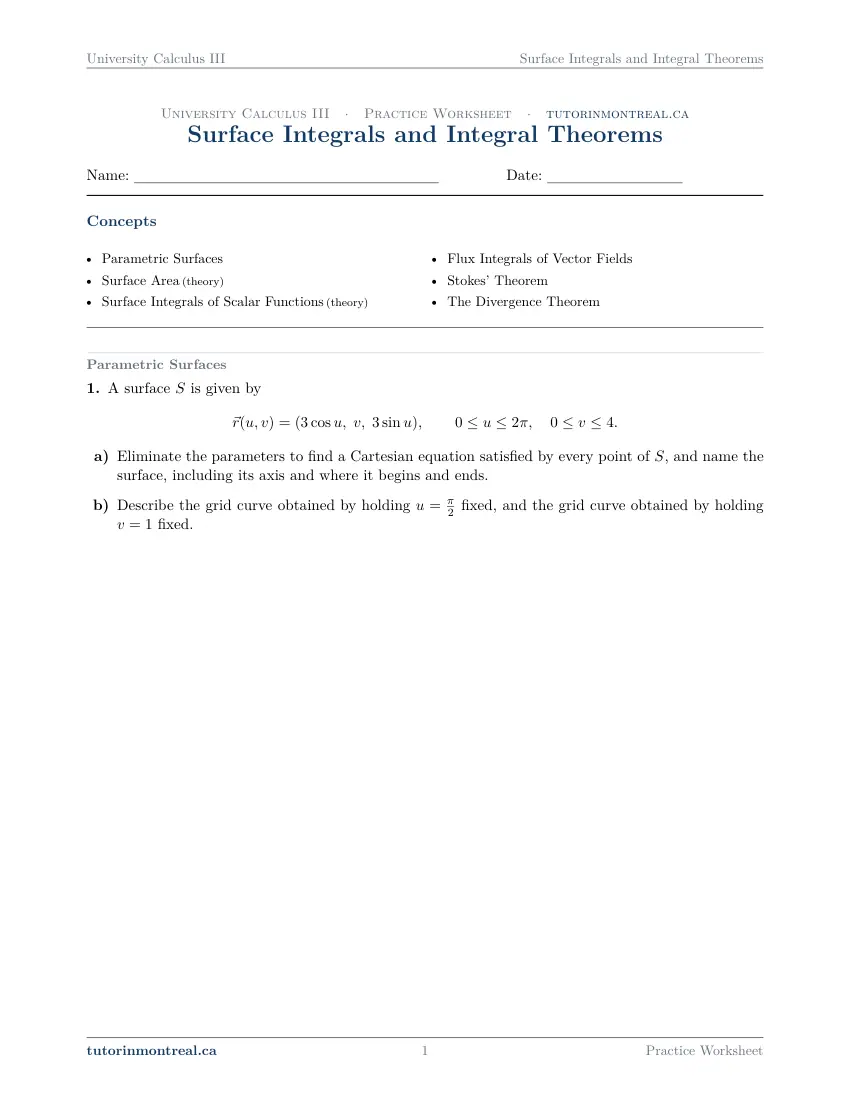
Q1Parametric Surfaces
A surface is given by
- Eliminate the parameters to find a Cartesian equation satisfied by every point of , and name the surface, including its axis and where it begins and ends.
- Describe the grid curve obtained by holding fixed, and the grid curve obtained by holding fixed.
-
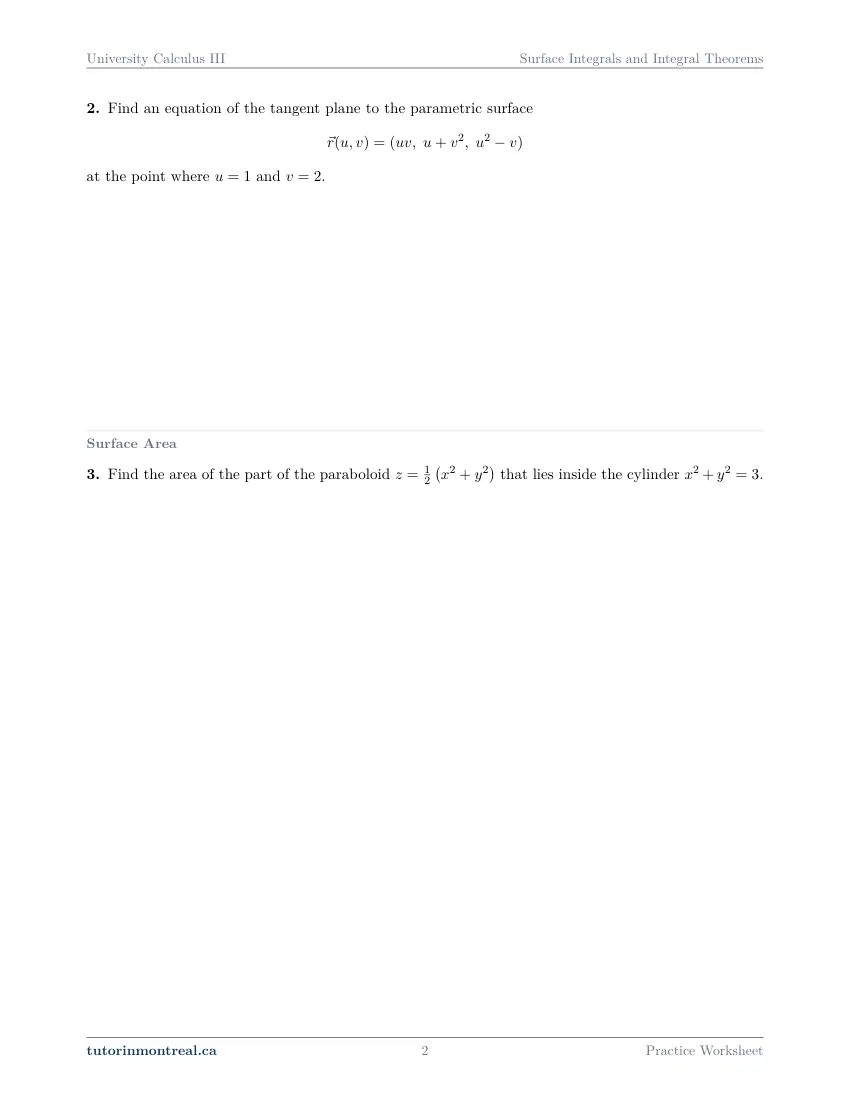
Q2Parametric Surfaces
Find an equation of the tangent plane to the parametric surface at the point where and .
-
Q3Surface Area
Find the area of the part of the paraboloid that lies inside the cylinder .
-
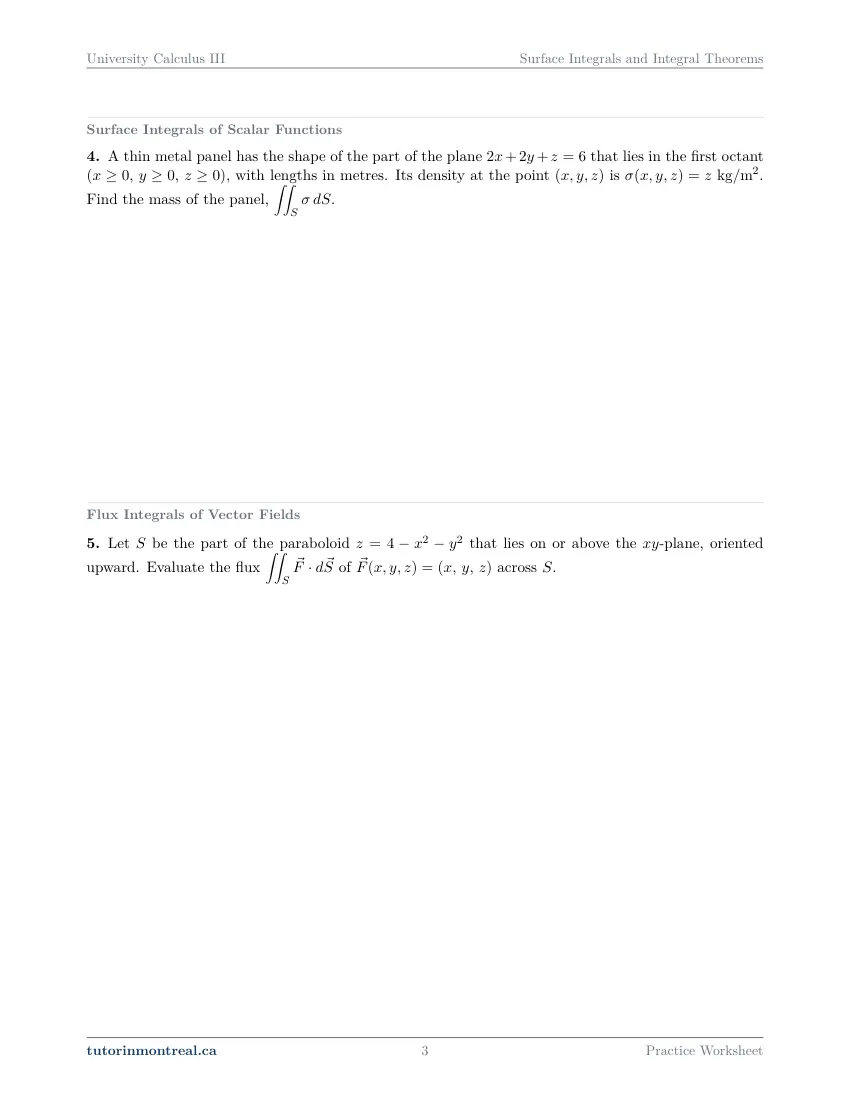
Q4Surface Integrals of Scalar Functions
A thin metal panel has the shape of the part of the plane that lies in the first octant (, , ), with lengths in metres. Its density at the point is . Find the mass of the panel, .
-
Q5Flux Integrals of Vector Fields
Let be the part of the paraboloid that lies on or above the -plane, oriented upward. Evaluate the flux of across .
-
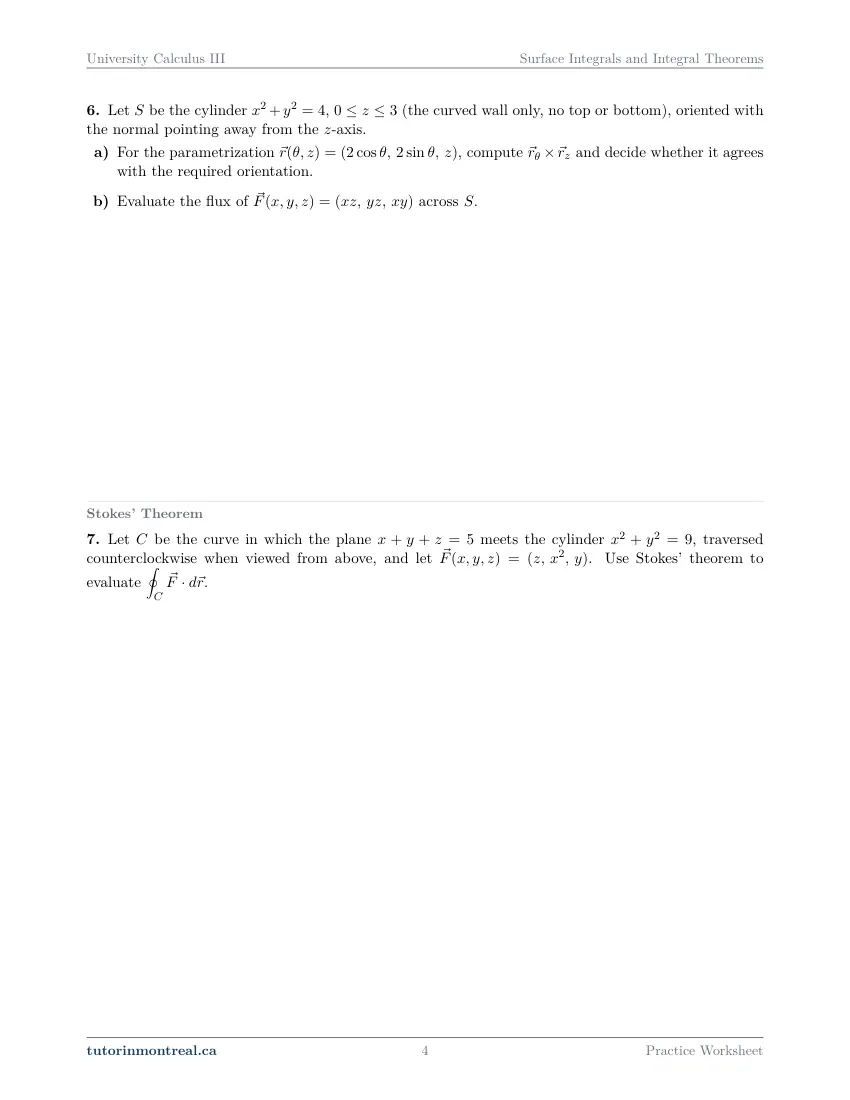
Q6Flux Integrals of Vector Fields
Let be the cylinder , (the curved wall only, no top or bottom), oriented with the normal pointing away from the -axis.
- For the parametrization , compute and decide whether it agrees with the required orientation.
- Evaluate the flux of across .
-
Q7Stokes' Theorem
Let be the curve in which the plane meets the cylinder , traversed counterclockwise when viewed from above, and let . Use Stokes' theorem to evaluate .
-
Q8Stokes' Theorem
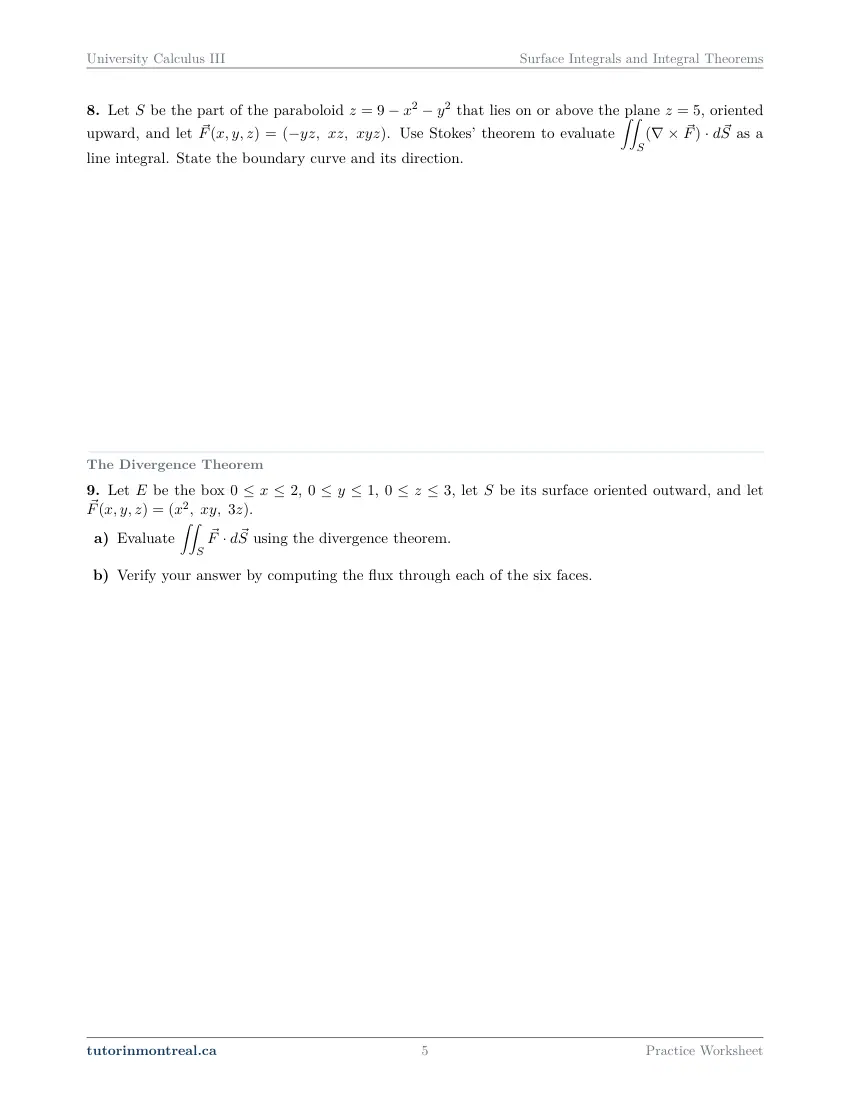
Let be the part of the paraboloid that lies on or above the plane , oriented upward, and let . Use Stokes' theorem to evaluate as a line integral. State the boundary curve and its direction.
-
Q9The Divergence Theorem
Let be the box , , , let be its surface oriented outward, and let .
- Evaluate using the divergence theorem.
- Verify your answer by computing the flux through each of the six faces.
-
Q10The Divergence Theorem
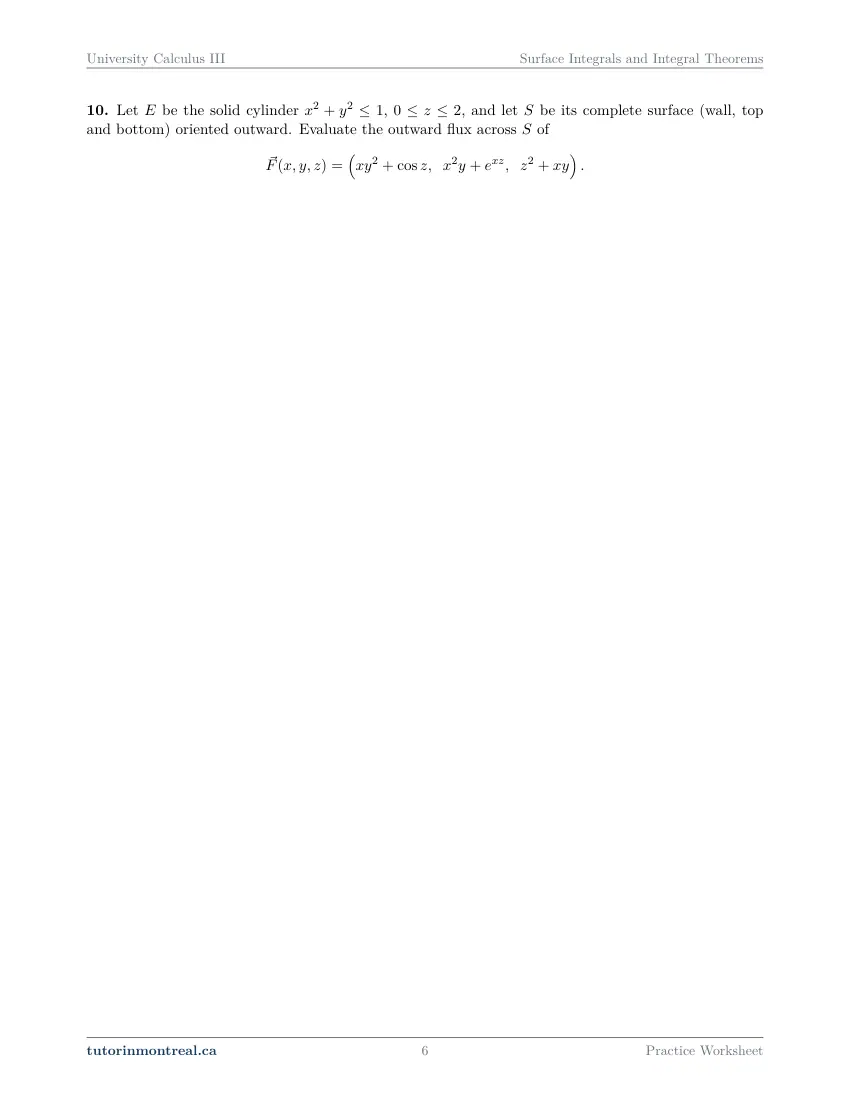
Let be the solid cylinder , , and let be its complete surface (wall, top and bottom) oriented outward. Evaluate the outward flux across of
-
Q11Synthesis — drawing on several topics in this unit
Let be the solid bounded below by the paraboloid and above by the plane . Its boundary consists of the flat top (the disk in the plane ) and the curved bowl (the part of with ), both oriented outward from . Let .
- State the direction (upward or downward) of the outward normal on and on , and compute the flux of across each piece.
- Evaluate in cylindrical coordinates and confirm that the divergence theorem holds.
The 7 challenge problems for this topic are a separate, paid sheet and are not reproduced here.
What does this set assume? This set stands on CEGEP Calculus I, CEGEP Calculus II and CEGEP Linear Algebra, and on the earlier Calculus III sets: the cross product and the equation of a plane, double integrals in rectangular and polar form, triple integrals in cylindrical coordinates, and the previous set's curl, divergence, line integrals and Green's theorem, which are used here as tools and never practised for their own sake. The surfaces are the standard ones — graphs, planes, cylinders, spheres and a paraboloid cap — and every integral that comes out of them is meant to be done by hand. Gauss's law and other physics applications are left out. This is the part of Calculus III that not every course reaches: some stop at Green's theorem, and some take all of vector calculus in a second term, so check your own outline before you work it.
Which course is this for? In the public course calendars of Montreal universities, this material is part of the courses numbered MAST 219, ENGR 233 and MAT1410. Each course orders and weights the topics its own way, so check your own outline for what your exam covers. Which sets match your course.
The rest of this unit
The worksheet is the practice, and it is free. Two more printable documents cover the same unit and come with the University Calculus III bundle: read the notes first, work this sheet, then sit the test closed-book. See what each one covers.
What the Surface Integrals and Integral Theorems notes cover About the Surface Integrals and Integral Theorems unit test
How to do every concept on this sheet
This is the part worksheet sites usually leave out. Below is the actual reasoning behind each group of questions — not a full solution set, the decisions that get you to one. Read it before you start, or after you get stuck.
A surface is a function of two parameters
A curve needed one parameter; a surface needs two. The parametrization r(u, v) sends each point of a region in the uv-plane to a point in space, and the whole surface is what that region becomes. Q1 runs the process backwards: it hands you r(u, v) and asks what surface it is.
Eliminate the parameters by finding a combination in which they cancel. Two of the three coordinates are a cosine and a sine of the same parameter with the same coefficient, so squaring and adding them removes that parameter completely. The coordinate that does not appear in the resulting equation is free to take any value, and that is what tells you the direction of the axis. The range of the other parameter then says where the surface begins and where it ends — part (a) asks for all three facts, not just the equation.
Part (b) is about grid curves: freeze one parameter and let the other run. Freezing u leaves a curve along which only v moves, so ask which coordinates v controls and which are now constants. Freezing v does the opposite. Each grid curve is a familiar object — a line or a circle — and naming it, with where it sits, is the whole answer.
The tangent plane comes from a cross product
Holding v fixed and differentiating in u gives ru, a vector tangent to one grid curve; holding u fixed gives rv, tangent to the other. Both lie in the tangent plane, so their cross product is perpendicular to it — and a point plus a normal vector is all an equation of a plane has ever needed.
Tangent plane to r(u, v) at given (u, v)
The routine Q2 asks for, in order.
- 1Find the point
Substitute the given parameter values into r(u, v). The point is in xyz-space; the parameter values are not a point on the surface.
- 2Differentiate each component
ru and rv as functions first, then evaluated at the given (u, v). Evaluating too early is how a product like uv loses a term.
- 3Cross them
ru × rv is a normal vector. Any non-zero multiple of it will do, so clear a common factor if one appears.
- 4Write the plane
n · (x − x₀, y − y₀, z − z₀) = 0, then check the point satisfies your final equation.
Surface area is the length of that same cross product
The cross product does a second job. Its length is the area of the small parallelogram that a tiny rectangle of the parameter region is stretched into, so the area of the surface is the double integral of ‖ru × rv‖ over the parameter region. For a graph z = f(x, y), using x and y themselves as the parameters, that length becomes √(1 + fx² + fy²).
Area = ∬ over D of √(1 + fₓ² + f_y²) dA for the graph z = f(x, y) over DQ3 is really two decisions. The first is the region D: the part of the surface inside a cylinder lies above the disk the cylinder cuts out of the xy-plane, and the radius is read off the cylinder's equation. The second is the coordinates: an integrand that depends on x² + y² over a disk is asking for polar coordinates, and the extra factor r in the polar area element is exactly what makes the square root integrable by a substitution. Forget the r and the integral becomes much harder, not just different.
A surface integral of a density adds up mass
Q4 is the surface version of the wire in the line-integral set: a thin panel with a density σ that varies from point to point, and the mass is the integral of σ over the surface with respect to area, dS. The panel is a flat piece of a plane, which makes it the gentlest possible surface to parametrize.
Solve the plane for z, and find the shadow. Written as z = g(x, y), the plane has constant slopes, so the stretch factor √(1 + gx² + gy²) is one number, not a function — work it out once and bring it outside. The region of integration is the shadow of the panel in the xy-plane: the part of the first quadrant where the plane is still above the floor, found by setting z = 0 in the plane's equation. The density z must be rewritten in terms of x and y before you integrate over that shadow.
Flux: orientation first, then the integral
A flux integral measures how much of a vector field passes through a surface, and it has a sign: flow in the direction of the chosen normal counts positive, flow against it negative. That is why every flux question names an orientation, and why deciding the direction of your normal vector comes before any integration.
For a graph z = g(x, y) oriented upward, the vector (−gx, −gy, 1) dA is the oriented area element: its last component is positive, so it points up. Q5 uses exactly this. Dot the field with it, rewrite z in terms of x and y, and integrate over the disk the surface stands on — polar coordinates again, for the same reason as in Q3.
For a parametric surface, the cross product has its own direction, and it may be the wrong one. Q6(a) makes you check. Compute rθ × rz as a vector and look at it at a convenient point: does it point away from the z-axis, as the question requires, or towards it? If it points the wrong way, the fix is a single minus sign on the whole integral — or crossing the partial derivatives in the other order. What is not acceptable is skipping the check, because on a closed-looking surface like a cylinder wall the wrong orientation gives an answer of the right size and the wrong sign.
Stokes' theorem: a line integral becomes a flux of the curl
∮ over C of F · dr = ∬ over S of (∇ × F) · dSThe curve C is the boundary of the surface S, and the two orientations must agree: walk along C in its direction with your head pointing along the normal of S, and the surface is on your left. Equivalently, curl the fingers of your right hand along C and your thumb gives the normal. Green's theorem from the previous set is the special case where S is flat and lies in the xy-plane.
Q7 runs the theorem forwards — and the trick is choosing S. The curve is the intersection of a plane with a cylinder, which is awkward to parametrize and integrate round. But Stokes' theorem lets you use any surface whose boundary is C, and the obvious one is the flat piece of the plane that the curve encloses. Compute the curl, write the upward normal of that plane (counterclockwise seen from above means upward), and integrate over the disk the piece stands above.
Q8 runs it backwards. It gives a surface integral of a curl and asks you to compute it as a line integral instead, which means naming the boundary curve and its direction before anything else. The boundary of a paraboloid cap cut off by a horizontal plane is where the two meet: substitute the plane's height into the paraboloid's equation and read off the circle. The direction comes from the right-hand rule with the given upward orientation. Then parametrize that circle and evaluate the line integral — the curl itself is never needed.
The divergence theorem: flux out of a closed surface
∯ over S of F · dS = ∭ over E of ∇ · F dV (S the whole boundary of E, oriented outward)The surface must be closed — the complete boundary of a solid — and oriented outward. Then the total flux out equals the integral of the divergence over the solid inside. One triple integral replaces several surface integrals, one per face.
Q9 does the same flux both ways on purpose. Part (a) is one triple integral over a box. Part (b) is the six faces separately, and the method is the same on each: on a face one coordinate is constant and the outward unit normal is plus or minus a coordinate vector, so F · n is just one component of F, with a sign, evaluated at that constant. Keep a running table of the six faces, one line each, and add them up at the end. The two totals must agree; if they do not, the sign on a face whose outward normal points in a negative direction is the usual culprit.
Q10 is built so that only one method is sensible. Look at the field before you look at the surface: some of its terms are the kind nobody wants to integrate over a cylinder wall. Now take the divergence. Each component is differentiated with respect to its own variable only, and the awkward terms do not depend on that variable. What survives is simple, and the solid is a cylinder — so cylindrical coordinates finish it.
The synthesis question, and why it is last
Q11 closes the course by checking the divergence theorem on a solid whose boundary has two pieces: a flat lid and a curved bowl. Part (a) asks for the outward direction on each piece before any computation, and the way to decide is to ask which side of the piece the solid lies on — outward always means away from the solid, which is not the same as upward. Each flux is then a graph flux like Q5, with the sign of the area element chosen to match. Part (b) computes the divergence integral in cylindrical coordinates, with the limits of z running from the bowl up to the lid, and the two sides of the theorem must meet.
Preview all 7 pages
Click any page to open the full PDF.
Getting the most out of it
Decide the orientation before you integrate
Every flux, every Stokes question and every divergence-theorem question turns on a direction: upward or downward, away from the axis or towards it, outward from the solid. Write the direction you need in words, then check your normal vector against it at one convenient point. A flux with the wrong orientation is the right number with the wrong sign, and it earns nothing.
Draw the shadow
Almost every surface integral here ends as a double integral over the region the surface stands above. Sketch that region in the xy-plane — a disk, a triangle, a rectangle — and write its limits before you touch the integrand. For a disk, reach for polar coordinates and do not forget the r.
Choose the easy side of the theorem
Stokes' theorem and the divergence theorem are equalities, so each question is really a choice: which side is easier? A messy field with a simple divergence says triple integral; a curl through a curved cap says line integral round its rim; a line integral round an awkward curve says flux through the flattest surface it bounds. Say which way you are going and why — the choice is where the understanding shows.
State the hypotheses in one line
The divergence theorem needs a closed surface oriented outward; Stokes' theorem needs the curve's direction and the surface's normal to agree by the right-hand rule. Write that line every time. It costs nothing when it holds, and it is exactly what stops you applying the divergence theorem to a cylinder wall with no top or bottom.
Want the solutions, or something more challenging?
The worksheet, the questions above and every explanation on this page stay free permanently. Three more PDFs exist for this topic — the worked answer key, a harder problem set, and the answer key to that. They come with the University Calculus III Solutions Bundle, beside the unit notes and the unit test, which is what keeps the rest of the series free.
What else exists for Surface Integrals and Integral Theorems
Three PDFs · 13 pages · all three are in the bundle below.
- Answer key — 3 pages. All 11 questions worked step by step, including the restrictions and the justifications. Not a list of final answers.
- Challenge problems — 7 pages, 7 problems. A separate sheet at exam-plus difficulty covering the same 6 concepts. Harder than anything on the free sheet.
- Challenge answer key — 3 pages. Every challenge problem worked to the same standard, with the checks shown.
- PDF, letter size, print-ready.
The one thing that's for sale
Every University Calculus III topic — the complete Solutions Bundle
One download, one payment, the whole program. For all 9 University Calculus III units: the worksheet, the reference notes, the challenge set, the unit test and every answer key — including this one.
- Worked solutions, not answer lists — every step written out
- Covers the whole year's program at this level
- Less than the price of one hour of tutoring — for the entire year's solutions
Taking Secondary 1 Math as well? The Secondary 1 Math bundle covers all 15 of its units — 106 PDFs, 474 pages — on the same terms.
Taking Secondary 2 Math as well? The Secondary 2 Math bundle covers all 14 of its units — 98 PDFs, 449 pages — on the same terms.
Taking Secondary 3 Math as well? The Secondary 3 Math bundle covers all 11 of its units — 77 PDFs, 367 pages — on the same terms.
Taking Secondary 4 Math as well? The Secondary 4 Math bundle covers all 17 of its units — 122 PDFs, 466 pages — on the same terms.
Taking Secondary 5 Math as well? The Secondary 5 Math bundle covers all 21 of its units — 147 PDFs, 589 pages — on the same terms.
Taking CEGEP Calculus I as well? The CEGEP Calculus I bundle covers all 9 of its units — 72 PDFs, 371 pages — on the same terms.
Taking CEGEP Calculus II as well? The CEGEP Calculus II bundle covers all 8 of its units — 64 PDFs, 335 pages — on the same terms.
Taking CEGEP Linear Algebra as well? The CEGEP Linear Algebra bundle covers all 7 of its units — 56 PDFs, 298 pages — on the same terms.
Taking University Linear Algebra as well? The University Linear Algebra bundle covers all 9 of its units — 72 PDFs, 496 pages — on the same terms.
Taking University Differential Equations as well? The University Differential Equations bundle covers all 9 of its units — 36 PDFs, 182 pages — on the same terms.
Taking University Business Math as well? The University Business Math bundle covers all 9 of its units — 36 PDFs, 190 pages — on the same terms.
Taking University Introductory Statistics as well? The University Introductory Statistics bundle covers all 9 of its units — 36 PDFs, 186 pages — on the same terms.
Taking University Discrete Math as well? The University Discrete Math bundle covers all 9 of its units — 36 PDFs, 155 pages — on the same terms.
Taking AP Calculus AB as well? The AP Calculus AB bundle covers all 8 of its units — 64 PDFs, 527 pages — on the same terms.
Common questions
Is this worksheet really free?
Yes — the questions are on this page to read, and the PDF downloads directly, no email and no account. The one paid item is optional: the complete University Calculus III Solutions Bundle, which covers every set at this level.
Which university courses is this for?
The course codes listed on this page come from the public course calendars of Montreal universities: those courses teach surface integrals, Stokes' theorem and the divergence theorem. Each course orders and weights the topics its own way, and some stop before this material entirely, so check the outline for your own section before you rely on it.
How do I know which way the normal should point?
The question tells you — upward, outward, away from an axis — and your job is to check that your normal vector agrees. Compute it, then evaluate it at one convenient point and look at the sign of the relevant component. If it points the wrong way, change the sign of the whole integral.
What is the difference between dS and the vector dS?
The scalar dS is an element of area, with no direction: it is what you integrate a density against to get a mass, or 1 against to get an area. The vector version carries the normal direction as well, and it is what a flux integral uses. For a parametric surface the first is the length of the cross product of the partial derivatives, the second is the cross product itself.
When should I use Stokes' theorem?
When the line integral round a closed curve is awkward but the curve bounds a simple surface — usually a flat piece of a plane — or, the other way round, when a flux of a curl through a curved surface is easier to compute as a line integral round its rim. The theorem lets you pick any surface with the right boundary, so pick the simplest.
When does the divergence theorem apply?
When the surface is closed — the whole boundary of a solid — and oriented outward, and the field has continuous partial derivatives on the solid. An open surface, like a cylinder wall without its top and bottom, does not qualify on its own; you would have to add the missing pieces and subtract their flux.
Why do some fields in the questions have such complicated terms?
Because the question is testing whether you choose the right method. Terms that would make a surface integral miserable often vanish when you take the divergence or the curl, so the theorem turns an impossible calculation into a short one. Look at what the theorem needs before you start integrating.
Is Green's theorem part of this set?
It is used, not practised. Green's theorem has its own sheet in the vector fields and line integrals set; here it appears as the flat special case of Stokes' theorem, which is the best way to remember how the orientation rule works.
Can teachers use this in class?
Yes. Print and photocopy it for your own classes freely — I just ask that the tutorinmontreal.ca footer stays on the page.
I'm stuck on one question. Can you help?
Yes — through one-on-one tutoring, in Montreal or online. Get in touch to arrange a session, or see the current rates.
← All 9 University Calculus III worksheets · Secondary 1 Math series (15 sheets) → · Secondary 2 Math series (14 sheets) → · Secondary 3 Math series (11 sheets) → · Secondary 4 Math series (17 sheets) → · Secondary 5 Math series (21 sheets) → · CEGEP Calculus I series (9 sheets) → · CEGEP Calculus II series (8 sheets) → · CEGEP Linear Algebra series (7 sheets) → · University Linear Algebra series (9 sheets) → · University Differential Equations series (9 sheets) → · University Business Math series (9 sheets) → · University Introductory Statistics series (9 sheets) → · University Discrete Math series (9 sheets) → · AP Calculus AB series (8 sheets) →