University Differential Equations — Constant-Coefficient Linear Equations Worksheet
The chapter where second-order equations stop being guesswork. A homogeneous linear equation with constant coefficients turns into a polynomial — the characteristic equation — and the kind of roots that polynomial has decides the shape of every solution. This set drills the three cases one at a time: distinct real roots, a repeated root, and a complex conjugate pair written in real form. Around them it builds what the cases need: the complex arithmetic, polar form and Euler's formula that turn a complex root into a sine and a cosine; powers and roots of a complex number, for the higher-order equations whose characteristic polynomial is a single power; and superposition and the Wronskian, which say why two solutions are enough. Have a look on this page, then print the free PDF when you want to write on it.
Practice worksheet — free PDF
No email, no account, no watermark. Teachers: photocopy it for your classes freely. Worked solutions and 8 harder problems come with the University Differential Equations bundle.
All 12 questions
Each question targets one named concept from the sheet. Read them here, or print the PDF — it has working space under each one.
-
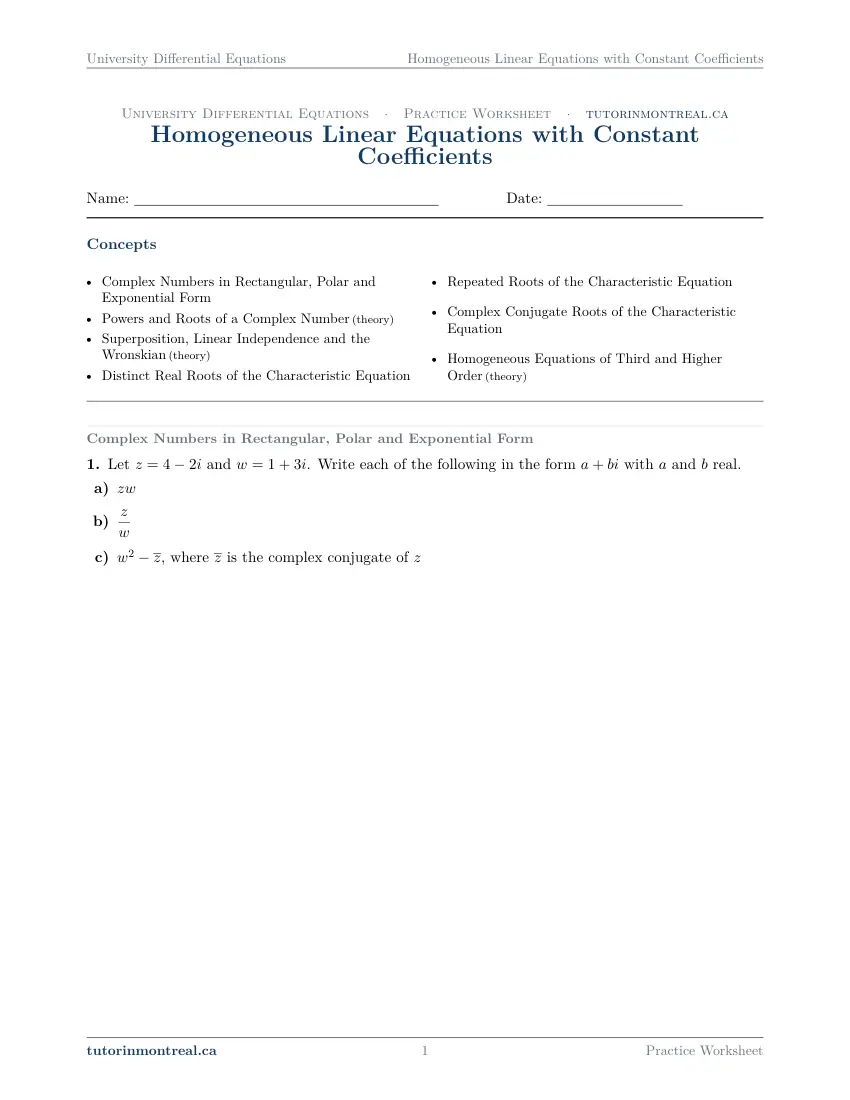
Q1Complex Numbers in Rectangular, Polar and Exponential Form
Let and . Write each of the following in the form with and real.
- , where is the complex conjugate of
-
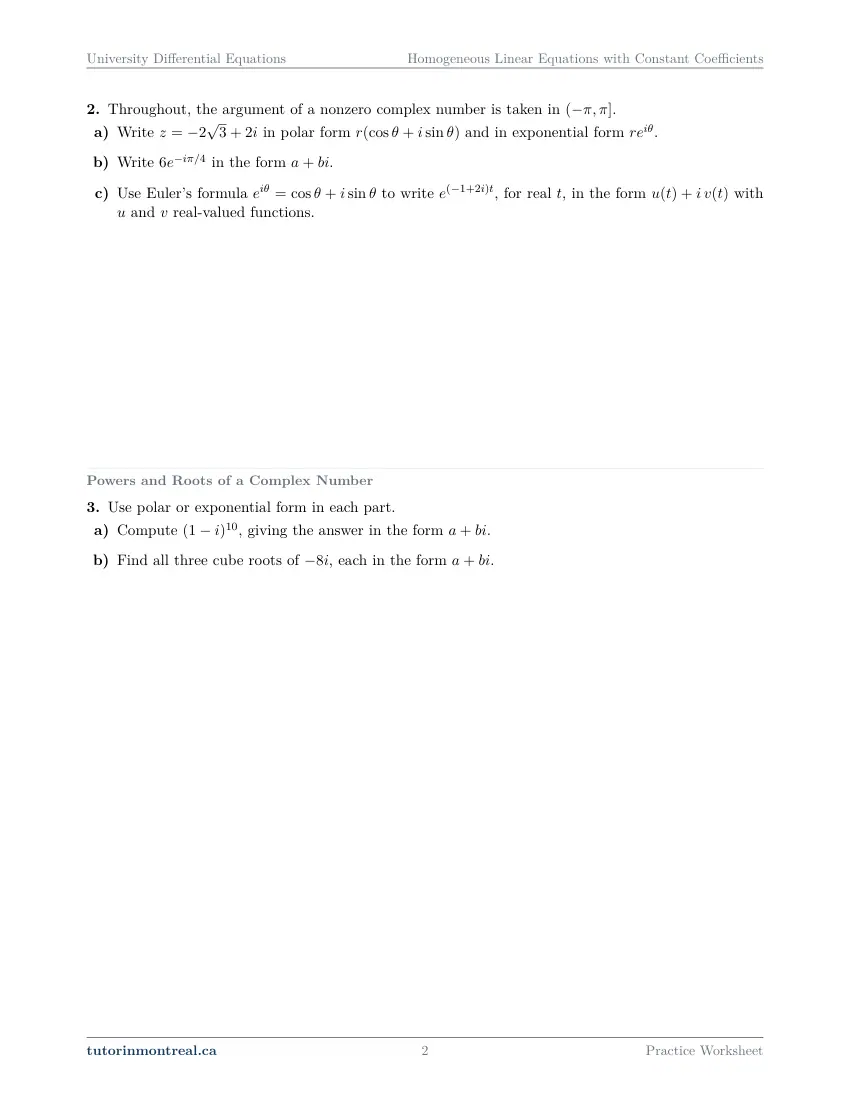
Q2Complex Numbers in Rectangular, Polar and Exponential Form
Throughout, the argument of a nonzero complex number is taken in .
- Write in polar form and in exponential form .
- Write in the form .
- Use Euler's formula to write , for real , in the form with and real-valued functions.
-
Q3Powers and Roots of a Complex Number
Use polar or exponential form in each part.
- Compute , giving the answer in the form .
- Find all three cube roots of , each in the form .
-
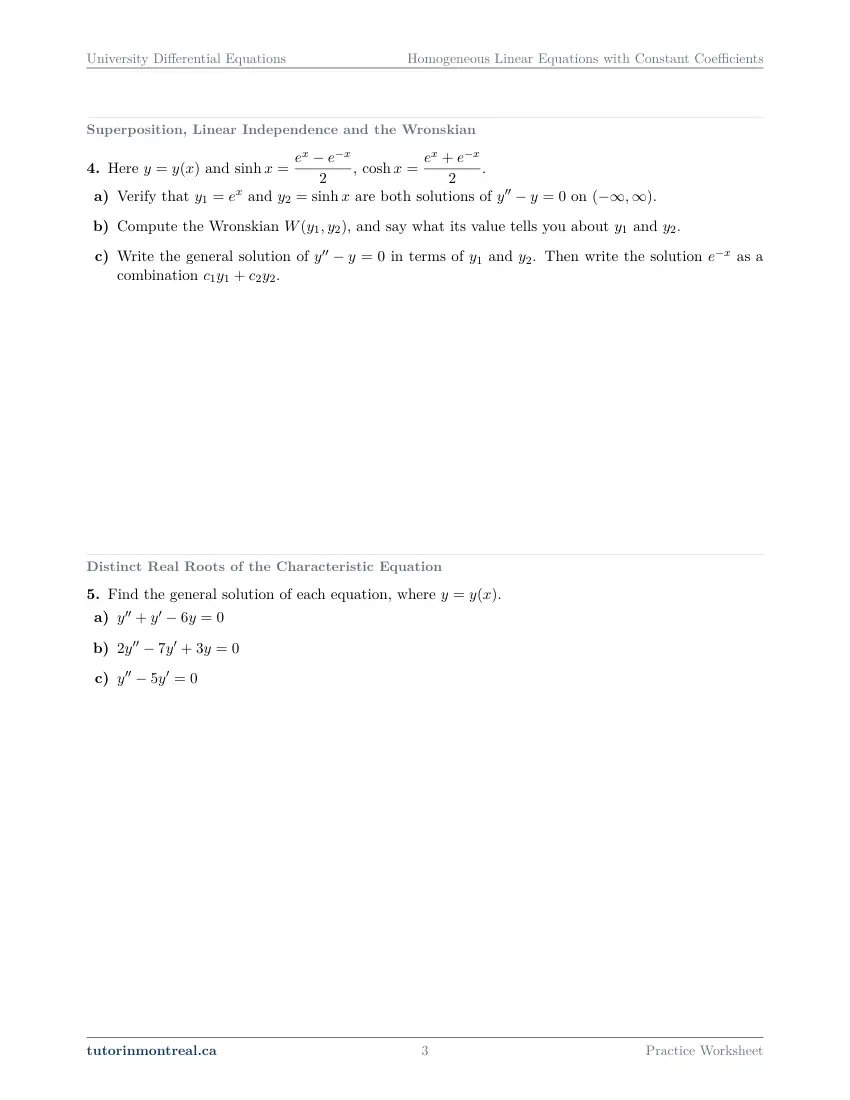
Q4Superposition, Linear Independence and the Wronskian
Here and , .
- Verify that and are both solutions of on .
- Compute the Wronskian , and say what its value tells you about and .
- Write the general solution of in terms of and . Then write the solution as a combination .
-
Q5Distinct Real Roots of the Characteristic Equation
Find the general solution of each equation, where .
-
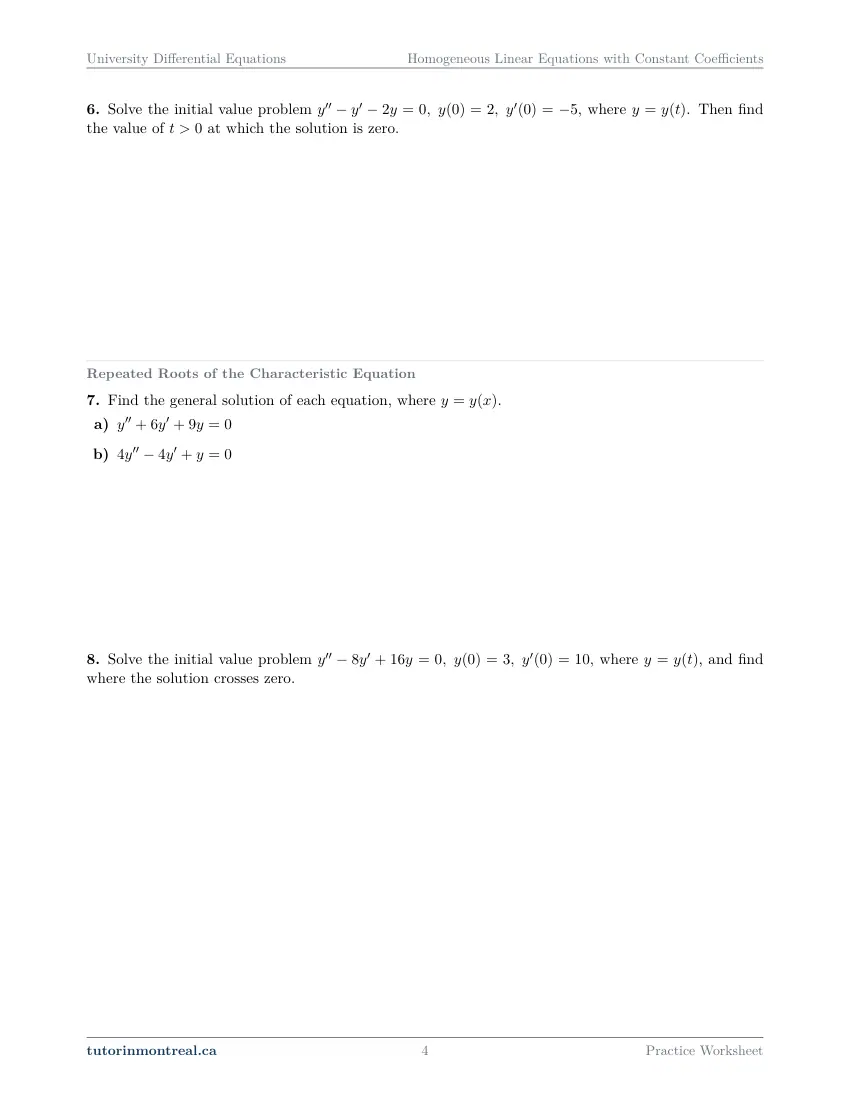
Q6Distinct Real Roots of the Characteristic Equation
Solve the initial value problem , where . Then find the value of at which the solution is zero.
-
Q7Repeated Roots of the Characteristic Equation
Find the general solution of each equation, where .
-
Q8Repeated Roots of the Characteristic Equation
Solve the initial value problem , where , and find where the solution crosses zero.
-
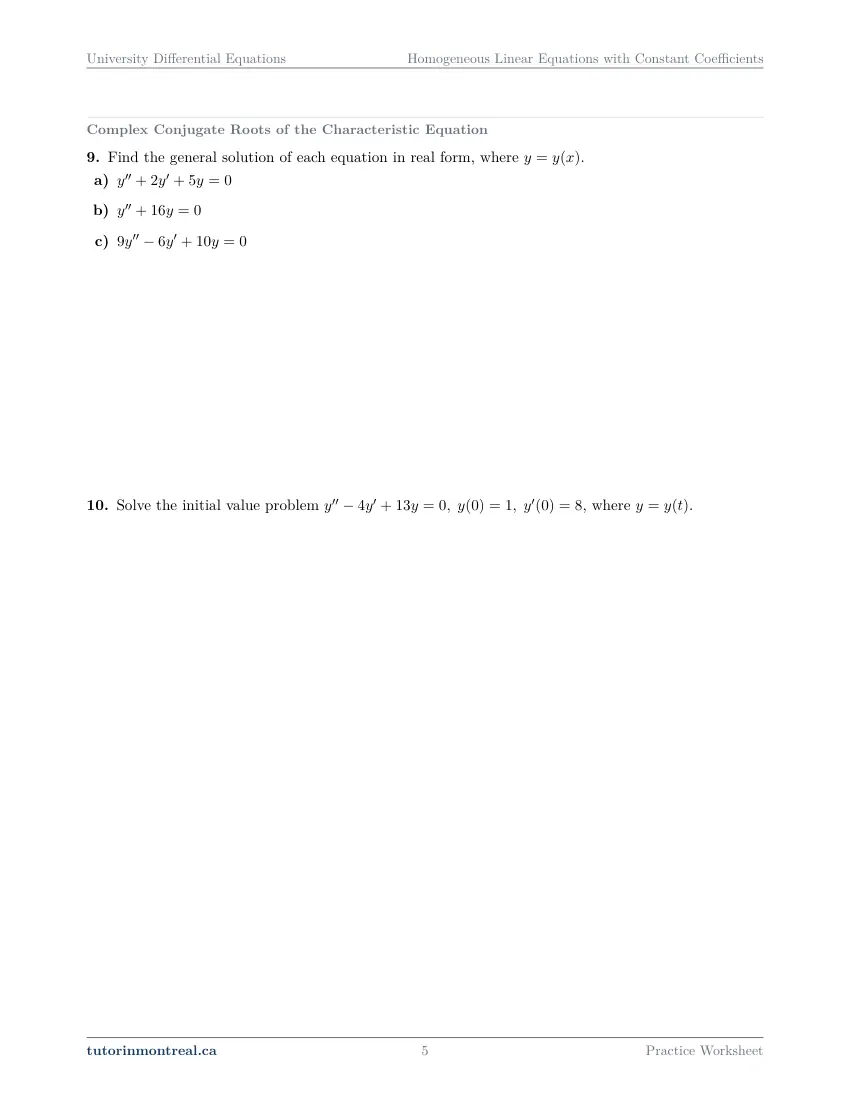
Q9Complex Conjugate Roots of the Characteristic Equation
Find the general solution of each equation in real form, where .
-
Q10Complex Conjugate Roots of the Characteristic Equation
Solve the initial value problem , where .
-
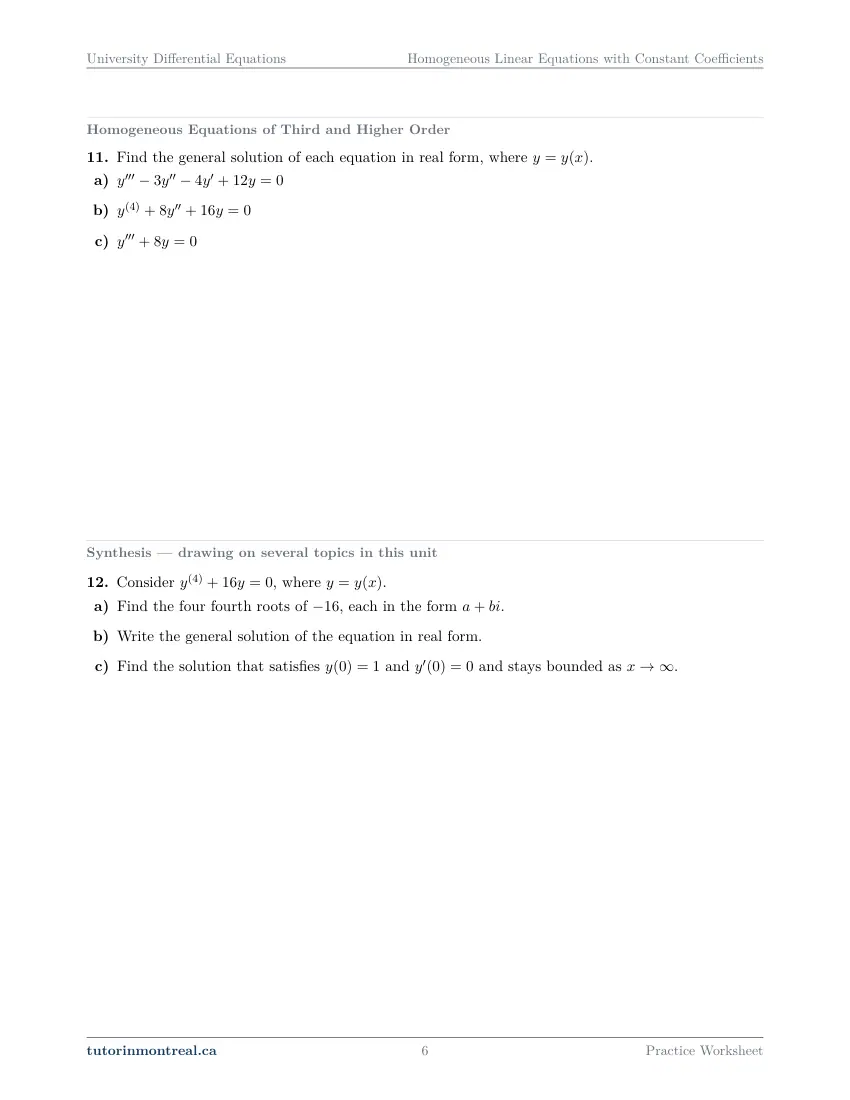
Q11Homogeneous Equations of Third and Higher Order
Find the general solution of each equation in real form, where .
-
Q12Synthesis — drawing on several topics in this unit
Consider , where .
- Find the four fourth roots of , each in the form .
- Write the general solution of the equation in real form.
- Find the solution that satisfies and and stays bounded as .
The 8 challenge problems for this topic are a separate, paid sheet and are not reproduced here.
What does this set assume? This set stands on CEGEP Calculus I and II — differentiating exponentials, sines and cosines, the product and chain rules, and solving for constants from two conditions — and on CEGEP Linear Algebra, since the Wronskian is a determinant you can already compute and fitting initial conditions is a small linear system. From the earlier sets, Differential Equations and Direction Fields gives the vocabulary of order, linearity and initial value problems; First-Order Solution Methods and Modelling with First-Order Equations are not used directly. Complex numbers are taught here, and only as far as the characteristic equation needs them: rectangular, polar and exponential form, Euler's formula, powers and roots. Every equation in this set is homogeneous with constant coefficients; a forcing term belongs to the next set, Nonhomogeneous Equations and Variable Coefficients, and so do Cauchy-Euler equations and reduction of order. Linear independence is stated for functions, not developed as vector-space theory.
Which course is this for? In the public course calendars of Montreal universities, this material is part of the courses numbered MATH 263, ENGR 213, MAT2115 and MAT265. Each course orders and weights the topics its own way, so check your own outline for what your exam covers. Which sets match your course.
How to do every concept on this sheet
This is the part worksheet sites usually leave out. Below is the actual reasoning behind each group of questions — not a full solution set, the decisions that get you to one. Read it before you start, or after you get stuck.
Complex numbers in rectangular, polar and exponential form
A complex root of a characteristic equation is only useful once you can move it between three forms: a + bi for adding and multiplying, r(cos θ + i sin θ) for seeing its size and direction, and reiθ for raising it to a power. Q1 works entirely in rectangular form. A product is expanded like any binomial, with i² replaced by −1 at the end. A quotient needs one move you must remember rather than improvise.
z / w → multiply top and bottom by the conjugate of w → the denominator becomes the real number |w|²Conjugate the right number. In Q1(b) the conjugate that clears the denominator is the conjugate of w, not of z. In Q1(c) the conjugate appears as part of the expression itself — conjugating flips the sign of the imaginary part only, never the real part.
Q2 moves between forms. For part (a), the modulus r is √(a² + b²), and the argument is where students lose marks: the calculator's arctangent only ever returns an angle in the first or fourth quadrant. Plot the point first, decide its quadrant from the signs of a and b, and then correct the reference angle so that θ lands in (−π, π] as the question requires. Part (b) runs the other way — evaluate the cosine and sine of the given angle and multiply by the modulus.
Part (c) is the reason this sheet exists. Split the exponent into its real and imaginary parts, so the exponential becomes a real exponential times eiθ with θ depending on t. Euler's formula then turns the second factor into a cosine plus i times a sine. The real part u(t) and the imaginary part v(t) are exactly the two functions that the complex-roots case of the characteristic equation will produce, so this is the step to get fluent in.
Powers and roots of a complex number
In exponential form, multiplying complex numbers multiplies their moduli and adds their arguments. That turns a tenth power, which would take nine multiplications in rectangular form, into two operations. Q3(a) asks for exactly that: write the base in polar form, raise the modulus to the power, multiply the argument by the power, and only then convert back to a + bi.
(reiθ)ⁿ = rⁿ einθ the n-th roots of reiθ: r1/n ei(θ + 2πk)/n, k = 0, 1, …, n − 1Reduce the argument before converting back. After multiplying by the power, the angle is usually far outside (−π, π]. Subtract whole turns of 2π until it is a familiar angle; its cosine and sine are then values you know exactly.
Q3(b) asks for all three cube roots. The number has one modulus and many possible arguments, each differing by a full turn, and dividing those arguments by three is what separates the roots. Write the argument with + 2πk, divide by three, and run k through 0, 1 and 2.
Three roots, evenly spaced. The n-th roots of a number sit on one circle, 2π/n apart. If your roots are not equally spaced around the origin, or if two of them coincide, an argument was divided before the 2πk was added. Checking one root by cubing it is quick and worth the line.
Superposition, linear independence and the Wronskian
For a homogeneous linear equation, any combination c₁y₁ + c₂y₂ of two solutions is again a solution. That is superposition, and it is why the whole chapter looks for just two solutions of a second-order equation. The catch is that the two must be genuinely different: neither may be a constant multiple of the other. The Wronskian is the test.
W(y₁, y₂) = y₁y₂′ − y₂y₁′ (the determinant with the functions in the top row, their derivatives below)Q4(a) is verification: differentiate each function twice and substitute into the equation. The definition of sinh x is printed in the question so that its derivatives can be built from those of ex and e−x. Part (b) computes the Wronskian and asks what its value says. Simplify it completely before interpreting it.
What the Wronskian can tell you. For two solutions of the same linear equation on an interval, the Wronskian is either zero everywhere or zero nowhere. Not zero means linearly independent, and then c₁y₁ + c₂y₂ is the general solution. Zero means one is a multiple of the other, and the pair cannot be a fundamental set. State which case you are in and draw the conclusion that goes with it.
Part (c) is the practical meaning of that conclusion. A fundamental set reaches every solution, including ones that look nothing like y₁ and y₂. To write a third solution as c₁y₁ + c₂y₂, expand the hyperbolic function back into exponentials and match the coefficients of ex and of e−x on both sides — two equations, two constants.
The characteristic equation, and the three cases
Try y = erx in ay″ + by′ + cy = 0. Every term carries the same exponential factor, which is never zero, so it cancels and leaves a polynomial in r. The derivatives become powers of r; the equation becomes algebra.
ay″ + by′ + cy = 0 → ar² + br + c = 0 → the discriminant b² − 4ac picks the caseFrom the equation to the general solution
The same route every time; only the last step changes.
- 1Write the characteristic equation
y″ becomes r², y′ becomes r, y becomes 1. A missing term has coefficient zero — it does not disappear from the reasoning.
- 2Find the roots
Factor if you can, use the quadratic formula if you cannot. Keep the leading coefficient: it is not always 1.
- 3Read the case off the roots
Two different real roots, one repeated real root, or a complex conjugate pair α ± βi.
- 4Write two independent solutions and combine
Each case has its own pair, below. The general solution is c₁ times the first plus c₂ times the second.
Distinct real roots
Two different real roots r₁ and r₂ give two exponentials, er₁x and er₂x, and their Wronskian is never zero, so they form a fundamental set. Q5 has three equations, and each one tests a different part of step 1 or 2. In part (b) the leading coefficient is not 1; keep it in the factoring rather than dividing it away and losing track of it. In part (c) the constant term is missing, which changes how the polynomial factors.
A root of zero is still a root. When the characteristic polynomial has a factor of r, one of the exponentials is e0x. Write what that function actually is rather than leaving it as an exponential — and do not drop it, since the general solution still needs two terms.
Q6 is an initial value problem in t. Write the general solution, differentiate it, and put t = 0 into both: that gives two linear equations in c₁ and c₂. The second part asks where the solution is zero for t > 0. Set the solution equal to zero, move one exponential to each side, and divide so that a single exponential remains; a logarithm then finishes it. Check that the t you find is positive, as the question demands.
Repeated roots
When the discriminant is zero, the characteristic equation gives only one exponential, erx, and one solution is not a general solution. The second solution is that exponential multiplied by x. Writing c₁erx + c₂erx is the classic error: those two terms are the same function, and their Wronskian says so.
repeated root r → y = c₁erx + c₂x erxQ7 asks for the general solution of two equations. Recognise the perfect square in each characteristic polynomial; in part (b), with a leading coefficient that is not 1, the square to look for is of a binomial with a coefficient in front of r.
Differentiate the second term with the product rule. Q8 is an initial value problem, and y′ now needs the derivative of x erx, which has two terms. Forgetting one of them gives a wrong c₂. Then Q8 asks where the solution crosses zero: the exponential factor is never zero, so factor it out and ask when the remaining linear factor vanishes. State whether that point lies in the domain the problem cares about.
Complex conjugate roots
A negative discriminant gives roots α ± βi. The two complex exponentials they produce are legitimate solutions, but the question wants the answer in real form. Q2(c) already did the conversion: by Euler's formula, the real and imaginary parts of e(α + βi)x are eαxcos βx and eαxsin βx, and those two real functions are themselves solutions.
roots α ± βi → y = eαx(c₁ cos βx + c₂ sin βx)Q9 has three equations and each checks one reading of that formula. In part (a), complete the square or use the quadratic formula to find α and β. In part (b) there is no first-derivative term; work out what that does to the real part α, and what an exponential factor with that exponent contributes. In part (c) the leading coefficient is not 1; divide the whole quadratic formula by 2a, not just the square root.
β, not βi, goes inside the sine and cosine. The argument of the trigonometric functions is the real number β times x. And the sign of β does not matter: the pair α + βi and α − βi produces the same two real solutions, so use the positive β.
Q10 is the complex case as an initial value problem. Put t = 0 into the general solution, where the sine vanishes and the cosine is 1, and one constant falls out at once. The derivative needs the product rule on both terms; evaluated at t = 0 it gives a second equation, which contains α as well as β. Leaving out the α contribution is the usual slip.
Homogeneous equations of third and higher order
Nothing new happens in theory: y⁽ⁿ⁾ becomes rⁿ, the characteristic polynomial has degree n, and each root contributes as before. A root of multiplicity k contributes erx, x erx, …, xk−1erx, and a repeated complex pair gets the same powers of x in front of its sine and cosine. The work is all in the factoring. Q11 has three polynomials, each built to need a different factoring idea.
Factoring a characteristic polynomial of degree three or more
Try these in order; one of them always opens the problem.
- 1Grouping
Pair the terms and look for a common binomial factor. When the coefficients come in matching ratios, this is the fastest route.
- 2Only even powers
A polynomial in r⁴ and r² alone is a quadratic in r². Solve for r² first, then take square roots, and keep track of multiplicity.
- 3A single power equal to a constant
rⁿ = c is a roots-of-a-complex-number problem: Q3(b)'s method gives all n roots at once.
- 4Otherwise, a rational root
Test the divisors of the constant term, then divide out the factor you find.
Count the solutions before you stop. An equation of order n needs n independent solutions, one for every root counted with its multiplicity. If your general solution has fewer than n arbitrary constants, a root was missed or a multiplicity was ignored.
The synthesis question
Q12 takes one fourth-order equation through the whole set. Part (a) is Q3(b) with four roots instead of three: write the negative real number in exponential form, add 2πk to its argument, and divide by four. Part (b) groups those roots into conjugate pairs and applies the complex case to each pair, so the general solution has four terms and four constants. Part (c) adds a condition that is not an initial value: the solution must stay bounded as x → ∞. Decide, for each term, whether its exponential factor grows or decays as x increases; boundedness forces the constants on the growing terms to be zero, and the two initial conditions then fix the rest.
Preview all 7 pages
Click any page to open the full PDF.
Getting the most out of it
Name the case before you write a solution
After finding the roots, write one word — distinct, repeated or complex — next to them. The shape of the general solution follows from that word, and most wrong answers in this chapter are a correct root put into the wrong case's formula.
Plot every complex number you convert
A two-second sketch of the point in the plane tells you its quadrant, and the quadrant is what the arctangent cannot. It also shows at a glance whether a set of n-th roots is evenly spaced around the circle, as it must be.
Check a root by substituting it
Put each root back into the characteristic polynomial, or raise a complex root to the required power. It takes a line and catches the sign and fraction errors that otherwise propagate into every constant downstream.
Differentiate the general solution before using initial conditions
Write y and y′ out in full, with the product rule on every term that has one, before substituting t = 0. Substituting too early, or differentiating only the obvious part of a product, is how an initial value problem goes wrong after the hard part was right.
Want the solutions, or something more challenging?
The worksheet, the questions above and every explanation on this page stay free permanently. Three more PDFs exist for this topic — the worked answer key, a harder problem set, and the answer key to that. They come with the University Differential Equations Solutions Bundle, beside the unit notes and the unit test, which is what keeps the rest of the series free.
What else exists for Homogeneous Linear Equations with Constant Coefficients
Three PDFs · 11 pages · all three are in the bundle below.
- Answer key — 3 pages. All 12 questions worked step by step, including the restrictions and the justifications. Not a list of final answers.
- Challenge problems — 5 pages, 8 problems. A separate sheet at exam-plus difficulty covering the same 7 concepts. Harder than anything on the free sheet.
- Challenge answer key — 3 pages. Every challenge problem worked to the same standard, with the checks shown.
- PDF, letter size, print-ready.
The one thing that's for sale
Every University Differential Equations topic — the complete Solutions Bundle
One download, one payment, the whole program. For all 9 University Differential Equations units: the worksheet, the reference notes, the challenge set, the unit test and every answer key — including this one.
- Worked solutions, not answer lists — every step written out
- Covers the whole year's program at this level
- Less than the price of one hour of tutoring — for the entire year's solutions
Taking Secondary 1 Math as well? The Secondary 1 Math bundle covers all 15 of its units — 106 PDFs, 474 pages — on the same terms.
Taking Secondary 2 Math as well? The Secondary 2 Math bundle covers all 14 of its units — 98 PDFs, 449 pages — on the same terms.
Taking Secondary 3 Math as well? The Secondary 3 Math bundle covers all 11 of its units — 77 PDFs, 367 pages — on the same terms.
Taking Secondary 4 Math as well? The Secondary 4 Math bundle covers all 17 of its units — 122 PDFs, 466 pages — on the same terms.
Taking Secondary 5 Math as well? The Secondary 5 Math bundle covers all 21 of its units — 147 PDFs, 589 pages — on the same terms.
Taking CEGEP Calculus I as well? The CEGEP Calculus I bundle covers all 9 of its units — 72 PDFs, 371 pages — on the same terms.
Taking CEGEP Calculus II as well? The CEGEP Calculus II bundle covers all 8 of its units — 64 PDFs, 335 pages — on the same terms.
Taking CEGEP Linear Algebra as well? The CEGEP Linear Algebra bundle covers all 7 of its units — 56 PDFs, 298 pages — on the same terms.
Taking University Calculus III as well? The University Calculus III bundle covers all 9 of its units — 72 PDFs, 516 pages — on the same terms.
Taking University Linear Algebra as well? The University Linear Algebra bundle covers all 9 of its units — 72 PDFs, 496 pages — on the same terms.
Taking University Business Math as well? The University Business Math bundle covers all 9 of its units — 36 PDFs, 190 pages — on the same terms.
Taking University Introductory Statistics as well? The University Introductory Statistics bundle covers all 9 of its units — 36 PDFs, 186 pages — on the same terms.
Taking University Discrete Math as well? The University Discrete Math bundle covers all 9 of its units — 36 PDFs, 155 pages — on the same terms.
Taking AP Calculus AB as well? The AP Calculus AB bundle covers all 8 of its units — 64 PDFs, 527 pages — on the same terms.
Common questions
Is this worksheet really free?
Yes — the questions are on this page to read, and the PDF downloads directly, no email and no account. The one paid item is optional: the complete University Differential Equations Solutions Bundle, which covers every set at this level.
Which university courses is this for?
The course codes listed on this page are taken from the public course calendars of universities that teach a first course in ordinary differential equations after CEGEP. Each course orders and weights the chapters its own way, and some reach a chapter later or not at all — so check the outline for your own section to see where this set falls in your term.
What do I need to know before starting this set?
Derivatives of exponentials, sines and cosines, the product rule, solving two linear equations in two unknowns, and a 2 × 2 determinant. Complex numbers are taught in the set itself, from a + bi through polar form and roots.
Why are complex numbers in a differential equations worksheet?
Because a characteristic equation with a negative discriminant has complex roots, and turning them into real solutions needs Euler's formula. Higher-order equations whose characteristic polynomial is a single power need n-th roots of a complex number. The two complex-number sheets cover exactly that and nothing more.
Why does a repeated root need an extra factor of x?
A repeated root supplies only one exponential, but the general solution of an equation of order two is built from a pair of independent solutions. Two copies of the same exponential are not independent — their Wronskian is zero — so a genuinely different second solution is needed, and multiplying by x is what works.
Can I leave the answer with complex exponentials?
Not when the question asks for real form, as these do. The complex exponentials are valid solutions, but the real and imaginary parts give two real solutions that span the same set, and a real answer is what an equation with real coefficients and real initial conditions calls for.
What does the Wronskian actually tell me?
Whether two solutions of the same linear equation are linearly independent. If it is non-zero anywhere on the interval, they are, and any combination of them is the general solution. If it is zero everywhere, one is a multiple of the other and you need a different second solution.
Where are equations with a forcing term on the right-hand side?
In the next set, Nonhomogeneous Equations and Variable Coefficients. Everything there starts from the homogeneous solution built here, so this set comes first.
Can teachers use this in class?
Yes. Print and photocopy it for your own classes freely — I just ask that the tutorinmontreal.ca footer stays on the page.
I'm stuck on one question. Can you help?
Yes — through one-on-one tutoring, in Montreal or online. Get in touch to arrange a session, or see the current rates.
← All 9 University Differential Equations worksheets · Secondary 1 Math series (15 sheets) → · Secondary 2 Math series (14 sheets) → · Secondary 3 Math series (11 sheets) → · Secondary 4 Math series (17 sheets) → · Secondary 5 Math series (21 sheets) → · CEGEP Calculus I series (9 sheets) → · CEGEP Calculus II series (8 sheets) → · CEGEP Linear Algebra series (7 sheets) → · University Calculus III series (9 sheets) → · University Linear Algebra series (9 sheets) → · University Business Math series (9 sheets) → · University Introductory Statistics series (9 sheets) → · University Discrete Math series (9 sheets) → · AP Calculus AB series (8 sheets) →