University Differential Equations — Modelling with First-Order Equations Worksheet
Where first-order equations come from, and what their solutions say. Writing the equation that a sentence about a rate describes, and checking it with units; Newton's law of cooling; mixing problems where the inflow and outflow differ, so the volume changes as the tank runs; circuits with a resistor and an inductor or a capacitor; and the logistic equation, where growth levels off at a carrying capacity. Have a look on this page, then print the free PDF when you want to write on it.
Practice worksheet — free PDF
No email, no account, no watermark. Teachers: photocopy it for your classes freely. Worked solutions and 6 harder problems come with the University Differential Equations bundle.
All 9 questions
Each question targets one named concept from the sheet. Read them here, or print the PDF — it has working space under each one.
-
Q1Translating a Rate Statement into a Differential Equation
For each statement, name the unknown function and its independent variable, write the differential equation it describes (use for the constant of proportionality and say what sign it has), and say whether the equation is linear or nonlinear.
- On a frozen pond, the thickness of the ice, in centimetres, increases with time , in hours, at a rate inversely proportional to the thickness already present.
- In a town of residents, the number who have heard a rumour increases with time , in days, at a rate jointly proportional to the number who have heard it and the number who have not.
- Sunlight entering murky water loses intensity with depth: the intensity decreases with the depth below the surface, in metres, at a rate proportional to the intensity at that depth.
-
Q2Translating a Rate Statement into a Differential Equation
Dead leaves fall on a patch of forest floor at a constant rate of per year, and the litter on the ground decomposes at a rate proportional to the amount present, with constant of proportionality per year. The patch is cleared completely at . Let be the litter on the ground, in , years later.
- Write the initial-value problem for .
- Give the units of and of each term on the right-hand side, and confirm that they agree.
- Without solving the equation, find the amount of litter the patch approaches in the long run, and explain why that value is the one to expect.
-
Q3Newton's Law of Cooling and Heating
A steel bolt at is plunged into a large oil bath held at . Newton's law of cooling says that the rate of change of the bolt's temperature is proportional to the difference between the bath temperature and the bolt's temperature. Two minutes later the bolt is at . Let be its temperature, in , minutes after it enters the bath.
- Write the initial-value problem and solve it, finding the constant exactly.
- When does the bolt reach ?
-
Q4Mixing Problems with Unequal Flow Rates
A hydroponic reservoir can hold . It starts with of water in which of nutrient is dissolved. A solution containing of nutrient flows in at , the reservoir is kept well stirred, and the mixture is pumped out at . Let be the mass of nutrient in the reservoir, in grams, after minutes.
- Find the volume and write the initial-value problem for .
- Solve it.
- How much nutrient is in the reservoir at the moment it starts to overflow, and what is the concentration then?
-
Q5Mixing Problems with Unequal Flow Rates
A tank holds a solution containing of disinfectant. A solution with of disinfectant flows in at , and the well-stirred mixture drains at . Let be the mass of disinfectant in the tank, in kilograms, after minutes. Do not solve the equation.
- Find the volume and the time at which the tank is empty.
- Write the initial-value problem for , and state the interval of on which the model applies.
- Is the equation separable? Is it linear? Justify both answers.
-
Q6First-Order Electric Circuits
A series circuit has a resistor of , an inductor of and a battery switched in at , when no current flows. Kirchhoff's voltage law gives , where is the current in amperes and is in seconds.
- Solve for by an integrating factor.
- State the steady-state current and the time at which the current reaches .
-
Q7First-Order Electric Circuits
A series circuit has a resistor of , a capacitor of and a source. When the switch closes at the capacitor already carries a charge of . The charge , in coulombs, satisfies , and the current is ; is in seconds.
- Find and .
- When does the charge reach ?
-
Q8The Logistic Equation
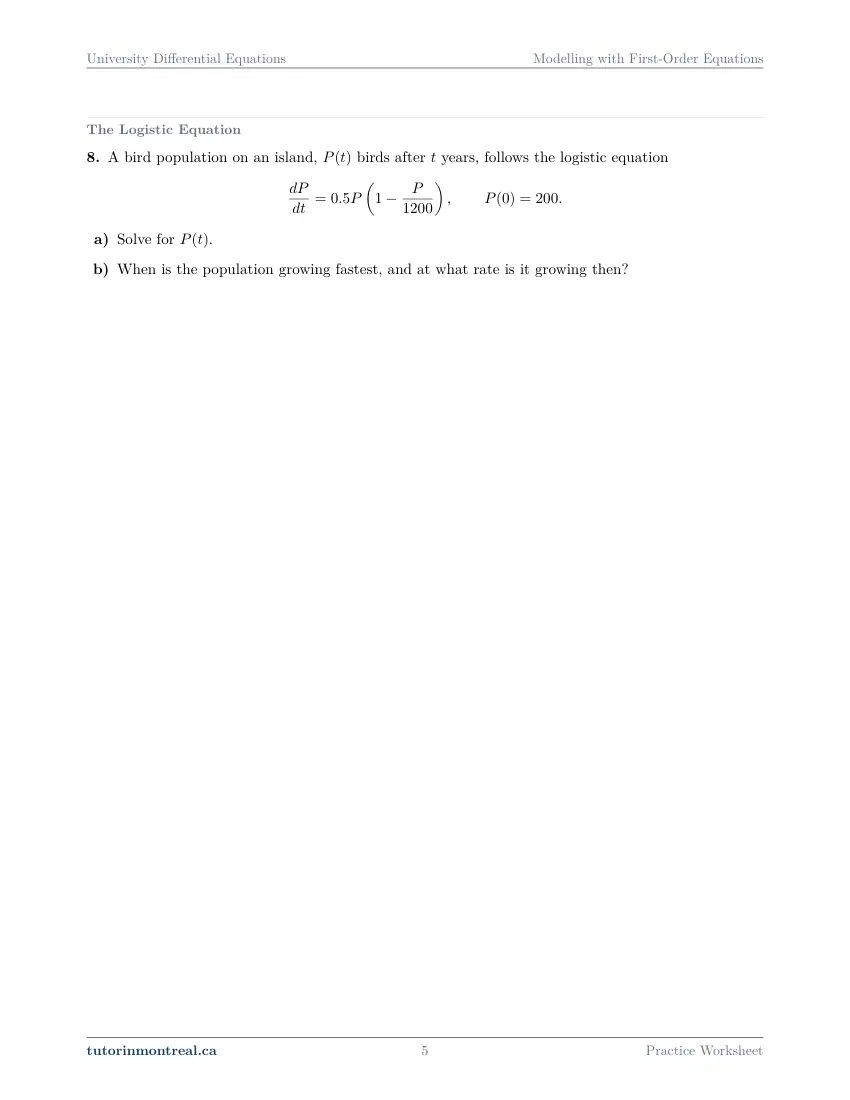
A bird population on an island, birds after years, follows the logistic equation
- Solve for .
- When is the population growing fastest, and at what rate is it growing then?
-
Q9Synthesis — drawing on several topics in this unit
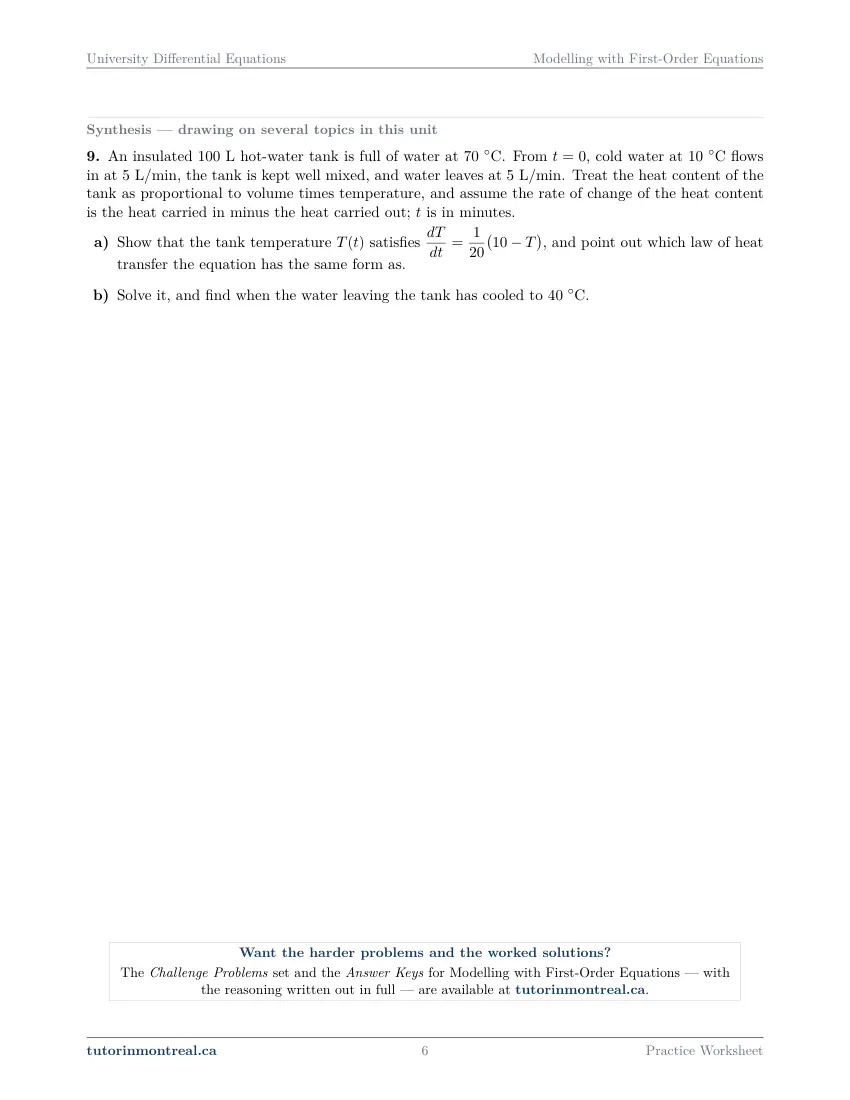
An insulated hot-water tank is full of water at . From , cold water at flows in at , the tank is kept well mixed, and water leaves at . Treat the heat content of the tank as proportional to volume times temperature, and assume the rate of change of the heat content is the heat carried in minus the heat carried out; is in minutes.
- Show that the tank temperature satisfies , and point out which law of heat transfer the equation has the same form as.
- Solve it, and find when the water leaving the tank has cooled to .
The 6 challenge problems for this topic are a separate, paid sheet and are not reproduced here.
What does this set assume? This set stands on the previous two: First-Order Solution Methods for the integrating factor and separation of variables, and Differential Equations and Direction Fields for equilibria and long-run behaviour. It also uses the partial fractions of CEGEP Calculus II. Exponential growth and decay and mixing with equal flow rates are already solved in CEGEP Calculus II and are not repeated; the mixing here has unequal rates, so the volume of the tank changes as it runs. Leaking tanks, falling bodies with air resistance and orthogonal trajectories are not part of the course. Second-order circuits, with all three components, come later, in Mechanical Vibrations and Electric Circuits.
Which course is this for? In the public course calendars of Montreal universities, this material is part of the courses numbered ENGR 213 and MAT265. Each course orders and weights the topics its own way, so check your own outline for what your exam covers. Which sets match your course.
How to do every concept on this sheet
This is the part worksheet sites usually leave out. Below is the actual reasoning behind each group of questions — not a full solution set, the decisions that get you to one. Read it before you start, or after you get stuck.
From a sentence to an equation
Every model in this set starts with a sentence about a rate. Q1 practises the translation alone: name the unknown function and what it depends on, then turn the sentence into an equation word by word.
The vocabulary of proportion. "Proportional to A" is kA. "Inversely proportional to A" is k/A. "Jointly proportional to A and B" is kAB. "The rate of change of y with respect to x" is dy/dx — so read which variable is the independent one; in Q1(c) it is a depth, not a time.
The sign of k comes from the sentence, not from the algebra: a quantity that "increases" has a positive rate, one that "decreases" or "loses" a negative one. Decide whether to write k with a minus sign in front or to say k < 0, and say which. In Q1(b), "the number who have not heard" has to be written in terms of the unknown and the town's population. Linearity is then the test from the first set.
Q2 builds a model with two competing effects — a constant input and a loss proportional to the amount present — and adds the initial condition from "cleared completely".
dL/dt = (rate in) − (rate out)Units are a free check. Q2(b) asks for the units of each term: every term in a rate equation must carry the units of the derivative, amount per unit time. A term that does not is a term written wrongly.
Q2(c) asks for the long-run amount without solving. The amount stops changing when the rate is zero, so set the right-hand side to zero — the equilibrium of the previous set — and explain in words why the two effects balance there.
Newton's law of cooling
The rate of change of an object's temperature is proportional to the difference between the surroundings' temperature and its own. Q3 states the law in words; writing it carefully fixes the sign.
dT/dt = k(Tₛ − T), k > 0The equation is both linear and separable, and either method works. Substituting u = T − Tₛ reduces it to exponential decay, which is the fastest route. The two data points — the start and the reading two minutes later — fix the constant C and then k; Q3(a) asks for k exactly, so keep it as a logarithm. Q3(b) is solving the solution for t.
Keep k exact until the last line. Rounding k before finding the time in Q3(b) moves the answer noticeably, because k is multiplied by t inside an exponential.
Mixing with unequal flow rates
A mixing tank gains solute from the inflow and loses it in the outflow, whose concentration is the tank's own: amount divided by current volume. When the two flow rates differ, the volume changes with time, and the time-dependent volume ends up in a denominator of the equation.
Setting up a mixing problem
Volume first, then the balance.
- 1The volume
V(t) = V₀ + (rate in − rate out)·t, in litres.
- 2Rate in
Concentration of the inflow times its flow rate: mass per minute.
- 3Rate out
(x / V(t)) times the outflow rate. This is the term with t in the denominator.
- 4Standard form and integrating factor
Move the x term to the left. The integrating factor is a power of V(t), found from ∫ of a rational function.
Q4 runs the whole method. Part (c) needs the time of overflow first: set V(t) equal to the capacity. Then evaluate the solution there, and divide by the volume for the concentration.
Q5 stops before solving. The tank drains faster than it fills, so part (a) is when V reaches zero, and part (b) asks for the interval on which the model makes sense — a model that divides by the volume cannot run past the moment the volume is zero. Part (c) asks you to decide separability and linearity and justify both; use the tests from First-Order Solution Methods on the equation you wrote.
The outflow concentration is not the inflow concentration. The single most common error in these problems is writing the rate out with the incoming concentration. What leaves is the tank's mixture.
First-order circuits
Kirchhoff's voltage law says the voltage drops around a loop add up to the source voltage. For a resistor and an inductor, the unknown is the current; for a resistor and a capacitor, the unknown is the charge, and the current is its derivative. Q6 and Q7 give the two equations.
L di/dt + Ri = E R dq/dt + q/C = EBoth are linear with constant coefficients. Divide by the leading coefficient, use the integrating factor (Q6(a) asks for it by name), and apply the initial condition — zero current in Q6, a given starting charge in Q7. In Q6(b) the steady state is what the current approaches as t grows, which is the term that does not decay. In Q7(a), differentiate q(t) to get i(t).
The time constant. In each circuit the decaying term is an exponential in −t divided by a combination of the components (L/R for the inductor circuit, RC for the capacitor circuit). Checking that the combination has units of seconds is a quick guard against inverting it.
The logistic equation
dP/dt = rP(1 − P/K) grows almost exponentially while P is small and levels off as P nears the carrying capacity K. It is separable: separate, split the P side by partial fractions, integrate, and solve the logarithms for P. Q8(a) asks for that explicit solution.
Solve for P before using the initial condition — or after, but carefully. The logarithm of a quotient becomes an exponential of t, and the constant multiplies it. Fixing the constant while the equation is still in logarithmic form is usually cleaner.
Q8(b) asks when growth is fastest. The growth rate dP/dt is a function of P — a quadratic — so maximise it as a function of P first, then use the solution from (a) to find the time at which P reaches that value, and substitute back for the rate.
The synthesis question
Q9 is a mixing problem where the quantity carried by the flow is heat rather than a solute. Part (a) asks you to derive the given equation: the flows in and out are equal, so the volume is constant; write the heat balance with heat proportional to volume times temperature, divide through by the constant of proportionality and the volume, and simplify. Then compare its form with the models earlier in the set. Part (b) is Q3 again — solve and then solve for the time.
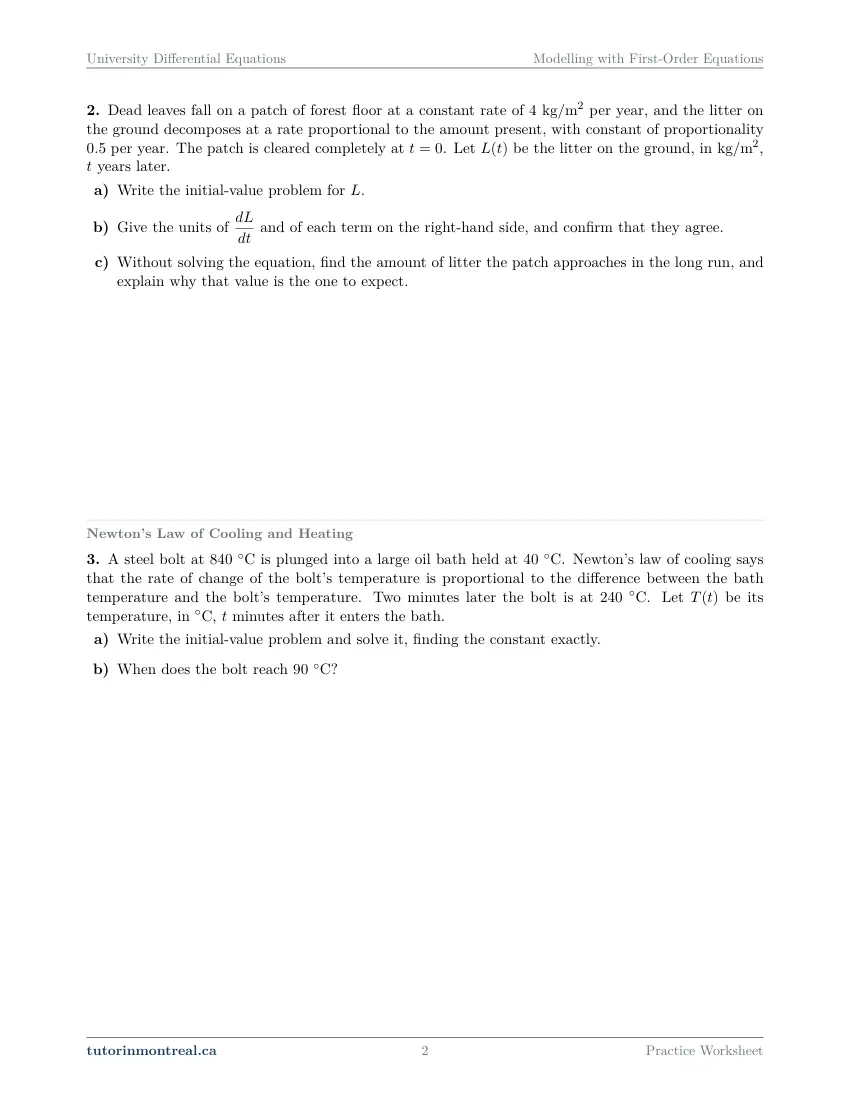
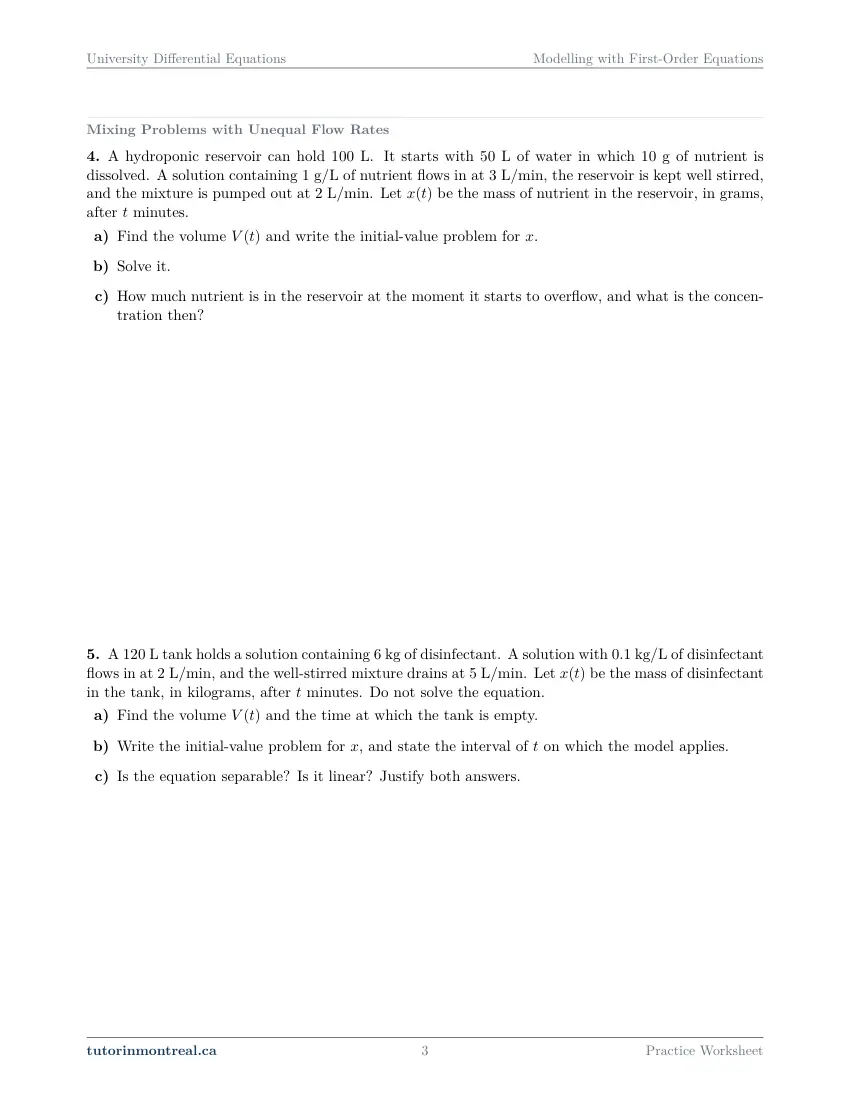
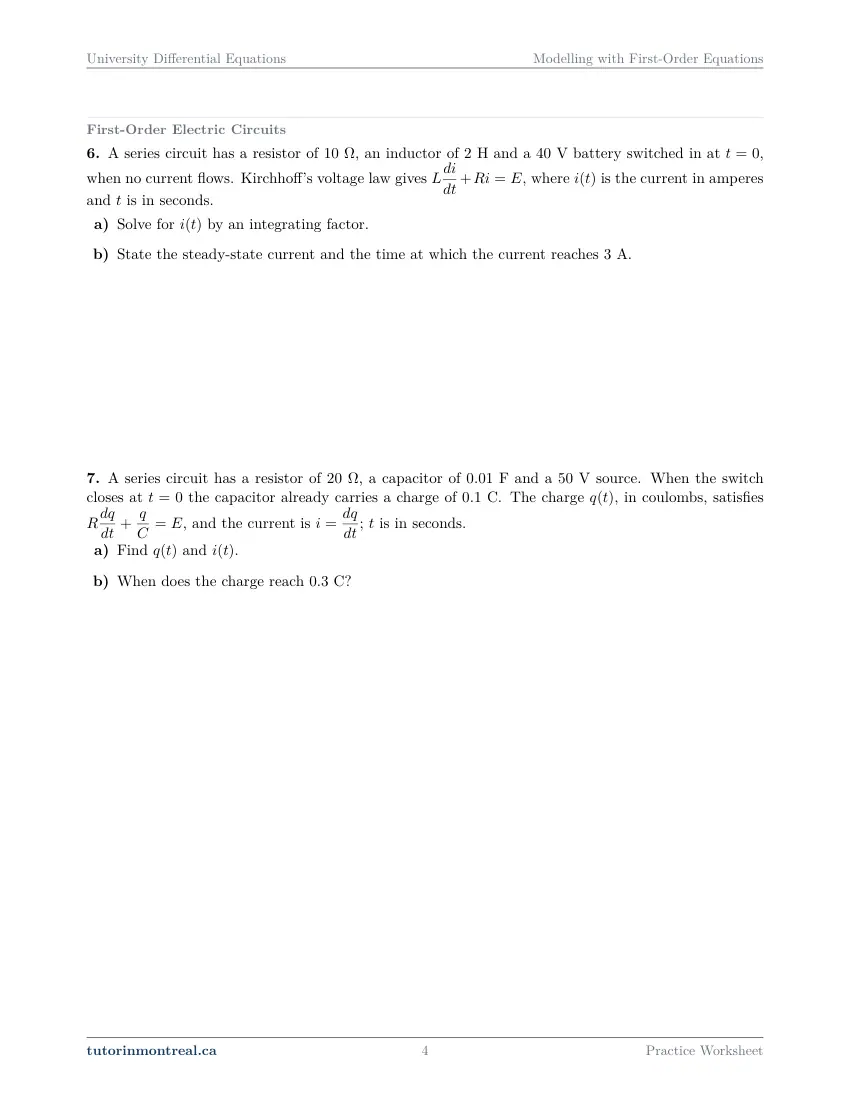
Preview all 6 pages
Click any page to open the full PDF.
Getting the most out of it
Write the balance in words first
"Rate of change equals rate in minus rate out" is the skeleton of nearly every model here. Write it in words above the equation, then fill in each term.
Carry the units
Check every term of the equation for the same units, and the answer too. It catches a concentration used as a mass and a time constant written upside down.
Ask what happens in the long run
Setting the rate to zero gives the equilibrium; it should match the limit of your solution as t grows. If the two disagree, one of them is wrong.
State where the model applies
A tank that overflows or empties, a population that cannot be negative: the equation outlives the situation it describes. Say when the model stops.
Want the solutions, or something more challenging?
The worksheet, the questions above and every explanation on this page stay free permanently. Three more PDFs exist for this topic — the worked answer key, a harder problem set, and the answer key to that. They come with the University Differential Equations Solutions Bundle, beside the unit notes and the unit test, which is what keeps the rest of the series free.
What else exists for Modelling with First-Order Equations
Three PDFs · 12 pages · all three are in the bundle below.
- Answer key — 3 pages. All 9 questions worked step by step, including the restrictions and the justifications. Not a list of final answers.
- Challenge problems — 6 pages, 6 problems. A separate sheet at exam-plus difficulty covering the same 5 concepts. Harder than anything on the free sheet.
- Challenge answer key — 3 pages. Every challenge problem worked to the same standard, with the checks shown.
- PDF, letter size, print-ready.
The one thing that's for sale
Every University Differential Equations topic — the complete Solutions Bundle
One download, one payment, the whole program. For all 9 University Differential Equations units: the worksheet, the reference notes, the challenge set, the unit test and every answer key — including this one.
- Worked solutions, not answer lists — every step written out
- Covers the whole year's program at this level
- Less than the price of one hour of tutoring — for the entire year's solutions
Taking Secondary 1 Math as well? The Secondary 1 Math bundle covers all 15 of its units — 106 PDFs, 474 pages — on the same terms.
Taking Secondary 2 Math as well? The Secondary 2 Math bundle covers all 14 of its units — 98 PDFs, 449 pages — on the same terms.
Taking Secondary 3 Math as well? The Secondary 3 Math bundle covers all 11 of its units — 77 PDFs, 367 pages — on the same terms.
Taking Secondary 4 Math as well? The Secondary 4 Math bundle covers all 17 of its units — 122 PDFs, 466 pages — on the same terms.
Taking Secondary 5 Math as well? The Secondary 5 Math bundle covers all 21 of its units — 147 PDFs, 589 pages — on the same terms.
Taking CEGEP Calculus I as well? The CEGEP Calculus I bundle covers all 9 of its units — 72 PDFs, 371 pages — on the same terms.
Taking CEGEP Calculus II as well? The CEGEP Calculus II bundle covers all 8 of its units — 64 PDFs, 335 pages — on the same terms.
Taking CEGEP Linear Algebra as well? The CEGEP Linear Algebra bundle covers all 7 of its units — 56 PDFs, 298 pages — on the same terms.
Taking University Calculus III as well? The University Calculus III bundle covers all 9 of its units — 72 PDFs, 516 pages — on the same terms.
Taking University Linear Algebra as well? The University Linear Algebra bundle covers all 9 of its units — 72 PDFs, 496 pages — on the same terms.
Taking University Business Math as well? The University Business Math bundle covers all 9 of its units — 36 PDFs, 190 pages — on the same terms.
Taking University Introductory Statistics as well? The University Introductory Statistics bundle covers all 9 of its units — 36 PDFs, 186 pages — on the same terms.
Taking University Discrete Math as well? The University Discrete Math bundle covers all 9 of its units — 36 PDFs, 155 pages — on the same terms.
Taking AP Calculus AB as well? The AP Calculus AB bundle covers all 8 of its units — 64 PDFs, 527 pages — on the same terms.
Common questions
Is this worksheet really free?
Yes — the questions are on this page to read, and the PDF downloads directly, no email and no account. The one paid item is optional: the complete University Differential Equations Solutions Bundle, which covers every set at this level.
Which university courses is this for?
The course codes listed on this page are taken from the public course calendars of universities that teach a first course in ordinary differential equations after CEGEP. Each course orders and weights the chapters its own way, and some reach a chapter later or not at all — so check the outline for your own section to see where this set falls in your term.
What do I need to know before starting this set?
The integrating factor and separation of variables from First-Order Solution Methods, equilibria from Differential Equations and Direction Fields, and partial fractions from CEGEP Calculus II.
Why does the volume matter in a mixing problem?
What leaves the tank carries the tank's own concentration, which is the amount divided by the volume at that moment. If the volume changes, that divisor changes with time, and it has to be written as a function of t before the equation can be solved.
Does the sign convention for k matter in Newton's law of cooling?
Only in that it must be consistent. Writing dT/dt = k(Tₛ − T) with k positive and writing dT/dt = k(T − Tₛ) with k negative describe the same law. Say which you are using.
Why are growth and decay not in this set?
They are solved in CEGEP Calculus II, together with mixing at equal flow rates. This set takes the models that need the methods of this course: unequal flows, circuits and the logistic equation.
What is the carrying capacity in the logistic equation?
It is the constant K in dP/dt = rP(1 − P/K): the population at which the growth rate is zero and the population stops changing. A population that starts between zero and K rises toward it and never passes it.
Can teachers use this in class?
Yes. Print and photocopy it for your own classes freely — I just ask that the tutorinmontreal.ca footer stays on the page.
I'm stuck on one question. Can you help?
Yes — through one-on-one tutoring, in Montreal or online. Get in touch to arrange a session, or see the current rates.
← All 9 University Differential Equations worksheets · Secondary 1 Math series (15 sheets) → · Secondary 2 Math series (14 sheets) → · Secondary 3 Math series (11 sheets) → · Secondary 4 Math series (17 sheets) → · Secondary 5 Math series (21 sheets) → · CEGEP Calculus I series (9 sheets) → · CEGEP Calculus II series (8 sheets) → · CEGEP Linear Algebra series (7 sheets) → · University Calculus III series (9 sheets) → · University Linear Algebra series (9 sheets) → · University Business Math series (9 sheets) → · University Introductory Statistics series (9 sheets) → · University Discrete Math series (9 sheets) → · AP Calculus AB series (8 sheets) →