University Introductory Statistics — Probability Rules and Conditional Probability Worksheet
The whole probability chapter of a first statistics course, in the order it is usually taught. Sample spaces and events written out as lists; Venn diagrams, unions, intersections and complements; the addition rule and what "at least one" and "neither" mean in symbols; permutations and combinations, used only as far as an equally likely sample space needs them; conditional probability read off a two-way table and off a chain of stages; the multiplication rule for draws without replacement; the test for independent events; and tree diagrams carrying total probability and Bayes' theorem, including the reversed question that most of the marks in this chapter hang on. Have a look on this page, then print the free PDF when you want to write on it.
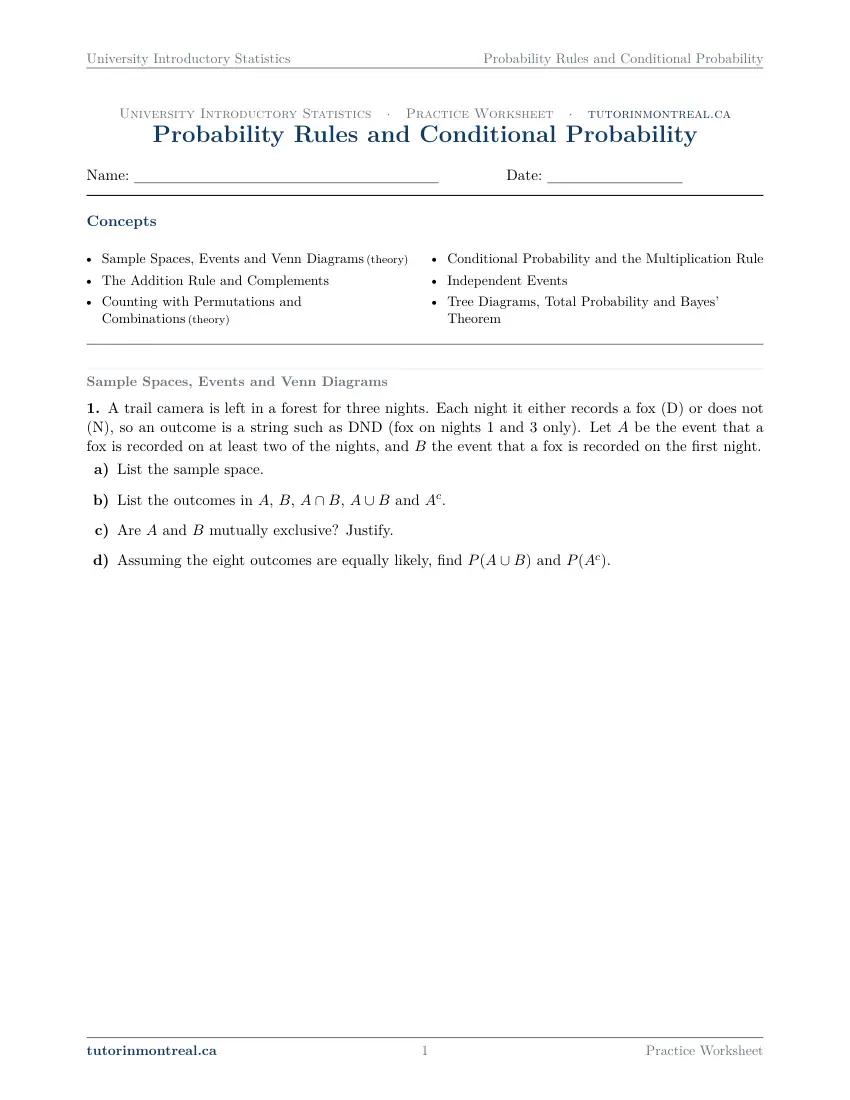
Practice worksheet — free PDF
No email, no account, no watermark. Teachers: photocopy it for your classes freely. Worked solutions and 7 harder problems come with the University Introductory Statistics bundle.
10 of the 11 questions
Each question targets one named concept from the sheet. Read them here, or print the PDF — it has working space under each one. 10 of the 11 questions are printed below. The other 1 is built on a diagram or a table of values that does not translate to the page, so it is in the free PDF — marked below where it would have come.
-
Q1Sample Spaces, Events and Venn Diagrams
A trail camera is left in a forest for three nights. Each night it either records a fox (D) or does not (N), so an outcome is a string such as DND (fox on nights and only). Let be the event that a fox is recorded on at least two of the nights, and the event that a fox is recorded on the first night.
- List the sample space.
- List the outcomes in , , , and .
- Are and mutually exclusive? Justify.
- Assuming the eight outcomes are equally likely, find and .
-
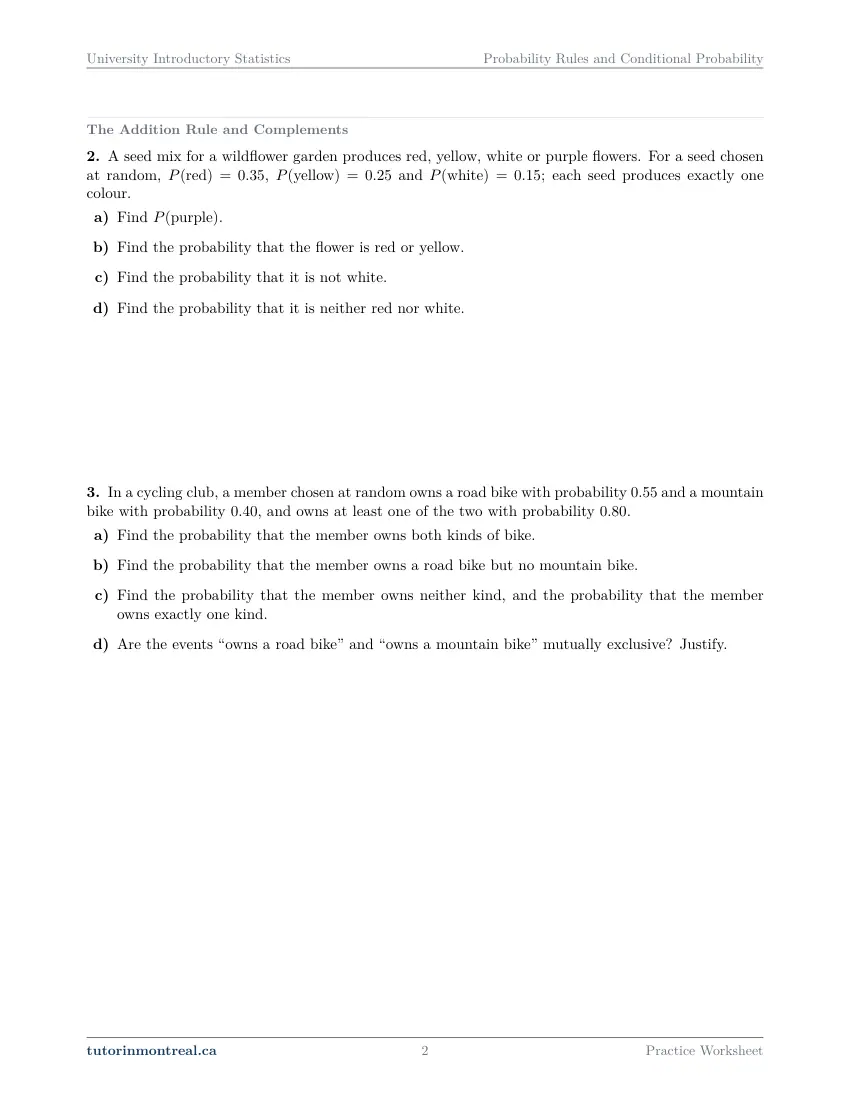
Q2The Addition Rule and Complements
A seed mix for a wildflower garden produces red, yellow, white or purple flowers. For a seed chosen at random, , and ; each seed produces exactly one colour.
- Find .
- Find the probability that the flower is red or yellow.
- Find the probability that it is not white.
- Find the probability that it is neither red nor white.
-
Q3The Addition Rule and Complements
In a cycling club, a member chosen at random owns a road bike with probability and a mountain bike with probability , and owns at least one of the two with probability .
- Find the probability that the member owns both kinds of bike.
- Find the probability that the member owns a road bike but no mountain bike.
- Find the probability that the member owns neither kind, and the probability that the member owns exactly one kind.
- Are the events “owns a road bike” and “owns a mountain bike” mutually exclusive? Justify.
-
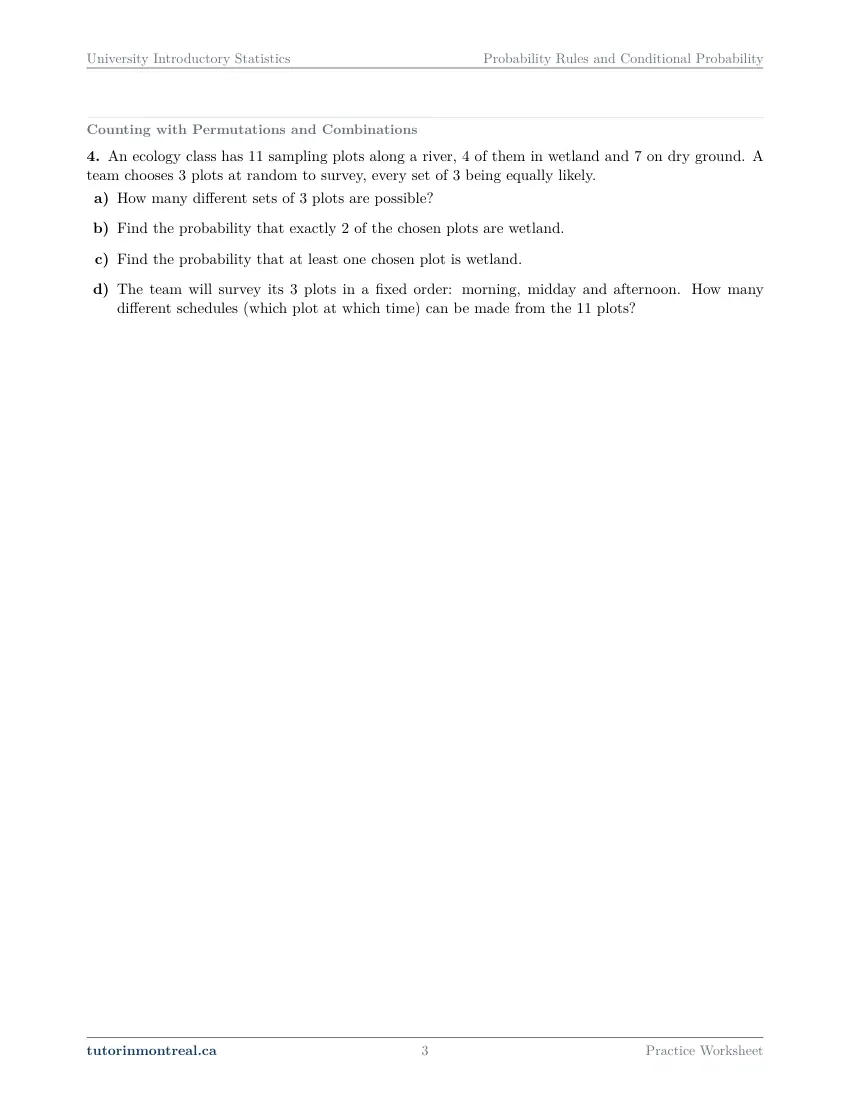
Q4Counting with Permutations and Combinations
An ecology class has sampling plots along a river, of them in wetland and on dry ground. A team chooses plots at random to survey, every set of being equally likely.
- How many different sets of plots are possible?
- Find the probability that exactly of the chosen plots are wetland.
- Find the probability that at least one chosen plot is wetland.
- The team will survey its plots in a fixed order: morning, midday and afternoon. How many different schedules (which plot at which time) can be made from the plots?
-
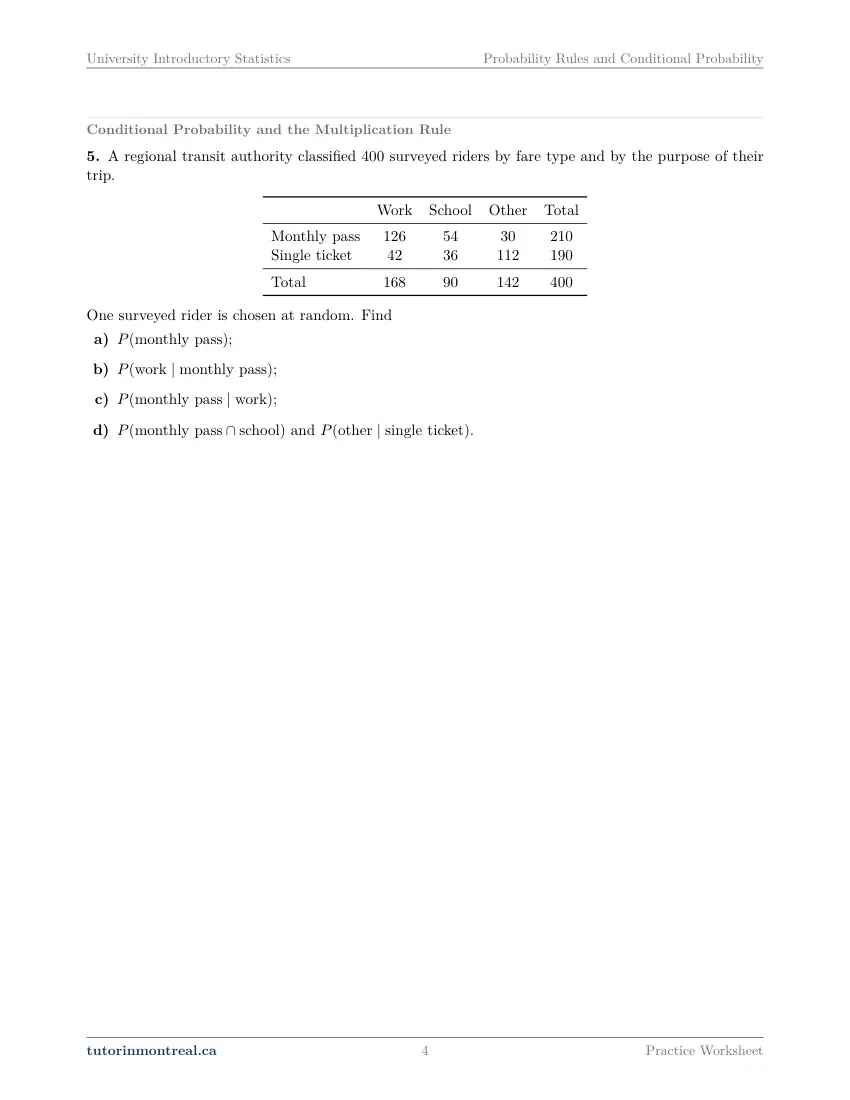
Q5Conditional Probability and the Multiplication Rule
This question is built around a diagram or a table of values. Open it in the PDF.
-
Q6Conditional Probability and the Multiplication Rule
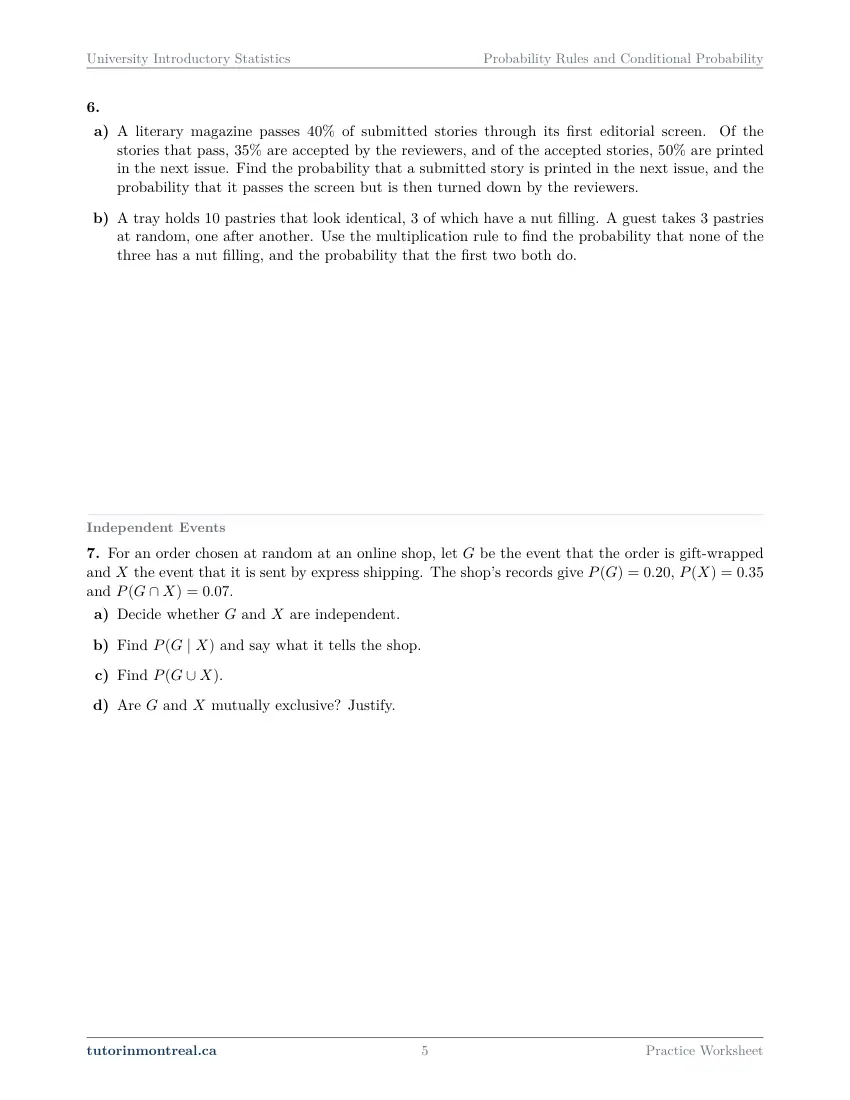
- A literary magazine passes of submitted stories through its first editorial screen. Of the stories that pass, are accepted by the reviewers, and of the accepted stories, are printed in the next issue. Find the probability that a submitted story is printed in the next issue, and the probability that it passes the screen but is then turned down by the reviewers.
- A tray holds pastries that look identical, of which have a nut filling. A guest takes pastries at random, one after another. Use the multiplication rule to find the probability that none of the three has a nut filling, and the probability that the first two both do.
-
Q7Independent Events
For an order chosen at random at an online shop, let be the event that the order is gift-wrapped and the event that it is sent by express shipping. The shop's records give , and .
- Decide whether and are independent.
- Find and say what it tells the shop.
- Find .
- Are and mutually exclusive? Justify.
-
Q8Independent Events
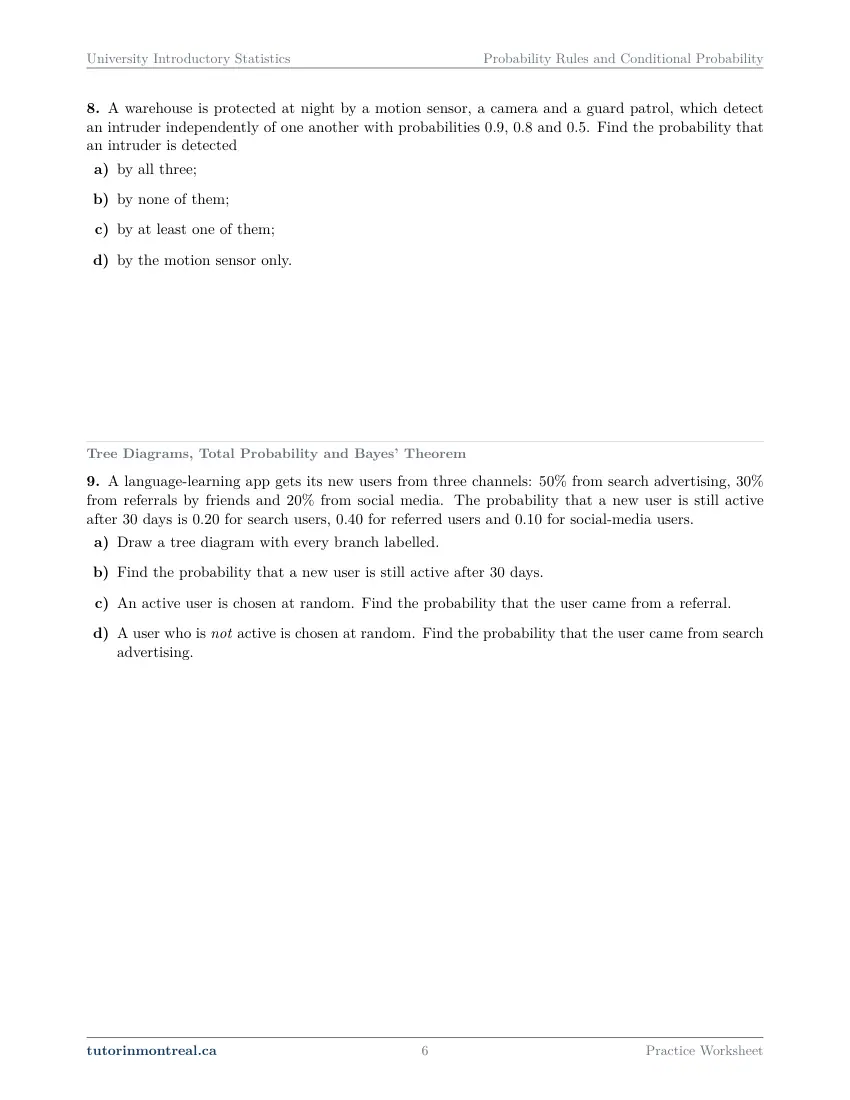
A warehouse is protected at night by a motion sensor, a camera and a guard patrol, which detect an intruder independently of one another with probabilities , and . Find the probability that an intruder is detected
- by all three;
- by none of them;
- by at least one of them;
- by the motion sensor only.
-
Q9Tree Diagrams, Total Probability and Bayes' Theorem
A language-learning app gets its new users from three channels: from search advertising, from referrals by friends and from social media. The probability that a new user is still active after days is for search users, for referred users and for social-media users.
- Draw a tree diagram with every branch labelled.
- Find the probability that a new user is still active after days.
- An active user is chosen at random. Find the probability that the user came from a referral.
- A user who is not active is chosen at random. Find the probability that the user came from search advertising.
-
Q10Tree Diagrams, Total Probability and Bayes' Theorem
At an orchard's packing line, of apples are bruised. An optical scanner flags a bruised apple with probability and flags a sound apple with probability .
- Find the probability that a randomly chosen apple is flagged.
- Find the probability that a flagged apple is bruised.
- Find the probability that an apple that is not flagged is bruised.
-
Q11Synthesis — drawing on several topics in this unit
A laboratory keeps two racks of sample vials. Rack~1 holds vials, of them contaminated; rack~2 holds vials, of them contaminated. A technician rolls a fair die and uses rack~1 on a roll of or and rack~2 otherwise, then takes vials at random from that rack.
- For each rack, find the probability that both vials taken are clean.
- Find the probability that both vials taken are clean.
- Given that both vials are clean, find the probability that they came from rack~1.
The 7 challenge problems for this topic are a separate, paid sheet and are not reproduced here.
What does this set assume? This set assumes Secondary 5 mathematics only: fractions, decimals and percentages handled comfortably, and the probability vocabulary of the Quebec secondary program — outcomes, events, drawing with and without replacement. It is not calculus-based, and nothing in this course is: no question here or in any later set asks for a derivative or an integral. Of the earlier University Introductory Statistics sets it needs only the habit of reading a table, from Descriptive Statistics; no summary statistic from that set is used. What it does do is carry everything after it. Discrete Random Variables, Continuous Distributions and the Normal Model, Sampling Distributions and the Central Limit Theorem, Confidence Intervals, Hypothesis Tests, Two-Sample Inference and Chi-Square Tests, and Simple Linear Regression and Correlation all rest on the rules drilled here. Two things are deliberately left out. Counting is a tool, not a chapter: permutations and combinations go exactly as far as an equally likely sample space and the binomial coefficient need them, and arrangements with repetition, inclusion–exclusion, the pigeonhole principle and combinatorial proof belong to University Discrete Mathematics. And random variables have not started yet — no expected value, no variance of a distribution, no binomial or normal model, and no software output anywhere in the course. Bayes' theorem is here as a tree read backwards, never as a formula with a summation sign to memorise.
Which course is this for? In the public course calendars of Montreal universities, this material is part of the courses numbered MAST 221, STAT 249, STT1700, MAT1720, MATH 10603 and MAT350. Each course orders and weights the topics its own way, so check your own outline for what your exam covers. Which sets match your course.
How to do every concept on this sheet
This is the part worksheet sites usually leave out. Below is the actual reasoning behind each group of questions — not a full solution set, the decisions that get you to one. Read it before you start, or after you get stuck.
Sample spaces, events and Venn diagrams
An event is a set of outcomes, so before any arithmetic there has to be a list. Q1 records three nights of a trail camera, and each outcome is a string of three letters, one per night, in order — which is why DND and NDD are different outcomes rather than the same one written twice.
Listing a sample space you can trust
Q1(a) asks for the list; the rest of the question is read off it.
- 1Fix an order and never change it
Night 1, night 2, night 3. Write all the strings that start with D first, then all the ones that start with N.
- 2Work through the later positions systematically
Within each block, hold the second letter and run the third through both values. Nothing is skipped and nothing is repeated.
- 3Check the length
Q1 tells you how many outcomes the experiment has. A list that comes out any other length has a duplicate or a gap, and it is far cheaper to find it now than three parts later.
Q1(b) turns each event into a sublist. Read the definitions literally: "at least two" includes the outcome with all three, which is the slip that costs the most marks in this part, and an event defined by the first night alone is settled by the first letter whatever the other two do. A ∩ B holds the outcomes appearing on both sublists; A ∪ B holds every outcome on either, written once; Aᶜ holds everything in the sample space that A does not.
Mutually exclusive is a question about the intersection. Q1(c) asks you to justify, and the justification is the list you already wrote in Q1(b): two events are mutually exclusive exactly when no outcome lies in both, so point at A ∩ B and say what is in it. A bare verdict with no intersection shown earns nothing.
Q1(d) is where equally likely outcomes turn counts into probabilities. With every outcome equally likely, P(E) is the number of outcomes in E over the number in the sample space — so the counts come straight off the sublists. Both parts can be checked a second way, by the addition rule and by the complement rule, and it is worth doing: agreement between a count and a rule is the fastest confirmation available in this chapter.
P(E) = (outcomes in E) / (outcomes in the sample space)The addition rule, complements and translation
From here on, probabilities are given rather than counted, and the work is translation. Q2 gives three of four colours in a seed mix and says each seed produces exactly one colour — which is the whole content of Q2(a): the four colour events are mutually exclusive and between them cover everything, so their probabilities must total 1.
P(A ∪ B) = P(A) + P(B) − P(A ∩ B), P(Aᶜ) = 1 − P(A)Q2(b) is an "or" between events that cannot happen together, so the subtraction in the addition rule contributes nothing and the two probabilities simply add. Q2(c) is a complement. Q2(d) can be done either way — as the complement of an "or", or by adding the colours that remain — and doing it both ways is a free check.
"At least one of the two" is the union. Q3 gives P(road), P(mountain) and the probability of owning at least one, and asks in Q3(a) for the probability of owning both. That is the addition rule rearranged: the union is known and the intersection is not, so solve for the intersection instead of substituting into the formula as it is usually written.
Once the overlap is known, fill a Venn diagram from the centre outward and every remaining part of Q3 is read off it. "Owns a road bike but no mountain bike" in Q3(b) is the first circle with the overlap removed. In Q3(c), "neither" is outside both circles — the complement of the union — and "exactly one kind" is the union without the overlap. Q3(d) asks the same kind of question as Q1(c): mutually exclusive means the intersection is empty, so compare the probability found in Q3(a) with 0 and say what the comparison shows.
The four regions add to 1. Both circles, the first only, the second only, and the outside: write the four numbers and total them. If the total is not 1, a region has been counted twice or missed, and the error is in the diagram rather than in the part you are on.
Counting with permutations and combinations
Counting appears here for one reason: to build an equally likely sample space that is too big to list. Q4 chooses three river plots out of eleven, every set of three equally likely, so every probability in it is one count over another.
C(n, r) = n!/(r!(n − r)!), P(n, r) = n!/(n − r)!Order, or no order
The decision to make before writing C or P.
- 1Ask whether rearranging changes the outcome
A set of three plots to survey is the same set however it is written, so Q4(a) is a combination.
- 2"Exactly so many of each kind" splits the pool
Choose the wetland plots from the wetland ones and the rest from the dry ones, multiply the two counts, and divide by the count from Q4(a). That is Q4(b).
- 3"At least one" calls for the complement
Q4(c) is quicker as 1 minus the probability that none of the chosen plots is wetland, which is a single count, than as a sum of cases.
Q4(d) changes the question. Morning, midday and afternoon are distinguishable slots, so the same three plots in a different order make a different schedule, and the count is a permutation rather than a combination. Notice that Q4(d) is a pure count and not a probability — read the instruction, because this part is answered with a number of schedules, not a fraction.
Conditional probability and the multiplication rule
P(A | B) is the probability of A once B is known to have happened. The sample space shrinks to B, and A is measured inside it — which in a two-way table is exactly a change of denominator.
P(A | B) = P(A ∩ B) / P(B), so P(A ∩ B) = P(B) · P(A | B)Q5 classifies surveyed riders by fare type and trip purpose, and every part of it is one count over another. The only decision is which total goes underneath. Q5(a) is a marginal probability, so the grand total goes underneath. Q5(b) conditions on fare type, so the total for that fare type does. Q5(c) reverses the condition, so the total for that trip purpose does — the cell on top is the same one as in Q5(b), and only the denominator moves. Q5(d) pairs a joint probability, which keeps the grand total underneath because nothing has been assumed, with one more conditional.
P(A | B) and P(B | A) are different questions. Say each one in words, starting from the condition: "among riders holding a monthly pass, the proportion travelling to work" is not "among riders travelling to work, the proportion holding a monthly pass". Q5(b) and Q5(c) are on the sheet next to each other precisely so the difference is visible.
Q6(a) is a chain of stages, each probability conditional on the one before it: a story passes a screen, then is accepted, then is printed. Multiply along the chain. The second half of Q6(a) asks for a path that succeeds at the first stage and then fails at the second, so take the complement within that stage before multiplying — the failure probability is 1 minus the acceptance probability quoted for the stories that passed, not 1 minus anything about the whole pool.
Q6(b) is the multiplication rule for draws without replacement, and the question says to use it rather than counting combinations. Each draw changes the tray: on a branch where a nut pastry has gone, both the nut count and the total drop by one for the next factor. The second part constrains only the first two draws, so it is a product of two factors — reading in a third condition that is not there is the usual error.
Independent events, and what independence is not
Independence means knowing one event happened does not change the probability of the other. There are two equivalent tests, and either settles Q7(a).
P(A ∩ B) = P(A) · P(B) or, equivalently, P(A | B) = P(A)Q7 gives P(G), P(X) and P(G ∩ X) for gift-wrapped and express orders, which is everything both tests need. Q7(a) asks for a decision, so compute both sides and write them next to each other before saying anything; a verdict with no comparison shown is not an answer. Q7(b) then asks for P(G | X) and for what it tells the shop — the sentence that earns the second half of the mark compares the conditional probability with P(G) and says, in the shop's own terms, whether knowing an order is express changes what is expected about gift wrapping. Q7(c) is the addition rule again, with the intersection already given.
Independent and mutually exclusive are unrelated properties. Mutually exclusive means the two cannot happen together, so P(A ∩ B) = 0; independent means neither carries information about the other. Q7(d) asks the mutually exclusive question about the same pair Q7(a) asks the independence question about, so answer it from P(G ∩ X) against 0 and not from the test you used in Q7(a). Two events with positive probabilities that are mutually exclusive can never be independent: if one has happened, the other is ruled out, which is a very large change in its probability.
Q8 runs three detectors that work independently of one another, which is what licenses multiplying their probabilities. Q8(a) multiplies the three detection probabilities. Q8(b) multiplies the three complements. Q8(c) is an "at least one", and its complement is precisely Q8(b) — one subtraction, rather than a sum of seven cases. Q8(d) turns on the word "only": it means one detector succeeds and the other two fail, so it is an intersection of one event with two complements, not a conditional probability and not the same as Q8(a) restricted.
Tree diagrams, total probability and Bayes' theorem
A tree is the tool for a two-stage experiment where the first stage decides which second-stage probabilities apply. Q9 splits new users of an app across three acquisition channels and gives a different retention probability on each.
Reading a two-stage tree
Q9(a) asks for every branch labelled, and the later parts are impossible without it.
- 1First stage: one branch per channel
The three branch probabilities must add to 1, which is a check the question data lets you make immediately.
- 2Second stage: label both outcomes on every branch
The question states one of the pair on each branch; the other is its complement. Each pair adds to 1 on its own branch.
- 3Multiply along a path, add across paths
A path's product is the probability of that channel and that outcome together. Adding the paths that end in the same outcome is the law of total probability, which is Q9(b).
Q9(c) and Q9(d) reverse the condition, and that reversal is Bayes' theorem in the only form this course wants: one path over the sum of the paths ending in the same outcome. The denominator for Q9(c) is the total from Q9(b), which is why Q9(b) is asked first. Q9(d) conditions on the outcome that was not given directly, so its numerator and its denominator are both built from the complements labelled in step 2 — either from a fresh sum, or as 1 minus the total in Q9(b) for the denominator.
The conditional you are given is rarely the one you are asked for. Q10 hands you the probability that an apple is flagged given that it is bruised, and the probability that it is flagged given that it is sound. Q10(b) asks for the reverse: bruised given flagged. The two differ because only a small share of apples are bruised to begin with, and that base rate enters through the denominator, never through the 0.95. Build the tree with the condition of the apple at the first stage and the scanner at the second, exactly as the information is given, and the reversal is then one division.
Q10(a) is the law of total probability: an apple is flagged along either of two paths. Q10(c) reverses a condition again, and this time both the event and the condition are complements of what the question states — take care to pick the right path for the numerator before dividing.
The synthesis question
Q11 is the chapter in one question: a die decides which of two racks of vials is used, and two vials are then drawn from that rack without replacement. Every idea above appears once.
Q11(a) works inside a single rack, where the two draws are dependent — either the multiplication rule with the second factor adjusted for the vial already taken, or a ratio of combinations, and the two agree. Q11(b) is total probability across the two racks, with the first-stage weights coming from the die: read the rule carefully, because the two racks are not equally likely and assuming they are is the one error that makes the rest of the question meaningless. Q11(c) reverses the condition once more, dividing one branch's contribution by the total from Q11(b).
Write the tree before the arithmetic. Q11 rewards a diagram more than any other question on the sheet: first stage the rack, second stage the pair of vials, with the results of Q11(a) sitting on the second-stage branches. Set up that way, Q11(b) and Q11(c) are one line each.
Preview all 7 pages
Click any page to open the full PDF.
Getting the most out of it
Translate the sentence into symbols first
"At least one" is a union. "Neither" is the complement of a union. "Exactly one" is a union with the overlap removed. "Only" is an intersection with complements. "Given that", "among those who" and "of the ones that" all signal a conditional, and they tell you what goes in the denominator. Write the symbols in the margin before touching the numbers, and most of the difficulty in this chapter disappears.
Draw the picture the question implies
Two overlapping events with a known intersection want a Venn diagram. Stages that happen one after another want a tree. Two categorical variables want a two-way table. The structure of the information, not the wording of the question, picks the picture — and with the right one drawn, nearly every part is read off it rather than derived.
Make everything add to 1
The four regions of a Venn diagram, the branches leaving any node of a tree, the ends of all paths, the probabilities of a set of outcomes that covers everything: each collection adds to 1. It is the cheapest check in probability, it takes seconds, and it catches a missed region or a complement applied to the wrong stage.
Name the condition out loud before dividing
Say the sentence "among the ___, the proportion that are ___" for every conditional probability you write. The first blank is the denominator. Doing this once per question is what stops P(A | B) and P(B | A) from being swapped, which is the single most common lost mark in this chapter and the reason a reversed question is worth practising until it is dull.
Justify, do not just decide
Several parts here ask whether events are mutually exclusive or independent. Both are settled by a comparison of two numbers, so write both numbers down and then the verdict. The marks are in the comparison; an answer that reports only the verdict cannot show the comparison was ever made.
Want the solutions, or something more challenging?
The worksheet, the questions above and every explanation on this page stay free permanently. Three more PDFs exist for this topic — the worked answer key, a harder problem set, and the answer key to that. They come with the University Introductory Statistics Solutions Bundle, beside the unit notes and the unit test, which is what keeps the rest of the series free.
What else exists for Probability Rules and Conditional Probability
Three PDFs · 13 pages · all three are in the bundle below.
- Answer key — 3 pages. All 11 questions worked step by step, including the restrictions and the justifications. Not a list of final answers.
- Challenge problems — 7 pages, 7 problems. A separate sheet at exam-plus difficulty covering the same 6 concepts. Harder than anything on the free sheet.
- Challenge answer key — 3 pages. Every challenge problem worked to the same standard, with the checks shown.
- PDF, letter size, print-ready.
The one thing that's for sale
Every University Introductory Statistics topic — the complete Solutions Bundle
One download, one payment, the whole program. For all 9 University Introductory Statistics units: the worksheet, the reference notes, the challenge set, the unit test and every answer key — including this one.
- Worked solutions, not answer lists — every step written out
- Covers the whole year's program at this level
- Less than the price of one hour of tutoring — for the entire year's solutions
Taking Secondary 1 Math as well? The Secondary 1 Math bundle covers all 15 of its units — 106 PDFs, 474 pages — on the same terms.
Taking Secondary 2 Math as well? The Secondary 2 Math bundle covers all 14 of its units — 98 PDFs, 449 pages — on the same terms.
Taking Secondary 3 Math as well? The Secondary 3 Math bundle covers all 11 of its units — 77 PDFs, 367 pages — on the same terms.
Taking Secondary 4 Math as well? The Secondary 4 Math bundle covers all 17 of its units — 122 PDFs, 466 pages — on the same terms.
Taking Secondary 5 Math as well? The Secondary 5 Math bundle covers all 21 of its units — 147 PDFs, 589 pages — on the same terms.
Taking CEGEP Calculus I as well? The CEGEP Calculus I bundle covers all 9 of its units — 72 PDFs, 371 pages — on the same terms.
Taking CEGEP Calculus II as well? The CEGEP Calculus II bundle covers all 8 of its units — 64 PDFs, 335 pages — on the same terms.
Taking CEGEP Linear Algebra as well? The CEGEP Linear Algebra bundle covers all 7 of its units — 56 PDFs, 298 pages — on the same terms.
Taking University Calculus III as well? The University Calculus III bundle covers all 9 of its units — 72 PDFs, 516 pages — on the same terms.
Taking University Linear Algebra as well? The University Linear Algebra bundle covers all 9 of its units — 72 PDFs, 496 pages — on the same terms.
Taking University Differential Equations as well? The University Differential Equations bundle covers all 9 of its units — 36 PDFs, 182 pages — on the same terms.
Taking University Business Math as well? The University Business Math bundle covers all 9 of its units — 36 PDFs, 190 pages — on the same terms.
Taking University Discrete Math as well? The University Discrete Math bundle covers all 9 of its units — 36 PDFs, 155 pages — on the same terms.
Taking AP Calculus AB as well? The AP Calculus AB bundle covers all 8 of its units — 64 PDFs, 527 pages — on the same terms.
Common questions
Is this worksheet really free?
Yes — the questions are on this page to read, and the PDF downloads directly, no email and no account. The one paid item is optional: the complete University Introductory Statistics Solutions Bundle, which covers every set at this level.
Which university courses is this for?
The course codes listed on this page are taken from the public course calendars of universities that teach a first, service-level statistics course. Each course orders and weights the chapters its own way, and some reach a chapter later or not at all — so check the outline for your own section to see where this set falls in your term.
What do I need to know before starting this set?
Secondary 5 mathematics only: fractions, decimals, percentages and the probability vocabulary of the secondary program. No calculus is used here or anywhere in this course, and nothing from the Descriptive Statistics set is needed beyond being comfortable reading a two-way table.
How do I tell independent events from mutually exclusive ones?
They answer different questions. Mutually exclusive means the two cannot happen together, so P(A ∩ B) = 0. Independent means neither one carries information about the other, so P(A ∩ B) = P(A) · P(B), or equivalently P(A | B) = P(A). Test the first against 0 and the second against the product — and note that two events with positive probabilities cannot be both.
Is P(A | B) the same as P(B | A)?
No. Both have P(A ∩ B) on top, but one divides by P(B) and the other by P(A), so they answer different questions — the proportion of B's that are A's, and the proportion of A's that are B's. They are equal only when P(A) = P(B), and confusing them is the classic error behind every medical-test and screening puzzle.
Do I have to memorise Bayes' theorem?
Not in this course. Every reversed question here is a two-stage tree read backwards: one path's probability divided by the sum of the paths that end in the same outcome. Written that way it is just the definition of conditional probability, and it survives contact with a question whose shape does not match a memorised formula.
How much counting do I need?
Only enough to size an equally likely sample space: combinations when order does not matter, permutations when it does, and the two combined when a selection is split between kinds. Arrangements with repetition, inclusion–exclusion and counting done for its own sake belong to University Discrete Mathematics, not here.
Can teachers use this in class?
Yes. Print and photocopy it for your own classes freely — I just ask that the tutorinmontreal.ca footer stays on the page.
I'm stuck on one question. Can you help?
Yes — through one-on-one tutoring, in Montreal or online. Get in touch to arrange a session, or see the current rates.
← All 9 University Introductory Statistics worksheets · Secondary 1 Math series (15 sheets) → · Secondary 2 Math series (14 sheets) → · Secondary 3 Math series (11 sheets) → · Secondary 4 Math series (17 sheets) → · Secondary 5 Math series (21 sheets) → · CEGEP Calculus I series (9 sheets) → · CEGEP Calculus II series (8 sheets) → · CEGEP Linear Algebra series (7 sheets) → · University Calculus III series (9 sheets) → · University Linear Algebra series (9 sheets) → · University Differential Equations series (9 sheets) → · University Business Math series (9 sheets) → · University Discrete Math series (9 sheets) → · AP Calculus AB series (8 sheets) →