Secondary 4 Linear Functions Worksheet
First-degree functions are where units start to matter as much as numbers, so these questions keep asking what the rate of change and the initial value mean in the situation described. You build a rule from two points, graph a line and read both intercepts, cut the domain and range down to what a real context allows, invert a first-degree rule and check the inverse with a point, and say precisely what each parameter controls. Printing is free, and the reasoning behind each method is written out further down.
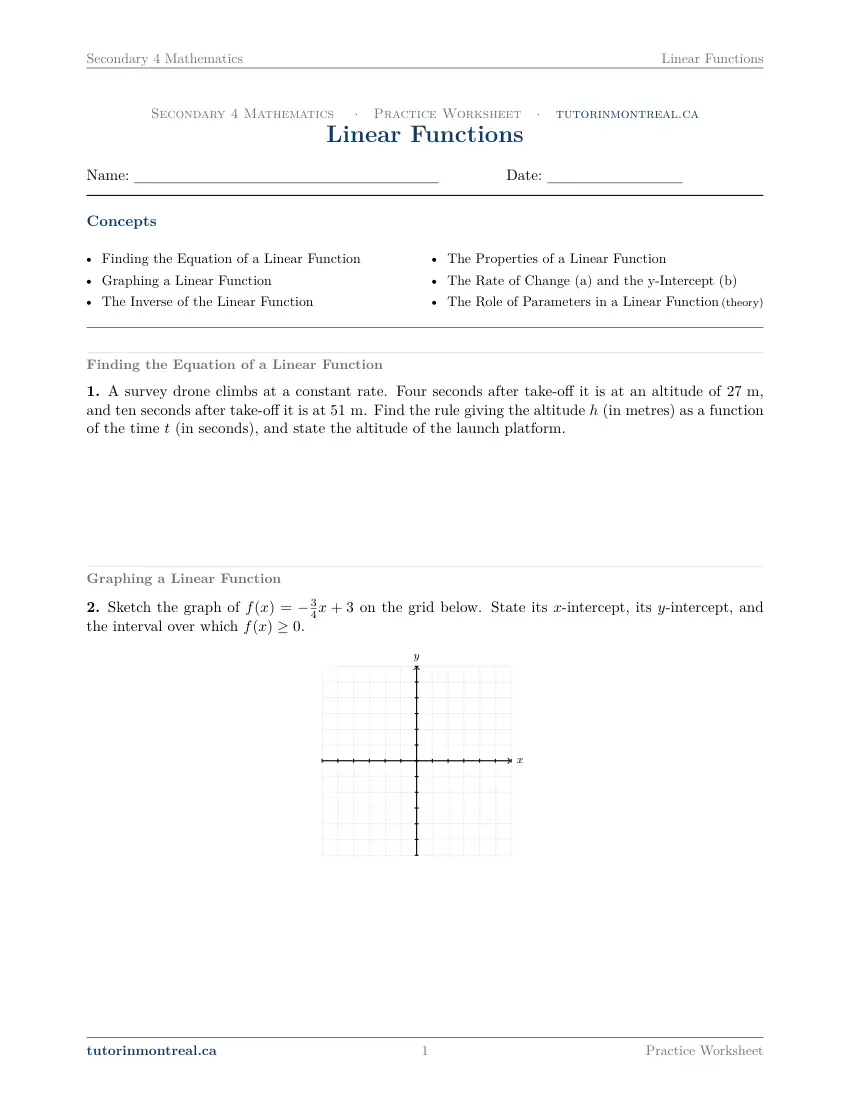
Practice worksheet — free PDF
No email, no account, no watermark. Teachers: photocopy it for your classes freely. Worked solutions and 5 harder problems come with the Secondary 4 Math bundle.
All 6 questions
Each question targets one named concept from the sheet. Read them here, or print the PDF — it has working space under each one.
-
Q1Finding the Equation of a Linear Function
A survey drone climbs at a constant rate. Four seconds after take-off it is at an altitude of , and ten seconds after take-off it is at . Find the rule giving the altitude (in metres) as a function of the time (in seconds), and state the altitude of the launch platform.
-
Q2Graphing a Linear Function
Sketch the graph of on the grid below. State its -intercept, its -intercept, and the interval over which .
A blank Cartesian grid for this question is on the printable PDF.
-
Q3The Inverse of the Linear Function
Let . Find the rule of and verify your answer with the point of the graph of whose abscissa is .
-
Q4The Properties of a Linear Function
An ~L pail of primer covers ~m per litre. The volume of primer left after painting square metres of wall is .
- State the rate of change and the initial value of , with their units.
- Find the zero of and explain what it represents.
- Give the domain and the range of in this context.
-
Q5The Rate of Change (a) and the y-Intercept (b)
A delivery drone descends at a constant rate. Its altitude is ~m after ~s and ~m after ~s.
- Find the rate of change and the initial value.
- Write the rule giving the altitude after seconds.
- After how many seconds is the drone at ~m?
-
Q6The Role of Parameters in a Linear Function
Two students describe the graph of .
- Alex: “Increasing makes the line steeper.”
- Bao: “Replacing by reflects the graph in the -axis.”
Decide whether each statement is true or false. Correct any false statement and justify your answers with the role of the parameters.
The 5 challenge problems for this topic are a separate, paid sheet and are not reproduced here.
Which stream is this for? This sheet is built for SN. It assumes you are modelling contexts with first-degree functions, giving units for the parameters, restricting domain and range to the situation, and inverting a rule and verifying the inverse, and it goes to the depth that program expects.
How to do every concept on this sheet
This is the part worksheet sites usually leave out. Below is the actual reasoning behind each group of questions — not a full solution set, the decisions that get you to one. Read it before you start, or after you get stuck.
From two points to the rule
Q1 and Q5 are the same computation dressed differently: two readings of a quantity at two times, and a rule to produce. The procedure never changes.
Two points → f(x) = ax + b
Rate first, then initial value, then a check with the point you did not use.
- 1Rate of change
a = (y₂ − y₁) ⁄ (x₂ − x₁). Keep the two points in the same order above and below the bar. Subtracting one way on top and the other way underneath flips the sign, and a wrong sign here poisons every line that follows. - 2Initial value
Substitute either point into
y = ax + bwith your a in place, and solve for b. It does not matter which point you choose — which means the other one is free to check with. - 3Write the rule
Put it together as
f(x) = ax + b, with the letters the question uses, not with x and y if it named them t and h. - 4Check with the unused point
One substitution. It costs a line and catches both the sign error in step 1 and an arithmetic slip in step 2.
- 5Answer the context question
"The altitude of the launch platform", "the charge at the start" — these ask for b, and saying which parameter answers them is part of the mark.
b is the value at x = 0, and nothing else. Q1 hands you an altitude a few seconds after take-off. That number is not the initial value, and dropping it straight into b is the single most common error on this kind of question. The give-away is built into the question: it asks separately for the altitude of the launch platform, which is what b actually is — and the two numbers are different.
The same trap is in Q5, where a reading is given at two seconds rather than at zero. Whenever a question hands you a value "after n units", treat it as an ordinary point to substitute, never as b.
The rate of change carries units, and the units carry marks
a is measured in units of y per unit of x. In Q4 that is litres per square metre; in Q5 it is metres per second. Writing the number without the unit answers half the question.
A negative rate of change means the quantity is being consumed or is falling, and saying so in one clause is usually explicitly worth something. b, by contrast, is measured in the units of y alone, because it is a value at an instant rather than a rate.
That difference has a consequence worth knowing: change the unit on the horizontal axis — from minutes to hours, say — and a is multiplied while b is untouched. The instant x = 0 is the same instant on both scales, so the value there cannot change; but "per minute" and "per hour" are genuinely different rates.
Intercepts, and answering an inequality without a graph
Q2 asks for both intercepts and for the interval where the function is non-negative.
- The y-intercept is b, read straight off the rule — no work.
- The x-intercept, the zero, comes from setting the rule equal to zero and solving.
- The interval where f(x) ≥ 0 then follows from the direction of the line alone. A decreasing line is above the axis to the left of its zero, so the answer is ]−∞, zero]; an increasing line gives [zero, +∞[. The endpoint is included because the sign asked for was "greater than or equal to".
Notice that the graph is not needed for this. Q2 gives you a grid, but the sign of a plus the zero decides the answer in two seconds, and that is the version you want on a test.
Rise over run, in that order. The rate of change is Δy ⁄ Δx: the number on top is the vertical move and the number underneath is the horizontal one. From a point on a line with rate 3⁄4 you move 4 right and 3 up, not 3 right and 4 up. Half of the mis-drawn lines in any class are this one swap, and it is caught instantly by substituting the x of your new point back into the rule and seeing whether the y agrees.
Domain and range inside a context
Algebraically, a first-degree rule is defined for every real number. Inside a situation it is not, and Q4 asks for the situation's version.
The reasoning is physical, not algebraic. A quantity of paint cannot be negative, and an area already painted cannot be negative either, so the domain starts at 0 and stops at the zero of the function — the point where the resource runs out. The range then runs from 0 up to the initial value. Write both as intervals, and add one clause per endpoint saying which physical fact closes it. That clause is what separates a full answer from a number.
Part of the same habit: interpret the zero in words. It is not "x equals a number", it is "the pail is empty after that many square metres". Q4 asks for the interpretation explicitly, and questions that do not ask for it still reward it.
The inverse of a first-degree function
Q3 asks for an inverse and then, in the same breath, tells you to verify it. Both halves matter.
To find it, swap x and y and re-isolate — which means undoing the operations in reverse order: subtract b first, then divide by a. The result is again a first-degree function, with rate of change 1⁄a and a new initial value. Because 1⁄a keeps the sign of a, the inverse of a decreasing line is decreasing.
The check is the method, not an extra. If (p, q) lies on f, then (q, p) must lie on f−1. Take the point Q3 names, evaluate f there, feed the result into your inverse, and confirm you land back where you started.
A sign slip during the rearrangement produces a rule that looks entirely plausible and is wrong, and there is no other way to notice. Geometrically the two graphs are reflections in the line y = x, which is the picture behind the coordinate swap.
What each parameter actually controls
Q6 gives two claims about the parameters and asks you to judge them. The content being tested is one sentence per parameter:
f(x) = ax + b · a = rate of change (direction and steepness) · b = initial value (vertical position)Changing b slides the line vertically, parallel to itself: same direction, same steepness, different height. Steepness is governed by |a| and by nothing else. Those two roles are swapped so routinely that the question exists mainly to catch the swap.
The second claim is about a transformation, and there is a mechanical way to settle any claim of that shape without geometric intuition: a reflection in the y-axis replaces x by −x everywhere in the rule. Perform that substitution, simplify, and compare the result with the rule you were asked about. If they match, the claim is true; if not, you have the counterexample in front of you.
"False" is not an answer. A true-or-false question of this kind is marked on the correction and the justification. Say which parameter actually does the job the statement misattributes, and why. A bare verdict, right or wrong, scores nothing.
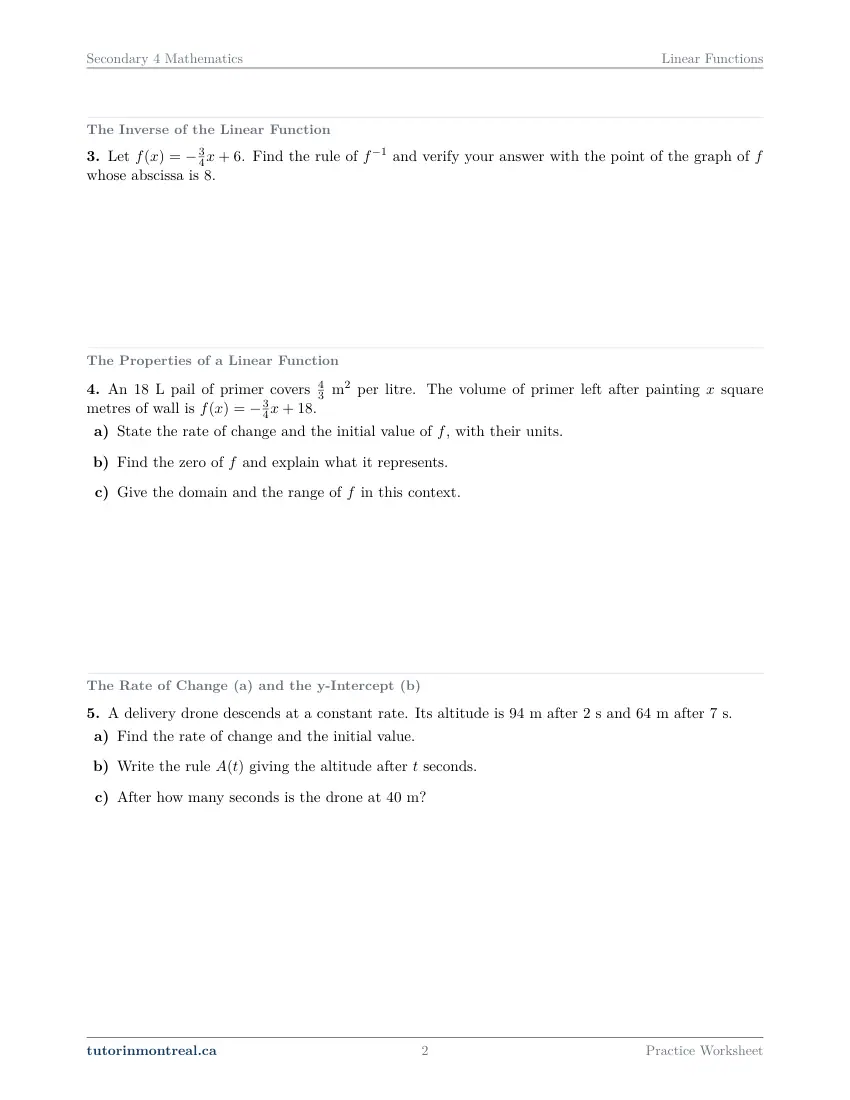
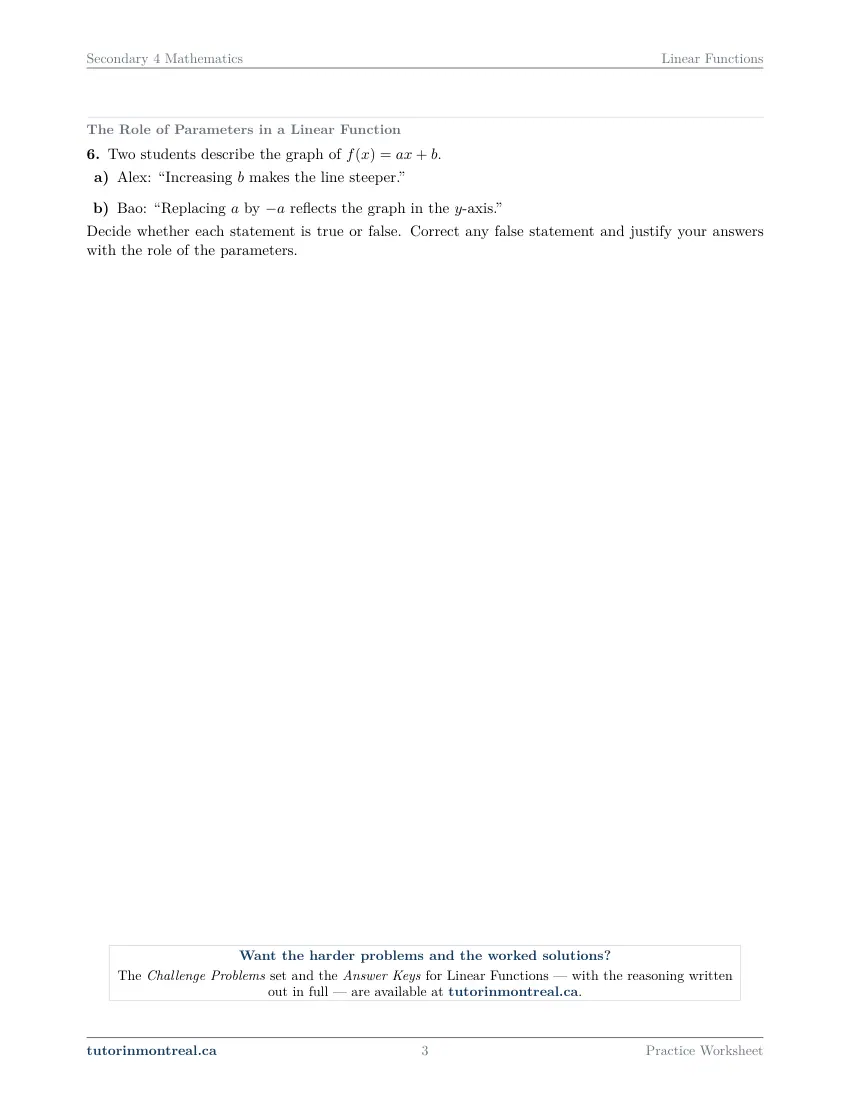
Preview all 3 pages
Click any page to open the full PDF.
Getting the most out of it
Always check with the point you did not use
Every two-point question gives you a free verification: build the rule from one point, then substitute the other. It takes one line, it catches the sign error in the rate of change and the arithmetic slip in the initial value, and it is the reason these questions should never cost you marks.
Write the units beside every parameter
Not at the end — as you compute them. Putting "m/s" next to a and "m" next to b forces you to say what each number means, and a parameter you can name in words is a parameter you will not mix up in the interpretation question underneath.
Do the modelling questions without the grid
Answer Q2's inequality from the sign of a and the zero, before you draw anything, then use the graph only to confirm. On an exam the picture is often absent, and the algebraic version is faster anyway.
Want the solutions, or something more challenging?
The worksheet, the questions above and every explanation on this page stay free permanently. Three more PDFs exist for this topic — the worked answer key, a harder problem set, and the answer key to that. They come with the Secondary 4 Math Solutions Bundle, which is what keeps the rest of the series free.
What else exists for Linear Functions
Three PDFs · 6 pages · all three are in the bundle below.
- Answer key — 1 page. All 6 questions worked step by step, including the restrictions and the justifications. Not a list of final answers.
- Challenge problems — 3 pages, 5 problems. A separate sheet at exam-plus difficulty covering the same 6 concepts. Harder than anything on the free sheet.
- Challenge answer key — 2 pages. Every challenge problem worked to the same standard, with the checks shown.
- PDF, letter size, print-ready.
The one thing that's for sale
Every Secondary 4 Math topic — the complete Solutions Bundle
One download, one payment, the whole program. Every answer key and every challenge set for all 17 Secondary 4 Math worksheet sets — including this one.
- Worked solutions, not answer lists — every step written out
- Covers the whole year's program at this level
- Less than the price of one hour of tutoring — for the entire year's solutions
Taking Secondary 1 Math as well? The Secondary 1 Math bundle covers all 15 of its sets — 45 PDFs, 182 pages — on the same terms.
Taking Secondary 2 Math as well? The Secondary 2 Math bundle covers all 14 of its sets — 42 PDFs, 181 pages — on the same terms.
Taking Secondary 3 Math as well? The Secondary 3 Math bundle covers all 11 of its sets — 33 PDFs, 154 pages — on the same terms.
Taking Secondary 5 Math as well? The Secondary 5 Math bundle covers all 21 of its sets — 63 PDFs, 228 pages — on the same terms.
Taking CEGEP Calculus I as well? The CEGEP Calculus I bundle covers all 8 of its sets — 24 PDFs, 82 pages — on the same terms.
Taking CEGEP Calculus II as well? The CEGEP Calculus II bundle covers all 8 of its sets — 24 PDFs, 90 pages — on the same terms.
Taking CEGEP Linear Algebra as well? The CEGEP Linear Algebra bundle covers all 7 of its sets — 21 PDFs, 82 pages — on the same terms.
Taking AP Calculus AB as well? The AP Calculus AB bundle covers all 8 of its sets — 24 PDFs, 126 pages — on the same terms.
Common questions
Is this worksheet really free?
Yes — the questions are on this page to read, and the PDF downloads directly, no email and no account. The one paid item is optional: the complete Secondary 4 Solutions Bundle, which covers every set at this level.
Why isn't b just the first value the question gives me?
Because b is the value at x = 0 and nothing else. A reading taken four seconds after take-off is an ordinary point to substitute, not the initial value. Compute the rate of change first, then substitute that point to solve for b — the two numbers are usually different, and the question often asks for both.
Which way do I count the slope when I draw a line?
The rate of change is the vertical change over the horizontal change, so the top number is how far you move up or down and the bottom number is how far you move right. A rate of 3/4 means 4 right and 3 up. Swapping them draws a completely different line, and substituting your new point back into the rule exposes it immediately.
How do I find the inverse of a first-degree function and check it?
Swap x and y in the rule and re-isolate, which means undoing the operations in reverse order: subtract the initial value, then divide by the rate of change. Check with a point — if (p, q) is on f then (q, p) must be on the inverse. A sign slip during the rearrangement is invisible any other way.
Why are the domain and the range restricted in a word problem?
Because the situation restricts them, even though the algebra does not. A volume cannot go below zero and an area cannot be negative, so the domain typically runs from 0 to the zero of the function and the range from 0 to the initial value. Say which physical fact closes each endpoint — that clause is part of the answer.
Which Secondary 4 stream is this for?
It is built for SN. The sheet assumes you are modelling contexts with first-degree functions, giving units for the parameters, restricting domain and range to the situation and verifying an inverse, and it goes to the depth that program expects.
Can teachers use this in class?
Yes. Print and photocopy it for your own classes freely — I just ask that the tutorinmontreal.ca footer stays on the page.
I'm stuck on one question. Can you help?
Yes — through one-on-one tutoring, in Montreal or online. Get in touch to arrange a session, or see the current rates.
← All 17 Secondary 4 Math worksheets · Secondary 1 Math series (15 sheets) → · Secondary 2 Math series (14 sheets) → · Secondary 3 Math series (11 sheets) → · Secondary 5 Math series (21 sheets) → · CEGEP Calculus I series (8 sheets) → · CEGEP Calculus II series (8 sheets) → · CEGEP Linear Algebra series (7 sheets) → · AP Calculus AB series (8 sheets) →