Secondary 4 Mathematical Expectation and Odds Worksheet
Conditional probability read off a two-way table, geometric probability built from areas, mathematical expectation and the question of whether a game is fair, odds for against odds against and how both differ from a probability, and the event vocabulary — compatible, complementary, certain, impossible. The recurring trap is naming the right sample space, so these questions make you state it before anything else. There is no sign-up, and the printable copy costs nothing.
Practice worksheet — free PDF
No email, no account, no watermark. Teachers: photocopy it for your classes freely. Worked solutions and 7 harder problems come with the Secondary 4 Math bundle.
6 of the 7 questions
Each question targets one named concept from the sheet. Read them here, or print the PDF — it has working space under each one. 6 of the 7 questions are printed below. The other 1 is built on a diagram or a table of values that does not translate to the page, so it is in the free PDF — marked below where it would have come.
-
Q1Conditional Probability
This question is built around a diagram or a table of values. Open it in the PDF.
-
Q2Geometric Probability –
A rectangular skate park measures by . Inside it, a circular bowl of radius is cut into the concrete. A leaf blown by the wind lands at a point chosen at random in the park, every point being equally likely. Find the probability that the leaf lands in the bowl, to the nearest thousandth.
-
Q3Mathematical Expectation
At a maple festival booth, a player pays $3 to spin a wheel once. The wheel pays $10 with probability , pays $4 with probability , and pays nothing with probability . Find the mathematical expectation of a player's net gain for one spin, and say whether the game is fair.
-
Q4The Odds For and the Odds Against
On a busy route, the odds that a ferry leaves on time are for.
- What is the probability that the ferry leaves on time?
- State the odds against the ferry leaving on time.
-
Q5The Types of Probability –
For each statement, say whether the probability given is theoretical, experimental (frequency-based) or subjective, and justify your choice in one line.
- “This 12-sided die is perfectly balanced, so the probability of rolling a multiple of 4 is .”
- “Of the 500 loaves we baked last month, 35 came out underbaked, so the probability that the next loaf is underbaked is .”
- “I think our team has a chance of winning Saturday — the players looked confident at practice.”
-
Q6Types of Events –
A box contains 20 tokens numbered from 1 to 20, and one token is drawn at random. Consider the events : “the number is even”, : “the number is a multiple of 5”, : “the number is greater than 20”.
- Are and compatible or incompatible? Justify with the outcomes.
- What type of event is , and what is its probability?
- Describe the complement of in words and give .
-
Q7Synthesis — drawing on several sheets in this topic
At a community fair, a beanbag is tossed onto a square target board measuring by ; it lands at a point chosen at random on the board. A circular zone centred on the board pays the player $6; anywhere else pays nothing. Each throw costs $2.
- The circular zone has radius . Find the organizer's expected profit per throw, to the nearest cent.
- The organizer now wants the odds against a player winning the $6 to be exactly . Find the radius of the zone he must use, to the nearest centimetre, and state his expected profit per throw when the odds are exactly .
The 7 challenge problems for this topic are a separate, paid sheet and are not reproduced here.
Which stream is this for? This sheet is built for SN. It expects conditional probability, mathematical expectation used to compare options, and odds converted back and forth with probability, and it goes to the depth that program expects.
How to do every concept on this sheet
This is the part worksheet sites usually leave out. Below is the actual reasoning behind each group of questions — not a full solution set, the decisions that get you to one. Read it before you start, or after you get stuck.
Every probability question is a fraction. Get the denominator right first.
Almost everything on this sheet comes down to deciding what the denominator is, and each section of the unit changes it in a different way: a condition shrinks it, a geometric setting turns it into an area, odds replace it with something that is not a total at all. Fix the denominator and the rest is arithmetic.
Conditional probability: the condition shrinks the sample space (Q1)
P(A | B) is read "the probability of A given B", and the word "given" means B has already happened. Everything that is not B is no longer in play, so B becomes the new universe:
P(A | B) = P(A ∩ B) ⁄ P(B)With a two-way table you rarely need the formula. The condition names one row or one column; that line's total becomes the denominator, and the single cell where the two categories meet becomes the numerator. Q1 conditions on holding a certificate, so the certificate column total is the denominator, not the 240 people surveyed. (This question depends on its table, so it lives on the printed sheet rather than on this page.)
The mistake: assuming P(A | B) and P(B | A) are the same number. They share a numerator and have completely different denominators. Among people who own climbing shoes, almost all climb; among people who climb, only some own shoes. Reversing a conditional statement is the most common error in the whole topic and it is worth checking every time which of the two the question is asking for.
The second slip is subtler: comparing P(A | B) with P(A) is what tells you whether B carries information. If the two agree, knowing B changed nothing — which is exactly the definition of independence, and the link to Q6.
Geometric probability: a ratio of measures (Q2, Q7)
When a point is chosen at random in a region and every point is equally likely, the probability of landing in a sub-region is the ratio of their sizes — lengths on a line, areas on a surface, volumes in a solid. There is no counting because there is nothing countable; the measure does the counting.
P = area of the target region ⁄ area of the whole regionTwo things to guard. Compare areas, not radii or diameters: a circle of radius 6 in a 30 by 18 rectangle covers 36π out of 540, and comparing 6 with 30 is meaningless. And make sure both measures are in the same unit before dividing — a probability is a pure number, so if the units do not cancel, something has gone wrong upstream.
Q7 runs the idea backwards, which is the harder direction and the one exams prefer: you are given the probability and asked for a dimension. Set up the same ratio, put the known probability on one side, and solve for the radius or the width. When that leaves a second-degree equation, expect one root to be geometrically impossible — a border wider than half the shorter side leaves no middle region at all — and reject it explicitly, with the reason written out.
Mathematical expectation: a long-run average, not a prediction (Q3, Q7)
Expectation is each outcome multiplied by its probability, all added up: E = Σ x · P(x). Set it out as two columns, outcomes and probabilities, and check the probabilities add to 1 before you multiply anything — a column that does not sum to 1 means a missing outcome, and the "nothing happens" outcome is the one people leave out.
Payout, cost, and net gain are three different numbers. The expectation computed from the prize table is the expected payout. The player's expected net gain is that minus the price of playing, subtracted once, whatever the outcome — and the organiser's expected profit is the same quantity with the sign reversed. A game is fair when the expected net gain is exactly zero. Q3 asks for the net gain and the verdict; Q7 asks for the profit from the organiser's side of the same arithmetic.
The interpretation sentence matters as much as the number. An expectation is an average over many repetitions, so it is not a claim about any single trial. Nobody loses 80 cents on one spin — they lose the price of the spin or win a prize. What the expectation says is what happens per play across a long evening, which is why it is the right tool for comparing two options and the wrong tool for predicting one.
Odds are not probability (Q4, Q7)
This is the single most misread notation in the unit, and the fix is one sentence: probability compares favourable cases to the total, odds compare favourable cases to unfavourable ones.
Converting between odds and probability
Add the two terms of the ratio to rebuild the total, then read off the fraction.
- 1Odds for of a : b
a favourable cases against b unfavourable ones, so there are
a + bcases in all andP = a ⁄ (a + b). Odds for of 9 : 5 give a probability of 9⁄14 — not 9⁄5, and not 9⁄10. - 2Odds against of a : b
The same ratio read the other way round, so
P = b ⁄ (a + b). Odds against of 3 : 1 mean one favourable case out of four, a probability of ¼. Q7 uses this direction to fix the size of a target. - 3From a probability back to odds
If
P = p ⁄ qin lowest terms, the odds for arep : (q − p)and the odds against are(q − p) : p. Swapping the two terms is all that separates "for" from "against".
Odds do not add. Two ratios cannot be combined by adding their first terms and their second terms — that operation has no meaning. To combine events, convert each set of odds to a probability, do the addition there (for incompatible events), then convert the result back to odds at the very end. Any time a question puts two odds statements next to each other, that round trip is the intended method.
Theoretical, experimental, subjective (Q5)
Three ways of arriving at a number, and the question is always about where the number came from, not whether it is right. Theoretical probability is counted from a model of equally likely outcomes, with no trials performed. Experimental probability is a relative frequency observed in actual trials. Subjective probability is a personal judgment — a hunch, an impression, an expert opinion — with no counting and no data behind it.
The trap is the model rather than the type. "Equally likely" is an assumption that has to be earned: five sectors on a spinner are equiprobable only if the five central angles are equal, and if they are not, the theoretical probabilities come from the angles. When experimental results disagree with a theoretical value, the honest first suspicion is that the model was wrong, not that the equipment is broken.
Types of events, and the word "independent" (Q6)
Two events are compatible when they can occur together — when their intersection is not empty — and incompatible when it is. An event with probability 0 is impossible, one with probability 1 is certain, and the complement A′ is "A does not happen", with P(A′) = 1 − P(A). Justify a compatibility claim by naming the outcomes in the intersection, as Q6(a) asks — listing them is the justification, and asserting the verdict alone is not.
Incompatible is not independent. They sound like synonyms and they are close to opposites. Incompatible means the two events cannot both happen. Independent means knowing one occurred does not change the probability of the other, tested by P(A ∩ B) = P(A) · P(B). If A and B are incompatible and both have non-zero probability, then learning B happened tells you A definitely did not — which is a large amount of information, so they are strongly dependent.
Q7: the synthesis problem
A target board that chains three tools together. Part (a) is geometric probability feeding straight into an expectation: work out the chance of landing in the circle from the areas, use it to get the expected payout, then subtract the cost of a throw to reach the organiser's expected profit per throw. Part (b) reverses the chain — convert the required odds into a probability, put that probability into the area ratio, and solve for the radius before recomputing the profit. Check at the end that the circle you found actually fits on the board; a geometric answer that does not fit its own figure is not an answer.
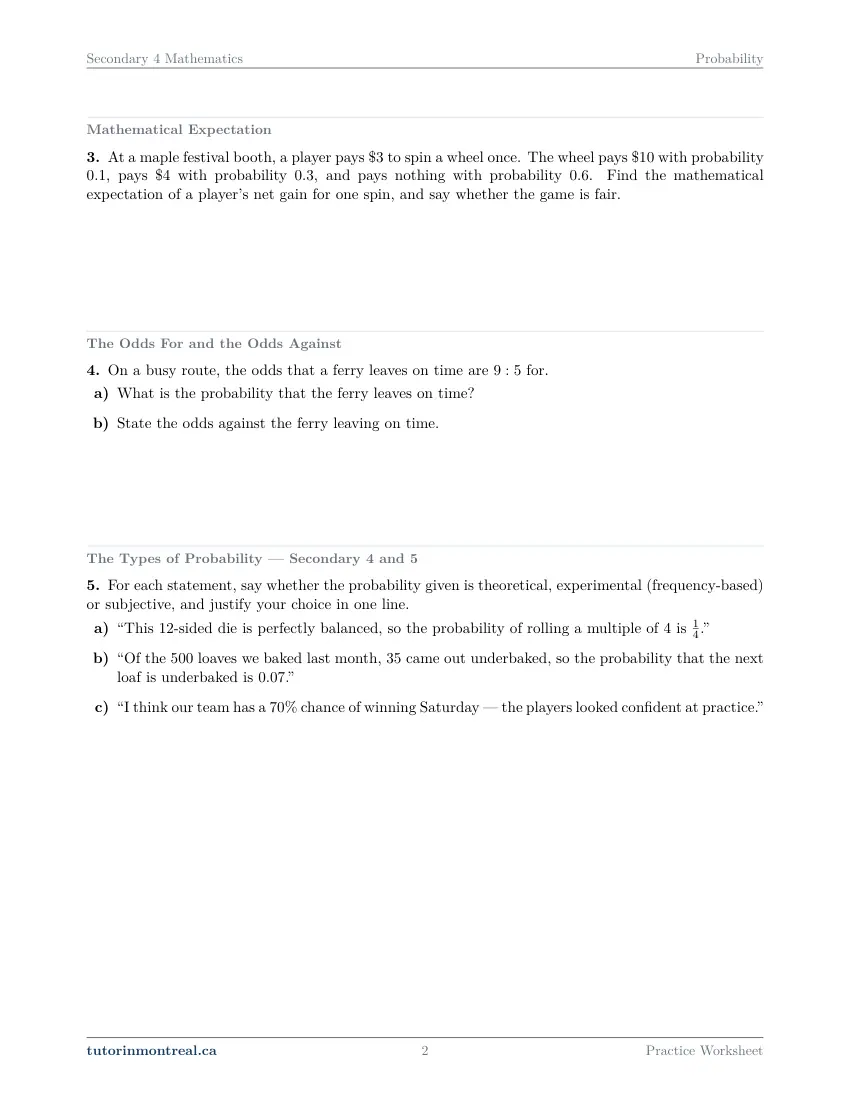
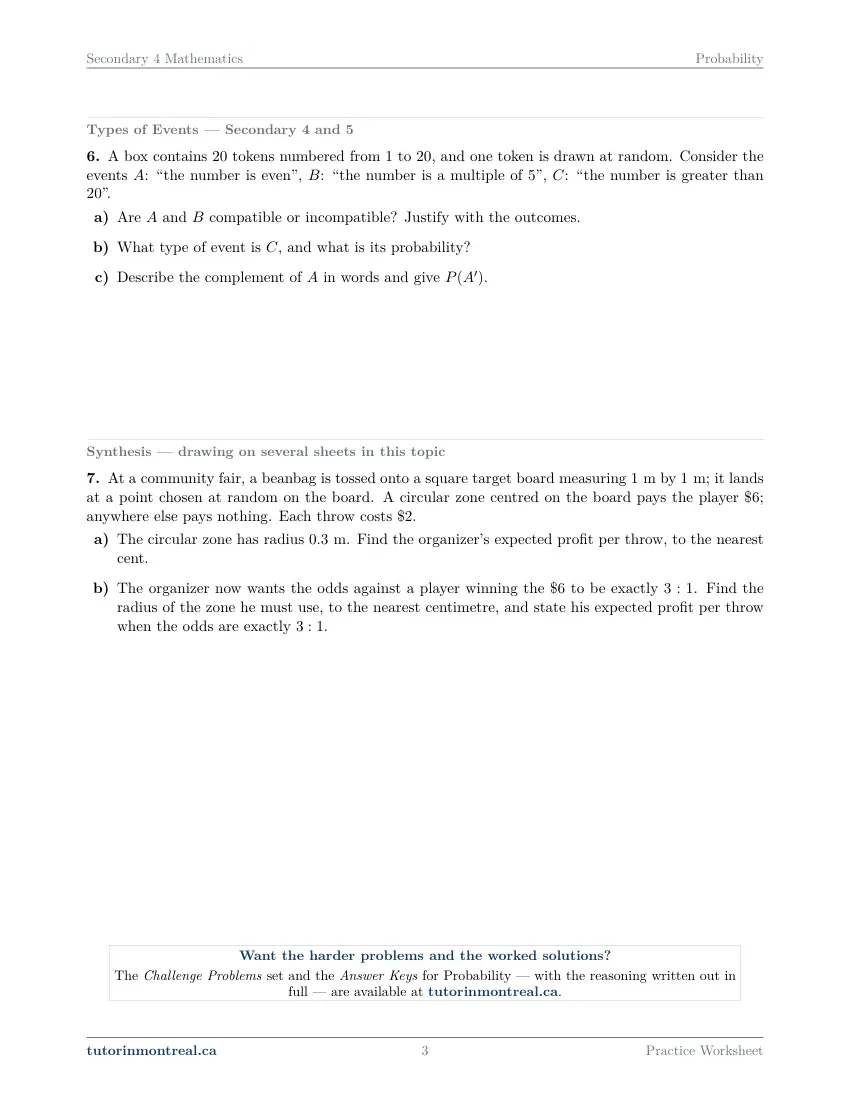
Preview all 3 pages
Click any page to open the full PDF.
Getting the most out of it
Write the denominator before anything else
On every question, write down what the whole sample space is — all members, all of the board, the certificate holders only — before you write a numerator. Most wrong answers in this unit are right fractions over the wrong total.
Convert odds to a probability the moment you see them
Odds are a reporting format, not a working format. Turn every odds statement into a fraction as soon as you read it, do all the mathematics in probabilities, and convert back only if the question asked for odds.
Say the interpretation out loud
Several questions here ask for a verdict as well as a number: is the game fair, is the spinner defective, is one option better. Practise finishing every calculation with one sentence in plain words, because on an exam that sentence is a separate mark.
Want the solutions, or something more challenging?
The worksheet, the questions above and every explanation on this page stay free permanently. Three more PDFs exist for this topic — the worked answer key, a harder problem set, and the answer key to that. They come with the Secondary 4 Math Solutions Bundle, which is what keeps the rest of the series free.
What else exists for Probability
Three PDFs · 8 pages · all three are in the bundle below.
- Answer key — 2 pages. All 7 questions worked step by step, including the restrictions and the justifications. Not a list of final answers.
- Challenge problems — 4 pages, 7 problems. A separate sheet at exam-plus difficulty covering the same 6 concepts. Harder than anything on the free sheet.
- Challenge answer key — 2 pages. Every challenge problem worked to the same standard, with the checks shown.
- PDF, letter size, print-ready.
The one thing that's for sale
Every Secondary 4 Math topic — the complete Solutions Bundle
One download, one payment, the whole program. Every answer key and every challenge set for all 17 Secondary 4 Math worksheet sets — including this one.
- Worked solutions, not answer lists — every step written out
- Covers the whole year's program at this level
- Less than the price of one hour of tutoring — for the entire year's solutions
Taking Secondary 1 Math as well? The Secondary 1 Math bundle covers all 15 of its sets — 45 PDFs, 182 pages — on the same terms.
Taking Secondary 2 Math as well? The Secondary 2 Math bundle covers all 14 of its sets — 42 PDFs, 181 pages — on the same terms.
Taking Secondary 3 Math as well? The Secondary 3 Math bundle covers all 11 of its sets — 33 PDFs, 154 pages — on the same terms.
Taking Secondary 5 Math as well? The Secondary 5 Math bundle covers all 21 of its sets — 63 PDFs, 228 pages — on the same terms.
Taking CEGEP Calculus I as well? The CEGEP Calculus I bundle covers all 8 of its sets — 24 PDFs, 82 pages — on the same terms.
Taking CEGEP Calculus II as well? The CEGEP Calculus II bundle covers all 8 of its sets — 24 PDFs, 90 pages — on the same terms.
Taking CEGEP Linear Algebra as well? The CEGEP Linear Algebra bundle covers all 7 of its sets — 21 PDFs, 82 pages — on the same terms.
Taking AP Calculus AB as well? The AP Calculus AB bundle covers all 8 of its sets — 24 PDFs, 126 pages — on the same terms.
Common questions
Is this worksheet really free?
Yes — the questions are on this page to read, and the PDF downloads directly, no email and no account. The one paid item is optional: the complete Secondary 4 Solutions Bundle, which covers every set at this level.
How do I read a conditional probability off a two-way table?
The condition names a row or a column, and that line's total becomes your denominator. The numerator is the single cell where the two categories meet. The grand total of the table is not used at all, because the condition has already ruled out everyone outside that line.
What is the difference between odds and probability?
Probability compares favourable cases to the total number of cases; odds compare favourable cases to unfavourable ones. Odds for of 9 to 5 therefore mean 14 cases in all and a probability of 9/14. Odds against are the same two numbers in the opposite order.
Does a negative mathematical expectation mean I will lose money?
It means you lose on average, over many repetitions. Expectation is a long-run average, not a prediction for a single trial, so one lucky outcome does not contradict it and one unlucky one does not confirm it.
How do I work out a geometric probability?
Divide the measure of the target region by the measure of the whole region — lengths, areas or volumes, in the same unit. Compare areas rather than radii or side lengths, and if the question gives you the probability instead, set up the same ratio and solve for the missing dimension.
Which Secondary 4 stream is this for?
It is built for SN. The sheet expects conditional probability, mathematical expectation used to compare two options, and odds converted back and forth with probability, which is the depth that program expects.
Can teachers use this in class?
Yes. Print and photocopy it for your own classes freely — I just ask that the tutorinmontreal.ca footer stays on the page.
I'm stuck on one question. Can you help?
Yes — through one-on-one tutoring, in Montreal or online. Get in touch to arrange a session, or see the current rates.
← All 17 Secondary 4 Math worksheets · Secondary 1 Math series (15 sheets) → · Secondary 2 Math series (14 sheets) → · Secondary 3 Math series (11 sheets) → · Secondary 5 Math series (21 sheets) → · CEGEP Calculus I series (8 sheets) → · CEGEP Calculus II series (8 sheets) → · CEGEP Linear Algebra series (7 sheets) → · AP Calculus AB series (8 sheets) →
The same topic at the other level: Secondary 5 Math · Probability.