Secondary 4 Equations and Inequalities Worksheet
One equation type at a time — first and second degree, square root, exponential and greatest integer — and then the inequality version of each, where the work is deciding when the sign flips and which values the algebra quietly invented along the way. The sheet finishes with writing a solution set properly and shading a half-plane on the Cartesian plane. It prints free, and the method for each type is written out below the questions.
Practice worksheet — free PDF
No email, no account, no watermark. Teachers: photocopy it for your classes freely. Worked solutions and 10 harder problems come with the Secondary 4 Math bundle.
All 10 questions
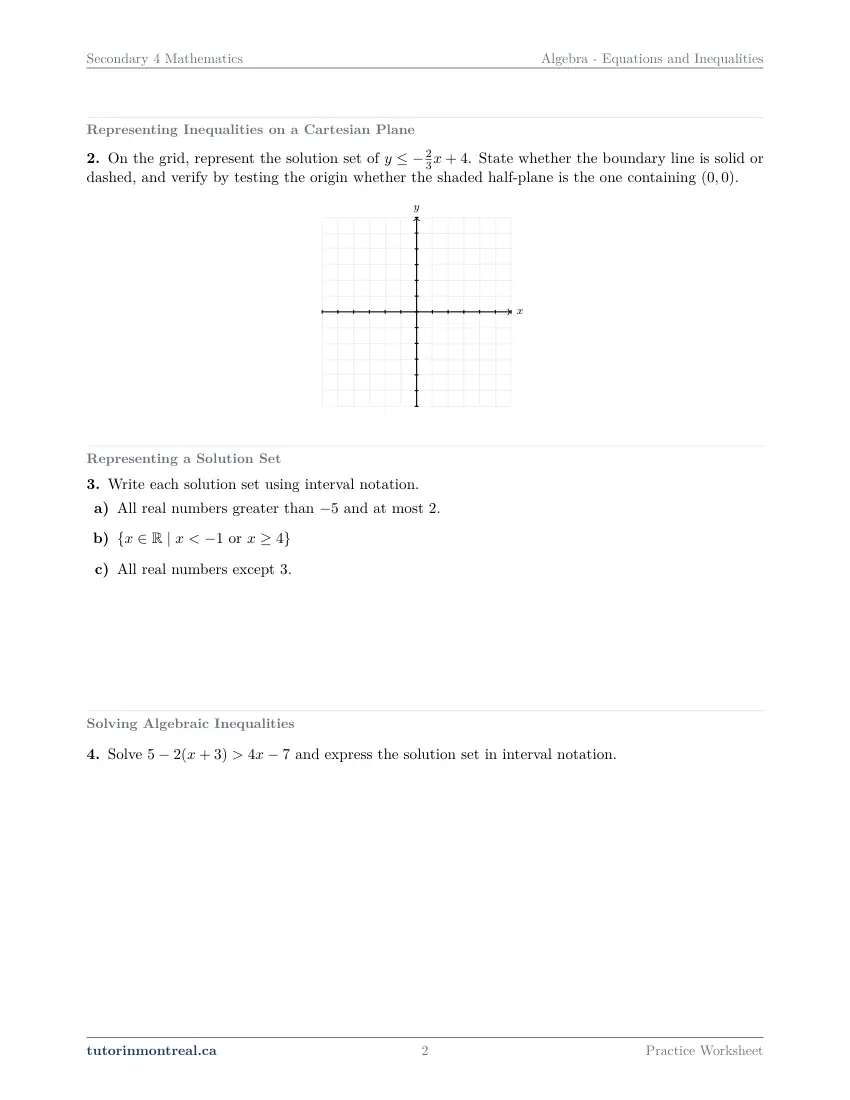
Each question targets one named concept from the sheet. Read them here, or print the PDF — it has working space under each one.
-
Q1Algebra — Equations and Inequalities
For each relation below, state whether it is an equation or an inequality, and name its type (first degree, second degree, square root, exponential, or greatest integer).
-
Q2Representing Inequalities on a Cartesian Plane
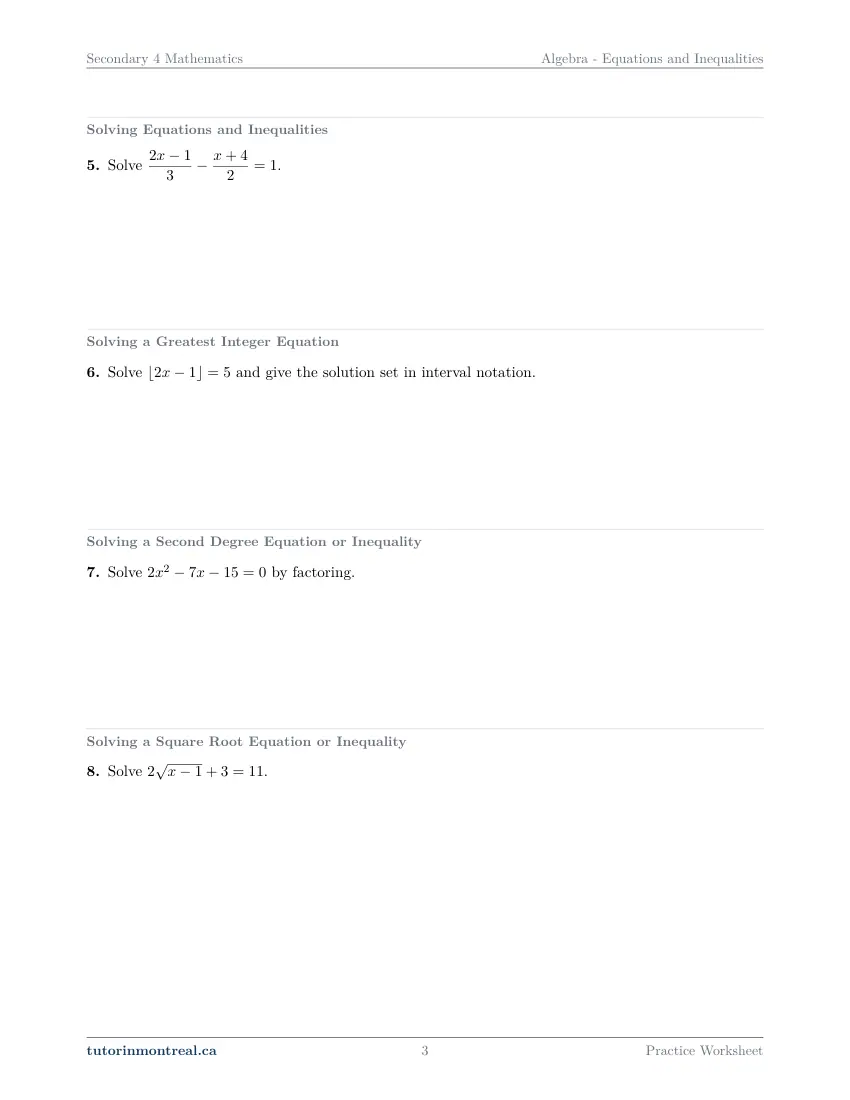
On the grid, represent the solution set of . State whether the boundary line is solid or dashed, and verify by testing the origin whether the shaded half-plane is the one containing .
A blank Cartesian grid for this question is on the printable PDF.
-
Q3Representing a Solution Set
Write each solution set using interval notation.
- All real numbers greater than and at most .
- All real numbers except .
-
Q4Solving Algebraic Inequalities
Solve and express the solution set in interval notation.
-
Q5Solving Equations and Inequalities
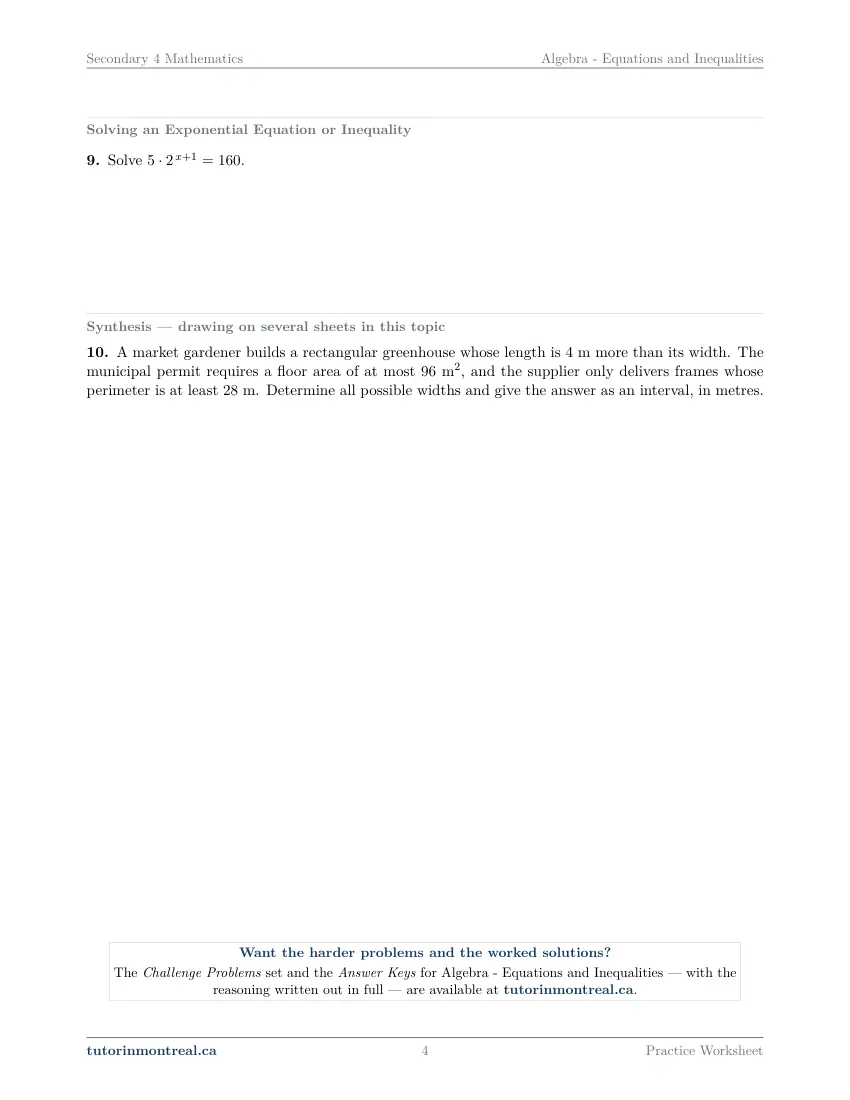
Solve .
-
Q6Solving a Greatest Integer Equation
Solve and give the solution set in interval notation.
-
Q7Solving a Second Degree Equation or Inequality
Solve by factoring.
-
Q8Solving a Square Root Equation or Inequality
Solve .
-
Q9Solving an Exponential Equation or Inequality
Solve .
-
Q10Synthesis — drawing on several sheets in this topic
A market gardener builds a rectangular greenhouse whose length is m more than its width. The municipal permit requires a floor area of at most , and the supplier only delivers frames whose perimeter is at least m. Determine all possible widths and give the answer as an interval, in metres.
The 10 challenge problems for this topic are a separate, paid sheet and are not reproduced here.
Which stream is this for? This sheet is built for SN. It assumes you are solving second-degree, square root and exponential relations and writing solution sets in interval notation, and it goes to the depth that program expects.
How to do every concept on this sheet
This is the part worksheet sites usually leave out. Below is the actual reasoning behind each group of questions — not a full solution set, the decisions that get you to one. Read it before you start, or after you get stuck.
The one rule that costs the most marks
Everything you do to an equation, you may do to an inequality — with a single exception, and it is the exception that shows up in the marking. Multiplying or dividing both sides by a negative number reverses the sense of the inequality. Adding, subtracting, and multiplying by a positive number all leave it alone.
Why it has to reverse. Start from something plainly true:
2 < 4Multiply both sides by −1 and keep the sense, and you get −2 < −4, which is false. The correct statement is −2 > −4. On a number line, multiplying by a negative reflects both numbers through zero, and reflection swaps which one is further right.
Q4 is where this bites on this sheet. Expand the bracket, then collect the x terms on the left and the last step divides by a negative coefficient — flip the sense there or the whole solution set points the wrong way. Collecting them on the other side instead keeps the coefficient positive and avoids the flip entirely; both routes are correct, and it is worth choosing one on purpose rather than by accident.
The same reflex is what Q1 is testing when it asks you to tell an inequality from an equation: naming the relation is how you remember that the rules for the two are not identical.
Interval notation: the bracket is the whole answer
Q3 is four seconds of work and a very common place to drop a mark, because the bracket carries the meaning. In Quebec notation the bracket turns outward at an end that is excluded:
Reading a bracket
Square bracket = the endpoint is in. Reversed bracket = it is out.
- 1Included endpoint → square bracket
"at most 2" and "greater than or equal to 4" both include their endpoint:
… , 2]and[4, … - 2Excluded endpoint → reversed bracket
"greater than −5" excludes −5:
]−5, …Infinity is never reachable, so it is always reversed:]−∞and+∞[. - 3"or" means union
Two separate pieces are joined with
∪. "Every real number except 3" is not one interval — it is]−∞, 3[ ∪ ]3, +∞[, which is exactly how you say "3 is missing".
Greatest integer: turn it into a double inequality
Q6 looks unfamiliar and is mechanical once you know the move. The floor of something equals k exactly when that something sits between k and the next integer:
⌊u⌋ = k ⟺ k ≤ u < k + 1Note the brackets: closed on the left, open on the right, always. Substitute your expression for u, solve the two inequalities together, and the answer comes out as an interval rather than a single number — which is the point of the question. A greatest integer equation almost never has one solution.
Square root: solve, then check — the check is part of the method
Q8 is a straightforward one: isolate the radical, square, solve. The habit it builds matters more than the answer.
Squaring is a one-way street. If A = B then A² = B² — but the converse fails, because A² = B² only gives A = ±B. Squaring can therefore invent solutions that solve a different equation, the one with the minus sign. It can never lose a real solution, so the only risk is extra ones.
That is why every candidate must be substituted back into the original equation. Two restrictions are worth writing down before you start: whatever is under the radical must be ≥ 0, and because a square root is never negative, whatever the radical equals must also be ≥ 0.
Exponential: get the same base, then drop it
Q9 is the whole technique in one line. Once both sides are powers of the same base, the exponents must be equal, because an exponential function never takes the same value twice. Isolate the power first, then rewrite the number as a power: 32 is 2⁵, 81 is 3⁴, 243 is 3⁵.
One caution for the inequality version: comparing exponents preserves the sense only when the base is greater than 1. With a base between 0 and 1 the function is decreasing, and the inequality reverses — the same reflex as the negative-number rule, in different clothing.
Second degree: factor, then finish with the zero product
Q7 is a product-sum factoring: find two numbers whose product is a·c and whose sum is b, split the middle term into those two pieces, then group in pairs and take out the common bracket. The coefficient in front of x² is what makes the split necessary; with a coefficient of 1 you could have read the two numbers straight off.
Factoring is not the answer, though — it is the setup. The step that finishes the question is the zero product property: a product equals zero only when one of its factors does, so each bracket gives its own small first-degree equation. Say that out loud as you write it, because it is the only reason you are allowed to move from a factored form to a list of values, and it is also the reason this move works for = 0 and for nothing else. If the right-hand side is not zero, move everything across first; setting each factor equal to the number on the right is a genuine error, not a shortcut.
Two conditions at once
The last question puts two constraints on the same unknown. Solve each one separately, write each solution set as an interval, and then take the intersection — the values that satisfy both at once. Two things to watch: a constraint from the context (a width is positive; a number of sessions is a whole number) is as real as the algebraic one, and it is usually the constraint people forget.
One of those two constraints is where a second-degree inequality turns up, and there factoring really is only half the job. Bring everything to one side, factor, and then read the sign rather than the zeroes: written as (x − r₁)(x − r₂), a product of two factors is negative exactly between the zeroes and positive outside them, so the zeroes are the boundaries of the answer and not the answer itself. Sketching the parabola settles it in one line — where the curve sits below the axis is the solution to "< 0", and where it sits above is the solution to "> 0". Decide at the end whether the boundaries themselves belong, from whether the original sign was strict.
Preview all 4 pages
Click any page to open the full PDF.
Getting the most out of it
Write the restriction before you solve, not after
On the square root question, note "radicand ≥ 0" and "right-hand side ≥ 0" before you square anything. Ten seconds up front turns the check at the end from a guess into a confirmation.
Say the sense out loud when you divide
Every time you divide an inequality, say "by a positive, sense stays" or "by a negative, sense flips". It feels silly and it is the single highest-value habit on this sheet.
Do the classification question last, as a review
Q1 asks you to name each type rather than solve anything. Come back to it after the other nine and it stops being vocabulary and becomes a summary of what you just practised — which is how it tends to appear on an exam.
Want the solutions, or something more challenging?
The worksheet, the questions above and every explanation on this page stay free permanently. Three more PDFs exist for this topic — the worked answer key, a harder problem set, and the answer key to that. They come with the Secondary 4 Math Solutions Bundle, which is what keeps the rest of the series free.
What else exists for Equations and Inequalities
Three PDFs · 11 pages · all three are in the bundle below.
- Answer key — 2 pages. All 10 questions worked step by step, including the restrictions and the justifications. Not a list of final answers.
- Challenge problems — 6 pages, 10 problems. A separate sheet at exam-plus difficulty covering the same 9 concepts. Harder than anything on the free sheet.
- Challenge answer key — 3 pages. Every challenge problem worked to the same standard, with the checks shown.
- PDF, letter size, print-ready.
The one thing that's for sale
Every Secondary 4 Math topic — the complete Solutions Bundle
One download, one payment, the whole program. Every answer key and every challenge set for all 17 Secondary 4 Math worksheet sets — including this one.
- Worked solutions, not answer lists — every step written out
- Covers the whole year's program at this level
- Less than the price of one hour of tutoring — for the entire year's solutions
Taking Secondary 1 Math as well? The Secondary 1 Math bundle covers all 15 of its sets — 45 PDFs, 182 pages — on the same terms.
Taking Secondary 2 Math as well? The Secondary 2 Math bundle covers all 14 of its sets — 42 PDFs, 181 pages — on the same terms.
Taking Secondary 3 Math as well? The Secondary 3 Math bundle covers all 11 of its sets — 33 PDFs, 154 pages — on the same terms.
Taking Secondary 5 Math as well? The Secondary 5 Math bundle covers all 21 of its sets — 63 PDFs, 228 pages — on the same terms.
Taking CEGEP Calculus I as well? The CEGEP Calculus I bundle covers all 8 of its sets — 24 PDFs, 82 pages — on the same terms.
Taking CEGEP Calculus II as well? The CEGEP Calculus II bundle covers all 8 of its sets — 24 PDFs, 90 pages — on the same terms.
Taking CEGEP Linear Algebra as well? The CEGEP Linear Algebra bundle covers all 7 of its sets — 21 PDFs, 82 pages — on the same terms.
Taking AP Calculus AB as well? The AP Calculus AB bundle covers all 8 of its sets — 24 PDFs, 126 pages — on the same terms.
Common questions
Is this worksheet really free?
Yes — the questions are on this page to read, and the PDF downloads directly, no email and no account. The one paid item is optional: the complete Secondary 4 Solutions Bundle, which covers every set at this level.
When exactly does an inequality sign flip?
Only when you multiply or divide both sides by a negative number. Adding or subtracting anything, and multiplying or dividing by a positive number, all leave the sense alone. The other place it happens is comparing exponents when the base is between 0 and 1, because that exponential function is decreasing.
Why do I have to check the answers to a square root equation?
Because squaring both sides is not reversible. From A² = B² you can only conclude A = ±B, so squaring also drags in the solutions of the equation with the opposite sign. Those extra values solve the squared equation but not the original one, and the only way to tell them apart is to substitute back into the original.
How do I know which way the brackets go in interval notation?
A square bracket means the endpoint is included, a reversed bracket means it is excluded. Infinity always gets a reversed bracket because it is never reached. If the answer is "every real number except one value", it is a union of two intervals, not one.
Why does a greatest integer equation have infinitely many solutions?
Because the floor function is constant across a whole interval. Saying the floor of an expression equals k pins that expression between k and k + 1, not to a single value, so the solution is an interval — closed at the left end and open at the right.
Which Secondary 4 stream is this for?
It is built for SN. The sheet assumes you are working with second-degree, square root and exponential relations and writing solution sets in interval notation, and it goes to the depth that program expects.
Can teachers use this in class?
Yes. Print and photocopy it for your own classes freely — I just ask that the tutorinmontreal.ca footer stays on the page.
I'm stuck on one question. Can you help?
Yes — through one-on-one tutoring, in Montreal or online. Get in touch to arrange a session, or see the current rates.
← All 17 Secondary 4 Math worksheets · Secondary 1 Math series (15 sheets) → · Secondary 2 Math series (14 sheets) → · Secondary 3 Math series (11 sheets) → · Secondary 5 Math series (21 sheets) → · CEGEP Calculus I series (8 sheets) → · CEGEP Calculus II series (8 sheets) → · CEGEP Linear Algebra series (7 sheets) → · AP Calculus AB series (8 sheets) →
The same topic at the other level: Secondary 5 Math · Equations and Inequalities.