Secondary 4 Quadratic Functions Worksheet
Nearly every quadratic question is a decision about which form to write the rule in, and this sheet makes you make it: general, standard and factored form and the moves between them, completing the square when the leading coefficient is not 1, the vertex, zeroes, range and intervals of variation, the quadratic formula and what the discriminant predicts before you use it, and restricting the domain so the inverse becomes a function. The walkthrough below takes each form in turn. Printing is free, and nobody asks for your details.
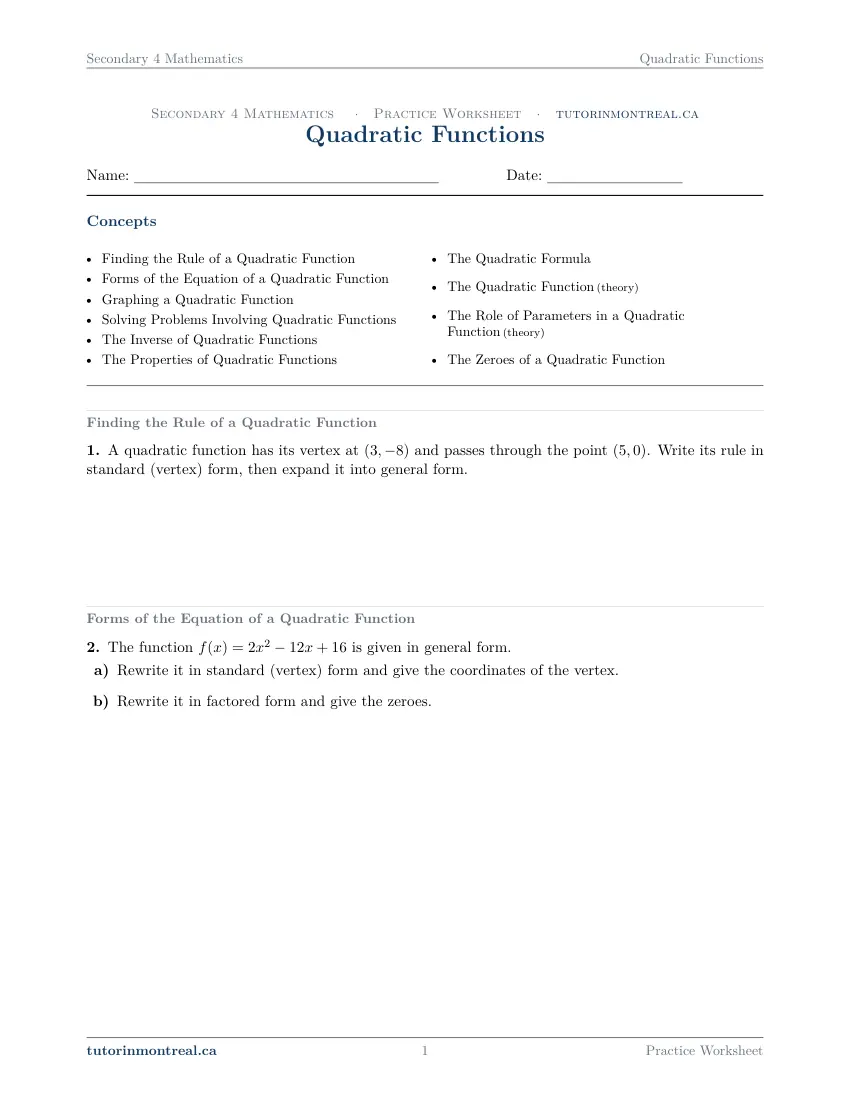
Practice worksheet — free PDF
No email, no account, no watermark. Teachers: photocopy it for your classes freely. Worked solutions and 9 harder problems come with the Secondary 4 Math bundle.
All 11 questions
Each question targets one named concept from the sheet. Read them here, or print the PDF — it has working space under each one.
-
Q1Finding the Rule of a Quadratic Function
A quadratic function has its vertex at and passes through the point . Write its rule in standard (vertex) form, then expand it into general form.
-
Q2Forms of the Equation of a Quadratic Function
The function is given in general form.
- Rewrite it in standard (vertex) form and give the coordinates of the vertex.
- Rewrite it in factored form and give the zeroes.
-
Q3Graphing a Quadratic Function
Sketch on the grid. State the vertex, the direction of opening, the zeroes and the -intercept.
A blank Cartesian grid for this question is on the printable PDF.
-
Q4Solving Problems Involving Quadratic Functions
A diver leaves a platform and her height above the water, in metres, seconds later is .
- What is the greatest height she reaches, and when?
- After how many seconds does she enter the water?
-
Q5The Inverse of Quadratic Functions
Let , with domain .
- Find the rule of the inverse relation .
- Explain why this relation is not a function.
- Restrict the domain of so that the inverse is a function, and give the rule and the domain of that inverse.
-
Q6The Properties of Quadratic Functions
Consider .
- Give the coordinates of the vertex and state whether has a maximum or a minimum.
- State the domain and the range of .
- Over which interval is increasing?
- Find the zeroes and the -intercept of .
-
Q7The Quadratic Formula
Solve using the quadratic formula. Show the value of the discriminant.
-
Q8The Quadratic Function
Only some of the rules below define quadratic (second-degree polynomial) functions. Identify them and justify each decision by simplifying the rule.
-
Q9The Role of Parameters in a Quadratic Function
For a quadratic function written , state a rule that gives the number of zeroes using only the signs of and , and justify it algebraically. Then apply your rule to without computing any zero.
-
Q10The Zeroes of a Quadratic Function
Find the zeroes of by factoring.
-
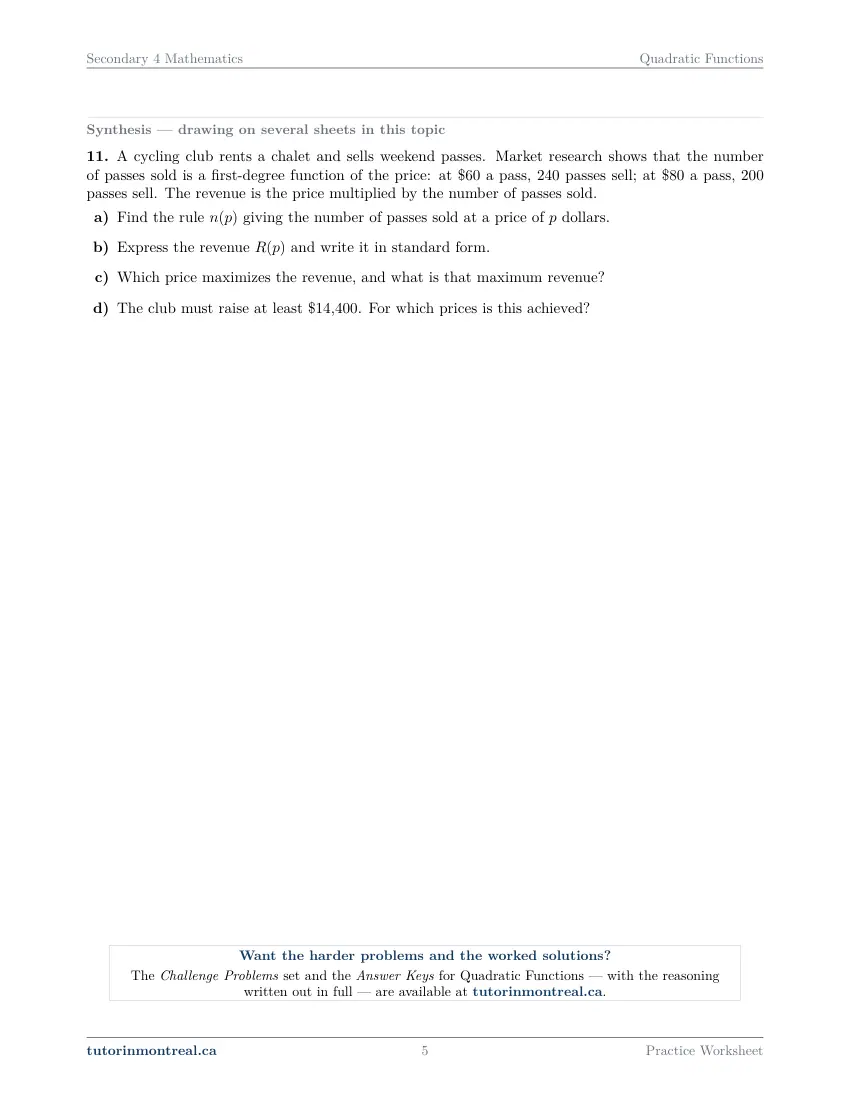
Q11Synthesis — drawing on several sheets in this topic
A cycling club rents a chalet and sells weekend passes. Market research shows that the number of passes sold is a first-degree function of the price: at $60 a pass, passes sell; at $80 a pass, passes sell. The revenue is the price multiplied by the number of passes sold.
- Find the rule giving the number of passes sold at a price of dollars.
- Express the revenue and write it in standard form.
- Which price maximizes the revenue, and what is that maximum revenue?
- The club must raise at least $14{,}400. For which prices is this achieved?
The 9 challenge problems for this topic are a separate, paid sheet and are not reproduced here.
Which stream is this for? This sheet is built for SN. It assumes you are completing the square with a leading coefficient, using the discriminant, solving quadratic inequalities from a context and handling the inverse of a restricted parabola, and it goes to the depth that program expects.
How to do every concept on this sheet
This is the part worksheet sites usually leave out. Below is the actual reasoning behind each group of questions — not a full solution set, the decisions that get you to one. Read it before you start, or after you get stuck.
Three forms of the same parabola, and what each one hands you
Almost everything on this sheet is a decision about which form to write the rule in. The three forms describe the same curve; they differ only in what you can read off them without doing any work. Choosing badly turns a two-line question into a page.
Which form do I need?
Decide from what the question asks for, not from what you were handed.
- 1Vertex, maximum, minimum, range, axis of symmetry → standard form
f(x) = a(x − h)² + k. The vertex is (h, k), read directly. Q3 and Q6 are already in this form, which is why they ask for so many properties at once — each one is a single reading. - 2Zeroes, or where the function is positive or negative → factored form
f(x) = a(x − x₁)(x − x₂). The zeroes sit in the brackets. Q10 asks for zeroes and the fastest route is to factor rather than to reach for the formula. - 3y-intercept, degree, the quadratic formula → general form
f(x) = ax² + bx + c. Here c is the y-intercept and the coefficients feed straight into the discriminant. Q7 and Q8 both live in this form. - 4General → standard: complete the square
Q2(a) and the second part of Q11. This is the conversion that goes wrong most often, and the next section is entirely about why.
- 5General → factored: find the zeroes first
Factor if you can see it, otherwise use the formula and rebuild as
a(x − x₁)(x − x₂). Q2(b) is this, and note it keeps the same a as the general form. - 6Standard or factored → general: expand
The easy direction, and the one Q1 finishes with. Expand the square first, then multiply by a — never distribute a into the bracket before squaring it.
One thing the tree does not say: not every quadratic has a factored form over the reals. If the parabola never meets the x-axis there are no zeroes to put in brackets. The general and standard forms always exist; the factored form is the conditional one.
Completing the square when a ≠ 1
With a = 1 the move is mechanical: halve the coefficient of x, square it, add and subtract it. Q2(a) has a leading coefficient in front, and that changes the order of operations completely.
The mistake: halving the coefficient of x while a is still attached to it. Factor a out of the first two terms only, complete the square inside the bracket, and then multiply what you subtracted back out by a as it leaves:
3x² + 12x + 5 = 3(x² + 4x) + 5 = 3[(x + 2)² − 4] + 5 = 3(x + 2)² − 12 + 5 = 3(x + 2)² − 7The −4 inside the bracket becomes −12 outside it. Forgetting to multiply it by a leaves the vertex at the right h and the wrong k, and every later answer — range, extremum, sign — inherits the error.
Check by expanding your standard form back to general. It costs one line and it is the only verification that catches this.
Reading a parabola: vertex, opening, range, variation
Q3 and Q6 are the same reading, one with a sketch and one without. From f(x) = a(x − h)² + k:
- Vertex (h, k) — and watch the sign, because (x + 1)² means h = −1. The bracket must read (x − h) before you read h out of it.
- Opening from the sign of a: upward when a > 0, downward when a < 0. That single sign then decides the next two lines.
- Range: [k, +∞[ if it opens upward, ]−∞, k] if it opens downward. The domain of a quadratic function is always ℝ unless a context restricts it.
- Variation: the split is always at x = h. A downward parabola climbs to its vertex and then falls, so it is increasing on ]−∞, h] — which feels backwards to students who memorised the upward case.
- Zeroes: from standard form, isolate the square and take the square root of both sides, remembering both signs. (x − h)² = m gives x = h ± √m. The quadratic formula is unnecessary here.
- y-intercept: substitute x = 0. One arithmetic line, and it is the point students forget to plot.
Range is not domain. The range is the set of y-values the function reaches; the interval you write is on the vertical axis. Every quadratic in Q3 and Q6 has domain ℝ, so if you have written the same interval twice, one of them is wrong.
Building the rule from what you are told
Q1 gives you a vertex and one other point. That combination is a signal: write a(x − h)² + k straight away with h and k filled in, substitute the other point, and solve for the one unknown left. Two points and no vertex would not be enough — a parabola needs three pieces of information, and a vertex is worth two of them.
The same logic runs the other way. If you are given two zeroes and one more point, start from a(x − x₁)(x − x₂). If you are given three scattered points, you are back to general form and a system of three equations. Pick the form that makes the information you have free.
Zeroes: how many, before you find them
Q7 asks for the discriminant explicitly, and Q9 asks you to count zeroes without computing any. They are two views of the same fact.
Δ = b² − 4ac · Δ > 0 → two zeroes · Δ = 0 → one · Δ < 0 → noneFrom standard form you do not need Δ at all. Solving a(x − h)² + k = 0 gives (x − h)² = −k⁄a, and a square is never negative. So: a and k of opposite signs gives two zeroes, k = 0 gives exactly one (the vertex sits on the axis), and a and k of the same sign gives none — the whole parabola is stranded on one side of the axis. Q9 asks you to state and justify that rule, so the argument above, not the conclusion, is what earns the marks.
Two sign traps in Δ = b² − 4ac. First, b² is positive even when b is negative: (−7)² = 49, not −49. Second, c carries its own sign into the subtraction, so a negative c makes −4ac a positive contribution. Both slips turn a two-zero quadratic into a no-zero one, and the answer then contradicts a sketch you could have drawn in five seconds.
The inverse of a parabola, and why it needs a restriction
Q5 is the conceptual question on this sheet. Swap x and y in y = a(x − h)² + k and isolate:
x = a(y − h)² + k → (y − h)² = (x − k)⁄a → y = h ± √((x − k)⁄a)That ± is the entire answer to part (b). It says one value of x is paired with two values of y, which a function is not allowed to do. The reason sits in the original parabola: it is symmetric about its axis, so two different inputs share every output except the vertex — it fails the horizontal line test.
Part (c) fixes it. Cut the parabola at its vertex and keep one branch: ]−∞, h] or [h, +∞[. On one branch the function is strictly monotonic, so it is injective, so the inverse is a function — and it keeps only one sign of the radical: the + branch for the increasing side, the − branch for the decreasing side. Then state the domain of the inverse, which is the range of the restricted f, and is where the marks usually go missing.
Is it even quadratic? (Q8)
Four rules, and only some of them are second-degree. The rule of the game is that degree can only be read from a simplified expression. Expand and collect first; the x² terms may cancel completely, and a rule that looks quadratic then turns out to be first-degree. A rule with the variable in a denominator or under a radical is not a polynomial at all, and the justification the question wants is the simplification, written out — not the verdict.
Contexts: Q4 and the synthesis question
Q4 gives a height in general form. The vertex is at t = −b⁄(2a), and substituting that back gives the maximum height; "when does she enter the water" is a zero. Two habits earn the marks here: answer with units, and say why you rejected a root. A negative time is not merely wrong, it is outside the domain of the model, and one clause saying so is what the marker is looking for.
The last question builds a quadratic from scratch. The number of items sold is a first-degree function of the price, revenue is price × quantity, and multiplying those two first-degree expressions is what produces the parabola. Once it is in standard form the maximising price is the h and the maximum revenue is the k. The final part is a quadratic inequality: because the parabola opens downward, "revenue at least this much" is satisfied between the two solutions, so the answer is a closed interval, not a single price. Sketching the parabola and marking the horizontal line at that revenue makes the direction obvious and takes ten seconds.
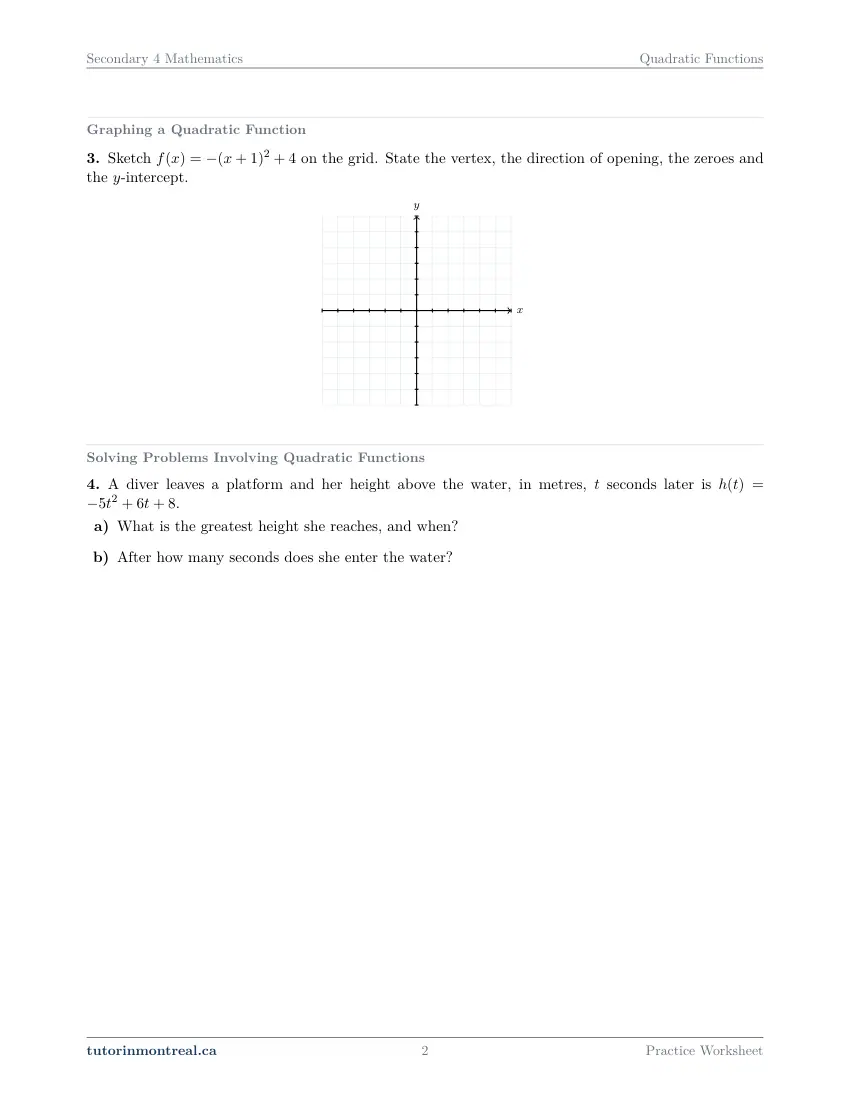
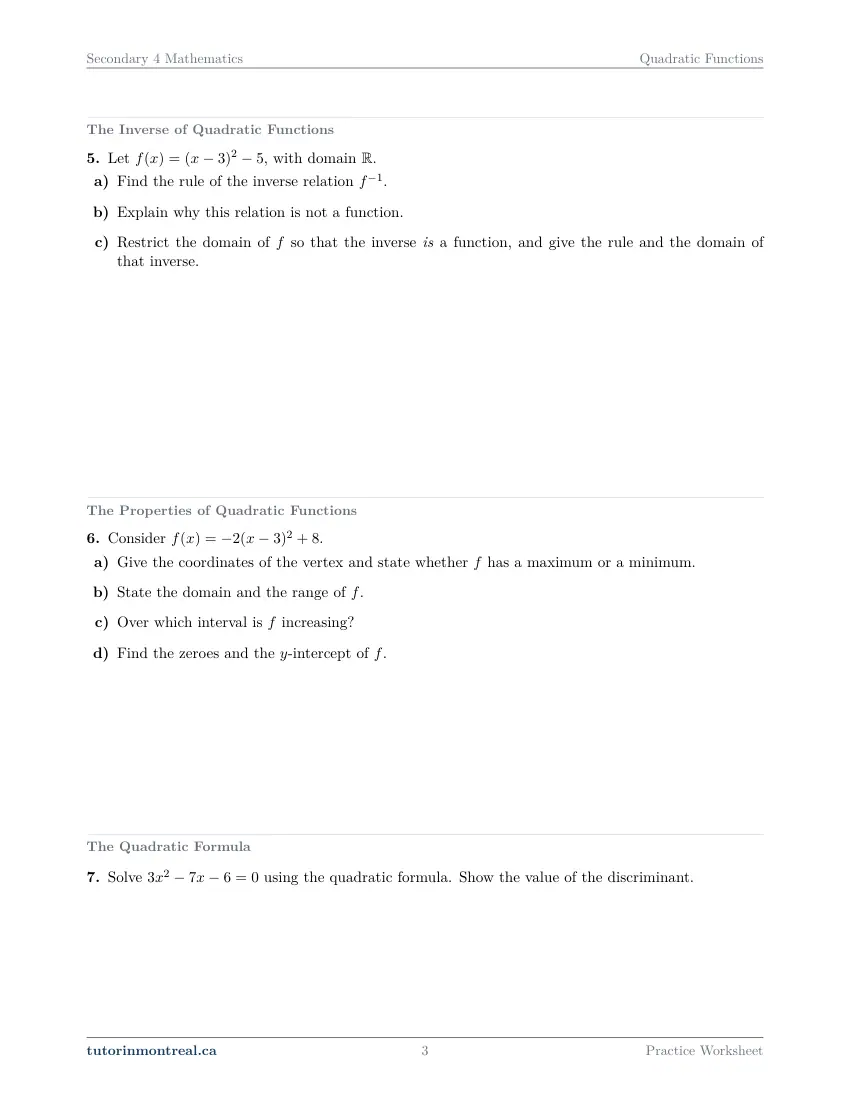
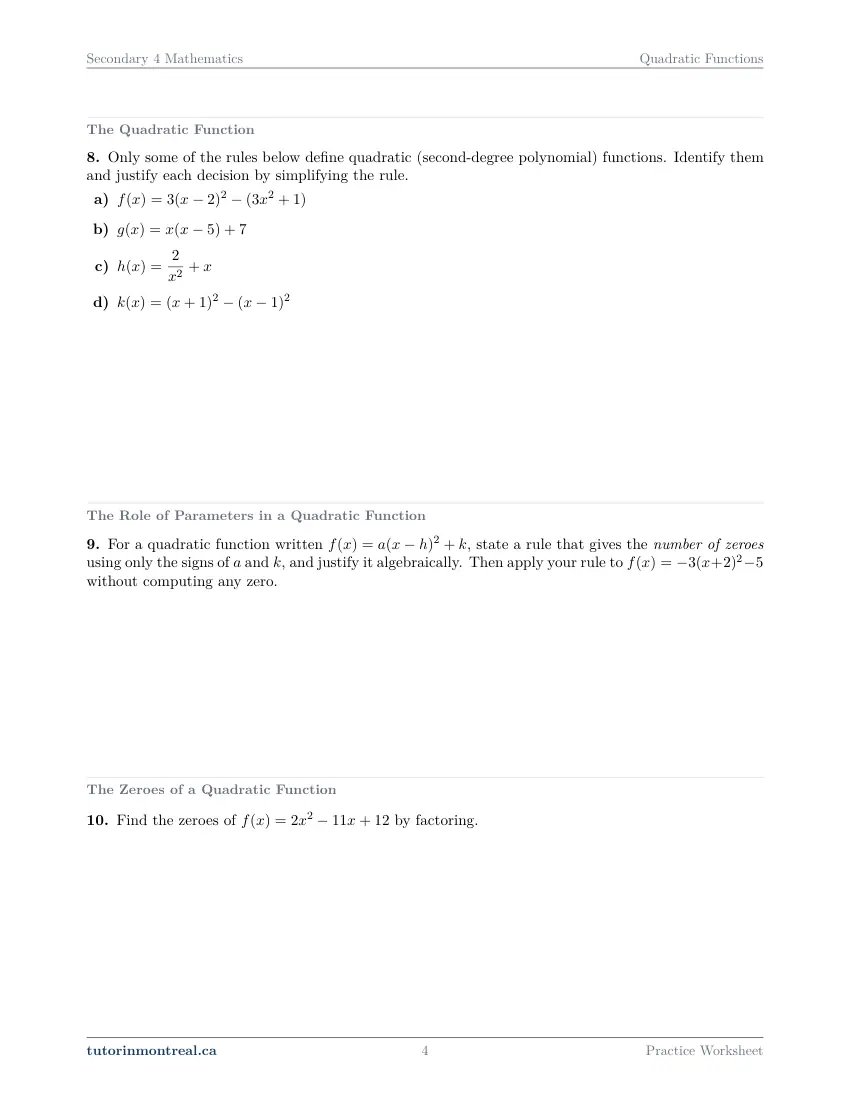
Preview all 5 pages
Click any page to open the full PDF.
Getting the most out of it
Rewrite every rule in all three forms
Take the rules in Q2, Q3, Q6 and Q10 and, whatever the question asked, write each one in general, standard and factored form. Four questions become twelve conversions, and the conversions are what the exam actually tests.
Sketch first, compute second
A rough parabola with the vertex marked and the opening right tells you the number of zeroes, the range and the sign before you touch the algebra. When the algebra disagrees with the sketch, one of them is wrong and you have caught it early instead of at the bottom of the page.
Justify the root you throw away
On the context questions, get into the habit of writing the sentence: "rejected because time cannot be negative", "rejected because a width must be positive". It is a mark on almost every modelling question and it is the one students leave on the table.
Want the solutions, or something more challenging?
The worksheet, the questions above and every explanation on this page stay free permanently. Three more PDFs exist for this topic — the worked answer key, a harder problem set, and the answer key to that. They come with the Secondary 4 Math Solutions Bundle, which is what keeps the rest of the series free.
What else exists for Quadratic Functions
Three PDFs · 9 pages · all three are in the bundle below.
- Answer key — 2 pages. All 11 questions worked step by step, including the restrictions and the justifications. Not a list of final answers.
- Challenge problems — 5 pages, 9 problems. A separate sheet at exam-plus difficulty covering the same 10 concepts. Harder than anything on the free sheet.
- Challenge answer key — 2 pages. Every challenge problem worked to the same standard, with the checks shown.
- PDF, letter size, print-ready.
The one thing that's for sale
Every Secondary 4 Math topic — the complete Solutions Bundle
One download, one payment, the whole program. Every answer key and every challenge set for all 17 Secondary 4 Math worksheet sets — including this one.
- Worked solutions, not answer lists — every step written out
- Covers the whole year's program at this level
- Less than the price of one hour of tutoring — for the entire year's solutions
Taking Secondary 1 Math as well? The Secondary 1 Math bundle covers all 15 of its sets — 45 PDFs, 182 pages — on the same terms.
Taking Secondary 2 Math as well? The Secondary 2 Math bundle covers all 14 of its sets — 42 PDFs, 181 pages — on the same terms.
Taking Secondary 3 Math as well? The Secondary 3 Math bundle covers all 11 of its sets — 33 PDFs, 154 pages — on the same terms.
Taking Secondary 5 Math as well? The Secondary 5 Math bundle covers all 21 of its sets — 63 PDFs, 228 pages — on the same terms.
Taking CEGEP Calculus I as well? The CEGEP Calculus I bundle covers all 8 of its sets — 24 PDFs, 82 pages — on the same terms.
Taking CEGEP Calculus II as well? The CEGEP Calculus II bundle covers all 8 of its sets — 24 PDFs, 90 pages — on the same terms.
Taking CEGEP Linear Algebra as well? The CEGEP Linear Algebra bundle covers all 7 of its sets — 21 PDFs, 82 pages — on the same terms.
Taking AP Calculus AB as well? The AP Calculus AB bundle covers all 8 of its sets — 24 PDFs, 126 pages — on the same terms.
Common questions
Is this worksheet really free?
Yes — the questions are on this page to read, and the PDF downloads directly, no email and no account. The one paid item is optional: the complete Secondary 4 Solutions Bundle, which covers every set at this level.
When should I use vertex form and when factored form?
Use standard (vertex) form when the question asks about the vertex, the maximum or minimum, the range, the axis of symmetry or the intervals of variation. Use factored form when it asks about the zeroes, or where the function is positive or negative. Use general form for the y-intercept and for anything that feeds the quadratic formula.
Why does completing the square go wrong when there is a number in front of x²?
Because that coefficient has to come out of the first two terms before you halve anything, and the constant you subtract inside the bracket then has to be multiplied by it on the way back out. Skipping that multiplication gives the correct h and a wrong k, which quietly corrupts the range, the extremum and the sign afterwards.
Can I tell how many zeroes a quadratic has without solving it?
Yes, two ways. From general form, the sign of the discriminant b² − 4ac decides it. From standard form you do not even need that: solving gives (x − h)² = −k⁄a, and since a square is never negative there are two zeroes when a and k have opposite signs, one when k = 0, and none when they share a sign.
Why isn't the inverse of a quadratic function a function?
Because a parabola is symmetric about its axis, so two different x-values share almost every y-value. Reversing the pairs therefore hands one input two outputs, which the definition of a function forbids — algebraically it shows up as the ± in front of the square root. Restricting the domain to one side of the vertex removes the symmetry and fixes it.
Which Secondary 4 stream is this for?
It is built for SN. The sheet assumes you are completing the square with a leading coefficient, using the discriminant, and handling the inverse of a restricted parabola, and it goes to the depth that program expects.
Can teachers use this in class?
Yes. Print and photocopy it for your own classes freely — I just ask that the tutorinmontreal.ca footer stays on the page.
I'm stuck on one question. Can you help?
Yes — through one-on-one tutoring, in Montreal or online. Get in touch to arrange a session, or see the current rates.
← All 17 Secondary 4 Math worksheets · Secondary 1 Math series (15 sheets) → · Secondary 2 Math series (14 sheets) → · Secondary 3 Math series (11 sheets) → · Secondary 5 Math series (21 sheets) → · CEGEP Calculus I series (8 sheets) → · CEGEP Calculus II series (8 sheets) → · CEGEP Linear Algebra series (7 sheets) → · AP Calculus AB series (8 sheets) →
The same topic at the other level: Secondary 5 Math · Quadratic Functions.