Secondary 4 Square Root Functions Worksheet
A square root function is half a parabola, and the parameters decide which half. You find the rule from an endpoint and one further point, sketch the branch from exact coordinates, read the domain and the range straight off a and b, locate the zero, build the inverse, and run a radical model in both directions. You can read along here; the PDF is free if you would rather work on paper.
Practice worksheet — free PDF
No email, no account, no watermark. Teachers: photocopy it for your classes freely. Worked solutions and 6 harder problems come with the Secondary 4 Math bundle.
All 6 questions
Each question targets one named concept from the sheet. Read them here, or print the PDF — it has working space under each one.
-
Q1Finding the Rule of a Square Root Function
A square root function has its endpoint at and passes through . Find its rule in the form , then state its domain and range.
-
Q2Graphing a Square Root Function
Sketch on the grid, using at least three exact points. State the domain, the range and the zero of the function.
A blank Cartesian grid for this question is on the printable PDF.
-
Q3Solving Problems Involving the Square Root Function
On wet asphalt, investigators estimate a car's speed just before braking, in km/h, from the length of its skid marks in metres by .
- Estimate the speed of a car that left m of skid marks.
- A driver claims to have been travelling at km/h. How long would the skid marks be?
-
Q4The Inverse of the Square Root Function
Let . Find the rule of , together with its domain and its range.
-
Q5The Properties of the Square Root Function
Consider .
- State the domain and the range.
- Is increasing or decreasing? Justify with the sign of .
- Find the zero of , and explain why has no -intercept.
-
Q6The Square Root Function
At a water park, the speed of a rider at the bottom of a straight slide is modelled by , where is the vertical drop in metres and is in m/s.
- Find the speed produced by a drop of ~m.
- What drop is needed to reach ~m/s?
The 6 challenge problems for this topic are a separate, paid sheet and are not reproduced here.
Which stream is this for? This sheet is built for SN. It assumes you work with the full form a√(b(x − h)) + k, state domains and ranges in interval notation, and construct inverses, and it goes to the depth that program expects.
How to do every concept on this sheet
This is the part worksheet sites usually leave out. Below is the actual reasoning behind each group of questions — not a full solution set, the decisions that get you to one. Read it before you start, or after you get stuck.
Four parameters, and each one controls exactly one thing
Every question on this sheet is the same rule in a different costume:
f(x) = a√(b(x − h)) + kStudents lose marks here not because the algebra is hard but because they treat the four letters as a blur. They are not a blur. Each parameter answers one question and no other, and once you can name which is which, most of this unit becomes reading rather than computing.
Reading a square root function from its rule
Four passes, in this order. Q1, Q2, Q4 and Q5 all begin with the same first pass.
- 1Locate the endpoint (h, k)
The branch starts there and never goes past it. Careful with the sign:
hsits behind a minus inside the radical, so√(x − 1)meansh = 1while√(x + 3)meansh = −3. Q4's2√(x + 3) − 1has its endpoint at (−3, −1), not (3, −1). - 2The sign of b gives the domain
A real square root needs a radicand that is not negative, so
b(x − h) ≥ 0. Ifb > 0the branch runs to the right: domain[h, +∞[. Ifb < 0it runs to the left: domain]−∞, h]. Nothing else in the rule can move the domain. - 3The sign of a gives the range
A square root is never negative, so
a√(…)is either always ≥ 0 or always ≤ 0, depending only ona. Addkand the range is[k, +∞[whena > 0and]−∞, k]whena < 0. Q5's−2√(x − 1) + 6is capped at 6 for exactly this reason. - 4One extra point gives a
The endpoint and the two signs can all be read from a picture or a description. The size of
acannot — it is the one number that needs a second point substituted into the rule. That is what Q1 is testing.
The mistake: letting the two signs cross over. b decides which side of the endpoint the curve lives on — the domain. a decides whether it climbs above the endpoint or falls below it — the range. Neither one touches the other's job, and a function with a and b both negative is not "doubly reversed": it opens left and goes down, one effect from each parameter.
Finding the rule from an endpoint and a point (Q1)
The endpoint hands you h and k at no cost, so write the rule down with those two filled in before you do anything else. Then substitute the second point and solve the resulting first-degree equation for a. With an endpoint at (−1, 4) and the curve through (8, 10):
f(x) = a√(x + 1) + 4 → a√9 + 4 = 10 → 3a = 6 → a = 2Notice that the horizontal gap from the endpoint to the second point was 9 — a perfect square. That is not luck; exam questions choose it so the radical evaluates exactly. If yours does not, keep the radical in surd form rather than reaching for a decimal, because the final rule is supposed to be exact.
Graphing: pick your x-values, do not march through them (Q2)
The reflex from linear and quadratic work — build a table with x = 1, 2, 3, 4 — is the worst possible habit here, because it produces a column of irrational values you then round and plot badly. Choose x so the radicand lands on 0, 1, 4, 9, 16 instead.
Why this works. For f(x) = 2√(x − 1) − 3 the radicand is x − 1, so take x = 1, 2, 5, 10 and the radicand becomes 0, 1, 4, 9. Every point that comes out is exact and lands on a grid intersection, which is precisely what "at least three exact points" is asking for. Three well-chosen points also pin the curvature: the branch is steepest right at the endpoint and flattens as it goes, and a sketch that misses that reads as a straight line to a marker.
Zeros, and the y-intercept that is often missing (Q2, Q5)
A zero is where the curve crosses the x-axis, so set the rule to 0, isolate the radical, and square. Isolating first is not optional — squaring a sum such as (2√(x − 1) − 3) term by term is the single most common wrong line in this unit.
Then check that the value you get actually lies in the domain. Squaring is a one-way step: it can invent a solution to the equation with the opposite sign, and the only filter is the domain and the original equation. Q5 adds the counterpart question — the y-intercept. There is none, and the reason is a single sentence: the intercept would be f(0), but 0 is not in the domain [1, +∞[, so the curve never reaches the y-axis at all. A square root function has at most one zero and sometimes no y-intercept — which is why "find the intercepts" is a question worth reading twice.
Increasing or decreasing, justified rather than eyeballed (Q5)
Q5 asks you to justify with the sign of a, and a sketch is not a justification. The argument is short: as x increases, √(x − 1) increases; multiplying an increasing quantity by a negative number reverses the direction, so with a = −2 the function decreases across its whole domain. Note "across its whole domain" — a square root branch never turns around, so it is increasing everywhere or decreasing everywhere, never both.
The inverse is half a parabola (Q4)
Swap the roles of x and y, then solve for y: isolate the radical, square both sides, and clear. What comes out is a second-degree rule, which is why this question catches people — a parabola is not a function of the kind you started with.
The restriction is the answer. The domain of the inverse is the range of the original, and its range is the original's domain. Skipping that swap leaves you with a whole parabola, and a whole parabola pairs two different inputs with the same output — it is not the inverse of anything one-to-one.
There is also an algebraic trace of it. When you isolate the radical you get an expression that a square root equals, and a square root is never negative, so that expression must be ≥ 0. That inequality is the domain of the inverse; you do not have to remember the swap rule if you notice it while working.
Radical models, read in both directions (Q3, Q6)
Both context questions use the simplest form, v = a√x with the endpoint at the origin, and both ask you to run it forwards in one part and backwards in the other. Forwards is substitution. Backwards is: isolate the radical, then square — and then check, because the context supplies its own restriction (a skid length and a drop height are never negative).
Worth noticing, because exams like to ask it in words: this model is not proportional. Doubling the speed does not double the distance — it quadruples it, since the distance sits under the root. That single fact is why braking distance grows so alarmingly with speed, and it is the kind of interpretation sentence that earns a mark on its own.
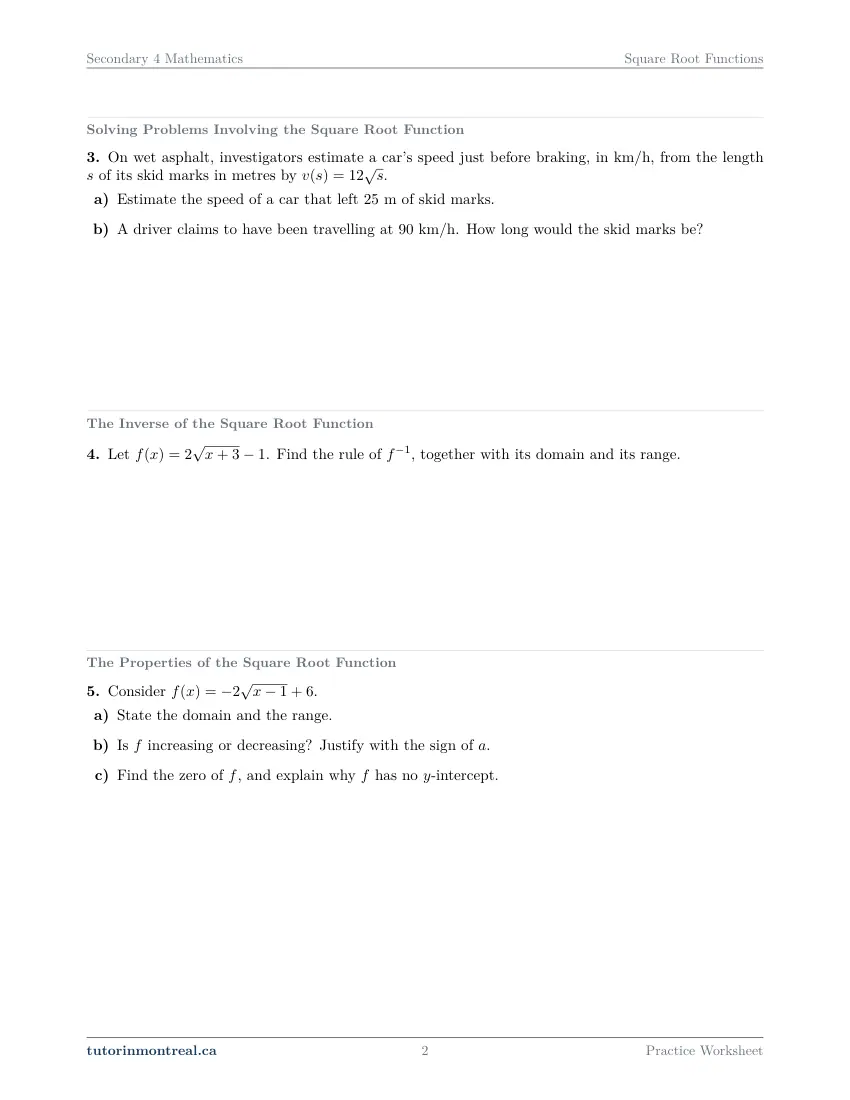
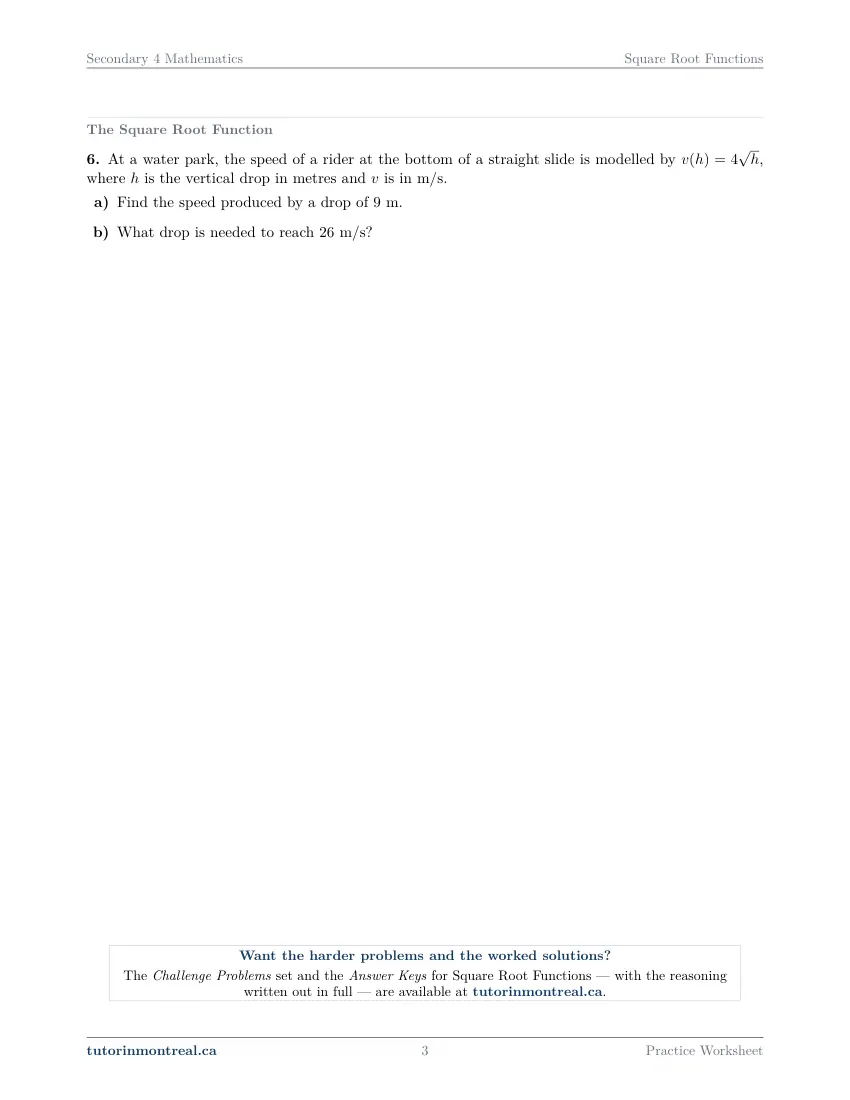
Preview all 3 pages
Click any page to open the full PDF.
Getting the most out of it
Name the four parameters before you touch the algebra
On every question that hands you a rule, write "h = , k = , a is , b is" in the margin first. It takes fifteen seconds and it turns the domain-and-range parts into recall instead of derivation.
Redo the sketch with the rule covered
A week after your first pass, look only at your graph from the graphing question and try to reconstruct the rule from it. Reading a curve backwards to its parameters is exactly what the rule-finding and property questions ask, and it is the skill that transfers to the exam.
Finish every squaring step with a domain check
Zeros, inverses and the context questions all involve squaring at some point. Build the habit of writing the domain down before you square and glancing back at it after, so rejecting an impossible value becomes automatic rather than something you remember on a good day.
Want the solutions, or something more challenging?
The worksheet, the questions above and every explanation on this page stay free permanently. Three more PDFs exist for this topic — the worked answer key, a harder problem set, and the answer key to that. They come with the Secondary 4 Math Solutions Bundle, which is what keeps the rest of the series free.
What else exists for Square Root Functions
Three PDFs · 7 pages · all three are in the bundle below.
- Answer key — 1 page. All 6 questions worked step by step, including the restrictions and the justifications. Not a list of final answers.
- Challenge problems — 4 pages, 6 problems. A separate sheet at exam-plus difficulty covering the same 6 concepts. Harder than anything on the free sheet.
- Challenge answer key — 2 pages. Every challenge problem worked to the same standard, with the checks shown.
- PDF, letter size, print-ready.
The one thing that's for sale
Every Secondary 4 Math topic — the complete Solutions Bundle
One download, one payment, the whole program. Every answer key and every challenge set for all 17 Secondary 4 Math worksheet sets — including this one.
- Worked solutions, not answer lists — every step written out
- Covers the whole year's program at this level
- Less than the price of one hour of tutoring — for the entire year's solutions
Taking Secondary 1 Math as well? The Secondary 1 Math bundle covers all 15 of its sets — 45 PDFs, 182 pages — on the same terms.
Taking Secondary 2 Math as well? The Secondary 2 Math bundle covers all 14 of its sets — 42 PDFs, 181 pages — on the same terms.
Taking Secondary 3 Math as well? The Secondary 3 Math bundle covers all 11 of its sets — 33 PDFs, 154 pages — on the same terms.
Taking Secondary 5 Math as well? The Secondary 5 Math bundle covers all 21 of its sets — 63 PDFs, 228 pages — on the same terms.
Taking CEGEP Calculus I as well? The CEGEP Calculus I bundle covers all 8 of its sets — 24 PDFs, 82 pages — on the same terms.
Taking CEGEP Calculus II as well? The CEGEP Calculus II bundle covers all 8 of its sets — 24 PDFs, 90 pages — on the same terms.
Taking CEGEP Linear Algebra as well? The CEGEP Linear Algebra bundle covers all 7 of its sets — 21 PDFs, 82 pages — on the same terms.
Taking AP Calculus AB as well? The AP Calculus AB bundle covers all 8 of its sets — 24 PDFs, 126 pages — on the same terms.
Common questions
Is this worksheet really free?
Yes — the questions are on this page to read, and the PDF downloads directly, no email and no account. The one paid item is optional: the complete Secondary 4 Solutions Bundle, which covers every set at this level.
How do I find the rule when I am only given the endpoint and one other point?
The endpoint gives you h and k immediately, so write the rule with those two filled in. Then substitute the coordinates of the second point, which leaves a first-degree equation in a, and solve it. The parameter a is the only one a second point is needed for.
Why does the graph stop instead of continuing in both directions?
Because a real square root needs a radicand that is not negative. The condition b(x − h) ≥ 0 cuts the x-axis at h and keeps only one side of it, so the curve has an endpoint rather than running off both ways like a line or a parabola.
How do I know whether the branch opens left or right, and whether it rises or falls?
The sign of b inside the radical decides left or right, because it decides which x values keep the radicand non-negative. The sign of a decides rising or falling, because the radical itself is never negative, so a alone controls whether the output sits above or below k.
Why is the inverse of a square root function only half a parabola?
Solving for y after the swap requires squaring, and squaring introduces the branch that the original function never produced. The domain of the inverse must equal the range of the original, and imposing that restriction cuts the parabola in half. Keeping the whole curve would pair two inputs with the same output.
Which Secondary 4 stream is this for?
It is built for SN. The sheet works with the full form a√(b(x − h)) + k, asks for domains and ranges in interval notation, and includes the inverse, which is the depth that program expects.
Can teachers use this in class?
Yes. Print and photocopy it for your own classes freely — I just ask that the tutorinmontreal.ca footer stays on the page.
I'm stuck on one question. Can you help?
Yes — through one-on-one tutoring, in Montreal or online. Get in touch to arrange a session, or see the current rates.
← All 17 Secondary 4 Math worksheets · Secondary 1 Math series (15 sheets) → · Secondary 2 Math series (14 sheets) → · Secondary 3 Math series (11 sheets) → · Secondary 5 Math series (21 sheets) → · CEGEP Calculus I series (8 sheets) → · CEGEP Calculus II series (8 sheets) → · CEGEP Linear Algebra series (7 sheets) → · AP Calculus AB series (8 sheets) →
The same topic at the other level: Secondary 5 Math · Square Root Functions.