Secondary 4 Linear Algebra Worksheet
A line and a parabola can meet twice, once or not at all, and the point of this sheet is knowing which before you finish solving. Classify the system and predict the number of solution points, solve by comparison, recognise a tangency from a double root, and read off the stretch over which one curve runs above the other — the discriminant does most of the work once you see why. Read the questions here, print the free PDF, keep your email to yourself.
Practice worksheet — free PDF
No email, no account, no watermark. Teachers: photocopy it for your classes freely. Worked solutions and 2 harder problems come with the Secondary 4 Math bundle.
All 5 questions
Each question targets one named concept from the sheet. Read them here, or print the PDF — it has working space under each one.
-
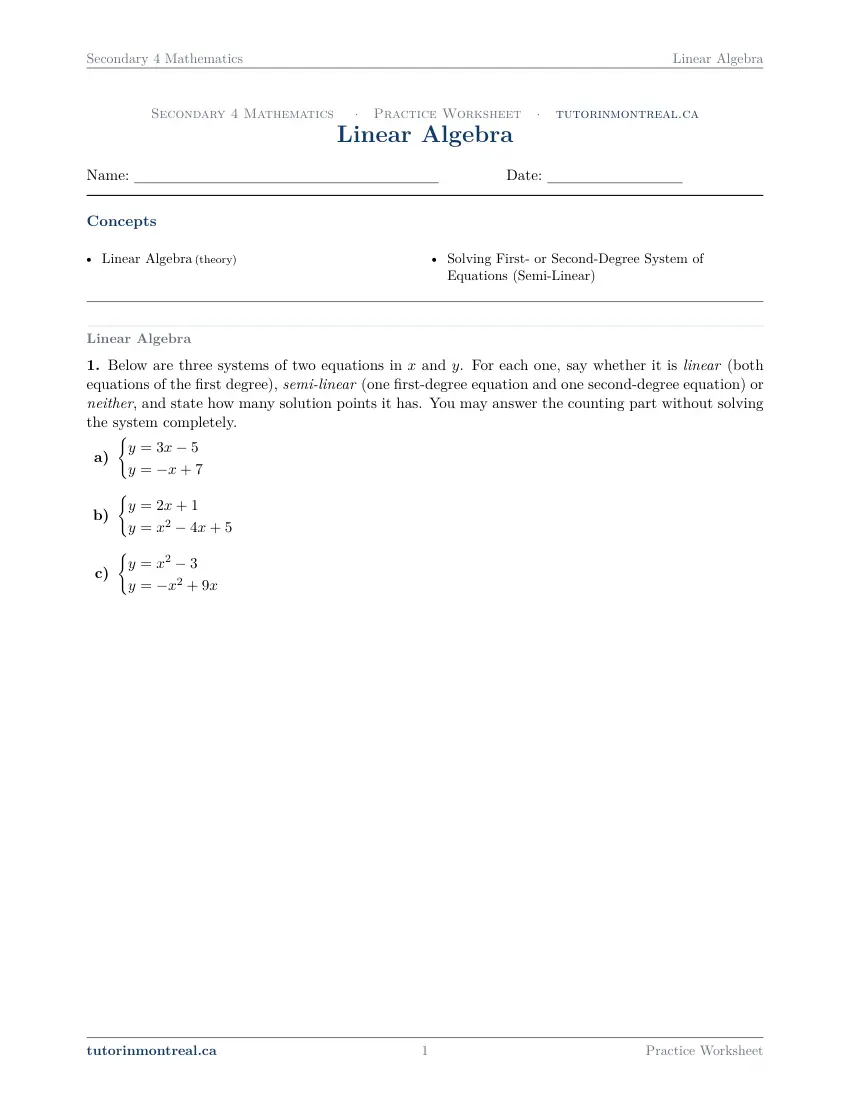
Q1Linear Algebra
Below are three systems of two equations in and . For each one, say whether it is linear (both equations of the first degree), semi-linear (one first-degree equation and one second-degree equation) or neither, and state how many solution points it has. You may answer the counting part without solving the system completely.
-
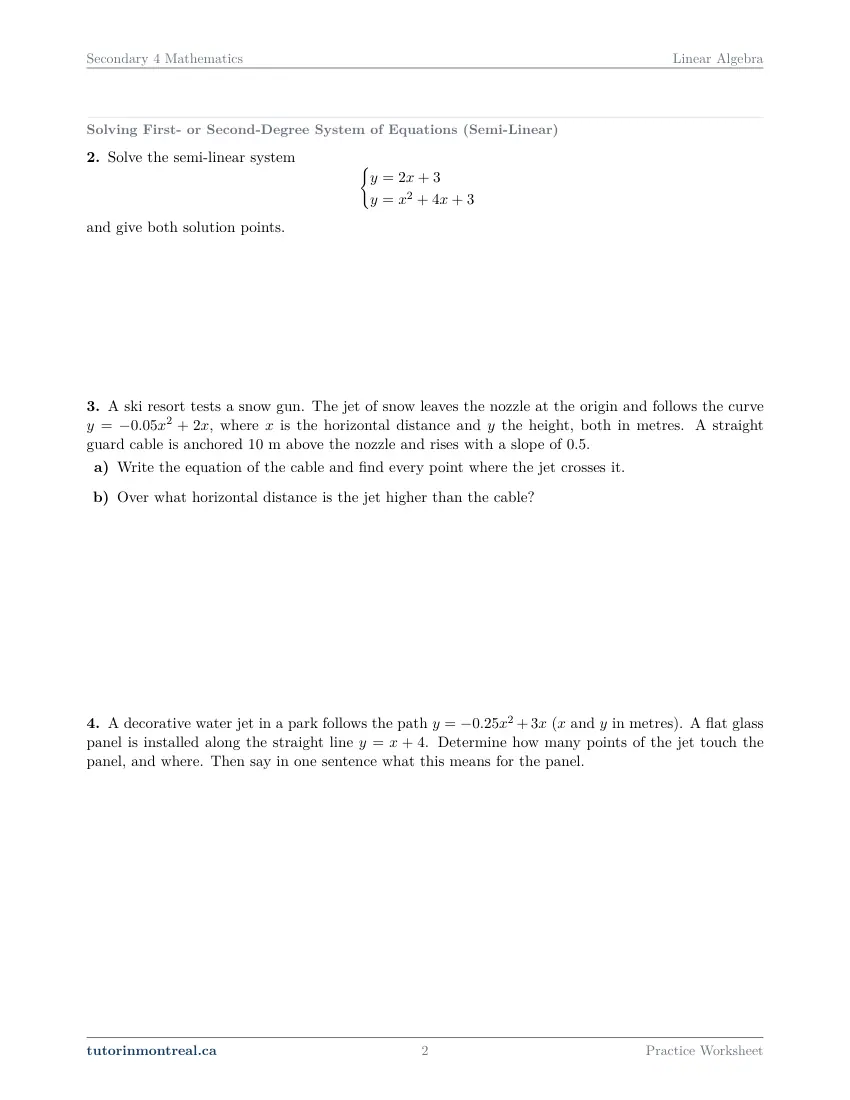
Q2Solving First- or Second-Degree System of Equations (Semi-Linear)
Solve the semi-linear system and give both solution points.
-
Q3Solving First- or Second-Degree System of Equations (Semi-Linear)
A ski resort tests a snow gun. The jet of snow leaves the nozzle at the origin and follows the curve , where is the horizontal distance and the height, both in metres. A straight guard cable is anchored m above the nozzle and rises with a slope of .
- Write the equation of the cable and find every point where the jet crosses it.
- Over what horizontal distance is the jet higher than the cable?
-
Q4Solving First- or Second-Degree System of Equations (Semi-Linear)
A decorative water jet in a park follows the path ( and in metres). A flat glass panel is installed along the straight line . Determine how many points of the jet touch the panel, and where. Then say in one sentence what this means for the panel.
-
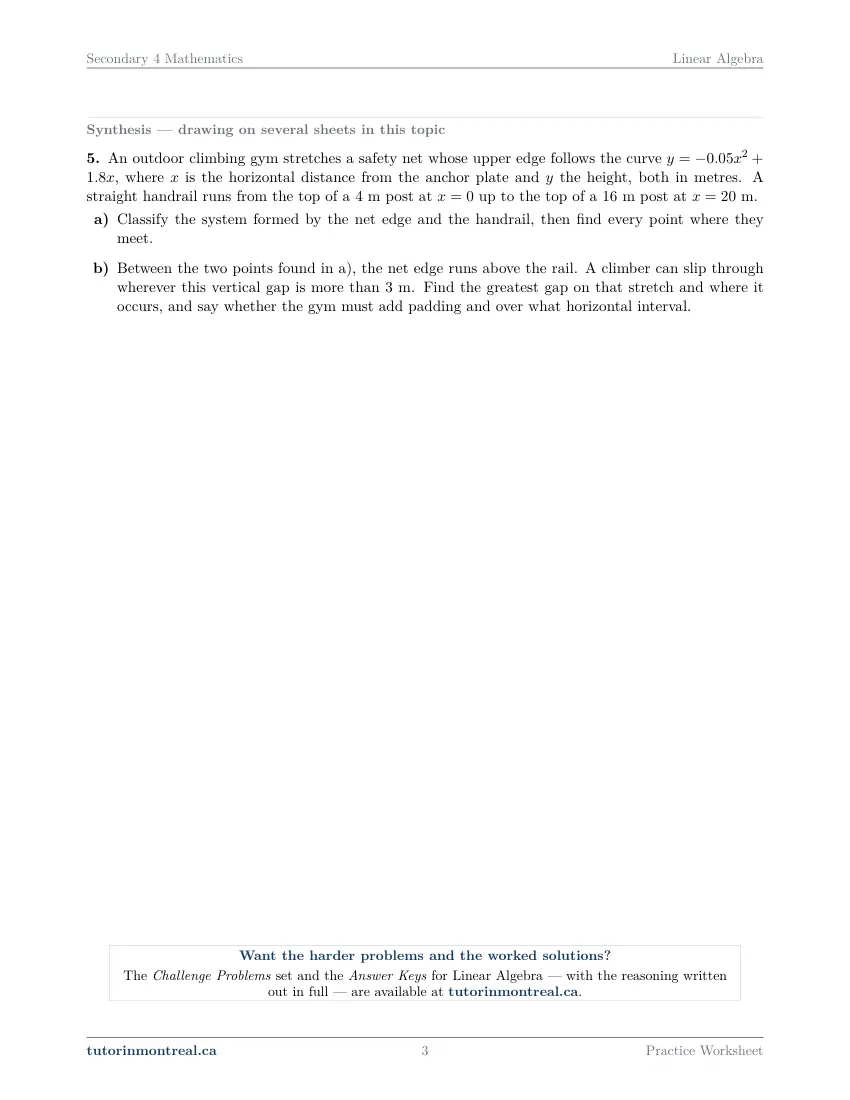
Q5Synthesis — drawing on several sheets in this topic
An outdoor climbing gym stretches a safety net whose upper edge follows the curve , where is the horizontal distance from the anchor plate and the height, both in metres. A straight handrail runs from the top of a m post at up to the top of a m post at m.
- Classify the system formed by the net edge and the handrail, then find every point where they meet.
- Between the two points found in a), the net edge runs above the rail. A climber can slip through wherever this vertical gap is more than m. Find the greatest gap on that stretch and where it occurs, and say whether the gym must add padding and over what horizontal interval.
The 2 challenge problems for this topic are a separate, paid sheet and are not reproduced here.
Which stream is this for? This sheet is built for SN. It expects you to solve second-degree equations, use the discriminant to count solutions before finding them, and interpret the result on a real situation, and it goes to the depth that program expects.
How to do every concept on this sheet
This is the part worksheet sites usually leave out. Below is the actual reasoning behind each group of questions — not a full solution set, the decisions that get you to one. Read it before you start, or after you get stuck.
Comparison: one method, used on every question here
Both equations on this sheet arrive already solved for y, and that is not a coincidence — it is what makes comparison the natural method. If y equals two things at once, those two things are equal to each other:
y = 2x + 3 and y = x² + 4x + 3 → x² + 4x + 3 = 2x + 3Move everything to one side, solve the second-degree equation that results, then substitute each root back to get its y. Two small habits pay off immediately. Substitute back into the line, because the arithmetic is trivial there — and then check in the parabola, which is a genuine verification rather than a repeat of the same computation. And when the coefficients are decimals, multiply the whole equation through by 20 or 4 or 100 first, because a factorable quadratic in decimals rarely looks factorable:
−0.05x² + 2x = 0.5x + 10 → (× 20) → −x² + 40x = 10x + 200 → x² − 30x + 200 = 0Same equation, and the second version factors on sight. Multiply every term, including the ones that were already whole numbers.
Classifying a system, and counting before solving (Q1)
Q1 asks for two things about each system: its name, and its number of solution points — and it explicitly allows you to answer the counting part without solving. That permission is the lesson.
Linear means both equations are of the first degree. Semi-linear means one first-degree and one second-degree equation — a line and a parabola. Anything else, such as two parabolas, is neither, and the label matters because it tells you what kind of equation comparison will leave behind.
How many solution points?
Compare, collect on one side, then look at what you are holding.
- 1If what is left is first degree
Two lines. Different slopes give exactly one intersection; equal slopes with different intercepts give none; identical equations describe the same line, and every point on it is a solution.
- 2If what is left is second degree, compute Δ = b² − 4ac
You do not need the roots to count them. This is the whole point of Q1(b) and Q1(c) — a discriminant is faster than a solution and answers exactly the question asked.
- 3Δ > 0 → two solution points
The line cuts the parabola twice. Q2, Q3 and Q5 are all this case.
- 4Δ = 0 → one solution point, a double root
The line touches the curve without crossing it: it is tangent. The quadratic turns out to be a perfect square trinomial, which is the algebraic fingerprint of tangency. Q4.
- 5Δ < 0 → no solution point
The line misses the parabola entirely, passing wholly above or wholly below it. No real roots means no crossings, not "an error somewhere".
The mistake this topic is built around: "a second-degree equation always has two roots, so a line and a parabola always meet twice." Degree gives an upper bound on the number of real roots, never a guarantee. Sketch a parabola and hold a ruler against it: you can cross it twice, graze it once, or miss it completely, and all three are ordinary. What the degree does tell you is that three or more intersection points are impossible — which is a genuine and useful conclusion, and one Q1 hints at directly.
Building the line before you can solve anything (Q3, Q5)
In the context questions the parabola is handed to you and the line is not; you have to construct it from a sentence. Two situations, both routine once you notice which one you are in.
A point and a slope. "Anchored 10 m above the nozzle" — and the nozzle is at the origin — gives the point (0, 10), which is the y-intercept, so with a stated slope the rule is immediate. Two points. The tops of two posts of known heights at known horizontal positions are two coordinate pairs; compute the slope from them, then use either point to find the intercept. Take the time to write down what x and y represent and in what unit, because the final sentence of the answer has to be about metres and not about numbers.
Tangency, and what a double root means physically (Q4)
When comparison produces a perfect square, the two intersection points have merged into one. Geometrically the line touches the curve and immediately leaves again on the same side, rather than passing through it. Q4 asks what that means for the panel, and the interpretation is the marked part: the jet grazes the surface at a single point instead of crossing it, so the water makes contact without passing through.
Worth recognising both directions. If you are told a line is tangent, you may write Δ = 0 as an equation and solve it for an unknown parameter. If you are asked how many intersections there are, computing Δ answers it without solving. The discriminant is the bridge between "how many" and "which", and questions in this unit cross it in both directions.
Above, below, and the interval between the crossings (Q3, Q5)
Once you have the two intersection points, "where is the jet higher than the cable?" is not another equation — it is a reading. Between two crossings the two curves cannot swap order without meeting again, so the whole open interval between the roots has one curve consistently on top. Which one it is you settle with a single test value: pick any x strictly between the roots, evaluate both rules, and compare. One line of arithmetic, and it is more reliable than reasoning from the shape.
The gap is itself a parabola. Subtracting the two rules, d(x) = parabola − line, gives a new second-degree function whose value is the vertical distance between the curves. That turns two harder questions into routine ones:
— The largest gap is the vertex of d, found at x = −b⁄(2a). Its y-coordinate is the size of the gap; the x-coordinate is where it happens, and the answer has to say both.
— The stretch where the gap exceeds some fixed amount comes from solving d(x) = that amount and taking the interval between the two roots. Q5 uses exactly this to decide over what horizontal stretch padding is needed.
Note that the zeros of d are the intersection points you already found, which is a free check on the subtraction before you go any further.
Answers a context can refuse
A root the algebra produces is not automatically an answer. In these situations x is a horizontal distance from a fixed point and y is a height, so a negative root usually lies behind the nozzle or the anchor plate and has to be rejected with a stated reason. The domain the situation imposes — the jet exists only until it lands, the net runs only as far as the last post — is part of the answer, and writing it down converts an algebraic result into the sentence the question actually asked for.
Preview all 3 pages
Click any page to open the full PDF.
Getting the most out of it
Sketch the line against the parabola before solving
Thirty seconds of rough drawing tells you whether to expect two answers, one or none — and if your algebra then disagrees with your picture, one of them is wrong and you will know to look.
Substitute into the line, verify in the parabola
Finding the second coordinate from the simpler equation and checking it in the harder one catches sign errors that repeating the same substitution twice never will. It costs one line.
Practise counting without solving
Go back over the systems on this sheet and compute only the discriminant of each, out loud, in under a minute. Exams frequently ask how many solutions a system has, or for which parameter it has exactly one, and both are discriminant questions rather than solving questions.
Want the solutions, or something more challenging?
The worksheet, the questions above and every explanation on this page stay free permanently. Three more PDFs exist for this topic — the worked answer key, a harder problem set, and the answer key to that. They come with the Secondary 4 Math Solutions Bundle, which is what keeps the rest of the series free.
What else exists for Linear Algebra
Three PDFs · 3 pages · all three are in the bundle below.
- Answer key — 1 page. All 5 questions worked step by step, including the restrictions and the justifications. Not a list of final answers.
- Challenge problems — 1 page, 2 problems. A separate sheet at exam-plus difficulty covering the same 2 concepts. Harder than anything on the free sheet.
- Challenge answer key — 1 page. Every challenge problem worked to the same standard, with the checks shown.
- PDF, letter size, print-ready.
The one thing that's for sale
Every Secondary 4 Math topic — the complete Solutions Bundle
One download, one payment, the whole program. Every answer key and every challenge set for all 17 Secondary 4 Math worksheet sets — including this one.
- Worked solutions, not answer lists — every step written out
- Covers the whole year's program at this level
- Less than the price of one hour of tutoring — for the entire year's solutions
Taking Secondary 1 Math as well? The Secondary 1 Math bundle covers all 15 of its sets — 45 PDFs, 182 pages — on the same terms.
Taking Secondary 2 Math as well? The Secondary 2 Math bundle covers all 14 of its sets — 42 PDFs, 181 pages — on the same terms.
Taking Secondary 3 Math as well? The Secondary 3 Math bundle covers all 11 of its sets — 33 PDFs, 154 pages — on the same terms.
Taking Secondary 5 Math as well? The Secondary 5 Math bundle covers all 21 of its sets — 63 PDFs, 228 pages — on the same terms.
Taking CEGEP Calculus I as well? The CEGEP Calculus I bundle covers all 8 of its sets — 24 PDFs, 82 pages — on the same terms.
Taking CEGEP Calculus II as well? The CEGEP Calculus II bundle covers all 8 of its sets — 24 PDFs, 90 pages — on the same terms.
Taking CEGEP Linear Algebra as well? The CEGEP Linear Algebra bundle covers all 7 of its sets — 21 PDFs, 82 pages — on the same terms.
Taking AP Calculus AB as well? The AP Calculus AB bundle covers all 8 of its sets — 24 PDFs, 126 pages — on the same terms.
Common questions
Is this worksheet really free?
Yes — the questions are on this page to read, and the PDF downloads directly, no email and no account. The one paid item is optional: the complete Secondary 4 Solutions Bundle, which covers every set at this level.
What makes a system semi-linear?
One equation is of the first degree and the other of the second — in practice, a line and a parabola. Two first-degree equations make a linear system; two second-degree equations make neither, even though comparison still leaves a quadratic behind.
Does a line always cross a parabola at two points?
No. Comparison leaves a second-degree equation, and the sign of its discriminant decides: positive gives two crossings, zero gives one point of tangency, negative gives none at all. The degree only guarantees that there can never be more than two. Set the two expressions equal, collect everything on one side, compute b² − 4ac, and you have counted the solutions without finding any of them.
What does it mean when the system has a double root?
The two intersection points have merged into one and the line is tangent to the parabola: it touches the curve without passing through it. Algebraically you will see a perfect square trinomial, and in a context question the interpretation — grazing rather than crossing — is usually what the marks are for.
How do I find where one curve is above the other?
Find the intersection points first; between two consecutive crossings the order cannot change. Then test one value strictly between them in both rules to see which is on top. Subtracting the two rules also gives a gap function whose vertex is the largest separation.
Which Secondary 4 stream is this for?
It is built for SN. The sheet expects you to solve second-degree equations, use the discriminant to count solutions before finding them, and interpret the result on a real situation, which is the depth that program expects.
Can teachers use this in class?
Yes. Print and photocopy it for your own classes freely — I just ask that the tutorinmontreal.ca footer stays on the page.
I'm stuck on one question. Can you help?
Yes — through one-on-one tutoring, in Montreal or online. Get in touch to arrange a session, or see the current rates.
← All 17 Secondary 4 Math worksheets · Secondary 1 Math series (15 sheets) → · Secondary 2 Math series (14 sheets) → · Secondary 3 Math series (11 sheets) → · Secondary 5 Math series (21 sheets) → · CEGEP Calculus I series (8 sheets) → · CEGEP Calculus II series (8 sheets) → · CEGEP Linear Algebra series (7 sheets) → · AP Calculus AB series (8 sheets) →
The same topic at the other level: Secondary 5 Math · Linear Algebra.