Secondary 4 Arithmetic Worksheet
The notation half of Secondary 4, which every later chapter assumes you already read fluently: factorials, logarithms and their laws, the exponent laws including negative and fractional powers, rationalizing an irrational denominator, absolute value, common denominators carrying a variable, interval notation, and telling a rational number from an irrational one. Make these automatic and the function chapters stop being about arithmetic. Nothing is locked behind a form, and the sheet prints at no cost.
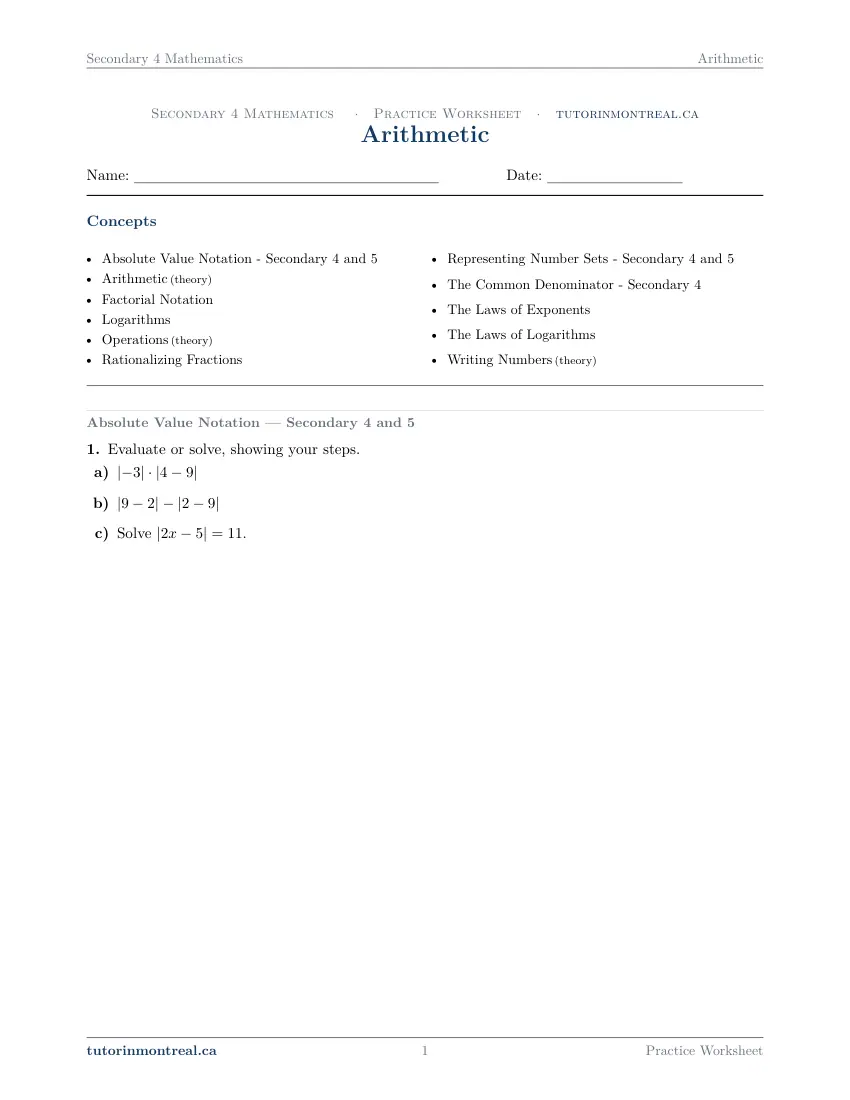
Practice worksheet — free PDF
No email, no account, no watermark. Teachers: photocopy it for your classes freely. Worked solutions and 10 harder problems come with the Secondary 4 Math bundle.
All 11 questions
Each question targets one named concept from the sheet. Read them here, or print the PDF — it has working space under each one.
-
Q1Absolute Value Notation –
Evaluate or solve, showing your steps.
- Solve .
-
Q2Arithmetic (topic overview)
Each expression below uses a different piece of notation from this topic. Name the notation, then give the value (or the simplest exact form).
-
Q3Factorial Notation
Evaluate without a calculator, simplifying before multiplying.
-
Q4Logarithms
Evaluate or solve.
- Solve .
-
Q5Operations
Nadia and Owen both evaluate . Nadia gets ; Owen gets . Decide who is correct, show the correct evaluation step by step, and state precisely which rule the other student broke.
-
Q6Rationalizing Fractions
Rationalize the denominator and simplify.
-
Q7Representing Number Sets –
Write each set in interval notation.
- all real numbers greater than or equal to and strictly less than
-
Q8The Common Denominator –
Add or subtract, giving the result in lowest terms.
- , and state the restriction on .
-
Q9The Laws of Exponents
Simplify, leaving no negative exponents.
- Evaluate .
-
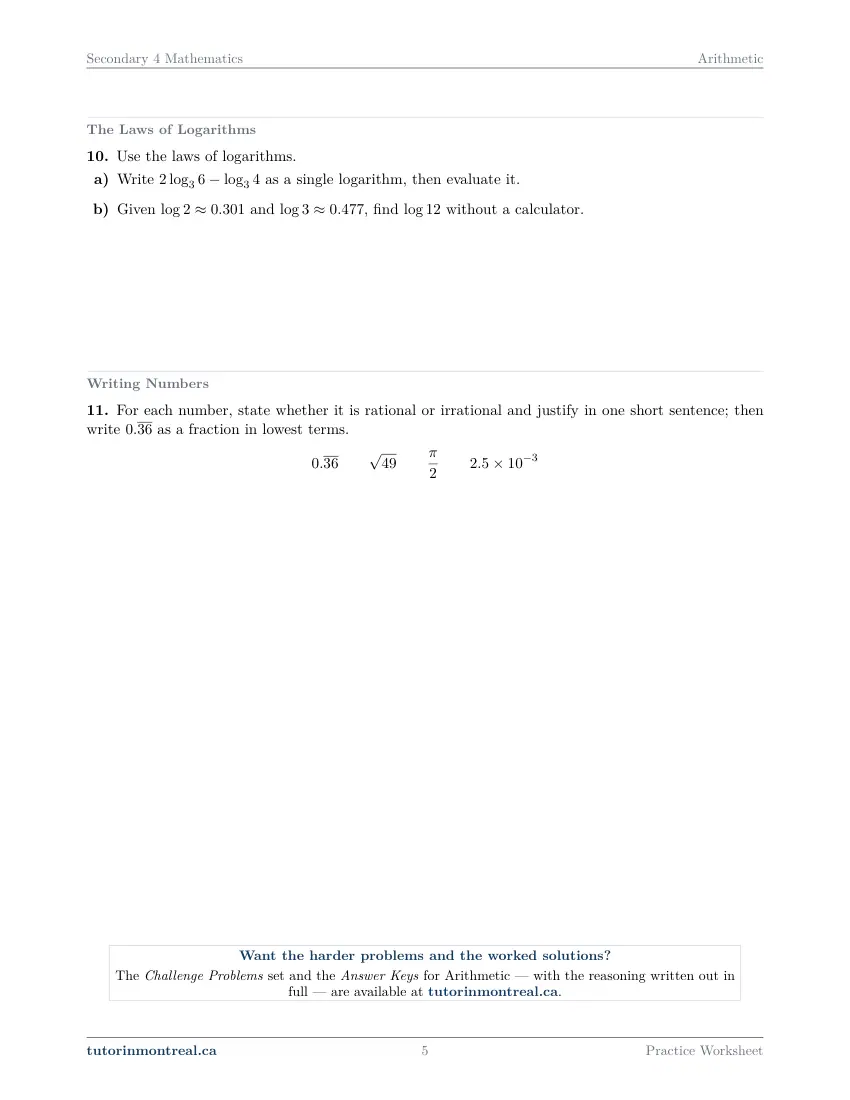
Q10The Laws of Logarithms
Use the laws of logarithms.
- Write as a single logarithm, then evaluate it.
- Given and , find without a calculator.
-
Q11Writing Numbers
For each number, state whether it is rational or irrational and justify in one short sentence; then write as a fraction in lowest terms.
The 10 challenge problems for this topic are a separate, paid sheet and are not reproduced here.
Which stream is this for? This sheet is built for SN. It expects logarithms and their laws, fractional and negative exponents, rationalized denominators and interval notation, and it goes to the depth that program expects.
How to do every concept on this sheet
This is the part worksheet sites usually leave out. Below is the actual reasoning behind each group of questions — not a full solution set, the decisions that get you to one. Read it before you start, or after you get stuck.
Read the notation before you compute anything
Q2 puts five different pieces of notation side by side and asks you to name each one before evaluating it, and that is not a warm-up — it is the point of the whole topic. Almost every error on this sheet is a misread symbol rather than bad arithmetic: an exclamation mark treated as emphasis, a negative exponent treated as a negative number, a logarithm treated as multiplication.
What each symbol is actually asking
Say the sentence in the right-hand column out loud, and the computation follows.
- 1
n!— factorial"Multiply every whole number from n down to 1." It grows terrifyingly fast, which is why questions are always built so that most of it cancels.
- 2
log_b x— logarithm"What exponent turns b into x?" The answer is an exponent, always. Q4 and Q10 are both easier the moment you write the exponential form underneath.
- 3
|x|— absolute value"How far is x from zero?" A distance, so never negative — and it forgets which direction you came from, which is why
|9 − 2|and|2 − 9|agree in Q1. - 4
a−n— negative exponent"One over a to the n." It is an instruction to flip, never a sign.
10⁻² = 1⁄100, a small positive number, not −100. - 5A radical in a denominator
Not wrong, but not standard form. "Rationalize it": multiply top and bottom by the radical so the denominator becomes a whole number.
Factorials: cancel first, multiply never (Q3)
The instruction "simplify before multiplying" is the entire technique. The identity that does all the work is n! = n · (n − 1)!, applied as many times as you need to expose the smaller factorial and cancel it:
9!⁄7! = (9 · 8 · 7!)⁄7! = 9 · 8 = 72A quotient of factorials always collapses to a short product of consecutive integers, and if yours has not, you expanded too far. Working out 10! in full and dividing is not just slow — it overflows a calculator display and loses precision, and questions in this unit are written to be done without one.
The mistake: treating factorial as something that distributes. 8!⁄6! is not (8⁄6)! and it is certainly not 2!. In the same way (a + b)! has nothing to do with a! + b!. Factorial applies to one whole number at a time, and the only legal move is peeling factors off the front.
Logarithms are exponents wearing a different hat (Q4)
The definition is a translation, and it is worth writing out every single time until you stop needing to:
log_b x = y ⟺ b^y = xThat is the whole of Q4. "What is log₂ 64?" becomes "2 to the what is 64?", which you can answer by counting. "Solve log₃ x = 4" becomes "x = 3⁴", which is not really an equation to solve at all. And log₅(1⁄25) comes out negative because reaching a number smaller than 1 needs a negative exponent — a logarithm being negative is normal and says nothing alarming.
Why the argument has to be positive. A base is required to be positive and different from 1, and a positive number raised to any real exponent is positive. So there is no exponent that turns a positive base into a negative number or into zero, and log_b(−25) simply does not exist. This is not a convention to memorise — it falls out of the definition, and saying so is what a justification question wants.
The laws of logarithms: combine, then evaluate (Q10)
Three laws, all of them the exponent laws seen from the other side. A product inside becomes a sum outside, a quotient becomes a difference, and an exponent inside comes out to the front as a coefficient. Q10(a) runs them backwards: pull the coefficient back inside as a power, combine into a single logarithm, and only then evaluate — because log₃ 9 is something you can answer and 2 log₃ 6 is not.
Q10(b) is the same idea used as a computational trick. Given only log 2 and log 3, you can reach any number built from 2s and 3s by factoring it first: 12 is 2² · 3, so log 12 = 2 log 2 + log 3. Factoring the argument before applying a law is the move that makes these questions possible without a calculator.
The mistake that costs the most marks in this unit: inventing a law for a sum inside the logarithm. There is no rule for log(a + b) — it does not equal log a + log b, and it does not equal anything simpler. The laws only ever apply to a product, a quotient or a power. Likewise log a ⁄ log b is a quotient of two logarithms and is not log(a⁄b); that ratio is the change-of-base formula, which is a different statement entirely.
Exponent laws, and what a fractional exponent means (Q9)
Q9(a) is bookkeeping: apply the power to every factor inside the bracket including the numerical coefficient, add exponents when multiplying like bases, subtract when dividing, and finish by clearing negative exponents. "Leaving no negative exponents" is part of the instruction, so a technically correct answer with a b⁻¹ in it is not finished.
Q9(b) is the more interesting half. A fractional exponent packs a root and a power into one symbol: a^(m⁄n) is the nth root of a, raised to m. Add a minus sign and you also flip. The order you do the three operations in is free — the result is the same — but one order keeps the numbers small:
Flip, root, power. For (27⁄8)^(−2⁄3): flip for the minus sign to get (8⁄27)^(2⁄3), take the cube root of each part to get 2⁄3, then square to get 4⁄9. Doing the power first would have you cube-rooting 64 over 729 instead. Same answer, much worse arithmetic — and questions in this unit are designed so that the root comes out whole, which is a useful signal that you have picked the right cube or square root to look for.
Order of operations, and the two "left to right" pairs (Q5)
Q5 hands you two students with two answers and asks you to referee, which is harder than doing the computation yourself because you have to name the broken rule. The order is brackets, then exponents, then multiplication and division, then addition and subtraction — with one clause people forget: multiplication and division sit at the same level and are done left to right, and so do addition and subtraction. Division does not wait for every multiplication to finish.
The failure in Q5 is a different one, and it is the classic: doing a subtraction that appears first on the page before the multiplication and division that outrank it. Reading order is not priority order. When you write up the answer, name the rule that was broken rather than just showing the correct chain — that is what the question is marked on.
Rationalizing a denominator (Q6)
Multiply the fraction by the radical over itself. That is multiplying by 1, so the value never changes; only the way it is written does, and √a · √a = a clears the denominator.
5⁄√10 = (5⁄√10)(√10⁄√10) = 5√10⁄10 = √10⁄2Two habits: simplify the radical before you rationalize when it hides a perfect square factor — √48 is 4√3, and rationalizing before spotting that makes the numbers four times bigger than they need to be — and always reduce the fraction at the end, because the numerator and the cleared denominator usually share a factor, as they do above. When the denominator is a sum containing a radical, the same idea works with the conjugate, since (p − √q)(p + √q) = p² − q has no radical left in it.
Absolute value: a distance, and an equation with two answers (Q1)
|x| is how far x sits from zero, which is why it is never negative and why the order of a subtraction inside it is irrelevant. Treat the bars as brackets: finish the arithmetic inside, then take the size.
Solving is where the structure matters. |u| = 11 says "u is 11 away from zero", and two numbers satisfy that, so the equation splits into u = 11 and u = −11, each solved separately. Two solutions is the normal outcome, one is possible when the right-hand side is zero, and none at all when the right-hand side is negative — which is worth checking before you split anything, because a distance is never negative.
Intervals, common denominators and the number sets (Q7, Q8, Q11)
In Quebec notation a bracket turns outward at an endpoint that is excluded, so [−3, 7[ includes −3 and stops just short of 7, and infinity always gets a reversed bracket because it is never reached. An intersection, as in Q7(c), keeps only the numbers satisfying both conditions at once — sketch the two intervals on the same number line and read off the overlap rather than trying to reason it out symbolically.
Q8 adds a variable to a familiar operation. The method is unchanged — build the smallest common denominator, rewrite each fraction, combine the numerators — but the answer is incomplete without the restriction. A denominator of 3x or 6x requires x ≠ 0, and that condition comes from the denominators you started with, not from the simplified result.
Q11 asks which numbers are rational. A number is rational exactly when it can be written as a ratio of two integers, and three signals cover almost every case you will meet: a terminating decimal is rational, a repeating decimal is rational, and a root that comes out whole is rational. Everything else needs an argument rather than an impression — and a non-zero rational multiple of an irrational number stays irrational, which is the sentence Q11 is fishing for. To convert a repeating decimal, put the repeating block over as many 9s as it has digits, then reduce.
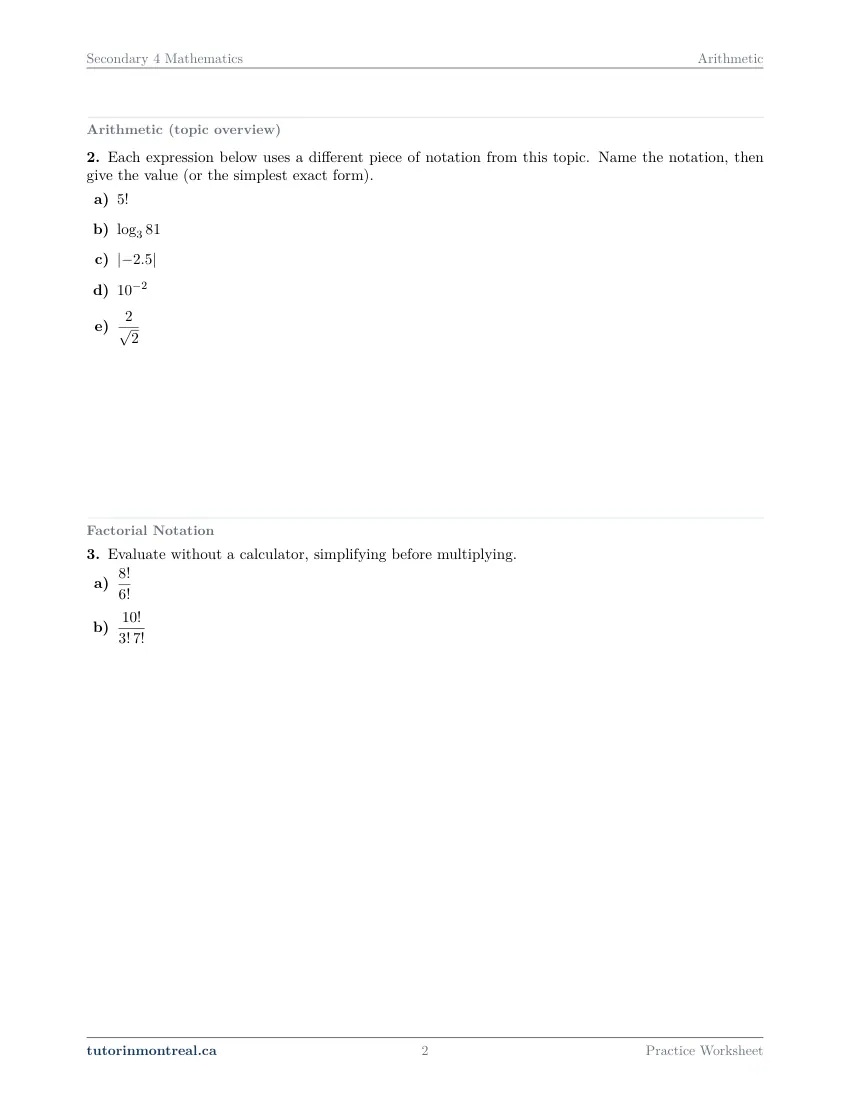
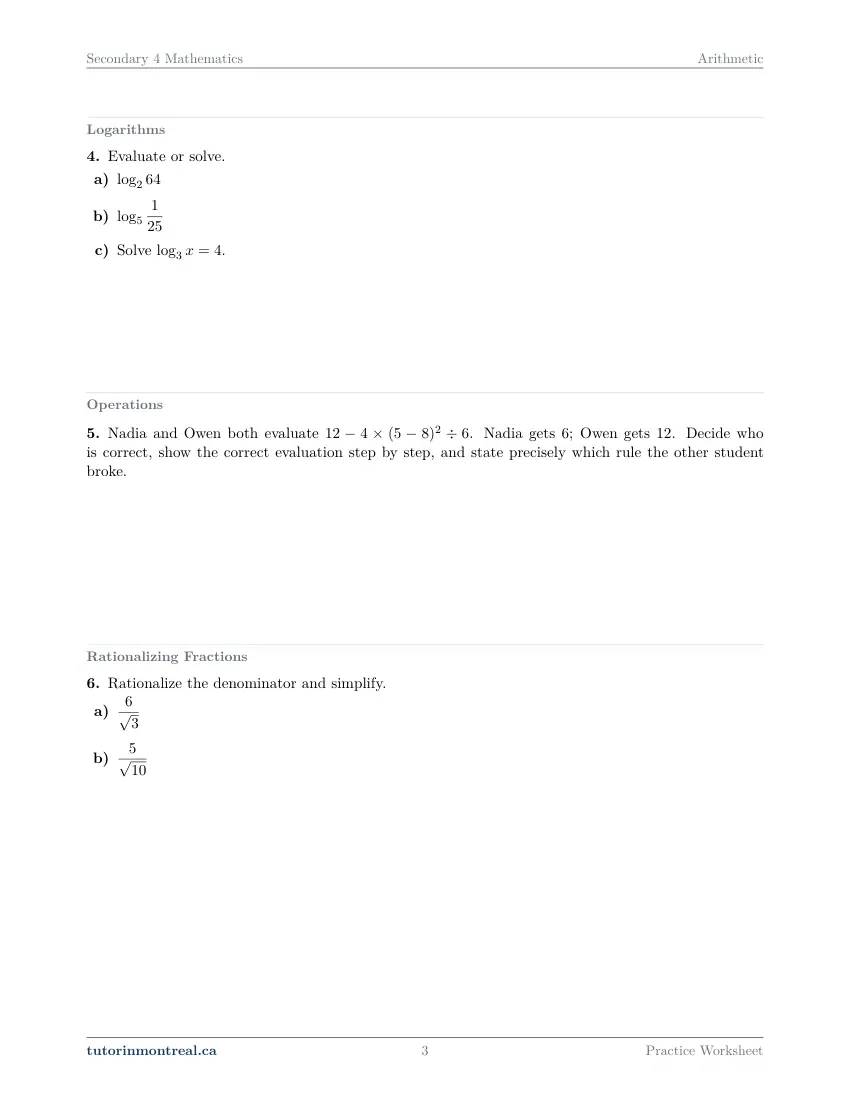
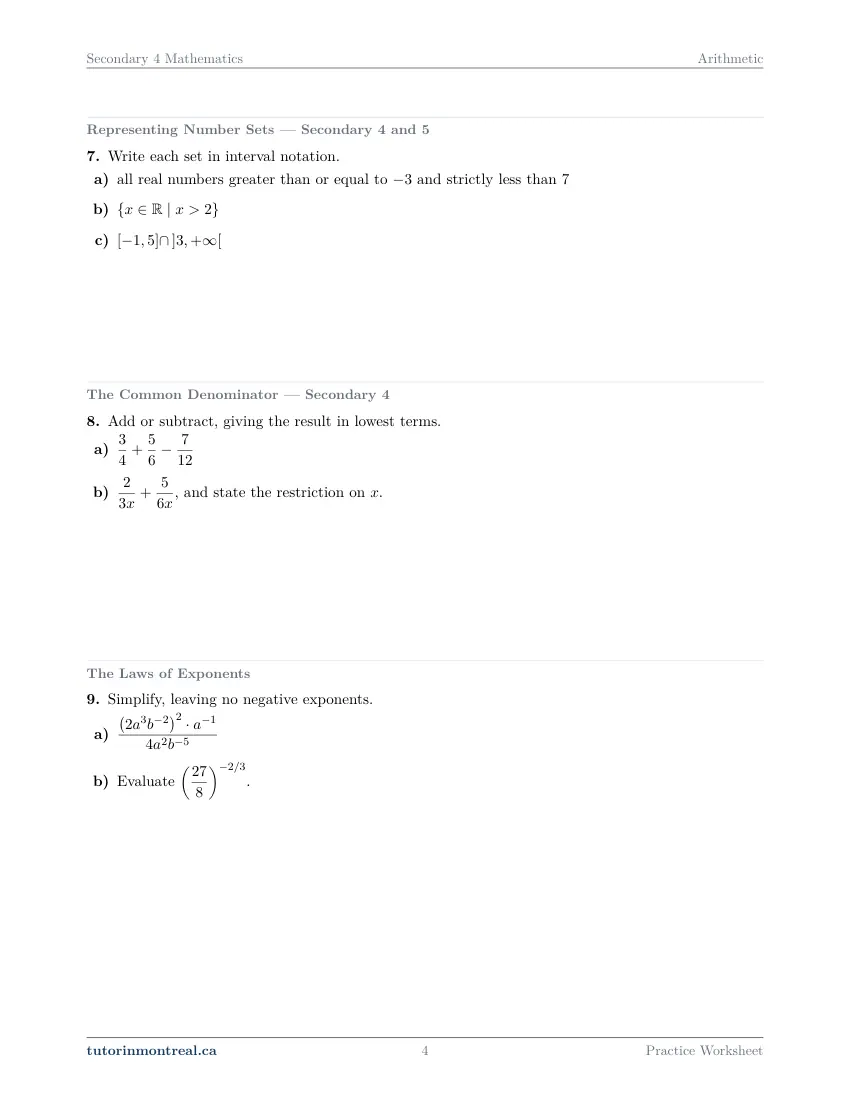
Preview all 5 pages
Click any page to open the full PDF.
Getting the most out of it
Do the notation question twice
Answer the overview question cold before anything else, and mark honestly which of the five symbols you could not name. Those are your revision list. Answer it again after the rest of the sheet and the difference is a fair measure of what actually stuck.
Put the calculator away
Every question here is designed to come out exactly: the factorials cancel, the logarithms land on whole numbers, the roots are perfect. Reaching for a calculator hides whether you understood the notation, and the exam version of these questions is written the same way.
Write the exponential form under every logarithm
Under log₂ 64 = ?, write 2^? = 64. It is one extra line and it converts a piece of unfamiliar notation into a question you have been able to answer since Secondary 1.
Want the solutions, or something more challenging?
The worksheet, the questions above and every explanation on this page stay free permanently. Three more PDFs exist for this topic — the worked answer key, a harder problem set, and the answer key to that. They come with the Secondary 4 Math Solutions Bundle, which is what keeps the rest of the series free.
What else exists for Arithmetic
Three PDFs · 10 pages · all three are in the bundle below.
- Answer key — 2 pages. All 11 questions worked step by step, including the restrictions and the justifications. Not a list of final answers.
- Challenge problems — 6 pages, 10 problems. A separate sheet at exam-plus difficulty covering the same 11 concepts. Harder than anything on the free sheet.
- Challenge answer key — 2 pages. Every challenge problem worked to the same standard, with the checks shown.
- PDF, letter size, print-ready.
The one thing that's for sale
Every Secondary 4 Math topic — the complete Solutions Bundle
One download, one payment, the whole program. Every answer key and every challenge set for all 17 Secondary 4 Math worksheet sets — including this one.
- Worked solutions, not answer lists — every step written out
- Covers the whole year's program at this level
- Less than the price of one hour of tutoring — for the entire year's solutions
Taking Secondary 1 Math as well? The Secondary 1 Math bundle covers all 15 of its sets — 45 PDFs, 182 pages — on the same terms.
Taking Secondary 2 Math as well? The Secondary 2 Math bundle covers all 14 of its sets — 42 PDFs, 181 pages — on the same terms.
Taking Secondary 3 Math as well? The Secondary 3 Math bundle covers all 11 of its sets — 33 PDFs, 154 pages — on the same terms.
Taking Secondary 5 Math as well? The Secondary 5 Math bundle covers all 21 of its sets — 63 PDFs, 228 pages — on the same terms.
Taking CEGEP Calculus I as well? The CEGEP Calculus I bundle covers all 8 of its sets — 24 PDFs, 82 pages — on the same terms.
Taking CEGEP Calculus II as well? The CEGEP Calculus II bundle covers all 8 of its sets — 24 PDFs, 90 pages — on the same terms.
Taking CEGEP Linear Algebra as well? The CEGEP Linear Algebra bundle covers all 7 of its sets — 21 PDFs, 82 pages — on the same terms.
Taking AP Calculus AB as well? The AP Calculus AB bundle covers all 8 of its sets — 24 PDFs, 126 pages — on the same terms.
Common questions
Is this worksheet really free?
Yes — the questions are on this page to read, and the PDF downloads directly, no email and no account. The one paid item is optional: the complete Secondary 4 Solutions Bundle, which covers every set at this level.
Why does an absolute value equation have two answers?
Because the bars measure distance from zero, and two numbers sit at any given distance. An equation of the form |u| = k with k positive therefore splits into u = k and u = −k, each solved separately, and both answers should be substituted back into the original equation. The count changes only at the edges: if k is zero there is a single solution, and if k is negative there is none at all, because a distance is never negative — worth checking before you split anything.
How do I simplify a quotient of factorials without a calculator?
Expand the larger factorial only as far as the smaller one, using the fact that n! equals n times (n − 1)!, then cancel. What is left is a short product of consecutive integers. If you have written out every factor, you have gone too far.
Does a negative exponent make the answer negative?
No. A negative exponent means take the reciprocal, so 10 to the power −2 is one hundredth, a small positive number. Combine it with a fraction exponent and the order that keeps the arithmetic easiest is: flip for the minus sign, take the root, then apply the power.
Why do I have to rationalize the denominator at all?
Because it is the standard form an answer is expected in, and it makes two expressions easy to compare and to add. Multiplying by the radical over itself is multiplying by 1, so the value never changes — only the way it is written.
Which Secondary 4 stream is this for?
It is built for SN. The sheet expects logarithms and their laws, fractional and negative exponents, rationalized denominators and interval notation, which is the depth that program expects.
Can teachers use this in class?
Yes. Print and photocopy it for your own classes freely — I just ask that the tutorinmontreal.ca footer stays on the page.
I'm stuck on one question. Can you help?
Yes — through one-on-one tutoring, in Montreal or online. Get in touch to arrange a session, or see the current rates.
← All 17 Secondary 4 Math worksheets · Secondary 1 Math series (15 sheets) → · Secondary 2 Math series (14 sheets) → · Secondary 3 Math series (11 sheets) → · Secondary 5 Math series (21 sheets) → · CEGEP Calculus I series (8 sheets) → · CEGEP Calculus II series (8 sheets) → · CEGEP Linear Algebra series (7 sheets) → · AP Calculus AB series (8 sheets) →
The same topic at the other level: Secondary 5 Math · Arithmetic.