Secondary 4 Step Functions Worksheet
The greatest integer function is where a graph stops being a curve and becomes a staircase. You read step length and jump height off the parameters, decide which endpoint of each step is closed and justify it, graph the staircase, turn a charged-per-started-period situation into a rule, and explain why inverting a staircase cannot produce a function. The methods are set out underneath, and the printable sheet is free.
Practice worksheet — free PDF
No email, no account, no watermark. Teachers: photocopy it for your classes freely. Worked solutions and 5 harder problems come with the Secondary 4 Math bundle.
All 7 questions
Each question targets one named concept from the sheet. Read them here, or print the PDF — it has working space under each one.
-
Q1Finding the Rule of a Step Function (Greatest Integer Function)
Consider .
- Compute , and .
- State the length of each step, the size of the jump between two consecutive steps, and whether the solid (closed) endpoint of each step is on the left or on the right.
-
Q2Graphing a Step Function (Greatest Integer Function)
Sketch on the interval , marking clearly which endpoint of each step is closed. Give the value of and of .
A blank Cartesian grid for this question is on the printable PDF.
-
Q3Solving Problems Involving the Step Function (the Greatest Integer Function)
A riverside outfitter rents kayaks and charges $9 for each started -minute period. For a rental of minutes () the cost in dollars is
- What does a -minute rental cost?
- What is the longest rental that still costs $27?
-
Q4The Inverse of the Step Function (Greatest Integer Function)
Consider the greatest integer function with domain . Explain why its inverse is not a function, and describe the inverse relation precisely (which elements it starts from, and what each one is paired with).
-
Q5The Properties of the Step Function (Greatest Integer Function)
Let .
- Evaluate and .
- Give the length of each step and the vertical distance between two consecutive steps.
- State the range of .
- Sketch for on the grid, showing clearly which endpoint of each step is included.
A blank Cartesian grid for this question is on the printable PDF.
-
Q6The Role of the Parameters in a Step Function (Greatest Integer Function)
Consider . Without drawing the graph, state the length of each step, the vertical distance between two consecutive steps, and whether the steps rise or fall as increases. Say which endpoint of each step is included, and justify your answer using the signs of and .
-
Q7The Step Function (Greatest Integer Function)
At a train station, the fee in dollars for leaving a bag at the luggage counter for hours is , for .
- Find and .
- For how long may a bag be left if exactly $13 is paid? Give an interval.
The 5 challenge problems for this topic are a separate, paid sheet and are not reproduced here.
Which stream is this for? This sheet is built for SN. It assumes you are working with the full parametered form a⌊b(x − h)⌋ + k, justifying the closed endpoint from the sign of b, and solving started-period pricing problems, and it goes to the depth that program expects.
How to do every concept on this sheet
This is the part worksheet sites usually leave out. Below is the actual reasoning behind each group of questions — not a full solution set, the decisions that get you to one. Read it before you start, or after you get stuck.
The definition every step question comes back to
⌊u⌋ is the greatest integer that is less than or equal to u. That sentence is enough to evaluate anything, but the version you actually use for solving is the double inequality:
⌊u⌋ = n ⟺ n ≤ u < n + 1Closed on the left, open on the right — always, for every step function on this sheet. Every open and closed circle you will ever draw traces back to those two inequality signs.
Negative numbers are where this is lost. The floor moves left on the number line, never right. So ⌊−0.25⌋ is −1, not 0, and ⌊−2.4⌋ is −3. Q2 asks for a floor of a negative number for exactly this reason, and Q1 and Q5 both feed negative inputs into the bracket.
The floor is not rounding and it is not chopping off the decimals. For positive numbers chopping happens to agree with it, which is why the habit survives long enough to fail on the first negative. Test yourself on ⌊−3.1⌋ before you trust yourself on a whole question.
The four parameters, and what each one controls
Q1, Q5 and Q6 all ask the same thing about different rules: read the staircase off f(x) = a⌊b(x − h)⌋ + k without drawing it. Each parameter owns exactly one feature.
Reading a⌊b(x − h)⌋ + k at a glance
Four parameters, four separate questions. Answer them one at a time.
- 1Step length = 1 ⁄ |b|
The bigger |b|, the shorter each step, because b multiplies the input and so compresses the horizontal axis. A b of 1⁄3 gives steps three units long; a b of 3 gives steps a third of a unit long. Q1 and Q6 are that pair, deliberately.
- 2Jump height = |a|
The vertical distance between two consecutive steps. Note it is the distance between steps — the steps themselves are flat, and asking for "the height of a step" means this gap.
- 3Closed endpoint: the sign of b, alone
b > 0 → each step is closed on the left and open on the right. b < 0 → closed on the right. Nothing else in the rule affects this.
- 4Rise or fall: the signs of a and b together
Same signs → the staircase climbs as x increases. Opposite signs → it descends. With b < 0 the inner expression decreases as x grows, which reverses whatever a would have done.
- 5h and k slide the staircase
h moves the whole picture horizontally, so it decides where the jumps happen; k moves it vertically, so it decides which values the steps take. Neither changes the shape.
The mistake this sheet is built to catch: deciding the closed endpoint from the sign of a. It has nothing to do with a. Q1 and Q6 both have a negative a and a positive b — descending staircases whose steps are still closed on the left.
Why it is b. The floor is constant on [n, n + 1[, closed at the left end. Substituting u = b(x − h), that interval is pulled back onto the x-axis. If b > 0 the pull-back preserves order, so the closed end stays on the left; if b < 0 it reverses the interval and the closed end lands on the right. The parameter a acts after the floor, on the output, and cannot touch which inputs belong to which step. Q6 asks you to write that argument out.
The range is a list of values, not an interval
Q5 asks for the range and the interval answer is an automatic loss. The floor produces an integer, so the outputs are a·n + k as n runs through the integers — a set of isolated values spaced |a| apart, with nothing in between. Write it in set notation, {an + k : n ∈ ℤ}, and if the numbers let you name it in words (the odd integers, the multiples of 4 shifted up by 5), say that too.
Solving "for which x is f(x) equal to this value?"
Q3 and Q7 both ask for the whole set of inputs producing one output, and the answer is always an interval. The procedure is fixed:
From an equation to an interval
Isolate the bracket, then unfold the definition. Never guess a single value.
- 1Isolate the floor
Undo k, then undo a, until the rule reads
⌊ something ⌋ = n. - 2Check that n is an integer
If it is not, there is no solution — the function simply never takes that value. Saying so is a complete answer, and step functions are the one place where "no solution" is a likely outcome.
- 3Unfold the definition
n ≤ (the something) < n + 1. This is where the interval is born. - 4Solve the double inequality for x
Do the same operation to all three parts. If you multiply or divide by a negative, both inequality signs reverse — and the closed end swaps to the other side of the interval. Q3 is exactly that case, which is why its answer is closed on the right while Q7's is closed on the left.
- 5Answer the question that was asked
"The longest rental", "how long may a bag be left" — often the question wants one endpoint of the interval you just found, and whether that endpoint is included is the point of the whole question.
Started periods versus completed periods
This is the modelling distinction the word problems turn on, and the two questions on this sheet sit on opposite sides of it.
Q7 charges for completed units: the price steps up as the clock passes each whole hour, so a plain ⌊t⌋ does the job and the steps are closed on the left. Q3 charges for every started half-hour: the price steps up the instant you begin a new period, which needs the ceiling instead.
Why the double minus. The ceiling of u — the smallest integer at or above u — is −⌊−u⌋. Negating reflects the number line, the floor rounds it down on the reflected line, and negating back turns that into a round-up. So a rule shaped like −a⌊−u⌋ is a "each started period" model, and its steps are closed on the right, because the negative sign inside the bracket makes b negative.
Practical reading: if a price rises the moment you cross into a new period, the bracket contains a negative multiple of the variable. If it rises only once a period is finished, it does not. Reading which one a word problem describes is most of the difficulty.
Graphing: the circles carry the marks
On Q2 and on the sketch in Q5, the shape is never in doubt — it is deciding where each step starts and stops. Work step by step: pick the interval, evaluate the rule at a convenient point inside it, draw a horizontal segment at that height, then put a filled circle on the included end and an open circle on the excluded one.
Two rules that are never broken. Never join two steps with a vertical segment — a vertical line would hand one x two images, and the picture would stop being a function. And when the question gives you an interval to work on, respect its own endpoints: Q2 is drawn on a half-open interval, so the picture has a definite closed left end and a definite open right end.
Why the inverse is not a function
Q4 asks for a proof and a description, and the two halves are marked separately.
The proof: the greatest integer function is not injective. Every real number in [3, 4[ has image 3 — a whole interval collapsing onto one value. Reverse those pairs and the single number 3 is now partnered with infinitely many outputs, which a function may not do. Naming two specific inputs with the same image is what turns this from an assertion into a proof.
The description: the inverse relation starts from the integers — the range of f — and pairs each integer n with the whole interval [n, n + 1[. Reflecting the horizontal half-open steps in the line y = x turns them into vertical half-open segments, and the vertical line test then fails visibly. The inverse still exists as a relation; it is only the word "function" that it fails to earn.
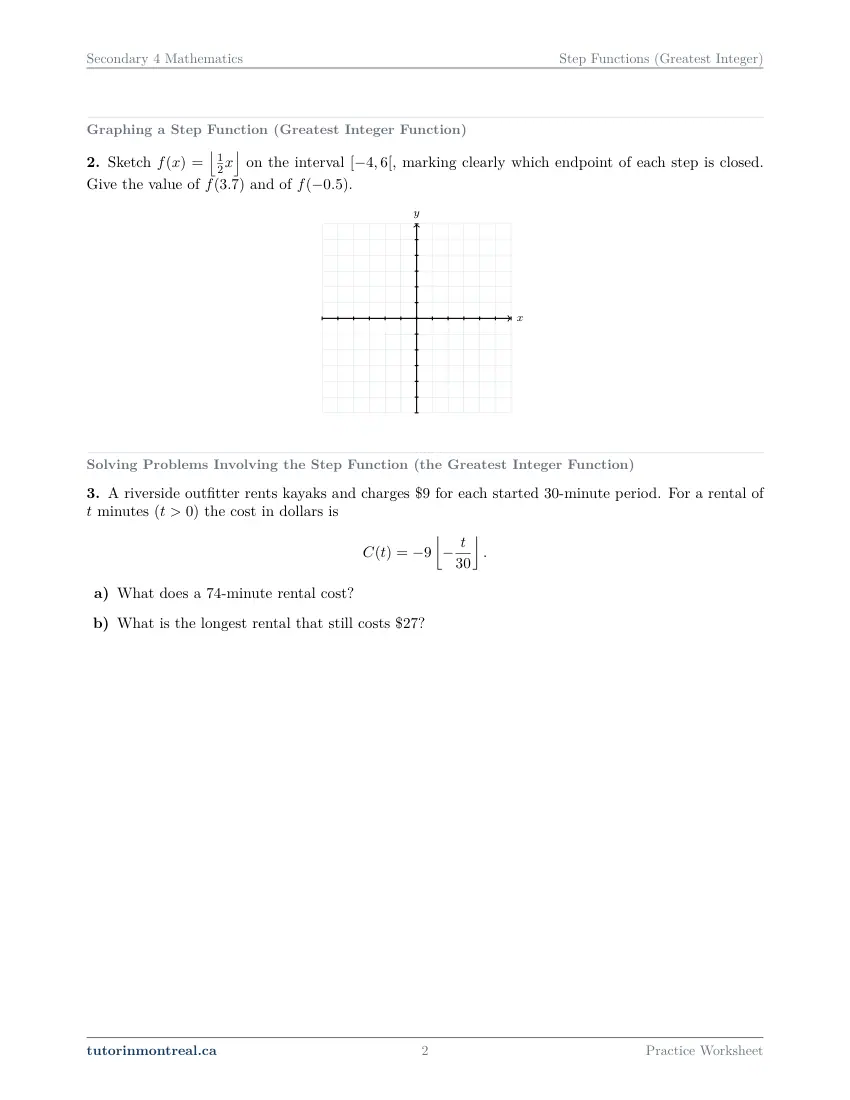
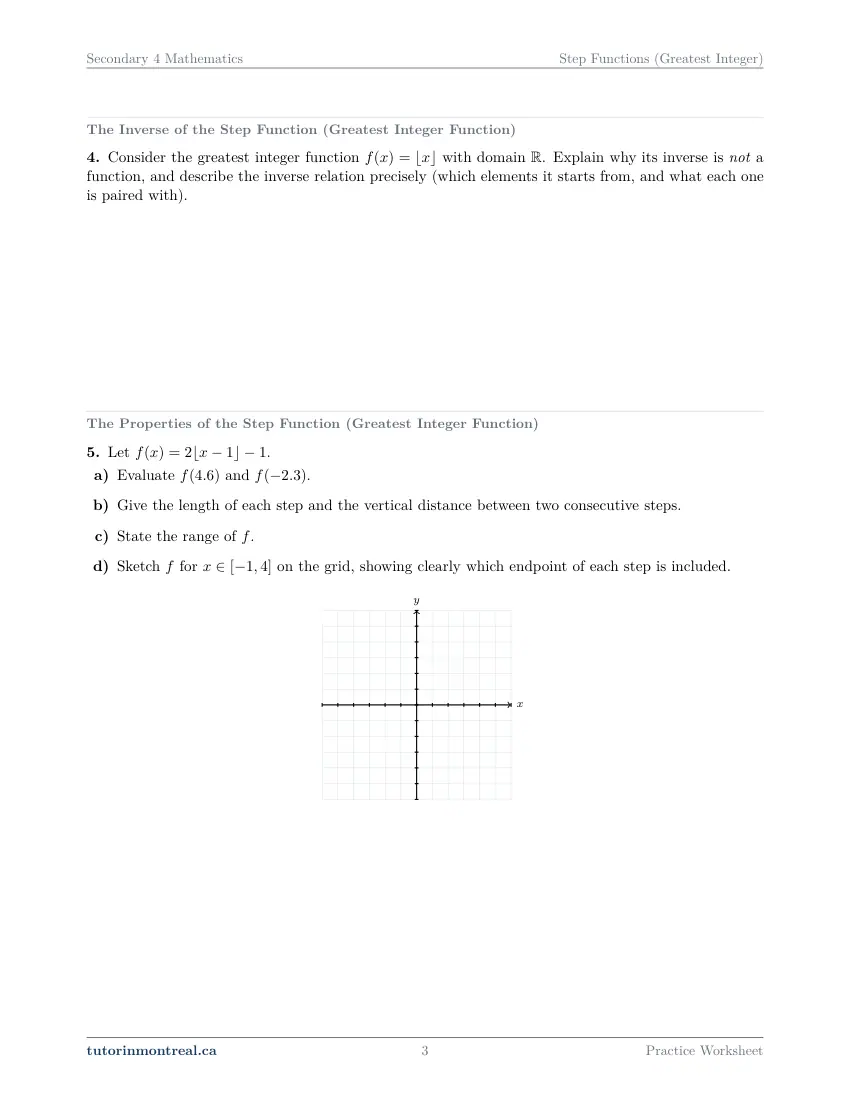
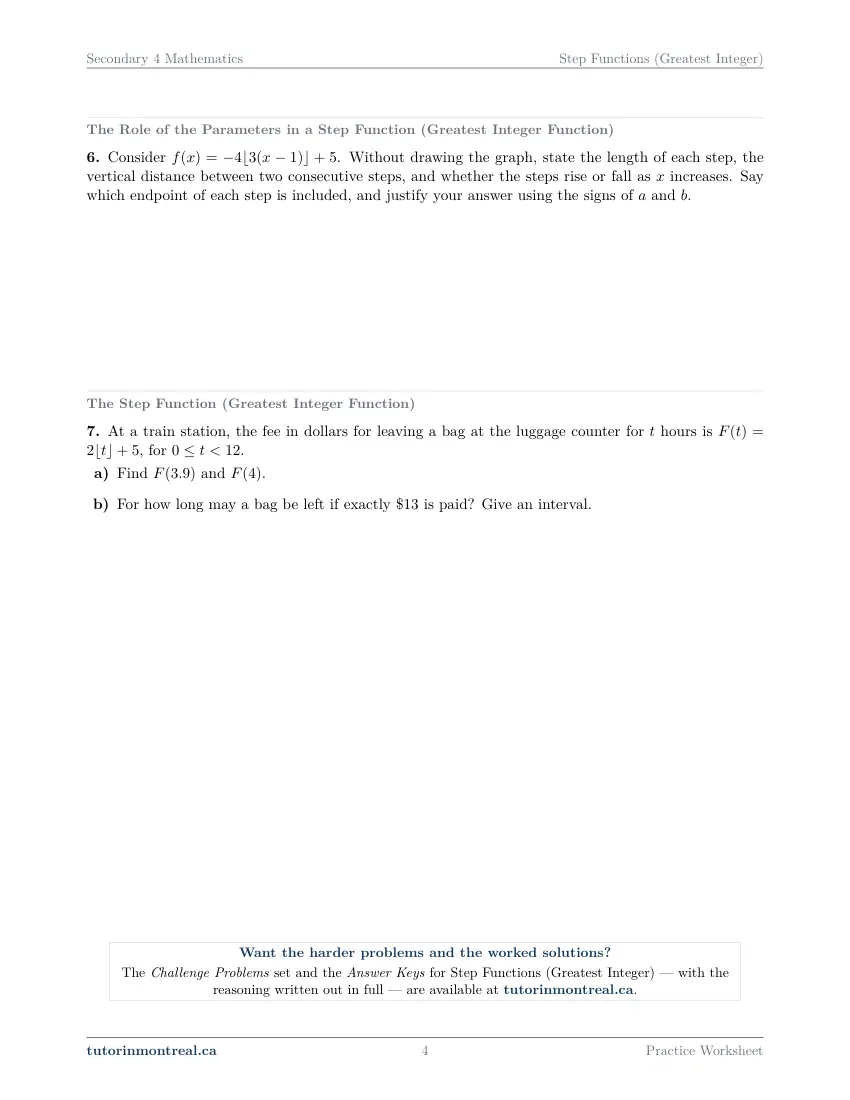
Preview all 4 pages
Click any page to open the full PDF.
Getting the most out of it
Test just left and just right of a jump
Evaluating a step function in the middle of a step tells you almost nothing. Pick an x a hair below a jump and one a hair above it: if the two values differ, you have found the jump height and confirmed which side owns the boundary in one line of arithmetic.
Do the parameter questions back to back
Q1 and Q6 ask the same four readings of rules with different parameter signs. Answering them consecutively is the only way to find out whether you read the first one correctly or got it right by accident.
Sketch even when the question does not ask
Three or four steps drawn roughly, with the circles marked, catches a swapped endpoint or an upside-down staircase in seconds — errors that are invisible in a written answer and obvious in a picture.
Want the solutions, or something more challenging?
The worksheet, the questions above and every explanation on this page stay free permanently. Three more PDFs exist for this topic — the worked answer key, a harder problem set, and the answer key to that. They come with the Secondary 4 Math Solutions Bundle, which is what keeps the rest of the series free.
What else exists for Step Functions (Greatest Integer)
Three PDFs · 7 pages · all three are in the bundle below.
- Answer key — 2 pages. All 7 questions worked step by step, including the restrictions and the justifications. Not a list of final answers.
- Challenge problems — 3 pages, 5 problems. A separate sheet at exam-plus difficulty covering the same 7 concepts. Harder than anything on the free sheet.
- Challenge answer key — 2 pages. Every challenge problem worked to the same standard, with the checks shown.
- PDF, letter size, print-ready.
The one thing that's for sale
Every Secondary 4 Math topic — the complete Solutions Bundle
One download, one payment, the whole program. Every answer key and every challenge set for all 17 Secondary 4 Math worksheet sets — including this one.
- Worked solutions, not answer lists — every step written out
- Covers the whole year's program at this level
- Less than the price of one hour of tutoring — for the entire year's solutions
Taking Secondary 1 Math as well? The Secondary 1 Math bundle covers all 15 of its sets — 45 PDFs, 182 pages — on the same terms.
Taking Secondary 2 Math as well? The Secondary 2 Math bundle covers all 14 of its sets — 42 PDFs, 181 pages — on the same terms.
Taking Secondary 3 Math as well? The Secondary 3 Math bundle covers all 11 of its sets — 33 PDFs, 154 pages — on the same terms.
Taking Secondary 5 Math as well? The Secondary 5 Math bundle covers all 21 of its sets — 63 PDFs, 228 pages — on the same terms.
Taking CEGEP Calculus I as well? The CEGEP Calculus I bundle covers all 8 of its sets — 24 PDFs, 82 pages — on the same terms.
Taking CEGEP Calculus II as well? The CEGEP Calculus II bundle covers all 8 of its sets — 24 PDFs, 90 pages — on the same terms.
Taking CEGEP Linear Algebra as well? The CEGEP Linear Algebra bundle covers all 7 of its sets — 21 PDFs, 82 pages — on the same terms.
Taking AP Calculus AB as well? The AP Calculus AB bundle covers all 8 of its sets — 24 PDFs, 126 pages — on the same terms.
Common questions
Is this worksheet really free?
Yes — the questions are on this page to read, and the PDF downloads directly, no email and no account. The one paid item is optional: the complete Secondary 4 Solutions Bundle, which covers every set at this level.
Why is the greatest integer of −0.5 equal to −1 and not 0?
Because the definition asks for the greatest integer that is less than or equal to the number, and 0 is greater than −0.5. The floor always moves left on the number line. It is not rounding and not chopping off the decimals — those two happen to agree with it for positive numbers, which is why the habit survives until the first negative input.
How do I know whether each step is closed on the left or on the right?
From the sign of b, and nothing else. If b is positive the steps are closed on the left and open on the right; if b is negative they are closed on the right. The parameter a decides only whether the staircase climbs or descends, so a descending staircase can perfectly well have every step closed on its left endpoint.
What is the difference between charging for started periods and completed periods?
A completed-period charge rises only once a whole period has passed, and a plain greatest integer bracket models it. A started-period charge rises the instant a new period begins, which needs a ceiling — written as minus the floor of minus the quantity. The negative inside the bracket also flips which endpoint of each step is closed.
Why isn't the range of a step function an interval?
Because the bracket only ever produces integers. Multiplying by a and adding k turns those into values spaced |a| apart with nothing between them, so the range is a set written in set notation, not an interval. Writing an interval says the function takes values it never takes.
Which Secondary 4 stream is this for?
It is built for SN. The sheet assumes you are working with the full parametered form, justifying the closed endpoint from the sign of b, and solving started-period pricing problems, and it goes to the depth that program expects.
Can teachers use this in class?
Yes. Print and photocopy it for your own classes freely — I just ask that the tutorinmontreal.ca footer stays on the page.
I'm stuck on one question. Can you help?
Yes — through one-on-one tutoring, in Montreal or online. Get in touch to arrange a session, or see the current rates.
← All 17 Secondary 4 Math worksheets · Secondary 1 Math series (15 sheets) → · Secondary 2 Math series (14 sheets) → · Secondary 3 Math series (11 sheets) → · Secondary 5 Math series (21 sheets) → · CEGEP Calculus I series (8 sheets) → · CEGEP Calculus II series (8 sheets) → · CEGEP Linear Algebra series (7 sheets) → · AP Calculus AB series (8 sheets) →
The same topic at the other level: Secondary 5 Math · Step Functions (Greatest Integer).