Secondary 4 Analytic Geometry Worksheet
Coordinates turn a geometry problem into an arithmetic one, and this sheet works the whole conversion: distance between two points, from a point to a line and between two parallel lines; slope as the test for parallel, perpendicular and collinear; division points and midpoints; the general, functional and symmetric forms of a line; half-planes and their boundaries; and what a coordinate argument must contain before it counts as a proof. Look the questions over here first, then print the PDF free of charge — no email, no account.
Practice worksheet — free PDF
No email, no account, no watermark. Teachers: photocopy it for your classes freely. Worked solutions and 11 harder problems come with the Secondary 4 Math bundle.
All 14 questions
Each question targets one named concept from the sheet. Read them here, or print the PDF — it has working space under each one.
-
Q1Analytic Geometry
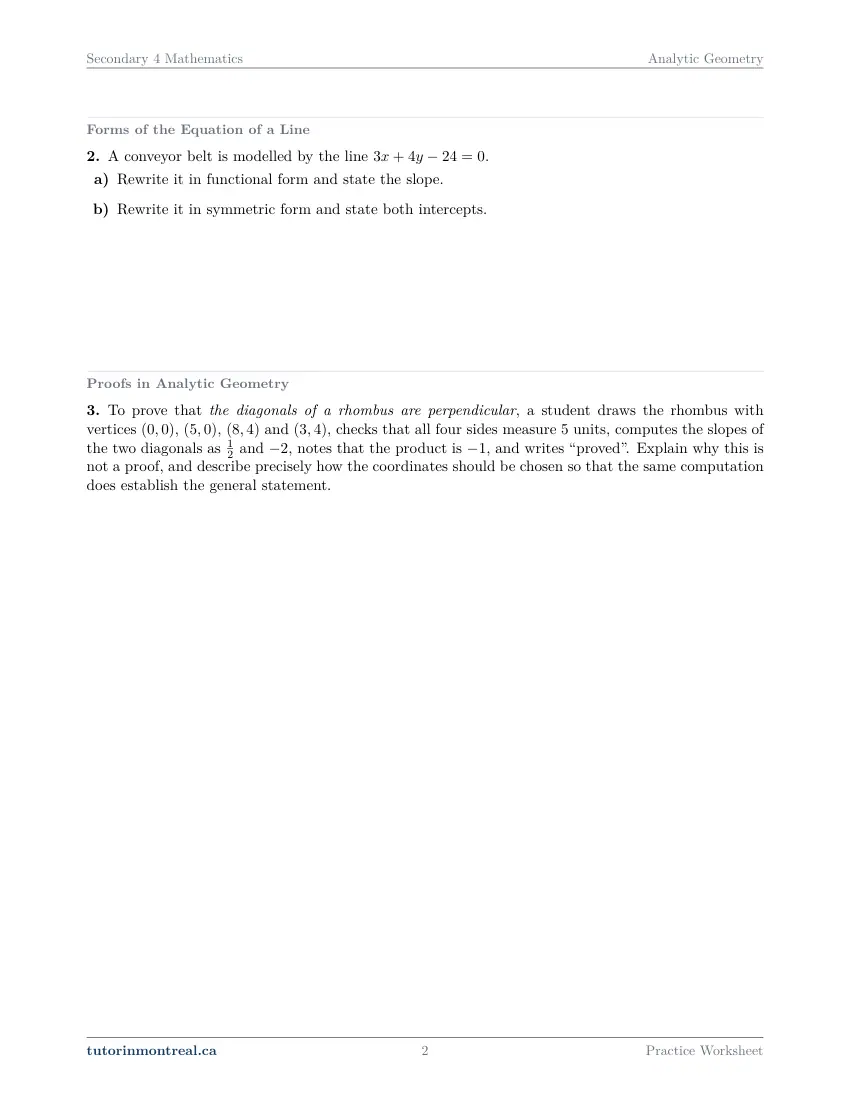
Analytic geometry answers geometric questions with coordinates and algebra. For each situation below, name the analytic tool you would use (a formula or a condition on slopes), and say what the tool produces — a number, a pair of coordinates, or a yes/no verdict.
- Deciding whether two segments of a roof truss meet at a right angle.
- Locating the point three-fifths of the way along a segment from to .
- Showing that a triangle drawn on a plan is isosceles.
- Deciding whether a house at lies on the protected side of a straight shoreline.
-
Q2Forms of the Equation of a Line
A conveyor belt is modelled by the line .
- Rewrite it in functional form and state the slope.
- Rewrite it in symmetric form and state both intercepts.
-
Q3Proofs in Analytic Geometry
To prove that the diagonals of a rhombus are perpendicular, a student draws the rhombus with vertices , , and , checks that all four sides measure units, computes the slopes of the two diagonals as and , notes that the product is , and writes “proved”. Explain why this is not a proof, and describe precisely how the coordinates should be chosen so that the same computation does establish the general statement.
-
Q4Straight Lines and Half-Planes
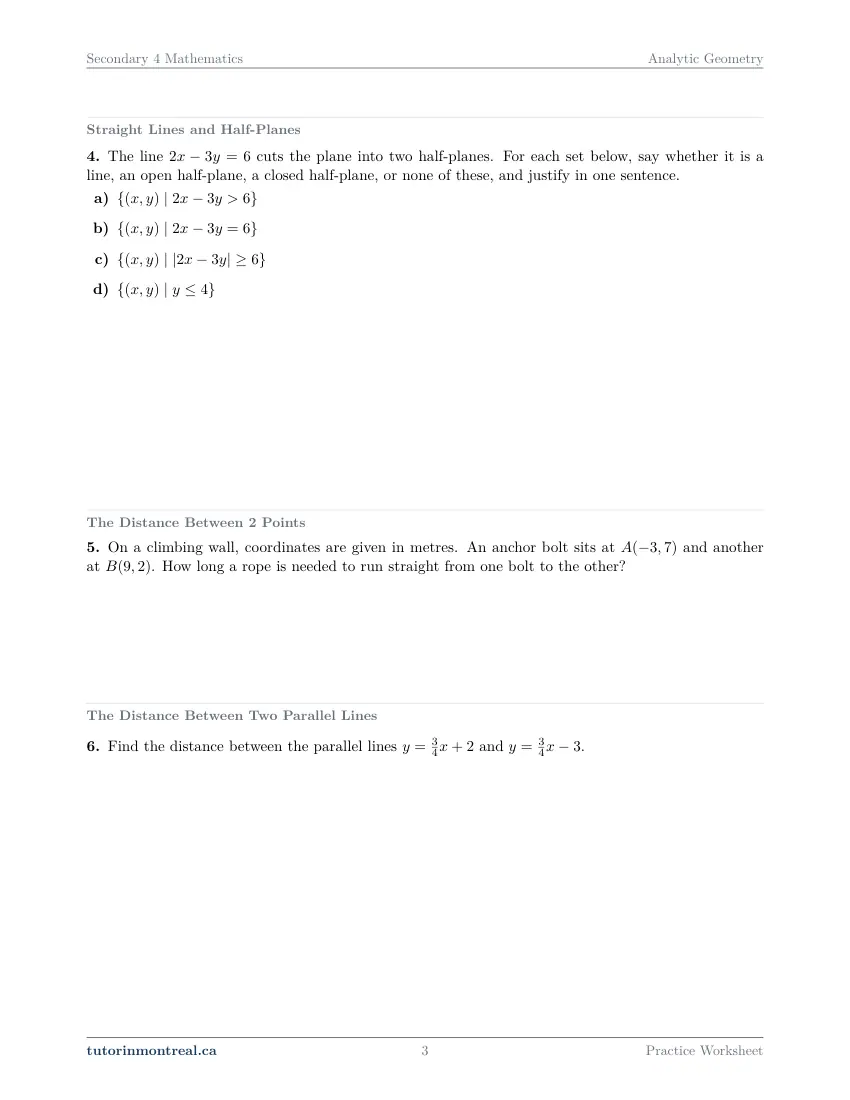
The line cuts the plane into two half-planes. For each set below, say whether it is a line, an open half-plane, a closed half-plane, or none of these, and justify in one sentence.
-
Q5The Distance Between 2 Points
On a climbing wall, coordinates are given in metres. An anchor bolt sits at and another at . How long a rope is needed to run straight from one bolt to the other?
-
Q6The Distance Between Two Parallel Lines
Find the distance between the parallel lines and .
-
Q7The Distance From a Point to a Line on a Cartesian Plane
Find the distance from the point to the line .
-
Q8The Division Point and Midpoint of a Segment
A straight ski trail runs from the chalet to the summit (units in hundreds of metres).
- Find the midpoint of .
- A rest bench is placed one quarter of the way from to . Find its coordinates.
-
Q9The Equation of a Line From the Coordinates or Slope
Find the equation, in functional form, of the line passing through and .
-
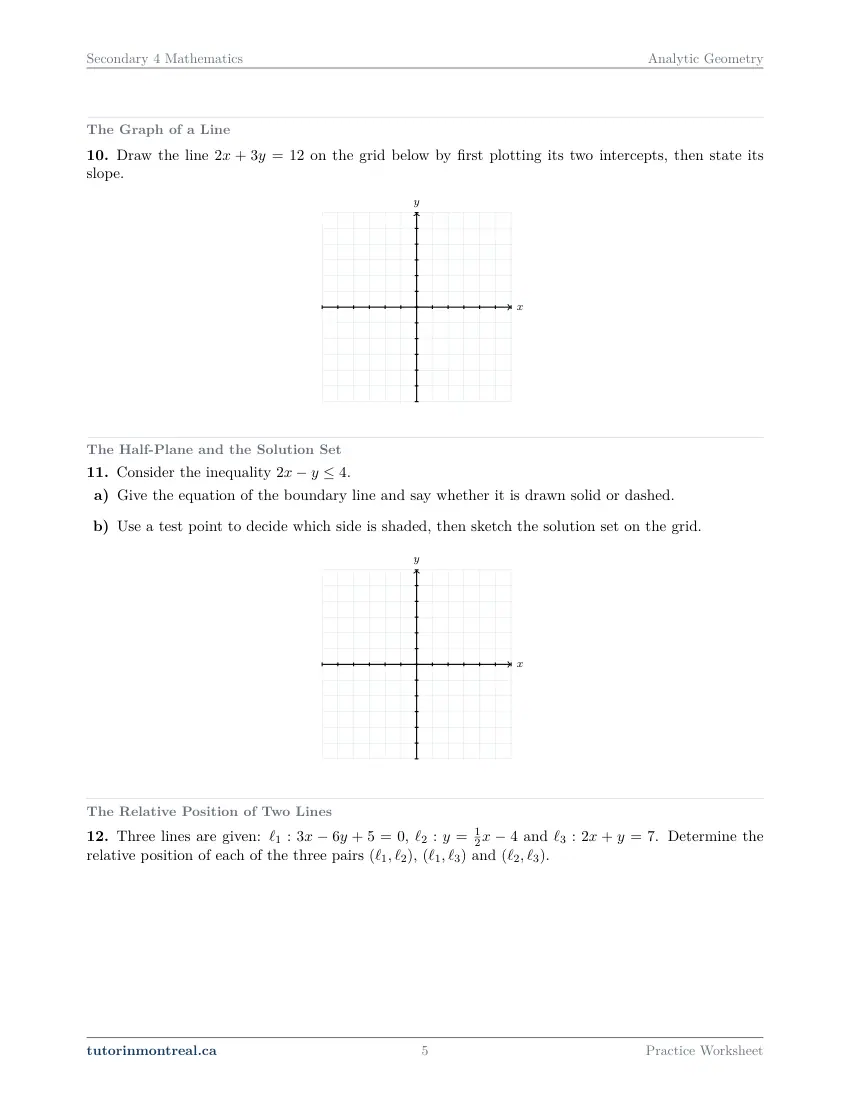
Q10The Graph of a Line
Draw the line on the grid below by first plotting its two intercepts, then state its slope.
A blank Cartesian grid for this question is on the printable PDF.
-
Q11The Half-Plane and the Solution Set
Consider the inequality .
- Give the equation of the boundary line and say whether it is drawn solid or dashed.
- Use a test point to decide which side is shaded, then sketch the solution set on the grid.
A blank Cartesian grid for this question is on the printable PDF.
-
Q12The Relative Position of Two Lines
Three lines are given: , and . Determine the relative position of each of the three pairs , and .
-
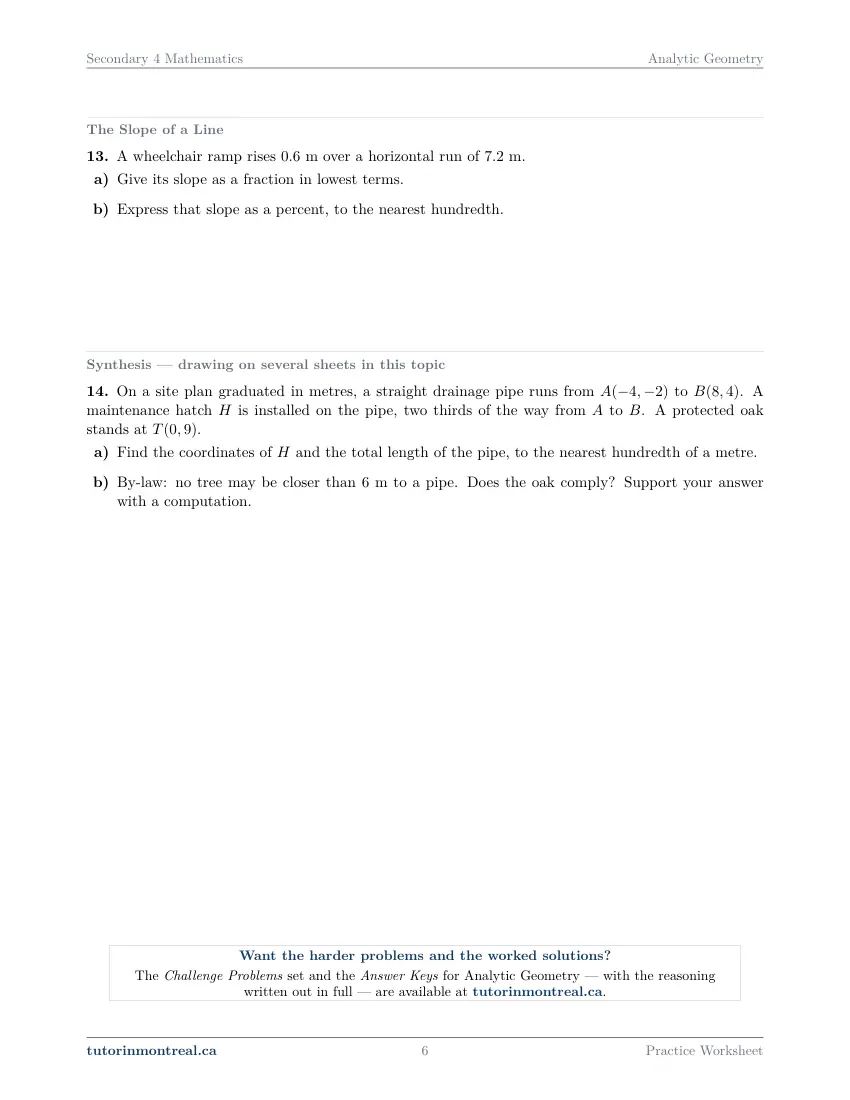
Q13The Slope of a Line
A wheelchair ramp rises m over a horizontal run of m.
- Give its slope as a fraction in lowest terms.
- Express that slope as a percent, to the nearest hundredth.
-
Q14Synthesis — drawing on several sheets in this topic
On a site plan graduated in metres, a straight drainage pipe runs from to . A maintenance hatch is installed on the pipe, two thirds of the way from to . A protected oak stands at .
- Find the coordinates of and the total length of the pipe, to the nearest hundredth of a metre.
- By-law: no tree may be closer than m to a pipe. Does the oak comply? Support your answer with a computation.
The 11 challenge problems for this topic are a separate, paid sheet and are not reproduced here.
Which stream is this for? This sheet is built for SN. It expects the point-to-line distance formula, the division point formula, coordinate proofs with literal coordinates and solution sets written as half-planes, and it goes to the depth that program expects.
How to do every concept on this sheet
This is the part worksheet sites usually leave out. Below is the actual reasoning behind each group of questions — not a full solution set, the decisions that get you to one. Read it before you start, or after you get stuck.
Choosing the tool is the actual skill
Analytic geometry is a small box of formulas and one large decision: which one this question wants. Q1 asks that decision directly, with no numbers at all, and it is the best predictor on the sheet of how the exam will go. Work from what the question wants out, not from what it gives you.
What do you want out of it?
Match the output to the tool, then read off what the tool needs as input.
- 1A length → the distance formula
d = √((x₂ − x₁)² + (y₂ − y₁)²). Also the tool for "is this triangle isosceles?" — compute all three sides and compare, as Q1(c) asks. Q5 is the bare version. - 2A clearance from a line → the point-to-line distance
d = |Ax₀ + By₀ + C| ⁄ √(A² + B²), with the line in general form. Q7 is the bare version; Q6 uses it for two parallel lines; Q14 uses it to decide whether a tree is far enough from a pipe. - 3Coordinates of a point on a segment → the division point formula
P = (x_A + k(x_B − x_A), y_A + k(y_B − y_A)). Withk = ½it is the midpoint. Q8 and Q14 both use it. - 4A yes/no about direction → slopes
Equal slopes mean parallel, a product of −1 means perpendicular, and equal slopes through a shared point mean collinear. Q12 and Q13 live here, and so does Q1(a).
- 5A yes/no about a side → substitute into an inequality
Write the boundary as a line, decide which inequality describes the region you want, and put the point's coordinates in. True means it is in the region. Q1(d), Q4 and Q11.
The three forms of a line, and why anyone needs three (Q2)
They are the same line written for three different purposes, and switching between them is a mechanical skill worth practising until it is boring.
General form Ax + By + C = 0 puts everything on one side. It is the form every distance formula demands, and the only one that can describe a vertical line. Functional form y = ax + b isolates y and hands you the slope and the y-intercept by inspection. Symmetric form x⁄a + y⁄b = 1 hands you both intercepts by inspection, which is why it is the form to reach for when a question is about where a line meets the axes.
Getting to symmetric form. Move the constant to the right, then divide the whole equation by it so the right-hand side becomes exactly 1. For 3x + 4y − 24 = 0:
3x + 4y = 24 → 3x⁄24 + 4y⁄24 = 1 → x⁄8 + y⁄6 = 1The denominators, 8 and 6, are the intercepts. Two things this form cannot do: a line through the origin has no symmetric form, because dividing by a constant of zero is not available, and neither has a line parallel to an axis.
One relation is worth memorising rather than re-deriving each time: in general form the slope is −A⁄B. It falls straight out of isolating y, and it saves a rearrangement every time a question hands you a line as Ax + By + C = 0 and asks about direction — which Q12 does three times over.
The two distance formulas people mix up (Q5, Q6, Q7)
Between two points you use coordinates only. Between a point and a line you use the coefficients of the line and the coordinates of the point. They look nothing alike and they still get swapped, usually because the line was left in functional form.
Put the line in general form first, every time. d = |Ax₀ + By₀ + C| ⁄ √(A² + B²) reads the numbers A, B and C off Ax + By + C = 0. Feed it y = ¾x + 2 as it stands and you will invent coefficients that are not there. Rearranged, that line is 3x − 4y + 8 = 0, and now A = 3, B = −4, C = 8.
The other two slips: dropping the absolute value in the numerator, which can hand you a negative distance, and writing the denominator as A + B instead of √(A² + B²).
Q6 asks for the distance between two parallel lines, and there is no separate formula for it. Pick any point you like on one line — the easiest is usually its y-intercept — and measure from that point to the other line. Because the lines are parallel, the answer does not depend on which point you picked, and that is the whole reason the trick works. If the two lines you were handed do not share the same A and B after simplifying, they are not parallel and the question has a different answer.
Slope, and the four verdicts it gives (Q12, Q13)
Slope is rise over run, a = (y₂ − y₁)⁄(x₂ − x₁), and Q13 asks for it as a fraction in lowest terms and again as a percent — the two ways construction and engineering write the same number. A percent grade is simply the slope multiplied by 100, so a slope of one twelfth is a grade of about 8.33%.
For a pair of lines, compute both slopes and read the verdict. Equal slopes with different y-intercepts means parallel and distinct — no intersection. Equal slopes and equal intercepts means the same line drawn twice, and every point is a solution. A product of −1 means perpendicular. Anything else means they cross exactly once. The case to watch is a vertical line: it has no slope at all, so the product test cannot be applied, and a vertical and a horizontal line are perpendicular by inspection instead.
Division points: k is measured from A (Q8, Q14)
The formula P = A + k(B − A) reads as "start at A and walk the fraction k of the way toward B". Applied to each coordinate separately, that is all there is to it, and the midpoint is just the case k = ½.
A ratio is not a fraction. "One quarter of the way from A to B" gives k = ¼ directly. But a point that divides a segment in the ratio AM : MB = 3 : 2 is not at k = 3⁄2 — the segment is cut into 3 + 2 = 5 equal parts and the point sits after three of them, so k = 3⁄5. Converting the ratio to a fraction of the whole is the step that gets skipped.
Two sanity checks that cost nothing: k between 0 and 1 must land the point between A and B, and the answer to Q8(b) should sit between A and the midpoint you just computed.
Half-planes: the boundary and the side (Q4, Q11)
An inequality in two variables describes a region, and describing it takes two decisions. First, the boundary: draw it solid for ≤ or ≥, because those points belong to the set, and dashed for < or >, because they do not. That is the difference between a closed and an open half-plane, and Q4 asks you to name it.
Second, the side. Take any point not on the boundary, substitute it, and see whether the statement is true; if it is, shade that side. The origin is the easiest test point in existence — unless the boundary passes through it, in which case pick something else. Do not try to reason it out from the direction of the inequality sign; the sign flips meaning depending on which side of the equation y ended up, and the test point never lies.
Q4 also includes a set that is not a half-plane, and the reason is a definition worth stating precisely: a half-plane is bounded by one line. A condition built from an absolute value produces two boundary lines and the region outside a strip between them, so it fails the definition no matter how plausible it looks.
What makes a coordinate argument a proof (Q3)
Q3 is the hardest question on the sheet and the one most students hand in half-done, because checking a specific rhombus feels like work and reads like a proof. It is not one. Verifying a single case cannot establish a claim made about every figure; it only fails to contradict it.
How the coordinates have to be chosen. Use letters, not numbers, so that no particular figure is assumed. Then place the figure conveniently: put one vertex at the origin and one side along the x-axis, which costs no generality because any figure can be translated and rotated into that position. Give the remaining vertices literal coordinates, and write down the algebraic condition that makes the figure the kind you claim — for a rhombus, that all four sides are equal.
From there the computation is the same one the student did, but every line now holds for all admissible values of the letters. The closing sentence matters too: say explicitly that the letters stood for any figure of that kind, so the result holds for all of them. That sentence is where the proof mark is.
Q14: the synthesis problem
A pipe from A to B, a hatch two thirds of the way along it, and a protected tree that must be far enough from the pipe. Three tools in one question: the division point for the hatch, the distance formula for the pipe's length, and the point-to-line distance for the clearance — and that last one needs the equation of the pipe, which you build from its two endpoints first. Read the by-law carefully before you conclude: a clearance comfortably larger than the minimum and one comfortably smaller both need the same sentence of interpretation to earn the mark.
Preview all 6 pages
Click any page to open the full PDF.
Getting the most out of it
Draw the axes even when the question looks purely algebraic
A rough sketch with the points plotted takes twenty seconds and catches almost every sign error on this sheet — a midpoint outside its segment, a distance that came out larger than the whole line, a half-plane shaded on the wrong side.
Convert to general form once, at the start
Both distance formulas and the slope shortcut all read from Ax + By + C = 0. Rewriting every line the question gives you before you begin removes the most common source of wrong coefficients.
Come back to the tool-naming question at the end
Q1 asks which tool applies and what it produces, without computing anything. Do it once before you start and once after you finish; the second attempt is a summary of the whole sheet, and exam questions are usually phrased that way rather than as bare formulas.
Want the solutions, or something more challenging?
The worksheet, the questions above and every explanation on this page stay free permanently. Three more PDFs exist for this topic — the worked answer key, a harder problem set, and the answer key to that. They come with the Secondary 4 Math Solutions Bundle, which is what keeps the rest of the series free.
What else exists for Analytic Geometry
Three PDFs · 12 pages · all three are in the bundle below.
- Answer key — 3 pages. All 14 questions worked step by step, including the restrictions and the justifications. Not a list of final answers.
- Challenge problems — 6 pages, 11 problems. A separate sheet at exam-plus difficulty covering the same 13 concepts. Harder than anything on the free sheet.
- Challenge answer key — 3 pages. Every challenge problem worked to the same standard, with the checks shown.
- PDF, letter size, print-ready.
The one thing that's for sale
Every Secondary 4 Math topic — the complete Solutions Bundle
One download, one payment, the whole program. Every answer key and every challenge set for all 17 Secondary 4 Math worksheet sets — including this one.
- Worked solutions, not answer lists — every step written out
- Covers the whole year's program at this level
- Less than the price of one hour of tutoring — for the entire year's solutions
Taking Secondary 1 Math as well? The Secondary 1 Math bundle covers all 15 of its sets — 45 PDFs, 182 pages — on the same terms.
Taking Secondary 2 Math as well? The Secondary 2 Math bundle covers all 14 of its sets — 42 PDFs, 181 pages — on the same terms.
Taking Secondary 3 Math as well? The Secondary 3 Math bundle covers all 11 of its sets — 33 PDFs, 154 pages — on the same terms.
Taking Secondary 5 Math as well? The Secondary 5 Math bundle covers all 21 of its sets — 63 PDFs, 228 pages — on the same terms.
Taking CEGEP Calculus I as well? The CEGEP Calculus I bundle covers all 8 of its sets — 24 PDFs, 82 pages — on the same terms.
Taking CEGEP Calculus II as well? The CEGEP Calculus II bundle covers all 8 of its sets — 24 PDFs, 90 pages — on the same terms.
Taking CEGEP Linear Algebra as well? The CEGEP Linear Algebra bundle covers all 7 of its sets — 21 PDFs, 82 pages — on the same terms.
Taking AP Calculus AB as well? The AP Calculus AB bundle covers all 8 of its sets — 24 PDFs, 126 pages — on the same terms.
Common questions
Is this worksheet really free?
Yes — the questions are on this page to read, and the PDF downloads directly, no email and no account. The one paid item is optional: the complete Secondary 4 Solutions Bundle, which covers every set at this level.
How do I find the distance from a point to a line?
Put the line in general form Ax + By + C = 0 first, then substitute the point's coordinates into |Ax₀ + By₀ + C| divided by the square root of A² + B². The absolute value is what keeps the result positive, and the denominator is a square root of a sum, never A + B. The same formula handles two parallel lines: pick any point on one of them and measure to the other.
What does k mean in the division point formula?
It is the fraction of the way from the first point to the second, so k = 1/2 gives the midpoint. A ratio has to be converted first: dividing a segment in the ratio 3 : 2 cuts it into five parts, so k is 3/5, not 3/2.
How do I know which side of the line to shade?
Substitute a test point that is not on the boundary — the origin, whenever the line does not pass through it. If the inequality is true for that point, shade its side. Draw the boundary solid for a condition that includes equality and dashed for one that does not.
Why is checking one figure not a proof in analytic geometry?
Because a statement about every rhombus, or every triangle, is not established by one example that happens to work. A coordinate proof uses letters for the coordinates, placed conveniently, so the computation covers all figures of that kind at once.
Which Secondary 4 stream is this for?
It is built for SN. The sheet expects the point-to-line distance formula, the division point formula, coordinate proofs written with literal coordinates and solution sets described as half-planes, which is the depth that program expects.
Can teachers use this in class?
Yes. Print and photocopy it for your own classes freely — I just ask that the tutorinmontreal.ca footer stays on the page.
I'm stuck on one question. Can you help?
Yes — through one-on-one tutoring, in Montreal or online. Get in touch to arrange a session, or see the current rates.
← All 17 Secondary 4 Math worksheets · Secondary 1 Math series (15 sheets) → · Secondary 2 Math series (14 sheets) → · Secondary 3 Math series (11 sheets) → · Secondary 5 Math series (21 sheets) → · CEGEP Calculus I series (8 sheets) → · CEGEP Calculus II series (8 sheets) → · CEGEP Linear Algebra series (7 sheets) → · AP Calculus AB series (8 sheets) →
The same topic at the other level: Secondary 5 Math · Analytic Geometry.