Secondary 4 Random Experiments and Sample Spaces Worksheet
Before any formula, the vocabulary: which experiments count as random, how to list a sample space and size it, what an event and its complement are, and how theoretical, experimental and subjective probability differ in where their numbers come from. Getting these straight is what stops the later conditional-probability questions from turning into guesswork. Have a look on this page, then print the free PDF when you want to write on it.
Practice worksheet — free PDF
No email, no account, no watermark. Teachers: photocopy it for your classes freely. Worked solutions and 2 harder problems come with the Secondary 4 Math bundle.
All 3 questions
Each question targets one named concept from the sheet. Read them here, or print the PDF — it has working space under each one.
-
Q1Probability –
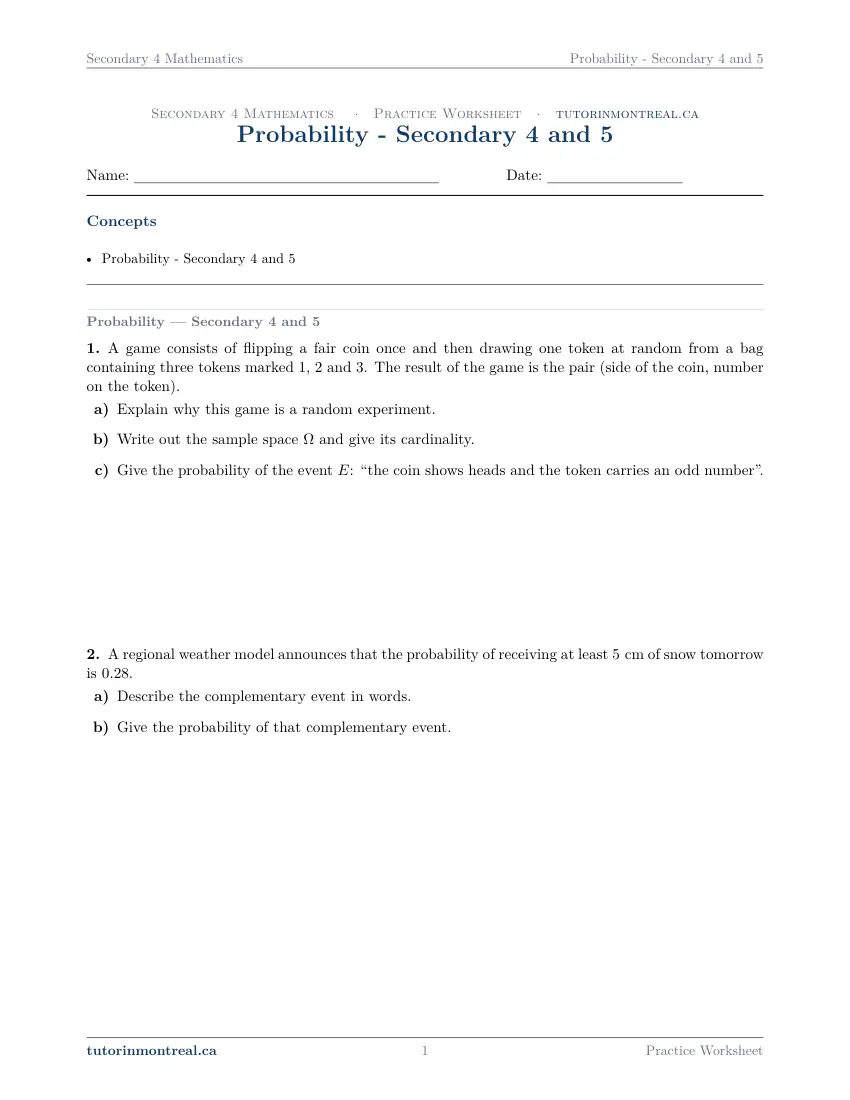
A game consists of flipping a fair coin once and then drawing one token at random from a bag containing three tokens marked 1, 2 and 3. The result of the game is the pair (side of the coin, number on the token).
- Explain why this game is a random experiment.
- Write out the sample space and give its cardinality.
- Give the probability of the event : “the coin shows heads and the token carries an odd number”.
-
Q2Probability –
A regional weather model announces that the probability of receiving at least of snow tomorrow is .
- Describe the complementary event in words.
- Give the probability of that complementary event.
-
Q3Probability –
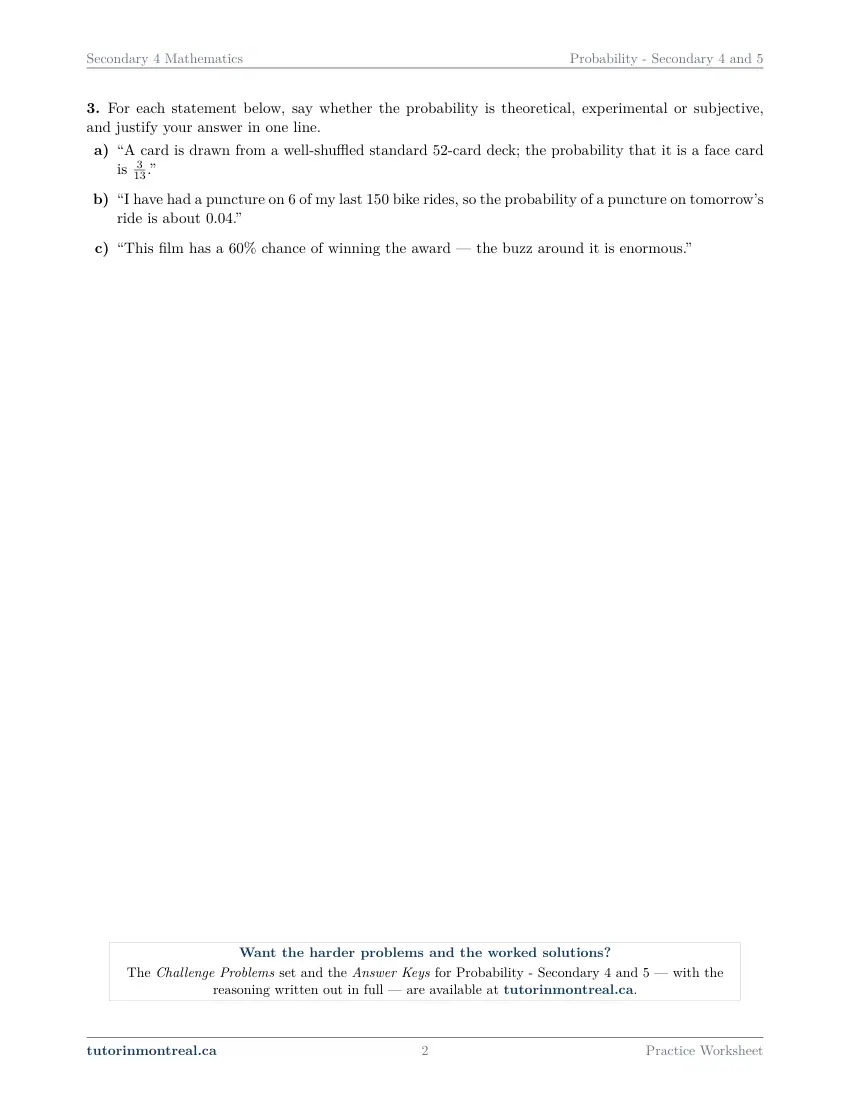
For each statement below, say whether the probability is theoretical, experimental or subjective, and justify your answer in one line.
- “A card is drawn from a well-shuffled standard 52-card deck; the probability that it is a face card is .”
- “I have had a puncture on 6 of my last 150 bike rides, so the probability of a puncture on tomorrow's ride is about .”
- “This film has a chance of winning the award — the buzz around it is enormous.”
The 2 challenge problems for this topic are a separate, paid sheet and are not reproduced here.
Which stream is this for? This sheet is built for SN. It assumes you can write out the sample space of a two-stage experiment, work with complementary events and justify which kind of probability a statement is reporting, and it goes to the depth that program expects.
How to do every concept on this sheet
This is the part worksheet sites usually leave out. Below is the actual reasoning behind each group of questions — not a full solution set, the decisions that get you to one. Read it before you start, or after you get stuck.
Three conditions make an experiment random
Q1(a) asks you to explain why, so the mark is for naming conditions, not for saying the word "chance". An experiment is random when all three of these hold at once:
1. It can be repeated as many times as you like under the same conditions. 2. All of its possible results are known in advance — you could write them down before you start. 3. The result of any single trial cannot be predicted with certainty.
Drop condition 2 and there is no sample space to count with; drop condition 3 and there is nothing left to compute. "You can't know what will happen" is only one third of the answer, and it is the third every student writes.
Writing the sample space of a two-stage experiment
Q1 chains two experiments: a coin, then a draw. The result of the game is neither "heads" nor "a 2" — it is the ordered pair made of one result from each stage, and pairs are what Ω has to contain.
Listing Ω without losing an outcome
Work systematically. A list written in the order the outcomes occur to you is a list with a gap in it.
- 1Count before you list
Multiply the number of results available at each stage. Two sides times three tokens is six, so you know Ω must end up with six elements before you have written a single one.
- 2Hold the first stage fixed
Write every pair that starts with heads, then every pair that starts with tails. A tree diagram, or a table with one row per side of the coin, enforces the same discipline.
- 3State the cardinality
n(Ω)is simply how many elements you listed. Compare it with the product from step 1: if the two disagree, you have duplicated an outcome or missed one. - 4Read the event off the list
An event is a subset of Ω. Underline the pairs that match the description word for word — "heads and an odd number" needs both halves true — then count them to get
n(E).
The counting formula, and the condition that makes it legal
P(E) = n(E) ⁄ n(Ω)This formula counts outcomes, nothing more. It is valid only when every outcome of Ω is equally likely — which is exactly why Q1 tells you the coin is fair and the token is drawn at random. Those two words are not scene-setting; they are the hypothesis the formula needs.
The mistake: splitting a situation into two outcomes and concluding that each one has probability ½. A thumbtack tossed on a table lands point up or point down — two outcomes, nowhere near equally likely. Cutting a sample space in two does not make its parts interchangeable. When you cannot argue that the outcomes are equiprobable, the counting formula is unavailable and the only honest route is to repeat the experiment and measure frequencies.
Complementary events (Q2)
The complement E′ holds every outcome of Ω that is not in E — no more and no less. Since E and E′ overlap nowhere and together fill Ω:
P(E) + P(E′) = 1, so P(E′) = 1 − P(E)That identity earns its keep later in the course: whenever an event is described with the words "at least one", the complement ("none") is far easier to count than the event itself, and one subtraction finishes the job.
Where the mark goes: the boundary value. "At least 5 cm" includes exactly 5 cm, so the complement is "less than 5 cm" — not "at most 5 cm", which would count 5 cm in both events at once. Negate the inequality rather than the sentence: the opposite of ≥ is <, and the opposite of > is ≤. Then check your two descriptions cover everything and overlap nowhere; if they do not, the probabilities cannot add to 1.
Theoretical, experimental or subjective (Q3)
Q3 gives three statements and asks for a one-line justification of each label. The label follows from where the number came from — never from how confident the sentence sounds.
Which kind of probability is it?
Ask how the value was obtained, in this order.
- 1Counted from equally likely cases?
Then it is theoretical. Nothing was tried: a model — a fair die, a shuffled deck — supplies the answer in advance, and the justification names the count, such as "12 face cards out of 52".
- 2Measured over a number of trials?
Then it is experimental, or frequency-based: successes divided by trials. It is an estimate, and its reliability grows with the number of trials — which is why the justification should quote that number.
- 3A judgment about a one-off event?
Then it is subjective. An award, an election, a first attempt at something: the event cannot be repeated and its cases cannot be counted, so the figure expresses an opinion, however well informed.
The three are related rather than rival. Where a theoretical model exists, the experimental probability drifts towards it as trials accumulate — that is the whole reason a frequency measured over a hundred and fifty rides is worth quoting while one measured over three rides is not. And where no model exists, an experimental value is the best thing available, which is why it is the standard tool in sport, insurance and quality control.
Preview all 2 pages
Click any page to open the full PDF.
Getting the most out of it
Write Ω out in full, at least once
It is tempting to jump straight to 2 × 3 = 6. Listing the six pairs by hand is what stops you writing "heads" as an outcome later on, and on an exam the list itself is usually worth a mark.
Say the number back in a sentence
After every probability you compute, translate it: "in roughly seven days out of ten, less than that much snow falls". A value above 1 or below 0 dies instantly under that test, and so does a complement you have taken the wrong way round.
Justify in one line, on purpose
Q3 is marked on the justification, not the label — a coin flip gets you the label half the time. Practise writing the reason in a single clause: "counted from equiprobable cases", "observed over 150 trials", "a personal judgment on an unrepeatable event".
Want the solutions, or something more challenging?
The worksheet, the questions above and every explanation on this page stay free permanently. Three more PDFs exist for this topic — the worked answer key, a harder problem set, and the answer key to that. They come with the Secondary 4 Math Solutions Bundle, which is what keeps the rest of the series free.
What else exists for Probability - Secondary 4 and 5
Three PDFs · 4 pages · all three are in the bundle below.
- Answer key — 1 page. All 3 questions worked step by step, including the restrictions and the justifications. Not a list of final answers.
- Challenge problems — 2 pages, 2 problems. A separate sheet at exam-plus difficulty covering the same 1 concept. Harder than anything on the free sheet.
- Challenge answer key — 1 page. Every challenge problem worked to the same standard, with the checks shown.
- PDF, letter size, print-ready.
The one thing that's for sale
Every Secondary 4 Math topic — the complete Solutions Bundle
One download, one payment, the whole program. Every answer key and every challenge set for all 17 Secondary 4 Math worksheet sets — including this one.
- Worked solutions, not answer lists — every step written out
- Covers the whole year's program at this level
- Less than the price of one hour of tutoring — for the entire year's solutions
Taking Secondary 1 Math as well? The Secondary 1 Math bundle covers all 15 of its sets — 45 PDFs, 182 pages — on the same terms.
Taking Secondary 2 Math as well? The Secondary 2 Math bundle covers all 14 of its sets — 42 PDFs, 181 pages — on the same terms.
Taking Secondary 3 Math as well? The Secondary 3 Math bundle covers all 11 of its sets — 33 PDFs, 154 pages — on the same terms.
Taking Secondary 5 Math as well? The Secondary 5 Math bundle covers all 21 of its sets — 63 PDFs, 228 pages — on the same terms.
Taking CEGEP Calculus I as well? The CEGEP Calculus I bundle covers all 8 of its sets — 24 PDFs, 82 pages — on the same terms.
Taking CEGEP Calculus II as well? The CEGEP Calculus II bundle covers all 8 of its sets — 24 PDFs, 90 pages — on the same terms.
Taking CEGEP Linear Algebra as well? The CEGEP Linear Algebra bundle covers all 7 of its sets — 21 PDFs, 82 pages — on the same terms.
Taking AP Calculus AB as well? The AP Calculus AB bundle covers all 8 of its sets — 24 PDFs, 126 pages — on the same terms.
Common questions
Is this worksheet really free?
Yes — the questions are on this page to read, and the PDF downloads directly, no email and no account. The one paid item is optional: the complete Secondary 4 Solutions Bundle, which covers every set at this level.
How do I write the sample space of an experiment with two stages?
Each outcome is an ordered pair holding one result from each stage, so multiply the counts to know how many pairs to expect, then list them by keeping the first stage fixed and running through the second. A tree diagram does the same job and makes a missing branch visible.
When am I allowed to use P(E) = n(E)/n(Ω)?
Only when every outcome in the sample space is equally likely — a fair coin, a balanced die, a random draw. If the outcomes are not interchangeable, counting them tells you nothing about their probabilities, and you need observed frequencies instead.
What is the complement of 'at least 5 cm'?
"Less than 5 cm", strictly. "At least 5 cm" already includes the value 5, so the complement has to exclude it; negate the inequality symbol rather than the English sentence. Its probability is 1 minus the probability of the original event.
How do I tell theoretical, experimental and subjective probability apart?
By where the number came from. Counted from equally likely cases with no trials run, it is theoretical; measured as successes over trials, it is experimental; offered as a judgment about an event that cannot be repeated, it is subjective.
Which Secondary 4 stream is this for?
It is built for SN. The sheet assumes you can write out a sample space, work with complementary events and justify which kind of probability a statement reports, and it goes to the depth that program expects.
Can teachers use this in class?
Yes. Print and photocopy it for your own classes freely — I just ask that the tutorinmontreal.ca footer stays on the page.
I'm stuck on one question. Can you help?
Yes — through one-on-one tutoring, in Montreal or online. Get in touch to arrange a session, or see the current rates.
← All 17 Secondary 4 Math worksheets · Secondary 1 Math series (15 sheets) → · Secondary 2 Math series (14 sheets) → · Secondary 3 Math series (11 sheets) → · Secondary 5 Math series (21 sheets) → · CEGEP Calculus I series (8 sheets) → · CEGEP Calculus II series (8 sheets) → · CEGEP Linear Algebra series (7 sheets) → · AP Calculus AB series (8 sheets) →
The same topic at the other level: Secondary 5 Math · Probability - Secondary 4 and 5.