Secondary 4 Trigonometry and Metric Relations Worksheet
The Secondary 4 triangle unit is a choice between tools, and choosing well is most of the mark: the sine, cosine and tangent ratios, the metric relations in a right triangle, the law of sines, the law of cosines, Heron's formula and the sine area formula. The questions are built so that one tool is short and the others are long. No registration and no charge: print it, or work straight from the screen.
Practice worksheet — free PDF
No email, no account, no watermark. Teachers: photocopy it for your classes freely. Worked solutions and 10 harder problems come with the Secondary 4 Math bundle.
All 11 questions
Each question targets one named concept from the sheet. Read them here, or print the PDF — it has working space under each one.
-
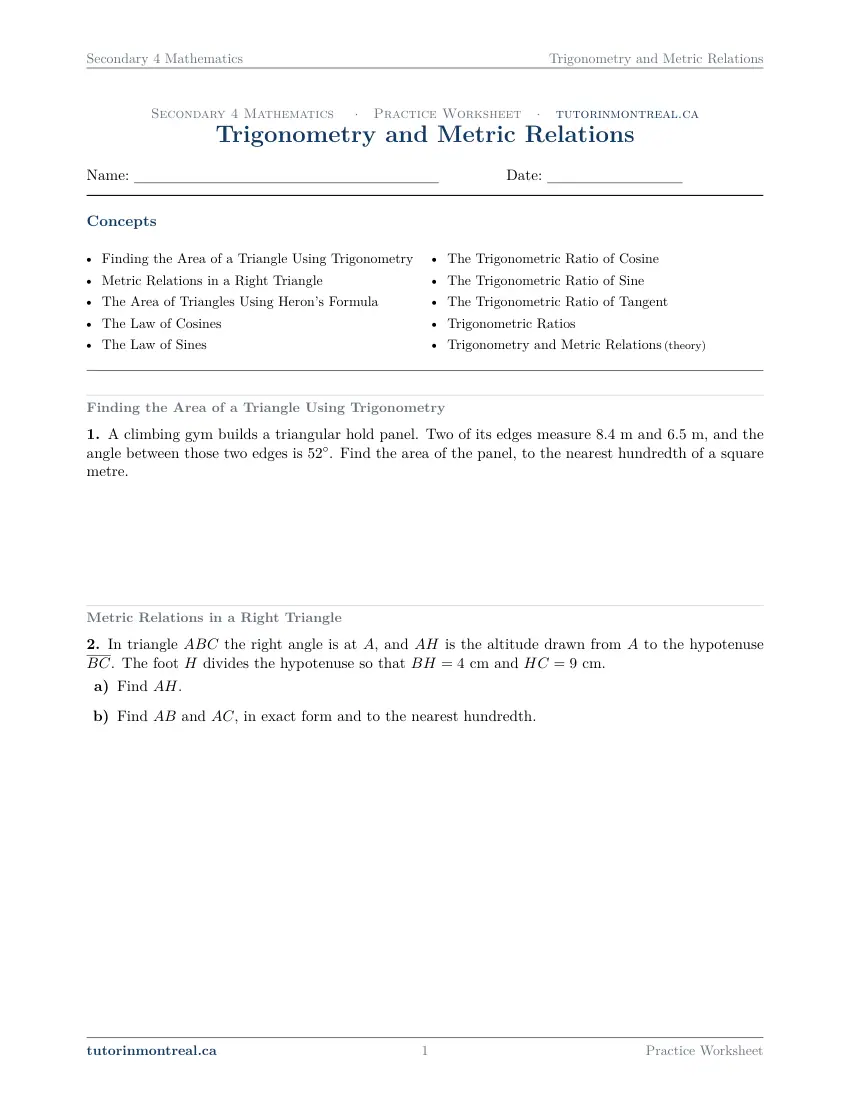
Q1Finding the Area of a Triangle Using Trigonometry
A climbing gym builds a triangular hold panel. Two of its edges measure and , and the angle between those two edges is . Find the area of the panel, to the nearest hundredth of a square metre.
-
Q2Metric Relations in a Right Triangle
In triangle the right angle is at , and is the altitude drawn from to the hypotenuse . The foot divides the hypotenuse so that and .
- Find .
- Find and , in exact form and to the nearest hundredth.
-
Q3The Area of Triangles Using Heron's Formula
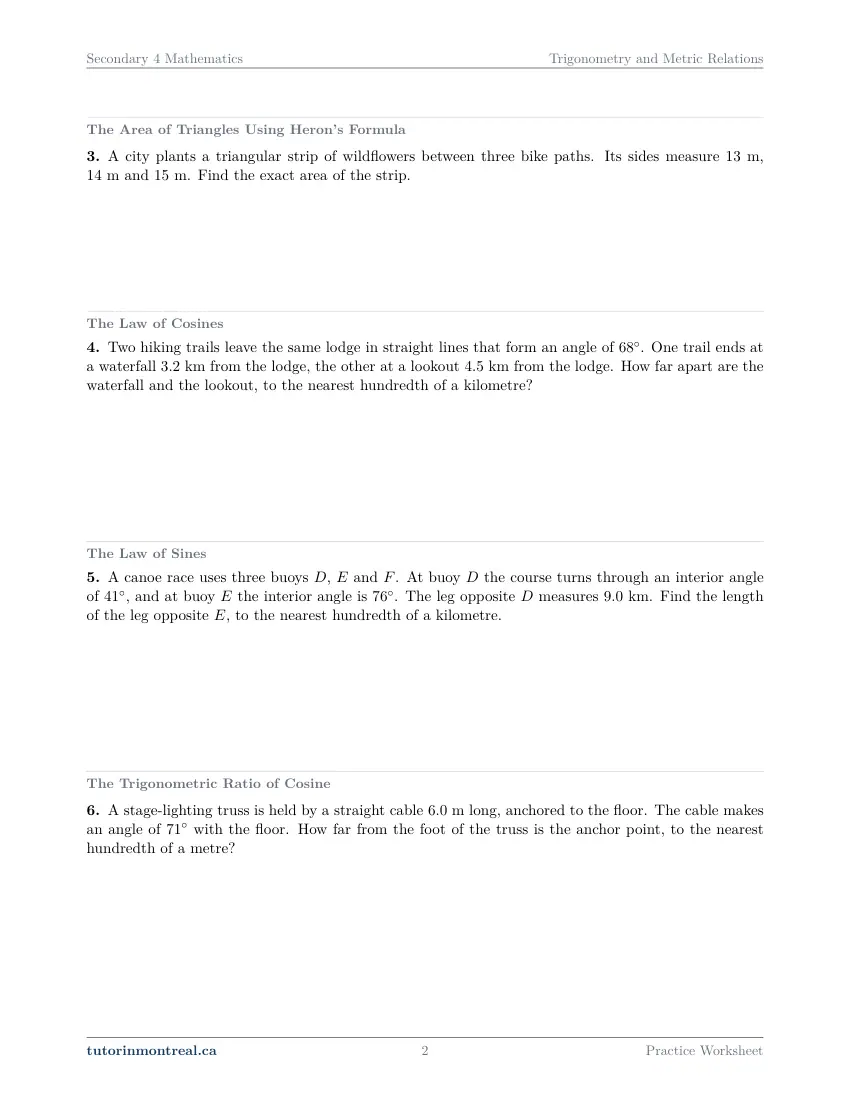
A city plants a triangular strip of wildflowers between three bike paths. Its sides measure , and . Find the exact area of the strip.
-
Q4The Law of Cosines
Two hiking trails leave the same lodge in straight lines that form an angle of . One trail ends at a waterfall from the lodge, the other at a lookout from the lodge. How far apart are the waterfall and the lookout, to the nearest hundredth of a kilometre?
-
Q5The Law of Sines
A canoe race uses three buoys , and . At buoy the course turns through an interior angle of , and at buoy the interior angle is . The leg opposite measures . Find the length of the leg opposite , to the nearest hundredth of a kilometre.
-
Q6The Trigonometric Ratio of Cosine
A stage-lighting truss is held by a straight cable long, anchored to the floor. The cable makes an angle of with the floor. How far from the foot of the truss is the anchor point, to the nearest hundredth of a metre?
-
Q7The Trigonometric Ratio of Sine
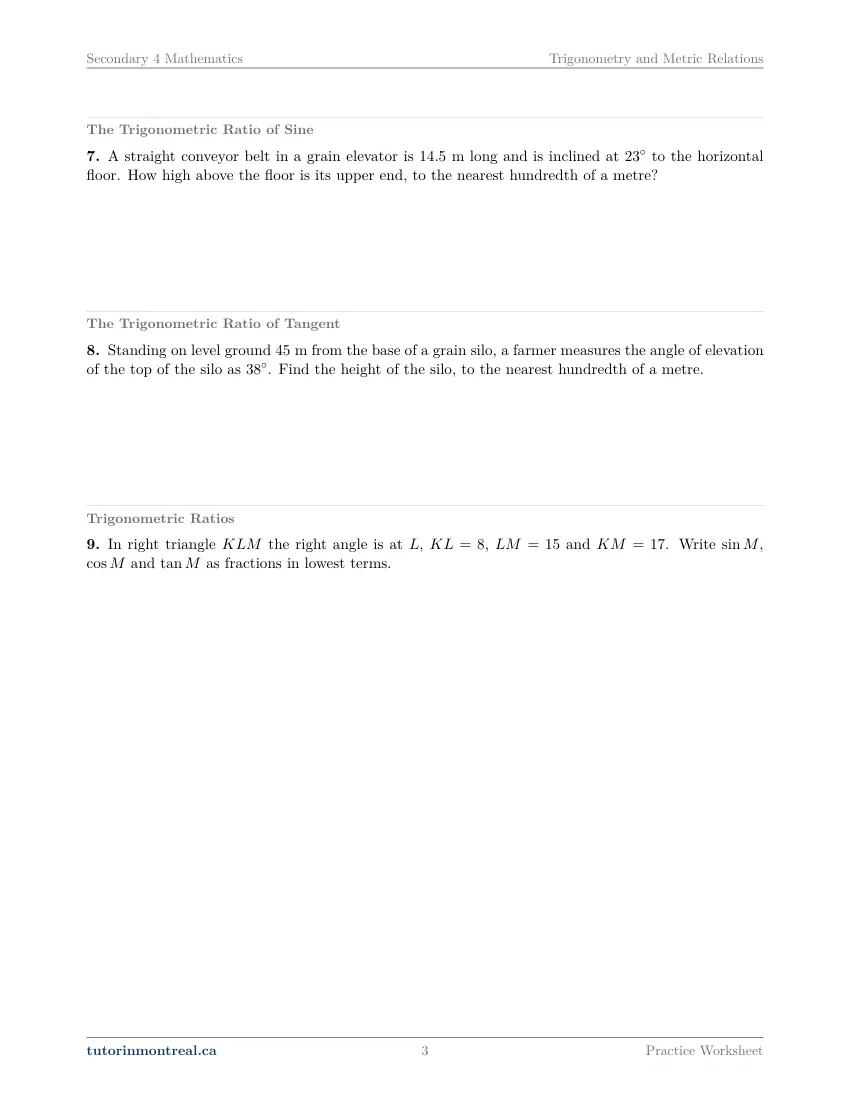
A straight conveyor belt in a grain elevator is long and is inclined at to the horizontal floor. How high above the floor is its upper end, to the nearest hundredth of a metre?
-
Q8The Trigonometric Ratio of Tangent
Standing on level ground from the base of a grain silo, a farmer measures the angle of elevation of the top of the silo as . Find the height of the silo, to the nearest hundredth of a metre.
-
Q9Trigonometric Ratios
In right triangle the right angle is at , , and . Write , and as fractions in lowest terms.
-
Q10Trigonometry and Metric Relations
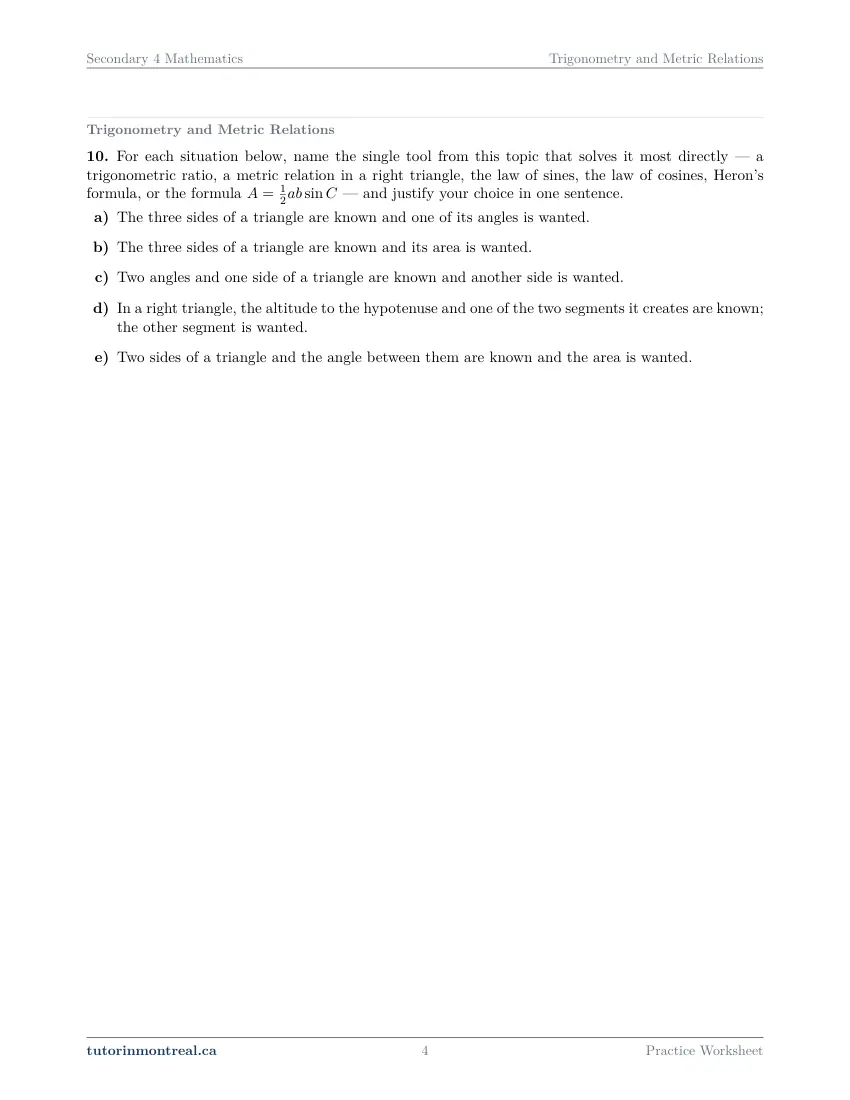
For each situation below, name the single tool from this topic that solves it most directly — a trigonometric ratio, a metric relation in a right triangle, the law of sines, the law of cosines, Heron's formula, or the formula — and justify your choice in one sentence.
- The three sides of a triangle are known and one of its angles is wanted.
- The three sides of a triangle are known and its area is wanted.
- Two angles and one side of a triangle are known and another side is wanted.
- In a right triangle, the altitude to the hypotenuse and one of the two segments it creates are known; the other segment is wanted.
- Two sides of a triangle and the angle between them are known and the area is wanted.
-
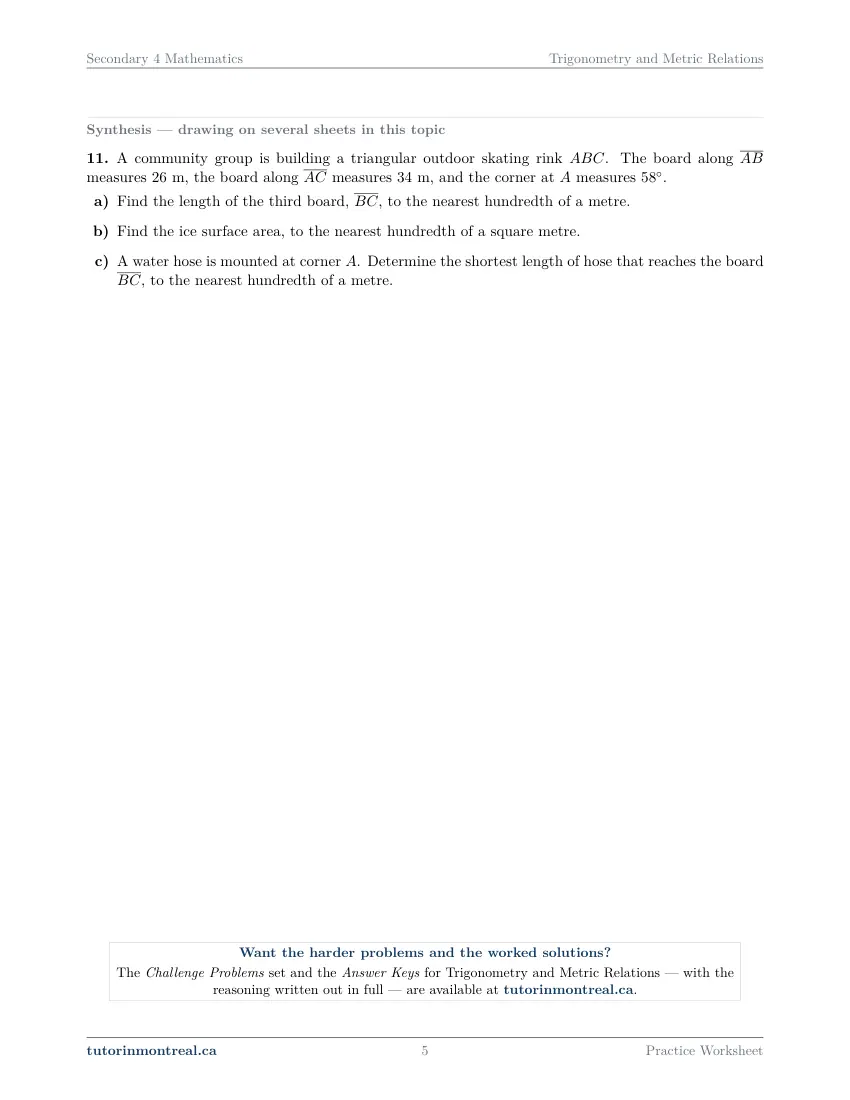
Q11Synthesis — drawing on several sheets in this topic
A community group is building a triangular outdoor skating rink . The board along measures , the board along measures , and the corner at measures .
- Find the length of the third board, , to the nearest hundredth of a metre.
- Find the ice surface area, to the nearest hundredth of a square metre.
- A water hose is mounted at corner . Determine the shortest length of hose that reaches the board , to the nearest hundredth of a metre.
The 10 challenge problems for this topic are a separate, paid sheet and are not reproduced here.
Which stream is this for? This sheet is built for SN. It assumes you are working with any triangle, not only right ones, and that the laws of sines and cosines, Heron's formula and the metric relations are all on the table, and it goes to the depth that program expects.
How to do every concept on this sheet
This is the part worksheet sites usually leave out. Below is the actual reasoning behind each group of questions — not a full solution set, the decisions that get you to one. Read it before you start, or after you get stuck.
Choosing the tool: the decision that is the actual skill
Q10 asks you outright which tool solves each situation, and every other question on the sheet is a disguised version of the same choice. On an exam nobody labels the question, so run through this list and stop at the first line that matches the data you were given.
Which relation fits the data?
Start by asking one question: is the triangle right-angled, and is the unknown a length, an angle or an area?
- 1Right triangle, one acute angle and one side → a trigonometric ratio
SOH-CAH-TOA. Q6 pairs an angle with the hypotenuse and wants the adjacent side, Q7 pairs an angle with the hypotenuse and wants the opposite side, Q8 pairs the two legs. Choose the ratio that mentions the side you know and the side you want, and nothing else.
- 2Right triangle with the altitude to the hypotenuse → a metric relation
The moment a figure has a foot on the hypotenuse, as in Q2, no trigonometry is needed: the three metric relations link the segments, the legs and the altitude directly.
- 3Any triangle, an angle paired with its opposite side → the law of sines
Q5 gives two angles and the side opposite one of them. If you can complete a pair (angle, opposite side) and a second item of that pair, the law of sines is the shortest road.
- 4Any triangle, two sides and the included angle, or all three sides → the law of cosines
Q4 is the first case. Rearranged as
cos A = (b² + c² − a²)/(2bc), it is also the only relation that gets an angle out of three sides. - 5Area from two sides and the angle between them → ½ab sin C
Q1. Built exactly for that data; Heron's formula would force you to find the third side first.
- 6Area from three sides → Heron's formula
Q3. No angle needed, and no angle should be computed on the way.
Labelling a right triangle: adjacent depends on which angle you mean
Questions 6 to 9 are one skill practised four ways. The hypotenuse is fixed — it is always the side facing the right angle — but "opposite" and "adjacent" swap places the moment you switch to the other acute angle. Q9 makes the point explicitly by asking for all three ratios of one named angle.
sin θ = opp ⁄ hyp cos θ = adj ⁄ hyp tan θ = opp ⁄ adjBefore you write a ratio, mark the figure. Put your finger on the angle named in the question, label the side facing it "opp", the remaining leg "adj", and the side facing the right angle "hyp". Then pick the ratio whose two letters are the side you know and the side you want — that is the whole decision.
Two sanity checks that cost nothing. Since the hypotenuse is the longest side, sin and cos of an acute angle always land strictly between 0 and 1; a value above 1 means the ratio was inverted. And an angle of elevation, as in Q8, is measured up from the horizontal, which puts the height opposite it and the ground distance adjacent — so the tangent is the ratio that involves neither the hypotenuse nor a calculation you were not given.
The three metric relations in a right triangle (Q2)
Drop the altitude from the right angle onto the hypotenuse and it cuts that hypotenuse into two segments, m and n. The three relations that follow are all consequences of one fact: the altitude splits the triangle into two smaller triangles similar to it and to each other.
h² = m · n leg² = (its own projection) · (whole hypotenuse) (leg)(leg) = (hypotenuse)(h)In words: the altitude is the geometric mean of the two segments; each leg is the geometric mean of the segment beneath it and the whole hypotenuse; and the product of the legs equals the product of the hypotenuse and the altitude. That third relation is the same statement as "the area computed two ways", which is why it makes such a good check — Q2 invites you to use it as one.
The mistake: feeding the whole hypotenuse into the relation where a projection belongs, or the far segment instead of the near one. Each leg pairs with the segment it touches. Write m, n and m + n on the figure before substituting anything, and remember that the hypotenuse in the second relation is the whole of it, not the piece.
Law of sines or law of cosines?
Both hold in any triangle; they answer different questions.
a ⁄ sin A = b ⁄ sin B = c ⁄ sin C a² = b² + c² − 2bc·cos AThe law of sines needs a complete pair — an angle together with the side facing it — plus one more item. Q5 gives two angles and one side, so the third angle is free (the three add to 180°) and every side follows. The law of cosines needs no such pair: it works from two sides and the angle between them, as in Q4, and rearranged it delivers an angle from three sides. It is the generalisation of the Pythagorean theorem, and you can see it — set A = 90°, so cos A = 0, and the correction term vanishes.
Check the answer against the shape. A third side must sit strictly between the difference and the sum of the other two, so Q4's answer has to lie between 1.3 km and 7.7 km. And in any triangle the longest side faces the largest angle, which is the check Q5 is set up for: the angle at E is bigger than the angle at D, so the side opposite E must come out longer. These take five seconds and catch a mis-typed calculator entry every time.
One caution for later: using the law of sines to find an angle is not always conclusive, because an angle and its supplement have the same sine. Finding a length is safe; finding an angle from a sine deserves a second thought about whether the obtuse option is possible too.
Two roads to an area, and a third use for one of them
Q1 and Q3 are the same task with different data. With two sides and the angle between them, use
A = ½ · a · b · sin CThe angle must be the included one — the corner where the two sides meet — because the formula is really "half base times height" with b sin C playing the part of the height. Since sin C ≤ 1, the area can never exceed ½ab, which is a free upper bound on your answer.
With three sides and no angle at all, use Heron's formula, where s is the half-perimeter:
s = (a + b + c) ⁄ 2 A = √( s(s − a)(s − b)(s − c) )Compute s first and write down all four factors before you multiply; the usual error is halving the perimeter of only part of the triangle, or forgetting that s itself is one of the four factors.
An area is also a way to find a height. Once you know the area by any method, the relation A = ½ × base × height gives the altitude to any side you like. That is the move part (c) of the synthesis question needs: the shortest path from a corner to the opposite board is the perpendicular — that is, the altitude — and dividing twice the area by that side produces it without any further trigonometry.
The synthesis question (Q11)
Two boards and the corner between them: the same data set feeds all three parts. Part (a) is a law of cosines, part (b) is the sine area formula on the identical numbers, and part (c) reuses the area from (b) together with the side from (a). Answer them in order and the question shrinks; answer part (c) first and you will find yourself computing an angle you were never asked for. A last check: the altitude from a corner is always shorter than either side meeting at that corner.
Calculator discipline, and the rounding instruction
Degrees, not radians. Every angle on this sheet is in degrees. A calculator left in radian mode gives answers that look plausible and are wrong, and it is the single most common reason a whole page of trigonometry loses its marks.
Round once, at the end. Each question states its precision — "to the nearest hundredth" — and that instruction applies to the final answer only. Rounding sin 52° to two decimals partway through and then multiplying by two lengths moves the result by more than a hundredth, so keep the full value in the calculator and round when you write the answer down, with its unit.
Preview all 5 pages
Click any page to open the full PDF.
Getting the most out of it
Draw the triangle, even when one is described in words
Most questions here give a situation, not a figure. Sketch it, mark the right angle if there is one, and write every known length and angle onto your sketch before choosing a formula. Half the difficulty of this topic is deciding what you have, and a labelled sketch decides it for you.
Name the tool out loud before you compute
Say "two sides and the included angle, so law of cosines" before touching the calculator. Q10 marks exactly that sentence, and building the habit on the computing questions is what makes the naming question free.
Finish every answer with a check line
A side between the difference and the sum of the other two; the largest side facing the largest angle; an area below ½ab; an altitude shorter than the sides beside it. One line of checking per question catches the mode errors and the mis-keyed entries that otherwise survive to the end of the exam.
Want the solutions, or something more challenging?
The worksheet, the questions above and every explanation on this page stay free permanently. Three more PDFs exist for this topic — the worked answer key, a harder problem set, and the answer key to that. They come with the Secondary 4 Math Solutions Bundle, which is what keeps the rest of the series free.
What else exists for Trigonometry and Metric Relations
Three PDFs · 11 pages · all three are in the bundle below.
- Answer key — 3 pages. All 11 questions worked step by step, including the restrictions and the justifications. Not a list of final answers.
- Challenge problems — 5 pages, 10 problems. A separate sheet at exam-plus difficulty covering the same 10 concepts. Harder than anything on the free sheet.
- Challenge answer key — 3 pages. Every challenge problem worked to the same standard, with the checks shown.
- PDF, letter size, print-ready.
The one thing that's for sale
Every Secondary 4 Math topic — the complete Solutions Bundle
One download, one payment, the whole program. Every answer key and every challenge set for all 17 Secondary 4 Math worksheet sets — including this one.
- Worked solutions, not answer lists — every step written out
- Covers the whole year's program at this level
- Less than the price of one hour of tutoring — for the entire year's solutions
Taking Secondary 1 Math as well? The Secondary 1 Math bundle covers all 15 of its sets — 45 PDFs, 182 pages — on the same terms.
Taking Secondary 2 Math as well? The Secondary 2 Math bundle covers all 14 of its sets — 42 PDFs, 181 pages — on the same terms.
Taking Secondary 3 Math as well? The Secondary 3 Math bundle covers all 11 of its sets — 33 PDFs, 154 pages — on the same terms.
Taking Secondary 5 Math as well? The Secondary 5 Math bundle covers all 21 of its sets — 63 PDFs, 228 pages — on the same terms.
Taking CEGEP Calculus I as well? The CEGEP Calculus I bundle covers all 8 of its sets — 24 PDFs, 82 pages — on the same terms.
Taking CEGEP Calculus II as well? The CEGEP Calculus II bundle covers all 8 of its sets — 24 PDFs, 90 pages — on the same terms.
Taking CEGEP Linear Algebra as well? The CEGEP Linear Algebra bundle covers all 7 of its sets — 21 PDFs, 82 pages — on the same terms.
Taking AP Calculus AB as well? The AP Calculus AB bundle covers all 8 of its sets — 24 PDFs, 126 pages — on the same terms.
Common questions
Is this worksheet really free?
Yes — the questions are on this page to read, and the PDF downloads directly, no email and no account. The one paid item is optional: the complete Secondary 4 Solutions Bundle, which covers every set at this level.
When do I use the law of sines and when the law of cosines?
Use the law of sines when you can complete a pair made of an angle and the side facing it, which is the case whenever two angles are known. Use the law of cosines when you have two sides and the angle between them, or all three sides — it is the only relation that links three sides to one angle. For an area the same logic applies: two sides and the included angle call for the sine area formula, three sides call for Heron's.
What are the metric relations in a right triangle?
With the altitude drawn to the hypotenuse, the altitude is the geometric mean of the two segments it creates, each leg is the geometric mean of the segment beneath it and the whole hypotenuse, and the product of the legs equals the product of the hypotenuse and the altitude. All three come from the similar triangles the altitude creates.
How do I know whether a side is opposite or adjacent?
Relative to the angle named in the question. The hypotenuse always faces the right angle; of the two legs, the one facing your angle is opposite and the other is adjacent. Switch to the other acute angle and those two labels swap, which is why you should mark the figure before writing a ratio.
Why do my answers come out wrong even though my method is right?
Almost always the calculator is in radian mode, or a value was rounded partway through. Set the calculator to degrees before you start, keep full precision until the final line, and only then round to the precision the question asks for.
Which Secondary 4 stream is this for?
It is built for SN. The sheet works with any triangle, not only right-angled ones, and expects the laws of sines and cosines, Heron's formula and the metric relations, at the depth that program requires.
Can teachers use this in class?
Yes. Print and photocopy it for your own classes freely — I just ask that the tutorinmontreal.ca footer stays on the page.
I'm stuck on one question. Can you help?
Yes — through one-on-one tutoring, in Montreal or online. Get in touch to arrange a session, or see the current rates.
← All 17 Secondary 4 Math worksheets · Secondary 1 Math series (15 sheets) → · Secondary 2 Math series (14 sheets) → · Secondary 3 Math series (11 sheets) → · Secondary 5 Math series (21 sheets) → · CEGEP Calculus I series (8 sheets) → · CEGEP Calculus II series (8 sheets) → · CEGEP Linear Algebra series (7 sheets) → · AP Calculus AB series (8 sheets) →
The same topic at the other level: Secondary 5 Math · Trigonometry and Metric Relations.