Secondary 4 Algebraic Expressions Worksheet
Factoring is the skill the rest of Secondary 4 keeps borrowing, so this sheet drills the whole decision: greatest common factor, difference of squares, perfect square trinomial, the product-sum technique, grouping, and the quadratic formula used as a factoring tool. From there it moves to the four operations on rational expressions and the restrictions that ride along with them, completing the square, and dividing a polynomial by a binomial. Read it on screen if you like; the printable PDF costs nothing and asks for no account.
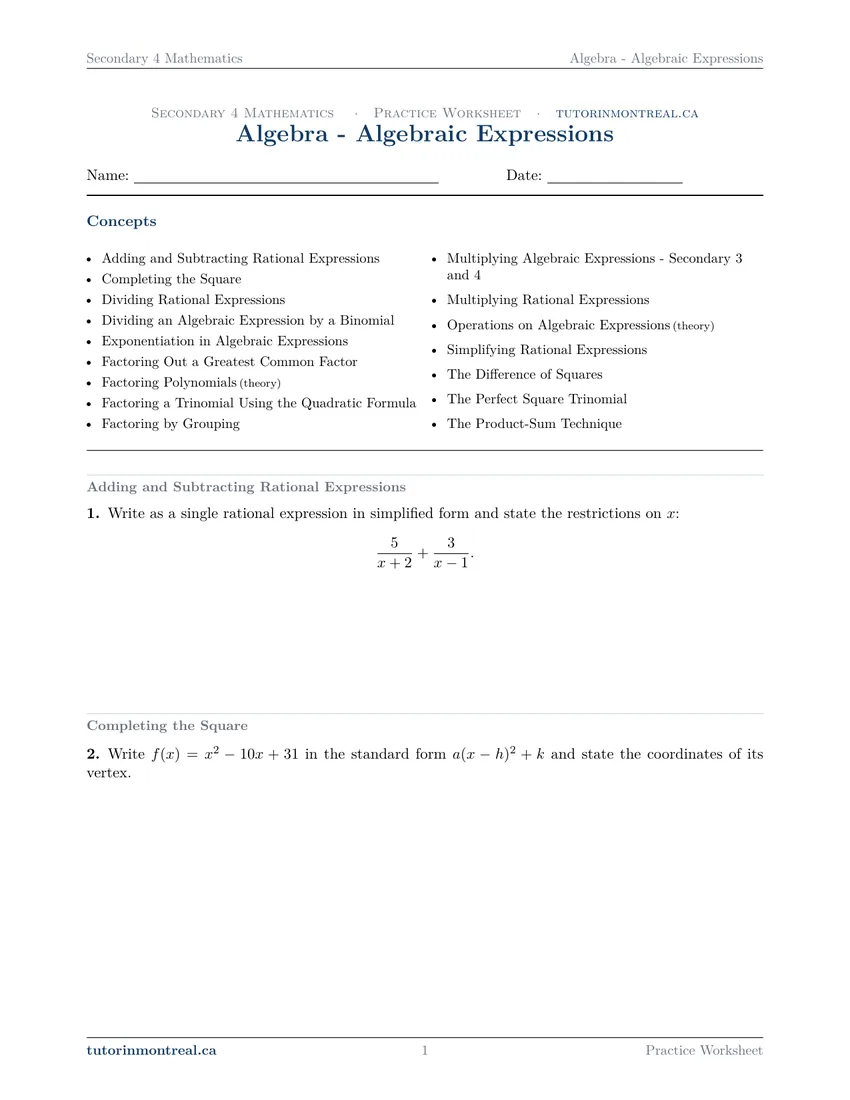
Practice worksheet — free PDF
No email, no account, no watermark. Teachers: photocopy it for your classes freely. Worked solutions and 15 harder problems come with the Secondary 4 Math bundle.
All 17 questions
Each question targets one named concept from the sheet. Read them here, or print the PDF — it has working space under each one.
-
Q1Adding and Subtracting Rational Expressions
Write as a single rational expression in simplified form and state the restrictions on :
-
Q2Completing the Square
Write in the standard form and state the coordinates of its vertex.
-
Q3Dividing Rational Expressions
Simplify and state the restrictions:
-
Q4Dividing an Algebraic Expression by a Binomial
Carry out the division and state the quotient and the remainder.
-
Q5Exponentiation in Algebraic Expressions
Simplify, writing the result with positive exponents only:
-
Q6Factoring Out a Greatest Common Factor
Factor completely: .
-
Q7Factoring Polynomials
For each polynomial below, name the factoring technique that should be applied first, then give the complete factorization.
-
Q8Factoring a Trinomial Using the Quadratic Formula
Use the quadratic formula to factor over the integers.
-
Q9Factoring by Grouping
Factor by grouping: .
-
Q10Multiplying Algebraic Expressions –
Expand and simplify: .
-
Q11Multiplying Rational Expressions
Simplify and state the restrictions:
-
Q12Operations on Algebraic Expressions
Decide whether each statement is true for all polynomials concerned. Justify a true statement with an argument and a false one with an explicit counterexample.
- The product of two binomials is always a trinomial.
- The sum of two polynomials of degree is always a polynomial of degree .
- The product of a polynomial of degree and a polynomial of degree always has degree .
-
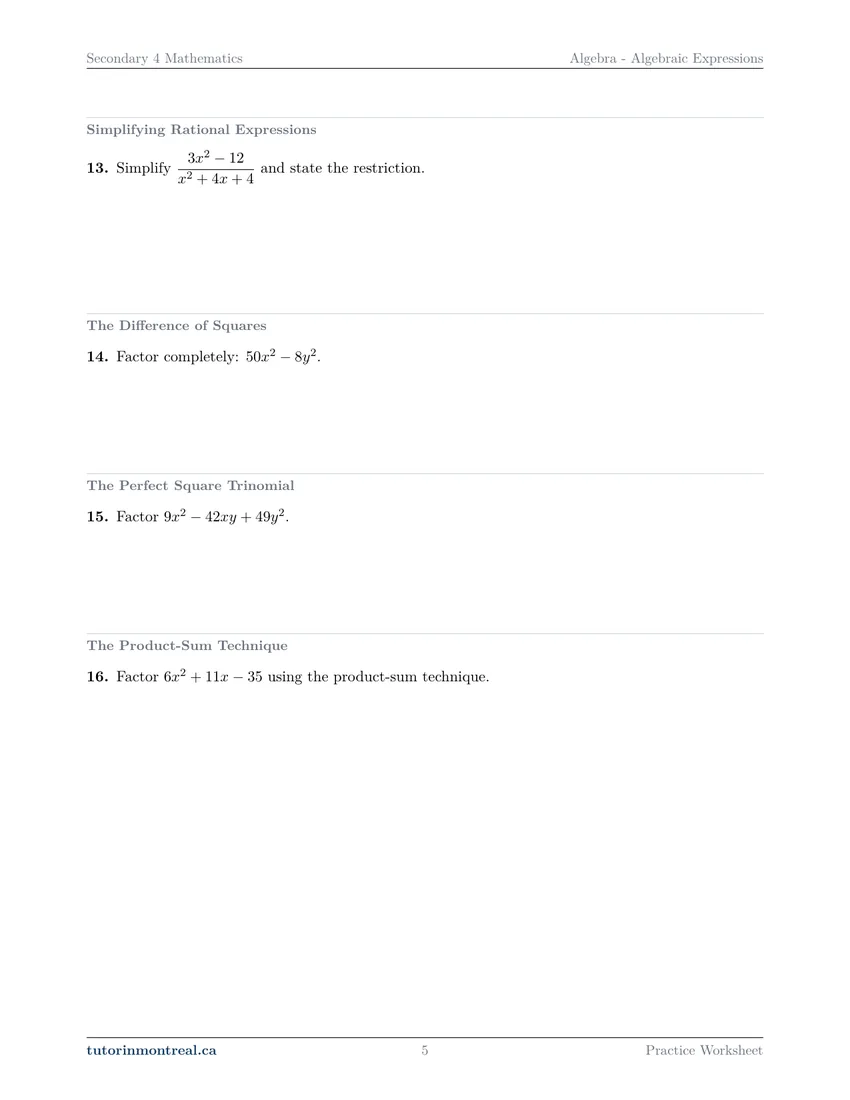
Q13Simplifying Rational Expressions
Simplify and state the restriction.
-
Q14The Difference of Squares
Factor completely: .
-
Q15The Perfect Square Trinomial
Factor .
-
Q16The Product-Sum Technique
Factor using the product-sum technique.
-
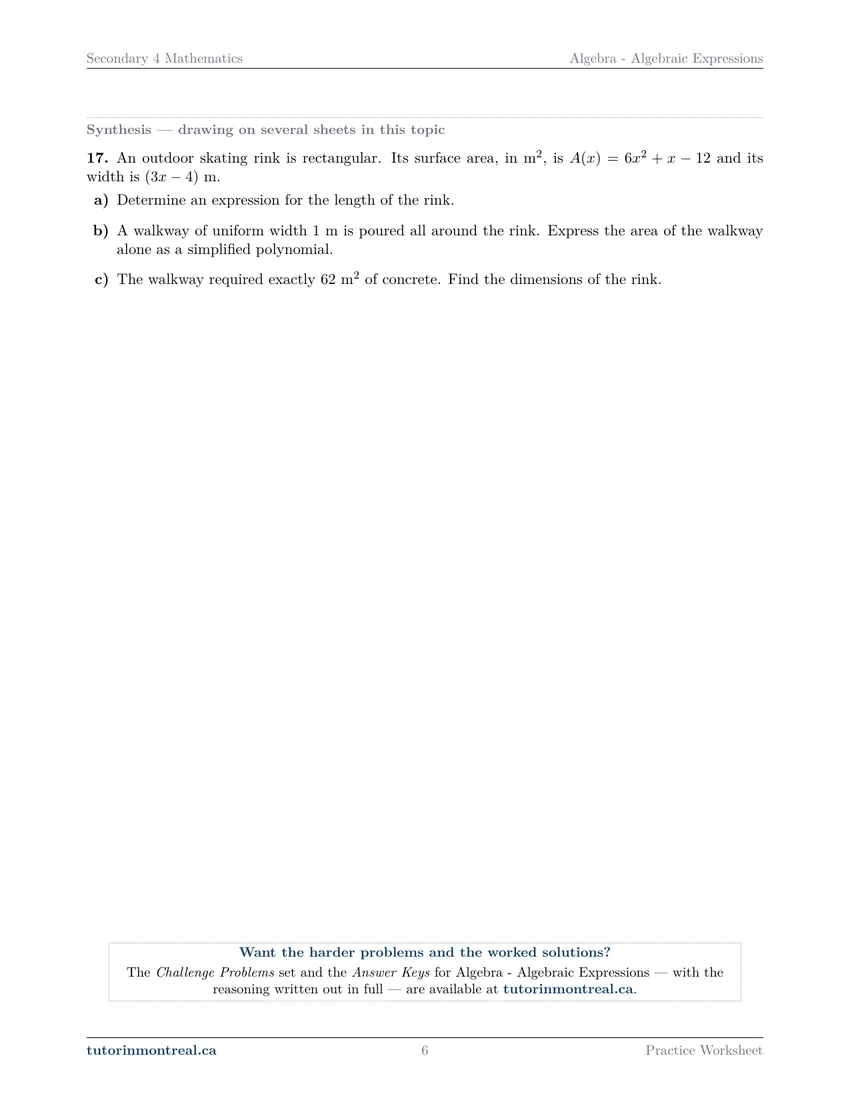
Q17Synthesis — drawing on several sheets in this topic
An outdoor skating rink is rectangular. Its surface area, in , is and its width is m.
- Determine an expression for the length of the rink.
- A walkway of uniform width m is poured all around the rink. Express the area of the walkway alone as a simplified polynomial.
- The walkway required exactly of concrete. Find the dimensions of the rink.
The 15 challenge problems for this topic are a separate, paid sheet and are not reproduced here.
Which stream is this for? This sheet is built for SN — it assumes you're working with rational expressions, completing the square and the quadratic formula, and it goes to the depth that program expects.
How to do every concept on this sheet
This is the part worksheet sites usually leave out. Below is the actual reasoning behind each group of questions — not a full solution set, the decisions that get you to one. Read it before you start, or after you get stuck.
Factoring: how to know which technique to use
Seven of the seventeen questions are factoring, and they're deliberately shuffled — because on a test nobody tells you which method to reach for. That choice is the skill. Work down this list in order and stop at the first match — unless the question names a method, which Q8 does:
The factoring decision order
Always in this order. In my sessions, skipping step 1 is the mistake I correct most often.
- 1Is there a common factor?
Pull it out first, every time.
50x² − 8y²looks like nothing until you take out the 2 and see2(25x² − 4y²)— that's Q14, and it's a difference of squares hiding behind a GCF. - 2Two terms → difference of squares
a² − b² = (a − b)(a + b). Check that both terms are perfect squares and the sign between them is a minus. A sum of squares does not factor over the reals. - 3Three terms, and the outer two are squares → perfect square trinomial
Test whether the middle term is
±2ab— and its sign is the sign inside the bracket:+2ab → (a + b)²,−2ab → (a − b)². In Q15,9x² − 42xy + 49y²hasa = 3xandb = 7y, so2ab = 42xy; the middle term is−42xy, which makes it(3x − 7y)². - 4Three terms, no square pattern → product-sum
Find two numbers whose product is
a·cand whose sum isb, split the middle term, then group. For Q16's6x² + 11x − 35: product−210, sum11→21and−10. - 5Four terms → grouping
Pair them, factor each pair, and the two pairs must leave the same bracket behind. Q9's
3xy − 6x + 5y − 10gives3x(y − 2) + 5(y − 2)→(y − 2)(3x + 5). - 6Any quadratic → the quadratic formula (the fallback that never fails)
Find the roots r₁, r₂, then write
a(x − r₁)(x − r₂). It's last because it's the slowest, not because it's a last resort. If the roots are fractions, absorb each denominator into its bracket to finish over the integers: Q8's6x² − 7x − 20has roots5/2and−4/3, so6(x − 5/2)(x + 4/3) = (2x − 5)(3x + 4). Note that product-sum would also crack Q8 (ac = −120, and−15 + 8 = −7) — the question asks for the formula on purpose, because exams sometimes specify the method.
Rational expressions: the restrictions are where the marks are
Questions 1, 3, 11 and 13 are the same move in four costumes: factor everything first, then cancel, then state the restrictions. The algebra is rarely the problem. The restrictions are, and usually for the same reason.
The mistake: reading the restrictions off the simplified expression. In Q13 you factor top and bottom:
(3x² − 12) ⁄ (x² + 4x + 4) = [3(x − 2)(x + 2)] ⁄ (x + 2)²then cancel one (x + 2):
= [3(x − 2)] ⁄ (x + 2)The restriction x ≠ −2 comes from the original denominator, before you cancelled anything. A factor you cancel still had to be non-zero for the expression to exist in the first place. On a division question like Q3, that includes the denominator of the divisor and the divisor itself.
Practical rule: write down every restriction the moment you finish factoring, before you cancel a single thing. It costs ten seconds and it's often the difference between full marks and most of them.
Completing the square (Q2)
You're converting x² − 10x + 31 into a(x − h)² + k so the vertex can be read directly. Halve the coefficient of x, square it, add and subtract it:
x² − 10x + 31 = (x² − 10x + 25) − 25 + 31 = (x − 5)² + 6Vertex (5, 6). The only place this goes wrong is when a ≠ 1 — then you must factor a out of the first two terms before halving, or every number afterwards is wrong. The challenge set leans on exactly that case.
Polynomial division (Q4)
Dividing 2x³ − x² − 16x + 3 by (x − 3). The remainder comes out to 0, and that's the point: a remainder of zero means (x − 3) is a factor, so this is a factoring question wearing a division costume. Q17(a) runs the same trick — dividing 6x² + x − 12 by (3x − 4) comes out clean precisely because (3x − 4) is a factor.
(If a polynomial ever is missing a power — x³ − 8, say — keep a 0x² and a 0x column, or the terms drift out of alignment and the arithmetic goes with them.)
The two theory questions (Q7 and Q12)
Q7 asks you to name the technique before applying it. Q12 gives three claims about polynomials and asks you to justify or disprove each. They're the hardest questions to bluff, and the ones students skip in practice because they don't look like "real" math.
How they're marked
A false claim needs one explicit counterexample — a specific pair of polynomials, multiplied out, with the contradiction shown. For "the product of two binomials is always a trinomial", (x + 2)(x − 2) = x² − 4 settles it in one line: two terms, not three. A true claim needs a general argument, not an example — showing it works for one case proves nothing. Vague sentences ("sometimes it doesn't work") earn zero.
Question 17: the synthesis problem
A rectangular rink with area A(x) = 6x² + x − 12 and width (3x − 4). Part (a) is a division — and the fact that it divides evenly is the hint for what follows. Part (b) is the classic border problem: build the outer rectangle, subtract the inner one. The trap is the walkway's width; read the question twice before you decide what to add. Part (c) turns your answer to (b) into an equation.
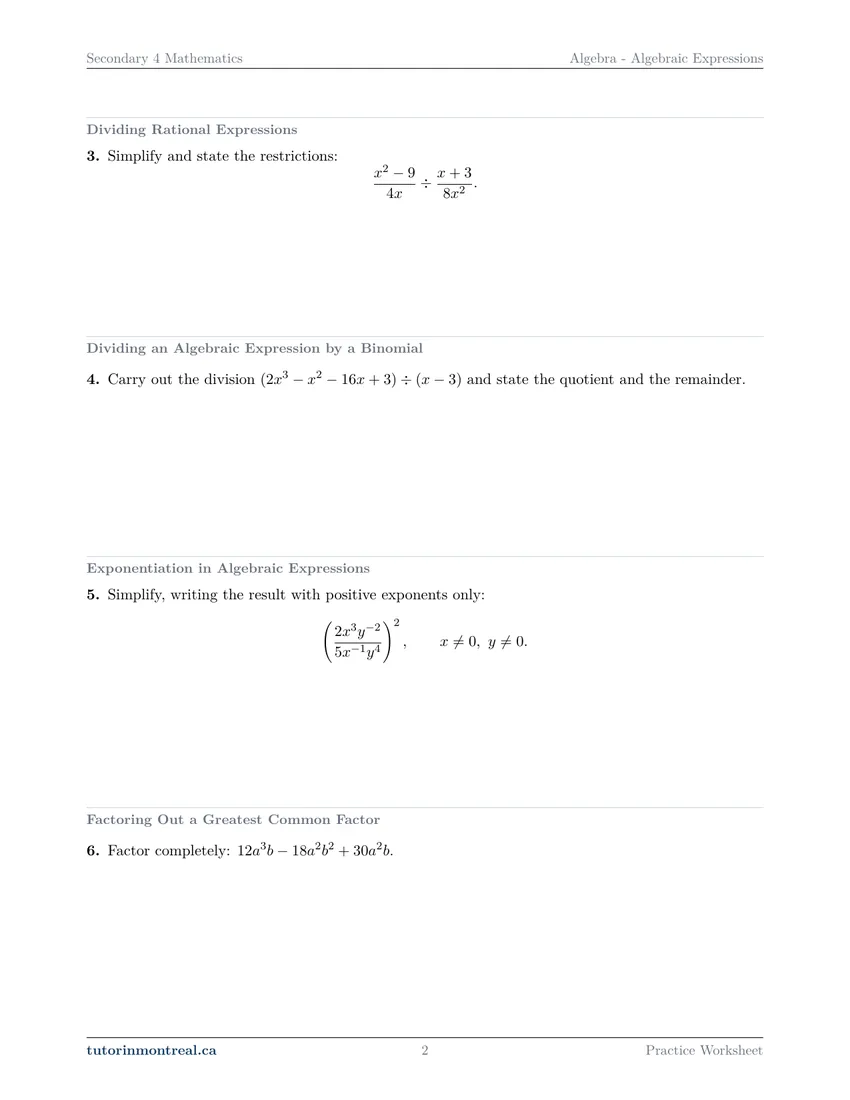
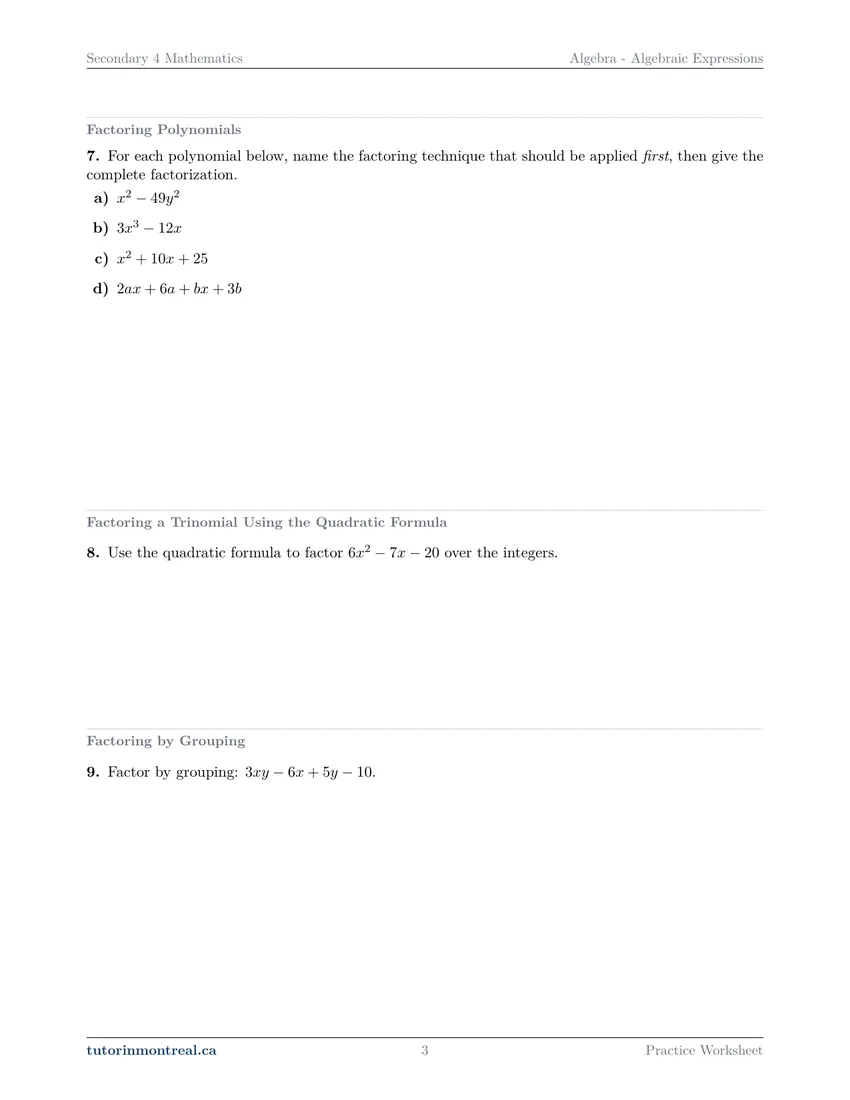
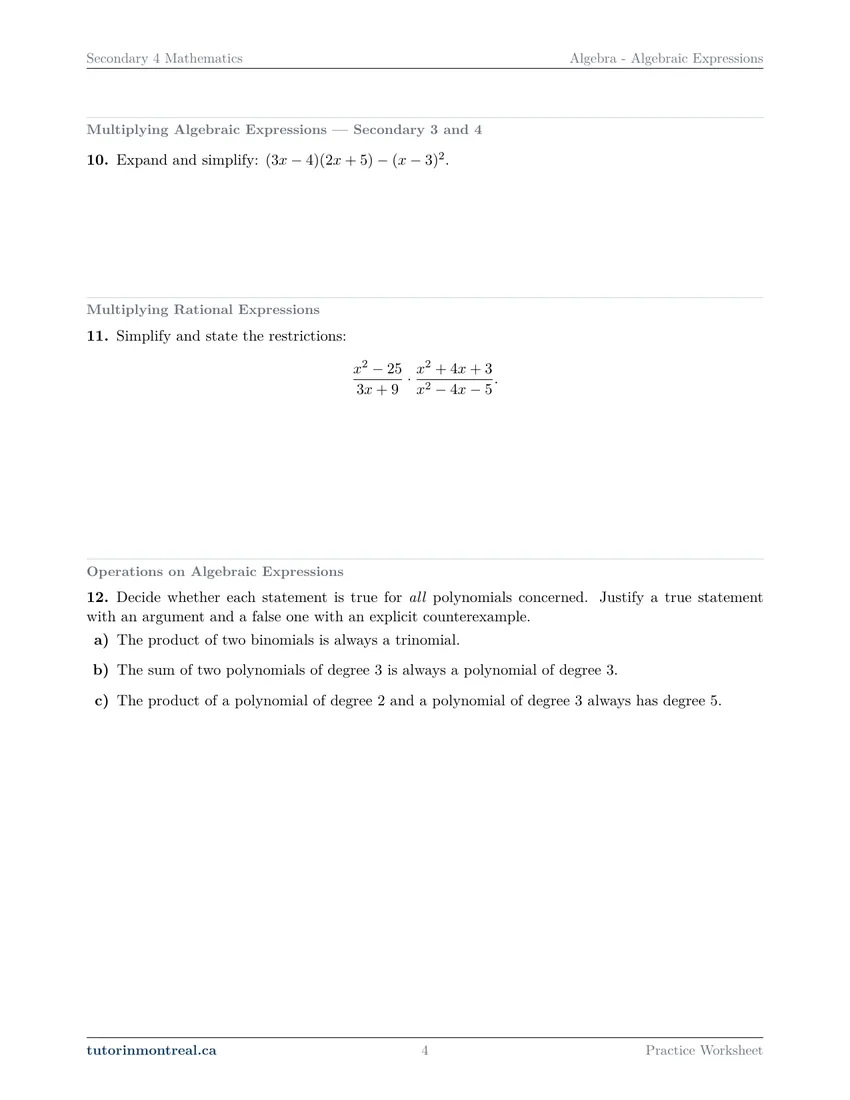
Preview all 6 pages
Click any page to open the full PDF.
Getting the most out of it
Print it — don't type on it
Factoring is pattern recognition, and patterns stick faster when you write them by hand. The sheet is laid out at letter size with working space under each question for exactly that reason.
Do the theory questions properly
Q7 and Q12 are the ones you'll want to skip. They're also the ones most likely to appear on your exam in a form you haven't seen, because they can't be brute-forced.
Time yourself on the second pass
The first pass is about getting them right. A week later, redo questions 6–9 and 14–16 against a clock — six factoring questions in ten minutes. Speed on these is what leaves you time for the long problems on the actual exam.
Want the solutions, or something more challenging?
The worksheet, the questions above and every explanation on this page stay free permanently. Three more PDFs exist for this topic — the worked answer key, a harder problem set, and the answer key to that. They come with the Secondary 4 Math Solutions Bundle, which is what keeps the rest of the series free.
What else exists for Algebraic Expressions
Three PDFs · 15 pages · all three are in the bundle below.
- Answer key — 3 pages. All 17 questions worked step by step, including the restrictions and the justifications. Not a list of final answers.
- Challenge problems — 8 pages, 15 problems. A separate sheet at exam-plus difficulty covering the same 16 concepts. Harder than anything on the free sheet.
- Challenge answer key — 4 pages. Every challenge problem worked to the same standard, with the checks shown.
- PDF, letter size, print-ready.
"The product of a polynomial of degree 2 and a polynomial of degree 3 always has degree 5." True — but an example earns no marks, so here is the argument:
Write the two leading terms as a₂x² and b₃x³. Multiplying:
(a₂x²)(b₃x³) = a₂b₃x⁵By definition of degree, a₂ ≠ 0 and b₃ ≠ 0. Over the reals a product of two non-zero numbers is non-zero, so a₂b₃ ≠ 0 and the x⁵ term cannot cancel. No lower-degree term can reach degree 5, so the degree is exactly 5. That middle step — saying why the leading coefficients can't cancel — is the sentence the mark is for.
A camera drone is launched from a platform. Its altitude, in metres, t seconds after launch is h(t) = −5t2 + 30t + 8.
- Rewrite the rule in standard form and deduce the greatest altitude and when it occurs.
- The drone can only film a roof while it is more than 33 m above the ground. During which interval of time can it film?
Q2 on the free sheet completes the square where a = 1. This one has a = −5, so the coefficient must come out of the first two terms first — and part (b) then turns the vertex form into an inequality. That gap, on all sixteen concepts, is what the challenge set is.
The one thing that's for sale
Every Secondary 4 Math topic — the complete Solutions Bundle
One download, one payment, the whole program. Every answer key and every challenge set for all 17 Secondary 4 Math worksheet sets — including this one.
- Worked solutions, not answer lists — every step written out
- Covers the whole year's program at this level
- Less than the price of one hour of tutoring — for the entire year's solutions
Taking Secondary 1 Math as well? The Secondary 1 Math bundle covers all 15 of its sets — 45 PDFs, 182 pages — on the same terms.
Taking Secondary 2 Math as well? The Secondary 2 Math bundle covers all 14 of its sets — 42 PDFs, 181 pages — on the same terms.
Taking Secondary 3 Math as well? The Secondary 3 Math bundle covers all 11 of its sets — 33 PDFs, 154 pages — on the same terms.
Taking Secondary 5 Math as well? The Secondary 5 Math bundle covers all 21 of its sets — 63 PDFs, 228 pages — on the same terms.
Taking CEGEP Calculus I as well? The CEGEP Calculus I bundle covers all 8 of its sets — 24 PDFs, 82 pages — on the same terms.
Taking CEGEP Calculus II as well? The CEGEP Calculus II bundle covers all 8 of its sets — 24 PDFs, 90 pages — on the same terms.
Taking CEGEP Linear Algebra as well? The CEGEP Linear Algebra bundle covers all 7 of its sets — 21 PDFs, 82 pages — on the same terms.
Taking AP Calculus AB as well? The AP Calculus AB bundle covers all 8 of its sets — 24 PDFs, 126 pages — on the same terms.
Common questions
Is this worksheet really free?
Yes — the questions are on this page to read, and the PDF downloads directly, no email and no account. The one paid item is optional: the complete Secondary 4 Solutions Bundle, which covers every set at this level.
What do I get if I buy the bundle?
Every answer key and every challenge set for the whole Secondary 4 series, in one download. For this topic that is the worked answer key to the practice questions, a set of challenge problems at exam-plus difficulty, and the worked answer key to those. The practice worksheets themselves stay free.
How do I know which factoring technique to use?
Work down the decision order above: GCF first, always. Then count the terms — two suggests a difference of squares, three suggests a perfect square or product-sum, four suggests grouping. The quadratic formula is the fallback that always works.
Where do the restrictions on a rational expression come from?
From the original denominator, before you cancel anything. A factor you cancel still had to be non-zero for the original expression to be defined, so its restriction stays.
Which Secondary 4 stream is this for?
It's built for SN. The sheet assumes you're working with rational expressions, completing the square and the quadratic formula, and it goes to the depth that program expects.
Can teachers use this in class?
Yes. Print and photocopy it for your own classes freely — I just ask that the tutorinmontreal.ca footer stays on the page.
I'm stuck on one question. Can you help?
Yes — through one-on-one tutoring, in Montreal or online. Get in touch to arrange a session, or see the current rates.
← All 17 Secondary 4 Math worksheets · Secondary 1 Math series (15 sheets) → · Secondary 2 Math series (14 sheets) → · Secondary 3 Math series (11 sheets) → · Secondary 5 Math series (21 sheets) → · CEGEP Calculus I series (8 sheets) → · CEGEP Calculus II series (8 sheets) → · CEGEP Linear Algebra series (7 sheets) → · AP Calculus AB series (8 sheets) →
The same topic at the other level: Secondary 5 Math · Algebraic Expressions.