Secondary 5 Algebraic Expressions Worksheet
Rational expressions are fractions whose denominators can vanish, so the restrictions matter as much as the simplifying. This sheet works the four operations on them, the factoring toolkit that makes those operations possible — including the quadratic formula used as a factoring device and the discriminant test for a trinomial that does not factor over the reals — and closes with a proof about the degree of a sum and of a product. The written methods sit below the questions; the download is free.
Practice worksheet — free PDF
No email, no account, no watermark. Teachers: photocopy it for your classes freely. Worked solutions and 7 harder problems come with the Secondary 5 Math bundle.
All 9 questions
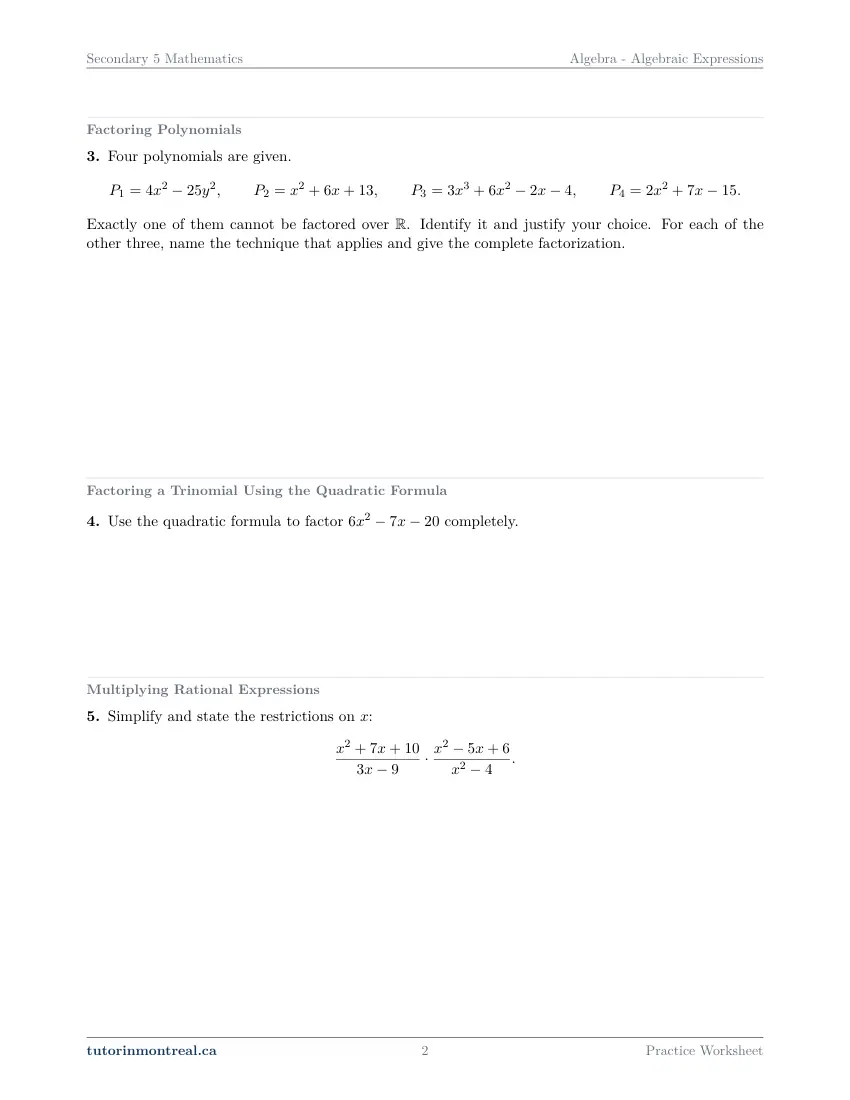
Each question targets one named concept from the sheet. Read them here, or print the PDF — it has working space under each one.
-
Q1Adding and Subtracting Rational Expressions
Write as a single rational expression in lowest terms and state the restrictions on :
-
Q2Dividing Rational Expressions
Simplify and state the restrictions on :
-
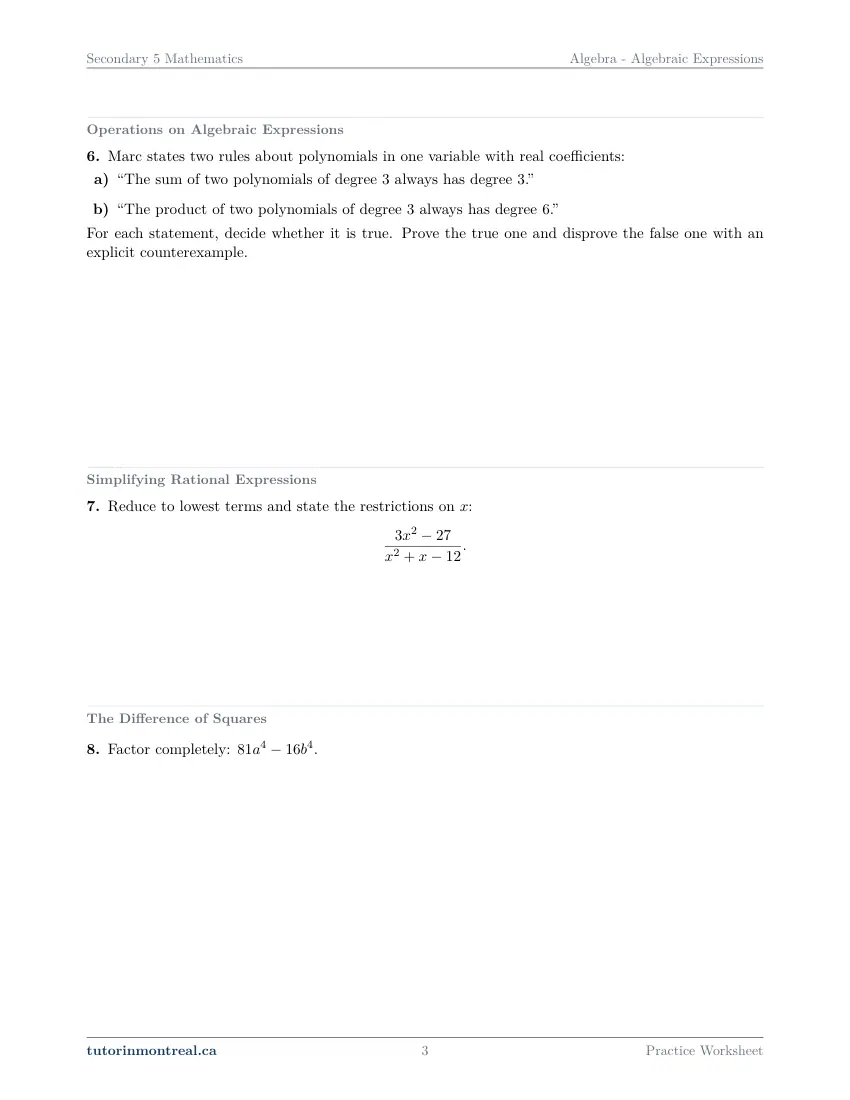
Q3Factoring Polynomials
Four polynomials are given. Exactly one of them cannot be factored over . Identify it and justify your choice. For each of the other three, name the technique that applies and give the complete factorization.
-
Q4Factoring a Trinomial Using the Quadratic Formula
Use the quadratic formula to factor completely.
-
Q5Multiplying Rational Expressions
Simplify and state the restrictions on :
-
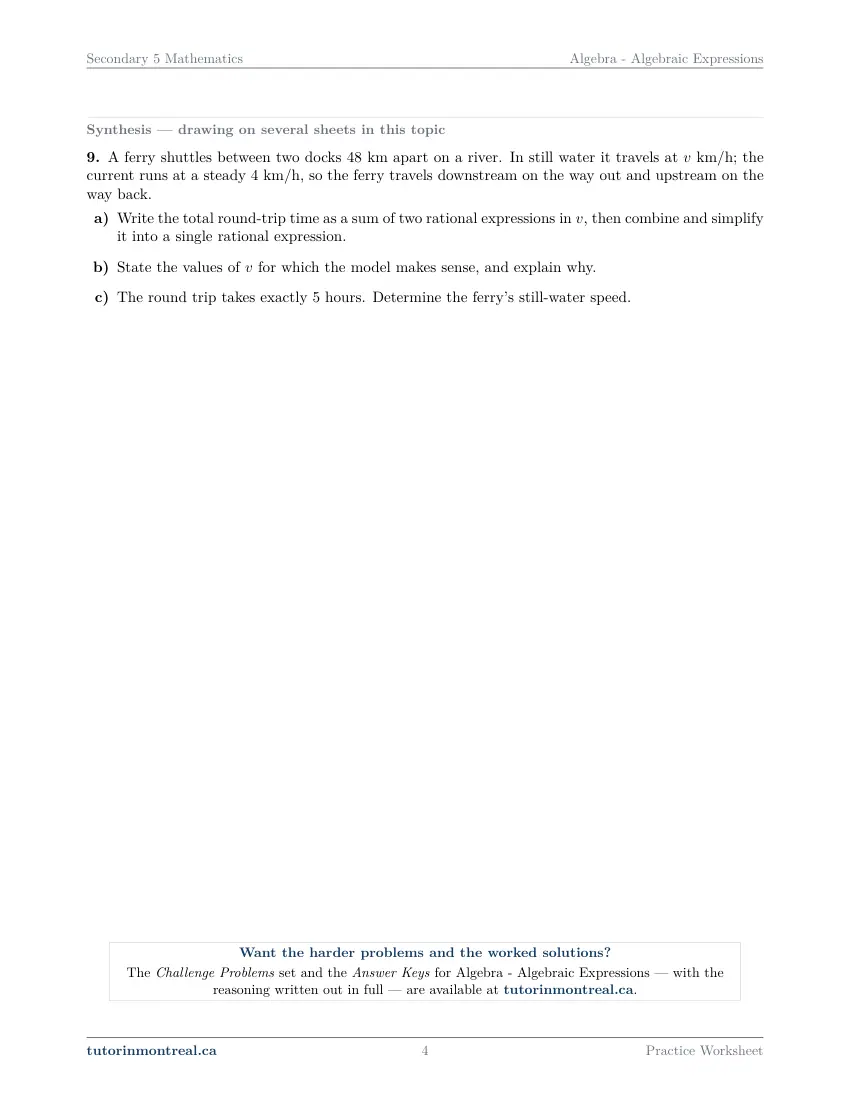
Q6Operations on Algebraic Expressions
Marc states two rules about polynomials in one variable with real coefficients:
- “The sum of two polynomials of degree always has degree .”
- “The product of two polynomials of degree always has degree .”
For each statement, decide whether it is true. Prove the true one and disprove the false one with an explicit counterexample.
-
Q7Simplifying Rational Expressions
Reduce to lowest terms and state the restrictions on :
-
Q8The Difference of Squares
Factor completely: .
-
Q9Synthesis — drawing on several sheets in this topic
A ferry shuttles between two docks km apart on a river. In still water it travels at km/h; the current runs at a steady km/h, so the ferry travels downstream on the way out and upstream on the way back.
- Write the total round-trip time as a sum of two rational expressions in , then combine and simplify it into a single rational expression.
- State the values of for which the model makes sense, and explain why.
- The round trip takes exactly hours. Determine the ferry's still-water speed.
The 7 challenge problems for this topic are a separate, paid sheet and are not reproduced here.
Which stream is this for? This sheet is built for SN. It assumes you can factor with every technique on demand, carry restrictions through a chain of operations, and argue about factorability over the reals rather than just try things, and it goes to the depth that program expects.
How to do every concept on this sheet
This is the part worksheet sites usually leave out. Below is the actual reasoning behind each group of questions — not a full solution set, the decisions that get you to one. Read it before you start, or after you get stuck.
Everything starts with factoring, so decide the technique first
Q3 asks you to name a technique for each of four polynomials and to identify the one that has no real factorization at all. That naming skill is what the rest of the sheet silently depends on: you cannot reduce, multiply or divide a rational expression until both of its polynomials are in factored form. Work down this list and stop at the first line that fits.
The factoring decision order
Always in this order, and always finishing the job — a factor that can still be broken up means the expression is not fully factored.
- 1Common factor, every single time
Pull out the greatest common factor before you look at anything else. It is what turns a four-term expression into something recognisable, and it is the step that hides a difference of squares behind a coefficient.
- 2Two terms → difference of squares
a² − b² = (a − b)(a + b), provided both terms are perfect squares and the sign between them is a minus. A sum of squares has no real factorization, which is the fact Q8 ends on. - 3Three terms with square outer terms → perfect square trinomial
Test the middle term against
±2ab; its sign is the sign inside the bracket. - 4Three terms otherwise → product-sum
Find two numbers whose product is
a·cand whose sum isb, split the middle term into those two pieces, then group. For3x² + 11x + 6: product 18, sum 11, so 9 and 2. - 5Four terms → grouping
Pair them, factor each pair, and the same bracket must survive in both — that shared bracket is the signal the pairing was right. If it is not, try the other pairing before giving up.
- 6Any trinomial → the quadratic formula
The fallback that never fails, and the method Q4 asks for by name. It is last because it is the slowest, not because it is a last resort.
Does it factor at all? For a trinomial ax² + bx + c, the discriminant settles it before you try anything:
Δ = b² − 4acIf Δ < 0 there is no real zero, so no real linear factor exists and the polynomial is irreducible over ℝ. If Δ is a perfect square the factorization has integer coefficients; if Δ ≥ 0 but not a perfect square, it still factors over the reals, only with irrational zeroes. That single computation is the justification Q3 wants — "I couldn't find two numbers that work" is not an argument, because it says something about your search rather than about the polynomial.
The quadratic formula as a factoring tool (Q4)
Find the zeroes r₁ and r₂, then rebuild the trinomial as a(x − r₁)(x − r₂) — the leading coefficient is not optional, and dropping it is the classic slip. When the zeroes are fractions, absorb each denominator into its own bracket to finish over the integers.
On 4x² + 4x − 15, for instance, the discriminant is 16 + 240 = 256, so the zeroes are (−4 ± 16)⁄8, that is 3⁄2 and −5⁄2. Rebuilding gives 4(x − 3⁄2)(x + 5⁄2); pushing the 2 from each denominator inside its bracket turns that into (2x − 3)(2x + 5). Multiply it back out — the check takes one line and it catches a sign error every time.
Difference of squares, applied until it stops (Q8)
A fourth power is a square of a square, so a difference of fourth powers factors twice. Take 16x⁴ − 1: it is (4x² − 1)(4x² + 1), and the first bracket is itself a difference of squares, giving (2x − 1)(2x + 1)(4x² + 1). The second bracket is a sum of squares and stops there — over the reals it has no factorization, because it is never zero.
The mistake: stopping after the first split. "Factor completely" means checking every factor you produce against the decision order again, and a difference of squares almost always produces one more. The mirror-image mistake is not stopping: writing a sum of squares as a product of two brackets that quietly do not multiply back.
Rational expressions: fractions with a domain attached
Questions 1, 2, 5 and 7 are the four operations, and they obey exactly the rules of numerical fractions. What is new is that a denominator now contains a variable, so before anything else there is a set of values the expression is not allowed to take.
The order of work, whichever operation it is
Factor, restrict, then operate. Reversing the first two steps is what loses the marks.
- 1Factor every numerator and denominator
Nothing can be cancelled, and no common denominator can be found, until this is done. It also reveals the restrictions.
- 2Write the restrictions down immediately
Every factor that ever sits in a denominator gives one, and it is read from the expression as written, before a single cancellation.
- 3Do the operation
Multiply straight across; divide by multiplying by the reciprocal; add or subtract over a common denominator, which is the product of the distinct factors, each taken at its highest power.
- 4Reduce, and only cancel factors
A factor is a whole bracket multiplying the rest. A term inside a bracket can never be cancelled against anything.
- 5Test one value
Substitute a convenient admissible number, usually
x = 0, into both the original and your answer. They must agree, and this catches nearly every sign error.
Restrictions come from the original expression, not the simplified one. A factor you cancel still had to be non-zero for the expression to exist in the first place, so its restriction survives the cancellation. That is exactly why the simplified form and the original are not the same function: the graph of the simplified form has a hole at every value you cancelled away.
A division has three sources of restrictions, not two. In A⁄B ÷ C⁄D, the values that must be excluded come from B, from D, and from C — the divisor itself may not be zero, even though C starts life as a numerator. Q2 is built on that third source, and it is the one everybody forgets.
Subtraction: the sign that gets away (Q1)
When two denominators share no factor, the common denominator is their product and each numerator is multiplied by the other denominator. The subtraction then applies to the whole numerator that follows it, so it must be bracketed before it is expanded:
a ⁄ p − b ⁄ q = [ a·q − b·p ] ⁄ (p·q)Written without that bracket, only the first term of b·p gets its sign changed, and the answer is wrong by a constant that no later step can repair. Expand the numerator, collect like terms, and then — this is the step people skip — check whether the result factors, because a numerator that factors may still cancel against the denominator.
When the denominators do share a factor, factoring first gives a common denominator smaller than their product, which keeps the numbers manageable and the reduction visible.
Degrees: why a sum can collapse and a product cannot (Q6)
Q6 gives two claims and asks you to prove one and disprove the other. They are marked in completely different ways, and knowing which is which is half the question.
To disprove a claim, one explicit counterexample is enough — a specific pair of polynomials, written out, with the contradiction shown in a line of arithmetic. Adding degree-3 polynomials whose leading terms are opposites is the whole idea: the x³ terms annihilate each other and the degree drops.
To prove a claim, an example proves nothing. You need a general argument about arbitrary leading coefficients: write the leading terms as anxn and bmxm, multiply them, and say why the product of the two leading coefficients cannot be zero — because a product of two non-zero real numbers is never zero. That middle sentence is the sentence the mark is for, and it is also the reason the two situations differ: addition can cancel a leading term, multiplication cannot.
The synthesis question (Q9)
A round trip with a current is the standard setting for building a rational model. Time is distance over speed, the outward and return speeds differ by the current, and adding the two times produces a sum of rational expressions to combine — where the common denominator turns out to be a difference of squares.
Part (b) is worth more attention than its length suggests. Two kinds of restriction meet here: the algebraic ones, which forbid a zero denominator, and the physical one, which requires the boat to actually beat the current on the way back. The context restriction is the stronger of the two, and it is what lets you discard a root in part (c) without apology. Whenever a word problem ends in a quadratic, expect one root to be rejected, and say in a sentence which condition rejects it.
Preview all 4 pages
Click any page to open the full PDF.
Getting the most out of it
Write the restrictions the moment you finish factoring
Not at the end, not after cancelling — the instant every denominator is in factored form. It takes ten seconds, it is where the marks on four of these questions live, and doing it late is doing it from the wrong expression.
Check by substitution, not by re-reading
Pick an easy admissible value and put it through both the original expression and your simplified one. Re-reading your own algebra reproduces your own mistake; a number does not.
Practise naming the technique before applying it
Cover the instructions on Q3 and say out loud which technique each polynomial needs and why. On an exam nothing tells you which method to reach for, and that choice — not the execution — is what the factoring questions are really testing.
Want the solutions, or something more challenging?
The worksheet, the questions above and every explanation on this page stay free permanently. Three more PDFs exist for this topic — the worked answer key, a harder problem set, and the answer key to that. They come with the Secondary 5 Math Solutions Bundle, which is what keeps the rest of the series free.
What else exists for Algebraic Expressions
Three PDFs · 8 pages · all three are in the bundle below.
- Answer key — 2 pages. All 9 questions worked step by step, including the restrictions and the justifications. Not a list of final answers.
- Challenge problems — 4 pages, 7 problems. A separate sheet at exam-plus difficulty covering the same 8 concepts. Harder than anything on the free sheet.
- Challenge answer key — 2 pages. Every challenge problem worked to the same standard, with the checks shown.
- PDF, letter size, print-ready.
The one thing that's for sale
Every Secondary 5 Math topic — the complete Solutions Bundle
One download, one payment, the whole program. Every answer key and every challenge set for all 21 Secondary 5 Math worksheet sets — including this one.
- Worked solutions, not answer lists — every step written out
- Covers the whole year's program at this level
- Less than the price of one hour of tutoring — for the entire year's solutions
Taking Secondary 1 Math as well? The Secondary 1 Math bundle covers all 15 of its sets — 45 PDFs, 182 pages — on the same terms.
Taking Secondary 2 Math as well? The Secondary 2 Math bundle covers all 14 of its sets — 42 PDFs, 181 pages — on the same terms.
Taking Secondary 3 Math as well? The Secondary 3 Math bundle covers all 11 of its sets — 33 PDFs, 154 pages — on the same terms.
Taking Secondary 4 Math as well? The Secondary 4 Math bundle covers all 17 of its sets — 51 PDFs, 154 pages — on the same terms.
Taking CEGEP Calculus I as well? The CEGEP Calculus I bundle covers all 8 of its sets — 24 PDFs, 82 pages — on the same terms.
Taking CEGEP Calculus II as well? The CEGEP Calculus II bundle covers all 8 of its sets — 24 PDFs, 90 pages — on the same terms.
Taking CEGEP Linear Algebra as well? The CEGEP Linear Algebra bundle covers all 7 of its sets — 21 PDFs, 82 pages — on the same terms.
Taking AP Calculus AB as well? The AP Calculus AB bundle covers all 8 of its sets — 24 PDFs, 126 pages — on the same terms.
Common questions
Is this worksheet really free?
Yes — the questions are on this page to read, and the PDF downloads directly, no email and no account. The one paid item is optional: the complete Secondary 5 Solutions Bundle, which covers every set at this level.
How do I know a polynomial cannot be factored over the reals?
For a trinomial, compute the discriminant b² − 4ac. If it is negative there is no real zero and therefore no real linear factor, which is a proof rather than a report of an unsuccessful search. A sum of squares is the other standard case: it is never zero, so it never factors over the reals.
Where do the restrictions on a rational expression come from?
From every denominator in the expression as originally written, before anything is cancelled. A factor you cancel still had to be non-zero for the expression to be defined, so its restriction stays — which is why the simplified form has a hole at that value rather than being a genuinely equal expression. A division carries one more: the divisor itself may not be zero, so its numerator produces a restriction too.
Can I cancel an x that appears on the top and the bottom?
Only if it is a factor of the whole numerator and the whole denominator, meaning everything above and below is a product. If either side is a sum, factor it first; cancelling a term out of a sum changes the value of the expression.
When should I use the quadratic formula to factor instead of product-sum?
Whenever the question names it, and whenever product-sum is taking too long — a large or awkward product a·c is the usual signal. Find both zeroes, write a(x − r₁)(x − r₂) keeping the leading coefficient, and absorb any fractional denominators into their brackets to land back on integer coefficients.
Which Secondary 5 stream is this for?
It is built for SN. The sheet expects you to factor with any technique on demand, carry restrictions through a chain of operations and argue about factorability over the reals, at the depth that program requires.
Can teachers use this in class?
Yes. Print and photocopy it for your own classes freely — I just ask that the tutorinmontreal.ca footer stays on the page.
I'm stuck on one question. Can you help?
Yes — through one-on-one tutoring, in Montreal or online. Get in touch to arrange a session, or see the current rates.
← All 21 Secondary 5 Math worksheets · Secondary 1 Math series (15 sheets) → · Secondary 2 Math series (14 sheets) → · Secondary 3 Math series (11 sheets) → · Secondary 4 Math series (17 sheets) → · CEGEP Calculus I series (8 sheets) → · CEGEP Calculus II series (8 sheets) → · CEGEP Linear Algebra series (7 sheets) → · AP Calculus AB series (8 sheets) →
The same topic at the other level: Secondary 4 Math · Algebraic Expressions.