Secondary 5 Exponential Functions Worksheet
Two points fix the rule, a common base solves the equation, and the parameters hand you the asymptote — this sheet drills all three, then adds deciding whether the function increases or decreases when the base and the coefficient disagree, working with growth and decay models, and recognising the logarithm as the inverse. The explanations underneath take the awkward cases first, and the PDF prints free.
Practice worksheet — free PDF
No email, no account, no watermark. Teachers: photocopy it for your classes freely. Worked solutions and 5 harder problems come with the Secondary 5 Math bundle.
All 7 questions
Each question targets one named concept from the sheet. Read them here, or print the PDF — it has working space under each one.
-
Q1Finding the Rule of an Exponential Function
An exponential function of the form passes through the points and .
- Find its rule.
- Solve .
- Give the equation of the asymptote and the range of .
-
Q2Graphing an Exponential Function
Consider .
- Give the equation of the asymptote, the -intercept and the zero of .
- Sketch the curve, plotting also the points of abscissa and .
- Give the range of and say whether is increasing or decreasing.
-
Q3Properties of the Exponential Function
Consider .
- Give the domain, the range and the equation of the asymptote.
- Find the zero and the -intercept.
- Is increasing or decreasing? Justify.
-
Q4Solving Problems Involving the Exponential Function
A batch of maple syrup cools in a sugar shack. Its temperature is , in degrees Celsius, minutes after the boil.
- What is the temperature at ?
- What is the temperature after minutes, to the nearest tenth of a degree?
- What temperature does the syrup approach in the long run, and what does that number represent?
-
Q5The Exponential Function
Four rules are proposed below. State which ones define exponential functions. For each exponential function, give the equation of its asymptote and say whether it is increasing or decreasing; for each rejected rule, justify the rejection.
-
Q6The Inverse of the Exponential Function
Find the rule of the inverse of , and state the domain of .
-
Q7The Role of the Parameters in an Exponential Function
Let .
- Give the equation of the horizontal asymptote, the range and the -intercept.
- Is increasing or decreasing? Rewrite the rule with a base smaller than and explain what this shows about the sign of the parameter .
The 5 challenge problems for this topic are a separate, paid sheet and are not reproduced here.
Which stream is this for? This sheet is built for SN. It assumes you work with the full form a·c^(b(x − h)) + k, write ranges in interval notation, handle negative exponents and reciprocal bases, and recognise the logarithm as the inverse, and it goes to the depth that program expects.
How to do every concept on this sheet
This is the part worksheet sites usually leave out. Below is the actual reasoning behind each group of questions — not a full solution set, the decisions that get you to one. Read it before you start, or after you get stuck.
One fact generates almost every answer on this sheet
A power of a positive base is always strictly positive. Not sometimes, not usually — always, for every real exponent, including the negative ones. That single fact is the engine behind the asymptote, the range, and half the justifications you will be asked to write.
Take the general shape:
f(x) = a · cx + k (c > 0, c ≠ 1, a ≠ 0)Because cx is never zero, a·cx is never zero either, so f(x) can never equal k. That is the horizontal asymptote y = k. And because cx is always positive, the term a·cx keeps the sign of a forever — so the curve lives entirely on one side of the asymptote: above it when a > 0, below it when a < 0. The range follows immediately, with an open bracket at k, since that value is approached and never attained.
The asymptote is not always y = 0. It is y = k. Q1 has no k at all, so the asymptote is the x-axis; Q2 has k = −4, Q3 has k = −6, Q4 has k = 20, Q7 has k = 3. Writing y = 0 out of habit throws away the range, the sketch and the meaning of the context question in one stroke. The domain, meanwhile, is always ℝ — you can raise a positive base to anything.
Increasing or decreasing: the base does not decide on its own
This is the point Q3(c), Q5 and Q7(b) are all built to test, and the plausible-sounding rule "base under 1 means decreasing" is false. Two things vote: the base sets a direction, and the sign of a can reverse it.
Increasing when a > 0 and c > 1, or when a < 0 and 0 < c < 1.
Decreasing when a > 0 and 0 < c < 1, or when a < 0 and c > 1.
Rather than memorising four lines, reason it out in two steps every time: c > 1 means cx grows and 0 < c < 1 means it shrinks; then a negative a flips whichever it was. That is the sentence a "justify" question wants — the conclusion alone earns little.
Notice what is not on the list: k. Shifting a curve up or down cannot change whether it rises, so Q3's −6 and Q7's +3 are irrelevant to the direction. They only move the asymptote.
Negative exponents, reciprocal bases, and the parameter b (Q7)
Q7 gives you 5(2)−x + 3 and asks you to rewrite it with a base smaller than 1. The identity you need is the definition of a negative exponent:
c−x = (c−1)x = (1 ⁄ c)xSo base 2 with a negative exponent is base one-half with a positive one — the same function, two spellings. That is why the parameter b in the full form and the choice of base are not independent: flipping the sign of b and flipping the base to its reciprocal are the same operation. It also means no exam can ask you to find b and c separately from a graph; only their combined effect is visible.
Practical consequence: whenever a rule arrives with a negative exponent, rewrite it with a positive one before you judge the direction, or you will apply the base rule to the wrong base.
Finding the rule from two points (Q1)
Two unknowns, two points, and one shortcut that makes it quick.
From two points to a·cx
Use the point on the y-axis first if you are given one — Q1 is.
- 1Substitute the point whose abscissa is 0
Since
c⁰ = 1for every base,f(0) = a. The initial value is the coefficient, with no work at all. If neither point sits on the axis, substitute both and divide one equation by the other — the a cancels and leaves a single power to solve. - 2Substitute the second point and isolate the power
You are left with something of the form
cⁿ = number. Take the n-th root, or recognise the number as a perfect power: 27 is 3³, 32 is 2⁵, 81 is 3⁴. - 3Reject a negative base
The definition requires
c > 0. When an even root offers you ±, only the positive value is a legal base, and saying so is worth a mark. The same definition rules outc = 1, which would collapse the rule to a constant. - 4Check with the point you did not use to finish
Substitute back into the finished rule. A wrong base shows up instantly.
When the model has a + k, as the context questions do, get k first from the asymptote — in a cooling problem that is the ambient temperature, in a population problem the floor the count settles toward — then subtract it and you are back to the two-point case above.
Solving exponential equations: same base, then drop it
Q1(b) and the zeros in Q2 and Q3 all use one technique, and it rests on a property worth naming: an exponential function never takes the same value twice. So if two powers of the same base are equal, their exponents must be equal.
Isolate the power first. Undo the + k, then divide by a, so the equation reads cx = number. Only then rewrite the number as a power of c and equate the exponents. Finding a zero is the same job with the target value 0, which after isolating becomes cx = −k ⁄ a.
Before you split, check the number is positive. If isolating leaves cx equal to a negative number or to zero, the equation has no solution — and that is the complete answer, not a dead end. It is exactly the situation that proves a curve never crosses its asymptote. Concretely, a function with a > 0 and k > 0 has no zero at all, because its whole graph sits above the x-axis.
Two rewriting tricks cover most exam cases. A reciprocal is a negative exponent: 2 = (1 ⁄ 2)−1, which is how a base-one-half equation gets solved without a calculator. And a root is a fractional exponent, so √c = c1/2. When no common base exists — bases 3 and 5, say — the technique fails and you need a logarithm, which is the other half of this pair of units.
Sketching an exponential curve (Q2)
Draw the asymptote y = k as a dashed line first; it is the boundary the curve is not allowed to cross. Plot the y-intercept, which is always a + k, and the zero if there is one. Then evaluate the two or three extra abscissas the question names — negative exponents give reciprocals, so x = −1 produces a fraction rather than an error.
Finally draw a curve that flattens toward the dashed line on one end and climbs steeply on the other. Two things markers look for: the curve must never touch the asymptote, and it must not turn around. An exponential function has no maximum, no minimum and no vertex — if your sketch has a bend in it, you have drawn a parabola.
Growth and decay in context (Q4)
Contextual exponentials are usually described in percentages, and converting the percentage into a base is the step that decides everything after it.
Growing by r% per period means multiplying by 1 + r ⁄ 100 each period: +18% gives base 1.18. Losing r% means multiplying by 1 − r ⁄ 100: −15% gives base 0.85. The base is what you keep, not what you lose, which is why Q4's 0.85 describes a batch cooling by 15% of its excess heat each minute.
Halving and doubling are the same idea in disguise: "halves every 10 minutes" is base 1 ⁄ 2 with the exponent t ⁄ 10, because the exponent counts periods, not units of t.
In these models each parameter has a meaning you can state in a sentence, and part (c)-style questions ask for exactly that. The value k is the level the quantity settles toward — the room temperature, the background concentration. The initial value is a + k, not a. And "settles toward" is literal: the model never actually reaches k, so a claim that the syrup will be at room temperature at some finite time is false, however convincing the graph looks at that scale.
What is not an exponential function (Q5)
Q5 is the definition question, and each rejected rule fails for a different named reason.
The variable must be in the exponent. A rule like x4 has the variable in the base and a constant exponent — that is a power function, and confusing x4 with 4x is the mix-up the question exists to catch. The base must also satisfy c > 0 and c ≠ 1. Base 1 is excluded because 1x equals 1 for every x, so the rule collapses to a constant function: a horizontal line, no asymptote, no growth. Negative bases are excluded because they are not defined for every real exponent.
Note that the question asks for the direction of the accepted rules too — and one of them pairs a base above 1 with a negative coefficient, precisely so that "base > 1 means increasing" gives the wrong answer.
The inverse is a logarithm (Q6)
Swap x and y, isolate the power, and then you need to bring the exponent down — which is what a logarithm is for. From x = a·cy you get cy = x ⁄ a, and therefore y = logc(x ⁄ a). The logarithm with base c is defined as the exponent you must put on c; reading it that way makes the step feel like a translation rather than a new rule.
The domain of the inverse is the range of the original. Q6 asks for it because that is the real content of the question. The exponential's range was ]0, +∞[, so the logarithm accepts only strictly positive inputs — which is the reason logarithms of zero and of negative numbers do not exist. Domain and range swap; asymptotes swap with them, a horizontal one becoming vertical.
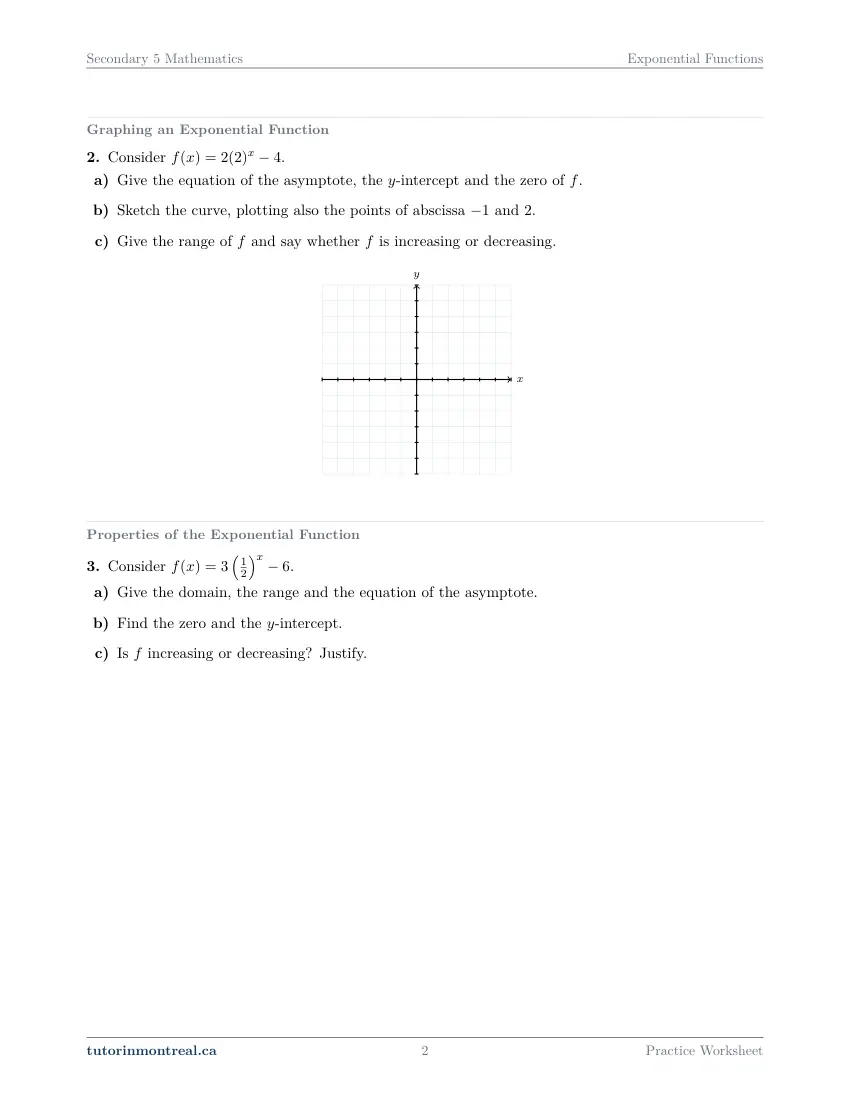
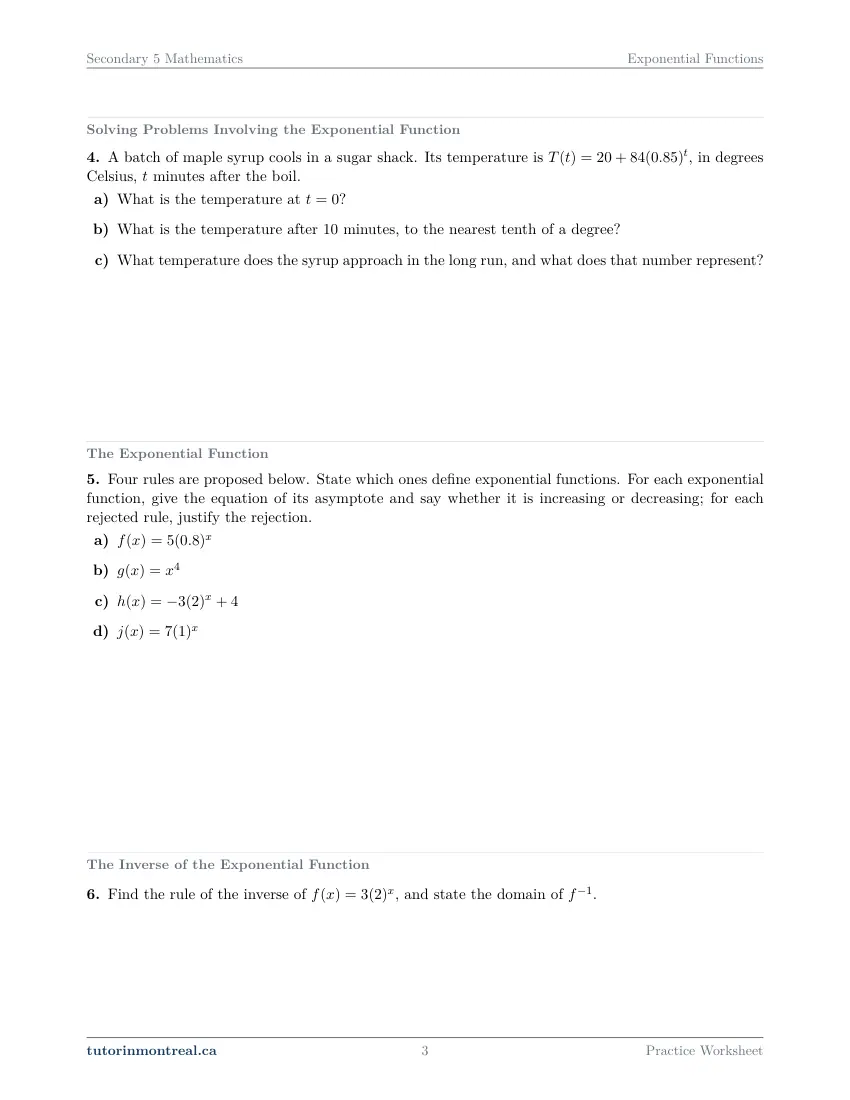
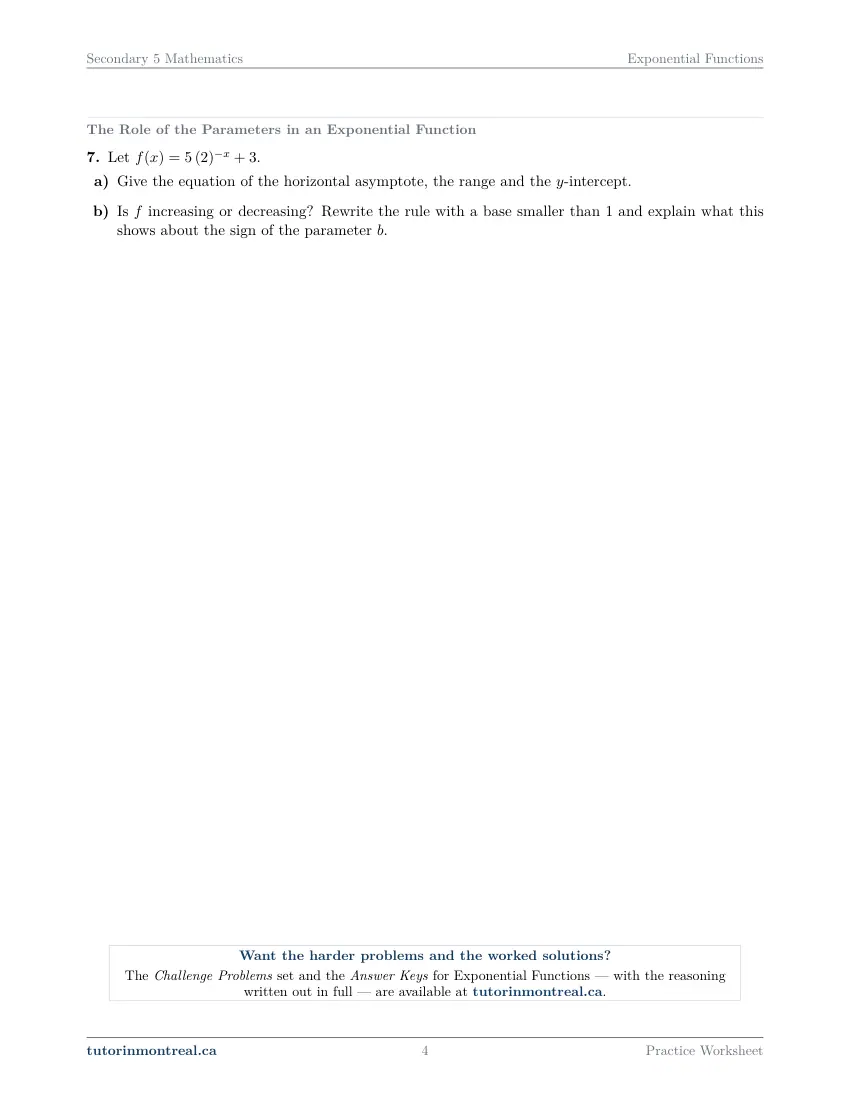
Preview all 4 pages
Click any page to open the full PDF.
Getting the most out of it
Rewrite every number as a power before you solve
Learn the small powers cold — the powers of 2 up to 256, of 3 up to 243, of 5 up to 625 — and recognising 81 as 3⁴ becomes instant instead of a search. Nearly every common-base question on this sheet is decided in that one instant of recognition.
State the asymptote before answering anything else
On each question, write "asymptote: y = k" in the margin first. The range, the sketch, the existence of a zero and the meaning of the context all fall out of it, and it stops the reflex answer of y = 0.
Turn every percentage into a base on sight
When you read "loses 12% per year", write 0.88 next to it immediately, before doing anything else with the sentence. Most errors on contextual questions happen in that translation, not in the algebra that follows it.
Want the solutions, or something more challenging?
The worksheet, the questions above and every explanation on this page stay free permanently. Three more PDFs exist for this topic — the worked answer key, a harder problem set, and the answer key to that. They come with the Secondary 5 Math Solutions Bundle, which is what keeps the rest of the series free.
What else exists for Exponential Functions
Three PDFs · 7 pages · all three are in the bundle below.
- Answer key — 2 pages. All 7 questions worked step by step, including the restrictions and the justifications. Not a list of final answers.
- Challenge problems — 3 pages, 5 problems. A separate sheet at exam-plus difficulty covering the same 7 concepts. Harder than anything on the free sheet.
- Challenge answer key — 2 pages. Every challenge problem worked to the same standard, with the checks shown.
- PDF, letter size, print-ready.
The one thing that's for sale
Every Secondary 5 Math topic — the complete Solutions Bundle
One download, one payment, the whole program. Every answer key and every challenge set for all 21 Secondary 5 Math worksheet sets — including this one.
- Worked solutions, not answer lists — every step written out
- Covers the whole year's program at this level
- Less than the price of one hour of tutoring — for the entire year's solutions
Taking Secondary 1 Math as well? The Secondary 1 Math bundle covers all 15 of its sets — 45 PDFs, 182 pages — on the same terms.
Taking Secondary 2 Math as well? The Secondary 2 Math bundle covers all 14 of its sets — 42 PDFs, 181 pages — on the same terms.
Taking Secondary 3 Math as well? The Secondary 3 Math bundle covers all 11 of its sets — 33 PDFs, 154 pages — on the same terms.
Taking Secondary 4 Math as well? The Secondary 4 Math bundle covers all 17 of its sets — 51 PDFs, 154 pages — on the same terms.
Taking CEGEP Calculus I as well? The CEGEP Calculus I bundle covers all 8 of its sets — 24 PDFs, 82 pages — on the same terms.
Taking CEGEP Calculus II as well? The CEGEP Calculus II bundle covers all 8 of its sets — 24 PDFs, 90 pages — on the same terms.
Taking CEGEP Linear Algebra as well? The CEGEP Linear Algebra bundle covers all 7 of its sets — 21 PDFs, 82 pages — on the same terms.
Taking AP Calculus AB as well? The AP Calculus AB bundle covers all 8 of its sets — 24 PDFs, 126 pages — on the same terms.
Common questions
Is this worksheet really free?
Yes — the questions are on this page to read, and the PDF downloads directly, no email and no account. The one paid item is optional: the complete Secondary 5 Solutions Bundle, which covers every set at this level.
How do I know whether an exponential function is increasing or decreasing?
Two things decide it together. A base greater than 1 makes the power grow and a base between 0 and 1 makes it shrink; then a negative coefficient a reverses whichever it was. So a base under 1 with a negative a is increasing, and the base alone is never a sufficient answer.
Where does the horizontal asymptote come from?
From the constant k added at the end. A power of a positive base is never zero, so the term a·c^x is never zero and f(x) is never exactly k. The curve approaches the line y = k without reaching it, which is also why the range has an open bracket at k.
How do I solve an exponential equation without a calculator?
Isolate the power first, then write both sides as powers of the same base and set the exponents equal — an exponential function never takes the same value twice, so that step is valid. Reciprocals and roots are your rewriting tools: 2 is (1/2) to the power −1, and √c is c to the power one half.
What does the base 0.85 mean in a decay model?
That 85% of the quantity survives each period, so 15% is lost. The base is always what you keep: growth of r percent gives 1 + r/100 and a loss of r percent gives 1 − r/100. A quantity that halves every 10 minutes is base 1/2 with the exponent t/10, because the exponent counts periods.
Why is x⁴ not an exponential function?
Because the variable is the base and the exponent is a fixed number — that is a power function. An exponential function has the variable in the exponent and a constant base, which must also be positive and different from 1.
Can teachers use this in class?
Yes. Print and photocopy it for your own classes freely — I just ask that the tutorinmontreal.ca footer stays on the page.
I'm stuck on one question. Can you help?
Yes — through one-on-one tutoring, in Montreal or online. Get in touch to arrange a session, or see the current rates.
← All 21 Secondary 5 Math worksheets · Secondary 1 Math series (15 sheets) → · Secondary 2 Math series (14 sheets) → · Secondary 3 Math series (11 sheets) → · Secondary 4 Math series (17 sheets) → · CEGEP Calculus I series (8 sheets) → · CEGEP Calculus II series (8 sheets) → · CEGEP Linear Algebra series (7 sheets) → · AP Calculus AB series (8 sheets) →
The same topic at the other level: Secondary 4 Math · Exponential Functions.