Secondary 5 Conditional Probability Worksheet
One technique at a time: conditional probability with and without replacement, mathematical expectation and expected profit, converting between odds and probabilities, telling theoretical from experimental and subjective probability, deciding whether two events are compatible and separately whether they are independent, and a synthesis problem that reverses a condition and then puts a price on the result. Compatible and independent are not the same property, and the sheet keeps testing that. No sign-up, and no charge for the printable version.
Practice worksheet — free PDF
No email, no account, no watermark. Teachers: photocopy it for your classes freely. Worked solutions and 6 harder problems come with the Secondary 5 Math bundle.
5 of the 6 questions
Each question targets one named concept from the sheet. Read them here, or print the PDF — it has working space under each one. 5 of the 6 questions are printed below. The other 1 is built on a diagram or a table of values that does not translate to the page, so it is in the free PDF — marked below where it would have come.
-
Q1Conditional Probability
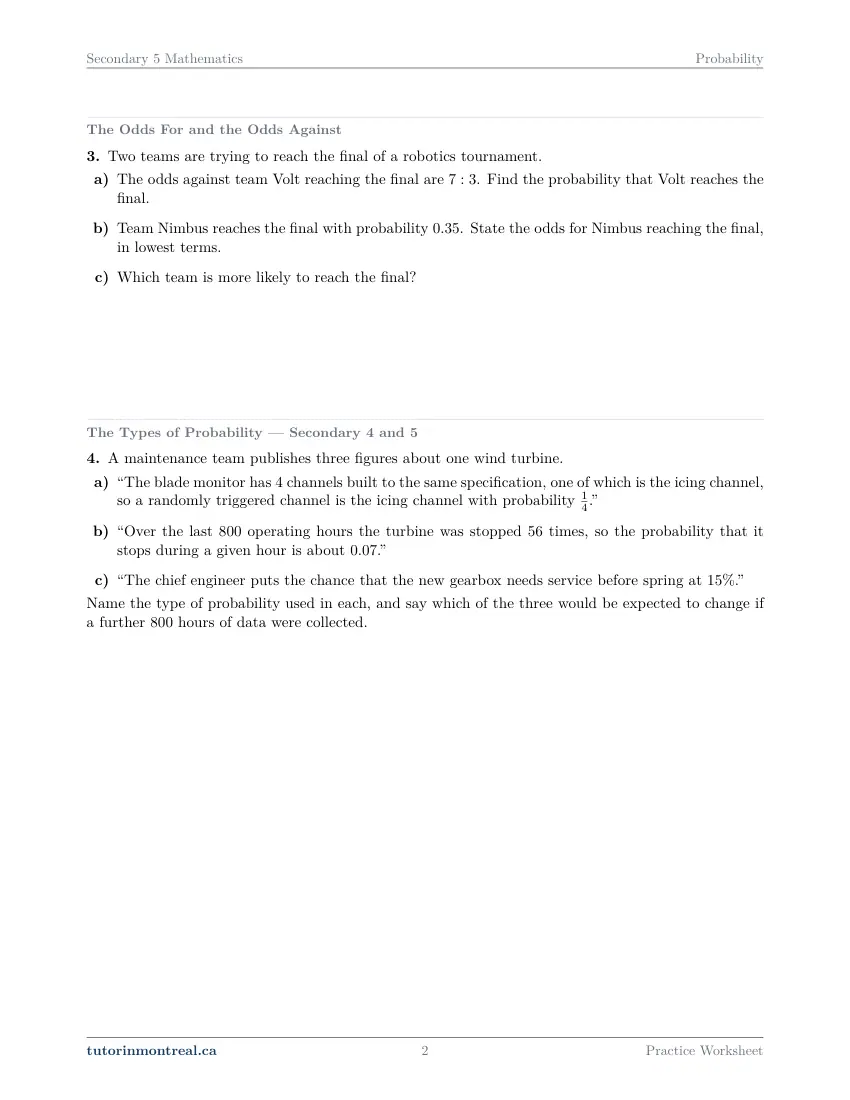
A hydroponic greenhouse receives 15 seedling trays, and 6 of them carry a root fungus. An inspector examines two trays chosen at random, one after the other, without replacement.
- Given that the first tray examined carries the fungus, what is the probability that the second one does too?
- Find the probability that both trays carry the fungus.
- Find the probability that exactly one of the two trays carries it.
-
Q2Mathematical Expectation
This question is built around a diagram or a table of values. Open it in the PDF.
-
Q3The Odds For and the Odds Against
Two teams are trying to reach the final of a robotics tournament.
- The odds against team Volt reaching the final are . Find the probability that Volt reaches the final.
- Team Nimbus reaches the final with probability . State the odds for Nimbus reaching the final, in lowest terms.
- Which team is more likely to reach the final?
-
Q4The Types of Probability –
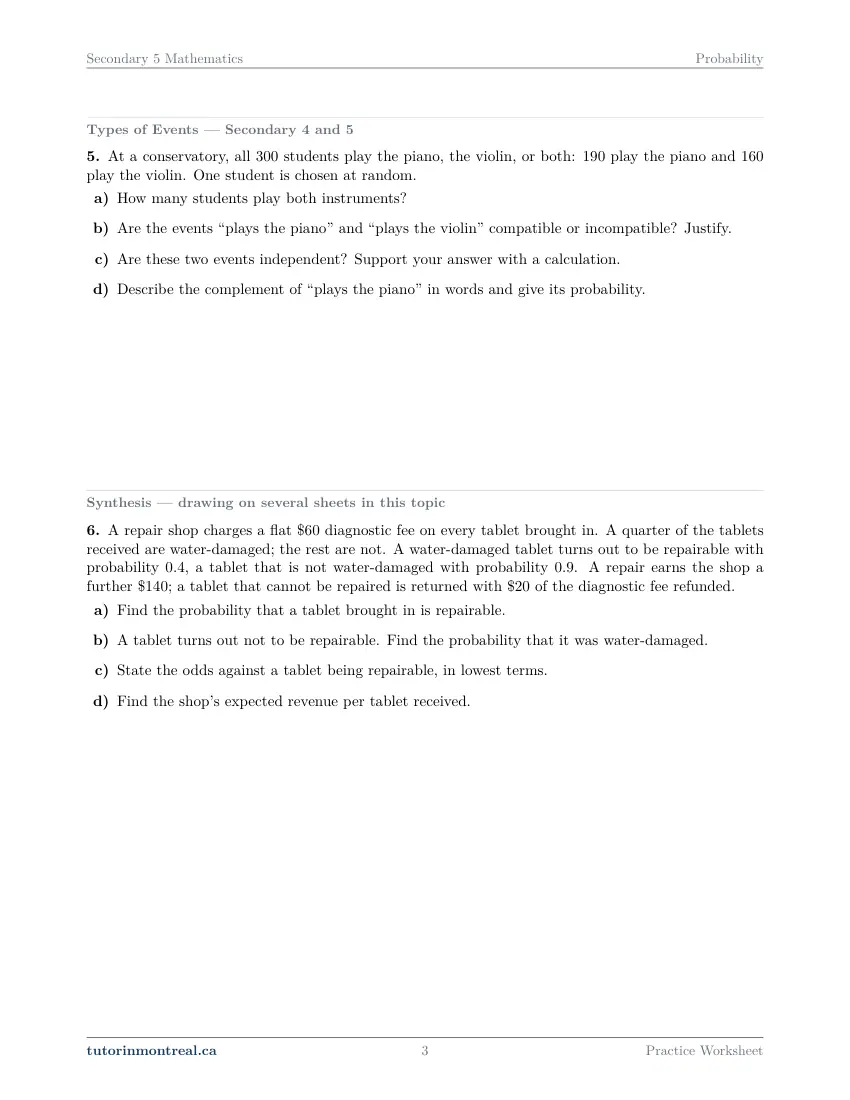
A maintenance team publishes three figures about one wind turbine.
- “The blade monitor has 4 channels built to the same specification, one of which is the icing channel, so a randomly triggered channel is the icing channel with probability .”
- “Over the last 800 operating hours the turbine was stopped 56 times, so the probability that it stops during a given hour is about .”
- “The chief engineer puts the chance that the new gearbox needs service before spring at .”
Name the type of probability used in each, and say which of the three would be expected to change if a further 800 hours of data were collected.
-
Q5Types of Events –
At a conservatory, all 300 students play the piano, the violin, or both: 190 play the piano and 160 play the violin. One student is chosen at random.
- How many students play both instruments?
- Are the events “plays the piano” and “plays the violin” compatible or incompatible? Justify.
- Are these two events independent? Support your answer with a calculation.
- Describe the complement of “plays the piano” in words and give its probability.
-
Q6Synthesis — drawing on several sheets in this topic
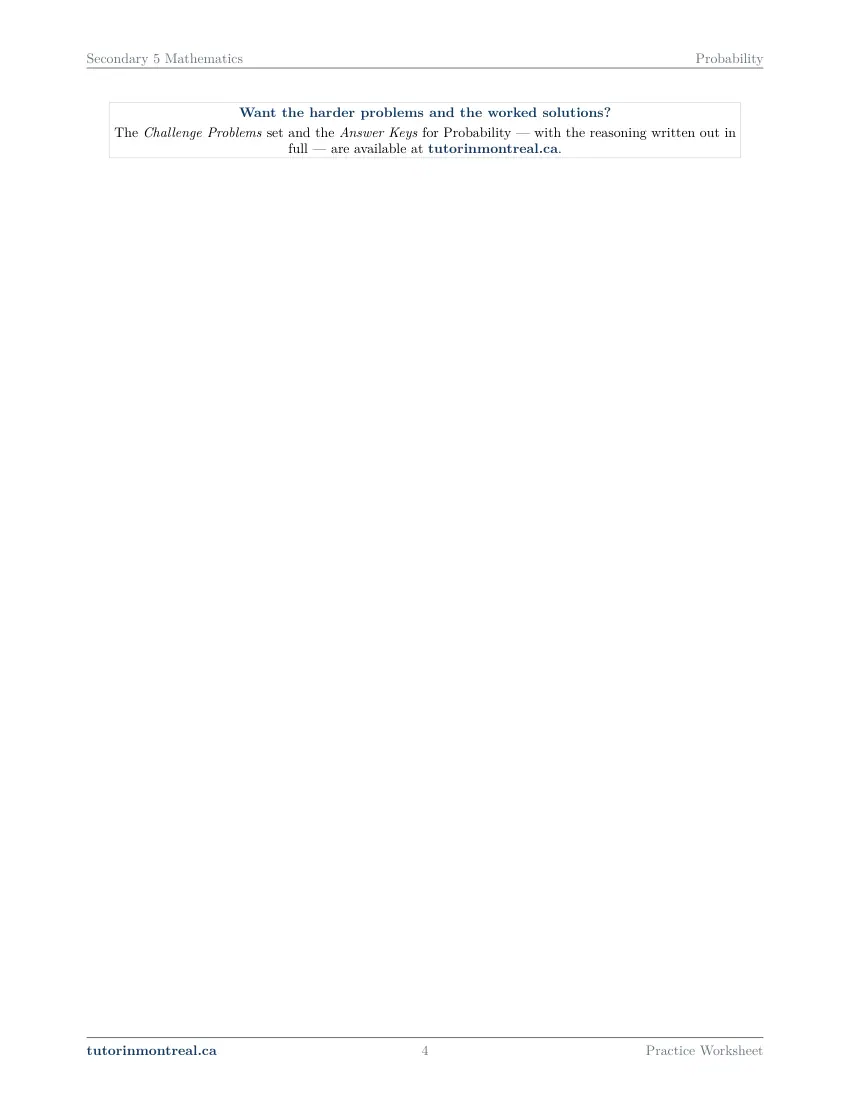
A repair shop charges a flat $60 diagnostic fee on every tablet brought in. A quarter of the tablets received are water-damaged; the rest are not. A water-damaged tablet turns out to be repairable with probability , a tablet that is not water-damaged with probability . A repair earns the shop a further $140; a tablet that cannot be repaired is returned with $20 of the diagnostic fee refunded.
- Find the probability that a tablet brought in is repairable.
- A tablet turns out not to be repairable. Find the probability that it was water-damaged.
- State the odds against a tablet being repairable, in lowest terms.
- Find the shop's expected revenue per tablet received.
The 6 challenge problems for this topic are a separate, paid sheet and are not reproduced here.
Which stream is this for? This sheet is built for SN. It assumes you are working with conditional probability, expectation and odds, and that a question may ask you to justify independence rather than assume it, and it goes to the depth that program expects.
How to do every concept on this sheet
This is the part worksheet sites usually leave out. Below is the actual reasoning behind each group of questions — not a full solution set, the decisions that get you to one. Read it before you start, or after you get stuck.
Without replacement: the second draw is a different experiment (Q1)
Everything in Q1 comes out of one formula, read in the direction the question needs:
P(A ∩ B) = P(A) × P(B | A)Part (a) asks for the conditional probability on its own. The word given means you are no longer looking at the original collection — one item has already gone, so both the count of favourable items and the total count drop by one. Halving only the numerator, or only the denominator, is the classic error and it is worth being deliberate about: rewrite the situation in words ("fourteen trays remain, five of them affected") before writing any fraction.
"Exactly one" is two disjoint cases, not one. Part (c) asks for exactly one of the two items to have the property, and that happens in two mutually exclusive orders: affected then clean, or clean then affected. Compute each as a product of a probability and a conditional probability, then add. Forgetting the second order halves the answer, and it is the most frequently lost mark on this whole topic.
The check is free and you should always take it: the three outcomes — both, exactly one, neither — are exhaustive and mutually exclusive, so their probabilities must add to exactly 1. Work them all out over a common denominator and confirm.
Mathematical expectation (Q2)
The expectation of a random variable is the average of its values, each weighted by how likely it is:
E(X) = Σ x · P(X = x)Before computing, check that the given probabilities add to 1 — if they do not, the table is misread and every later number is wrong. Afterwards, sanity-check the value: an expectation must land between the smallest and the largest value in the table, and for a symmetric distribution it lands exactly at the centre.
Part (b) turns each outcome into money, and it does not require a new table. Expectation is linear: if every unit brings in a fixed amount and there is a fixed cost, the expected profit is that amount times the expectation, minus the cost. Rebuilding the whole distribution in dollars gives the same answer and takes five times as long.
An expectation need not be a possible outcome. An expected 2.4 contracts a week is not a prediction that some week will contain 2.4 contracts; it is the long-run average per week. This is exactly what the interpretation marks on this topic are asking for, and it is also why an expectation alone never settles a one-off decision — it says nothing about the spread of what might happen.
Odds are counts of cases, not probabilities (Q3)
This is the sheet's most reliable source of dropped marks, because the notation looks like a fraction and is not one. Odds compare favourable cases to unfavourable cases. A probability compares favourable cases to all cases.
Converting in both directions
Always go through the counts. Never divide the two numbers of an odds ratio.
- 1Odds against, a : b → probability
a unfavourable cases for b favourable ones, so there are a + b cases in all and the probability of the event is b/(a + b). Odds against of 7 : 3 give a probability of 3/10 — note the 3 on top, not the 7.
- 2Odds for, a : b → probability
Now a is the favourable count, so the probability is a/(a + b). Odds for of 7 : 13 give 7/20, not 7/13. Reading the second number as the total is the single most common slip.
- 3Probability → odds
Write the probability as a fraction in lowest terms. The numerator is the favourable count, and the unfavourable count is the denominator minus the numerator. Odds for are favourable : unfavourable; odds against are the same pair reversed.
Odds cannot be multiplied. Chaining two stages by multiplying the two odds ratios term by term gives an answer that is not merely inaccurate, it is meaningless — the denominators refer to different collections of cases. Convert each set of odds to a probability, multiply the probabilities, then convert the result back to odds if the question wants odds. Q3(c) and the last part of the synthesis both live on this point.
Theoretical, experimental, subjective (Q4)
Three sources, and the question is always which source a stated number came from. Theoretical probability is counted from a model of equiprobable cases, before any trial takes place. Experimental probability is a relative frequency read off real data. Subjective probability is an expert's judgment about a one-off event that cannot be repeated under identical conditions.
Q4 then asks which of the three would change if more data were collected, and only the experimental one would. A theoretical value is fixed by the model; a subjective one changes only if the person changes their mind. The law of large numbers is the sentence worth having ready: as the number of trials grows, the relative frequency settles down towards the theoretical value — it does not reach it, and no finite number of trials ever proves it.
Compatible and independent are two different questions (Q5)
Q5 asks both about the same pair of events, and they are answered by different calculations. Compatible is about whether the two events can happen together at all: they are compatible when their intersection is non-empty. Independent is about whether knowing one changes the chance of the other:
A and B are independent ⟺ P(A ∩ B) = P(A) × P(B)equivalently, when P(B | A) = P(B). To get the overlap in the first place, use the counting identity n(A ∪ B) = n(A) + n(B) − n(A ∩ B), remembering that "every student plays at least one" is what tells you n(A ∪ B) is the whole group.
Incompatible does not mean independent — it means the opposite. If two events with non-zero probabilities cannot occur together, then learning that one happened tells you the other certainly did not. That is the strongest possible dependence. In symbols, incompatible gives P(A ∩ B) = 0 while P(A) × P(B) > 0, so the independence test fails. Answering "incompatible, therefore independent" is a guaranteed zero, and it is written on exam scripts every year.
Q5(d) asks for a complement in words as well as a probability. The complement of "plays the piano" is "does not play the piano" — and in this particular group, where everyone plays at least one instrument, that description simplifies to "plays only the violin". Saying both is what the mark is for: the general description, and what it amounts to here.
Reversing a condition (Q6)
The synthesis question gives you the probability of an outcome within each category and asks for the probability of the category given the outcome. That reversal is the whole difficulty, and it is done in two steps.
From P(outcome | category) to P(category | outcome)
Two steps, and the first is a weighted total.
- 1Total probability
Split the population into its categories, multiply each category's share by the conditional probability inside it, and add. That gives the overall probability of the outcome — the number you will divide by.
- 2Divide the branch by the total
The conditional probability is the probability of the one branch you care about, divided by the probability of the outcome overall. Both numbers came out of the tree you already drew, so there is nothing new to compute.
P(A | B) and P(B | A) are not the same number. They are computed over different populations: one among the members of B, the other among the members of A. A quick illustration of my own: suppose 1 item in 100 is defective, that a test flags every defective item, and that it also flags 5 good ones in 100. Then the probability that a defective item is flagged is 1, but the probability that a flagged item is defective is only about 1 in 6 — the two conditionals differ by a factor of six. The link between them is P(A) × P(B | A) = P(B) × P(A | B), and they coincide only in the special case where P(A) = P(B).
The last part of Q6 puts money on the branches. Each outcome carries an amount, so the expected revenue is a fixed part plus each conditional amount weighted by the probability of the branch it sits on. Work out the probability of each outcome first, in a column, then attach the money — doing both at once is how a term goes missing.
Preview all 4 pages
Click any page to open the full PDF.
Getting the most out of it
Draw the tree before you write a single fraction
Every conditional question here — the two-stage draw, the reversed condition, the expected revenue — is the same tree with different labels. Branches out of one node must add to 1, which is a free check on your reading of the question, and the probability of a complete path is the product along it.
Name the events with letters, at the top of the page
"Let F be 'the tray carries the fungus'" takes ten seconds and turns the rest of the question into symbols you can manipulate. It also forces you to notice when a question is about a complement, which is the moment most of the reading errors happen.
Use the sum-to-one check on every partition
Both, exactly one, neither. Repairable, not repairable. Each category of the population. Whenever you have listed every possibility once, the probabilities must add to exactly 1 — and when they do not, you have found the error while it is still cheap to fix.
Want the solutions, or something more challenging?
The worksheet, the questions above and every explanation on this page stay free permanently. Three more PDFs exist for this topic — the worked answer key, a harder problem set, and the answer key to that. They come with the Secondary 5 Math Solutions Bundle, which is what keeps the rest of the series free.
What else exists for Probability
Three PDFs · 10 pages · all three are in the bundle below.
- Answer key — 2 pages. All 6 questions worked step by step, including the restrictions and the justifications. Not a list of final answers.
- Challenge problems — 5 pages, 6 problems. A separate sheet at exam-plus difficulty covering the same 5 concepts. Harder than anything on the free sheet.
- Challenge answer key — 3 pages. Every challenge problem worked to the same standard, with the checks shown.
- PDF, letter size, print-ready.
The one thing that's for sale
Every Secondary 5 Math topic — the complete Solutions Bundle
One download, one payment, the whole program. Every answer key and every challenge set for all 21 Secondary 5 Math worksheet sets — including this one.
- Worked solutions, not answer lists — every step written out
- Covers the whole year's program at this level
- Less than the price of one hour of tutoring — for the entire year's solutions
Taking Secondary 1 Math as well? The Secondary 1 Math bundle covers all 15 of its sets — 45 PDFs, 182 pages — on the same terms.
Taking Secondary 2 Math as well? The Secondary 2 Math bundle covers all 14 of its sets — 42 PDFs, 181 pages — on the same terms.
Taking Secondary 3 Math as well? The Secondary 3 Math bundle covers all 11 of its sets — 33 PDFs, 154 pages — on the same terms.
Taking Secondary 4 Math as well? The Secondary 4 Math bundle covers all 17 of its sets — 51 PDFs, 154 pages — on the same terms.
Taking CEGEP Calculus I as well? The CEGEP Calculus I bundle covers all 8 of its sets — 24 PDFs, 82 pages — on the same terms.
Taking CEGEP Calculus II as well? The CEGEP Calculus II bundle covers all 8 of its sets — 24 PDFs, 90 pages — on the same terms.
Taking CEGEP Linear Algebra as well? The CEGEP Linear Algebra bundle covers all 7 of its sets — 21 PDFs, 82 pages — on the same terms.
Taking AP Calculus AB as well? The AP Calculus AB bundle covers all 8 of its sets — 24 PDFs, 126 pages — on the same terms.
Common questions
Is this worksheet really free?
Yes — the questions are on this page to read, and the PDF downloads directly, no email and no account. The one paid item is optional: the complete Secondary 5 Solutions Bundle, which covers every set at this level.
What is the difference between odds and a probability?
A probability compares favourable cases with the total number of cases; odds compare favourable cases with unfavourable ones. Odds for of 7 : 13 therefore mean a probability of 7/20, not 7/13. To convert a probability to odds, write it in lowest terms and subtract the numerator from the denominator to get the unfavourable count.
Why can't I just multiply two sets of odds together?
Because odds are ratios of counts of cases, and the counts in the two stages refer to different collections. Multiplying them term by term produces a number with no meaning. Convert each set of odds to a probability, multiply the probabilities — which is legitimate, since the probability of both stages is the first times the second given the first — then convert back.
When I draw without replacement, what exactly changes?
Both parts of the fraction. After an item with the property is removed, the count of items with that property drops by one and so does the total. Changing only one of the two is the most common error on this kind of question, so it is worth restating the situation in words before writing the second fraction.
If two events are incompatible, are they independent?
No — they are as dependent as two events can be. If they cannot occur together, then knowing that one occurred tells you with certainty that the other did not. The test confirms it: for incompatible events the probability of the intersection is 0, while the product of the two probabilities is not, so the independence condition fails.
Is P(A given B) the same as P(B given A)?
No. The two are computed over different populations, and they can differ enormously. They are linked by the fact that P(A) times P(B given A) and P(B) times P(A given B) are both equal to the probability of the intersection, so the two conditionals coincide only when P(A) and P(B) happen to be equal.
Can teachers use this in class?
Yes. Print and photocopy it for your own classes freely — I just ask that the tutorinmontreal.ca footer stays on the page.
I'm stuck on one question. Can you help?
Yes — through one-on-one tutoring, in Montreal or online. Get in touch to arrange a session, or see the current rates.
← All 21 Secondary 5 Math worksheets · Secondary 1 Math series (15 sheets) → · Secondary 2 Math series (14 sheets) → · Secondary 3 Math series (11 sheets) → · Secondary 4 Math series (17 sheets) → · CEGEP Calculus I series (8 sheets) → · CEGEP Calculus II series (8 sheets) → · CEGEP Linear Algebra series (7 sheets) → · AP Calculus AB series (8 sheets) →
The same topic at the other level: Secondary 4 Math · Probability.