Secondary 5 Logarithmic Functions Worksheet
Worked in the order the questions come: reading the domain off the argument, locating the vertical asymptote, building the rule from an asymptote and one point, finding zeros by turning a logarithmic equation into an exponential one, justifying the direction of variation from the base and the coefficient together, giving sign intervals, and inverting the function. That last justification is the step most people skip. Nothing here sits behind a form: the PDF downloads and prints for free.
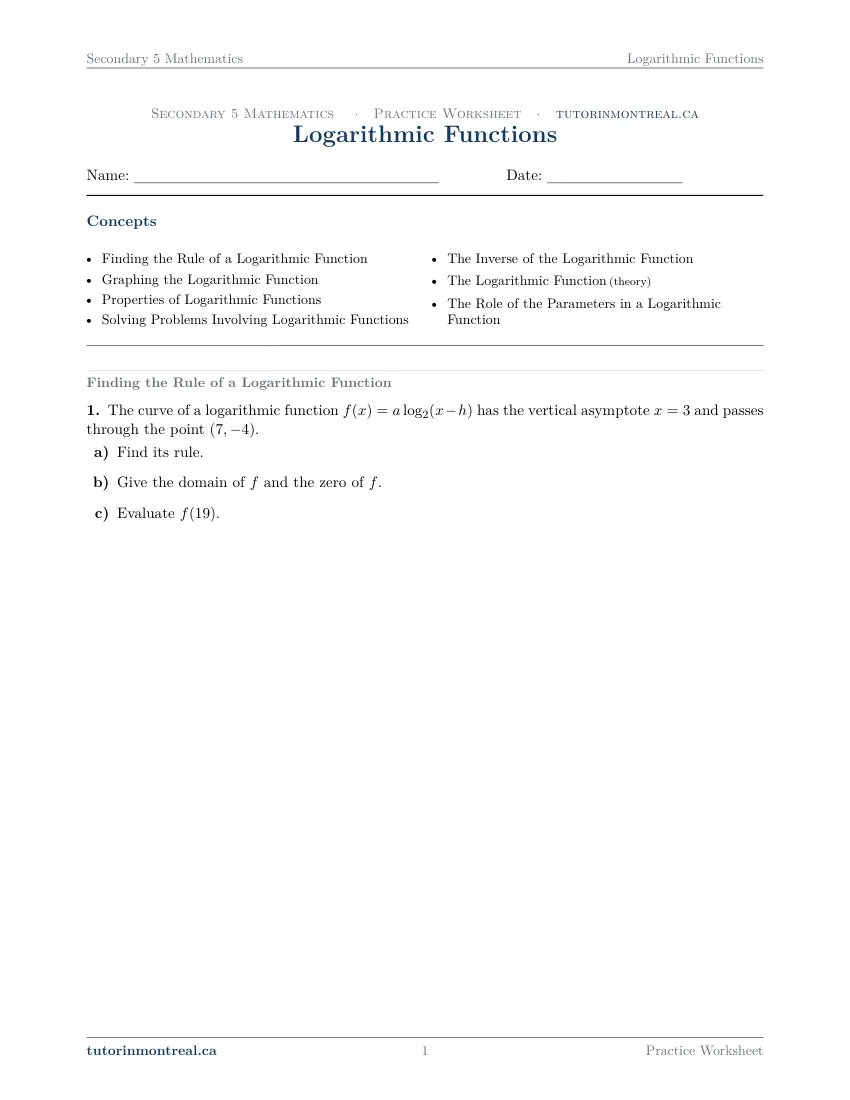
Practice worksheet — free PDF
No email, no account, no watermark. Teachers: photocopy it for your classes freely. Worked solutions and 6 harder problems come with the Secondary 5 Math bundle.
All 7 questions
Each question targets one named concept from the sheet. Read them here, or print the PDF — it has working space under each one.
-
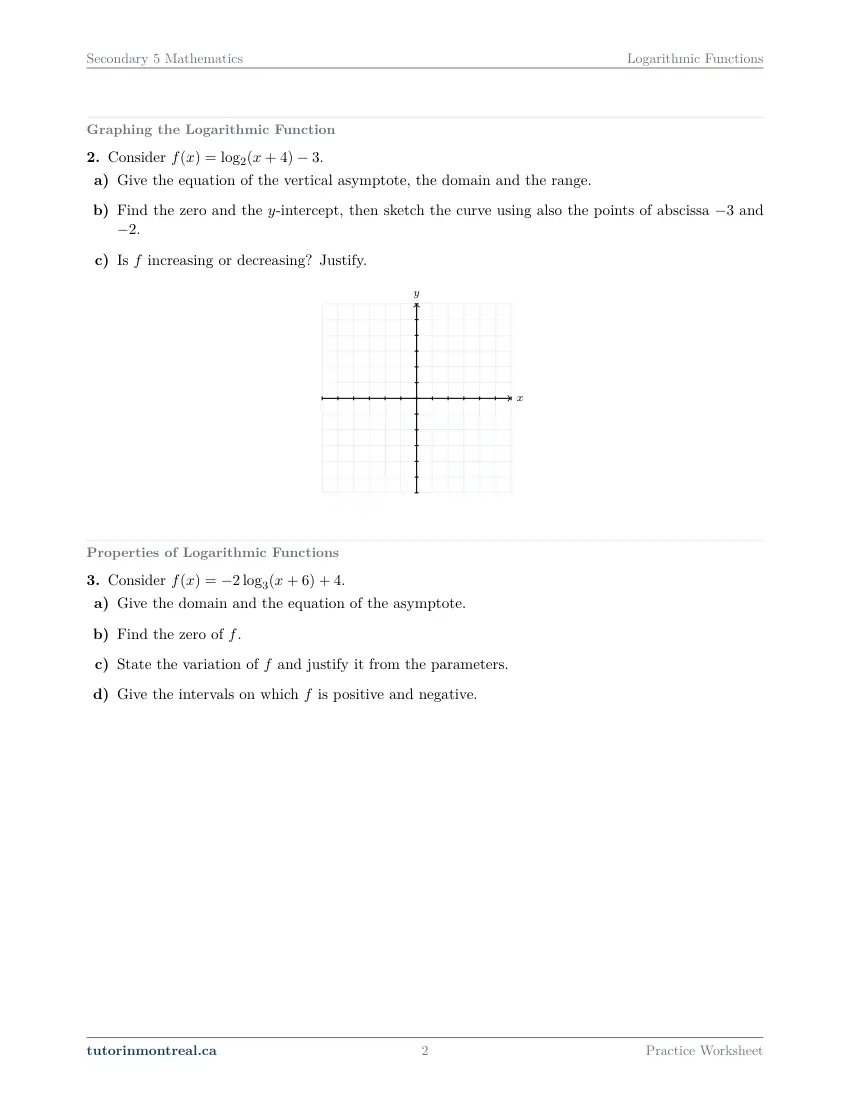
Q1Finding the Rule of a Logarithmic Function
The curve of a logarithmic function has the vertical asymptote and passes through the point .
- Find its rule.
- Give the domain of and the zero of .
- Evaluate .
-
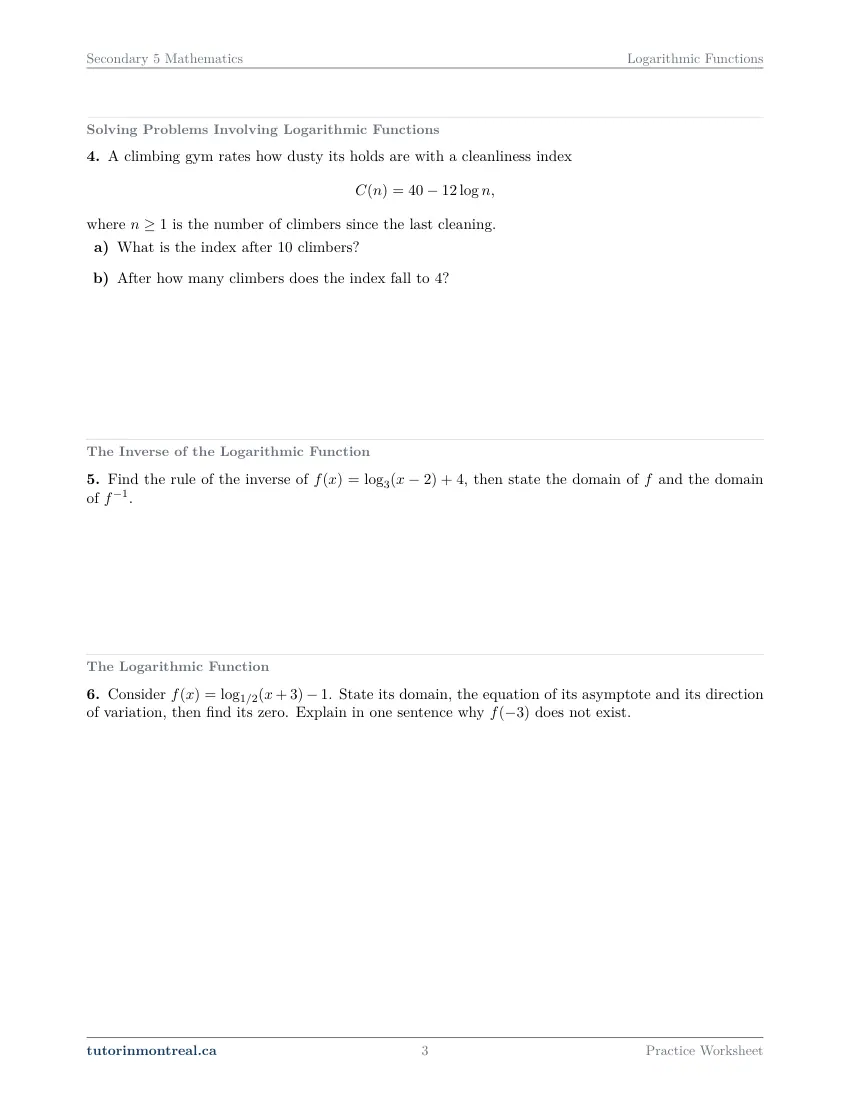
Q2Graphing the Logarithmic Function
Consider .
- Give the equation of the vertical asymptote, the domain and the range.
- Find the zero and the -intercept, then sketch the curve using also the points of abscissa and .
- Is increasing or decreasing? Justify.
-
Q3Properties of Logarithmic Functions
Consider .
- Give the domain and the equation of the asymptote.
- Find the zero of .
- State the variation of and justify it from the parameters.
- Give the intervals on which is positive and negative.
-
Q4Solving Problems Involving Logarithmic Functions
A climbing gym rates how dusty its holds are with a cleanliness index where is the number of climbers since the last cleaning.
- What is the index after climbers?
- After how many climbers does the index fall to ?
-
Q5The Inverse of the Logarithmic Function
Find the rule of the inverse of , then state the domain of and the domain of .
-
Q6The Logarithmic Function
Consider . State its domain, the equation of its asymptote and its direction of variation, then find its zero. Explain in one sentence why does not exist.
-
Q7The Role of the Parameters in a Logarithmic Function
Consider .
- Give the equation of the vertical asymptote and the domain.
- Is increasing or decreasing? Justify with the parameters.
- Find the zero of .
The 6 challenge problems for this topic are a separate, paid sheet and are not reproduced here.
Which stream is this for? This sheet is built for SN. It assumes you work with the full form a·log_c(b(x − h)) + k, bases above and below 1 as well as the common base 10, interval notation for domains and sign sets, and the exponential inverse, and it goes to the depth that program expects.
How to do every concept on this sheet
This is the part worksheet sites usually leave out. Below is the actual reasoning behind each group of questions — not a full solution set, the decisions that get you to one. Read it before you start, or after you get stuck.
A logarithm is an exponent — read every rule that way
Everything on this sheet becomes routine once you stop treating log as an unexplained button and read it as the question it actually asks:
logc(A) = m means cm = Alog2(16) is "what exponent turns 2 into 16?", so it is 4. That is not a calculation, it is a reading, and Q1(c), Q2 and Q4 are all designed to be answered by reading rather than by calculator. Two special cases are worth having permanently on hand: logc(1) = 0 for every base, because c0 is always 1, and logc(c) = 1. Those two are the reason a point of a logarithmic graph can drop out of a substitution with no work.
One notation convention: a logarithm written with no base at all, as in Q4's log n, means base 10. So log 1000 is 3.
The domain is the whole first half of most questions
A logarithm accepts only strictly positive arguments, because no exponent applied to a positive base ever produces zero or a negative number. That restriction is not a technicality bolted on afterwards; it is where the vertical asymptote comes from.
How to open any logarithmic question
Q2, Q3, Q6 and Q7 all begin the same way. Do these two lines before anything else.
- 1Set the argument greater than zero and solve
For
log₃(x + 6)you needx + 6 > 0, sox > −6. The domain is]−6, +∞[— reversed bracket at the finite end too, because the boundary value itself is excluded. - 2The boundary value is the vertical asymptote
The equation of the asymptote is
x = −6, the value that makes the argument zero. As x creeps down toward it the argument creeps toward 0 and the logarithm runs off to infinity, which is what an asymptote means. - 3Write the range without thinking: it is ℝ
A logarithmic function takes every real value. Nothing outside the bars — no
a, nok— can change that, because multiplying and shifting a set that already covers all the reals still covers all the reals. There is no horizontal asymptote and no extremum. - 4Only now start the question that was asked
Every later answer has to be intersected with that domain. A candidate value outside it is not a solution, however clean the algebra that produced it looked.
Domain and range are the mirror image of the exponential case, and students swap them. A logarithmic function has a restricted domain and an unrestricted range; its asymptote is vertical. Q6 makes the point concrete by asking why f(−3) does not exist for log1/2(x + 3) − 1: at x = −3 the argument is exactly 0, and no exponent applied to one-half ever gives 0. Saying "because it is outside the domain" is circular — the mark is for saying why the domain stops there.
Solving: isolate the logarithm, then convert
Q1(b), Q2(b), Q3(b), Q4(b), Q6 and Q7(c) are all the same two-step method, and the order matters.
Step one: get the logarithm completely alone. Move the + k across, then divide by a. The equation must read logc(argument) = number with nothing multiplying or added to the log.
Step two: rewrite it as an exponential statement using the definition above, then solve the ordinary equation that remains. For 4·log5(x − 1) − 8 = 0:
log5(x − 1) = 2 ⟹ x − 1 = 52 = 25 ⟹ x = 26You cannot convert while something is still attached. Turning 2·log3(x + 4) = 6 straight into x + 4 = 36 is the single most common error on this topic — the coefficient 2 has to be divided out first, giving 33. Equally, log(x + 4) is not log x + 4 and not log x + log 4. The logarithm of a sum does not break apart at all; only the logarithm of a product does.
Finish by checking the solution lies in the domain. A logarithmic equation can produce a value that satisfies the algebra but makes an argument negative, and such a value must be rejected explicitly, with the reason written down.
Finding the rule from an asymptote and a point (Q1)
The asymptote gives h immediately — it is the value that makes the argument zero, so for an asymptote at x = 3 the argument is x − 3. That leaves one unknown, and one point on the curve determines it.
Substitute the point, evaluate the logarithm as an exponent (this is where the "read it, don't compute it" habit pays), and solve a one-step equation. Then verify with a second value. If a question supplies two points instead of an asymptote, substitute both and divide one equation by the other to clear the coefficient — and be prepared for the domain to reject one of the resulting candidates for h.
Increasing or decreasing: the base and the coefficient vote together
Q2(c), Q3(c), Q6 and Q7(b) all ask you to justify the variation from the parameters, which means the answer is a sentence about signs, not a pair of substituted values.
A logarithm with base c > 1 is increasing; with 0 < c < 1 it is decreasing — that is the base's vote. Then a negative a reflects the curve across the horizontal and reverses it. So a > 0 with c > 1 increases, a < 0 with c > 1 decreases, and a base under 1 swaps both of those around.
And whichever it is, it holds on the whole domain. A logarithmic function is monotone from end to end — it never turns, so it has no maximum, no minimum, and exactly one zero.
k does not appear in that reasoning, and neither does h: shifting a curve sideways or vertically cannot change whether it rises. Q3's + 4 and Q7's − 6 move the zero, nothing more.
Sign intervals come free from monotonicity (Q3)
Because the function crosses the x-axis exactly once and never turns around, the domain splits into precisely two pieces at the zero: positive on one, negative on the other. You do not need a table of signs — you need the zero and the direction.
If the function is decreasing with its zero at x = z and its asymptote at x = p, then it is positive on ]p, z[ and negative on ]z, +∞[. Both intervals are open at p because the function does not exist there, and open at z because the function is zero there rather than positive or negative. If it is increasing, the two labels swap. That is also how a logarithmic inequality is solved: find where equality holds, then use the direction of variation to decide which side of it you keep, and intersect with the domain.
Sketching (Q2)
Draw the vertical asymptote as a dashed line first, then choose your points so the logarithm evaluates exactly. For base 2, pick x values that make the argument 1, 2, 4, 8 — the logarithms are then 0, 1, 2, 3 and the points are exact. That is precisely why Q2 names the abscissas −3 and −2: they make the argument 1 and 2.
The shape to aim for: plunging steeply along the asymptote, then flattening out as it moves away, but continuing to rise forever without any ceiling. Two errors to avoid: the curve must not stop or level off at a horizontal line — there is no horizontal asymptote — and it must not appear on both sides of the vertical one.
Contextual logarithms (Q4)
Logarithmic models show up where a quantity responds to multiplying the input rather than adding to it: sound levels, pH, magnitudes, and index scales like the one in Q4. The signature is that equal steps in the output correspond to equal factors in the input — going from 10 to 100 to 1000 climbers moves the index by the same amount each time.
Part (a) is direct substitution, and it is meant to be exact: with base 10, log 10 is 1. Part (b) reverses the model, which is the isolate-then-convert method again, ending with a power of 10. Finish by reading the answer back into the situation — a number of climbers is a whole number, and the stated condition n ≥ 1 is the model's domain, which exists because log 0 does not.
The inverse is an exponential (Q5)
Swap x and y, isolate the logarithm, then convert with the definition — the same two steps as solving, applied to a rule instead of a number. From x = log3(y − 2) + 4 you get log3(y − 2) = x − 4 and therefore y = 3x−4 + 2.
Q5 asks for both domains because that is the lesson. The domain of the original is restricted by its argument and its range is all of ℝ; the inverse has exactly the opposite pair, so its domain is ℝ and its range is what the original's domain was. The vertical asymptote of the logarithm becomes the horizontal asymptote of the exponential, at the same number. Check the pair numerically with one convenient value: compute f of something, feed the result to f−1, and you should land back where you started.
What the parameter b does that nothing else can
In the full form a·logc(b(x − h)) + k, the sign of b decides which side of the asymptote the curve lives on, because the argument has to stay positive. With b > 0 the domain runs to the right of x = h; with b < 0 it runs to the left, and the curve is the mirror image across the vertical line x = h. Its size, though, only translates the curve vertically, since multiplying the argument by a constant adds a constant to the logarithm. That asymmetry — sign matters, magnitude is absorbable — is unique to this family, and it is why the domain check in step 1 above must use the actual argument rather than an assumption about where the curve sits.
Preview all 4 pages
Click any page to open the full PDF.

Getting the most out of it
Write the domain before you write anything else
Make it a physical habit: on every question, the first line you put on the page is the argument set greater than zero, solved. It gives you the asymptote for free and it is the filter every later answer has to pass through.
Learn to read logarithms instead of computing them
Cover the answers and say aloud what log₂(32), log₃(81), log(10 000) and log₅(1) are. Every number in these questions is chosen to come out whole, so if you reach for a calculator you have probably misread the base or left a coefficient attached to the logarithm.
Redo the variation questions as one paragraph
Q2, Q3, Q6 and Q7 each ask for a justification. Once you have finished the sheet, write a single paragraph explaining how the base and the sign of a combine to fix the direction, then compare it against what you wrote in each question. Those are the marks that get lost to one-word answers.
Want the solutions, or something more challenging?
The worksheet, the questions above and every explanation on this page stay free permanently. Three more PDFs exist for this topic — the worked answer key, a harder problem set, and the answer key to that. They come with the Secondary 5 Math Solutions Bundle, which is what keeps the rest of the series free.
What else exists for Logarithmic Functions
Three PDFs · 8 pages · all three are in the bundle below.
- Answer key — 2 pages. All 7 questions worked step by step, including the restrictions and the justifications. Not a list of final answers.
- Challenge problems — 4 pages, 6 problems. A separate sheet at exam-plus difficulty covering the same 7 concepts. Harder than anything on the free sheet.
- Challenge answer key — 2 pages. Every challenge problem worked to the same standard, with the checks shown.
- PDF, letter size, print-ready.
The one thing that's for sale
Every Secondary 5 Math topic — the complete Solutions Bundle
One download, one payment, the whole program. Every answer key and every challenge set for all 21 Secondary 5 Math worksheet sets — including this one.
- Worked solutions, not answer lists — every step written out
- Covers the whole year's program at this level
- Less than the price of one hour of tutoring — for the entire year's solutions
Taking Secondary 1 Math as well? The Secondary 1 Math bundle covers all 15 of its sets — 45 PDFs, 182 pages — on the same terms.
Taking Secondary 2 Math as well? The Secondary 2 Math bundle covers all 14 of its sets — 42 PDFs, 181 pages — on the same terms.
Taking Secondary 3 Math as well? The Secondary 3 Math bundle covers all 11 of its sets — 33 PDFs, 154 pages — on the same terms.
Taking Secondary 4 Math as well? The Secondary 4 Math bundle covers all 17 of its sets — 51 PDFs, 154 pages — on the same terms.
Taking CEGEP Calculus I as well? The CEGEP Calculus I bundle covers all 8 of its sets — 24 PDFs, 82 pages — on the same terms.
Taking CEGEP Calculus II as well? The CEGEP Calculus II bundle covers all 8 of its sets — 24 PDFs, 90 pages — on the same terms.
Taking CEGEP Linear Algebra as well? The CEGEP Linear Algebra bundle covers all 7 of its sets — 21 PDFs, 82 pages — on the same terms.
Taking AP Calculus AB as well? The AP Calculus AB bundle covers all 8 of its sets — 24 PDFs, 126 pages — on the same terms.
Common questions
Is this worksheet really free?
Yes — the questions are on this page to read, and the PDF downloads directly, no email and no account. The one paid item is optional: the complete Secondary 5 Solutions Bundle, which covers every set at this level.
How do I find the domain of a logarithmic function?
Set the argument strictly greater than zero and solve. A logarithm is only defined for positive arguments, so that inequality is the domain, and the value that makes the argument zero is the equation of the vertical asymptote. The range, meanwhile, is always all the reals.
How do I solve an equation with a logarithm in it?
Isolate the logarithm completely first — move the constant across, then divide by the coefficient — and only then rewrite it as an exponential statement, since log base c of A equals m means c to the power m equals A. Converting before the coefficient is divided out is the most common mistake on this topic.
Why doesn't the function exist at the asymptote?
Because there the argument is exactly zero, and no exponent applied to a positive base ever produces zero. The logarithm of 0 does not exist, and the logarithm of a negative number does not either, which is why the asymptote is a wall the curve approaches but never reaches.
Is a logarithmic function increasing or decreasing?
A base greater than 1 gives an increasing logarithm and a base between 0 and 1 gives a decreasing one; a negative coefficient in front then reverses whichever it was. Whatever the combination, it holds across the whole domain, so the function has exactly one zero and no extremum.
Can log(x + 4) be split into log x + log 4?
No. Only a logarithm of a product splits into a sum, so log(4x) becomes log 4 + log x. The logarithm of a sum does not break apart at all, and treating it as though it does is the quickest way to a wrong domain and a wrong zero.
Can teachers use this in class?
Yes. Print and photocopy it for your own classes freely — I just ask that the tutorinmontreal.ca footer stays on the page.
I'm stuck on one question. Can you help?
Yes — through one-on-one tutoring, in Montreal or online. Get in touch to arrange a session, or see the current rates.
← All 21 Secondary 5 Math worksheets · Secondary 1 Math series (15 sheets) → · Secondary 2 Math series (14 sheets) → · Secondary 3 Math series (11 sheets) → · Secondary 4 Math series (17 sheets) → · CEGEP Calculus I series (8 sheets) → · CEGEP Calculus II series (8 sheets) → · CEGEP Linear Algebra series (7 sheets) → · AP Calculus AB series (8 sheets) →
The same topic at the other level: Secondary 4 Math · Logarithmic Functions.