Secondary 5 Operations on Functions Worksheet
Combining two functions is the easy part; knowing where the result exists is the actual question. Sums, differences, products, quotients and compositions, each paired with the domain problem that comes with it — the values a quotient has to exclude, and the inner function's range colliding with the outer function's domain. The composition case is taken slowly in the explanations below. Free to print, no account.
Practice worksheet — free PDF
No email, no account, no watermark. Teachers: photocopy it for your classes freely. Worked solutions and 5 harder problems come with the Secondary 5 Math bundle.
All 6 questions
Each question targets one named concept from the sheet. Read them here, or print the PDF — it has working space under each one.
-
Q1Operations on Functions
Let and .
- Evaluate and .
- Give the domain of in Québec interval notation, and name the two different restrictions that produce it.
-
Q2The Composition of Functions
Let and .
- Find the rules of and , and use them to show that composition is not commutative.
- Evaluate and solve .
-
Q3The Difference of Functions
Let and .
- Write the rule of and the rule of , and give the domain of each.
- Evaluate .
- A student claims that and are “the same function written the other way round”. Explain why this is false, then determine whether there is any value of at which the two rules give the same number.
-
Q4The Product of Functions
Let and . Give the rule of , determine its domain, and evaluate .
-
Q5The Quotient of Functions
Let and , both defined on .
- Give the simplified rule of and its domain.
- Evaluate .
- The simplified rule is a first-degree polynomial, which is defined for every real number. Explain why must nevertheless be excluded.
-
Q6The Sum of Functions
Let , defined on , and .
- Give the rule and the domain of .
- Evaluate .
- Explain why the domain of a sum of two functions is the intersection of their domains, using as an illustration.
The 5 challenge problems for this topic are a separate, paid sheet and are not reproduced here.
Which stream is this for? This sheet is built for SN. It assumes you are comfortable with square root and rational rules, with Québec interval notation, and with justifying a claim about functions rather than only computing — which is the depth that program expects.
How to do every concept on this sheet
This is the part worksheet sites usually leave out. Below is the actual reasoning behind each group of questions — not a full solution set, the decisions that get you to one. Read it before you start, or after you get stuck.
Every question on this sheet is really a domain question
The arithmetic of combining two functions is the easy half. You add the rules, you multiply the rules, you substitute one rule into the other. The half that carries the marks is stating where the result exists, and that is decided before you simplify anything. Q1, Q3, Q4, Q5 and Q6 all ask for it explicitly.
Finding the domain of a combined function
Always in this order. Step 3 is the one people skip, and it is the one that costs.
- 1Take each function on its own first
An even radical needs its radicand ≥ 0. A denominator inside the rule must not vanish. A logarithm needs a strictly positive argument. A polynomial is defined on all of ℝ. Write the two domains down separately before you combine anything.
- 2Intersect them
For
f + g,f − gandf · g, the domain isdom f ∩ dom g— no more, no less. That is exactly what Q6(c) asks you to justify, and the argument is one sentence: to add, subtract or multiply two images, both images must exist. If one of them does not, the expression has no meaning at that number. - 3For a quotient only: delete the zeroes of the bottom function
Two restrictions act at once on
f/g, which is the point of Q1(b) and Q4: the restrictions inherited from each rule, and the values where the denominator function is zero. A number can be perfectly admissible forfand forgseparately and still be lost by the division. - 4Write it in Québec interval notation
Reversed bracket at every excluded end, square bracket at every included one, and infinity always reversed. A single missing value in the middle makes the answer a union: "every number from 4 on, except 9" is not one interval, it is
[4, 9[ ∪ ]9, +∞[.
The quotient: why a cancelled factor still restricts
Q5 is short and it is the question students most often get half-right. You factor, you cancel, and the rule that comes out is a first-degree polynomial — defined for every real number. The question then asks you why one value must nevertheless be excluded.
The mistake: reading the domain off the simplified rule. Take my own example, h = f/g with f(x) = x² − 25 and g(x) = x − 5:
(x² − 25) ⁄ (x − 5) = [(x − 5)(x + 5)] ⁄ (x − 5) = x + 5At x = 5 the original expression asks for 0 ⁄ 0, which has no value. Cancelling (x − 5) is legitimate only where x − 5 ≠ 0, so the simplification cannot hand back a value that never existed. The domain of a quotient is fixed before you simplify.
Graphically the result is the line y = x + 5 with a hole punched in it at x = 5. Saying "the graph is a line with a hole" is a complete answer; saying "it simplifies so it's fine" earns nothing.
f − g and g − f are opposites, not the same function
Q3(c) puts a student's claim in front of you: that f − g and g − f are "the same function written the other way round". Subtraction is not commutative, and the precise statement is stronger and more useful:
(g − f)(x) = −[(f − g)(x)] for every x in the common domainSo the two rules are opposites. Two opposite numbers are equal only when both are zero, which turns the second half of the question into something concrete: the two functions agree exactly where f(x) = g(x). Set the two original rules equal and solve.
When one of them is a radical, that equation is solved by isolating the radical and squaring — and squaring is a one-way street, so every candidate has to be substituted back into the original equation before you keep it. If the resulting quadratic has a negative discriminant there is nothing to check: no real solution means the two functions never take the same value anywhere, which is itself a complete and well-marked answer.
Composition: substitute the whole rule, and mind the order
(f ∘ g)(x) means f(g(x)): you evaluate g first and feed the result into f. Read it right to left. In practice you replace every x in the rule of f by the entire rule of g, brackets included.
Q2 asks for both orders and then asks you to use them to show composition is not commutative. On my own pair, f(x) = 3x + 1 and g(x) = x²:
(f ∘ g)(x) = 3x² + 1 (g ∘ f)(x) = (3x + 1)² = 9x² + 6x + 1Why one counterexample is a complete proof here. "Composition is commutative" is a claim about every pair of functions and every input. A single input at which the two compositions disagree destroys it — above, x = 1 gives 4 against 16. The converse is not true: finding one input where they happen to agree proves nothing at all, because two different functions can cross. To show two compositions are equal you must compare the rules, not sample them.
The second half of Q2 asks you to solve an equation involving a composition. Two routes work. Compose first and solve the resulting equation, or peel the layers: solve g(u) = 1 for the inner value u, then solve f(x) = u. The peeling route is usually faster and it is much harder to make a sign error in. Whichever you use, expand squares properly — (2x − 5)² is 4x² − 20x + 25, never 4x² − 25, and a perfect-square trinomial appearing at the end is a hint that the equation has a double root rather than two.
Evaluating a combination at a number
Q1(a), Q3(b), Q4 and Q6(b) all ask for a single value. There are two honest routes: build the combined rule and substitute, or evaluate each function at the number and then combine the two results. The second is faster and safer under exam pressure — (f · g)(13) is just f(13) times g(13). Check that the number is in the domain first; an evaluation outside the domain is not a wrong number, it is a non-existent one, and saying so is the correct answer.
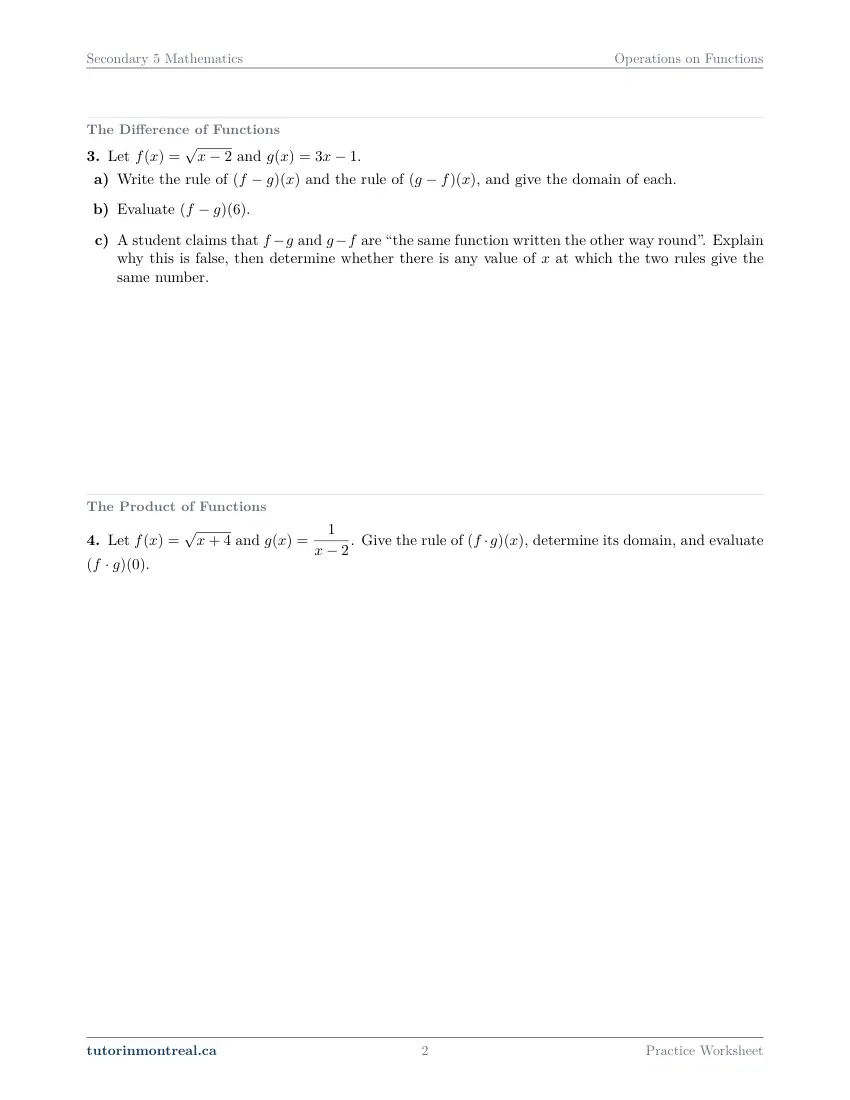
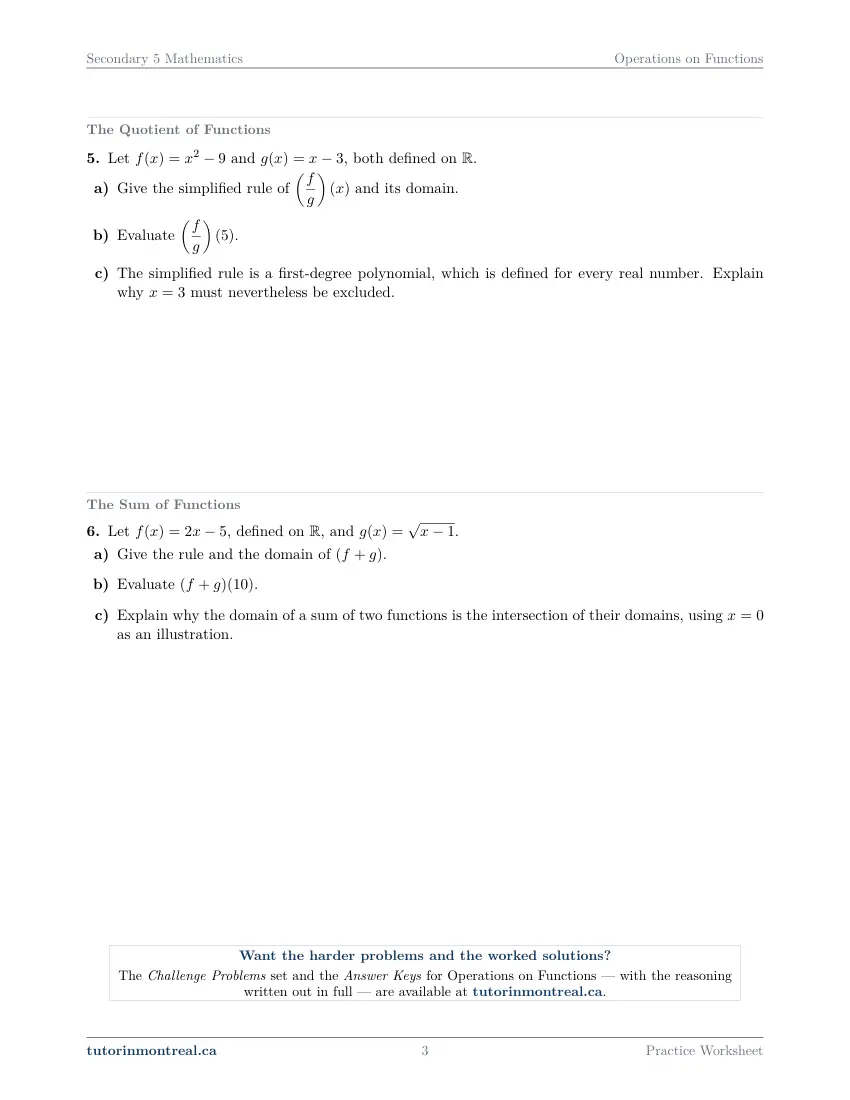
Preview all 3 pages
Click any page to open the full PDF.
Getting the most out of it
Write both domains before you write the combined rule
Cover the question, write dom f and dom g on their own line, and only then start combining. Nearly every mark lost on this sheet comes from a domain decided after the algebra instead of before it.
Say the composition out loud
"f of g of x" — innermost first. Two seconds of saying it prevents the single most common error on Q2, which is composing in the order the symbols happen to be written rather than the order they are applied.
Redo Q3 and Q5 with the two functions swapped
Same questions, letters exchanged. The domains move, the sign of the difference flips, and the quotient loses a different value — which is precisely the point both questions are making, felt rather than memorised.
Want the solutions, or something more challenging?
The worksheet, the questions above and every explanation on this page stay free permanently. Three more PDFs exist for this topic — the worked answer key, a harder problem set, and the answer key to that. They come with the Secondary 5 Math Solutions Bundle, which is what keeps the rest of the series free.
What else exists for Operations on Functions
Three PDFs · 9 pages · all three are in the bundle below.
- Answer key — 2 pages. All 6 questions worked step by step, including the restrictions and the justifications. Not a list of final answers.
- Challenge problems — 5 pages, 5 problems. A separate sheet at exam-plus difficulty covering the same 6 concepts. Harder than anything on the free sheet.
- Challenge answer key — 2 pages. Every challenge problem worked to the same standard, with the checks shown.
- PDF, letter size, print-ready.
The one thing that's for sale
Every Secondary 5 Math topic — the complete Solutions Bundle
One download, one payment, the whole program. Every answer key and every challenge set for all 21 Secondary 5 Math worksheet sets — including this one.
- Worked solutions, not answer lists — every step written out
- Covers the whole year's program at this level
- Less than the price of one hour of tutoring — for the entire year's solutions
Taking Secondary 1 Math as well? The Secondary 1 Math bundle covers all 15 of its sets — 45 PDFs, 182 pages — on the same terms.
Taking Secondary 2 Math as well? The Secondary 2 Math bundle covers all 14 of its sets — 42 PDFs, 181 pages — on the same terms.
Taking Secondary 3 Math as well? The Secondary 3 Math bundle covers all 11 of its sets — 33 PDFs, 154 pages — on the same terms.
Taking Secondary 4 Math as well? The Secondary 4 Math bundle covers all 17 of its sets — 51 PDFs, 154 pages — on the same terms.
Taking CEGEP Calculus I as well? The CEGEP Calculus I bundle covers all 8 of its sets — 24 PDFs, 82 pages — on the same terms.
Taking CEGEP Calculus II as well? The CEGEP Calculus II bundle covers all 8 of its sets — 24 PDFs, 90 pages — on the same terms.
Taking CEGEP Linear Algebra as well? The CEGEP Linear Algebra bundle covers all 7 of its sets — 21 PDFs, 82 pages — on the same terms.
Taking AP Calculus AB as well? The AP Calculus AB bundle covers all 8 of its sets — 24 PDFs, 126 pages — on the same terms.
Common questions
Is this worksheet really free?
Yes — the questions are on this page to read, and the PDF downloads directly, no email and no account. The one paid item is optional: the complete Secondary 5 Solutions Bundle, which covers every set at this level.
What is the difference between (f · g)(x) and (f ∘ g)(x)?
The first is a product: compute f(x), compute g(x), multiply the two numbers. The second is a composition: compute g(x) first, then put that result into f. They are different operations with different rules and usually different domains, and the dot is the only thing telling them apart, so read it carefully.
Why is the domain of f/g not just the intersection of the two domains?
Because the division adds a restriction of its own. You start from the intersection, then remove every value where the bottom function equals zero. Those values are usually perfectly fine for f and for g on their own — they are lost only because you divided by g there.
The fraction simplified, so why is a value still excluded?
Because the domain is decided before you simplify. Cancelling a factor is only allowed where that factor is non-zero, so the cancellation cannot create a value the original expression never had. The graph is the simplified curve with a hole at that point, and naming the hole is what the question is marking.
Can f ∘ g ever equal g ∘ f?
Sometimes, for particular pairs — a function and its inverse, for instance. But it is not a general rule, and that is what the question is testing. To disprove commutativity you only need one input where the two results differ; to claim they are equal you have to compare the two rules, because agreeing at one point proves nothing.
Which Secondary 5 stream is this for?
It is built for SN. The sheet assumes you are combining square root, rational and polynomial rules, writing domains in Québec interval notation, and justifying claims about functions rather than only evaluating them.
Can teachers use this in class?
Yes. Print and photocopy it for your own classes freely — I just ask that the tutorinmontreal.ca footer stays on the page.
I'm stuck on one question. Can you help?
Yes — through one-on-one tutoring, in Montreal or online. Get in touch to arrange a session, or see the current rates.
← All 21 Secondary 5 Math worksheets · Secondary 1 Math series (15 sheets) → · Secondary 2 Math series (14 sheets) → · Secondary 3 Math series (11 sheets) → · Secondary 4 Math series (17 sheets) → · CEGEP Calculus I series (8 sheets) → · CEGEP Calculus II series (8 sheets) → · CEGEP Linear Algebra series (7 sheets) → · AP Calculus AB series (8 sheets) →