Secondary 5 Vectors and Matrices Worksheet
Vectors first: components, norm and unit vectors, the Chasles relation, collinearity and orthogonality, linear combinations, the scalar product and the angle it hands you, orthogonal projection, and proofs written entirely in vector language. Then matrices — their operations, the transformation matrices, and the semi-linear system where a line meets a parabola. Work from the screen or from paper — the download is free and nobody asks you for an email address.
Practice worksheet — free PDF
No email, no account, no watermark. Teachers: photocopy it for your classes freely. Worked solutions and 13 harder problems come with the Secondary 5 Math bundle.
All 16 questions
Each question targets one named concept from the sheet. Read them here, or print the PDF — it has working space under each one.
-
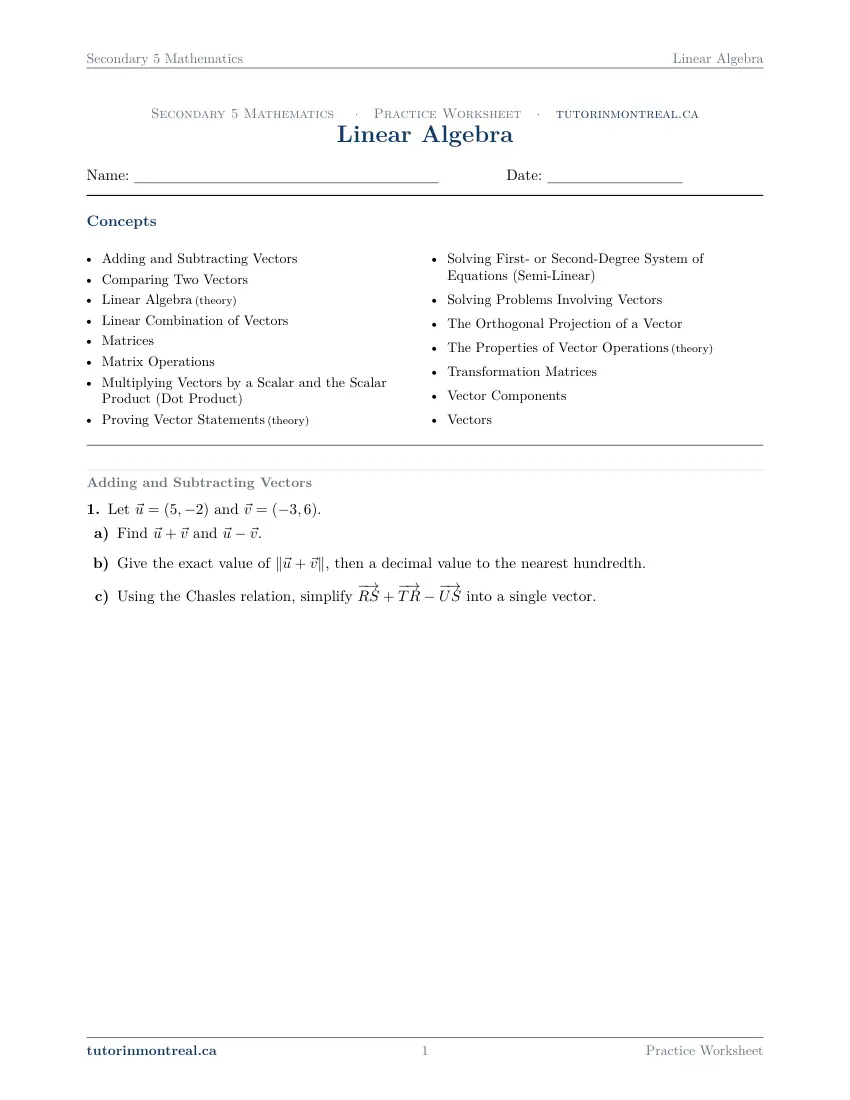
Q1Adding and Subtracting Vectors
Let and .
- Find and .
- Give the exact value of , then a decimal value to the nearest hundredth.
- Using the Chasles relation, simplify into a single vector.
-
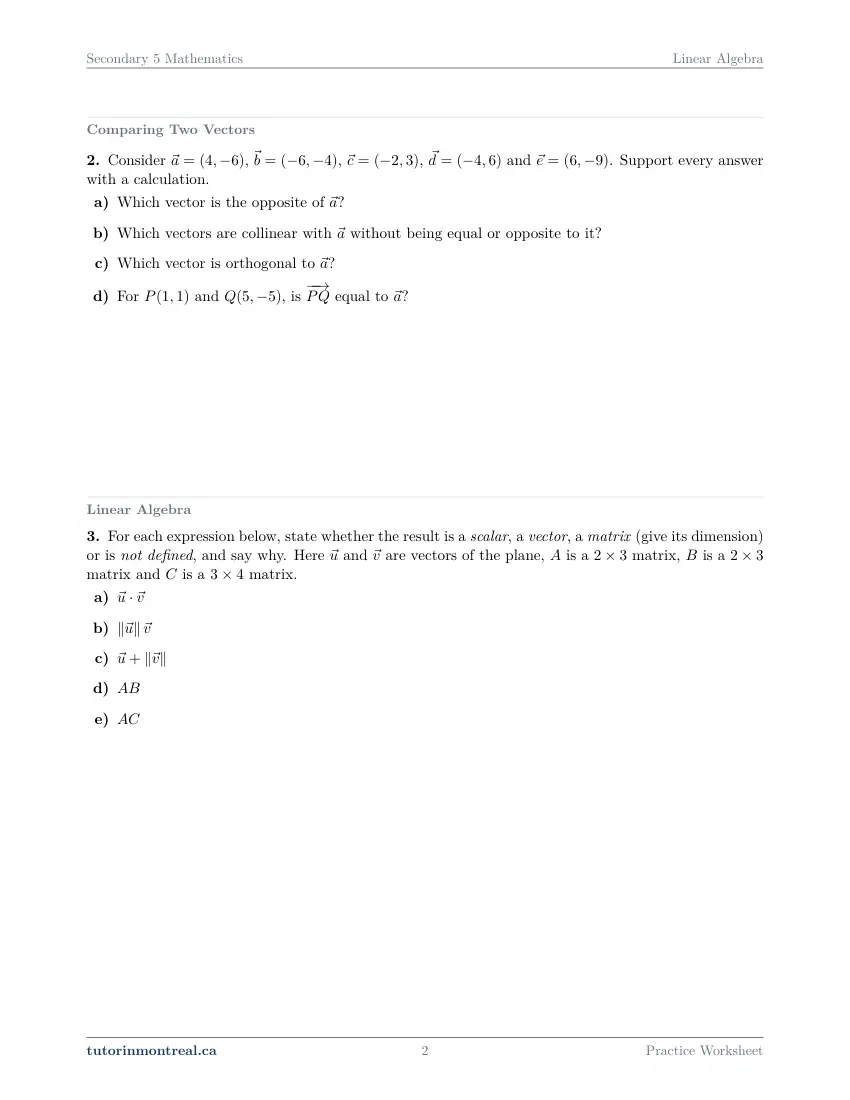
Q2Comparing Two Vectors
Consider , , , and . Support every answer with a calculation.
- Which vector is the opposite of ?
- Which vectors are collinear with without being equal or opposite to it?
- Which vector is orthogonal to ?
- For and , is equal to ?
-
Q3Linear Algebra
For each expression below, state whether the result is a scalar, a vector, a matrix (give its dimension) or is not defined, and say why. Here and are vectors of the plane, is a matrix, is a matrix and is a matrix.
-
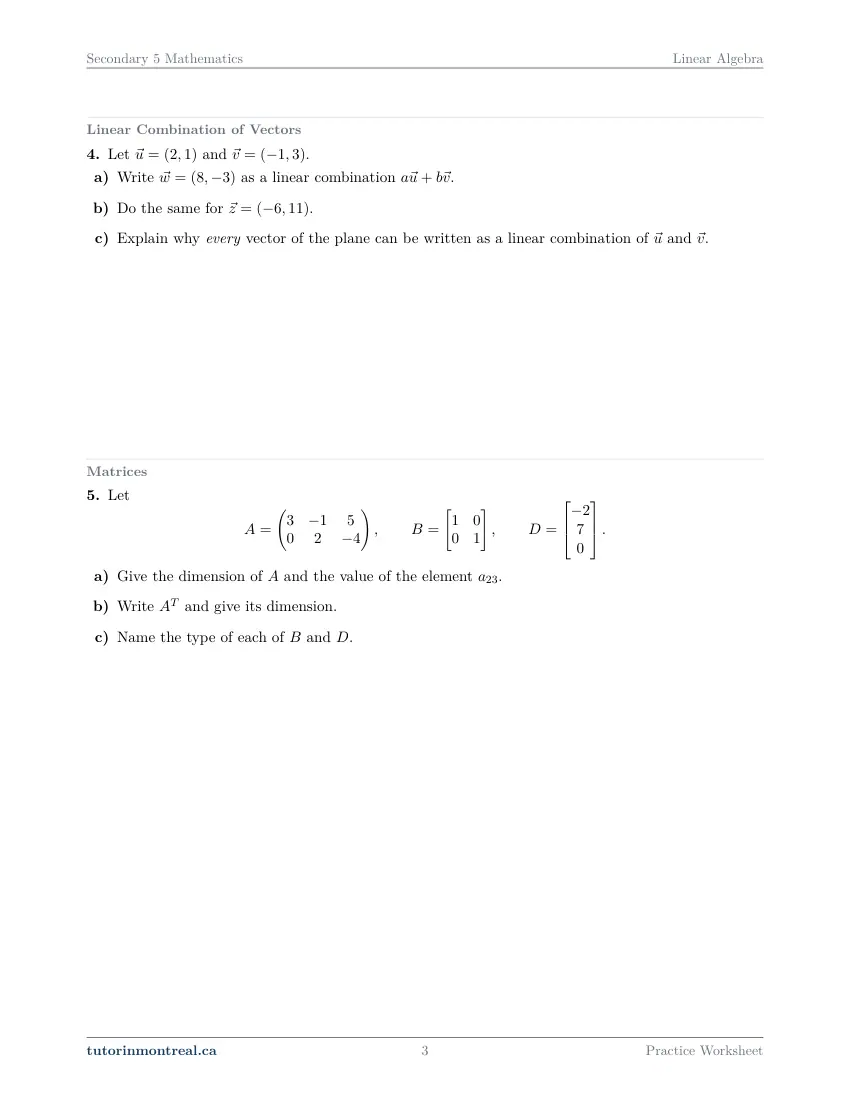
Q4Linear Combination of Vectors
Let and .
- Write as a linear combination .
- Do the same for .
- Explain why every vector of the plane can be written as a linear combination of and .
-
Q5Matrices
Let
- Give the dimension of and the value of the element .
- Write and give its dimension.
- Name the type of each of and .
-
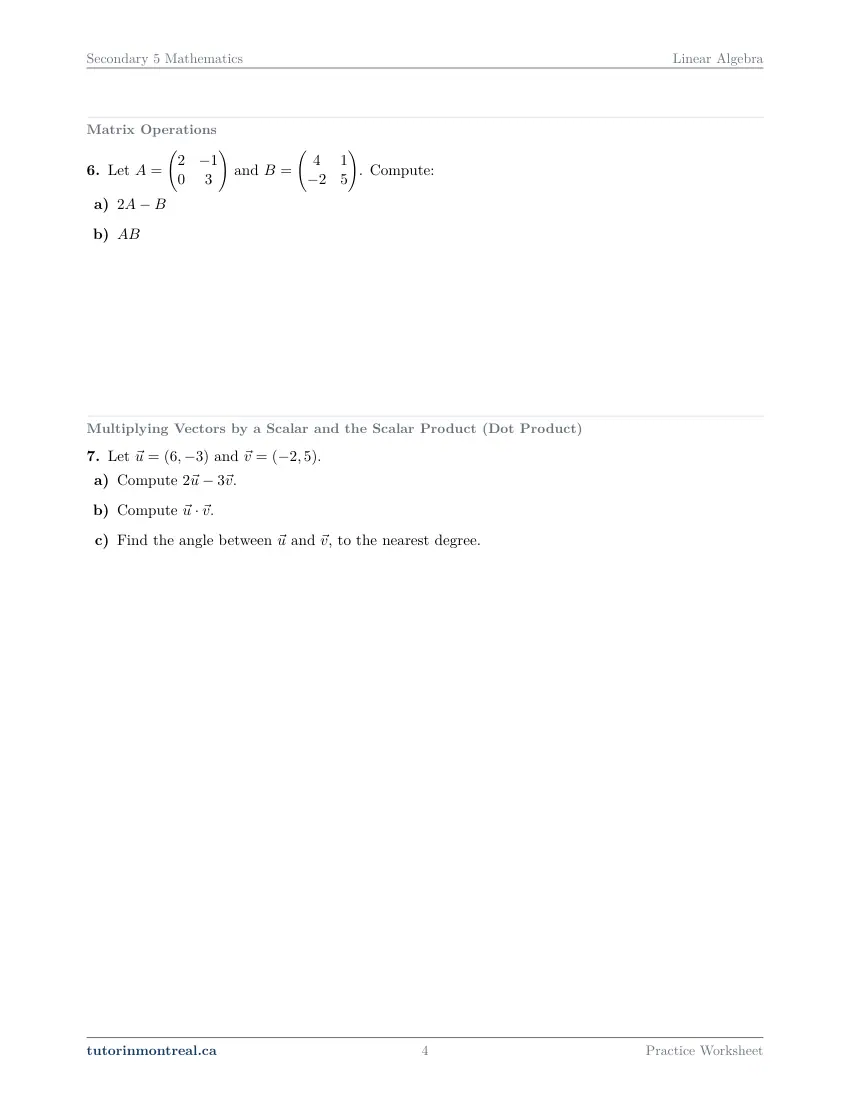
Q6Matrix Operations
Let and . Compute:
-
Q7Multiplying Vectors by a Scalar and the Scalar Product (Dot Product)
Let and .
- Compute .
- Compute .
- Find the angle between and , to the nearest degree.
-
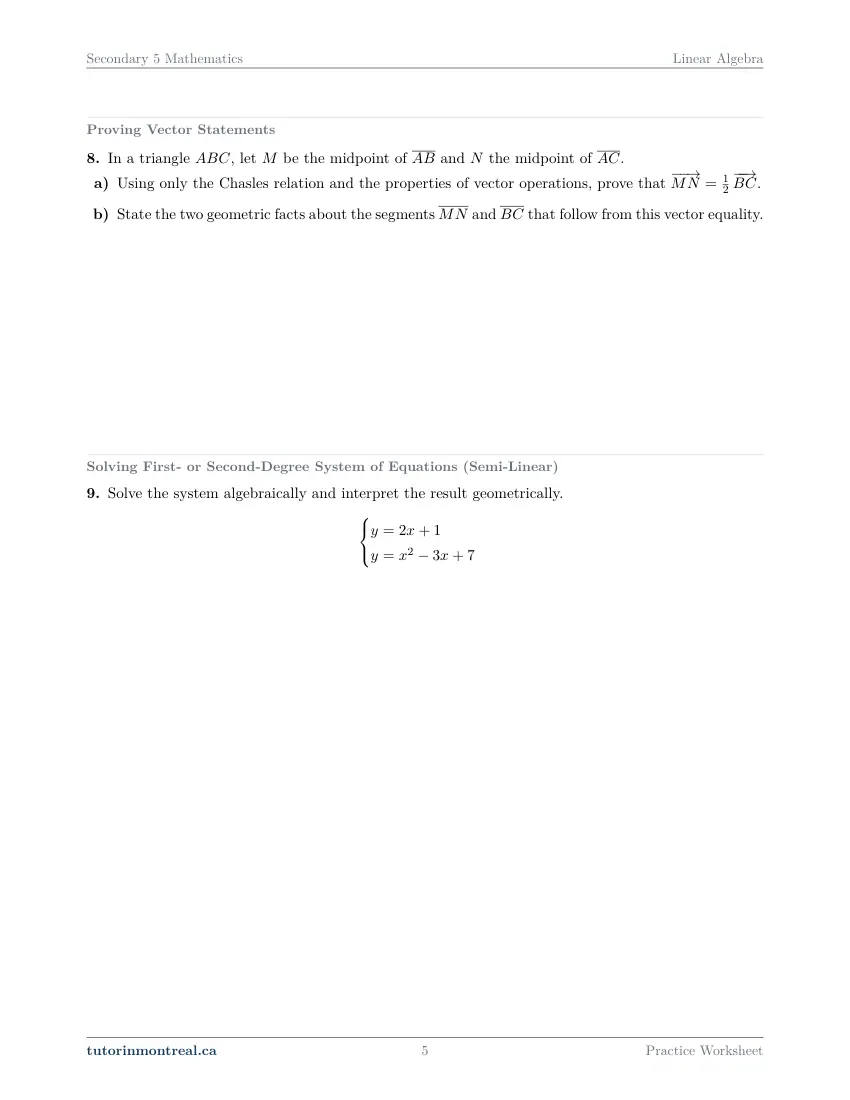
Q8Proving Vector Statements
In a triangle , let be the midpoint of and the midpoint of .
- Using only the Chasles relation and the properties of vector operations, prove that .
- State the two geometric facts about the segments and that follow from this vector equality.
-
Q9Solving First- or Second-Degree System of Equations (Semi-Linear)
Solve the system algebraically and interpret the result geometrically.
-
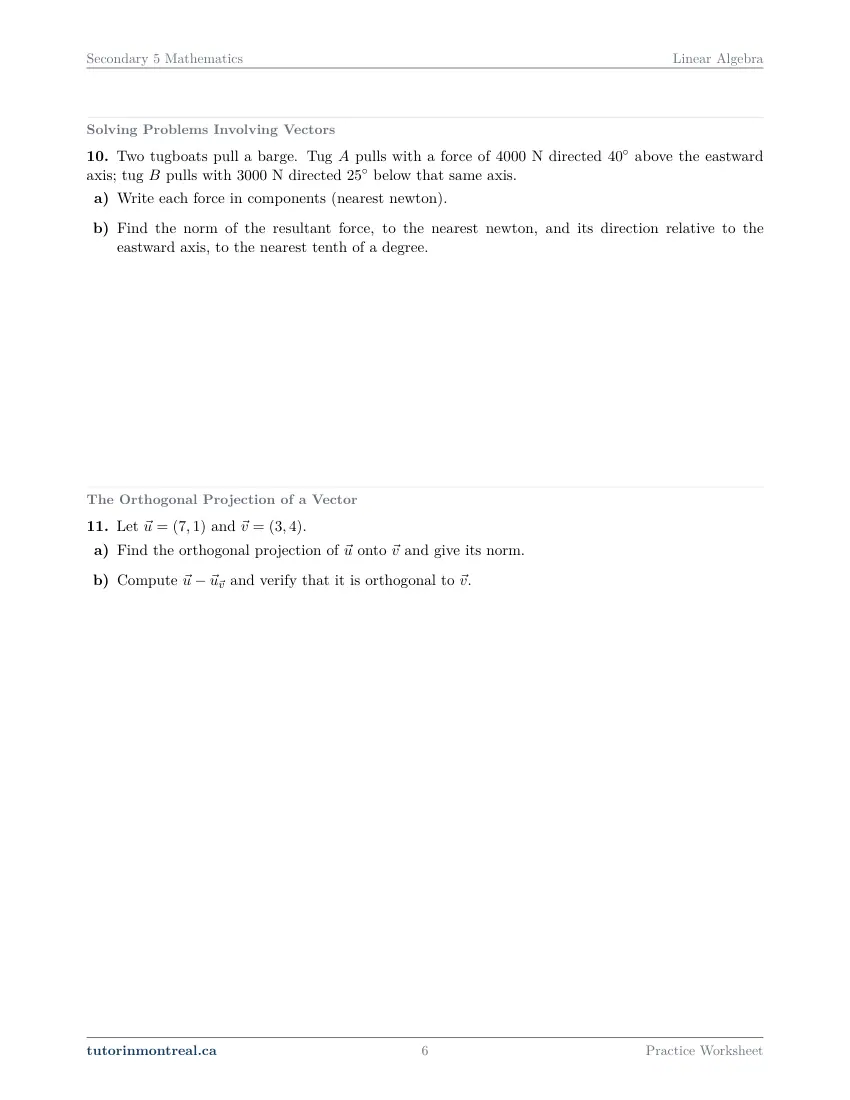
Q10Solving Problems Involving Vectors
Two tugboats pull a barge. Tug pulls with a force of N directed above the eastward axis; tug pulls with N directed below that same axis.
- Write each force in components (nearest newton).
- Find the norm of the resultant force, to the nearest newton, and its direction relative to the eastward axis, to the nearest tenth of a degree.
-
Q11The Orthogonal Projection of a Vector
Let and .
- Find the orthogonal projection of onto and give its norm.
- Compute and verify that it is orthogonal to .
-
Q12The Properties of Vector Operations
For each statement, decide whether it is true for all vectors of the plane and all . If it is true, name the property; if it is false, give an explicit counterexample.
-
Q13Transformation Matrices
Points of the plane are written as column matrices and transformed by multiplying on the left by a matrix. Consider the triangle , , .
- Write the matrix of the rotation of counterclockwise about the origin, and find the images , , .
- Write the matrix of the dilation centred at the origin with ratio , and find the image of .
-
Q14Vector Components
- A vector has norm and its direction makes an angle of with the positive -axis. Give its components, exactly and then to the nearest hundredth.
- Give the norm of and its direction, to the nearest tenth of a degree.
-
Q15Vectors
Let and .
- Give the components of and its norm.
- Give the unit vector having the same direction and sense as .
- Find the coordinates of the point such that .
-
Q16Synthesis — drawing on several sheets in this topic
A logo is built from the triangle , , . It is first rotated counterclockwise about the origin, then enlarged by a dilation centred at the origin with ratio .
- Write the single matrix that performs both transformations, and state whether reversing their order would change .
- Find the image of .
- Using the dot product and norms, verify that and that .
The 13 challenge problems for this topic are a separate, paid sheet and are not reproduced here.
Which stream is this for? This sheet is built for SN. It assumes you are working with vectors in components, the scalar product, orthogonal projections, matrix products and transformation matrices, and it goes to the depth that program expects.
How to do every concept on this sheet
This is the part worksheet sites usually leave out. Below is the actual reasoning behind each group of questions — not a full solution set, the decisions that get you to one. Read it before you start, or after you get stuck.
A vector is a displacement, not a place (Q15, Q14)
Everything on this sheet is easier once that sentence is settled. The components of the vector from P to Q are the arrival minus the departure:
PQ = (xQ − xP, yQ − yP)Its norm is Pythagoras on those components, and a unit vector with the same direction and sense is the vector divided by its own norm — always check afterwards that the components of your unit vector square-and-add to 1. Q15(c) then runs the idea backwards: knowing a vector and a starting point, the endpoint is the point plus the components.
The mistake that costs most here: reading a direction straight off a calculator. In Q14 you are given a norm and an angle, and you are asked to go back the other way from components to a direction. The calculator's inverse tangent only ever returns an angle between −90° and 90°, so for a vector pointing into the second or third quadrant it gives the angle of the opposite vector.
The reliable procedure: compute the reference angle from the absolute values of the components, then place it by quadrant — second quadrant gives 180° − reference, third gives 180° + reference, fourth gives 360° − reference. Sketching the two components with their signs takes five seconds and settles the quadrant before any arithmetic.
Going the other way, components from a norm and a direction, is (‖u‖ cos θ, ‖u‖ sin θ) — and the signs the formula produces are themselves the check. A direction of 210° is in the third quadrant, so both components must come out negative. If one of yours is positive, you have made an arithmetic slip, not discovered an exception.
The Chasles relation: make the heads meet the tails (Q1, Q8)
Chasles says a trip from A to C is the same displacement as the trip A to B followed by B to C, for any intermediate point B — including one that is nowhere near the segment. Reading it left to right joins two vectors; reading it right to left inserts a point of your choosing, and that is the move most proofs need.
Simplifying a sum of vectors to a single arrow
Q1(c) is exactly this drill; Q8 is the same drill dressed as a proof.
- 1Turn every subtraction into an addition
Subtracting a vector is adding its opposite, and the opposite of the arrow from U to S is the arrow from S to U. Reverse the letters and the minus sign is gone.
- 2Reorder freely
Vector addition is commutative and associative, so you may line the arrows up in whatever order makes a head meet a tail. Say that you are using commutativity — the justification is part of the answer on a proof question.
- 3Collapse each matching pair
Arrow into R followed by arrow out of R collapses to a single arrow, and the letter R disappears. Repeat until one arrow is left.
- 4To prove an identity, insert a point rather than remove one
In Q8 you want the arrow from M to N, and you know things about A. So insert A: the trip M to N becomes M to A then A to N, and each half is now a midpoint relation you can replace by half of a known vector.
Q8 also asks what the vector equality tells you geometrically, and that is a separate mark. A vector being a scalar multiple of another gives parallel; taking norms on both sides gives the length ratio. Two facts, two sentences.
Equal, opposite, collinear, orthogonal (Q2)
Q2 asks for four different relations between vectors, each "supported by a calculation" — an assertion with no arithmetic under it earns nothing. The tests:
Collinear — one is a scalar multiple of the other. In practice, check whether u1v2 − u2v1 = 0; if it is, divide a pair of components to find the factor. Opposite — collinear with factor exactly −1. Equal (equipollent) — identical components, whatever the position of the arrow on the page. Orthogonal — the scalar product is 0.
Direction and sense are not the same word. In Quebec vocabulary the direction is the line the vector lies along and the sense is which way the arrowhead points. Two opposite vectors have the same direction and opposite senses. Writing "opposite direction" for a vector and its opposite is the single most common vocabulary slip on this question, and it is the kind that is marked.
Linear combinations, and why two vectors are enough (Q4)
Writing w = a·u + b·v in components gives two equations in the two unknowns a and b. Solve by substitution and always substitute back — the check is one line and catches every sign error.
Part (c) asks why every vector of the plane can be reached, and an example is not an answer. The argument: u and v are not collinear, which means the system built from their components has a non-zero determinant, which means it has exactly one solution for any right-hand side. Two non-collinear vectors therefore form a basis, and the coefficients are unique. Had they been collinear, every combination would have stayed on a single line through the origin — most vectors unreachable, and the reachable ones reachable in infinitely many ways.
The scalar product tells you the angle before you compute it (Q7)
The scalar product of two vectors in components is u1v1 + u2v2 — a number, never a vector. From it:
cos θ = (u · v) ⁄ (‖u‖ · ‖v‖)Before touching the inverse cosine, read the sign. Positive means an acute angle, zero means a right angle, negative means an obtuse one — so a negative scalar product with an answer of 40° is wrong on sight. Keep the norms as exact square roots until the very last step; rounding two norms to two decimals each and then dividing is how an angle drifts by a degree.
Orthogonal projection: the formula divides by the norm squared (Q11)
uv = [ (u · v) ⁄ ‖v‖² ] · vThe projection of u onto v is the part of u that lies along v — a vector, parallel to v, obtained by scaling v. That is why the denominator is ‖v‖² and not ‖v‖: one factor of ‖v‖ converts the scalar product into a length along v, and the second turns v itself into a direction of length 1. Writing ‖v‖ once instead of twice is the standard error, and it produces a vector pointing the right way with the wrong length.
The verification in Q11(b) is worth learning as a habit. Subtracting the projection from the original leaves the part of u perpendicular to v, so the scalar product of u − uv with v must be exactly 0. If it is not, the projection is wrong — and you have found out in one line rather than at the end of a long problem. A negative scalar factor is not an error, incidentally: it means the projection points opposite to v, because the angle between them is obtuse.
Matrices: the dimensions decide what is even possible (Q3, Q5, Q6)
Q3 asks nothing but "what kind of object is this, and is it defined?", which is a fair description of half the marks on a matrix exam.
Is this expression defined, and what does it produce?
Check the shapes before computing anything.
- 1Scalar product of two vectors → a number
So it may be added to a number, multiplied by a vector, or divided by. It may not be added to a vector — a scalar and a vector are different kinds of object, and their sum is undefined, not zero.
- 2Number times a vector → a vector
Same direction; same sense if the number is positive, reversed if it is negative; norm multiplied by the absolute value of the number.
- 3Matrix product → check inner dimensions
An m × n times an n × p is defined and produces an m × p. The two inner numbers must be equal; the two outer numbers are the answer's shape. If the inner numbers differ, the product is undefined — say so, and say which two numbers failed to match.
- 4Sum or difference of matrices → identical dimensions
Addition and scalar multiplication are element by element, so 2A − B needs A and B to be exactly the same shape.
Two conventions that get confused constantly. The dimension is written rows × columns, and the element a23 is row 2, column 3 — row index first, always. The transpose exchanges rows and columns, so an m × n matrix transposes to an n × m one. For the product itself (Q6), each entry is a row of the left matrix run against a column of the right one: entry in row i, column j comes from row i of the left and column j of the right.
Matrix multiplication is not commutative. AB and BA may have different dimensions, and even when both are defined and square they are usually different matrices. So "multiply the two matrices" is not a complete instruction — the order is part of the question, and reversing it is a wrong answer rather than a rearrangement.
Transformation matrices: build them, don't memorise them (Q13, Q16)
A 2 × 2 matrix acting on column matrices is completely determined by what it does to the two basic directions, and those two images are literally its columns. That is the whole trick: to write the matrix of a quarter-turn counterclockwise, ask where (1, 0) goes — to (0, 1) — and where (0, 1) goes — to (−1, 0) — and write those two answers down as the first and second columns. No memorisation, and it works for reflections and dilations equally.
A dilation centred at the origin with ratio k is k times the identity, which is why it multiplies every length by k and changes no angle. In a composition, the matrix applied first is written on the right, next to the point it acts on — so "rotate, then enlarge" is the dilation times the rotation. Q16 asks you to build the single matrix doing both, then to verify with norms and a scalar product that the image is twice as long and perpendicular to the original. That verification is the point of the question: it is the transformation's geometric meaning, recovered from arithmetic.
True, false, and what counts as proof (Q12)
Q12 gives four claims about vector operations and asks you to name the property or produce a counterexample. The asymmetry is the thing to internalise: a false claim needs one explicit counterexample — actual vectors, actual arithmetic, both sides evaluated and seen to differ — while a true claim needs a general argument, since no number of examples proves it.
Two of the four are worth knowing in their corrected form. The norm of a sum is not the sum of the norms; it is at most that, with equality only when the two vectors have the same sense — the triangle inequality, and geometrically obvious the moment you draw two arrows head to tail. And scaling a vector multiplies its norm by |k|, not by k, because a norm is never negative.
A line meeting a parabola (Q9)
Substituting the linear equation into the quadratic one collapses the system to a single second-degree equation. Its number of real roots is the geometry: two roots means the line cuts the curve twice, one (double) root means it is tangent, no real root means they never meet. Q9 ends by asking for that interpretation, so finish with the sentence, not with the pair of coordinates — and substitute both solutions back into the parabola, since a slip there is invisible if you only check the line.
Forces, and why components come first (Q10)
Two forces pulling at different angles cannot be added as numbers. Resolve each into (magnitude · cos θ, magnitude · sin θ), add the components separately, then rebuild the resultant's norm with Pythagoras and its direction with an inverse tangent placed by quadrant. An angle measured below the reference axis is negative — feed it in as a negative angle and the sine will take care of the sign of the vertical component for you.
Preview all 9 pages
Click any page to open the full PDF.
Getting the most out of it
Draw the axes, even for a two-line question
A sketch with the two components marked settles the quadrant before you touch an inverse trigonometric function, and it makes an impossible answer look wrong instead of looking finished. On the projection and angle questions it also tells you in advance whether to expect a negative scalar product.
Name the object before you compute it
Say "this will be a number" or "this will be a 2 × 4 matrix" out loud before starting. It takes a second, it is exactly what one of the questions asks for in its own right, and it stops you from writing an answer whose shape cannot possibly be right.
Substitute back, every time
Every question on this sheet has a cheap check built into it: the coefficients of a linear combination can be recomputed, a unit vector's components square-and-add to 1, the leftover of a projection has scalar product 0 with the direction, the solutions of the system satisfy the parabola. Doing the check is a habit worth more than any individual technique here.
Want the solutions, or something more challenging?
The worksheet, the questions above and every explanation on this page stay free permanently. Three more PDFs exist for this topic — the worked answer key, a harder problem set, and the answer key to that. They come with the Secondary 5 Math Solutions Bundle, which is what keeps the rest of the series free.
What else exists for Linear Algebra
Three PDFs · 20 pages · all three are in the bundle below.
- Answer key — 4 pages. All 16 questions worked step by step, including the restrictions and the justifications. Not a list of final answers.
- Challenge problems — 12 pages, 13 problems. A separate sheet at exam-plus difficulty covering the same 15 concepts. Harder than anything on the free sheet.
- Challenge answer key — 4 pages. Every challenge problem worked to the same standard, with the checks shown.
- PDF, letter size, print-ready.
The one thing that's for sale
Every Secondary 5 Math topic — the complete Solutions Bundle
One download, one payment, the whole program. Every answer key and every challenge set for all 21 Secondary 5 Math worksheet sets — including this one.
- Worked solutions, not answer lists — every step written out
- Covers the whole year's program at this level
- Less than the price of one hour of tutoring — for the entire year's solutions
Taking Secondary 1 Math as well? The Secondary 1 Math bundle covers all 15 of its sets — 45 PDFs, 182 pages — on the same terms.
Taking Secondary 2 Math as well? The Secondary 2 Math bundle covers all 14 of its sets — 42 PDFs, 181 pages — on the same terms.
Taking Secondary 3 Math as well? The Secondary 3 Math bundle covers all 11 of its sets — 33 PDFs, 154 pages — on the same terms.
Taking Secondary 4 Math as well? The Secondary 4 Math bundle covers all 17 of its sets — 51 PDFs, 154 pages — on the same terms.
Taking CEGEP Calculus I as well? The CEGEP Calculus I bundle covers all 8 of its sets — 24 PDFs, 82 pages — on the same terms.
Taking CEGEP Calculus II as well? The CEGEP Calculus II bundle covers all 8 of its sets — 24 PDFs, 90 pages — on the same terms.
Taking CEGEP Linear Algebra as well? The CEGEP Linear Algebra bundle covers all 7 of its sets — 21 PDFs, 82 pages — on the same terms.
Taking AP Calculus AB as well? The AP Calculus AB bundle covers all 8 of its sets — 24 PDFs, 126 pages — on the same terms.
Common questions
Is this worksheet really free?
Yes — the questions are on this page to read, and the PDF downloads directly, no email and no account. The one paid item is optional: the complete Secondary 5 Solutions Bundle, which covers every set at this level.
What is the difference between the direction and the sense of a vector?
The direction is the line the vector lies along; the sense is which way the arrow points along that line. Two opposite vectors have the same direction and opposite senses, so describing them as having "opposite directions" is the wrong word — and it is a word that gets marked.
How do I know whether a matrix product is defined?
Write the two dimensions side by side as rows × columns. The product is defined exactly when the inner two numbers match, and the result then has the shape of the outer two. An expression that fails this test is undefined, not zero, and the answer should say which two numbers failed to match.
Why does the projection formula divide by the norm squared?
Because the scalar product already contains one factor of the norm of the direction vector, and the formula then has to scale that direction vector itself down to length 1. One factor converts the scalar product to a length along the direction, the second normalises the vector being scaled. Dividing by the norm only once gives a vector pointing the right way with the wrong length.
Does the order of two transformations matter?
Almost always, yes — matrix multiplication is not commutative, so composing a rotation with a reflection in the two possible orders generally gives two different transformations. The exception on this sheet is a dilation centred at the origin, which is a multiple of the identity and therefore commutes with everything. In a product, the transformation applied first is the one written on the right.
How do I get the direction of a vector when my calculator gives a negative angle?
The inverse tangent only returns angles between −90° and 90°, so it cannot distinguish a vector from its opposite. Compute the reference angle from the absolute values of the components, then place it by quadrant: 180° minus the reference in the second, 180° plus it in the third, 360° minus it in the fourth.
Can teachers use this in class?
Yes. Print and photocopy it for your own classes freely — I just ask that the tutorinmontreal.ca footer stays on the page.
I'm stuck on one question. Can you help?
Yes — through one-on-one tutoring, in Montreal or online. Get in touch to arrange a session, or see the current rates.
← All 21 Secondary 5 Math worksheets · Secondary 1 Math series (15 sheets) → · Secondary 2 Math series (14 sheets) → · Secondary 3 Math series (11 sheets) → · Secondary 4 Math series (17 sheets) → · CEGEP Calculus I series (8 sheets) → · CEGEP Calculus II series (8 sheets) → · CEGEP Linear Algebra series (7 sheets) → · AP Calculus AB series (8 sheets) →
The same topic at the other level: Secondary 4 Math · Linear Algebra.